
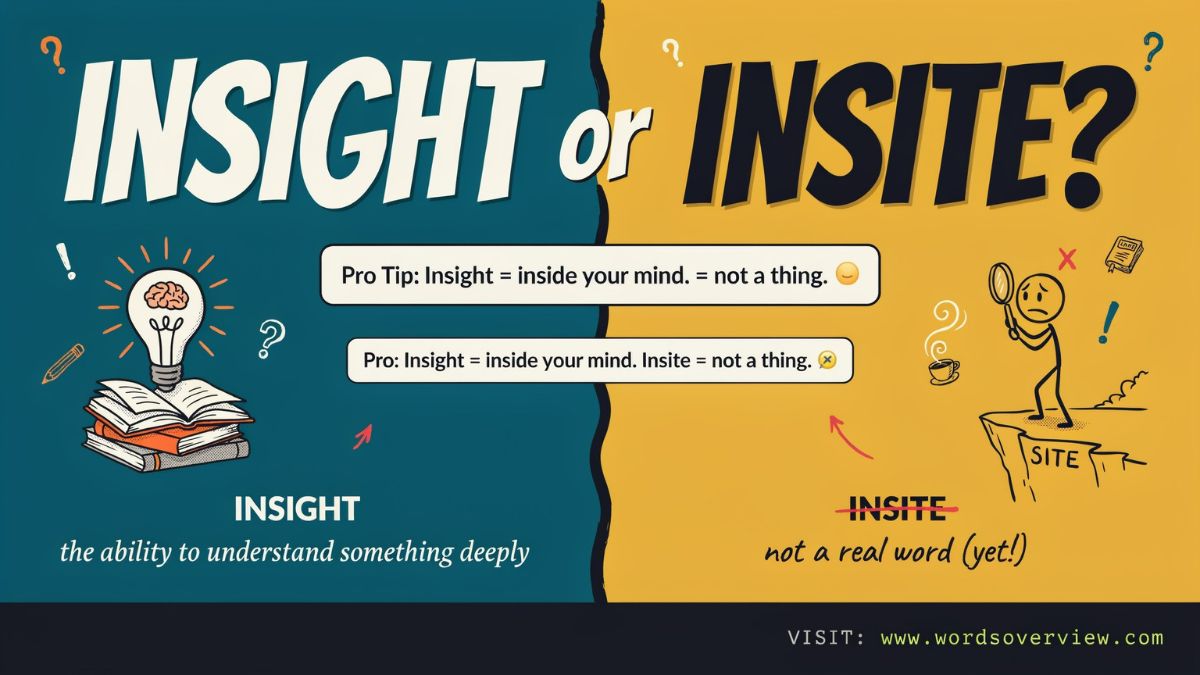
English spelling loves to set little traps and insight or insite is one of them. At first glance, “insite” looks perfectly reasonable, especially because “site” is already a familiar English word. However, that extra “s” swap changes the spelling and creates a common mistake. The correct word is insight when you mean deep understanding, clear perception or a useful realization. Meanwhile, “insite” isn’t the standard spelling for this meaning. This confusion becomes even trickier when “sight,” “site,” and “incite” join the party. In this guide, you’ll learn the correct spelling, meanings, grammar, examples and simple memory tricks to avoid this mistake.
Insight or Insite Which Is Correct?
The correct spelling is insight when you mean a deep or clear understanding of something.
Insite is generally an incorrect spelling when someone intends to write insight.
| Word | Correct for “deep understanding”? | Meaning |
| Insight | Yes | Deep or clear understanding |
| Insite | No | Not the standard spelling of this meaning |
| Incite | No | Encourage or provoke an action |
| Sight | No | The ability to see or something you see |
| Site | No | A place or location |
So, if you’re asking “insight or insite which is correct?”, the answer is straightforward: insight.
For example:
- The interview provided valuable insight into the problem.
- Her experience gave her a deeper insight into the industry.
- The report offers useful insights into consumer behavior.
Writing insite in these sentences creates a spelling mistake.
What Does Insight Mean?
Insight is a noun that describes a clear, deep or sometimes sudden understanding of a complicated situation, problem, person or idea.
In simple terms, insight means seeing or understanding something more clearly than before.
For example, imagine that you have been trying to understand why customers keep leaving an online store. You examine customer feedback and discover that most visitors abandon their carts because the checkout process is confusing.
That discovery gives you insight into customer behavior.
You didn’t merely collect information. You understood something important that wasn’t immediately obvious.
Insight Definition
A simple insight definition is:
Insight means a deep or clear understanding of something.
It can refer to understanding:
- A problem
- A person’s behavior
- A situation
- A complicated idea
- A pattern
- A hidden cause
- A particular subject
Cambridge Dictionary defines insight as the ability to develop a clear and deep understanding of a complicated problem or situation.
The word often appears when information leads to a useful realization.
What Is the Meaning of Insight?
The meaning of insight goes beyond basic knowledge.
For example, knowing that a company lost customers is information. Understanding why those customers left and what the company can do about it provides insight.
Therefore, insight often combines knowledge, perception, awareness and understanding.
Consider these examples:
- The survey provided new insight into student preferences.
- Her comments gave me valuable insight into the situation.
- The study offers useful insights into sleep patterns.
- Talking to experienced workers can give you practical insight into a career.
Why Is Insite Incorrect?
The spelling confusion usually happens because insight contains the familiar word sight.
When people hear the word quickly, they may mentally separate it as “in + site.” That can lead to the incorrect spelling insite.
However, the standard English word is formed with sight, not site.
The correct spelling is:
in + sight = insight
The spelling insite replaces sight with site, which changes the word into something that does not carry the standard meaning of deep understanding.
So, if you have searched for “insite correct spelling”, remember this simple rule:
Deep understanding = insight.
Not:
Deep understanding = insite.
Is Insite a Word?
This question requires a little care.
Insite is not the standard English spelling of insight. However, a spelling can sometimes appear in names, brands organizations, technical terms or other specific contexts.
That does not make insite an acceptable replacement for insight in ordinary English writing.
For standard vocabulary, use insight when you mean understanding or perception.
Therefore:
- She gave me insight into the problem. ✓
- She gave me insite into the problem. ✗
The second sentence contains the common insite spelling mistake.
Insight Spelling and Word Formation
The spelling of insight becomes easier to remember when you understand its structure.
The word developed from the combination of in and sight. Historically, it referred to mental vision or understanding from within. Over time, its meaning developed toward the idea of penetrating or deep understanding.
This connection explains why sight appears at the end of insight.
Think about the relationship:
Sight → seeing with your eyes
Insight → understanding with your mind
That distinction provides an easy memory trick.
The word insight has been part of English for centuries. Historical sources trace it to Middle English forms dating to around the 1200s. Its modern meaning became associated more strongly with deep understanding over time.
Learn the difference between confusing English words step by step
Persuing or Pursuing Which Spelling Is Correct?
Insight or Insite Difference
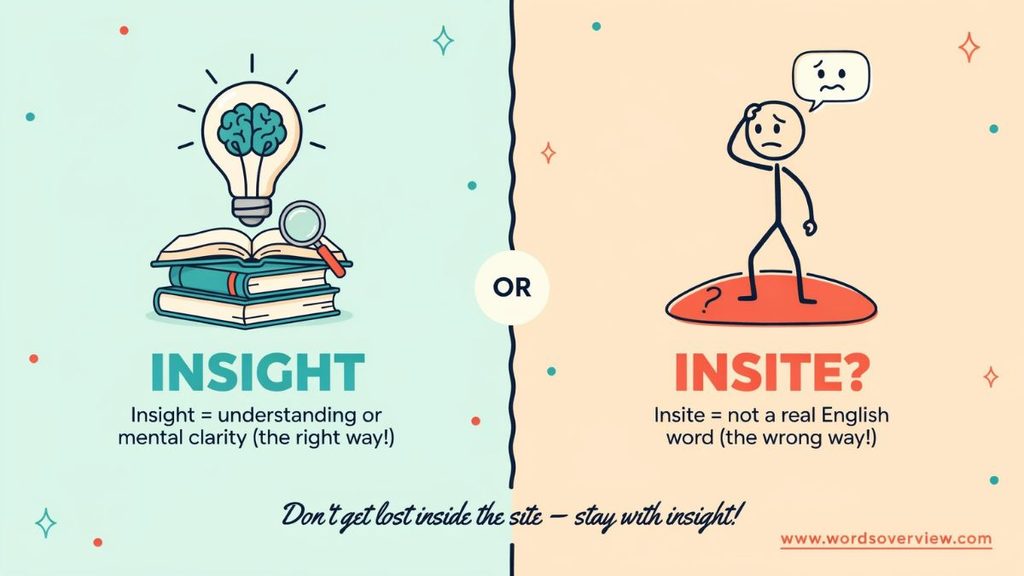
The insight or insite difference mainly comes down to standard spelling and meaning.
Insight is the established English noun for deep understanding.
Insite is not the standard spelling for that concept.
Consider the difference:
| Spelling | Standard English meaning | Example |
| Insight | Deep understanding | The report provides insight into the issue. |
| Insite | Not the standard spelling for this meaning | Avoid this spelling when you mean insight. |
Therefore, there isn’t a normal vocabulary distinction such as “insight means one thing while insite means another.” Instead, insite is usually a misspelling of insight when writers intend to express understanding.
Insight or Sight
The words insight and sight share the word “sight,” but they don’t mean the same thing.
Sight relates primarily to seeing or something that you see.
For example:
- The accident was a frightening sight.
- His sight improved after treatment.
- We caught sight of the mountains.
Insight, on the other hand, refers to understanding.
For example:
- The discussion gave me valuable insight into the problem.
- Her experience provides useful insight into teaching.
A simple memory trick works well:
Sight = see
Insight = understand
Insight or Site
Site refers to a place or location.
For example:
- The company selected a new building site.
- Workers visited the construction site.
- The university operates on a large site.
Insight, however, refers to understanding.
Compare these sentences:
- The engineers inspected the construction site.
- The engineers gained valuable insight from the inspection.
The words may sound similar in some contexts, but their meanings are completely different.
This distinction becomes especially important in professional and academic writing.
Learn the difference between confusing English words step by step
Gos or Goes Which Spelling Is Correct?
Insight and Incite What Is the Difference?
The confusion becomes more interesting when incite enters the picture.
Insight is a noun meaning deep understanding.
Incite is a verb meaning to encourage, provoke or stir someone toward an action, especially an unpleasant or violent action.
Therefore, insight and incite have completely different meanings.
| Word | Part of speech | Meaning | Example |
| Insight | Noun | Deep understanding | The report provided useful insight. |
| Incite | Verb | Encourage or provoke action | The speech could incite anger. |
The difference becomes clear in context.
Insight Examples
- The interview gave me insight into her decision.
- The research produced valuable insights.
- His experience offers useful insight into the industry.
Incite Examples
- The speech could incite anger.
- The group attempted to incite violence.
- His comments might incite people to protest.
So, if you’re asking “incite or insight?”, first determine what you want to say.
If you mean understanding, choose insight.
If you mean provoking or encouraging an action, choose incite.
Learn the difference between similar English words
Honored or Honoured Which Spelling Is Correct?
Insight or Incite Pronunciation
Insight and incite also differ in pronunciation and word stress.
With insight, the stress falls on the first syllable.
With incite, the stress falls on the second syllable.
They can sound confusing in fast speech, especially because both contain the sound associated with “-sight.”
However, their grammatical roles help separate them:
Insight → noun → understanding
Incite → verb → provoke
When you hear either word, consider the sentence around it. Context usually makes the meaning obvious.
How to Use Insight in a Sentence
The most common way to use insight is as a noun referring to understanding.
A particularly useful structure is:
insight into + noun
For example:
- The survey provides insight into customer behavior.
- The book offers insight into human relationships.
- The discussion gave us insight into the problem.
- The interview provided insight into the candidate’s experience.
You can also use insight with verbs such as gain, provide, offer and give.
Gain Insight
Use gain insight when someone develops a better understanding.
- Students can gain insight into how businesses operate.
- The research helped scientists gain insight into the issue.
Provide Insight
Use provide insight when something gives someone useful understanding.
- The report provides insight into market trends.
- The interview provided insight into the team’s challenges.
Offer Insight
Use offer insight when a person, experience, study or source contributes useful understanding.
- The expert offered insight into the problem.
- The survey offers valuable insight into customer expectations.
Insight Grammar
Insight functions as a noun in standard contemporary English.
It can be:
- Singular: insight
- Plural: insights
For example:
- The article provides an important insight.
- The article provides several important insights.
You will often see insight used as an uncountable noun when writers discuss understanding in a general sense.
For example:
- The research provides insight into the issue.
You can also use the plural when referring to several separate discoveries or observations:
- The researchers gained several insights from the study.
Learn the difference between confusing more English words
Tie or Tye: Meaning, Difference and Usage
Insightful
The adjective form is insightful.
For example:
- She made an insightful observation.
- His comments were thoughtful and insightful.
- The discussion was surprisingly insightful.
Don’t confuse insight with insightful. The first is a noun, while the second is an adjective.
Insight in a Sentence Everyday Examples
Seeing the word in realistic sentences makes the correct insight usage easier to remember.
Academic Writing
- The study provides insight into the causes of student stress.
- The research offers new insights into language learning.
- The experiment gave researchers valuable insight into the process.
Workplace Writing
- The meeting gave the manager useful insight into customer concerns.
- Sales data can provide insight into changing market behavior.
- Employee feedback offers valuable insights for future planning.
Personal Conversations
- Your explanation gave me some insight into what happened.
- Talking with her helped me gain insight into the situation.
- His experience gave us a different perspective and insight.
Technology
- User data can provide insight into how people interact with an application.
- The analytics dashboard offers useful insights into website traffic.
- Testing gave the development team valuable insight into user behavior.
Learn the difference between confusing English words step by step
Bosses or Boss’s? Which One Is Correct?
Insight and Incite in One Sentence

You can use insight and incite in one sentence because they have completely different meanings.
For example:
The report provided insight into how inflammatory messages can incite public anger.
Here, insight means understanding, while incite means provoke.
Another example:
The investigation gave researchers insight into the factors that could incite violent behavior.
Again, the two words perform different grammatical jobs.
This contrast makes the distinction easier to remember.
Common Mistakes With Insight
Even though insight seems simple, several mistakes appear frequently.
Writing Insite Instead of Insight
Incorrect:
The study gave us useful insite into the problem.
Correct:
The study gave us useful insight into the problem.
The issue is spelling, not meaning.
Learn the difference between basic English word mistakes
Where or When: Usage and Classic Song
Confusing Insight With Incite
Incorrect:
The speech gave the audience valuable incite into the issue.
Correct:
The speech gave the audience valuable insight into the issue.
Incite cannot replace insight because it is a verb with a completely different meaning.
Confusing Insight With Site
Incorrect:
The report gives us valuable site into customer behavior.
Correct:
The report gives us valuable insight into customer behavior.
Site refers to a place. It doesn’t mean understanding.
Using Insight as a Regular Verb
In standard contemporary English, insight functions as a noun rather than a regular verb.
Instead of writing:
The research insights the problem.
Use:
The research provides insight into the problem.
Or:
The research gives us a better understanding of the problem.
This approach sounds natural and grammatically correct.
Learn the difference between more words people mix up
Inconsolable or Unconsolable Which Is Correct?
A Quick Memory Trick for Insight
Here’s an easy way to remember the correct spelling.
Think:
Insight = inner sight
The word contains sight, not site.
You can also connect the meaning with vision:
Sight helps you see.
Insight helps you understand.
That mental connection can prevent the insite spelling mistake.
For incite, remember:
Incite = encourage or provoke.
So you can create this three-word memory chain:
Sight → seeing
Insight → understanding
Incite → provoking
Once you separate those meanings, the spelling becomes much easier.
Learn the difference between similar English words the easy way
Access or Acess Which Spelling Is Correct?
Insight, Insite, Sight, Site and Incite Compared
These five words create a classic spelling trap. They look similar, but their meanings and grammatical functions differ.
| Word | Part of Speech | Meaning | Example |
| Insight | Noun | Deep understanding | The study gave us useful insight. |
| Insite | — | Not the standard spelling for “insight” | Don’t use it for deep understanding. |
| Sight | Noun | Ability to see or something seen | The mountain was an amazing sight. |
| Site | Noun/Verb | Place or location | They chose the construction site. |
| Incite | Verb | Provoke or encourage action | The speech could incite anger. |
The easiest way to choose the right word is to focus on meaning instead of sound.
Ask yourself:
Am I talking about understanding?
Use insight.
Am I talking about seeing?
Use sight.
Am I talking about a location?
Use site.
Am I talking about provoking someone to act?
Use incite.
Learn the difference between confusing word pairs
Directer or Director Which Spelling Is Correct?
A Practical Case Study Choosing the Right Word
Imagine that a university analyzes feedback from 1,000 students.
The researchers discover that students struggle most with online registration because the interface contains too many confusing steps.
The researchers now have a better understanding of the problem.
That understanding is an insight.
They might write:
The student survey provided valuable insight into the problems students experience during registration.
Now imagine that the university selects a new location for a student center.
That location is a site.
The university might write:
The university selected a new site for the student center.
Next, imagine that someone encourages a crowd to become violent.
That person may incite violence.
Finally, imagine that someone sees the completed student center for the first time.
The building may be an impressive sight.
One situation can therefore demonstrate all four standard words:
- Insight = understanding
- Site = location
- Sight = something seen
- Incite = provoke action
This comparison shows why spelling alone isn’t enough. Meaning determines the correct word.
Learn the difference between commonly misused words
Blackout or Backout: Difference and Usage
Quick Reference Insight or Insite?
| Question | Answer |
| Insight or insite which is correct? | Insight |
| Is it insight or insite? | Insight for deep understanding |
| What does insight mean? | Deep or clear understanding |
| Is insite a correct spelling of insight? | No |
| Is insight a noun? | Yes |
| What is the plural of insight? | Insights |
| What is the adjective form? | Insightful |
| What does incite mean? | To provoke or encourage action |
| What does site mean? | A place or location |
| What does sight mean? | Seeing or something seen |
| Common phrase with insight? | Insight into something |
| Correct spelling? | Insight |
How to Spell Insight Correctly
If you’re wondering “how do you spell insight correctly?”, remember the final four letters:
sight
The complete spelling is:
I-N-S-I-G-H-T
A useful trick is to write in + sight.
Don’t replace sight with site.
Therefore:
Insight ✓
Insite ✗
When you’re writing an academic paper, business report, blog post, email or application, this small spelling distinction matters because insite can make an otherwise polished sentence look careless.
Insight Synonyms
Several words can express ideas related to insight, although their meanings aren’t always identical.
Depending on context, you may use:
- Understanding
- Awareness
- Perception
- Knowledge
- Realization
- Perspective
- Comprehension
- Clarity
For example:
Insight into the problem
can sometimes become:
Understanding of the problem
However, insight often suggests a deeper or more useful understanding than ordinary knowledge.
For that reason, don’t replace it with a synonym automatically. Consider the exact meaning you want to express.
Learn the difference between confusing English words step by step
Chears or Cheers Which Spelling Is Correct?
Practice Session Insight, Insite, Sight, Site or Incite
Fill in each blank with the correct word: insight, insights, insite, sight, site or incite.
- The research provided valuable ______ into customer behavior.
- The construction team inspected the building ______ before starting work.
- Her experience gave us useful ______ into the challenges students face.
- The speaker’s comments could ______ anger among the audience.
- The mountain was an incredible ______ at sunrise.
- The study revealed several important ______ about language learning.
- Is “______” the correct spelling when you mean deep understanding?
- The interview gave the manager greater ______ into the employee’s concerns.
- The company selected a new ______ for its headquarters.
- The article offers valuable ______ into modern communication.
- The speech was criticized because it might ______ violence.
- His explanation gave me a completely new ______ into the problem.
- The completed building was an impressive ______ from the highway.
- Researchers gained important ______ from the experiment.
- The university plans to develop the ______ next year.
- The campaign could ______ people to take immediate action.
- Good customer feedback can provide useful ______ into what buyers want.
- The word “______” is a common misspelling when someone means “deep understanding.”
- The investigation gave police new ______ into what happened.
- Workers arrived at the construction ______ early in the morning.
- The documentary gave viewers valuable ______ into the lives of remote communities.
- The leader’s remarks could ______ hostility between the two groups.
- The fireworks were an amazing ______ in the night sky.
- The report contains several useful ______ that can help the company improve.
- If you mean “deep understanding,” always spell the word as ______.
Answers
- insight
- site
- insight
- incite
- sight
- insights
- insight
- insight
- site
- insights
- incite
- insight
- sight
- insights
- site
- incite
- insight
- insite
- insight
- site
- insight
- incite
- sight
- insights
- insight
Here’s a trusted source for clear more words Comparison:
Grammar Update
Frequently Asked Questions
Is it insite or insight?
Insight is the correct spelling when you mean deep understanding, clear perception or a useful realization. Insite is not the standard spelling for this meaning.
What does insight mean?
Insight means a deep or clear understanding of a person, situation, problem or idea. For example, “The research provided valuable insight into customer behavior.”
What does insite mean?
Insite is not the standard English spelling of insight when referring to understanding or perception. If you mean “deep understanding,” use insight.
What is the difference between insight and incite?
Insight is a noun meaning deep understanding, while incite is a verb meaning to encourage, provoke or stir someone toward an action. For example, “The report provided insight into the issue” uses insight, while “The speech could incite anger” uses incite.
How can I use the word insight in a sentence?
Use insight as a noun when you want to describe understanding or perception. A common structure is insight into something. For example, “The interview gave us valuable insight into her experience.”
What is an example of incite?
An example is: “The speaker’s inflammatory remarks could incite anger among the crowd.” Here, incite means to provoke or encourage a strong reaction.
What is the difference between insight and insights?
Insight is the singular form, while insights is the plural form. Use insight for one understanding or realization and insights for multiple observations or discoveries. For example, “The study provided one important insight” and “The study revealed several useful insights.”
What is another word for insight?
Depending on the context, synonyms for insight include understanding, awareness, perception, realization, perspective and knowledge. However, each synonym can carry a slightly different meaning.
What does incite mean in simple words?
In simple terms, incite means to encourage, provoke or stir someone to take action, particularly an unpleasant or harmful action. For example, someone might incite anger or violence.
Is it insight or incite?
Both insight and incite are correct English words, but they have different meanings. Use insight for deep understanding and incite for provoking or encouraging action. Therefore, the correct choice depends on what you want your sentence to mean.
Conclusion
The insight or insite confusion may look like a tiny spelling problem, but one missing letter can send your sentence in the wrong direction. When you mean deep understanding, clear perception or a useful realization, the correct word is insight. On the other hand, insite is not the standard spelling for this meaning. Meanwhile, sight relates to seeing, site refers to a location and incite means to provoke or encourage action. So, when these look-alike words start causing trouble, let meaning be your guide. Remember: insight means understanding, sight means seeing, site means location and incite means provoking. With that simple trick, this spelling trap becomes much easier to avoid.

Ethan AJS is an experienced blogger and language enthusiast at Words Overview, dedicated to making English easier to understand and use. He writes about grammar, vocabulary, spelling, word meanings and commonly confused words, turning tricky language questions into clear, practical insights. With a passion for effective communication, Ethan creates engaging, readerfocused content that helps readers write accurately, choose the right words and communicate with confidence.




