
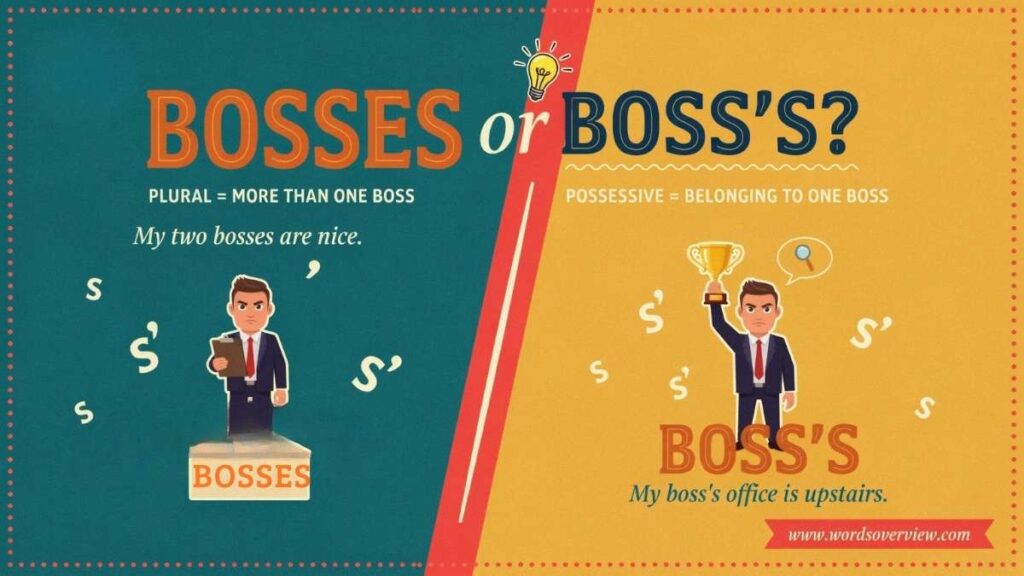
English grammar has a funny way of turning one tiny apostrophe into a workplace drama. If you’re wondering about bosses or boss’s, you’re not alone. These forms look almost identical, yet they serve completely different grammatical purposes. One talks about more than one boss, while the other shows that something belongs to one boss. Add bosses’ to the mix and suddenly that little apostrophe has even more responsibility. Don’t worry, your grammar skills haven’t been fired! This guide explains bosses or boss’s clearly, with simple rules, practical examples and common mistakes. By the end, you’ll know exactly which form to use.
Bosses or Boss’s Quick Answer
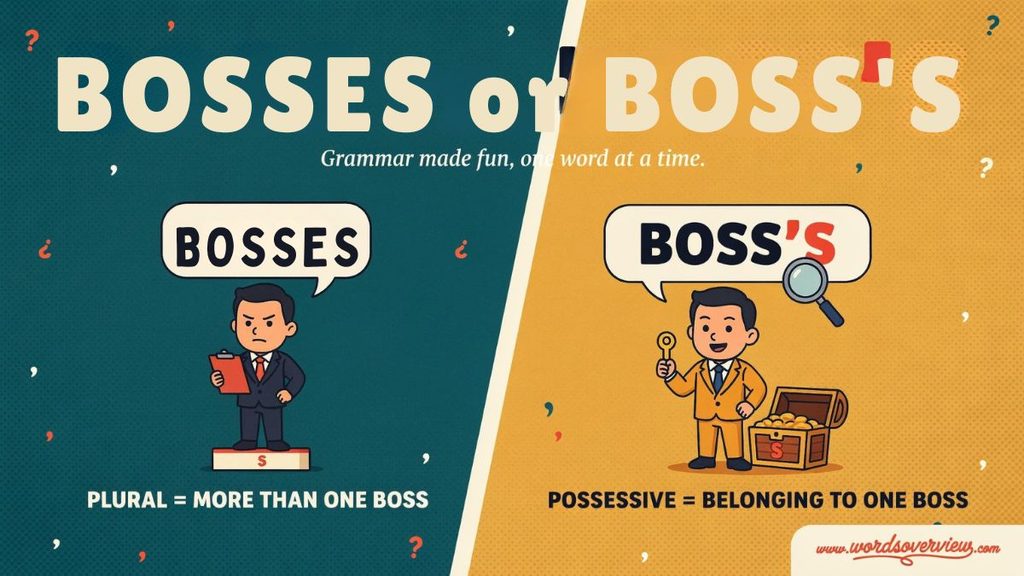
The bosses or boss’s meaning depends on the role the word plays in your sentence.
Use bosses when you mean more than one boss:
The bosses approved the proposal.
Use boss’s when something belongs to or relates to one boss:
The boss’s decision surprised the team.
Use bosses’ when something belongs to or relates to multiple bosses:
The bosses’ decision affected every department.
Therefore, if you’re asking bosses or boss’s which is correct, both forms can be correct. However, they aren’t interchangeable.
Bosses Means More Than One Boss
Bosses is a plural noun. It refers to two or more bosses.
For example:
Two bosses attended the meeting.
Several bosses approved the plan.
The bosses discussed the new schedule.
In each sentence, bosses identifies multiple people. It doesn’t show possession, so you don’t need an apostrophe.
Boss’s Shows Possession by One Boss
Boss’s is a singular possessive form. It normally connects one boss with another noun.
For example:
The boss’s office is upstairs.
The office belongs to or relates to one boss.
Likewise:
I followed the boss’s instructions.
Here, the instructions came from or relate to one boss.
Bosses’ Shows Possession by Multiple Bosses
Bosses’ is the plural possessive form.
For example:
The bosses’ offices are on different floors.
The sentence refers to offices associated with multiple bosses.
This distinction gives you a simple pattern:
- bosses = multiple bosses
- boss’s = one boss’s possession
- bosses’ = multiple bosses’ possession
What Does “Boss” Mean?
Before examining bosses or boss’s, it helps to understand the base word.
Boss is a noun that commonly describes a person who supervises or manages other people. Depending on the workplace, a boss might be a manager, supervisor, department head, employer or another person in authority.
For example:
My boss asked me to finish the report.
The word boss refers to one person.
Because boss functions as a singular noun in this sentence, you can change its form depending on the meaning you want to express.
| Purpose | Form | Example |
| Singular | boss | My boss called me. |
| Plural | bosses | Several bosses attended. |
| Singular possessive | boss’s | The boss’s desk is clean. |
| Plural possessive | bosses’ | The bosses’ desks are clean. |
This four-form pattern provides the foundation for understanding bosses or boss’s grammar.
What Does “Bosses” Mean?
Bosses Is the Plural of Boss
The plural of boss is bosses.
English usually forms the plural of many nouns by adding -s. However, words that end in certain sounds and spellings often take -es instead. Since boss ends in ss, its regular plural becomes:
boss → bosses
The same pattern appears in words such as:
- bus → buses
- class → classes
- glass → glasses
- box → boxes
- watch → watches
- boss → bosses
Therefore, the correct spelling of bosses is bosses, not boss’s.
Why Bosses Does Not Need an Apostrophe
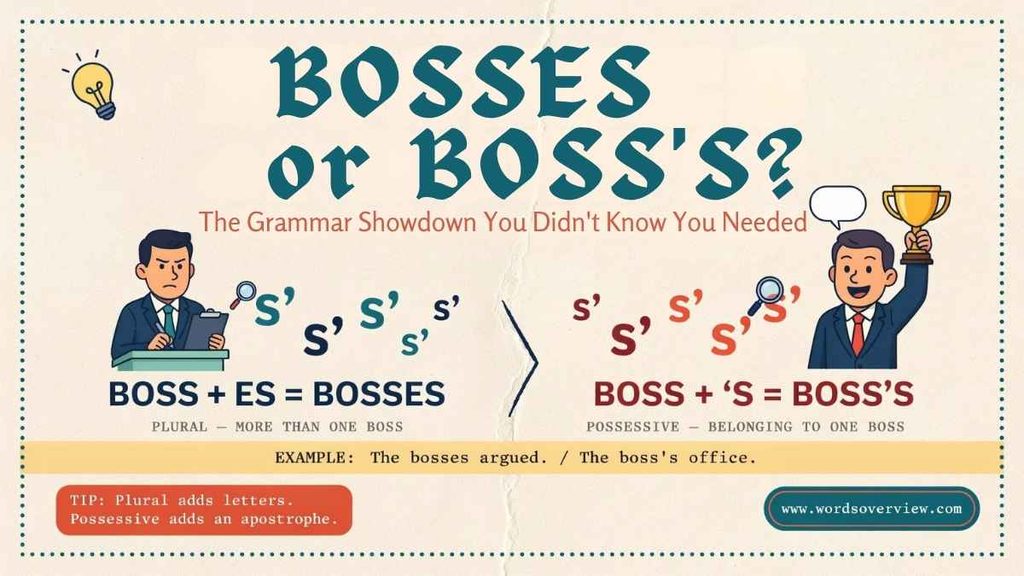
One of the most common apostrophe mistakes involves using an apostrophe to create a plural.
Apostrophes generally don’t make ordinary nouns plural. Instead, they can show possession, contractions or certain specialized forms.
So, write:
The bosses arrived early.
Don’t write:
The boss’s arrived early.
The second version doesn’t work when you simply mean multiple bosses. The apostrophe changes the word into a possessive form.
Bosses in a Sentence
If you’re looking for bosses in a sentence, consider these examples:
- The bosses met before the conference.
- Several bosses attended the training session.
- Our bosses approved the new schedule.
- The bosses discussed the company’s policy.
- Two bosses interviewed the candidate.
- The department bosses agreed on the timetable.
In every example, bosses means more than one boss.
What Does “Boss’s” Mean?
Boss’s Is the Singular Possessive Form
The boss’s meaning differs from the meaning of bosses.
Boss’s is the singular possessive form of boss. It usually shows that something belongs to, comes from or relates to one boss.
The basic structure is:
boss + ’s + noun
For example:
The boss’s office is upstairs.
The office belongs to or is associated with one boss.
You can use the same structure with many other nouns:
- the boss’s desk
- the boss’s car
- the boss’s decision
- the boss’s instructions
- the boss’s assistant
- the boss’s schedule
- the boss’s opinion
- the boss’s computer
The apostrophe matters because it tells the reader that boss has a possessive relationship with the following word.
Boss’s in a Sentence
If you’re searching for boss’s in a sentence, these examples show the form clearly:
The boss’s office is next to the conference room.
Everyone respected the boss’s decision.
I need to ask the boss’s permission.
The boss’s assistant scheduled the meeting.
We discussed the boss’s instructions.
Each example refers to one boss.
Why the Apostrophe Comes Before the S
This point causes a surprising number of mistakes.
For a singular noun, English commonly forms the possessive by adding ’s.
For example:
- manager → manager’s
- teacher → teacher’s
- student → student’s
- employee → employee’s
- boss → boss’s
Therefore:
The manager’s office is closed.
And:
The boss’s office is closed.
In both cases, one person has a relationship with the noun that follows.
This pattern explains the boss’s apostrophe as well as the general singular possessive rule.
Learn the difference between confusing English words step by step
Gos or Goes Which Spelling Is Correct?
Bosses or Boss’s or Bosses’
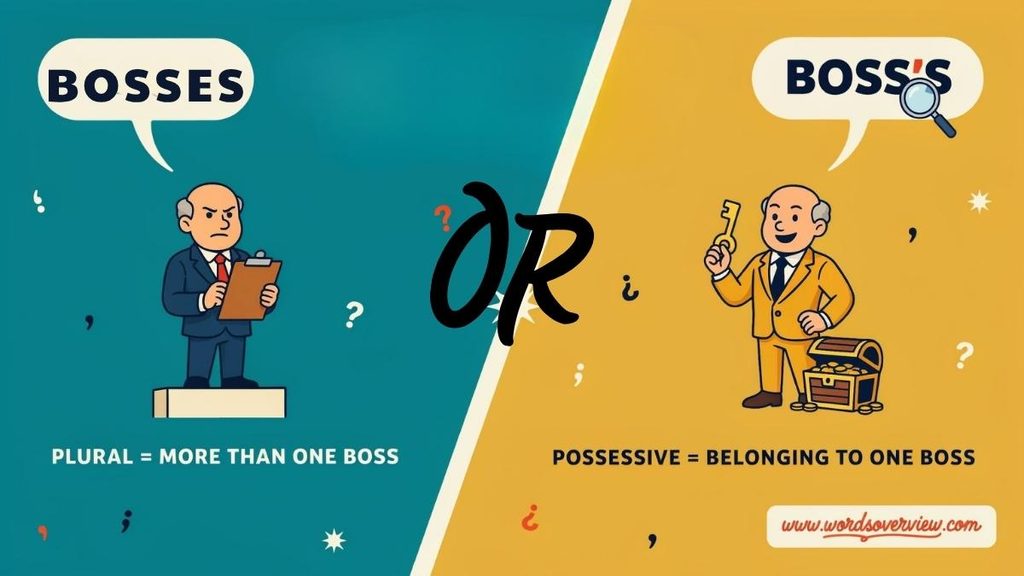
The easiest way to understand the three forms is to compare them directly.
Bosses = Plural
The bosses are meeting today.
The sentence refers to multiple bosses. Nothing in the word itself indicates possession.
Boss’s = Singular Possessive
The boss’s meeting starts at noon.
The meeting belongs to or relates to one boss.
Bosses’ = Plural Possessive
The bosses’ meeting starts at noon.
The meeting belongs to or relates to multiple bosses.
A single apostrophe can therefore change the grammatical meaning of the sentence.
| Form | Number | Possessive? | Example |
| boss | One | No | The boss arrived. |
| bosses | More than one | No | The bosses arrived. |
| boss’s | One | Yes | The boss’s car arrived. |
| bosses’ | More than one | Yes | The bosses’ cars arrived. |
This is the central distinction behind bosses or boss’s or bosses’.
How to Form the Plural of Boss
If you’re asking what is the plural of boss, the answer is simple:
boss → bosses
The word takes -es because of its ending.
How to Make Boss Plural
Use this pattern:
boss + es = bosses
Examples include:
- one boss → two bosses
- one boss → several bosses
- one boss → many bosses
- one boss → the bosses
This process belongs to noun pluralization, not possession.
Consequently, don’t add an apostrophe when you simply want to show that there is more than one boss.
Correct:
There are three bosses in the company.
Incorrect:
There are three boss’s in the company.
The second sentence incorrectly treats the apostrophe as a plural marker.
How to Form the Possessive of Boss
If you’re asking what is the possessive form of boss, you need to consider the number of people involved.
For one boss:
boss → boss’s
For multiple bosses:
bosses → bosses’
This distinction follows standard possessive grammar.
Singular Possessive Form of Boss
Use boss’s when one boss possesses or relates to something.
- The boss’s desk is near the window.
- The boss’s decision surprised everyone.
- The boss’s car is outside.
Plural Possessive Form of Boss
Use bosses’ when multiple bosses possess or relate to something.
- The bosses’ desks are near the window.
- The bosses’ decisions affected the company.
- The bosses’ cars are outside.
This explains why the plural possessive of boss is bosses’, not boss’s.
Learn the difference between similar English words
Honored or Honoured Which Spelling Is Correct?
Bosses’ Meaning: The Form Many Writers Miss
The bosses’ meaning relates to possession or association involving multiple bosses.
Consider this sentence:
The bosses’ meeting lasted two hours.
The meeting involved or belonged to multiple bosses.
Now compare it with:
The boss’s meeting lasted two hours.
This sentence refers to one boss.
The difference becomes even clearer in these examples:
| Singular possessive | Plural possessive |
| the boss’s office | the bosses’ offices |
| the boss’s car | the bosses’ cars |
| the boss’s decision | the bosses’ decisions |
| the boss’s assistant | the bosses’ assistants |
| the boss’s meeting | the bosses’ meetings |
| the boss’s policy | the bosses’ policies |
Bosses’ in a Sentence
Here are several examples of bosses’ in a sentence:
- The bosses’ decision affected the entire team.
- The bosses’ offices are closed today.
- We reviewed the bosses’ recommendations.
- The bosses’ schedules were different.
- Employees discussed the bosses’ new policy.
In every case, bosses’ refers to multiple bosses and their relationship to another noun.
Learn the difference between confusing English words step by step
Persuing or Pursuing Which Spelling Is Correct?
Bosses’ or Boss’s What Is the Difference?
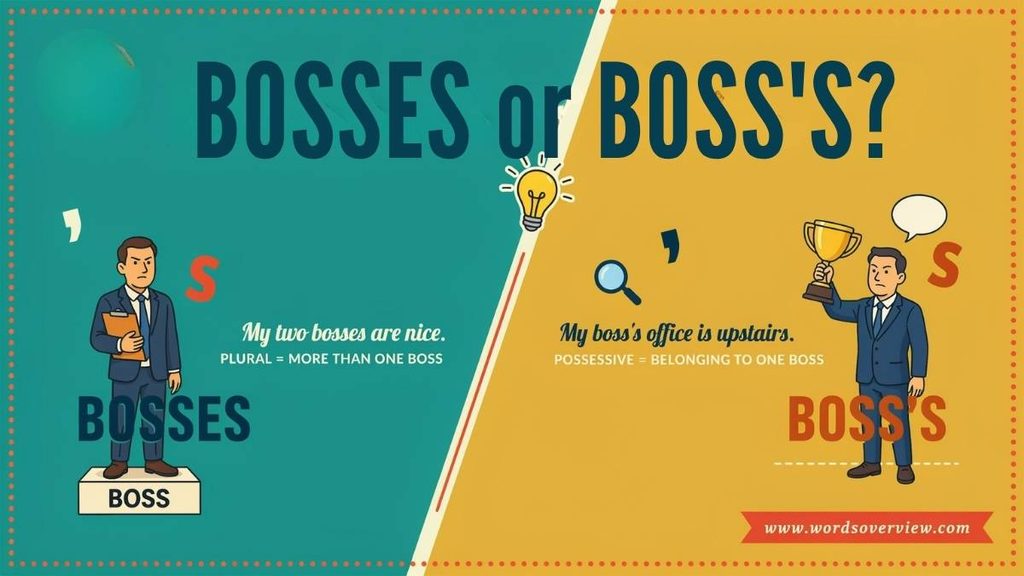
The difference between boss’s and bosses’ comes down to number.
Boss’s refers to one boss.
Bosses’ refers to multiple bosses.
Compare:
The boss’s office is large.
This sentence refers to one boss.
Now consider:
The bosses’ offices are large.
This sentence refers to multiple bosses.
The same rule applies to many workplace nouns.
| One person | Multiple people |
| manager’s | managers’ |
| employee’s | employees’ |
| teacher’s | teachers’ |
| supervisor’s | supervisors’ |
| boss’s | bosses’ |
For example:
The manager’s report was detailed.
But:
The managers’ reports were detailed.
The noun changes from singular to plural and the possessive punctuation changes with it.
Learn the difference between basic English word mistakes
Where or When: Usage and Classic Song
Bosses or Bosses’ Plural or Plural Possessive?
The bosses or bosses’ distinction is another important part of the topic.
Bosses simply identifies multiple bosses.
Bosses’ shows a relationship between multiple bosses and another noun.
Compare:
The bosses arrived at noon.
Here, bosses acts as a plural noun.
Now look at:
The bosses’ meeting began at noon.
Here, bosses’ acts as a plural possessive.
A useful test is to look at what follows the word.
If you’re simply naming multiple people, use bosses.
If you’re connecting multiple bosses to another noun, use bosses’.
Learn the difference between confusing more English words
Tie or Tye: Meaning, Difference and Usage
Common Mistakes With Bosses or Boss’s
Using Boss’s as a Simple Plural
Incorrect:
The boss’s attended the conference.
Correct:
The bosses attended the conference.
Why? Because the sentence refers to multiple bosses rather than something belonging to one boss.
Using Bosses When You Mean Possession
Incorrect:
The bosses office is upstairs.
Correct:
The boss’s office is upstairs.
The sentence refers to one boss and one office. Therefore, the singular possessive form works here.
Using Boss’s When You Mean Multiple Owners
Consider this sentence:
The boss’s offices are on different floors.
This sentence can mean that one boss has multiple offices.
However, if several bosses each have offices, write:
The bosses’ offices are on different floors.
The apostrophe therefore helps readers understand the intended ownership or association.
Adding an Apostrophe to Every Plural
Incorrect:
We have three boss’s in the company.
Correct:
We have three bosses in the company.
An apostrophe doesn’t normally create a plural noun.
This mistake appears with many other words as well:
- employee’s → employee’s can show singular possession, but employees is the plural
- manager’s → manager’s can show singular possession, but managers is the plural
- teacher’s → teacher’s can show singular possession, but teachers is the plural
Once you understand the pattern, you can apply it across English grammar.
Learn the difference between confusing English words step by step
Chears or Cheers Which Spelling Is Correct?
Bosses or Boss’s in a Sentence Clear Examples

The easiest way to understand bosses or boss’s in a sentence is to compare similar sentences.
| Sentence | Meaning |
| The bosses arrived. | Multiple bosses arrived. |
| The boss’s car arrived. | One boss’s car arrived. |
| The bosses’ cars arrived. | Multiple bosses’ cars arrived. |
| The bosses approved the plan. | Multiple bosses approved it. |
| The boss’s approval was required. | One boss’s approval was required. |
| The bosses’ approval was required. | Multiple bosses’ approval was required. |
| The bosses discussed the policy. | Multiple bosses discussed it. |
| The boss’s policy changed. | One boss’s policy changed. |
| The bosses’ policies changed. | Multiple bosses’ policies changed. |
These examples demonstrate why punctuation can affect meaning. The words may look almost identical, but the grammatical relationship changes.
Bosses or Boss’s in Workplace Writing
Workplace communication provides plenty of situations where these forms appear.
Talking About Multiple Bosses
The bosses discussed the project during the meeting.
Here, bosses is simply a plural noun.
Talking About One Boss’s Instructions
The boss’s instructions were clear.
Here, boss’s shows that one boss gave or owns the instructions.
Talking About Multiple Bosses’ Instructions
The bosses’ instructions were clear.
Here, several bosses provided the instructions.
Learn the difference between more words people mix up
Inconsolable or Unconsolable Which Is Correct?
Talking About Multiple Bosses
Several bosses attended the conference.
Again, bosses simply identifies more than one person.
Talking About One Boss’s Decision
The boss’s decision surprised the employees.
The decision belongs to or came from one boss.
Talking About Multiple Bosses’ Decisions
The bosses’ decisions affected several departments.
Multiple bosses made decisions.
A Practical Case Study Three Forms, Three Meanings
Imagine a company with three department heads.
First, you want to say that all three department heads met:
The bosses met in the conference room.
The plural noun bosses tells readers that more than one boss attended.
Next, suppose the company president has a private office:
The boss’s office is on the top floor.
The singular possessive boss’s tells readers that the office belongs to or relates to one boss.
Finally, suppose each department head has a separate office:
The bosses’ offices are on different floors.
The plural possessive bosses’ tells readers that the offices belong to multiple bosses.
The three forms therefore create three distinct meanings:
bosses → multiple people
boss’s → one person’s possession
bosses’ → multiple people’s possession
This pattern applies far beyond the word boss. For example:
manager → managers → manager’s → managers’
The same grammatical structure works in both cases.
Learn the difference between confusing English words step by step
Insight or Insite What’s the Correct English Word?
How to Know Which Form You Need
When you’re unsure when to use bosses, when to use boss’s or when to use bosses’, ask a few simple questions.
Ask: How Many Bosses?
If you mean more than one boss, use:
bosses
Example:
Several bosses attended the event.
Ask: Does Something Belong to One Boss?
If yes, use:
boss’s
Example:
The boss’s computer needs repair.
Ask: Does Something Belong to Multiple Bosses?
If yes, use:
bosses’
Example:
The bosses’ computers need repair.
This gives you a quick decision guide:
| Question | Answer | Form |
| Do you mean one person? | One boss | boss |
| Do you mean multiple people? | More than one boss | bosses |
| Does something belong to one boss? | One owner | boss’s |
| Does something belong to multiple bosses? | Multiple owners | bosses’ |
Once you identify the number and possession, the spelling usually becomes obvious.
Learn the difference between confusing word pairs
Directer or Director Which Spelling Is Correct?
Bosses or Boss’s Spelling Quick Reference
If you’re checking bosses or boss’s spelling, this table provides the answer at a glance.
| Meaning | Correct form | Example |
| One manager or supervisor | boss | My boss called me. |
| More than one boss | bosses | The bosses called me. |
| Something belonging to one boss | boss’s | The boss’s phone rang. |
| Something belonging to multiple bosses | bosses’ | The bosses’ phones rang. |
Apostrophe Before S
Write:
boss’s
when you mean one boss’s possession.
The apostrophe comes before the final s.
Apostrophe After S
Write:
bosses’
when you mean possession involving multiple bosses.
The apostrophe comes after the plural s.
This difference illustrates an important apostrophe rule:
Singular possessive → ’s
Plural noun ending in s + possessive → s’
American English and British English
The basic distinction among bosses, boss’s and bosses’ remains the same in standard American and British English.
In both varieties:
- bosses functions as the plural.
- boss’s functions as the singular possessive.
- bosses’ functions as the plural possessive.
Some possessive conventions can vary between American and British style guides, particularly with certain proper names and nouns that end in s. However, that variation doesn’t change the basic distinction needed for this word.
Therefore, whether you’re writing for a US audience or a British audience, the practical forms remain:
bosses = more than one boss
boss’s = possession or association involving one boss
bosses’ = possession or association involving multiple bosses
For everyday English spelling and grammar, you don’t need a different plural form simply because the audience uses British English.
Bosses or Boss’s: Important Grammar Facts
Several facts are worth remembering.
- Boss is a singular noun.
- Bosses is the regular plural of boss.
- Boss’s is the singular possessive form.
- Bosses’ is the plural possessive form.
- An apostrophe doesn’t normally create an ordinary plural.
- Bosses doesn’t need an apostrophe when it simply means multiple bosses.
- Boss’s uses apostrophe-s because it refers to one boss’s possession or association.
- Bosses’ places the apostrophe after the plural s.
- The correct form depends on meaning and grammatical context.
- The same pattern applies to related words such as manager, managers, manager’s and managers’.
These rules cover the core bosses or boss’s grammar that most writers need.
Learn the difference between commonly misused words
Blackout or Backout: Difference and Usage
Bosses or Boss’s Final Comparison
| Form | Meaning | Correct example |
| boss | One boss | The boss arrived. |
| bosses | More than one boss | The bosses arrived. |
| boss’s | Something belonging to one boss | The boss’s office is open. |
| bosses’ | Something belonging to multiple bosses | The bosses’ offices are open. |
The most important point is simple: don’t choose the form based only on how it looks. Choose it based on what you want the sentence to mean.
- If you’re talking about more than one boss, write bosses.
- If you’re talking about something connected to one boss, write boss’s.
- If you’re talking about something connected to multiple bosses, write bosses’.
Learn the difference between similar English words the easy way
Access or Acess Which Spelling Is Correct?
Practice Session
Fill in each blank with the correct form
- My ______ office is on the third floor.
- Several ______ attended the company meeting.
- The ______ decision surprised everyone.
- The two ______ offices are next to each other.
- Our ______ asked us to finish the report today.
- The company has three ______ in the management department.
- The ______ meeting starts at 10 a.m.
- The ______ meeting starts after lunch.
- Both ______ approved the new project.
- I borrowed my ______ laptop for the presentation.
- The ______ discussed the employees’ concerns.
- The ______ responsibilities include managing the entire team.
- The department has several ______ with different roles.
- The ______ desks are near the conference room.
- My ______ instructions were very clear.
- The ______ agreed to change the schedule.
- All the ______ signed the new workplace policy.
- The ______ car is parked outside the building.
- The two ______ cars are parked outside the building.
- Our company’s ______ have different management styles.
- I need to speak with my ______ before leaving early.
- The ______ offices were renovated last month.
- The ______ assistant prepared the documents.
- Several ______ reviewed the proposal before approval.
- The ______ decision affected everyone in the department.
Answer Session
- boss’s
- bosses
- boss’s
- bosses’
- boss
- bosses
- boss’s
- boss’s
- bosses
- boss’s
- boss
- boss’s
- bosses
- bosses’
- boss’s
- boss
- bosses
- boss’s
- bosses’
- bosses
- boss
- bosses’
- boss’s
- bosses
- boss’s
Here’s a trusted source for clear more words Comparison:
Grammar Update
Frequently Asked Questions
Is it bosses or boss’s?
Bosses is the plural of boss, meaning more than one boss. Boss’s is the singular possessive form, meaning something belongs to one boss. For example, “The bosses attended the meeting” and “The boss’s office is upstairs.”
What is the plural form of boss?
The plural form of boss is bosses. You add -es because the word ends in s. For example, “Several bosses approved the new policy.”
Is “bosses” a word?
Yes, bosses is a correct English word. It is the plural form of boss and refers to two or more people who manage, supervise or lead others.
What does boss’s mean?
Boss’s is the singular possessive form of boss. It shows that something belongs to one boss. For example, “I left the report on my boss’s desk.”
What is the plural possessive form of boss?
The plural possessive form of boss is bosses’. It shows that something belongs to two or more bosses. For example, “The bosses’ decision affected the entire department.”
What is the difference between bosses and boss’s?
Bosses means more than one boss, while boss’s shows possession by one boss. For example, “The bosses are meeting” means several bosses are meeting, while “The boss’s meeting starts at noon” refers to one boss.
What is the difference between boss’s and bosses’?
Boss’s shows possession by one boss, whereas bosses’ shows possession by multiple bosses. For example, “The boss’s office” belongs to one boss, while “The bosses’ offices” belong to multiple bosses.
How do you use bosses in a sentence?
Use bosses when you mean two or more bosses. For example, “The company’s bosses discussed the employees’ concerns during the meeting.”
How do you use boss’s in a sentence?
Use boss’s when something belongs to one boss. For example, “My boss’s computer stopped working during the presentation.”
How do you use bosses’ in a sentence?
Use bosses’ when something belongs to multiple bosses. For example, “The bosses’ offices are located on the second floor.”
Conclusion
word actually means. Boss refers to one person, while bosses refers to more than one boss. If something belongs to one boss, use boss’s, such as “the boss’s office.” However, if something belongs to multiple bosses, use bosses’, as in “the bosses’ meeting.”
The apostrophe may look small, but it can completely change your sentence. That tiny mark isn’t just decoration—it has a job! So, before you choose between bosses or boss’s, ask yourself whether you mean multiple bosses or something belonging to one boss. Once you understand that difference, the confusion disappears.

Ethan AJS is an experienced blogger and language enthusiast at Words Overview, dedicated to making English easier to understand and use. He writes about grammar, vocabulary, spelling, word meanings and commonly confused words, turning tricky language questions into clear, practical insights. With a passion for effective communication, Ethan creates engaging, readerfocused content that helps readers write accurately, choose the right words and communicate with confidence.




