
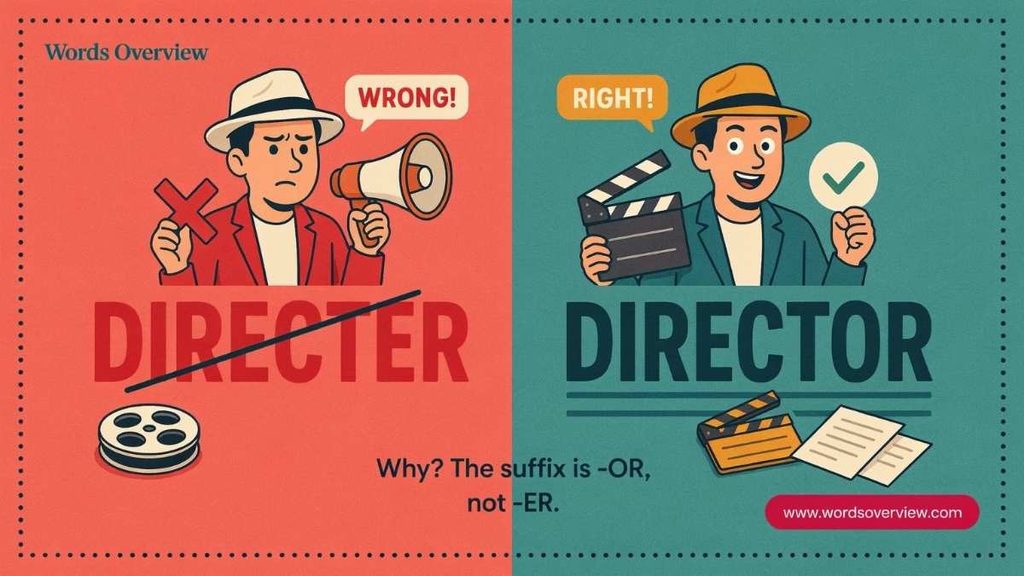
Ever typed a job title, paused and wondered whether it should be “directer” or “director”? You’re not alone. The two spellings look almost identical, which makes this tiny spelling difference surprisingly easy to miss. However, only one is the standard spelling for the person who manages, leads or directs an organization, film, department or project. So, if you’ve ever written “directer” and hoped Grammarly wouldn’t raise an eyebrow, this guide is for you. In this article, we’ll clear up the confusion between directer or director, explain why the mistake happens and show you simple examples so you can choose the correct spelling confidently every time.
Directer or Director Quick Answer
Director is the correct and standard spelling when you mean a person who directs something.
| Word | Standard noun for a person who directs? | Typical use |
| Director | Yes | Film director, company director, program director |
| Directer | No, not as the standard noun | May appear as a nonstandard noun spelling or as a comparative adjective |
For example:
- Correct: The director approved the project.
- Correct: She became the director of the company.
- Correct: The film director spoke with the actors.
- Incorrect for the noun: The directer approved the project.
Therefore, if you’re asking, “is it director or directer?” when referring to someone’s role, choose director.
The same answer applies to common searches such as:
- directer or director which is correct
- is director or directer correct
- how do you spell director
- how to spell director correctly
- director or directer which spelling is correct
The director correct spelling is director.
Director in a Sentence
The meaning of director changes slightly according to context, but the spelling stays the same.
- The director called a meeting with the department heads.
- The movie’s director explained how the final scene was filmed.
- She works as the marketing director for a technology company.
- The school appointed a new director of education.
- The board elected him as a company director.
- The theater director reviewed the cast’s performance.
These examples show why context matters. A film director and a company director perform very different jobs, yet both use the same noun.
What Does Director Mean?
The basic director meaning is a person who directs, manages or oversees something. The exact meaning depends on the setting.
- In business, a director may hold a senior management or governance role.
- In film, the director leads the creative direction of a production.
- In education, a director may oversee a school, department or specific program.
Therefore, a simple director definition is:
A director is a person who directs, manages or oversees a particular organization, activity, department, production or group.
The word doesn’t always mean “the person in charge of everything.” Instead, a director usually holds responsibility for a defined area.
Learn the difference between confusing more English words
Tie or Tye: Meaning, Difference and Usage
Director Meaning in a Company
A company director can help govern or manage a business. Depending on the organization’s structure, directors may serve on a board and take part in major decisions concerning strategy, finances, operations and corporate governance.
Companies can also give the title to senior executives who oversee particular functions.
Common examples include:
- Managing director
- Executive director
- Finance director
- Marketing director
- Operations director
- Sales director
- Human resources director
- Technical director
- Regional director
The exact director role depends on the organization. A managing director, for instance, can have responsibilities that differ substantially from those of a finance director.
Director Meaning in Film
A film director leads the creative direction of a movie. The role often involves working with actors, cinematographers, editors, designers and other members of the production team.
The director helps shape important elements such as performances, visual storytelling, pacing and the interpretation of the script. However, filmmaking involves many specialized roles, so the director doesn’t personally perform every production task.
The term movie director also appears frequently in American English.
Director Meaning in Theater
A theater director guides the artistic development of a stage production. The director may work with actors, designers, stage managers and other members of the production team.
For example:
The theater director asked the actors to perform the final scene with more urgency.
Here, director refers to the person guiding the production rather than someone managing a company.
Director Meaning in Education
Educational institutions often use director for someone responsible for a particular department, program or activity.
Examples include:
- Education director
- Program director
- Admissions director
- Research director
- Academic director
- Athletic director
A director in education may supervise staff, manage programs, coordinate activities, develop policies or oversee day-to-day operations.
Learn the difference between confusing English words step by step
Persuing or Pursuing Which Spelling Is Correct?
Why Is It “Director” Instead of “Directer”?
The answer becomes clearer when you look at the word’s history.
Director comes from a Latin-derived word and entered English through French and Anglo-French forms. Its history ultimately connects it with the Latin verb dirigere, meaning to guide, direct or set straight.
The word has been part of English since the late 15th century. Over time, its meaning expanded beyond the basic idea of a guide or person who directs.
This history explains why English doesn’t simply form the noun by adding -er to direct.
Consider these examples:
| Verb | Person noun |
| Teach | Teacher |
| Drive | Driver |
| Write | Writer |
| Act | Actor |
| Inspect | Inspector |
| Direct | Director |
English uses several different patterns to create nouns for people. Consequently, you can’t always predict the correct form simply by attaching -er to a verb.
That’s the key to understanding the directer or director spelling question.
The Origin and History of “Director”
The history of director stretches back several centuries.
The word entered English in the late 15th century with the general sense of a guide or someone who directs. Its development connects English director with Anglo-French and French forms as well as the Latin dirigere.
Later, the word developed more specialized meanings.
By the 17th century, director had acquired a corporate sense connected with someone who helped manage a company’s affairs. Much later, the word developed its familiar theatrical and filmmaking meanings.
That historical development produced the modern word family:
direct → direction → director → directorial → directorship
The connection between these words can help you remember the spelling.
For example, directorship refers to the position or role of a director, while directorial describes something connected with a director or the work of a director.
Why “Directer” Looks Correct at First
English spelling creates this confusion for a very understandable reason.
When you see the verb direct, you may naturally think of words such as teacher, worker, driver and runner. Those examples encourage the familiar pattern:
verb + -er = person who performs the action
That pattern works often enough to feel reliable. Nevertheless, it doesn’t work for every English word.
The form directer therefore looks logical even though director is the established noun.
Think of it like following a familiar recipe that works for most ingredients but not this particular one. The method looks right. The result isn’t.
This distinction becomes especially important in professional writing. A spelling mistake in a casual message may disappear into the background, but an incorrect job title can stand out immediately.
Directer or Director What’s the Difference?
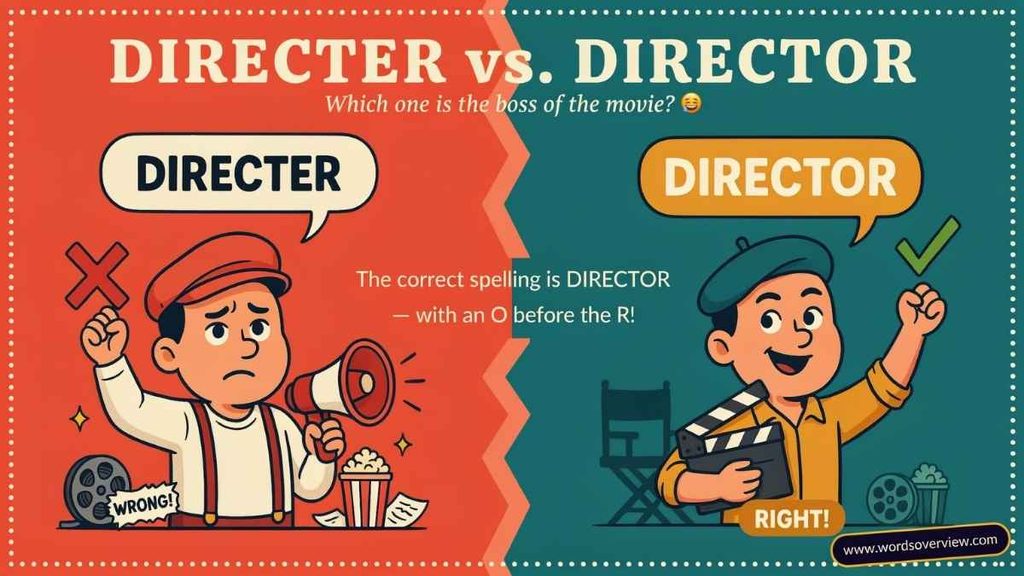
The basic directer or director distinction is simple:
Director is the standard noun for a person who directs.
Directer is not the standard noun for that role.
However, grammar adds an important layer to the comparison.
Directer can occur as a comparative form of the adjective direct. In other words, someone may use it to mean “more direct.” Still, modern writers often prefer more direct, especially in formal or polished prose.
Consider the difference:
| Word or phrase | Grammatical role | Meaning |
| Direct | Adjective | Straightforward or without an intermediary |
| Directer | Comparative adjective in some usage | More direct |
| Director | Noun | A person who directs |
| More direct | Comparative adjective | More direct |
For example:
The director revised the script.
Here, director names a person.
Now compare:
The second route is more direct than the first.
Here, direct functions as an adjective.
The two forms therefore aren’t interchangeable.
Learn the difference between similar English words
Honored or Honoured Which Spelling Is Correct?
Is Directer a Correct Word?
The question “is directer a correct word?” requires some context.
As a noun meaning a person who directs, directer is not the standard modern English form. In that situation, use director.
As a comparative adjective, however, directer can appear in English. Even so, more direct often sounds more natural in contemporary usage.
For example:
The second route is more direct than the first.
This construction is clear and widely familiar.
By contrast:
The directer of the film arrived.
This sentence attempts to use directer as a noun. The standard form is:
The director of the film arrived.
Therefore, the answer to “is directer a correct word?” depends on what you mean. For the professional noun, choose director.
Is Directer a Word?
So, is directer a word?
It can occur in English, particularly as a comparative form of direct. However, that fact doesn’t make it the correct noun for a person who directs.
This distinction matters because real-world usage and standard usage aren’t always identical. A word can appear in websites, informal writing, historical texts or user-generated content without becoming the standard form for a particular meaning.
For the noun, dictionaries consistently recognize director.
Learn the difference between confusing English words step by step
Gos or Goes Which Spelling Is Correct?
Directer as a Comparative Adjective
The phrase directer as a comparative adjective explains one legitimate-looking use of the form.
English commonly compares adjectives in two ways. Short adjectives often take -er, while longer adjectives frequently use more.
For example:
- fast → faster
- small → smaller
- useful → more useful
- important → more important
With direct, modern writers commonly use:
- direct
- more direct
- most direct
Some speakers and writers may use directer as the comparative. However, more direct usually provides the clearer and more familiar choice.
For example:
Her explanation was more direct than the original version.
The important point is that this grammatical use has nothing to do with the noun director.
Director or Directer Pronunciation
Pronunciation can create additional confusion because director has more than one accepted pronunciation in English.
In American English, speakers commonly pronounce the first syllable with either a reduced vowel or a pronunciation closer to the vowel in die. Regional and individual differences account for this variation.
However, pronunciation doesn’t change the standard spelling.
Whether a speaker says the word with one accepted regional pronunciation or another, the written noun remains:
director
Therefore, directer or director pronunciation shouldn’t lead you to treat the spellings as interchangeable.
The spelling question is grammatical and lexical rather than simply phonetic.
Learn the difference between more words people mix up
Inconsolable or Unconsolable Which Is Correct?
Director in American English or British English
One common misconception suggests that directer might represent British English while director represents American English.
That isn’t the case.
Both major varieties use director as the standard noun.
| English variety | Standard spelling |
| American English | director |
| British English | director |
| Canadian English | director |
| Australian English | director |
Therefore, this isn’t an American-versus-British spelling difference like color/colour or center/centre.
You don’t change director to directer when switching from American English to British English.
Common Mistakes With Director
Several spelling mistakes occur because writers apply familiar English patterns too quickly.
Adding “er” to Direct
The most obvious mistake follows this pattern:
direct + er = directer
Although the construction looks logical, it doesn’t produce the standard noun.
The established noun is:
direct + or = director
Confusing Direct With Director
Direct and director belong to the same word family, but they serve different grammatical functions.
For example:
Direct the team toward the exit.
Here, direct is a verb.
The instructions were direct.
Here, direct is an adjective.
The director approved the plan.
Here, director is a noun.
Understanding the difference between direct or director makes the spelling much easier to remember.
Misspelling Professional Titles
Job titles provide one of the clearest places where this mistake appears.
| Incorrect | Correct |
| Managing Directer | Managing Director |
| Creative Directer | Creative Director |
| Finance Directer | Finance Director |
| Marketing Directer | Marketing Director |
| Executive Directer | Executive Director |
| Film Directer | Film Director |
If you’re preparing a resume, LinkedIn profile, company biography or email signature, check this word carefully. A small spelling mistake in a prominent job title can distract readers from otherwise strong professional content.
Learn the difference between confusing English words step by step
Bosses or Boss’s? Which One Is Correct?
Assuming Online Frequency Means Correctness
Seeing directer online doesn’t automatically make it standard.
The internet contains informal posts, comments, typing errors, user-generated content, historical documents and poorly edited pages. Consequently, raw search frequency doesn’t determine whether a spelling is standard English.
For spelling questions, established dictionaries and reputable language references provide more useful evidence.
Director and Directer in Everyday Examples
Context makes the distinction much easier once you understand the basic rule.
Workplace Examples
Correct:
The marketing director presented the company’s new strategy.
Correct:
The operations director reviewed the monthly report.
Incorrect for the noun:
The marketing directer presented the company’s new strategy.
Film Examples
Correct:
The director worked with the actors to improve the scene.
Correct:
The film director discussed the production during an interview.
Incorrect for the noun:
The film directer discussed the production.
Education Examples
Correct:
The education director introduced the new program.
Correct:
The program director approved the updated curriculum.
General Writing
Correct:
The director asked the team to submit the report by Friday.
Correct:
She served as the company’s regional director for five years.
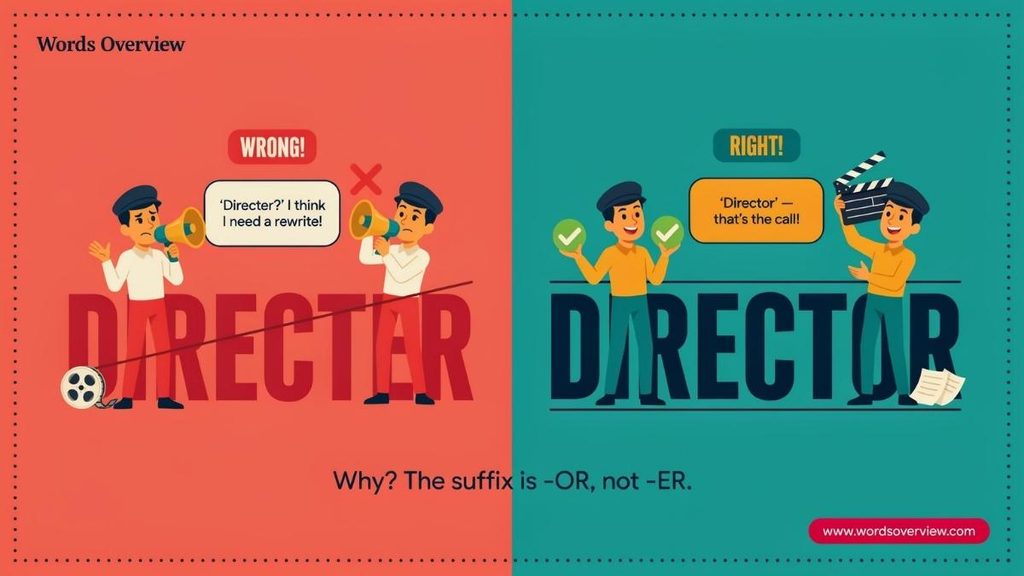
The pattern remains consistent. When the word names the person responsible for directing something, director is the standard choice.
Learn the difference between commonly misused words
Blackout or Backout: Difference and Usage
Director in a Sentence Examples by Meaning
If you’re searching for director in a sentence, the examples below show how the word works in different contexts.
| Context | Example |
| Business | The director approved the annual budget. |
| Film | The director gave the actors new instructions. |
| Theater | The theater director changed the final scene. |
| Education | The education director launched a new training program. |
| Finance | The finance director presented the financial report. |
| Marketing | The marketing director reviewed the campaign. |
| Organization | The program director welcomed the new participants. |
| Board | She was elected as a director of the company. |
Notice how the surrounding words clarify the meaning. Director can refer to different kinds of professionals, but the spelling remains unchanged.
Directer in a Sentence Why Context Matters
A search for directer in a sentence can create confusion because the word doesn’t have the same standard noun status as director.
If you intend the noun, write:
The director approved the proposal.
Not:
The directer approved the proposal.
However, if directer functions as a comparative adjective, it can appear in certain contexts:
The second route is directer than the first.
Even here, many modern readers will find this version more natural:
The second route is more direct than the first.
Therefore, don’t correct the form without considering the sentence’s grammatical meaning.
Learn the difference between similar English words the easy way
Access or Acess Which Spelling Is Correct?
Director Job Titles and Professional Usage
The word director appears in a wide range of professional titles because organizations divide responsibility among departments, functions and levels of management.
Common examples include:
- Managing director
- Executive director
- Company director
- Finance director
- Marketing director
- Operations director
- Creative director
- Technical director
- Program director
- Project director
- Education director
- Research director
- Regional director
- Film director
- Theater director
However, these titles don’t all describe the same position.
For example, a managing director may have broad responsibility for an organization’s operations, while a finance director focuses primarily on financial matters. Similarly, a program director may oversee one specific educational or professional program.
The title tells you something about the person’s director position, but the exact responsibilities depend on the organization.
When Should Director Be Capitalized?
The word director doesn’t automatically require a capital letter.
Use lowercase when you refer to the role generally:
The director approved the proposal.
When a title directly precedes a person’s name, many style systems capitalize it:
Director Maria Lopez approved the proposal.
However, capitalization practices can vary according to an organization’s style guide and the sentence structure.
The important point is that director isn’t automatically a proper noun.
Director or Related Words
The word belongs to a broader family of terms that share the root direct.
| Word | Part of speech | Basic meaning |
| Direct | Verb/adjective/adverb | Guide, control or proceed without an intermediary |
| Direction | Noun | Guidance, course or instruction |
| Director | Noun | A person who directs |
| Directly | Adverb | In a direct manner |
| Directive | Noun/adjective | An instruction or something that directs |
| Directorial | Adjective | Related to a director or directorial work |
| Directorship | Noun | The position or office of a director |
This word family provides a useful memory aid:
direct → direction → director → directorial → directorship
Once you recognize the relationship, director becomes easier to remember.
Director Synonym What Words Can Replace It?
A director synonym depends on the context. No single synonym works in every sentence because the word director describes several different roles.
Synonyms of Director in Management
Depending on the organization’s structure and the person’s responsibilities, possible alternatives include:
- Manager
- Executive
- Administrator
- Leader
- Head
- Supervisor
These words aren’t perfect substitutes. For example, a director may have governance responsibilities that a supervisor doesn’t have.
Likewise, the title manager doesn’t necessarily indicate the same organizational level as director.
Synonyms of Director in Film and Theater
Depending on the exact role, related terms include:
- Filmmaker
- Stage director
- Theater director
- Producer-director
However, these terms can describe different responsibilities.
A producer generally handles production-related responsibilities that differ from those of a director. Therefore, calling every film director a producer would create an inaccurate description.
Synonyms of Director in Music
In some musical contexts, conductor can function as a related term. For example, an orchestra or choir may have a musical director who leads performances and rehearsals.
The broader lesson is simple: when looking for synonyms of director, choose a replacement according to the specific meaning rather than treating all synonyms as interchangeable.
Learn the difference between basic English word mistakes
Where or When: Usage and Classic Song
Is “Directer” an Archaic Word?
The question “is directer an archaic word?” doesn’t have a simple yes-or-no answer for every historical example.
Older English contains spelling and grammatical forms that differ from contemporary standard English. At the same time, directer can function as a comparative adjective in some usage.
Therefore, calling every historical occurrence of directer an “archaic spelling” would oversimplify the evidence.
For modern standard English, however, the distinction is straightforward:
Director is the standard noun for a person who directs.
So, if you’re writing a current resume, academic paper, business report, email, article or professional profile, use director for the noun.
Can Directer Be Used as a Noun?
In ordinary modern English, directer should not replace director as the noun for a person who directs.
For example:
The director of the company attended the meeting.
Not:
The directer of the company attended the meeting.
The second sentence remains understandable, but it doesn’t use the standard noun.
This distinction answers the long-tail question “can directer be used as a noun?” in practical terms: avoid it when you’re referring to the established professional or organizational role.
Directer or Director Spelling A Quick Test
When you’re unsure about the directer or director spelling, ask yourself one question:
Am I naming a person whose role is to direct something?
If the answer is yes, use:
director
For example:
- company director
- film director
- school director
- program director
- marketing director
- managing director
- board director
If you’re comparing how directly two things work, use more direct in most modern writing:
This route is more direct.
That simple distinction solves most spelling problems involving these two forms.
Directer Correct Spelling or Director Correct Spelling
The phrase directer correct spelling can itself create confusion because it assumes that directer should serve as the noun being checked.
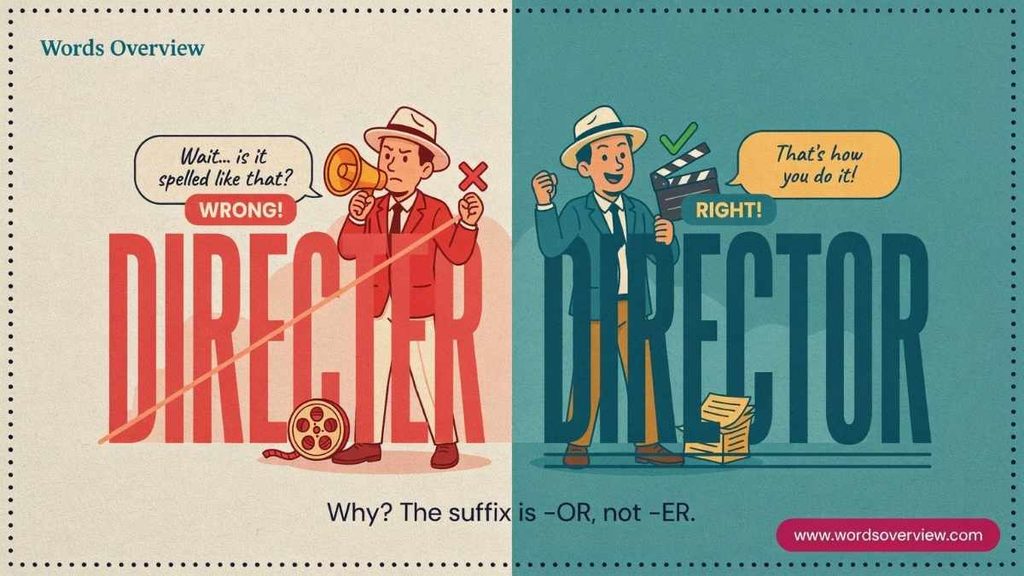
For the noun meaning a person who directs, the correct spelling of director is:
director
The director spelling remains the same in both American and British English.
If you’ve written a professional title such as Managing Directer, the correction is:
Managing Directer → Managing Director
Likewise:
Film Directer → Film Director
Creative Directer → Creative Director
Company Directer → Company Director
Therefore, when someone searches for the correct spelling of directer, the intended correction will usually be director if the word refers to a person or professional role.
A Practical Case Study Fixing a Job Title
Imagine that a resume contains this line:
Managing Directer (ABC) Technologies
Most readers will understand the intended meaning immediately. Nevertheless, the spelling remains incorrect for the standard job title.
The corrected version is:
Managing Director (ABC) Technologies
This small correction matters because professional documents rely heavily on precision. Job titles often appear in prominent locations, so spelling errors can attract attention quickly.
The same principle applies to:
- Resumes
- LinkedIn profiles
- Company websites
- Business cards
- Cover letters
- Email signatures
- Organizational charts
- Formal certificates
- Business reports
A quick dictionary check can prevent an unnecessary mistake.
Learn the difference between confusing English words step by step
Chears or Cheers Which Spelling Is Correct?
Directer or Director Examples at a Glance
| Context | Incorrect or less appropriate | Standard form |
| Film | Film directer | Film director |
| Business | Managing directer | Managing director |
| Company | Company directer | Company director |
| Board | Board directer | Board director |
| Marketing | Marketing directer | Marketing director |
| Education | Education directer | Education director |
| Comparative adjective | The directer route | The more direct route |
| Person who directs | The directer approved it | The director approved it |
This table captures the central distinction: director names the person, while more direct normally expresses the comparative adjective.
How to Remember the Correct Spelling of Director
A simple memory trick can keep the spelling straight.
Think:
A person who directs is a director.
The noun uses -or:
direct + or = director
You can also connect the word with familiar professional titles:
- Film director
- Company director
- Managing director
- Creative director
- Executive director
- Program director
Whenever you’re describing the person who directs something, director should come to mind.
Another useful strategy involves the word family:
direct → direction → director → directorial → directorship
That pattern helps separate director from the tempting but incorrect noun form directer.
Learn the difference between confusing English words step by step
Insight or Insite What’s the Correct English Word?
Directer or Director Final Comparison
| Question | Answer |
| What is the correct noun? | Director |
| Is directer the standard noun for a person who directs? | No |
| Can directer occur in English? | Yes, including some comparative-adjective usage |
| Should you use directer for a job title? | No |
| Is director standard in US English? | Yes |
| Is director standard in British English? | Yes |
| What is the plural? | Directors |
| What is the singular possessive? | Director’s |
| What is the plural possessive? | Directors’ |
| What adjective relates to director? | Directorial |
| What noun describes the position? | Directorship |
Practice Session Directer or Director
Fill in each blank with the correct word: director or directer.
- The film ________ explained the scene to the actors.
- She was appointed as the new marketing ________.
- The company’s ________ approved the annual budget.
- The school ________ welcomed the new students.
- The movie ________ worked closely with the production team.
- He hopes to become a successful film ________ one day.
- The ________ of the department organized an important meeting.
- Our project ________ reviewed the team’s progress.
- The theater ________ selected the cast for the play.
- The managing ________ announced several changes.
- She became the ________ of the research center.
- The ________ asked the actors to repeat the scene.
- The company hired a new sales ________.
- The ________ is responsible for guiding the creative team.
- Everyone praised the ________ for the film’s creative vision.
- The board of ________ met to discuss the company’s future.
- He works as a ________ at a large technology company.
- The ________ gave clear instructions before filming began.
- The hospital’s medical ________ introduced new procedures.
- The ________ carefully managed the production schedule.
- If you mean a person who directs something, use ________.
- “Directer” is usually a spelling ________ when you mean a person who directs.
- The theater ________ spoke to the performers before the show.
- The company ________ signed the final agreement.
- Remember: direct + or = ________.
Answer Session
- director
- director
- director
- director
- director
- director
- director
- director
- director
- director
- director
- director
- director
- director
- director
- directors
- director
- director
- director
- director
- director
- mistake
- director
- director
- director
Here’s a trusted source for clear more words Comparison:
Grammar Update
Frequently Asked Questions
What is the correct spelling: directer or director?
The correct spelling is director when you mean a person who leads, manages or directs an organization, department, project, film or other activity. “Directer” is generally a spelling mistake in this context.
Is it director or directer?
It is director. Although “directer” may look logical because it resembles the verb “direct,” English uses “director” as the standard noun for someone who directs or manages something.
What does directer mean?
“Directer” is not the standard spelling for the professional noun meaning a person who directs. In most everyday and professional writing, use director instead.
Why do people spell director as directer?
People often write “directer” because the word comes from “direct,” and they may naturally expect the noun to follow a pattern such as “teach” → “teacher.” However, the established English spelling is director, which uses the ending “-or.”
How do you use director in a sentence?
You can use director to describe someone who leads or manages a particular activity. For example: “The director approved the project before the team began development.”
What is the plural of director?
The plural of director is directors. For example: “The directors discussed the company’s plans during the meeting.”
Is director a noun or an adjective?
Director is primarily a noun. It refers to a person who directs, manages or supervises something. For example, “She became the director of the department.”
What is the difference between director and direct?
Direct can function as a verb, adjective or adverb, depending on the sentence. Director is a noun that refers to a person who directs or manages something. For example, “She will direct the film” uses “direct” as a verb, while “She is the film’s director” uses “director” as a noun.
How do you remember the spelling of director?
A simple way to remember it is to focus on the ending: direct + or = director. When you mean a person who directs, remember the -or ending rather than changing it to “-er.”
Is directer ever correct in English?
“Directer” is not the standard spelling for the noun meaning a person who directs. In formal, academic, business and professional writing, director is the appropriate spelling for that meaning.
Conclusion
When it comes to “directer or director,” one small letter can send your spelling in the wrong direction. Although “directer” may look logical because the word “direct” ends with “t,” “director” is the standard spelling for a person who leads, manages or directs something. So, whether you’re talking about a film director, company director, school director or project director, choose “director.”
The confusion is understandable, especially when you type quickly and your fingers decide to improvise. However, once you remember that the professional noun is “director,” the choice becomes much easier. Next time Grammarly catches “directer,” don’t argue with the red underline. Let it guide you toward “director” and keep your writing clear, accurate and professional.

Ethan AJS is an experienced blogger and language enthusiast at Words Overview, dedicated to making English easier to understand and use. He writes about grammar, vocabulary, spelling, word meanings and commonly confused words, turning tricky language questions into clear, practical insights. With a passion for effective communication, Ethan creates engaging, readerfocused content that helps readers write accurately, choose the right words and communicate with confidence.




