Words can cause surprisingly big problems when one tiny space changes the meaning. That’s exactly what happens with blackout or backout. A blackout might leave your room dark, erase parts of your memory or describe a temporary information ban. Meanwhile, back out means to withdraw from a plan, promise or decision. Then there’s backout, which appears in some specialized contexts but doesn’t replace the everyday phrasal verb back out. Confused yet? Don’t worry; English has plenty of these little traps. In this guide, you’ll learn the differences, spelling rules, common mistakes and even how “Blackout or Backout” connects to party games and drinking-game terminology.
Blackout or Backout Quick Answer
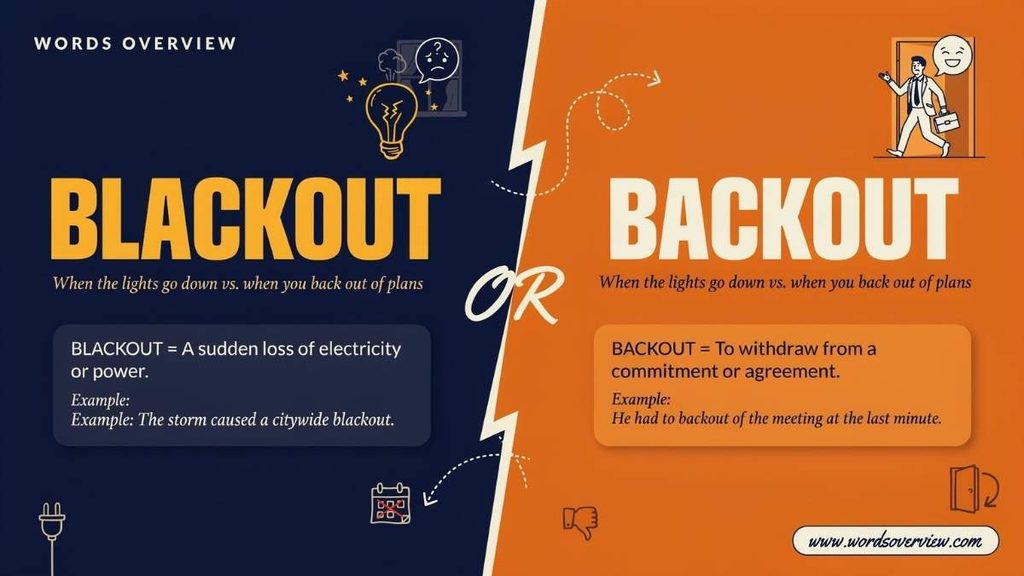
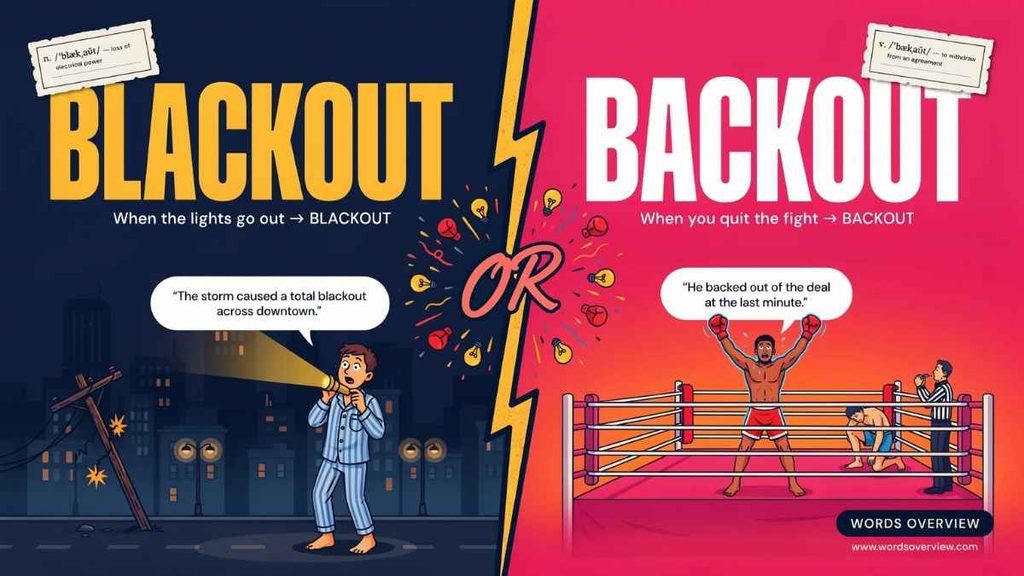
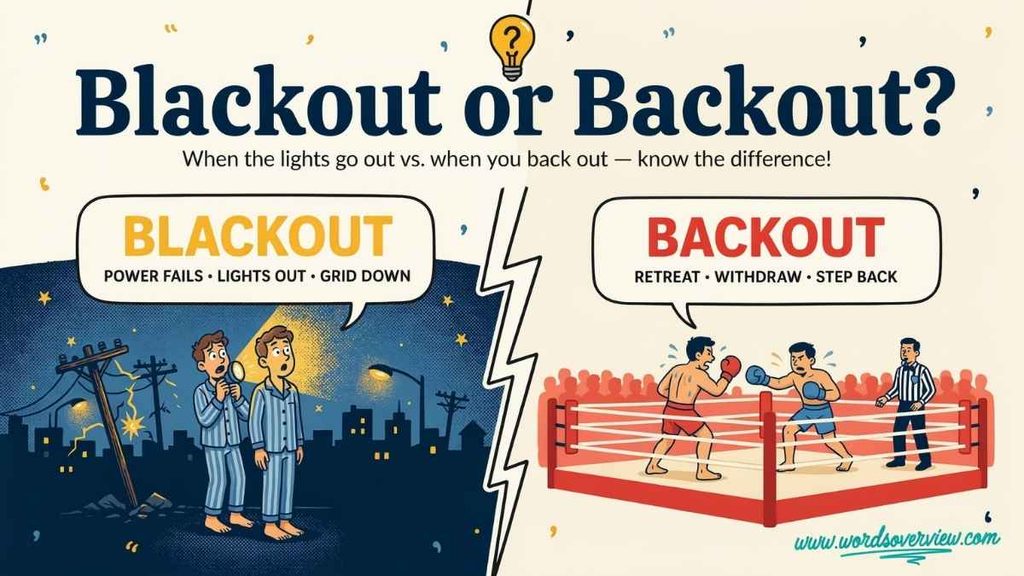
The simplest blackout or backout meaning is easy to remember:
Blackout refers to darkness, interruption, suppression or a period of memory loss.
Back out means to withdraw from something you previously agreed or planned to do.
For example:
- The neighborhood experienced a blackout after the storm.
- The company backed out of the agreement.
- He experienced an alcohol-related blackout.
- She decided not to back out of the trip.
Therefore, these terms aren’t alternative spellings of the same word. They represent different words with different meanings.
There is also an important grammatical distinction. Blackout commonly works as a noun, whereas back out works as a phrasal verb.
For example:
The blackout lasted three hours.
Here, “blackout” names an event.
The company backed out of the deal.
Here, “backed out” describes an action.
Once that distinction becomes clear, most blackout or backout questions become much easier to answer.
Learn the difference between confusing English words step by step
Persuing or Pursuing Which Spelling Is Correct?
Blackout or Backout The Core Difference
The easiest way to understand blackout or backout is to examine what each word describes.
A blackout usually involves something becoming unavailable, hidden, dark or forgotten. A power blackout removes electricity. An information blackout restricts communication. An alcohol blackout involves missing memories.
By contrast, back out involves a person withdrawing from something.
Someone can back out of a:
- deal
- agreement
- plan
- purchase
- commitment
- arrangement
- decision
- activity
For example:
The electricity failed during the storm, causing a blackout.
However:
The contractor backed out of the agreement.
The first sentence describes an interruption. The second describes a person’s decision to withdraw.
That difference remains the same regardless of the situation.
| Feature | Blackout | Back Out |
| Word type | Usually a noun | Phrasal verb |
| Basic idea | Darkness, interruption, suppression or memory loss | Withdrawal from a commitment |
| Common context | Electricity, memory, broadcasting, information | Plans, deals, agreements, commitments |
| Typical construction | a blackout | back out of something |
| Example | We had a power blackout. | They backed out of the deal. |
What Does Blackout Mean?
The blackout definition covers several established meanings. Although those meanings differ by context, they share a general idea of something being interrupted, unavailable, hidden or lost.
Blackout as a Loss of Electricity
The most familiar use of blackout describes a complete loss of electrical power.
A power blackout can affect a single building, a neighborhood or a much larger area. Severe weather, equipment failures, accidents and problems within an electrical grid can all cause blackouts.
For example:
A severe storm caused a blackout across several neighborhoods.
Similarly:
The hospital switched to backup generators during the blackout.
A blackout differs from a brownout. A blackout generally involves a complete loss of electrical service in the affected area, whereas a brownout involves reduced voltage or diminished electrical power.
Blackout as Memory Loss
The word also has an important meaning related to memory.
A person can experience a blackout when they cannot remember what happened during a particular period. Alcohol can cause this type of memory impairment, which makes phrases such as alcohol blackout, drinking blackout and blackout from drinking common in everyday conversation.
However, an alcohol blackout doesn’t necessarily mean that a person becomes unconscious.
Someone may remain awake, speak to other people, walk around and even participate in activities while failing to form lasting memories of what happens.
That distinction matters because memory loss and unconsciousness are different conditions.
Learn the difference between confusing word pairs
Directer or Director Which Spelling Is Correct?
Blackout as Information Suppression
A blackout can also involve information or communication.
For example, people use expressions such as:
- media blackout
- news blackout
- information blackout
- communications blackout
In these contexts, the word doesn’t refer to darkness or electricity. Instead, it describes a restriction or interruption of information.
For example:
The organization announced a temporary media blackout.
Here, the organization isn’t turning off the lights. It is restricting communication with the media.
Blackout in Broadcasting and Sports
The word also appears in broadcasting.
A broadcast blackout can prevent a particular event from being shown in a specific area or under specific conditions. Sports broadcasting has historically used blackout policies for various reasons, including market and distribution arrangements.
Consequently, a blackout can restrict what viewers see rather than interrupt electricity.
Blackout in Theater
In theater, a blackout refers to a complete darkening of the stage.
A director may use a blackout to end a scene, create a transition or separate one part of a performance from another.
For example:
The scene ended with a sudden blackout.
This meaning demonstrates how flexible the word has become. The same term can describe darkness on a stage, a power failure, restricted information or memory loss.
Blackout Meaning When Drinking
If you’re searching for what does blackout mean when drinking, the answer involves memory rather than simply falling unconscious.
An alcohol blackout occurs when alcohol interferes with the brain’s ability to form or retain memories of events that happen while a person is intoxicated.
During an alcohol-related blackout, a person may appear awake and responsive. However, the brain may fail to create lasting memories for some or all of that period.
That can produce:
- memory gaps
- incomplete memories
- missing periods of an evening
- difficulty recalling conversations
- inability to remember specific events
- temporary inability to form new memories
The National Institute on Alcohol Abuse and Alcoholism describes alcohol-induced blackouts as periods when a person remains conscious but fails to remember events because alcohol interferes with memory formation.
What Is an Alcohol Blackout?
So, what is an alcohol blackout in practical terms?
Imagine that someone attends a party and remembers arriving. They also remember leaving several hours later. However, they cannot remember conversations, activities or events that occurred between those two points.
That missing period may represent an alcohol-induced blackout.
Importantly, the person may not have appeared unconscious during the missing period. They may have talked with friends and moved around normally enough for others to assume everything was fine.
That is why alcohol memory blackout and unconsciousness shouldn’t be treated as identical.
Can You Be Conscious During an Alcohol Blackout?
Yes.
A person can remain conscious during an alcohol blackout. They may answer questions, interact with people and perform actions while their ability to create new memories has become severely impaired.
The distinction is important because people sometimes assume that anyone who experiences a blackout must have passed out.
That isn’t necessarily true.
Alcohol can impair memory formation before it causes complete loss of consciousness. Therefore, blackout does not mean unconscious.
Learn the difference between similar English words
Honored or Honoured Which Spelling Is Correct?
Blackout or Passing Out
The distinction between blackout or passing out is especially important when discussing alcohol.
A blackout primarily involves memory loss. Passing out involves loss of consciousness.
| Feature | Alcohol Blackout | Passing Out |
| Consciousness | The person may remain conscious | The person loses consciousness |
| Memory | New memories may not form | Memory may be absent for the unconscious period |
| Interaction | The person may talk or move | The person is generally unresponsive |
| Main issue | Memory formation | Consciousness |
| Relationship to alcohol | Can occur during heavy intoxication | Can occur during severe intoxication |
Therefore, the difference between blackout and passing out isn’t simply a matter of severity. The terms describe different effects.
Someone can experience an alcohol blackout without passing out. Likewise, someone who passes out after drinking may later have no memory of the period when they were unconscious.
Blackout or Passing Out Alcohol
Searches for blackout or passing out alcohol often come from people trying to understand why someone can’t remember part of a drinking session.
The important distinction is that alcohol can affect several brain functions at once.
As intoxication increases, judgment, coordination, reaction time, attention and memory can all become impaired. At sufficiently high levels, alcohol can also cause loss of consciousness and create life-threatening medical emergencies.
Therefore, a drinking blackout shouldn’t be treated as a harmless synonym for being extremely tired or falling asleep.
Learn the difference between more words people mix up
Inconsolable or Unconsolable Which Is Correct?
What Does Back Out Mean?
The back out meaning is much more specific than the various meanings of blackout.
Back out means to withdraw from something you previously agreed, promised or planned to do.
For example:
The buyer backed out of the purchase.
The buyer had planned to complete the purchase but decided not to continue.
Similarly:
She backed out of the trip at the last minute.
Here, she withdrew from a plan.
The expression often appears with of:
back out of + noun
For example:
- back out of a deal
- back out of an agreement
- back out of a contract
- back out of a plan
- back out of a commitment
- back out of a purchase
Learn the difference between confusing more English words
Tie or Tye: Meaning, Difference and Usage
Back Out in Everyday English
People use back out in both casual and professional situations.
In everyday conversation:
I was going to the concert, but my friend backed out.
In business:
The investor backed out of the agreement.
In personal commitments:
He didn’t want to back out of his promise.
In a purchase:
The buyer backed out of the transaction.
In each example, someone withdraws from something they had previously intended or agreed to do.
Back Out or Cancel
Back out and cancel sometimes overlap, but they don’t always communicate the same idea.
To cancel something means to stop or call it off.
To back out usually emphasizes that someone withdraws from a commitment or arrangement.
Compare these sentences:
The organizer canceled the event.
The singer backed out of the event.
The organizer ended the event. The singer withdrew from a commitment to participate.
That difference can make back out more precise when the person rather than the event is the focus.
Back Out or Back Down
The expressions back out and back down also have different meanings.
Back out means to withdraw from a plan, agreement or commitment.
Back down means to stop resisting or opposing someone.
For example:
He backed out of the business deal.
This means he withdrew from the deal.
He backed down during the argument.
This means he stopped resisting.
Although both expressions begin with “back,” they describe different actions.
Learn the difference between confusing English words step by step
Gos or Goes Which Spelling Is Correct?
Backout Definition Is Backout One Word or Two?
The backout definition creates another layer of confusion.
Backout does exist as a word. However, it has limited usage and shouldn’t automatically replace back out.
Some dictionaries recognize backout as a noun referring to an instance of withdrawing from an agreement or commitment. The term also appears in specialized technical contexts.
Nevertheless ordinary English generally uses the two-word phrasal verb:
They decided to back out.
Not:
They decided to backout.
Therefore, if you’re asking is backout one word or two, the practical answer is:
Use “back out” as two words when you’re using the phrasal verb. Use “backout” only when the context specifically calls for the noun or another established specialized use.
Backout or Back Out: Spelling Rules
The backout or back out distinction becomes easier when grammar enters the picture.
| Form | Function | Example |
| back out | Phrasal verb | She decided to back out. |
| backed out | Past tense | He backed out of the agreement. |
| backing out | Present participle | They are backing out of the deal. |
| backout | Noun in specific uses | The contract included a backout provision. |
This distinction follows a common pattern in English. Phrasal verbs often consist of a verb followed by a particle, while related nouns sometimes develop into closed compounds.
However, you shouldn’t assume that every two-word verb becomes a one-word noun in ordinary usage.
For example, back out remains the standard everyday verb.
Blackout or Black Out: Don’t Confuse the Forms
The blackout spelling also depends on grammatical function.
When blackout acts as a noun, write it as one word:
The blackout lasted for two hours.
When black out acts as a verb, write it as two words:
The storm blacked out the neighborhood.
The same distinction appears when someone conceals information:
The agency blacked out the names.
Here, blacked out functions as the verb.
So you have three separate forms to keep apart:
- blackout → noun
- black out → verb
- back out → different phrasal verb
Once you recognize those grammatical roles, the spelling becomes much easier.
Learn the difference between basic English word mistakes
Where or When: Usage and Classic Song
Why Do People Confuse Blackout and Backout?
The confusion comes mainly from visual similarity.
Both forms contain out and both appear in everyday speech. Furthermore, online searches often combine unrelated meanings because search engines group similar-looking phrases together.
There is also a second source of confusion: the commercial Blackout or Backout card game.
Someone searching for blackout or backout cards may be looking for the game. Someone searching for blackout or backout meaning may simply be trying to determine which English word fits a sentence.
The context changes the answer.
A useful mental shortcut is:
Blackout = something goes dark, becomes unavailable or disappears from memory.
Back out = someone withdraws.
That single distinction resolves most usage questions.
Learn the difference between confusing English words step by step
Bosses or Boss’s? Which One Is Correct?
Blackout or Backout in Real-World Sentences
Real examples make the difference even clearer.
Business and Contracts
The investor backed out of the agreement before the final signing.
Here, backed out means withdrew from a commitment.
Electricity
The storm caused a major blackout across the region.
Here, blackout refers to a loss of electrical power.
Documents
The editor blacked out confidential information before publication.
Here, blacked out means concealed information.
Alcohol and Memory
He experienced an alcohol-related blackout and couldn’t remember several hours of the evening.
Here, blackout refers to memory loss.
Broadcasting
The event was subject to a local broadcast blackout.
Here, blackout means restricted availability of the broadcast.
Personal Plans
She backed out of the trip because her schedule changed.
Here, backed out means withdrew from a previously planned activity.
Blackout or Backout Drinking Game
The phrase blackout or backout drinking game can also refer to a specific commercial product rather than the vocabulary question.
Blackout or Backout is the name of an adult drinking card game created by Jessica Harnett. According to the game’s published information, the original deck contains 50 poker-sized cards, with a challenge on each card.
The game was developed while Harnett was a student at Penn State. Its original concept centers on challenges that players complete as part of a group activity.
This is why searches for blackout card game, blackout drinking game, drinking card game and Blackout or Backout adult party game can produce results unrelated to dictionary definitions.
What Is the Blackout or Backout Card Game?
The Blackout or Backout card game is a challenge-based party game for adults.
The original deck contains 50 cards and each card presents a challenge or instruction. The game can involve drinking, although the publisher states that players can use a nonalcoholic beverage instead.
The deck therefore functions differently from a conventional trivia deck. Rather than simply asking questions, its cards create actions, challenges or group interactions.
Blackout or Backout Game Rules
The Blackout or Backout game rules depend on the challenge printed on each card.
Published examples include cards involving quick physical reactions, category-based responses and group drinking mechanics.
For example, the Floor challenge requires players to touch the floor, while the last person to react drinks. A Categories challenge asks players to name items belonging to a selected category. A Waterfall challenge creates a sequence in which players drink in order.
These examples show the basic structure of the Blackout or Backout game rules: draw a card, read the challenge and follow its instructions.
Because the deck itself contains the complete instructions for each challenge, unofficial online summaries shouldn’t automatically be treated as the official rules.
Learn the difference between similar English words the easy way
Access or Acess Which Spelling Is Correct?
Blackout or Backout Cards
The original Blackout or Backout cards use a standard poker-card format.
The publisher describes the original product as a 50-card deck. Each card contains a challenge, which means players don’t need a separate question list to begin playing.
The game also has an explicit expansion pack. According to the publisher’s product information, that expansion contains 25 additional cards.
Therefore, phrases such as Blackout or Backout drinking cards, Blackout or Backout card deck and Blackout or Backout cards and rules generally refer to the commercial game rather than the ordinary English words.
Blackout or Backout Questions and Challenges
People searching for Blackout or Backout questions, Blackout or Backout prompts or Blackout or Backout challenges may be looking for examples of the game’s card content.
The deck uses different types of challenges rather than relying exclusively on traditional questions.
Published examples include:
- reaction-based challenges
- category challenges
- group drinking challenges
- physical-response challenges
- competitive party activities
That variety helps explain why the game fits the broader category of party card game, adult drinking game and group activity.
Blackout or Backout Online
Searches for blackout or backout online can be misleading because several different things may appear under similar search terms.
Some results refer to the official commercial card game. Others may refer to unrelated printable drinking games, homemade card decks, party prompts or websites using similar wording.
Consequently, if you’re looking for the Blackout or Backout official game, verify that the product information comes from the game’s publisher before assuming that an online version represents the original deck.
The same caution applies to searches for Blackout or Backout game online, Blackout or Backout party game online and Blackout or Backout drinking game online.
Blackout or Backout Party Theme
A blackout or backout party theme can refer to a party built around the game’s name or a broader black-themed party concept.
However, the phrase doesn’t automatically identify the official card game.
A party organizer might use black decorations, dark clothing, themed invitations, party challenges and card-based activities. Those elements can create a similar atmosphere without forming part of the commercial game’s official rules.
Therefore, separate the party theme from the game itself when describing the activity.
Learn the difference between confusing English words step by step
Insight or Insite What’s the Correct English Word?
Blackout or Backout: Common Mistakes
Using Backout When You Mean Back Out
Incorrect:
She decided to backout of the contract.
Standard everyday form:
She decided to back out of the contract.
The verb is normally written as two words.
Using Blackout as the Verb
If you mean that something caused an area to lose electricity, use the verb phrase black out.
The storm blacked out the city.
If you’re naming the event, use the noun:
The city experienced a blackout.
Confusing Blackout With Back Out
Consider these two sentences:
The city suffered a blackout.
The contractor backed out.
The city lost electrical power. The contractor withdrew from an agreement.
The words aren’t interchangeable.
Treating Backout as a Universal Spelling
Although backout appears as a noun in certain dictionaries and specialized contexts, it doesn’t mean you should combine back out into one word in ordinary sentences.
When you’re using the phrasal verb, keep it separate:
They backed out of the deal.
Blackout or Backout: Quick Comparison
| Question | Blackout | Back Out |
| Standard everyday form | One word | Two words |
| Grammatical role | Usually noun | Phrasal verb |
| Main meaning | Interruption, darkness, suppression or memory loss | Withdrawal from a commitment |
| Common phrase | power blackout | back out of a deal |
| Alcohol connection | Alcohol blackout | No inherent alcohol meaning |
| Business connection | Information or broadcast blackout | Withdrawal from an agreement |
| Example | The blackout lasted an hour. | He backed out of the deal. |
How to Remember Blackout or Backout
A simple memory trick can make blackout or backout much easier.
Think of black as something becoming dark or disappearing.
Blackout → darkness, interruption or missing memory.
Then think of back as moving away from something.
Back out → withdraw from a plan or commitment.
The distinction can be visualized like this:
BLACKOUT
- darkness
- power interruption
- information restriction
- memory loss
BACK OUT
- withdraw
- leave a plan
- leave an agreement
- change your commitment
This approach works better than memorizing two unrelated spellings because it connects each word to its core meaning.
Learn the difference between confusing English words step by step
Chears or Cheers Which Spelling Is Correct?
Practice Session: Blackout or Backout
Fill in each blank with the correct word or phrase: blackout, black out, back out, backout, blacked out or passing out.
- The entire neighborhood experienced a power __________ after the storm.
- She decided to __________ of the agreement before signing the final documents.
- The sudden __________ left thousands of homes without electricity.
- He was afraid that the lights would __________ during the performance.
- The company announced an information __________ during the investigation.
- I agreed to join the trip, but I had to __________ because of a scheduling conflict.
- She said she had __________ after drinking too much alcohol and couldn’t remember several hours of the night.
- An alcohol __________ can involve memory loss without complete loss of consciousness.
- __________ means losing consciousness, whereas an alcohol blackout involves memory loss.
- The journalist reported a temporary media __________ surrounding the incident.
- Don’t __________ of the deal simply because the process became difficult.
- The correct everyday expression is “__________ of the plan,” not “backout of the plan.”
- The stadium introduced a television __________ for the local game.
- The theater used a complete __________ to signal the end of the scene.
- If the lights suddenly disappear, you can say they __________.
- He promised to attend the event but later decided to __________.
- During an alcohol __________, a person may remain conscious but fail to form new memories.
- The city worked for several hours to restore power after the __________.
- The company placed a temporary __________ on certain sensitive information.
- She didn’t __________ of the project until she understood the new requirements.
- “Blackout” is commonly used as a __________, while “black out” functions as a verb.
- “Back out” is a __________ verb that means to withdraw from a plan or commitment.
- A person who is __________ from alcohol may lose consciousness rather than simply experiencing memory loss.
- The phrase “__________ of an agreement” means to withdraw from an agreement you previously accepted.
- Remember the simple distinction: blackout describes an interruption or memory loss, while __________ describes withdrawing from something.
Answer Key
- blackout
- back out
- blackout
- black out
- blackout
- back out
- blacked out
- blackout
- passing out
- blackout
- back out
- back out
- blackout
- blackout
- black out
- back out
- blackout
- blackout
- blackout
- back out
- noun
- phrasal
- passing out
- backing out
- back out
Here’s a trusted source for clear more words Comparison:
Grammar Update
Frequently Asked Questions
What does blackout or backout mean?
Blackout and back out have different meanings. Blackout can describe a power failure, memory loss, information restriction or broadcasting interruption. Back out means to withdraw from a plan, agreement, decision or commitment.
Is it blackout or backout?
The correct form depends on what you mean. Use blackout for an interruption, loss of memory or period of darkness. Use back out when someone withdraws from a plan or commitment. Backout as one word has specialized uses but isn’t the standard everyday form of the phrasal verb.
Is it black out or blackout?
Both forms can be correct because they perform different grammatical roles. Blackout is usually a noun, as in “The city experienced a blackout.” Black out is a verb, as in “The lights may black out during the storm.”
What does “blacked out” mean?
Blacked out usually means that someone experienced a temporary loss of memory or that something became completely dark or unavailable. When discussing alcohol, it commonly refers to being conscious while being unable to remember events that occurred during intoxication.
What does back out mean?
Back out means to withdraw from something you previously agreed to do. For example, if you accept an invitation and later decide not to attend, you might say, “I backed out of the plan.”
What is an alcohol blackout?
An alcohol blackout is a period of alcohol-related memory loss in which a person remains conscious but fails to form or retain memories of events. It differs from passing out, which involves losing consciousness.
What is the difference between blackout and passing out?
A blackout primarily involves memory loss, while passing out means losing consciousness. During an alcohol blackout, a person may continue talking, walking or interacting with others but later remember little or nothing about what happened.
What are the rules of the Blackout or Backout game?
The rules depend on the specific Blackout or Backout card or party game because different versions can use different cards, prompts, challenges and drinking rules. Players should follow the instructions included with their particular deck rather than assuming every version uses the same rules.
Is Blackout or Backout a drinking game?
Blackout or Backout can refer to an adult party or drinking card game, depending on the particular product or version being discussed. The game may use questions, challenges or prompts, while the exact rules vary by deck.
How can I remember the difference between blackout and back out?
Use this simple memory trick: blackout is one word when you mean an interruption, darkness or memory loss; back out is two words when you mean withdrawing from something. For example, “The power went out during a blackout,” but “He decided to back out of the deal.”
Conclusion
Blackout or backout may look like a tiny spelling puzzle, but the difference can completely change your sentence. A blackout can mean a power failure, missing information, memory loss or a period when something is unavailable. In contrast, back out is a phrasal verb that means to withdraw from a plan, agreement, decision or commitment. Meanwhile, backout appears mainly as a specialized noun, so it shouldn’t replace the everyday phrase back out.
The easiest trick is to remember the space: blackout describes an interruption or loss, while back out describes a retreat from something. Once you know that distinction, these words stop looking like English’s latest practical joke. Whether you’re writing an email, explaining an alcohol-related blackout or discussing the Blackout or Backout game, choosing the correct form keeps your meaning clear.

Ethan AJS is an experienced blogger and language enthusiast at Words Overview, dedicated to making English easier to understand and use. He writes about grammar, vocabulary, spelling, word meanings and commonly confused words, turning tricky language questions into clear, practical insights. With a passion for effective communication, Ethan creates engaging, readerfocused content that helps readers write accurately, choose the right words and communicate with confidence.