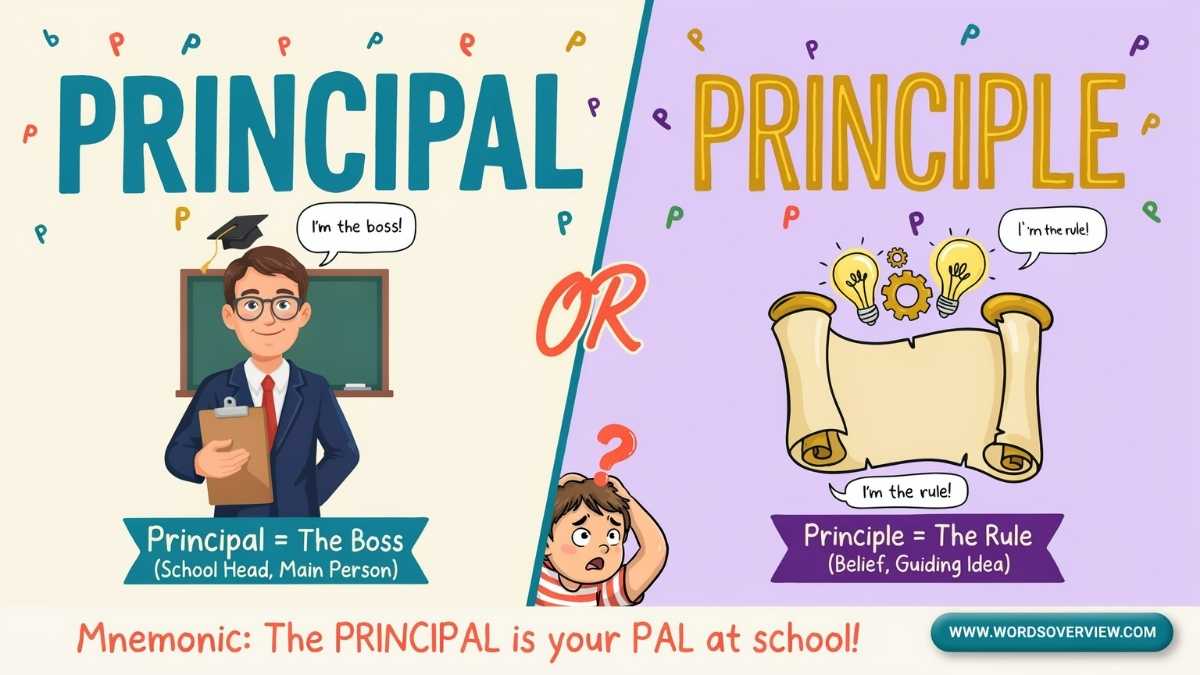
Have you ever written “school principle” when you meant “school principal”? Don’t worry! You’re not alone in this grammatical mix-up. The confusion between principal or principle catches plenty of writers off guard because these words sound alike but have different meanings. One can lead a school or refer to the main amount of a loan while the other describes a rule, belief or guiding standard. Mixing them up can turn a polished sentence into an embarrassing spelling slip. Fortunately, you don’t need a grammar degree to master the difference. Let’s explore their meanings, practical examples and easy memory tricks to help you choose the right word every time.
Principal or Principle: What’s the Difference?
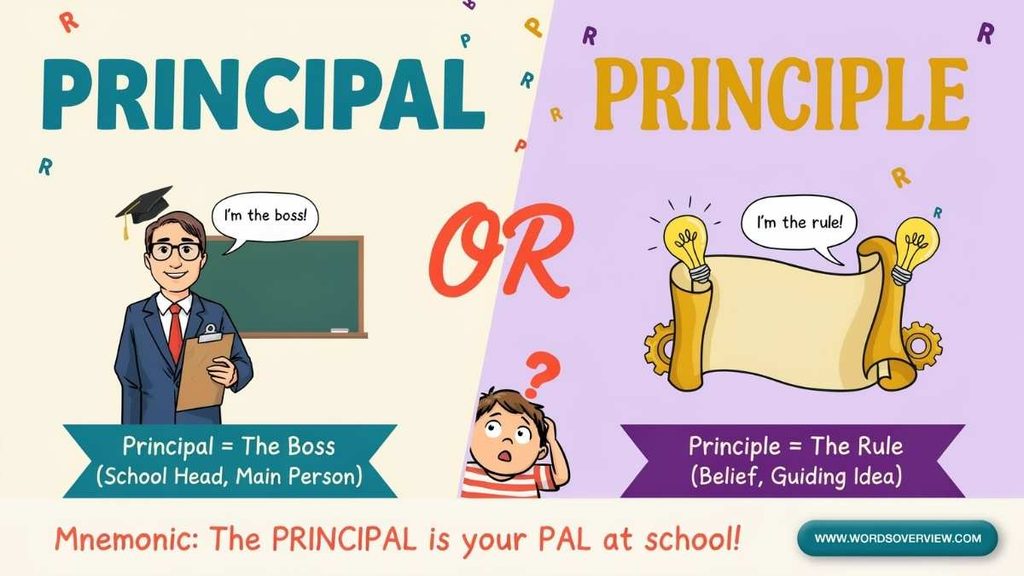
The main difference between principal and principle is that principal refers to a person in charge, something main or most important or the original amount of money borrowed or invested. Principle refers to a fundamental rule, belief, truth or standard that guides behavior or explains how something works.
Although the words sound alike, you can’t use them interchangeably.
Consider these examples:
- The school principal welcomed the new students. Here, principal refers to the person leading the school.
- Honesty is an important principle in education. In this sentence, principle refers to a moral standard.
- The principal reason for the delay was heavy traffic. Here, principal means the main reason.
- The borrower made an extra payment toward the loan principal. In this financial context, principal means the amount borrowed.
Principal or Principle Comparison Table
| Feature | Principal | Principle |
| Basic meaning | A person in charge, something primary or an original sum of money | A fundamental rule, belief or truth |
| Part of speech | Noun and adjective | Noun |
| Education example | The principal addressed the students. | The school promotes the principle of fairness. |
| Finance example | The principal balance decreased. | The investor follows sound investment principles. |
| Everyday example | Her principal concern was safety. | He refused to compromise his principles. |
| Plural form | Principals | Principles |
| Memory clue | The principal is your pal. | A principle is a rule you believe in. |
Quick rule: Use principal when you mean a person in charge, something primary or money borrowed. Choose principle when you mean a rule, belief or fundamental truth.
What Does Principal Mean?
The principal definition covers several related meanings. The word can identify a person with authority, describe something as the most important or refer to the original amount of money in a financial arrangement.
Context determines which meaning applies. Once you recognize how the word functions in a sentence, choosing the correct spelling becomes much easier.
Learn the difference between tricky English words with easy explanations
Holliday or Holiday: Which Spelling Is Correct?
Principal as a Noun
As a noun, principal often refers to a person who holds a leading position or plays a primary role in an activity. It also has a specific meaning in finance.
School leadership: A school principal leads an educational institution. The role typically involves supervising teachers and staff, supporting students, managing daily operations and maintaining educational standards.
Example: The principal met with parents to discuss the school’s attendance policy.
Business and legal roles: A principal can be a person or organization that authorizes an agent to act on its behalf. In other professional contexts, the term may refer to someone who holds a leading position or participates directly in a transaction.
Example: The agent obtained approval from the principal before signing the agreement.
Finance: Principal refers to the original amount borrowed or invested, excluding interest and investment earnings.
Example: She paid an additional $500 toward the principal on her loan.
Although these uses differ, they share an important idea: principal identifies a primary person, role or amount within a particular situation.
Principal as an Adjective
Can principal be an adjective? Yes. In this role, principal means main, primary or most important.
The word appears in business reports, contracts, academic writing and everyday conversations. You don’t need to associate it with a school to use it correctly.
Common expressions include:
- Principal reason: The main reason something happened.
- Principal objective: The primary goal of a project or plan.
- Principal concern: The most important issue requiring attention.
- Principal character: The leading character in a story or dramatic work.
- Principal bedroom: The main bedroom in a home, often the largest or one designated for the homeowner.
- Principal photography: The main phase of filming a movie or television production, when the production team records the planned scenes with the cast.
For example, consider this sentence: The principal objective of the campaign is to improve public safety.
Here, principal describes the importance of the objective. Replacing it with principle would be incorrect because the sentence refers to the main goal rather than a fundamental rule or belief.
Principal in Education
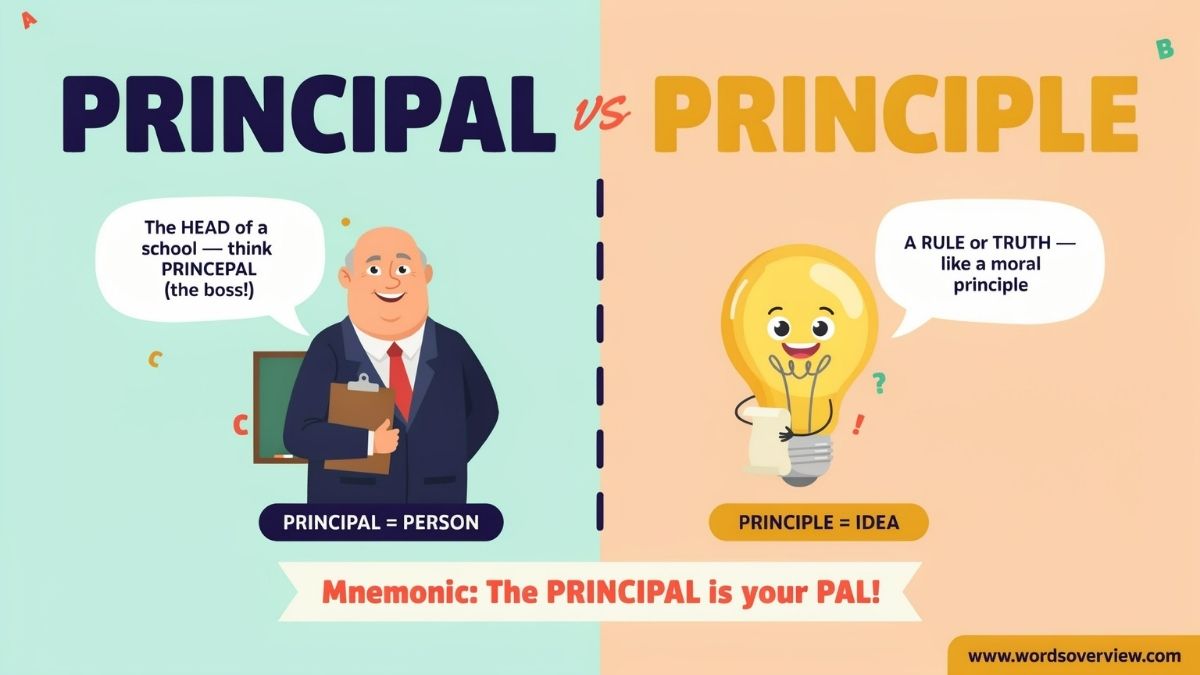
The school principal meaning is one of the easiest ways to understand this word.
A principal leads a school and coordinates its academic, administrative and operational activities. Depending on the school system, the principal may oversee staff evaluations, student discipline, educational planning, parent communication and compliance with school policies.
For example:
The principal introduced a new reading program to help students improve their literacy skills.
The word principal refers to the person in charge, so this spelling is correct. A school principle, by contrast, would refer to a rule or belief associated with the school rather than its leader.
Importantly, American and British English both use principal for a school leader. Neither variety treats principle as an alternative spelling for this meaning.
Principal in Business
The phrase principal of a company can refer to someone who holds a leading role, has an ownership interest or participates directly in the company’s affairs. However, the precise meaning depends on the professional or legal context.
For example:
The company’s principal negotiated the terms of the acquisition.
In this sentence, principal refers to a person with a leading role in the transaction.
The word can also describe a company’s main goal or concern:
The principal objective of the company is to expand its customer base.
Here, principal functions as an adjective meaning primary.
However, the phrase principles of a company has a different meaning. It refers to the rules, values and standards that guide business decisions. A company principal may establish or uphold those principles, but the words describe different things.
Learn the difference between more words people mix up
Cubical or Cubicle: Meaning, Differences and Spelling
What Does Principle Mean?
The principle definition focuses on rules, beliefs and fundamental ideas. A principle can establish a standard for behavior, explain how a system works or guide decisions when people face difficult choices.
In simple words, a principle is a basic rule, belief or idea that helps you decide how to act or understand how something works.
For example, a person might believe in the principle of honesty. A scientist might investigate a principle of physics. Similarly, a company might establish guiding principles for treating customers fairly.
In each case, principle identifies an idea or standard rather than a person or an amount of money.
Principle as a Moral Rule or Belief
Moral principles are standards that people use to evaluate actions and make ethical decisions. They often reflect beliefs about fairness, honesty, responsibility, respect and the treatment of others.
Common examples of moral principles include:
- Honesty: Tell the truth and avoid deliberately misleading people.
- Fairness: Treat people impartially and consider their circumstances.
- Integrity: Act consistently with your values, even when doing so feels difficult.
- Respect: Recognize other people’s dignity, rights and boundaries.
- Responsibility: Accept accountability for your decisions and actions.
Imagine that a student finds a wallet containing money in a classroom. The student could keep it or return it to its owner. If the student returns it because they believe taking something that belongs to another person is wrong, the decision reflects a moral principle.
For example:
She refused to take credit for her colleague’s work because it went against her principles.
The plural principles is correct because the sentence refers to the person’s ethical standards and beliefs.
Principle as a Fundamental Rule or Law
The word principle also describes a fundamental idea that explains how a system works. These principles appear in science, mathematics, engineering, economics and many other fields.
Scientific principles help researchers and students understand patterns, relationships and processes. However, not every principle represents a universal law. Some principles describe broad guidelines, while others explain well-established relationships within a particular field.
Examples include:
- Principle of conservation of energy: In an isolated system, energy remains constant, although it can change from one form to another.
- Archimedes’ principle: An object immersed in a fluid experiences an upward buoyant force equal to the weight of the fluid it displaces.
- Principle of supply and demand: Changes in supply and demand influence market prices, although real markets involve many other factors.
- Principles of mathematics: Foundational rules and relationships support mathematical reasoning and problem-solving.
For example, the engineer applied the principles of physics to improve the bridge design.
Here, principles refers to foundational scientific ideas. Writing principals of physics would change the intended meaning and make the sentence incorrect in this context.
Principle as a Guiding Standard
Organizations, teams and individuals often establish guiding principles to keep their decisions consistent with their goals and values.
For example, a business might follow principles of transparency and customer service. A research team might emphasize accuracy, reproducibility and ethical treatment of participants. Meanwhile, a family might teach children to show kindness and take responsibility for their actions.
These standards become especially useful when written rules don’t cover every possible situation. A guiding principle helps people evaluate their options and make consistent decisions.
Consider this example:
The manager followed the principle of equal treatment when assigning work to team members.
The sentence describes a standard that guided the manager’s decision. Therefore, principle is the correct word.
Learn the difference between similar English words
Conex or Connex: Meaning, Spelling and Correct Usage
Principal or Principle: Key Differences in Grammar and Usage
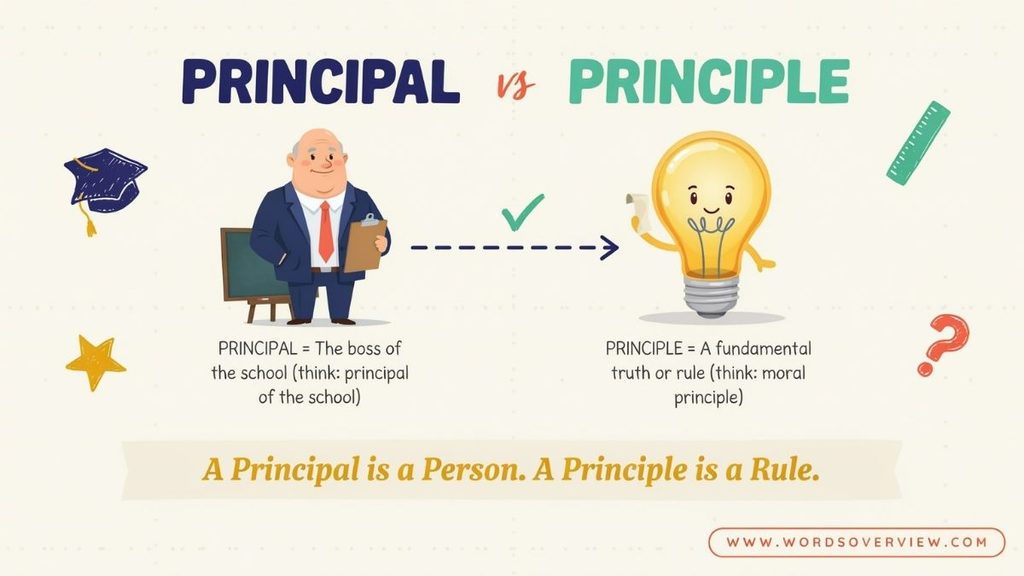
Understanding the principal and principle difference becomes easier when you examine their grammatical roles. Although both words appear in formal writing, they don’t perform the same function.
Principal as a Noun and an Adjective
Principal can function as either a noun or an adjective.
As a noun, it identifies a person or an amount:
- The principal announced the schedule change.
- The borrower paid down the principal.
As an adjective, it describes something as main or most important:
- Safety is our principal concern.
- Her principal responsibility is managing the team.
The surrounding words often reveal which meaning applies. If principal describes a concern, reason, objective or responsibility, it usually functions as an adjective. If it identifies a school leader or loan amount, it functions as a noun.
Principle as a Noun
Principle functions as a noun in standard contemporary English. It identifies a rule, belief, concept or fundamental truth.
Examples include:
- The principle of fairness influenced the decision.
- Scientists tested the principle under controlled conditions.
- She refused to compromise her principles.
- The organization published its guiding principles.
Is principle a noun or adjective? In standard usage, principle is a noun rather than an adjective. You can use it to identify a concept or standard, but you can’t substitute it for principal when you mean main or most important.
For instance, write the principal objective rather than the principle objective.
Principal or Principle Spelling
The principal and principle spelling difference is small but important.
- Principal ends in -pal.
- Principle ends in -ple.
Both words begin with the same six letters, which makes them easy to confuse when typing quickly. However, their final letters provide a useful visual clue.
| Correct expression | Meaning |
| School principal | The person leading a school |
| Moral principles | Ethical rules or beliefs |
| Principal reason | The main reason |
| Scientific principles | Foundational scientific ideas |
| Loan principal | The original amount borrowed |
| Guiding principles | Standards that guide decisions |
Neither word is simply a British or American spelling variant of the other. The intended meaning determines the correct spelling.
Learn the difference between tricky grammar words
Encode or Incode: Which Is Correct?
Principal and Principle Pronunciation
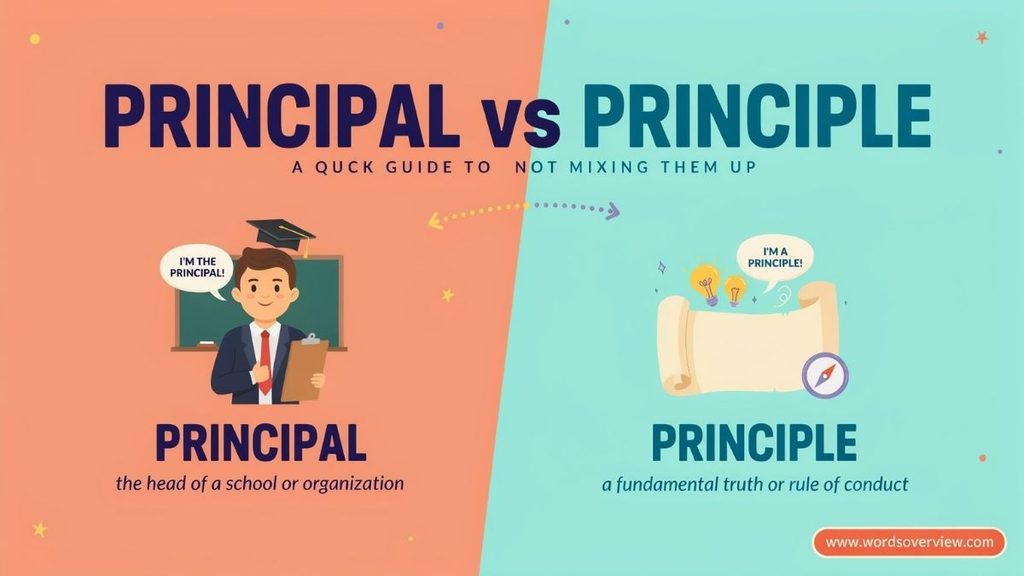
Are principal and principle homophones? Yes. In standard American English, they have the same pronunciation, so they qualify as homophones: words with identical pronunciation but different meanings and spellings.
Both generally have three syllables and the same stress pattern. As a result, their pronunciation won’t help you distinguish them in spoken English.
For example, if someone says a sentence containing principal, the listener may need context to determine whether the speaker means a school leader, a primary concern or a financial amount. In writing, however, the final letters make the distinction visible.
Because pronunciation can’t resolve the spelling difference, focus on meaning and grammar when choosing the correct word.
Principal or Principle Examples in Sentences
The easiest way to master principal vs principle usage is to compare complete sentences. Each example below shows how context determines the correct word.
Principal or Principle in Everyday English
| Sentence | Correct word | Explanation |
| The principal greeted the students. | Principal | Refers to a person in charge of a school |
| Kindness is one of her core principles. | Principles | Refers to moral beliefs or standards |
| The principal reason for the cancellation was bad weather. | Principal | Means the main reason |
| He refused to lie on principle. | Principle | Refers to a personal moral standard |
| The principal objective is to reduce costs. | Principal | Means the primary goal |
| The team agreed on three guiding principles. | Principles | Refers to rules that guide decisions |
Notice how principal often identifies a person, an amount or something that ranks first in importance. In contrast, principle usually identifies a rule, belief or underlying idea.
These distinctions aren’t a substitute for understanding grammar, but they offer a practical way to choose the correct word in everyday writing.
Principal or Principle in Professional Writing
Professional communication frequently uses both words, especially in education, finance, management and policy.
Education: The principal explained the school’s guiding principles to the teachers.
The first word identifies the school leader. The second identifies the standards that guide the school community.
Business: The principal concern during the merger was protecting customer data.
Here, principal means the most important concern.
Ethics: The company adopted principles of transparency and accountability.
In this sentence, principles refers to the standards the company intends to follow.
Finance: The borrower made an extra payment to reduce the principal balance.
The sentence refers to the amount of the loan that remains unpaid, not a rule or belief.
These examples demonstrate why the correct word in context matters more than memorizing a single definition.
Principal or Principle in Common Expressions
Several established expressions make the distinction easier to recognize.
In principle means in theory or according to a general idea, even if practical details remain unresolved.
Example: The committee agreed in principle to the proposal.
On principle means because of a belief or moral standard.
Example: He refused the offer on principle.
Principal reason means the main reason for an event or decision.
Example: The principal reason for the delay was a technical problem.
Principal character means the leading character in a story or dramatic work.
Example: The principal character faces a difficult choice.
Principal bedroom means the main bedroom in a home. The term often refers to the bedroom designated for the homeowner or the largest bedroom.
Example: The house includes a principal bedroom with an attached bathroom.
Principal photography refers to the main phase of filming in a movie or television production.
Example: Principal photography began in early spring.
The phrases principal or principle character, principal or principle bedroom and principal or principle photography sometimes appear in searches because readers aren’t sure which spelling fits. In standard usage, principal is correct in all three expressions because it means main or primary.
Principal or Principle in Finance: Money Meaning Explained
Financial writing is one of the most important contexts for understanding the principal vs principle money meaning. The words may appear in the same discussion, but they describe different things.
Principal refers to the original amount borrowed or invested. Principles refers to the rules or ideas that guide financial decisions.
What Does Principal Mean in Finance?
When you borrow money, the principal is the amount you borrow before interest and other applicable charges.
Suppose you take out a loan of $10,000. At the beginning of the loan, the principal is $10,000. As you repay the loan, the outstanding principal balance generally decreases, although the exact timing depends on the loan’s terms and payment structure.
Similarly, if you invest $2,000, that amount is your initial principal. Investment returns or losses affect the investment’s value, but they don’t change the amount you originally contributed.
Loan Principal or Interest
Principal and interest represent different parts of a loan payment.
- Principal payment: The portion that reduces the amount you owe.
- Interest payment: The amount the lender charges for borrowing money.
- Principal balance: The amount of principal that remains unpaid.
Consider a simplified example. You borrow $10,000 and make a payment of $300. Assume $80 of the payment covers interest and there are no additional fees.
| Item | Amount |
| Original loan principal | $10,000 |
| Total payment | $300 |
| Interest portion | $80 |
| Principal portion | $220 |
| Remaining principal balance | $9,780 |
The calculation is straightforward:
$300 payment − $80 interest = $220 principal repayment
The remaining principal is $9,780 because the $220 principal payment reduces the original balance of $10,000.
This example illustrates how a loan payment works. Actual payments depend on the interest rate, repayment schedule, fees and loan terms.
Learn the difference between commonly confused words in English
Seal or Seel: Which Is Correct?
What Are Financial Principles?
Financial principles are general rules or practices that guide money management. They can help you make thoughtful decisions about saving, spending, borrowing and investing.
Common examples include:
- Spend less than you earn: Maintaining a gap between income and expenses can help you save.
- Build an emergency fund: Setting money aside can reduce the need to borrow when unexpected expenses arise.
- Understand borrowing costs: Compare interest rates, fees and repayment terms before taking out a loan.
- Diversify investments: Spreading investments across different assets can reduce exposure to a single investment, although it doesn’t eliminate risk.
- Consider your time horizon: Money you need soon generally calls for a different approach from money you invest for a distant goal.
These are financial principles, not financial principals. They describe ideas that guide decisions rather than a person or a sum of money.
Principal or Principle: Common Mistakes to Avoid
Even experienced writers can confuse these words because spell-checkers may accept both spellings. The solution is to identify the intended meaning before choosing one.
Writing “School Principle” Instead of “School Principal”
Incorrect: The school principle announced the exam schedule.
Correct: The school principal announced the exam schedule.
The sentence refers to the person leading the school, so principal is correct.
Writing “Moral Principals” Instead of “Moral Principles”
Incorrect: Honesty and fairness are important moral principals.
Correct: Honesty and fairness are important moral principles.
The sentence describes ethical standards, so principles is correct.
Writing “Principle Reason” Instead of “Principal Reason”
Incorrect: The principle reason for the change was cost.
Correct: The principal reason for the change was cost.
Here, principal means main or most important.
Writing “Loan Principle” Instead of “Loan Principal”
Incorrect: The borrower made an extra payment toward the loan principle.
Correct: The borrower made an extra payment toward the loan principal.
A loan has a principal balance. As the borrower repays the principal, the outstanding balance generally decreases.
Assuming the Words Are Interchangeable
Incorrect: The company’s principal are honesty and transparency.
Correct: The company’s principles are honesty and transparency.
The intended meaning determines the spelling. A principal is a person or something primary, while principles are rules or standards.
How to Remember Principal or Principle
You don’t need to memorize every definition separately. Instead, use a couple of simple memory tricks to remember how to use principal and principle correctly.
The Principal Is Your Pal
The familiar mnemonic “The principal is your pal” helps you remember the spelling of the person who leads a school.
The word pal appears at the end of principal in the same letter order. When you picture a friendly school principal, the spelling may come to mind more easily.
However, remember that this mnemonic helps with spelling rather than defining every use of principal. The word also means main or primary and refers to the original amount of money borrowed or invested.
Principle Means a Rule
Think of a principle as a rule you believe in or use to guide your actions.
For example:
- Honesty is a moral principle.
- Fairness is an ethical principle.
- Conservation of energy is a scientific principle.
The word principle ends in -ple. You can connect its spelling with the idea of a rule or belief that people apply to different situations.
Learn the difference between similar English words the easy way
Stairwell or Staircase: Meaning, Differences and usage
A Simple Decision Test
When you’re unsure which word to use, ask yourself what the sentence describes.
| If you mean… | Choose… | Example |
| A school leader | Principal | The principal met with parents. |
| The main reason | Principal | Cost was the principal concern. |
| The original amount borrowed | Principal | The principal balance fell. |
| A moral rule | Principle | She acted on principle. |
| A fundamental scientific idea | Principle | The experiment demonstrated a scientific principle. |
If the sentence refers to a person, something primary or money borrowed, principal is usually correct. If it refers to a rule, belief or fundamental truth, choose principle.
Practice Session
- The school ______ welcomed the new students.
- Honesty is an important ______ in life.
- She paid extra money toward her loan ______.
- We agreed in ______ with the proposed changes.
- The company follows a strict ethical ______.
- Who is the ______ of your school?
- The original loan amount is called the ______.
- Fairness is a guiding ______ for good leaders.
- The ______ reason for leaving was exhaustion.
- He believes in the ______ of equal treatment.
- Is your school ______ attending the meeting?
- She reduced her loan ______ with extra payments.
- The ______ character appears throughout the novel.
- Scientists study the basic ______ of physics.
- The correct phrase is “in ______.”
- A school leader is called a ______.
- A personal belief can be called a ______.
- The ______ bedroom is located upstairs.
- The bank calculates interest on the outstanding ______.
- Good managers apply every important business ______.
- The word ______ can describe something most important.
- Never confuse moral principles with school ______.
- He refused the offer on ______ of fairness.
- The ______ of the investment was $5,000.
- Remember: the principal is your ______.
Answer Key
- principal
- principle
- principal
- principle
- principle
- principal
- principal
- principle
- principal
- principle
- principal
- principal
- principal
- principles
- principle
- principal
- principle
- principal
- principal
- principle
- principal
- principals
- principle
- principal
- pal
Frequently Asked Questions
What Is the Difference Between Principal and Principle?
Principal refers to a person in charge, something of primary importance or the original amount of money borrowed or invested. Principle refers to a rule, belief or fundamental truth that guides behavior or explains how something works. For example, “The school principal values honesty” identifies a school leader while “Honesty is an important principle” describes a guiding belief.
Is It Principal or Principle When Talking About Money?
Principal is the correct word when discussing money borrowed or invested. It refers to the original amount of a loan or investment, excluding interest. For example, if you borrow $10,000, that amount is your loan principal. Principle is incorrect in this financial context because it refers to a rule, belief or fundamental truth rather than a sum of money.
What Does Principal Mean in Simple Words?
Principal means the person in charge, the main or most important thing or the original amount of money borrowed or invested. For example, a school principal manages a school while the principal of a loan is the amount borrowed before interest. The exact meaning depends on the context, but principal often refers to leadership, importance or money.
What Does Principle Mean in Simple Words?
Principle means a rule, belief or basic truth that guides how people behave or how something works. For example, fairness is an important principle in a workplace. Scientific principles explain how natural processes operate while personal principles guide decisions. Unlike principal, this word never refers to a school leader or the original amount of a loan.
Is It School Principal or School Principle?
School principal is correct because principal refers to the person who leads a school. For example, “The school principal welcomed the new students.” Writing “school principle” is a common spelling mistake because principle means a rule or belief. You can remember the correct spelling with the phrase “The principal is your pal.”
Is It Correct to Say “I Agree in Principle” or “I Agree in Principal”?
“I agree in principle” is correct. This expression means you support an idea or proposal in general, although you may not agree with every detail. For example, “I agree in principle with the new policy, but I want to review its costs.” The phrase uses principle because it refers to a general idea or guiding concept rather than a person or financial amount.
What Does “It’s the Principle” Mean?
“It’s the principle” means that a decision matters because of a belief, value or sense of fairness rather than simply because of the outcome or amount of money involved. For example, someone might return an incorrect refund because keeping money they did not earn would violate their principles. The expression emphasizes what a person believes is right.
What Are Some Examples of Principal and Principle in Sentences?
Here are examples that show how each word works in everyday writing. “The principal announced the school’s new schedule” uses principal for a school leader. “Honesty is a principle I follow” uses principle for a personal belief. “She paid an extra $500 toward her loan principal” uses principal for borrowed money. These examples show why context matters when choosing between the two words.
What Happens If You Pay Extra Money Toward Your Loan Principal?
Paying extra toward your loan principal can reduce the outstanding balance and may lower the total interest you pay over time. The exact savings depend on your interest rate, loan terms and how your lender applies the payment. Check whether your lender requires instructions to apply extra payments to principal and whether any prepayment penalties apply. An extra $500 payment does not automatically reduce your monthly payment unless your lender recalculates it.
How Can You Remember the Difference Between Principal and Principle?
Use two simple memory tricks: “The principal is your pal” helps you remember the school leader, while principle means a rule helps you recall its meaning as a belief or standard. For money, remember that principal is the original amount borrowed or invested. When you write a sentence, ask yourself whether you mean a person, an amount of money or a guiding rule. That quick check can prevent most common mistakes.
Conclusion
Confusing principal or principle doesn’t have to be your principal grammar problem! Remember that a principal can lead a school or represent the original amount of a loan while a principle is a rule, belief or guiding standard. If you’re unsure which word fits your sentence, use the memory trick “The principal is your pal” to recall the school leader. For rules and beliefs, choose principle. With a little practice, you’ll avoid common spelling mistakes and write with greater confidence. After all, good grammar follows sound principles and your writing deserves a principal place on the honor roll.

Ethan AJS is an experienced blogger and language enthusiast at Words Overview, dedicated to making English easier to understand and use. He writes about grammar, vocabulary, spelling, word meanings and commonly confused words, turning tricky language questions into clear, practical insights. With a passion for effective communication, Ethan creates engaging, readerfocused content that helps readers write accurately, choose the right words and communicate with confidence.