
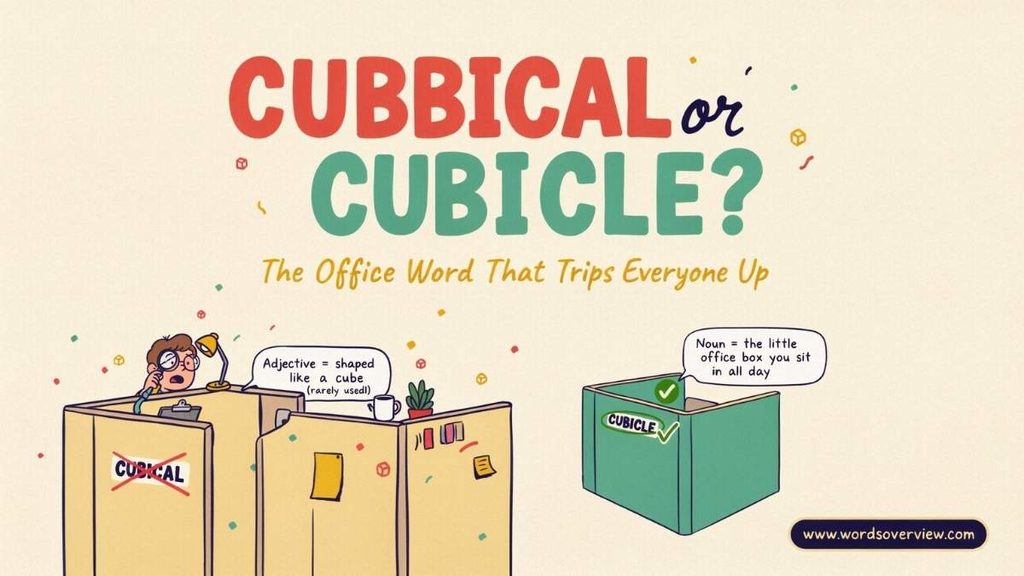
Have you ever looked at a tiny office workspace and wondered whether it’s a cubical vs cubicle situation? You’re not alone! These two words look almost identical and sound so similar that even confident English writers can mix them up. However, using the wrong one can turn a simple sentence into a spelling puzzle. A cubical describes something shaped like a cube while a cubicle refers to a small enclosed space such as an office workstation. Think of it this way: one describes the shape and the other describes the space. Let’s explore their meanings, spelling differences and examples so you can use both correctly.
Cubical or Cubicle: What’s the Difference?
The difference between cubical and cubicle comes down to what each word communicates. One describes a shape, while the other names a physical space.
Cubical is an adjective that describes something shaped like a cube or resembling one. For example, a cubical box has a cube-like form.
Cubicle is a noun that identifies a small space separated from a larger area by partitions or walls. Office workstations, changing compartments and certain bathroom spaces are common examples.
Here’s a quick comparison of their meanings and uses.
| Feature | Cubical | Cubicle |
| Part of speech | Adjective | Noun |
| Main meaning | Cube-shaped or cube-like | A small partitioned space |
| Purpose | Describes shape | Names a space |
| Common contexts | Geometry, architecture, design and object descriptions | Offices, bathrooms, changing rooms and study areas |
| Example | The sculpture has a cubical shape. | She works in a quiet office cubicle. |
| Related expression | Cube-shaped | Partitioned workspace |
| Plural form | Usually unchanged as an adjective | Cubicles |
The Core Rule: Shape or Space
Remember this simple distinction:
- Cubical describes what something looks like.
- Cubicle identifies a small partitioned space.
For example, imagine an office with several workstations. Each workstation has a desk and partition walls. You would call each separate workspace a cubicle, even if its overall layout resembles a cube.
Now imagine a cube-shaped decorative object sitting on one of those desks. You could describe that object as cubical.
The words refer to different characteristics, so the correct choice depends on your intended meaning.
What Does Cubical Mean?
The cubical definition is straightforward: cubical is an adjective meaning cube-shaped or resembling a cube. It describes the form of an object, structure or space rather than naming a separate area.
A geometric cube has six equal square faces, twelve equal edges and eight vertices. In everyday English, however, people may use cubical more loosely to describe something with a generally cube-like appearance.
For instance, a decorative storage box might look cubical even if its dimensions don’t match perfectly. In technical writing, precise measurements provide a clearer description when geometric accuracy matters.
Cubical as an Adjective
The phrase cubical is an adjective means that the word describes a noun or gives information about its characteristics. You can place it before a noun or use it after a linking verb such as is, looks or appears.
Consider these examples:
- The architect designed a cubical building.
- The storage container has a cubical shape.
- The sculpture looks cubical from every angle.
- The designer selected a cubical display stand.
- The small room has an almost cubical form.
In each sentence, cubical describes a shape or appearance. It doesn’t name a separate workspace.
Cubical Meaning in Geometry and Design
In geometry, cubical describes something shaped like a cube. A cube is a three-dimensional geometric figure with equal length, width and height.
For a perfect cube, you calculate its volume by raising the length of one edge to the third power:
[ V=s^3 ]
Here, (V) represents volume and (s) represents the length of one edge.
For example, a cube with edges measuring 3 feet has a volume of 27 cubic feet. This mathematical relationship helps explain why cubical appears in discussions of geometry, product design and three-dimensional structures.
In everyday design language, the word can describe a block-like piece of furniture, a geometric sculpture or a storage unit. However, technical descriptions should include actual measurements whenever precision matters.
Learn the difference between similar English words
Conex or Connex: Meaning, Spelling and Correct Usage
Cubical Definition and Examples
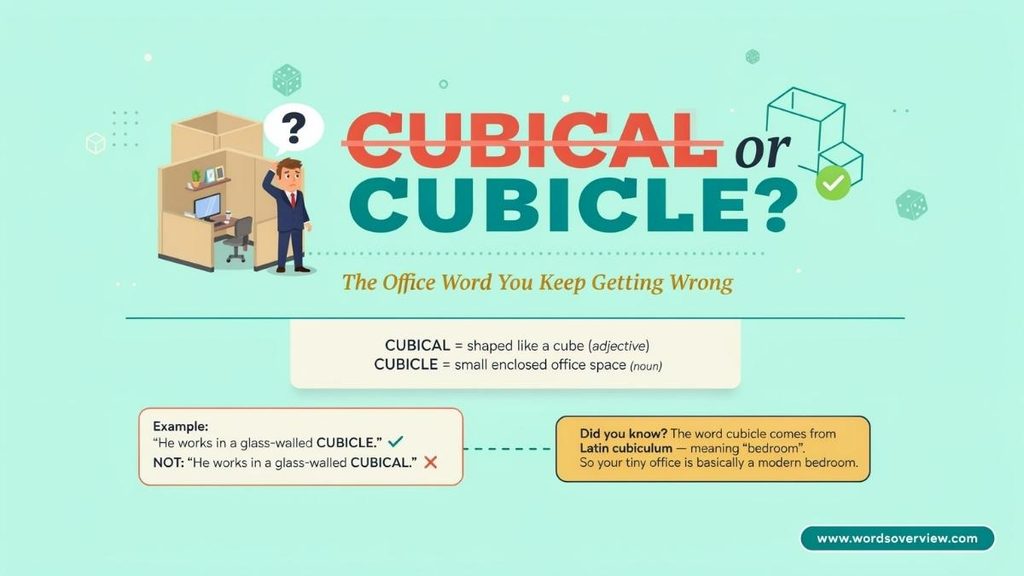
These cubical adjective examples show how the word works in different contexts.
| Example sentence | Why cubical is correct |
| The artist created a cubical sculpture. | It describes the sculpture’s shape. |
| The box has a cubical form. | It describes the box’s appearance. |
| The architect proposed a cubical structure. | It describes the building’s general form. |
| The toy consists of several cubical blocks. | It describes the blocks. |
| The container looks nearly cubical. | It describes the container’s shape. |
Notice that cubical doesn’t have to appear directly before a noun. You can also use it after a linking verb or with modifiers such as nearly, almost and perfectly.
Cubical Synonyms and Related Words
Several words express ideas similar to cubical, but their meanings aren’t always identical.
- Cube-shaped: A clear, everyday expression for something shaped like a cube.
- Cube-like: Something that resembles a cube without necessarily matching its exact geometry.
- Cubic: A word used for cube-related forms and mathematical concepts involving the third power.
- Geometric: A broader term associated with shapes, dimensions and geometry.
For general readers, cube-shaped is often the clearest alternative. In technical writing, choose the term that best matches the intended mathematical or physical meaning.
What Does Cubicle Mean?
The cubicle definition describes a small space separated from a larger area by partitions or walls. Unlike cubical, the word identifies a place or compartment rather than describing a shape.
A cubicle doesn’t have to form a perfect cube. In fact, many office cubicles have rectangular layouts and open fronts. Their defining feature is the separate, partitioned area they create.
You may encounter the word in offices, public restrooms, changing rooms, libraries and specialized technical environments. However, its precise meaning depends on the setting.
Learn the difference between confusing English words step by step
Steel or Steal: Meaning, Difference and Examples
Cubicle Meaning in an Office
An office cubicle is a workstation separated from nearby work areas by partial walls or partitions. It usually includes a desk or work surface and may contain storage, shelves, a computer and other workplace furniture.
Organizations use cubicle systems to divide larger rooms into individual work areas without building permanent offices for every employee.
For example, a company might arrange twenty cubicles across an open-plan floor. Each employee gets a defined workspace while remaining part of the shared office environment.
Common features of an office cubicle include:
- Work surface: A desk or platform for a computer, documents and other equipment.
- Partitions: Panels that mark the boundaries between workstations.
- Storage: Drawers, shelves or cabinets for supplies.
- Electrical access: Outlets and cable-management features where the installation provides them.
- Privacy features: Panels that reduce some visual distractions without fully enclosing the workspace.
An office cubicle can provide a personal work area, but it doesn’t guarantee complete privacy or soundproofing.
Other Types of Cubicles
Although many people associate cubicles with offices, the word has several other uses.
Bathroom cubicles: A toilet cubicle is a small compartment separated by partitions and a door. In American English, bathroom stall is often the more familiar term.
Changing cubicles: Retail stores and gyms may provide small enclosed areas where people can change clothes. Depending on their design and location, these spaces may also be called fitting rooms or changing rooms.
Library study cubicles: Some libraries provide individual study spaces with partitions to reduce visual distractions. Depending on the facility, these areas may also be called study carrels or study booths.
Electrical cubicles: In electrical engineering, a cubicle may refer to an enclosed compartment that houses electrical control equipment, switchgear or related components. The precise meaning depends on the equipment and industry.
These examples show why cubicle isn’t limited to office furniture. The shared idea is a distinct compartment or partitioned area.
Cubicle Noun Examples
The following cubicle definition and examples demonstrate how the word works in different settings.
| Example sentence | Context |
| She decorated her office cubicle with family photos. | Workplace |
| The new cubicle has a larger desk and better storage. | Office furniture |
| Please use the available toilet cubicle. | Public restroom |
| The store installed three changing cubicles. | Retail |
| Students used individual study cubicles. | Library |
| The technician inspected the electrical cubicle. | Engineering |
Each sentence uses cubicle as a noun because the word identifies a space or compartment.
Cubicle Synonyms and Related Words
Words such as booth, stall, compartment and workspace may overlap with cubicle, but each has a different emphasis.
- Booth: Often describes a small enclosed or partially enclosed area designed for a particular activity, such as a telephone booth.
- Stall: Commonly refers to an individual toilet compartment or a small divided space.
- Compartment: A separate section within a larger structure or area.
- Workspace: A broad term for any area where someone works.
- Study carrel: A desk or study area designed to provide some separation from nearby users.
Choose a synonym based on the actual structure and purpose. A cubicle may function as a booth or compartment, but those words aren’t universal substitutes.
Learn the difference between tricky English words with easy explanations
Holliday or Holiday: Which Spelling Is Correct?
Cubical or Cubicle: Spelling and Pronunciation
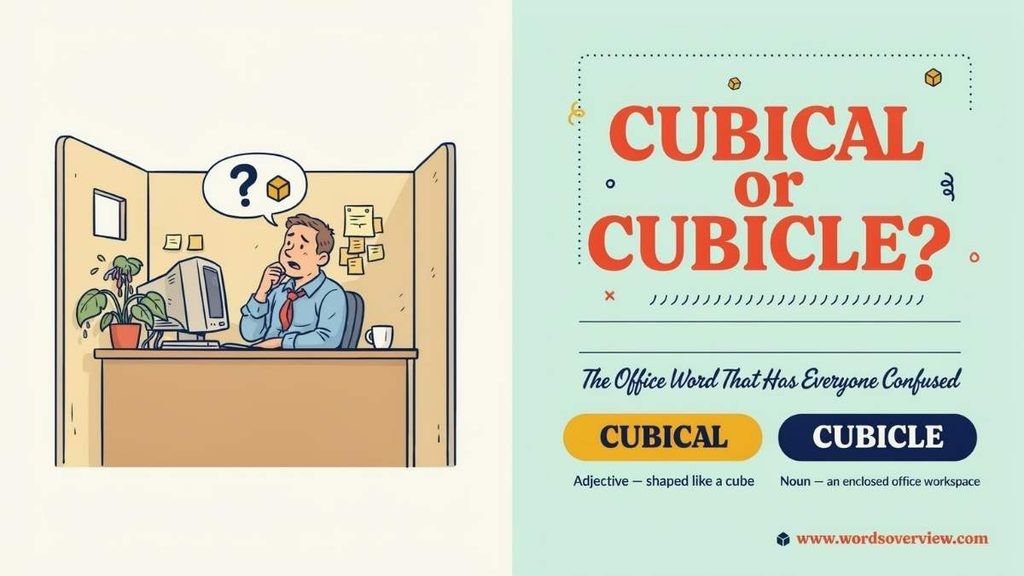
The cubical vs cubicle spelling difference involves more than one letter. Both are correctly spelled English words, but each has its own meaning and grammatical role.
Cubical ends in -cal, while cubicle ends in -cle. Neither spelling is a variant of the other when you use the words with their standard meanings.
Their pronunciation also differs slightly in some speakers’ speech, although the distinction can be subtle. In standard American English, both commonly begin with the same sound, /ˈkjuːbɪk-/, followed by a similar final syllable. The exact realization of the final vowel may vary by speaker and speaking style.
Because the words look and sound alike, context is especially useful. Even when pronunciation doesn’t clearly distinguish them, their grammatical roles usually do.
Why People Confuse Cubical and Cubicle
Several factors make these commonly confused words easy to mix up.
Similar spelling: Both words begin with cubi- and have similar lengths. A hurried writer may choose one without checking the ending.
Related meanings: Both words connect to the concept of a cube, although cubicle doesn’t require a cube-shaped structure.
Similar pronunciation: Their spoken forms sound close enough to cause confusion, particularly in fast conversation.
Spellcheck limitations: A spellchecker may accept both words because both are valid. It may not recognize that cubical is inappropriate in a sentence referring to an ordinary office workstation.
Context-dependent meaning: Writers may focus on the physical appearance of a workspace and mistakenly assume that cubical names the space itself.
The solution is to identify the role the word plays in the sentence rather than relying only on its spelling.
Cubical Pronunciation or Cubicle Pronunciation
The words have similar sounds, so pronunciation alone may not settle the question. Their spelling and meaning provide a more reliable guide.
- Use cubical when describing shape.
- Use cubicle when referring to a partitioned area.
- Read the complete sentence to determine the intended meaning.
This approach also works for many other commonly confused English words. Context often reveals distinctions that aren’t obvious from sound alone.
Learn the difference between commonly misused words
Mistery or Mystery: Spelling, Meaning and Examples
Cubical or Cubicle: Correct and Incorrect Examples
A side-by-side comparison makes the difference easier to remember. The issue isn’t whether a word exists. Instead, the question is whether it expresses the intended meaning.
| Incorrect or confusing sentence | Better sentence | Explanation |
| I work in a cubical. | I work in a cubicle. | An office workstation is a cubicle. |
| The box has a cubicle shape. | The box has a cubical shape. | The adjective describes the box’s form. |
| The company installed ten cubicals. | The company installed ten cubicles. | The plural noun is cubicles. |
| The artist made a cubicle sculpture. | The artist made a cubical sculpture. | The intended meaning concerns shape. |
| She decorated her cubical with plants. | She decorated her cubicle with plants. | The sentence refers to a workspace. |
| The designer created a cubicle block. | The designer created a cubical block. | The adjective describes the block’s shape. |
These corrections assume the intended meanings shown in the explanations. A sentence may be grammatically possible in another context, so consider the actual object or space before deciding whether a word is wrong.
How to Use Cubicle in a Sentence
Use cubicle when you need a noun that names a small partitioned area.
- The manager moved her desk to a quieter cubicle.
- Each cubicle has its own storage cabinet.
- The library added several study cubicles.
- The maintenance team repaired a damaged toilet cubicle.
- The technician checked the electrical cubicle before testing the equipment.
A useful test is to replace cubicle with partitioned space. If the sentence still expresses the intended idea, cubicle may be appropriate.
How to Use Cubical in a Sentence
Use cubical when you need an adjective that describes a cube-like shape.
- The architect designed a cubical pavilion.
- The package arrived in a cubical container.
- The sculpture has a simple cubical form.
- The designer arranged cubical blocks on the shelf.
- The building’s central section looks almost cubical.
Try replacing cubical with cube-shaped. If the sentence keeps its intended meaning, you’ve probably chosen the right word.
A Practical Case Study: Cubical or Cubicle at Work
Imagine a company redesigning its office. The facilities manager orders new desks and partitions to create separate workstations. During a meeting, one employee writes, “The company will install twelve cubicals next month.”
The intended meaning is clear, but the noun is incorrect for standard usage. The sentence should read, “The company will install twelve cubicles next month.”
Later, the design team describes a decorative structure planned for the reception area. One designer writes, “The entrance will feature a cubicle sculpture.” If the sculpture resembles a cube, cubical sculpture is the better expression.
The lesson is simple: choose the word based on what it identifies or describes, not on how similar the words look.
Cubicle Dimensions and Office Design: Does Shape Matter?
The words cubical and cubicle sometimes appear in discussions about workplace design, but they describe different things. A cubicle is a workspace, while cubical describes a shape. Understanding this distinction helps when discussing furniture, floor plans and office layouts.
Learn the difference between tricky grammar words
Encode or Incode: Which Is Correct?
What Are Standard Office Cubicle Dimensions?
Office cubicles don’t have one universal standard size. Their dimensions vary with available floor space, the type of work employees perform, furniture requirements, accessibility needs and the office’s overall design.
The following measurements illustrate common planning footprints rather than mandatory industry standards.
| Approximate footprint | Potential use |
| 5 × 5 feet | Compact workstation |
| 6 × 6 feet | Small individual workspace |
| 6 × 8 feet | Workstation with additional desk or storage space |
| 8 × 8 feet | Larger workstation with room for additional equipment |
Actual products vary by manufacturer and configuration. Before purchasing workplace furniture, check the product specifications and applicable building and accessibility requirements.
The shape of a cubicle also doesn’t determine its name. A rectangular workstation remains a cubicle even when its length and width differ considerably.
Cubicle or Open Office: What’s the Difference?
A cubicle creates a defined workspace using partitions. By contrast, an open-plan office generally provides shared work areas with fewer physical barriers.
Neither layout is automatically better for every organization. Cubicles can offer visual separation and help employees organize personal work areas. Open-plan layouts can make communication and collaboration easier, although they may expose employees to more noise and visual distractions.
The distinction matters when describing workplace design:
- Cubicle: A specific partitioned workstation.
- Open office: A broader layout with fewer enclosed work areas.
- Cubicle partition: A panel that separates workstations.
- Cubicle system: A collection of coordinated panels, desks and related components.
For example, a company might replace an open office layout with cubicles to create more defined work areas. However, those workstations don’t need to be cubical in shape.
Learn the difference between tricky words and use them correctly
Encorporate or Incorporate: Which Spelling Is Correct?
Common Mistakes When Using Cubical and Cubicle
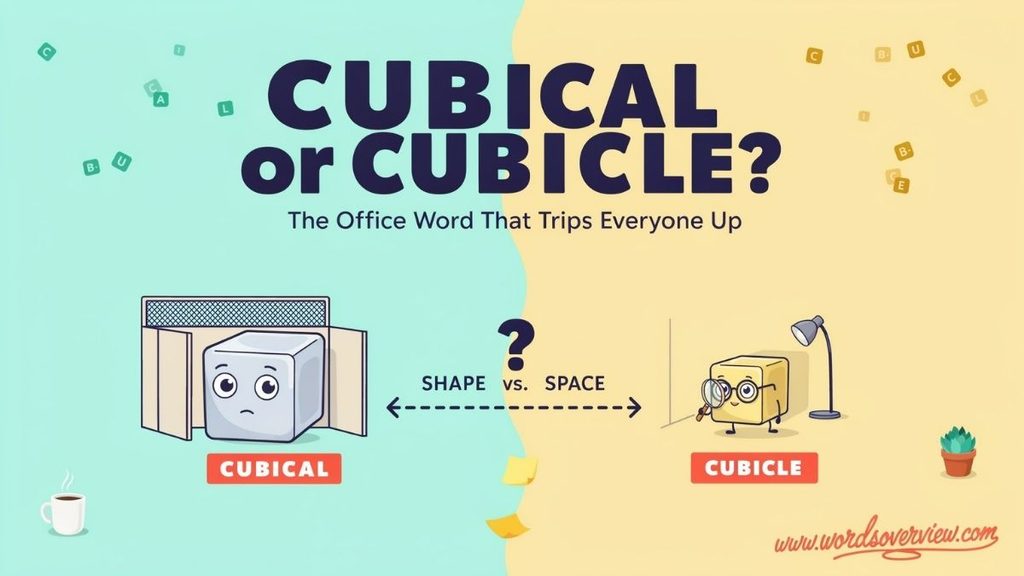
Even experienced writers can mix up these words because the difference is easy to overlook. Understanding the following mistakes will help you avoid confusion in everyday writing.
Using Cubical for an Office Workspace
The sentence “I spent the afternoon in my cubical” usually uses the wrong word if the writer means an office workstation.
Write “I spent the afternoon in my cubicle” instead. The noun cubicle identifies the workspace.
Using Cubicle to Describe a Shape
A cube-shaped object doesn’t become a cubicle simply because it resembles a small box.
For example, “The artist made a cubicle ornament” doesn’t clearly describe the ornament’s shape. If the intended meaning is that the ornament resembles a cube, use “cubical ornament” or the simpler “cube-shaped ornament.”
Assuming One Word Is a Misspelling
Neither cubical nor cubicle is inherently incorrect. Treating them as alternative spellings can lead to errors because they have different meanings.
The correct spelling of cubicle is cubicle when you mean a partitioned space. The correct spelling of cubical remains unchanged when you use it to describe a cube-like form.
Writing Cubicals Instead of Cubicles
The plural of cubicle is cubicles. The word cubical generally remains unchanged when it functions as an adjective.
Compare these examples:
- Correct: The office has six cubicles.
- Correct: The artist arranged several cubical blocks.
- Incorrect for office workstations: The office has six cubicals.
Ignoring the Part of Speech
Grammar provides one of the easiest ways to distinguish these words. A noun names a person, place, thing or concept. An adjective describes a noun or gives information about it.
In this comparison, cubicle names a space, while cubical describes a shape. Checking the word’s grammatical role can prevent errors even when spellcheck doesn’t flag them.
Learn the difference between commonly confused words in English
Kinesthesiology or Kinesiology: Differences and Usage
How to Choose Between Cubical and Cubicle
When you’re unsure whether to write cubical or cubicle, don’t focus on the similar spelling. Instead, start with the meaning you want to express.
Use this quick decision guide:
- Are you naming a small partitioned space? Use cubicle.
- Are you describing something shaped like a cube? Use cubical.
- Are you describing an office workstation? Use office cubicle.
- Are you describing a geometric object? Use cubical, cubic or cube-shaped, depending on the context.
For instance, “The office cubicle has a cubical storage unit” uses both words correctly. The first identifies the workspace, while the second describes the storage unit’s shape.
You can also use a substitution test. Replace cubicle with partitioned workspace and cubical with cube-shaped. If the replacement preserves your intended meaning, you’ve probably selected the right word.
Practice Session
1. The employee decorated her office ______ with family photos and a small plant.
2. The architect designed a ______ storage box with six equal square faces.
3. In English grammar, the word ______ describes something shaped like a cube.
4. A small enclosed workspace separated by partitions is called a ______.
5. The designer chose a ______ container to match the geometric theme of the room.
6. The restroom has a separate ______ for each visitor to provide privacy.
7. When describing an office workspace, the correct word is ______ rather than cubical.
8. The math teacher used a cube-shaped object to explain the meaning of ______.
9. Each employee had a personal ______ with a desk and a computer.
10. The carpenter built a ______ wooden box with equal dimensions on every side.
11. A library may provide a quiet study ______ for students who need privacy.
12. The word cubicle functions as a ______ in a sentence because it names a place or space.
13. The word cubical functions as an ______ because it describes the shape of an object.
14. The office manager rearranged the ______ to create more room for employees.
15. A box with six square faces of equal size has a ______ shape.
16. The company installed partitions to create an individual workspace for each employee, also known as an office ______.
17. The word cubicle originated from the Latin word cubiculum, which referred to a small room or ______ chamber.
18. A small compartment in a public bathroom is commonly called a toilet ______.
19. The phrase “a cube-shaped container” can describe the same general shape as “a ______ container.”
20. If you want to describe an object’s shape rather than name a workspace, use the word ______.
21. The office worker moved her files and computer into a new ______ after changing departments.
22. The terms cubical and cubicle are commonly confused because their spellings look ______.
23. A cube has six square faces of ______ size.
24. In the sentence “The cubical container fits on the shelf,” the word cubical describes the container’s ______.
25. To avoid a grammar mistake, remember that cubical describes a shape while cubicle names an enclosed ______.
Answer Key
- cubicle
- cubical
- cubical
- cubicle
- cubical
- cubicle
- cubicle
- cubical
- cubicle
- cubical
- cubicle
- noun
- adjective
- cubicles
- cubical
- cubicle
- sleeping
- cubicle
- cubical
- cubical
- cubicle
- similar
- equal
- shape
- space
Frequently Asked Questions
What is a cubicle?
A cubicle is a small enclosed or partitioned space designed for a specific purpose. In offices, cubicles provide employees with individual work areas separated by walls or panels. You can also find cubicles in bathrooms, libraries and changing rooms. For example, an office cubicle usually contains a desk, a chair and space for a computer.
What does “cubical” mean?
Cubical is an adjective that describes something shaped like a cube. A cube has six square faces of equal size. For example, you might describe a small storage container as cubical if it has a cube-like shape. Unlike cubicle, which names a space, cubical describes an object’s shape or appearance.
Is it cubicle or cubical?
Both cubicle and cubical are correct English words, but they have different meanings. Use cubicle when referring to an enclosed workspace or compartment. Use cubical when describing something with a cube-like shape. For example, “I work in an office cubicle” is correct, while “The box has a cubical shape” describes its geometry.
Why is a cubicle called a cubicle?
The word cubicle comes from the Latin word cubiculum, meaning a small room or sleeping chamber. English adopted the term to describe a small enclosed space. Modern office cubicles use partitions to create individual work areas within larger rooms. Despite the similar spelling, the word cubicle does not specifically mean a cube-shaped space.
What is another name for a cubicle?
Common alternatives to cubicle include workstation, office partition, work booth and enclosed workspace. The best choice depends on the context. For example, workstation often describes an employee’s desk area, while booth can refer to a small enclosed space. These terms aren’t always interchangeable because each can describe a slightly different type of space.
Does cubicle mean toilet?
Yes, cubicle can refer to a toilet compartment, especially in public restrooms. A toilet cubicle is a private space separated from neighboring compartments by partitions and a door. In the workplace, however, cubicle usually means an individual office workspace. The surrounding context tells you which meaning the writer intends.
What are the different types of cubicles?
Common types of cubicles include office cubicles, toilet cubicles, library study cubicles, changing cubicles and telephone booths. Office cubicles provide individual work areas, while study cubicles offer a quieter place to concentrate. Toilet and changing cubicles provide privacy. Although these spaces serve different purposes, they share the basic idea of a small, defined area.
What is a cubical box?
A cubical box is a box with a cube-like shape, usually featuring six square faces of equal size. For example, a box measuring 10 inches on each side has a cubical shape. In everyday English, cube-shaped box often sounds more natural. Remember that cubical describes the box’s shape, while cubicle refers to a small enclosed space.
What is another word for cubical?
Words and phrases similar to cubical include cube-shaped, cubic and cube-like. However, their meanings and grammatical uses can differ slightly. For example, “a cubical container” and “a cube-shaped container” both describe an object resembling a cube. Use cubical as an adjective rather than as a noun naming a workspace.
How do you use cubical and cubicle in a sentence?
Use cubical to describe a shape and cubicle to name a space. For example, “The designer created a cubical storage unit” describes the unit’s shape. In contrast, “She decorated her office cubicle” identifies her workspace. Remember the simple rule: cubical describes what something looks like, while cubicle names a small enclosed area.
Conclusion
Understanding cubical or cubicle is easier than it looks. A cubical describes something shaped like a cube while a cubicle refers to a small enclosed space such as an office workstation or bathroom stall. Confusing them won’t make your office disappear, but it might leave your sentence looking a little awkward! Remember this simple rule: cubical describes a shape and cubicle names a space. Once you understand the difference between cubical and cubicle, you’ll choose the correct word with confidence. So next time you describe your workspace, make sure you use cubicle unless you’re talking about its cube-like shape.

Ethan AJS is an experienced blogger and language enthusiast at Words Overview, dedicated to making English easier to understand and use. He writes about grammar, vocabulary, spelling, word meanings and commonly confused words, turning tricky language questions into clear, practical insights. With a passion for effective communication, Ethan creates engaging, readerfocused content that helps readers write accurately, choose the right words and communicate with confidence.




