

Have you ever stared at programme or program and wondered whether one of them had made a spelling mistake? You’re not alone! These two spellings often confuse students, writers and even experienced professionals. The tricky part is that both are correct, depending on where you live and what you mean. In American English, program works for almost everything. However, British English usually prefers programme for organized events, educational courses and television shows while keeping program for computer software. Choose the wrong spelling for your audience and your writing might look like it missed its geography lesson. Let’s clear up the confusion!
What Is the Difference Between Programme and Program?
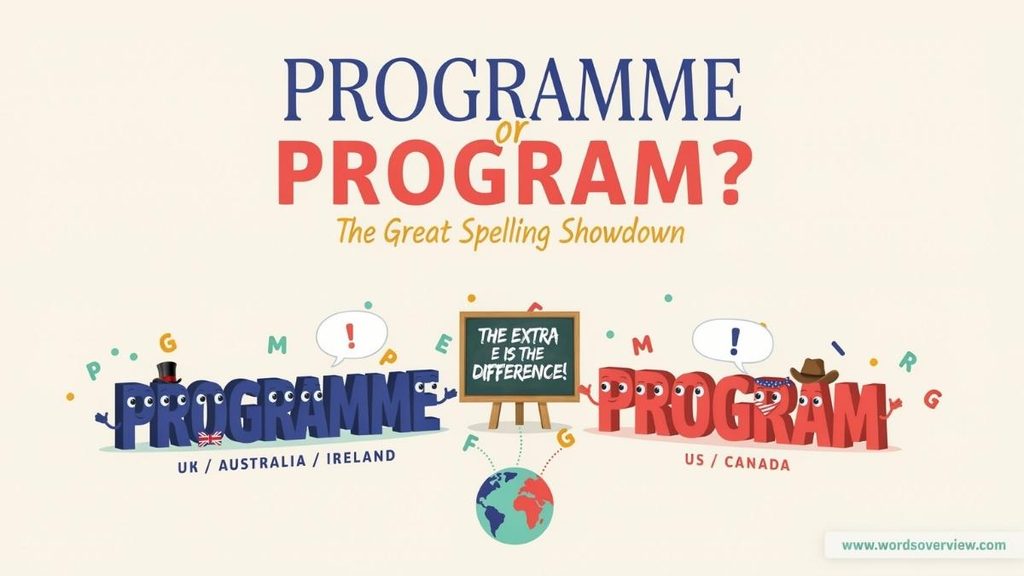
The main difference between programme and program is regional spelling rather than meaning. Both words can describe a planned series of activities, an organized initiative, a broadcast or a course of study. However, the preferred spelling changes according to the variety of English and sometimes the subject.
American English uses program for general and technical meanings. British English commonly uses programme for non-computing meanings but retains program in computing.
Consider these examples:
- American English: The school introduced a reading program for young students.
- British English: The school introduced a reading programme for young students.
- Both varieties: The developer created a computer program to manage customer records.
The first two examples demonstrate regional spelling preferences. The third follows the established computing convention in both varieties of English.
Programme or Program Meaning and Definition
The programme or program meaning in English centers on an organized plan, sequence or set of instructions. The exact definition depends on the context.
A program or programme can refer to:
- A planned series of activities: A community health program organizes medical screenings, awareness sessions and other health services.
- An educational course: A university degree programme outlines the courses and requirements students must complete.
- An organized series of events: A concert programme lists performances in the order they will take place.
- A broadcast: A television program or radio programme is a show produced for an audience.
- Computer software: A computer program contains instructions that tell a computer how to perform specific tasks.
- A structured initiative: A government program may provide financial assistance, job training or public services.
Although these meanings share the idea of organization, context determines the most appropriate spelling. For example, a British newspaper might discuss a government programme and a computer program in the same article.
Program and Programme Difference at a Glance
| Feature | Program | Programme |
| American English | Standard spelling | Generally not used |
| British English | Standard for computing | Common for many general meanings |
| Education | Standard in the US | Common in the UK |
| Television | Standard in the US | Common in the UK |
| Events | Standard in the US | Common in the UK |
| Computer software | Standard | Generally not standard |
| General meaning | An organized plan, broadcast or set of instructions | Usually the same general meaning as program |
The simplest rule is to use program for American English and follow the British distinction between programme for many general uses and program for computing.
Programme or Program in British and American English
British and American English developed different spelling conventions over time. These differences appear in familiar words such as color and colour, center and centre and organize and organise. The programme or program distinction follows a similar pattern, although computing has its own established rule.
Is Program or Programme Correct in American English?
In American English, program is the standard spelling for general and technical uses. American dictionaries and everyday writing use this form across education, entertainment, business and technology.
For example, an American newspaper might report on a government program. Similarly, a college website might advertise a degree program while a television guide lists an evening program.
Common examples include:
- The school launched a summer reading program.
- She enrolled in a nursing program at the university.
- The company offers a professional development program.
- The television program attracted millions of viewers.
- The developer updated the computer program.
The spelling remains program in all five examples. Unlike British English, American English doesn’t generally switch to programme for educational initiatives, broadcasts or organized activities.
Although American readers may recognize programme, it isn’t the standard spelling in ordinary US writing. Therefore, use program unless a proper name, quotation or official title requires another form.
Is Programme or Program Correct in British English?
British English uses both spellings, but they serve different purposes. Writers generally choose programme for organized activities, educational courses, public initiatives and television or radio broadcasts. Meanwhile, they use program for computer software and related computing terminology.
Here are some common British English examples:
- The government introduced a new employment programme.
- The university offers a postgraduate degree programme.
- The company arranged a training programme for new employees.
- The television programme starts at 9 p.m.
- The technician installed a computer program.
Notice the final example. Even though the sentence follows British English conventions, program remains the standard computing term.
This distinction explains why British English program vs programme cannot be resolved by geography alone. The subject matters, too.
Programme or Program in the UK and Other English Varieties
British English isn’t the only variety with regional spelling conventions. Other English-speaking countries also have established preferences, although usage can vary by institution, publication and context.
| English variety | General spelling preference | Computing spelling |
| American English | Program | Program |
| British English | Programme for many general meanings | Program |
| Canadian English | Program is common | Program |
| Australian English | Programme is used in many general contexts | Program |
| New Zealand English | Programme is used in many general contexts | Program |
These patterns offer useful guidelines rather than absolute rules for every organization. Canadian usage often aligns with American spelling for program, while Australian and New Zealand usage frequently follows British conventions in general contexts.
If you’re publishing for an international audience, identify your primary readership before choosing a spelling. A US-focused website should generally use program. A UK-focused publication may need both forms depending on the topic.
When to Use Programme or Program
Choosing between programme and program becomes easier when you follow two steps: identify your audience and determine the word’s meaning.
First, decide whether you’re writing in American or British English. Next, check whether the word refers to a general initiative or computer software. This approach helps you apply the correct spelling without memorizing a long list of unrelated rules.
When to Use Program
Use program when writing in American English. In British English, use it for computing and software-related meanings.
Common situations include:
- Education: The university launched a new engineering program.
- Training: Employees must complete the safety training program.
- Government: The city introduced a program to help low-income families.
- Entertainment: The television program begins after the evening news.
- Technology: The computer program processes customer information.
- Events: The printed program lists the speakers and their presentation times.
The correct spelling of program doesn’t change simply because an activity becomes more formal or complex. A short workshop can have a program just as a nationwide government initiative can.
For US readers, this rule applies across these contexts. For UK readers, the general examples would usually take programme instead.
When to Use Programme
Use programme when writing British English and referring to many non-computing meanings.
Typical examples include:
- Education: The school offers a language-learning programme.
- University: She applied for a postgraduate research programme.
- Training: The employer introduced a leadership development programme.
- Government: The council launched a recycling programme.
- Health: The clinic runs a smoking cessation programme.
- Broadcasting: We watched a documentary programme about wildlife.
- Events: The concert programme included works by several composers.
The spelling programme helps signal British English conventions to readers. However, it doesn’t have a different core meaning from program in these contexts.
One important exception concerns software. British writers normally refer to a computer program rather than a computer programme.
How to Choose the Correct Spelling for Your Audience
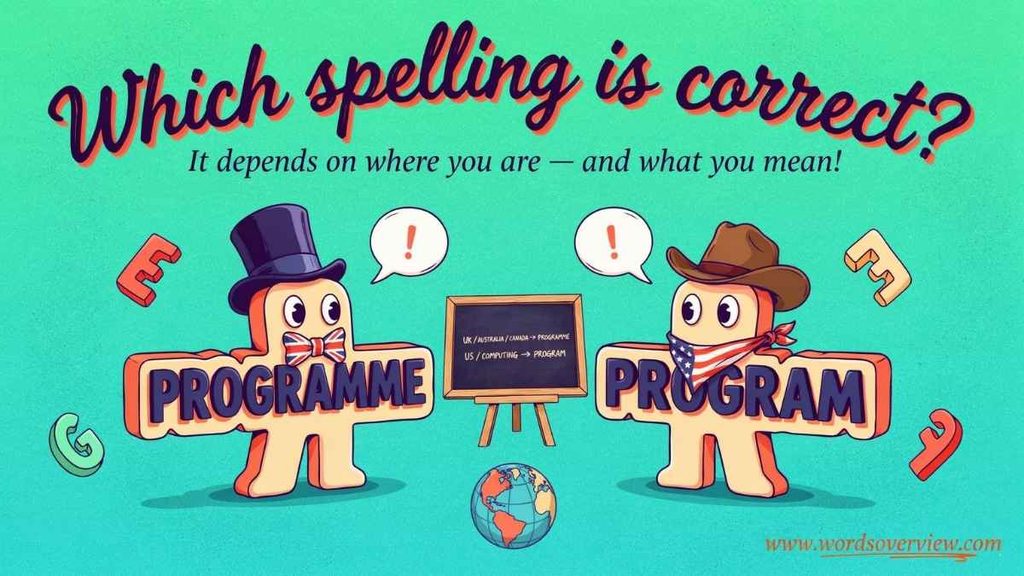
Imagine you’re writing an article about a university’s new scholarship initiative. If the article targets US students, scholarship program is the natural choice. For a UK audience, scholarship programme is generally more appropriate.
Now imagine you’re explaining how to install software. The phrase computer program works for both audiences because computing follows the same spelling convention in each variety.
Use this checklist when editing your work:
- Identify whether your audience expects American or British English.
- Check whether the word refers to software or another organized activity.
- Follow the publication’s style guide if one exists.
- Keep the spelling consistent throughout the document.
- Preserve official names and direct quotations when necessary.
These steps help you make the right choice without memorizing dozens of separate examples.
Learn the difference between more words people mix up
Cubical or Cubicle: Meaning, Differences and Spelling
Programme or Program in Education, Events and Training
Education, events and training are among the most common contexts in which readers encounter this spelling difference. Each context follows the same general regional rule, but the precise meaning can affect how you phrase a sentence.
Programme or Program for School and University
Schools and universities use the word to describe structured educational activities, academic pathways and courses of study.
In American English, you might see a school reading program, a university exchange program, a graduate degree program, a student mentoring program or an after-school program.
In British English, the corresponding forms commonly include a school reading programme, a university exchange programme, a graduate degree programme, a student mentoring programme and an after-school programme.
A program or programme can describe a broad educational initiative or a formal academic pathway. However, it doesn’t always mean an individual course. A degree program, for example, usually includes multiple courses and requirements that lead to a qualification.
Example: A university might create a four-year degree programme with required courses, electives, internships and a final research project. In the United States, the same concept would normally be called a degree program.
Programme or Program for an Event
An event program or programme often refers to a printed or digital document that tells attendees what will happen and when.
It may include the event schedule, speaker or performer names, presentation titles, performance order, break times, venue information and brief descriptions of sessions.
For example, an American conference organizer might print a conference program for attendees. A British organizer would commonly print a conference programme.
The word can also refer to the broader sequence of activities rather than the document itself.
Consider these examples:
- Event document: Please check the program for the keynote speaker’s name.
- Sequence of activities: The conference program includes three workshops and a panel discussion.
Both sentences use program in American English. British English commonly uses programme in both cases.
Programme or Program for Training
Organizations use training programs to help employees develop skills, learn procedures and meet professional requirements. The British equivalent is commonly training programme.
For example, a company might create a six-week training program for newly hired customer service representatives. The program could include product lessons, communication exercises, supervised practice and a final assessment.
In British English, the same initiative would generally be called a six-week training programme.
Other common examples include employee onboarding programs, leadership development programmes, workplace safety programs, technical training programmes, internship programs and apprenticeship programmes.
The distinction concerns spelling rather than the structure or purpose of the training itself.
Learn the difference between tricky English words with easy explanations
Holliday or Holiday: Which Spelling Is Correct?
Programme or Program for Government and Public Services

Governments and public agencies use the word for organized initiatives designed to address specific needs. These may cover public health, employment, education, housing, environmental protection or financial assistance.
An American city might introduce a public transportation program to improve access to buses and trains. A British local authority might launch a public transportation programme for a similar purpose.
| American English | British English |
| Government assistance program | Government assistance programme |
| Public health program | Public health programme |
| Job training program | Job training programme |
| Environmental protection program | Environmental protection programme |
| Housing support program | Housing support programme |
Official names deserve special care. If an agency gives an initiative a specific name, preserve its official spelling rather than automatically changing it to match the rest of your article.
Programme or Program for Projects
A program or programme can also describe a coordinated set of related projects. This usage appears in business, public administration and project management.
For example, a company might run a digital transformation program consisting of several connected projects: replacing old software, training employees, updating security systems and improving customer services.
In British English, the broader initiative may be called a digital transformation programme. However, individual software-related tasks can still involve computer programs.
It’s also useful to distinguish a program from a project plan:
- Program: Coordinates related activities or projects to achieve a broader objective.
- Project plan: Outlines the tasks, timeline, resources and responsibilities for a particular project.
These terms aren’t interchangeable in every situation. Their precise definitions can vary by organization and professional framework.
Programme or Program in Television, Radio and Computing
Entertainment and technology provide two of the clearest examples of how regional spelling conventions work. British English often uses programme for broadcasts but program for software. American English uses program in both contexts.
Television Program or Television Programme
A television program is a show or broadcast created for viewers. It might be a drama, documentary, news bulletin, comedy or educational series.
American publications typically write television program or TV program. British publications commonly use television programme or TV programme.
For example:
- American English: My favorite television program returns next week.
- British English: My favorite television programme returns next week.
The spelling doesn’t change the type of show or its format. Instead, it reflects the regional convention.
The same distinction applies to radio broadcasts. An American listener might tune in to a radio program, while a British listener might listen to a radio programme.
Learn the difference between tricky grammar words
Encode or Incode: Which Is Correct?
Computer Program or Computer Programme?
Computer program is the standard form in both American and British English. This is one of the most important exceptions to remember when learning the difference between program and programme.
A computer program consists of instructions that tell a computer or another digital device how to perform tasks. Programs can process data, display information, control hardware or support activities such as writing documents and editing images.
Examples include:
- A program that calculates monthly expenses.
- A program that organizes customer records.
- A program that processes online payments.
- A program that analyzes scientific data.
- A program that controls part of an automated system.
Suppose a British software developer writes an application to track inventory. The developer would normally describe it as a computer program rather than a computer programme.
The same spelling applies to common computing expressions such as programming language, program execution and software program.
Does the Verb Program Follow the Same Rule?
The verb has its own spelling pattern, particularly in British English.
American English uses program as both a noun and a verb. British English generally uses programme as a verb in non-computing contexts but retains program for computing.
| Context | American English | British English |
| Noun for software | Computer program | Computer program |
| Verb for software development | Program a computer | Program a computer |
| Verb for scheduling an event | Program the event | Programme the event |
| Past tense in computing | Programmed | Programmed |
| Present participle in computing | Programming | Programming |
For example, an American organizer might program a series of concerts. A British organizer might programme a series of concerts. However, a developer in either country would program a computer.
This distinction shows why finding the correct spelling requires more than checking whether a sentence uses British or American English. You must also consider the word’s function and context.
Programme or Program: Comparison Table
The following table brings together the main rules, meanings and examples for quick reference.
| Situation | American English | British English |
| General spelling | Program | Programme |
| School initiative | School program | School programme |
| University course of study | Degree program | Degree programme |
| Employee development | Training program | Training programme |
| Government initiative | Government program | Government programme |
| Television show | Television program | Television programme |
| Radio broadcast | Radio program | Radio programme |
| Printed event schedule | Event program | Event programme |
| Software application | Computer program | Computer program |
| Writing software instructions | Program a computer | Program a computer |
| Scheduling an event | Program the event | Programme the event |
These examples cover common uses, although official names and publication style guides may establish different requirements.
Learn the difference between similar English words
Conex or Connex: Meaning, Spelling and Correct Usage
British English Program or Programme Examples

These sentences demonstrate the spelling difference in everyday contexts.
Education
- US: The university introduced a new scholarship program.
- UK: The university introduced a new scholarship programme.
Training
- US: All employees must complete the training program.
- UK: All employees must complete the training programme.
Broadcasting
- US: The television program explores the history of ancient Rome.
- UK: The television programme explores the history of ancient Rome.
Technology
- US: The developer created a computer program to automate the task.
- UK: The developer created a computer program to automate the task.
The computing example stays the same because both varieties use program for software.
Common Mistakes When Using Programme and Program
Most errors happen when writers apply one spelling rule to every context or mix regional conventions without realizing it. Fortunately, a few practical checks can prevent these problems.
Using Programme for Computer Software
One common mistake is writing computer programme when referring to software in standard British English.
For example:
- Nonstandard in ordinary computing usage: The technician installed a computer programme.
- Standard: The technician installed a computer program.
The correction follows established computing terminology. It doesn’t mean programme is always wrong in British English. The word remains appropriate for many non-computing meanings.
Mixing American and British Spellings
Inconsistent spelling can make an article, report or website look poorly edited.
Imagine a US-focused article that uses training program, education programme and government program without any reason for the change. Readers may wonder whether the writer followed a consistent style guide.
To avoid this problem, choose American or British English based on your audience. Apply the same regional convention throughout the document, remember the computing exception when using British English and check official names before changing their spelling.
Consistency matters most in longer documents, where the same word may appear dozens of times.
Assuming Programme Is Always British English
Another mistake is assuming that British writers must use programme in every sentence. That’s incorrect because British computing terminology uses program.
For example, a British technology article might discuss a computer program in one section and a television programme in another. Both spellings are appropriate.
Confusing a Program With a Schedule
A program or programme may refer to a broader initiative, a sequence of activities or a document listing events. These meanings overlap, but context clarifies the intended meaning.
For example, a training program may describe an entire employee development initiative, while a training schedule specifies when each session takes place.
Similarly, an event programme may list performances and timings, but the event itself includes the actual performances and activities.
Choosing a precise term helps readers understand whether you’re discussing the initiative, its plan or its schedule.
Programme or Program: Origin and Spelling History
The difference between programme and program reflects the history of English spelling and the development of regional conventions.
The word entered English through French and ultimately traces back to the Greek word programma, which referred to something written or publicly announced. Over time, English adopted the word for notices, plans and organized sequences of activities.
The spelling program became established in American English, while programme remained common in British English for many general meanings. These preferences developed alongside broader differences in British and American spelling.
Computing later introduced an important distinction. As computer technology developed, program became the established spelling for instructions that direct a computer’s operations. British English retained that form in technical usage even as programme continued in other contexts.
This history explains why the modern difference isn’t simply a matter of adding or removing the letters -me. Regional spelling conventions and specialized terminology both influence the correct form.
Practice Session
- American English uses ______ for computer software.
- British English often uses ______ for television broadcasts.
- Which spelling is standard in American English: ______?
- A planned series of activities is a ______.
- British English uses ______ for organized events.
- A university degree ______ may include several courses.
- A company can offer a staff training ______.
- A television ______ airs new episodes every week.
- Both spellings are correct, depending on your ______.
- The plural of program is ______.
- The plural of programme is ______.
- Computer software is called a ______ in British English.
- Americans usually write “training ______” instead of “training programme.”
- British universities often advertise a degree ______.
- A printed guide to an event is a ______.
- Which spelling do Americans use for software: ______?
- British writers generally prefer ______ for non-computing activities.
- A planned set of lessons can be a training ______.
- Writers should remain ______ with their spelling choices.
- The word “program” can function as a noun or ______.
- Canadian English generally prefers the spelling ______.
- A PhD ______ refers to doctoral study arrangements.
- A school reading ______ helps students develop literacy.
- The correct spelling depends on meaning and ______.
- British English retains “program” for computer ______.
Answer Key
- program
- programme
- program
- program
- programme
- program
- program
- program
- audience
- programs
- programmes
- program
- program
- programme
- programme
- program
- programme
- program
- consistent
- verb
- program
- program
- program
- context
- software
Frequently Asked Questions
What Is the Difference Between Program and Programme?
Program is the standard spelling in American English for nearly all meanings. In British English, programme usually refers to organized activities, educational courses and television broadcasts while program refers to computer software. For example, an American might write “a training program” while a British writer might prefer “a training programme.”
Is Programme or Program the Correct Spelling?
Both spellings are correct. The right choice depends on your audience and context. Use program for American English and for computer software in both American and British English. Use programme for most non-computing meanings in British English. The key is to stay consistent throughout your writing.
What Does Programme Mean in Simple Words?
A programme is a planned series of activities or events designed to achieve a purpose. For example, a school may offer a reading programme to help students improve their skills. In British English, the word can also refer to a television broadcast or a printed guide to an event.
What Is a Programme Example?
Here is an example of programme in British English: “The university introduced a new training programme for teachers.” In American English, the same sentence would normally use program instead. Both sentences communicate the same meaning. The spelling changes to match the variety of English being used.
Is a Course a Programme or Program?
A course can be part of a programme in British English or a program in American English. For example, a university might offer a degree programme containing several courses. In the United States, the same arrangement is commonly called a degree program. The best spelling depends on your audience.
Is It a PhD Program or a PhD Programme?
Both PhD program and PhD programme are correct, depending on the English variety. American universities generally use PhD program while British universities commonly use PhD programme. For example, “She applied to a PhD program in biology” follows American spelling. Always check the institution’s official terminology when referring to a specific degree.
What Is the Difference Between a Training Program and a Training Programme?
There is no difference in meaning between training program and training programme. Both describe organized activities designed to develop knowledge or skills. American English uses training program while British English generally uses training programme. For example, a company might introduce a training program to help employees learn new software.
Is a TV Show Called a Program or Programme?
Both terms are correct, but regional spelling conventions differ. Americans generally write TV program while British writers usually prefer TV programme. For example, “My favorite TV program starts at eight” follows American English. In British English, the sentence would typically use programme instead.
Do Canadians Use Program or Programme?
Canadians generally use program rather than programme, especially in education, government and computing. However, some established names and specific contexts may retain other spellings. For example, Canadian institutions commonly use terms such as degree program and training program. When writing for a Canadian audience, program is usually the safest choice.
Is It Program or Programme in India?
Both spellings appear in India, where British English conventions have historically influenced formal writing. Programme is common in contexts such as educational programmes, government initiatives and organized events. However, program is also widely used, particularly in computing and in organizations that follow American English. For formal writing, follow the spelling used by the relevant institution or publication.
Conclusion
Choosing between programme or program doesn’t have to feel like a spelling exam with invisible rules. Remember the simple trick: American English uses program for almost everything while British English generally uses programme for organized activities, courses and broadcasts. However, both varieties use program for computer software. The biggest mistake is assuming that one spelling is always wrong. It isn’t! Your audience and context make the difference. So before you hit publish, check which English variety your readers expect. After all, a spelling choice shouldn’t turn your article into a programming problem!

Ethan AJS is an experienced blogger and language enthusiast at Words Overview, dedicated to making English easier to understand and use. He writes about grammar, vocabulary, spelling, word meanings and commonly confused words, turning tricky language questions into clear, practical insights. With a passion for effective communication, Ethan creates engaging, readerfocused content that helps readers write accurately, choose the right words and communicate with confidence.




