
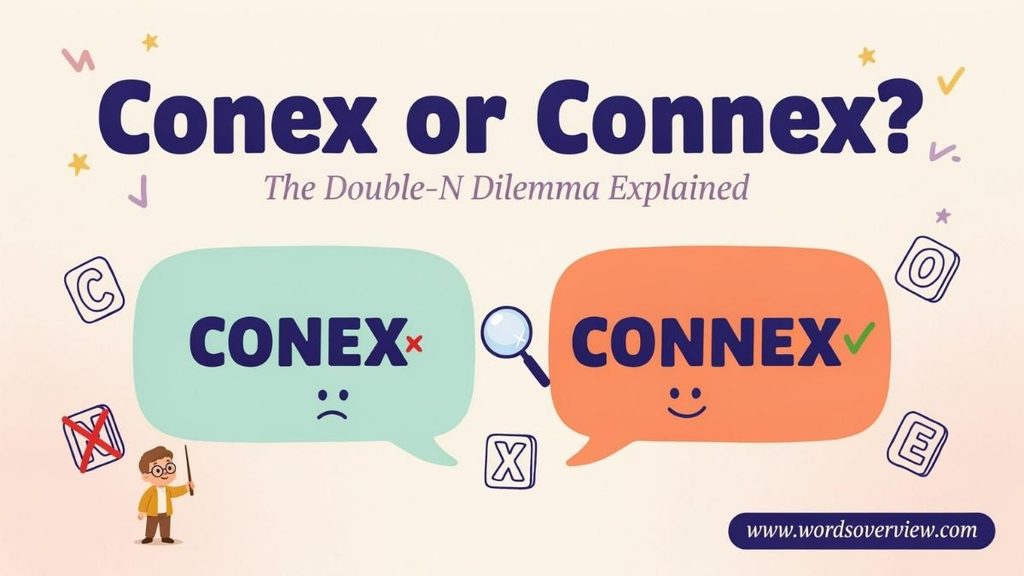
Ever searched for a steel storage container and wondered whether Conex or Connex is the correct spelling? You’re not alone! One extra letter can turn a simple search into a surprisingly confusing spelling debate. Some sellers advertise Conex boxes while others prefer Connex containers, leaving buyers wondering whether they need a different product or just a different spelling. Fortunately, you don’t need a grammar degree or a detective’s magnifying glass to figure it out. Both forms appear in container terminology, but they have different historical associations. Understanding their meanings origins and correct usage will help you write accurately and choose the right container.
What Does Conex Mean?
The word conex refers to a cargo or storage container, particularly one associated with the military’s historical Container Express system. In the United States, people also commonly use conex box to describe a large steel container designed to store equipment, tools, materials and other goods.
Today, the term appears in several practical settings. For example, contractors use Conex boxes to secure equipment at construction sites. Businesses use them to expand storage capacity, while suppliers advertise new and used Conex containers for different purposes.
However, the name doesn’t identify one universal container specification. Two products advertised as Conex boxes may differ in length, height, condition, door configuration and intended use. Therefore, check the actual product details rather than relying on the name alone.
What Is a Conex Box?
A Conex box is a large container designed to transport or store cargo. Modern examples commonly feature corrugated steel walls, reinforced corner posts and heavy doors. Many have the familiar rectangular shape of containers carried by ships, trains and trucks.
People use Conex boxes for several purposes:
- Construction sites: Store tools, building materials and machinery securely.
- Warehouses: Add storage capacity when indoor space becomes limited.
- Farms and rural properties: Protect equipment, supplies and seasonal materials.
- Businesses: Store inventory, maintenance supplies and bulky items.
- Transportation: Move cargo in containers designed for freight handling.
- Temporary projects: Provide portable storage at events, industrial sites and remote locations.
Nevertheless, not every container advertised as a Conex box suits every application. A storage-only unit may lack the condition, documentation or certification required for international freight transportation. Before buying or renting one, verify its construction, dimensions, condition and intended use.
What Does CONEX Stand For?
CONEX stands for Container Express. The term became associated with a military cargo container system designed to improve the handling and transportation of supplies.
The system addressed a major logistics challenge. Military operations require large quantities of equipment and supplies to move efficiently between storage facilities, transportation hubs and operational locations. By grouping cargo into manageable units, containers reduced the need to handle individual items repeatedly.
The Container Express system became particularly important during the Korean War era. Its containers helped military personnel organize supplies and move them through transportation networks more efficiently.
This history explains why CONEX holds particular significance in military and logistics contexts. However, modern commercial usage extends beyond its original military setting. Today, people also use Conex box informally to describe steel storage containers and other cargo units.
What Does Connex Mean in English?
The Connex meaning in English depends on the context. In container terminology, connex is a recognized spelling variant associated with a military cargo container. The word also appears in proper names, including company and product names.
The double-N spelling doesn’t automatically identify a different type of container. For example, one seller may advertise a Connex box while another lists a similar unit as a Conex box. The spelling alone doesn’t establish a difference in design, dimensions or performance.
However, a recognized spelling variant and an official name aren’t always interchangeable. If a company uses Connex as its established brand or product name, preserve that spelling when referring to it. Likewise, when discussing the historical military abbreviation, use the established form CONEX.
Is Connex Another Spelling of Conex?
Yes, connex can serve as a spelling variant of conex in the container context. Both forms can refer to a cargo container and neither spelling specifies the unit’s physical characteristics.
However, the two forms have different historical associations. CONEX directly represents the abbreviation Container Express. The spelling connex also appears in English usage, but that doesn’t establish it as the original military abbreviation.
In practical writing, follow these guidelines:
- Use CONEX when discussing the historical Container Express system.
- Use conex box when the term fits a general container context.
- Use connex when a reliable source or established usage supports that spelling.
- Preserve Connex in an official brand or product name.
- Use shipping container when you want the clearest general term.
This approach recognizes both spellings without suggesting that they have identical histories in every context.
Conex or Connex: What Is the Difference?
The main difference between conex and connex involves spelling and historical usage rather than a guaranteed difference in equipment.
The established military abbreviation is CONEX, short for Container Express. The spelling connex also appears in container terminology and modern usage. In commercial advertising, suppliers may use either spelling to describe similar steel storage or cargo containers.
| Feature | Conex | Connex |
| Spelling | One N in the middle | Two Ns in the middle |
| Historical association | Container Express military container system | Recognized variant spelling for a cargo container |
| General container usage | Common in commercial storage and shipping contexts | Also appears in container-related usage |
| Product dimensions | Not determined by the spelling | Not determined by the spelling |
| Official names | Use when this is the documented spelling | Preserve when this is the documented spelling |
| Historical military writing | Use CONEX for the military abbreviation | Use only when the relevant source supports it |
The key point is that Conex vs Connex is primarily a terminology question, not a technical comparison between two standardized container designs.
For example, a 20-foot container and a 40-foot container differ in length regardless of whether a supplier calls either unit a Conex box or a Connex box. Therefore, when buying storage equipment or arranging freight transportation, prioritize the actual product specifications.
Learn the difference between confusing English words step by step
Vinal or Vinyl: Spelling, Differences and Usage
Is Conex or Connex Correct?
Neither spelling should be declared universally correct or incorrect without considering the context.
When writing about the historical U.S. military system, CONEX is the established abbreviation. For a general cargo container, conex is widely understood in relevant U.S. commercial usage, while connex also appears as a documented variant.
For technical specifications, contracts and product descriptions, choose the term that matches the equipment documentation. Consistency matters, particularly when a document identifies a specific container model or supplier.
For general readers, shipping container or steel storage container may communicate the meaning more clearly than either spelling. These terms also reduce confusion when your audience includes readers unfamiliar with American container terminology.
Why Is It Called a Conex Box?
The name comes from the historical Container Express system. Rather than treating conex as an ordinary description of any metal box, it’s useful to understand its connection to military logistics.
Military forces must move supplies through complex transportation networks. Cargo may travel by truck, rail, ship or aircraft before reaching its destination. Each transfer can create delays, damage, loss and additional handling.
A container system helps address these challenges by grouping supplies into manageable units. As a result, workers can move and organize cargo more efficiently throughout the transportation process.
A Brief History of the Conex Box
Before containerized logistics became widespread, workers often had to load and unload individual packages or cargo items at different stages of a journey. This process consumed time and made cargo handling more complicated.
The U.S. military developed and expanded container-based supply methods to improve efficiency. During the Korean War era, the Container Express system became an important part of military logistics. Its containers helped move supplies through transportation networks while reducing repeated handling.
The history of the Conex box illustrates a broader principle: standardized cargo handling can make transportation more efficient and organized.
Modern intermodal shipping containers emerged as part of a wider shift toward standardized freight transportation. However, the original military CONEX system and modern ISO shipping containers shouldn’t be treated as identical designs simply because both use containers to move cargo.
When researching the historical development of Conex boxes, prioritize military logistics records and historical documentation over modern commercial advertisements. The original military context provides a more reliable explanation of the term’s origins and purpose.
What Is a Military Conex Container?
A military Conex container is associated with the transportation or storage of military supplies and equipment. Its purpose is to organize cargo and simplify movement through military supply networks.
The original historical containers served a different operational purpose from many modern commercial units. Today, sellers may use military Conex container to describe surplus equipment, a container with military origins or a product advertised in a military-style category.
However, these descriptions don’t automatically prove that a particular unit served in the military. If a seller claims military provenance and that history matters to your purchase, request supporting documentation.
Similarly, don’t assume that a modern container advertised as a Conex box follows the specifications of an original military unit. Verify its actual design, condition and intended use before making a decision.
Learn the difference between more words people mix up
Tapping or Taping: Differences, Spelling and Examples.
Conex Box vs Shipping Container: What’s the Difference?
The distinction between a Conex box and a shipping container can be confusing because people often use the terms interchangeably. However, the terms don’t communicate exactly the same thing in every situation.
A Conex box is a familiar informal term in the United States, particularly for large steel storage containers. A shipping container is a broader term for a container used to transport cargo. In everyday commercial language, people also use it to describe containers repurposed for storage.
The right term depends on the container’s purpose and how precisely you need to describe it.
| Term | Typical meaning | When to use it |
| Conex box | Informal term for a steel cargo or storage container | Everyday U.S. usage and commercial listings |
| Connex box | Variant spelling used for a cargo container | When the source or intended terminology supports it |
| Shipping container | Container used for cargo transportation and sometimes storage | General communication and purchasing research |
| Intermodal container | Container designed to move through multiple transportation modes | Technical freight and logistics discussions |
| ISO shipping container | Container built to applicable International Organization for Standardization requirements | When compliance with relevant ISO standards matters |
| Storage container | Container intended for storing goods or materials | Storage-focused projects and rental searches |
Conex Container vs Shipping Container
A Conex container can serve as a shipping container, but the name alone doesn’t establish whether the unit meets current freight requirements.
For example, a contractor might purchase a used container to store tools at a construction site. The unit could work perfectly for that purpose even if its condition or documentation makes it unsuitable for a particular international shipment.
By contrast, a business transporting goods internationally may need an intermodal container that meets the applicable requirements for its cargo and transportation route.
When comparing products, check whether the container is designed for transportation or stationary storage. Also examine its structural condition, weather resistance, dimensions and usable capacity. If you intend to use it for freight, confirm that it meets the requirements of the relevant transportation system and determine whether you need inspection records, certification or other documentation.
This approach provides a more reliable basis for choosing equipment than the word conex alone.
Conex Box vs Intermodal Container
An intermodal container is designed to move cargo between transportation modes, such as ships, trains and trucks, without requiring workers to unload the goods at every transfer.
The term describes a transportation function rather than simply a familiar container shape. Many standard freight containers use standardized dimensions and handling features that make them compatible with established logistics systems.
A Conex box, by comparison, may be a general storage unit, a surplus military container or an intermodal freight container. The label alone doesn’t tell you which category applies.
When technical precision matters, identify the actual container type and applicable standards instead of treating these terms as exact synonyms.
What Are the Standard Conex Box Dimensions?
One of the most common questions concerns the standard size of a Conex box. The answer depends on the specific container. Many commercial steel containers follow common nominal lengths of 20 feet or 40 feet. However, not every unit marketed as a Conex box uses those dimensions.
The following measurements illustrate common general-purpose ISO-style shipping container sizes. They represent approximate external dimensions, not guaranteed specifications for every Conex container.
| Container type | Approximate external length | Approximate external width | Approximate external height |
| Standard 20-foot container | 20 ft (6.06 m) | 8 ft (2.44 m) | 8 ft 6 in (2.59 m) |
| Standard 40-foot container | 40 ft (12.19 m) | 8 ft (2.44 m) | 8 ft 6 in (2.59 m) |
| 40-foot high-cube container | 40 ft (12.19 m) | 8 ft (2.44 m) | 9 ft 6 in (2.90 m) |
Actual manufacturer specifications can vary slightly. Internal dimensions are smaller than external dimensions because the walls, floor, roof and door structure occupy space.
Learn the difference between confusing English words step by step
Steel or Steal: Meaning, Difference and Examples
How Big Is a 20-Foot Conex Container?
A typical standard 20-foot shipping container measures approximately 20 feet long, 8 feet wide and 8 feet 6 inches tall externally.
This size often suits smaller storage projects, construction equipment, tools and supplies. Its shorter length can also make it easier to fit on a property with limited space.
However, the available interior space depends on the specific model. Door openings, internal dimensions, payload limits and the container’s condition all affect its suitability for a particular job.
Before purchasing one, compare the manufacturer’s specifications with your storage requirements. Also consider whether bulky equipment will fit through the doors and whether you need additional clearance to load or unload it.
How Big Is a 40-Foot Conex Container?
A typical standard 40-foot shipping container measures approximately 40 feet long, 8 feet wide and 8 feet 6 inches tall externally.
Its greater length provides more storage space for bulky equipment, inventory and larger shipments. A 40-foot high-cube container adds approximately one foot of external height compared with a standard-height unit.
Before ordering, confirm the supplier’s measurements and delivery requirements. If you plan to place the container on private property, check access routes, delivery clearance, ground conditions and local regulations.
Do Conex and Connex Containers Have Different Dimensions?
No. The spelling doesn’t determine a container’s dimensions.
A supplier may advertise a 20-foot Conex box, while another lists a similar unit as a 20-foot Connex container. The dimensions depend on the actual model and product specifications, not on whether the name contains one N or two.
When a listing uses the phrase Conex or Connex size, look for measurements in feet or meters rather than assuming the term identifies a particular size.
How to Use Conex and Connex Correctly
Choosing between the two spellings becomes easier when you identify the purpose of your writing. A historical article, a supplier listing and a technical specification may require different terminology even when they describe similar equipment.
Use CONEX for the Historical Military Term
When describing the Container Express system, use CONEX to preserve the established abbreviation.
For example:
“The historical account describes how the U.S. military used the CONEX system to improve the movement of supplies.”
This wording connects the term to its historical origin rather than treating it as an arbitrary product name.
Use Conex for General Container References
In general U.S. commercial writing, conex box is a recognizable term for a large steel storage or cargo container.
For example:
“The construction company rented a Conex box to store tools and materials at the job site.”
The sentence uses the term naturally without claiming that the container is an original military unit.
Use Connex When the Source Supports It
The spelling connex is appropriate when a reliable source uses it as a recognized variant or when it forms part of an official name.
For example:
“The supplier’s catalog lists the unit under the Connex container category.”
If the supplier consistently uses Connex, preserve that wording when identifying its products. However, don’t assume that every business follows the same spelling convention.
Use Shipping Container for General Clarity
When writing for an international audience, shipping container is often the clearest choice.
For example:
“The company purchased a used shipping container for additional warehouse storage.”
This wording helps readers who may not recognize the American term Conex box. It also avoids making a historical claim that the writer hasn’t verified.
Follow a Simple Decision Rule
Before choosing the word, consider your purpose:
- Writing about military history? Use CONEX when referring to the established Container Express abbreviation.
- Describing general steel storage equipment? Conex box is a familiar U.S. term.
- Following a supplier’s catalog? Preserve the documented product terminology.
- Writing an international freight specification? Identify the actual container type and applicable standards.
- Unsure which term readers will recognize? Use shipping container and add a more specific description when necessary.
This approach keeps your wording accurate without turning a practical terminology choice into an unnecessary spelling debate.
Learn the difference between commonly misused words
Mistery or Mystery: Spelling, Meaning and Examples
Is Conex Capitalized?
Capitalization depends on how you use the word.
CONEX is appropriate when treating the term as the historical abbreviation for Container Express. In ordinary commercial writing, conex box often appears in lowercase because writers use it as a common noun.
You may also see Conex box in headings, product listings or title case. That capitalization doesn’t necessarily make the word a proper noun.
Use Connex with a capital C when it begins a sentence or appears in an official name that uses that form. Otherwise, follow your publication’s style guide and the conventions of the source you’re referencing.
Consistency matters more than changing capitalization randomly. If an article introduces the term as conex box, maintain that usage unless the context changes.
What Is the Plural of Conex?
The ordinary English plural of conex is conexes.
For example:
- “The contractor ordered two conexes for the construction site.”
- “Several conexes provide storage space for the maintenance team.”
- “The supplier sells used conexes in multiple sizes.”
The same regular plural pattern produces connexes when you use the variant spelling.
However, containers may sound more natural in formal or technical writing. For example, “The facility stores six shipping containers” communicates the meaning clearly without relying on industry-specific terminology.
Don’t use an apostrophe to form the plural. Conex’s normally indicates possession or a contraction rather than the standard plural form.
Learn the difference between tricky grammar words
Encode or Incode: Which Is Correct?
Common Mistakes When Using Conex or Connex
Several recurring mistakes can make container-related writing less accurate. Most arise when people treat a historical abbreviation, a spelling variant and a commercial product label as though they were identical in every context.
Treating Connex as Always Incorrect
The double-N form appears in container terminology. Therefore, calling it a universal misspelling ignores documented usage.
Instead, distinguish between the historical abbreviation CONEX and the broader use of both spellings.
Assuming the Spelling Determines the Container Type
A Conex box isn’t automatically a 20-foot container and a Connex container isn’t automatically a different design.
Always check the actual specifications for dimensions, capacity, condition and intended use.
Calling Every Modern Shipping Container an Original Military CONEX
The historical military system and modern commercial freight containers serve related purposes, but they aren’t automatically identical products.
Use historical terminology when the context supports it. For general modern freight equipment, shipping container or intermodal container may be more precise.
Using Informal Terminology in Technical Documents
A casual product label may work well in conversation. However, a contract or freight specification needs clear identification.
Include the container’s dimensions, relevant technical requirements, condition and other necessary details. If compliance matters, specify the applicable standards instead of relying on the name alone.
Assuming a Spellchecker Can Settle the Question
Spellcheck tools may accept one spelling and flag another depending on their dictionaries and language settings. However, that doesn’t establish which term best fits a particular historical or commercial context.
When the distinction matters, consult reliable dictionaries, relevant historical sources and official product documentation.
Buying a Conex Box: What Should You Check?
If you’re researching Conex or Connex because you plan to buy a container, the spelling is only the beginning. A product listing can use either term, but the container’s condition and suitability should guide your decision.
Compare Dimensions and Intended Use
First, decide whether you need a 20-foot container, a 40-foot container, a high-cube model or a smaller storage unit. Measure the available space and confirm that the delivery vehicle can reach the placement area.
If you plan to transport freight, verify that the container suits the relevant transportation system. A unit designed only for stationary storage may not meet those requirements.
Learn the difference between tricky words and use them correctly
Encorporate or Incorporate: Which Spelling Is Correct?
Inspect the Container’s Condition
For used shipping containers, check the following features:
- Roof and wall damage.
- Rust, corrosion and previous repairs.
- Door operation and locking hardware.
- Floor condition and possible contamination.
- Signs of water entry.
- Structural condition and suitability for the intended load.
A fresh coat of paint doesn’t guarantee that a container is structurally sound or weatherproof. Whenever possible, inspect the actual unit before committing to a purchase.
Confirm the Price and Delivery Costs
The price of a Conex box depends on factors such as size, condition, location, availability and modifications. Delivery can also add a significant expense, particularly when the site requires specialized equipment or has limited access.
When comparing a Conex box for sale with a Connex box for sale, request written quotes that identify the exact unit and its specifications.
Ask the supplier these questions:
- Is the price for a new or used container?
- Are delivery and placement included?
- What are the exact external and internal dimensions?
- Does the unit have working doors and a sound floor?
- Is it suitable for storage only or for freight transportation?
- Are modifications, insulation or additional security features included?
No single price applies to every Conex container. Instead, compare current local supplier quotes for equivalent units rather than assuming the spelling indicates a price difference.
Learn the difference between commonly confused words in English
Kinesthesiology or Kinesiology: Differences and Usage
Understand Rental and Purchase Options
A Conex box rental may suit a short construction project, seasonal inventory or temporary storage need. Buying a container may provide better long-term value if you expect to use it regularly.
Before choosing, compare the rental period, delivery charges, pickup fees, site requirements and any restrictions on modifications.
If you’re searching for used Conex boxes for sale, inspect the actual unit whenever possible. Photographs, seller descriptions and general product labels can’t replace a proper condition assessment.
Practice Session
- The historical military term CONEX stands for Container __________.
- Both Conex and Connex appear in container terminology, but __________ is associated with the historical military acronym.
- A steel container used to transport cargo and store equipment is commonly called a __________ box.
- The standard exterior width of a 20-foot Conex container is typically __________ feet.
- A standard 40-foot Conex container is usually __________ feet long.
- A 40-foot high-cube container is typically __________ feet 6 inches tall on the outside.
- When referring to the historical military acronym, the preferred capitalization is __________.
- The plural form commonly used for multiple Conex containers is __________.
- A container designed to move goods between ships, trains and trucks is called an __________ container.
- The term __________ box has historical roots in military cargo transportation.
- A company that stores tools and construction materials may use a __________ container.
- The exterior dimensions of a shipping container are generally larger than its __________ dimensions.
- When writing about a specific company’s product, you should follow the company’s official __________.
- The term Container Express is commonly abbreviated as __________.
- A container used for freight transportation is often called a __________ container.
- A standard shipping container is typically made from strong __________.
- A 40-foot high-cube container provides extra vertical space compared with a standard 40-foot __________.
- The terms Conex and Connex refer to container terminology, but neither spelling alone identifies a container’s exact __________.
- A container designed to transfer between different transportation modes without unloading its contents is an __________ container.
- When writing a sentence about several storage units, “three Conex __________” is a clear alternative to using the plural form Conexes.
- The word Conex is commonly used as a __________ term for steel storage and shipping containers.
- Before purchasing a used Conex box, buyers should check its condition, dimensions and __________.
- A standard container’s interior space is slightly smaller than its exterior measurements because of its walls and __________.
- In professional writing, using shipping container can make the meaning clearer when readers may not recognize the term __________.
- Before loading machinery into a Conex box, you should confirm the container’s exact __________.
Answer Key
- Express
- CONEX
- Conex
- 8
- 40
- 9
- CONEX
- Conexes
- intermodal
- Conex
- storage
- interior
- spelling
- CONEX
- shipping
- steel
- container
- specifications
- intermodal
- boxes
- general
- specifications
- structure
- Conex
- dimensions
Frequently Asked Questions
How do you spell Conex or Connex?
Both Conex and Connex appear in container terminology. CONEX is associated with the historical military term Container Express while Connex is an alternative spelling used in some contexts. If you’re writing about a specific product or company, follow its official spelling.
What does CONEX stand for?
CONEX stands for Container Express, a term associated with the U.S. military’s historical cargo container system. The containers helped transport and store military supplies more efficiently. Today, people commonly use Conex box to refer to steel shipping and storage containers.
Is a Conex box the same as a shipping container?
Yes, a Conex box generally refers to a steel shipping or storage container. The term has historical military roots but now commonly describes containers used for freight, construction storage, equipment protection and temporary storage. However, container dimensions and features can vary by model.
Should Conex be capitalized?
Conex can be capitalized or written in lowercase, depending on how you use it. Use CONEX when referring to the historical military acronym, Conex in a title or name and conex box in general writing when treating it as a common term. Follow a source’s preferred style when discussing a specific product.
Why is a shipping container called a Conex?
The name comes from Container Express, a term associated with military cargo containers developed to improve the transportation of supplies. Over time, Conex box became a familiar name for steel storage and shipping containers. Not every modern shipping container is technically a historical military CONEX container.
What is a Conex box used for?
A Conex box is used for transporting cargo and storing goods, tools, machinery and construction materials. Businesses also use these containers as temporary storage units, workshops and modified offices. Their suitability depends on the container’s condition, size, ventilation, security and intended use.
What is another name for a Conex box?
Common alternatives include shipping container, cargo container, storage container and intermodal container. These terms overlap but aren’t always interchangeable in technical contexts. Intermodal container specifically describes a container designed for transportation across different modes, such as ships, trains and trucks, without unloading its contents.
What is the plural of Conex?
The plural of Conex is generally Conexes when you mean multiple containers. For example, you might write, “The construction company purchased three Conexes for equipment storage.” However, Conex containers or Conex boxes often sounds more natural and clearer in professional writing.
How wide is a 20-foot Conex container?
A standard 20-foot Conex container is typically 8 feet wide on the outside. Its exterior height is usually 8 feet 6 inches, while its interior dimensions are slightly smaller because of the walls and structure. Always check the manufacturer’s specifications if you need precise measurements for equipment or storage.
How big is a 40-foot Conex container?
A standard 40-foot Conex container typically measures 40 feet long, 8 feet wide and 8 feet 6 inches high on the outside. A 40-foot high-cube model is usually 9 feet 6 inches tall. Exact dimensions and interior capacity vary by model, so confirm the specifications before buying or loading cargo.
Conclusion
So, is it Conex or Connex? Fortunately, you don’t need to call a spelling referee or start a container-sized argument to find the answer! Both spellings appear in container terminology, but Conex has a stronger connection to the historical military term Container Express. Connex also appears as an alternative spelling in some contexts. However, neither spelling automatically tells you a container’s size, condition or features.
When writing about these containers, choose the spelling that fits your source and audience. If you’re buying one, focus on its dimensions, construction and specifications rather than getting stuck on an extra letter. After all, a container can hold your cargo, but it shouldn’t hold your attention hostage over spelling.

Ethan AJS is an experienced blogger and language enthusiast at Words Overview, dedicated to making English easier to understand and use. He writes about grammar, vocabulary, spelling, word meanings and commonly confused words, turning tricky language questions into clear, practical insights. With a passion for effective communication, Ethan creates engaging, readerfocused content that helps readers write accurately, choose the right words and communicate with confidence.




