
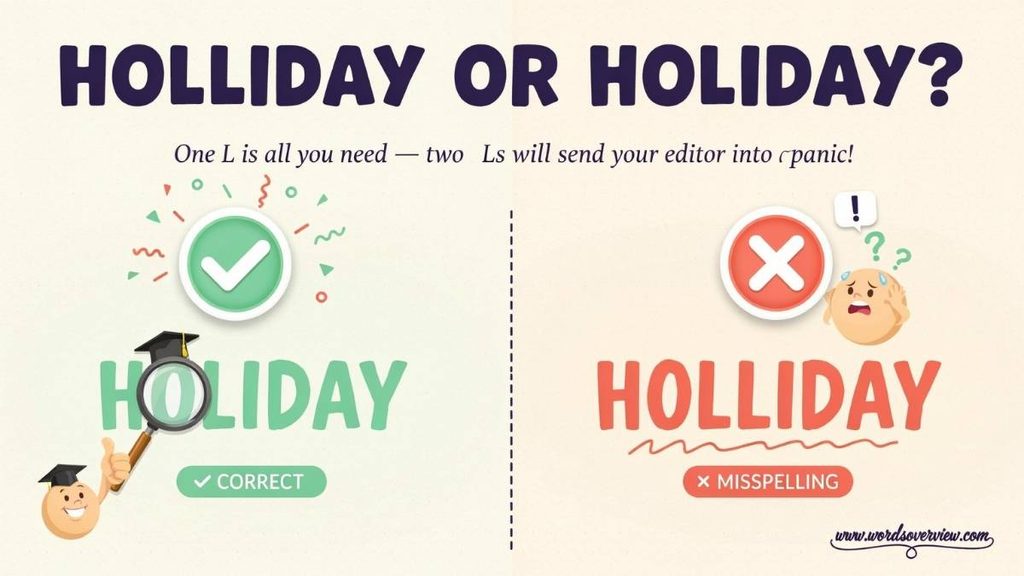
Have you ever typed “Holliday” when you meant “holiday” and wondered whether your spellchecker had missed a mistake? You’re not alone! The confusion between Holliday or Holiday often comes down to one extra letter, yet that tiny difference can change the meaning entirely. “Holiday” refers to a special day or time away from work, while “Holliday” usually appears as a surname. Although both spellings look similar, they don’t serve the same purpose. Fortunately, you don’t need a grammar detective to solve this mystery. In this guide, you’ll discover their meanings, spelling rules, pronunciation and practical examples to avoid common mistakes.
Holliday or Holiday: What’s the Difference?
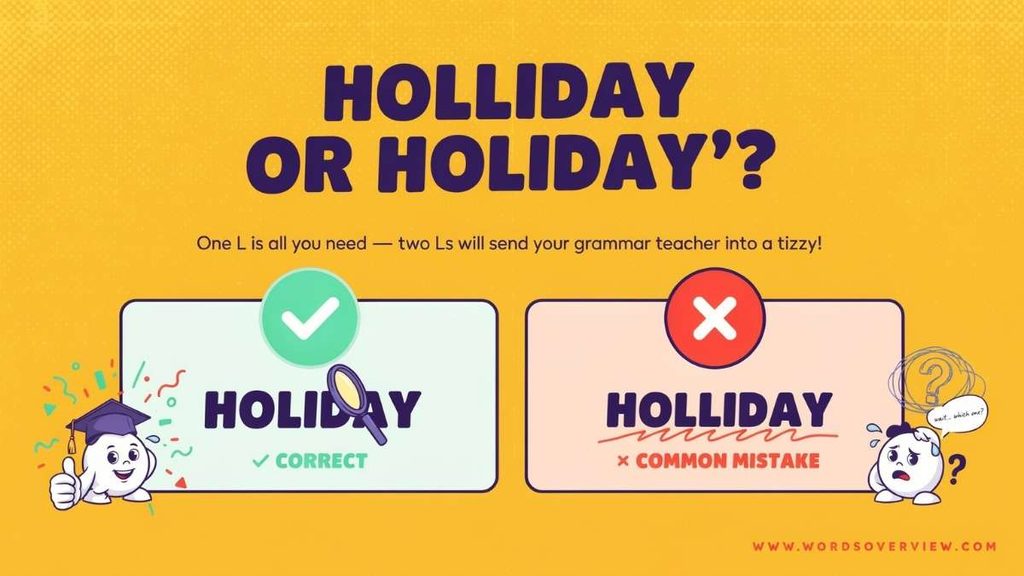
The main difference between Holliday and holiday is their spelling and typical use. Holiday is a common noun with established meanings in standard English, while Holliday is primarily a proper name, especially a surname.
Although the words share a similar appearance and pronunciation, their roles in writing differ.
| Feature | Holiday | Holliday |
| Spelling | One L | Two Ls |
| Main use | Common noun | Proper name, usually a surname |
| Meaning | A special day or period of leisure | Identifies a person or another named entity |
| Capitalization | Usually lowercase unless a capitalization rule applies | Capitalized as a proper name |
| Example | We have a holiday on Monday. | Doc Holliday was a historical figure. |
| Everyday usage | Common in ordinary English | Less common outside names |
Consider these examples:
- Correct: Our school holiday begins next week.
- Correct: Matt Holliday played professional baseball.
- Incorrect for the intended meaning: Our school Holliday begins next week.
- Incorrect for the intended name: Matt Holiday played professional baseball, if you mean the former baseball player Matt Holliday.
The last example highlights an important point: a person’s name has its own established spelling. Therefore, you shouldn’t change a surname just because another spelling looks more familiar.
Is Holliday or Holiday the Correct Spelling?
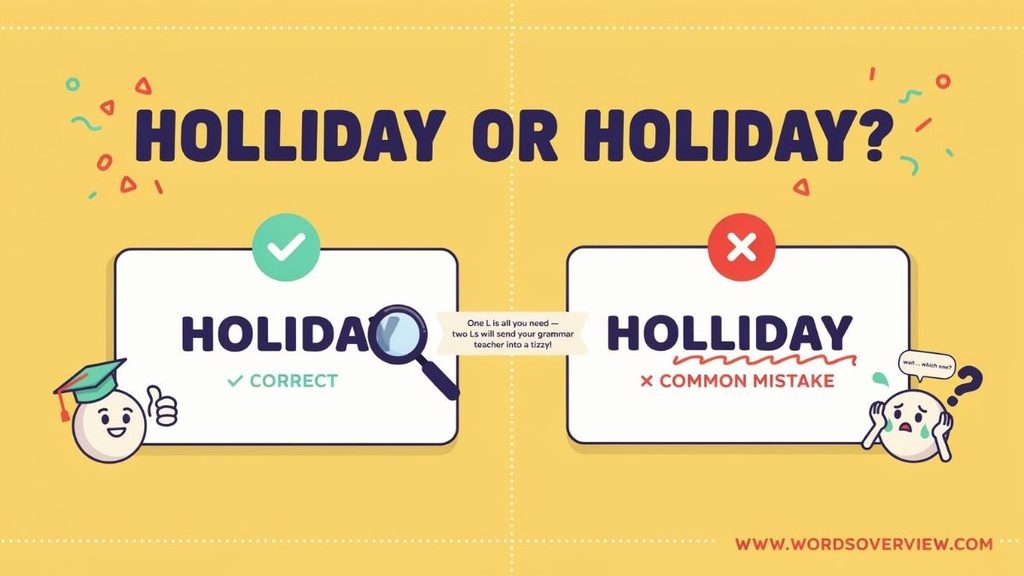
Both spellings can be correct, depending on the context. Use holiday when referring to a day off, celebration or period of leisure. Use Holliday when referring to a person or named entity whose established spelling contains two Ls.
For example:
- “We’re celebrating the holiday with our family.”
- “The article discusses the life of Doc Holliday.”
If you’re writing about a day off, the correct spelling of holiday contains one L. However, if you’re writing someone’s name, preserve the person’s actual surname.
What Does Holiday Mean?
The word holiday has several related meanings. It can describe an official day of observance, a religious or cultural celebration or a period when someone takes a break from work or school.
Holiday as a Special Day or Public Observance
A holiday can mark an important historical event, religious occasion, national celebration or cultural tradition. Governments, religious communities, schools and organizations may recognize different holidays.
A public holiday is a day officially recognized by a government or relevant authority. Depending on local rules, public offices, banks, schools or businesses may close.
Examples include:
- Independence Day: A national observance in the United States on July 4.
- Thanksgiving: A federal holiday observed in the United States on the fourth Thursday of November.
- Christmas: A Christian religious holiday observed on December 25 by many Christians and also celebrated culturally by many others.
- New Year’s Day: January 1, which marks the beginning of the Gregorian calendar year.
A national holiday usually commemorates an event, person or tradition important to a country. In contrast, a religious holiday relates to a faith or religious tradition. These categories can overlap. For instance, Christmas is both a religious holiday and a public holiday in many countries.
Holiday in a sentence: “The library will close early before the public holiday.”
Keep in mind that a holiday doesn’t always mean everyone gets a day off. Work schedules and official closures depend on the relevant country, employer and local rules.
Learn the difference between confusing English words step by step
Steel or Steal: Meaning, Difference and Examples
Holiday as Time Away From Work or School
In many contexts, holiday refers to a period of rest, travel or leisure. People may take a holiday to visit relatives, explore another country, relax at home or enjoy activities outside their usual routine.
For example:
- We’re going on holiday in December.
- She took a short holiday after completing her exams.
- They spent their summer holiday visiting family.
- He returned from his holiday feeling refreshed.
This meaning is particularly common in British English. In American English, people generally use vacation for an extended period away from work or school.
For example, an American might say, “We’re taking a vacation in Florida,” while a British speaker might say, “We’re going on holiday in Florida.”
Both sentences are natural in their respective varieties of English.
Holiday Before Another Noun
The word holiday can also describe another noun. In this role, it functions as a noun modifier that identifies something connected with a holiday or holiday period.
Common combinations include:
| Expression | Meaning | Example |
| Holiday season | A period associated with holidays | The holiday season gets busy for retailers. |
| Holiday weekend | A weekend associated with a holiday | We’re planning a road trip for the holiday weekend. |
| Holiday plans | Arrangements for a holiday | Have you finalized your holiday plans? |
| Holiday trip | A trip taken for leisure or celebration | Their holiday trip includes three cities. |
| Holiday calendar | A schedule of recognized holidays | Check the holiday calendar before booking. |
| Holiday decorations | Items used to decorate for a holiday | We put up holiday decorations in December. |
Notice that holiday retains its one-L spelling in every expression. Adding another noun doesn’t change the word’s spelling.
Learn the difference between tricky grammar words
Encode or Incode: Which Is Correct?
Holiday as a Verb
In standard modern English, holiday is not commonly used as a verb in everyday American writing. American speakers generally prefer expressions such as take a vacation or go on a trip.
However, the verb holiday does appear in British English, where it can mean to spend a holiday away from home.
For example:
- Natural: We plan to take a holiday next month.
- Natural: They are going on holiday this summer.
- Natural in American English: We plan to take a vacation next month.
- Possible in British English: They holiday in Spain every summer.
The final example is grammatically possible, although many British speakers would prefer “They go on holiday in Spain every summer.”
Therefore, holiday can function as a verb in some contexts. Its use varies by region and remains less common than the familiar noun constructions.
What Does Holliday Mean?
Unlike holiday, Holliday doesn’t have a widely used standard common-noun meaning in contemporary English. It appears primarily as a surname and occasionally as a first name or part of a place, business or another proper name.
This distinction matters because a surname identifies a particular person or family. Its established spelling doesn’t change simply because a related common word follows a different spelling convention.
Holliday as a Proper Noun
A proper noun identifies a specific person, place organization or named entity. English convention capitalizes proper nouns, including personal names.
Examples include:
- Doc Holliday: A historical figure associated with the American Old West.
- Matt Holliday: A former Major League Baseball player whose surname contains two Ls.
- Jackson Holliday: An American professional baseball player whose surname also contains two Ls.
In each case, the spelling belongs to the person’s name. Replacing Holliday with Holiday would change the established name rather than correct an ordinary spelling mistake.
Holliday Meaning and Origin
People often search for the Holliday meaning and origin because surnames can preserve historical spellings and family traditions.
Holliday is an established English surname associated with historical forms related to the word holiday and the older expression holy day. However, the precise origin of a particular family’s surname may vary. A general explanation of the surname can’t establish the ancestry of every person who bears it.
The ordinary word holiday also has historical roots in the expression holy day. Over time, its meaning expanded from religious observances to public holidays and periods of leisure.
That historical connection helps explain why the spellings look so similar. Nevertheless, it doesn’t mean modern writers can freely exchange them.
Is Holliday a Word?
Yes. Holliday is a recognized surname that appears in historical records, biographies and references to named people. However, that doesn’t make it a standard alternative spelling of the common noun holiday.
If you search for the Holliday definition, you’ll generally encounter information about a surname or named entity rather than a separate everyday meaning equivalent to a day off.
Similarly, a search for the holiday definition leads to the common English noun describing a special day or period of leisure.
The distinction is straightforward:
- Holiday: An ordinary English vocabulary word with established dictionary meanings.
- Holliday: Primarily a proper name with a historical relationship to the word holiday.
The Oxford Dictionary holiday definition is relevant when checking the common noun. For information about a person’s surname, a reliable biography or official profile is often more useful than a general dictionary.
Learn the difference between commonly misused words
Mistery or Mystery: Spelling, Meaning and Examples
Holliday or Holiday: Spelling and Pronunciation
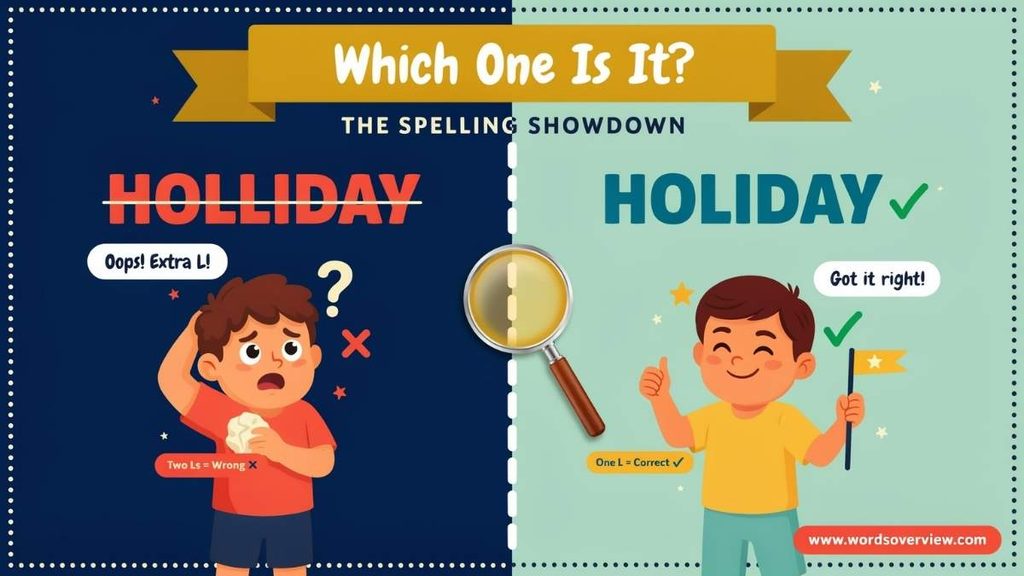
The difference in spelling is easy to identify once you focus on the number of Ls. Pronunciation, however, offers less help because the two forms often sound the same.
Holiday Spelling: One L or Two?
The standard common noun is spelled H-O-L-I-D-A-Y.
The surname Holliday is spelled H-O-L-L-I-D-A-Y.
Compare the two forms:
- Holiday: one L.
- Holliday: two Ls.
A useful memory aid connects the ordinary word with the historical expression holy day. Although modern holiday has broader meanings, this connection can help you remember its standard spelling.
When writing about a day off, public observance or leisure period, choose holiday. When writing someone’s name, check the established spelling instead of relying on a general English spelling rule.
Holliday or Holiday Pronunciation
In many English accents, holiday and Holliday sound the same or nearly the same. Both commonly have three syllables, with the main stress on the first syllable.
The difference in spelling generally doesn’t create a different spoken word. As a result, listening alone may not help you determine whether the written form contains one L or two.
Use context instead:
- If someone says they’re taking a holiday, the common noun is intended.
- If someone mentions Doc Holliday, the surname is intended.
Remember: Similar pronunciation doesn’t make two spellings interchangeable. English contains many words and names that sound alike while serving different grammatical or naming functions.
Why Does Holliday Have Two Ls?
The double L in Holliday belongs to its established spelling as a surname. Personal names can preserve historical forms even when those forms differ from a familiar common word.
For example, Matt Holliday and Jackson Holliday retain their surnames with two Ls. By contrast, holiday season uses the standard one-L common noun.
This is a matter of name identity rather than a general English spelling rule. There’s no universal rule that requires writers to double the L in holiday under certain grammatical conditions.
How to Use Holiday in a Sentence
The easiest way to use holiday correctly is to identify what you want to describe. In most cases, the word refers to a special day, an official observance or a period away from normal duties.
The following examples show how holiday works in everyday English.
| Context | Example sentence | Why it works |
| Public observance | Monday is a public holiday. | Holiday identifies an officially recognized day. |
| Religious celebration | We celebrate Christmas as a holiday. | The word refers to a special occasion. |
| Time away from work | She took a holiday after finishing the project. | It describes a period of rest. |
| Travel | We’re planning a holiday in California. | It refers to a leisure trip. |
| School break | The children are on holiday this week. | It describes time away from school. |
| Seasonal expression | The holiday season gets busy for retailers. | It identifies a period associated with holidays. |
| Compound noun | I need to check the holiday calendar. | Holiday modifies the noun calendar. |
Learn the difference between tricky words and use them correctly
Encorporate or Incorporate: Which Spelling Is Correct?
Holiday in American English
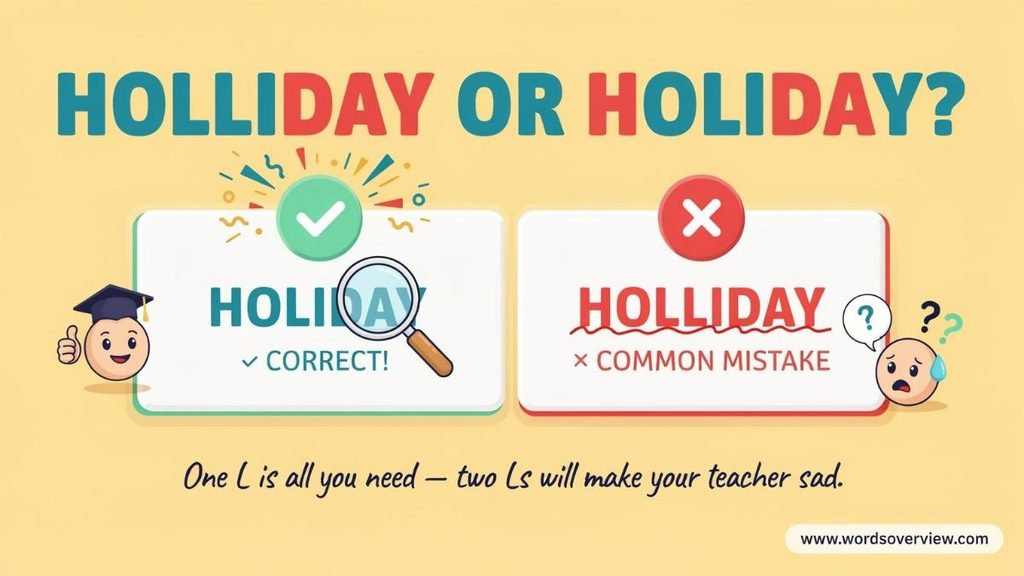
In American English, holiday most often refers to a special day, such as Thanksgiving, Memorial Day or Independence Day. Americans also use holiday season for the period around Thanksgiving, Christmas and New Year’s Day.
When discussing an extended leisure trip, however, Americans generally prefer vacation.
For example:
- We’re taking a vacation in Hawaii.
- Thanksgiving is my favorite holiday.
- The office will close for the federal holiday.
- Our holiday decorations are ready for December.
The first sentence uses vacation for time away from work. The remaining examples use holiday for a special day or seasonal observance.
Holiday in British English
British English uses holiday more broadly for both special days and leisure trips. A British speaker might say they’re going on holiday, booking a holiday or returning from holiday.
Examples include:
- We’re going on holiday to Italy.
- The school holidays begin next week.
- Is Monday a bank holiday?
- Have you booked your summer holiday yet?
The spelling remains holiday in both American and British English. The main difference lies in how speakers use the word in everyday conversation.
How to Use Holliday in a Sentence
Use Holliday when it forms part of a person’s actual name or another established proper name. Because personal names can have different spellings, verify the spelling when accuracy matters.
Here are examples of Holliday usage:
- Doc Holliday became a well-known figure in accounts of the American Old West.
- Matt Holliday played in Major League Baseball.
- Jackson Holliday is a professional baseball player.
- The biography examines the life of John Henry Holliday, better known as Doc Holliday.
In each sentence, Holliday identifies a specific person. It doesn’t describe a celebration or a break from work.
Can Holliday Be Used as a First Name?
Yes. People can use Holliday as a first name, just as they can use surnames or other words as personal names. However, that use doesn’t make it an alternative spelling of the common noun.
For example, if someone introduces themselves as Holliday, preserve that spelling when addressing them or referring to them in writing.
The rule is simple: Respect the person’s established or chosen name. Use the ordinary dictionary spelling when referring to the common noun.
Holiday or Holliday Examples
Seeing the words in context is one of the quickest ways to understand their difference. These Holliday vs holiday examples cover everyday writing, formal communication and references to real people.
| Sentence | Correct? | Explanation |
| We’re going on holiday next week. | Correct | Holiday refers to a leisure trip. |
| The office is closed for the holiday. | Correct | Holiday refers to a special day. |
| I can’t wait for the summer Holliday. | Incorrect for the intended meaning | Use holiday with one L. |
| Doc Holiday was a historical figure. | Incorrect if referring to Doc Holliday | The historical figure’s surname contains two Ls. |
| Jackson Holliday plays professional baseball. | Correct | Holliday is his surname. |
| The holiday season brings busy shopping days. | Correct | Holiday modifies another noun. |
| My Holliday starts tomorrow. | Usually incorrect for the intended meaning | Use holiday unless Holliday is a proper name. |
| We met someone named Holliday. | Correct | Holliday is a person’s name. |
Correct and Incorrect Holiday Spelling in Everyday Writing
Common spelling mistakes often occur when people type quickly or rely on memory. The extra L can slip into an ordinary noun without the writer noticing.
1: In an email
- Incorrect: “I will be unavailable during the Holliday weekend.”
- Correct: “I will be unavailable during the holiday weekend.”
2: In a school assignment
- Incorrect: “Independence Day is an important Holliday in the United States.”
- Correct: “Independence Day is an important holiday in the United States.”
3: In a travel message
- Incorrect: “We booked our Holliday for August.”
- Correct: “We booked our holiday for August.”
- Also natural in American English: “We booked our vacation for August.”
4: In a biography
- Incorrect if referring to the historical figure: “Doc Holiday lived in the American West.”
- Correct: “Doc Holliday lived in the American West.”
These examples show why context matters. The spelling that works for a surname may be wrong for a common noun and vice versa.
Learn the difference between commonly confused words in English
Kinesthesiology or Kinesiology: Differences and Usage
A Short Case Study: One Letter, Two Different Uses
Imagine that an editor receives this sentence:
“The family planned a Holliday trip to celebrate the holiday.”
At first glance, the sentence might seem acceptable because both spellings look familiar. However, the first use contains a spelling mistake if the writer means a leisure trip.
The corrected sentence reads:
“The family planned a holiday trip to celebrate the holiday.”
Now both uses follow standard English spelling. The first holiday describes the trip, while the second refers to the special occasion being celebrated.
The lesson is practical: Check the meaning of the word before changing its spelling. An extra letter isn’t a harmless variation when it changes a common noun into something that looks like a name.
Common Mistakes When Using Holiday and Holliday
Most errors involving these words fall into a few predictable categories. Recognizing them makes proofreading easier and helps you improve your English writing.
Treating Holliday as an Alternative Common-Noun Spelling
The most frequent mistake is assuming that Holliday is simply another acceptable way to spell holiday.
In standard contemporary English, it isn’t. Use one L for the common noun and preserve the double L when a proper name requires it.
Assuming Pronunciation Determines Spelling
Because the words sound alike in many accents, some writers assume that either spelling works.
However, pronunciation doesn’t determine whether a surname has one L or two. The spelling of a person’s name must come from a reliable source, while the ordinary noun follows standard dictionary spelling.
Capitalizing Holiday Unnecessarily
Capitalization doesn’t change the underlying spelling distinction.
For example:
- “We have a holiday next week.”
- “Holiday Inn is a hotel brand.”
- “We visited Holliday Park.”
First sentence, holiday is a common noun.
Second, Holiday Inn is a proper name.
Third, Holliday Park is correct only if that is the park’s established name.
The key point is that capitalization follows the role of the word and the name being used. It doesn’t turn Holliday into a standard alternative for the common noun.
Confusing Spelling With Word Choice
Writers sometimes focus on the extra L when the real issue is whether holiday or vacation sounds natural in their intended variety of English.
For example, an American writer would usually say, “I’m taking a vacation,” when describing an extended leisure trip. A British writer might naturally say, “I’m going on holiday.”
Both expressions can be correct. Neither requires the double-L spelling.
Forgetting to Check Personal Names
Names deserve special attention in biographies, news articles, academic assignments and professional documents.
Before publishing a person’s name, check an official profile, a reliable biography or another trustworthy source. Autocorrect can’t reliably determine whether a surname should contain one L or two.
Learn the difference between more words people mix up
Cubical or Cubicle: Meaning, Differences and Spelling
Holiday or Vacation: What’s the Difference?
Although holiday and vacation overlap in meaning, their everyday use differs between American and British English.
In the United States, vacation is the usual word for an extended period of leisure or travel. Holiday commonly refers to a special day of celebration or observance.
In the United Kingdom, holiday can refer to both a special day and a leisure trip. Vacation is understood but less common in everyday British conversation for this meaning.
| Situation | American English | British English |
| Extended leisure trip | We’re taking a vacation. | We’re going on holiday. |
| Special day | Thanksgiving is a holiday. | Christmas is a holiday. |
| Time away from work | I’m taking vacation time. | I’m taking annual leave or going on holiday, depending on context. |
| School break | Summer vacation is approaching. | The summer holidays are approaching. |
| Official day off | Federal holiday | Bank holiday or public holiday, depending on context |
Learn the difference between similar English words
Conex or Connex: Meaning, Spelling and Correct Usage
Holiday or Day Off
A day off simply means a day when someone doesn’t have to work or attend their usual duties. It doesn’t necessarily involve a celebration.
A holiday may be an official observance or a longer period of leisure.
For example:
- “I have a day off on Friday.” This describes your schedule.
- “Friday is a public holiday.” This identifies an official observance.
A public holiday may give many people a day off. However, the terms aren’t interchangeable in every situation.
Public Holiday or National Holiday
A public holiday is officially recognized under the relevant jurisdiction’s rules. A national holiday usually marks an event or tradition associated with a country.
The terms can overlap. Independence Day is a national holiday in the United States and also a federal public holiday.
However, not every public holiday is necessarily a national celebration. Some holidays apply only to a state, region or local jurisdiction.
Holiday Calendar 2026
When planning travel or work schedules, check the official holiday calendar for the relevant country, state or organization.
For example, U.S. federal holidays in 2026 include New Year’s Day on January 1, Independence Day observed on July 3 because July 4 falls on a Saturday, Thanksgiving Day on November 26 and Christmas Day on December 25.
Holiday dates and observed days can differ by jurisdiction. State holidays, school breaks, employer closures and bank holidays may follow different schedules. Therefore, verify the calendar that applies to your plans.
Practice Session
- The correct spelling for a special day or a period away from work is _________.
- Doc _________ was a historical figure associated with the American Old West.
- In American English, an extended break from work for leisure or travel is commonly called a _________.
- The word _________ refers to a special occasion or a public observance.
- Unlike “holiday,” the surname “Holliday” contains two consecutive letters _________.
- In British English, people commonly say they are going on _________ when traveling for leisure.
- Thanksgiving is an example of a public _________ celebrated in the United States.
- The words “holiday” and “Holliday” generally have the same _________ in American English.
- The word “holiday” originated from an Old English expression meaning “______ day.”
- A person’s surname begins with a capital letter because it is a _________ noun.
- In the sentence “Our office will close for the holiday,” the word “holiday” functions as a _________.
- The expression “day off” describes a day when a person does not have to _________.
- The incorrect spelling “holliday” should be replaced with _________ when referring to a special day.
- In American English, the word _________ is generally preferred when referring to an extended leisure trip.
- Although some holidays have religious significance, not every holiday has a _________ connection.
- The word “getaway” commonly refers to a short _________ taken for relaxation or enjoyment.
- The expression “holiday season” refers to a period associated with celebrations and festive _________.
- When writing a person’s surname, you should preserve its correct _________.
- A vacation often provides time for rest, recreation or _________.
- In British English, going on holiday commonly means spending time away from one’s usual routine for rest or _________.
- A day officially recognized for public observance may be called a public _________.
- The word “holiday” contains seven _________.
- In the sentence “Doc Holliday was a historical figure,” the word “Holliday” functions as a _________.
- To distinguish “holiday” from “Holliday,” consider the meaning and _________ of the word.
- In American English, “summer vacation” is generally more common than “summer _________” when referring to an extended school break.
Answer Key
- Holiday
- Holliday
- Vacation
- Holiday
- Ls
- Holiday
- Holiday
- Pronunciation
- Holy
- Proper
- Noun
- Work
- Holiday
- Vacation
- Religious
- Trip
- Activities
- Spelling
- Travel
- Recreation
- Holiday
- Letters
- Proper noun
- Context
- Vacation
Frequently Asked Questions
Which is correct, holiday or Holliday?
Holiday is the correct spelling for a special day or time away from work or school. Holliday is usually a surname. For example, “We’re going on holiday” uses the common noun, while “Doc Holliday was a historical figure” uses a proper name.
What does Holliday mean?
Holliday is primarily a surname rather than a standard spelling of the word holiday. It appears in family names and historical names, including Doc Holliday, the American Old West figure. If you mean a vacation, public celebration or day off, use “holiday” instead.
What is the correct spelling of holiday?
The correct spelling is holiday, with one “l” after the “o.” The word contains seven letters: H-O-L-I-D-A-Y. A common mistake is writing “holliday” with two consecutive Ls. Remember that the standard word for a special day or break from work has only one “l.”
How do you pronounce holiday and Holliday?
Holiday and Holliday usually sound the same in American English. Both commonly use three syllables: HOL-uh-day. Their pronunciation generally does not reveal the spelling difference, so pay attention to the meaning and context. Use “holiday” for a day off and “Holliday” when writing a person’s name.
What is the difference between a holiday and a vacation?
A holiday can mean a special day or a break from work, while a vacation usually means time away from work or your usual routine for rest or travel in American English. For example, Thanksgiving is a holiday, while a week spent relaxing at the beach is a vacation. British English commonly uses “holiday” for both meanings.
Why do British people say holiday instead of vacation?
British English commonly uses “holiday” where American English often uses “vacation.” In the UK, someone might say, “We’re going on holiday to Spain.” In the United States, the same person would more likely say, “We’re going on vacation to Spain.” Both expressions are correct in their respective varieties of English.
Is holiday derived from the words “holy day”?
Yes, the word “holiday” originated from the Old English expression “hāligdæg,” meaning “holy day.” Over time, its meaning expanded beyond religious observances to include public celebrations and time away from work or school. Today, a holiday does not necessarily have a religious connection.
What is another word for a holiday?
Common alternatives to “holiday” include vacation, break, day off, getaway and leave, depending on the context. In American English, “vacation” usually describes an extended period away from work for rest or travel. “Day off” refers to a day when you do not have to work, while “getaway” often suggests a short trip.
Do Americans say holiday or vacation?
Americans use both “holiday” and “vacation,” but they generally use “vacation” for time away from work and “holiday” for special days or celebrations. For example, Americans typically say “summer vacation” and “Christmas holiday.” However, “holiday” also appears in expressions such as “holiday season” and “holiday shopping.”
How do you use holiday and Holliday correctly in a sentence?
Use “holiday” for a special day or a break from work and “Holliday” for a person’s surname. For example, “Our office will close for the holiday” is correct when referring to a day off. “Doc Holliday became famous in the American Old West” is correct when referring to the historical figure.
Conclusion
The confusion between Holliday or Holiday proves that even one extra letter can make a big difference! Remember, “holiday” refers to a special day or time away from work or school, while “Holliday” usually refers to a person’s surname. So, before you blame autocorrect for ruining your sentence, check whether you’ve added an unnecessary “l.” After all, you don’t want to turn your holiday plans into a discussion about someone’s family name! With the correct spelling, clear examples and a little attention to detail, you can avoid this common mistake and write with greater confidence.

Ethan AJS is an experienced blogger and language enthusiast at Words Overview, dedicated to making English easier to understand and use. He writes about grammar, vocabulary, spelling, word meanings and commonly confused words, turning tricky language questions into clear, practical insights. With a passion for effective communication, Ethan creates engaging, readerfocused content that helps readers write accurately, choose the right words and communicate with confidence.




