
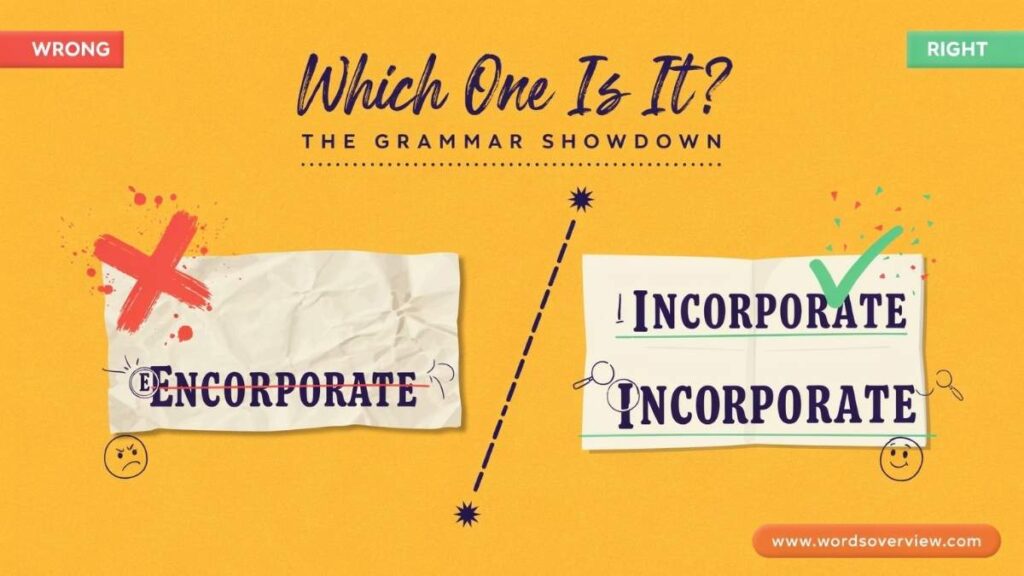
Have you ever typed “encorporate” and wondered whether your spell-checker was being too picky? You’re not alone! The confusion between encorporate or incorporate often leaves writers second-guessing themselves. One spelling looks convincing enough to sneak into an email, essay or business document. Unfortunately, confidence doesn’t make an incorrect word correct. Incorporate is the standard English spelling, while encorporate is a common misspelling. Mixing them up can make polished writing look less professional than intended. In this guide, you’ll discover the difference, explore practical examples and learn simple tricks to remember the correct spelling without letting this tiny typo steal the show.
Encorporate or Incorporate: What’s the Difference?
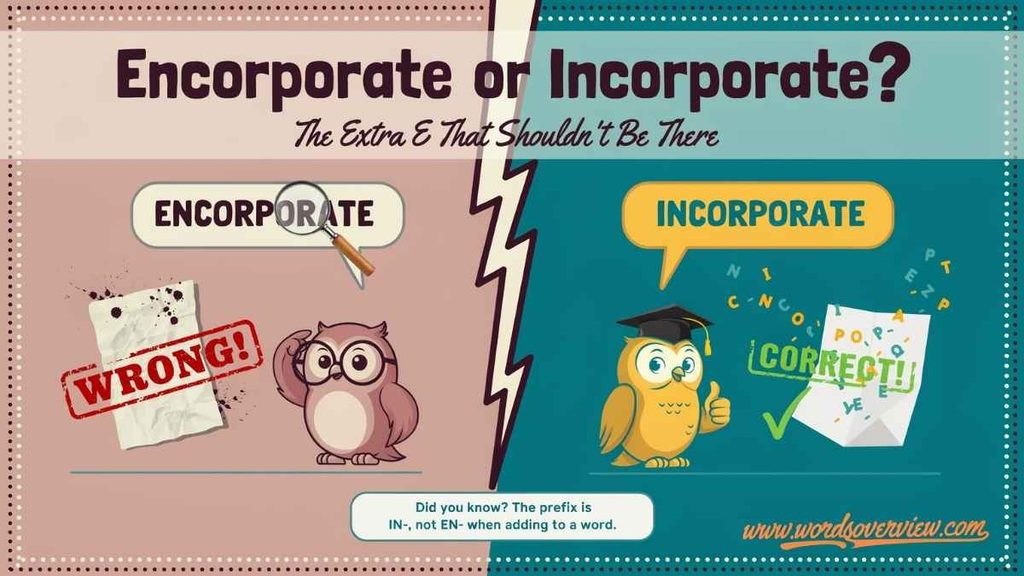
The main difference is spelling. Incorporate is the standard English word while encorporate is generally a misspelling.
| Feature | Incorporate | Encorporate |
| Spelling status | Correct standard spelling | Generally incorrect |
| Meaning | Include, combine or form a corporation | No established standard meaning in ordinary modern English |
| Part of speech | Verb | Not a standard spelling of the verb |
| Formal writing | Appropriate | Avoid |
| Business usage | Correct for legal incorporation | Incorrect |
| Example | We should incorporate your suggestions. | We should encorporate your suggestions. |
This distinction matters because a spelling error can make an otherwise clear sentence look unprofessional. In a job application, business proposal, research paper or client email, the correct spelling helps your writing appear polished and reliable.
Consider these examples:
- Correct: The designer will incorporate the client’s feedback into the new layout.
- Incorrect: The designer will encorporate the client’s feedback into the new layout.
- Correct: The founders plan to incorporate their company next year.
- Incorrect: The founders plan to encorporate their company next year.
Both incorrect examples communicate an understandable idea. Nevertheless, readers expect the standard spelling, so the extra e at the beginning creates an avoidable error.
Learn the difference between confusing English words step by step
Vinal or Vinyl: Spelling, Differences and Usage
Encorporate or Incorporate: Which One Should You Use?

Choose incorporate whenever you want to express the standard meaning of this verb. For example, use it when you want to:
- Include something: Incorporate additional information into your report.
- Combine elements: Incorporate several ingredients into the mixture.
- Apply feedback: Incorporate the manager’s suggestions into the proposal.
- Form a company: Incorporate a business under the applicable law.
- Express a quality: The design incorporates elements of traditional architecture.
You don’t need to assign a separate meaning to encorporate to understand the difference. In ordinary modern English, incorporate is the established choice.
What Does Incorporate Mean?
The incorporate definition centers on making something part of a larger whole. Depending on the context, the word can describe adding information to a document, combining ingredients, bringing ideas into a plan or establishing a legally recognized corporation.
These meanings share one central idea: something becomes part of a larger structure, system or entity.
For example, a teacher might incorporate student feedback into a lesson plan. Similarly, a chef might incorporate butter into a sauce. In business, an entrepreneur might incorporate a company to establish a separate legal entity under the relevant law.
Although these actions differ, the same verb describes each one.
Incorporate Meaning and Examples
The following examples explain the main meanings of incorporate and show how the word works in context.
| Meaning | Explanation | Example sentence |
| Include | Add something as part of a larger item | Please incorporate the missing details into the report. |
| Combine | Bring different elements together | Incorporate the ingredients into the mixture. |
| Integrate | Make something part of a working system | The school will incorporate digital tools into its lessons. |
| Embody | Express or contain a particular quality | The building incorporates traditional design features. |
| Establish a corporation | Legally form a corporate entity | The founders decided to incorporate their business. |
Although include, combine and integrate sometimes replace incorporate, they don’t always express exactly the same idea. Incorporate often emphasizes adding something to an existing whole and making it part of that whole.
For instance, you can include a photograph in a report without suggesting that it changes the report’s structure. However, when you incorporate new evidence into an argument, that evidence becomes part of the argument’s reasoning.
Learn the difference between confusing English words step by step
Steel or Steal: Meaning, Difference and Examples
How to Use Incorporate in a Sentence
The most common sentence pattern is:
Subject + incorporate + object + optional phrase explaining where or how it fits.
Examples include:
- The editor incorporated the corrections into the final manuscript.
- Our team will incorporate the new requirements into the project plan.
- The chef incorporated fresh herbs into the sauce.
- The teacher incorporates practical activities into every lesson.
- The company incorporated customer feedback into its latest update.
In each sentence, the verb takes a direct object: the corrections, the new requirements, fresh herbs, practical activities or customer feedback.
You can also use incorporate in the infinitive form after another verb or expression:
- We need to incorporate the latest figures.
- The goal is to incorporate more accessible features.
- They decided to incorporate the business.
The surrounding sentence determines the appropriate construction. However, the spelling remains unchanged whether the verb appears in the present tense, follows to or comes after another verb.
Is Encorporate a Word?
If you’re asking whether encorporate is a real word, the practical answer is no: it isn’t the standard spelling of the verb used in modern English. Standard writing uses incorporate.
This distinction deserves a little care. English contains unusual, regional, historical and specialized words that may not appear in everyday conversation. Therefore, it’s more precise to say that encorporate isn’t an accepted standard spelling in ordinary modern English than to claim that nobody has ever written or used it.
What Is the Meaning of Encorporate?
People searching for encorporate meaning usually want to know whether the word has a meaning separate from incorporate.
In standard contemporary usage, encorporate has no established independent meaning that you should use in place of incorporate. Writers generally intend to express one of these ideas:
- Add something to an existing whole.
- Combine several elements.
- Integrate information or ideas into a plan.
- Form a corporation legally.
For all these meanings, incorporate is the correct choice.
For example:
Incorrect: We need to encorporate the latest research into our presentation.
Correct: We need to incorporate the latest research into our presentation.
The correction doesn’t change the intended meaning. Instead, it replaces the misspelling with the accepted word.
Is Incorporate the Only Correct Spelling?
For the standard English verb discussed here, yes. Use incorporate rather than encorporate.
You might encounter the incorrect form in online comments, early drafts, social media posts or unedited documents. However, its appearance doesn’t establish it as a recognized alternative spelling.
When accuracy matters, consult a reputable dictionary to confirm the accepted spelling, meaning and usage of the word.
Learn the difference between more words people mix up
Tapping or Taping: Differences, Spelling and Examples
Why Do People Confuse Encorporate and Incorporate?
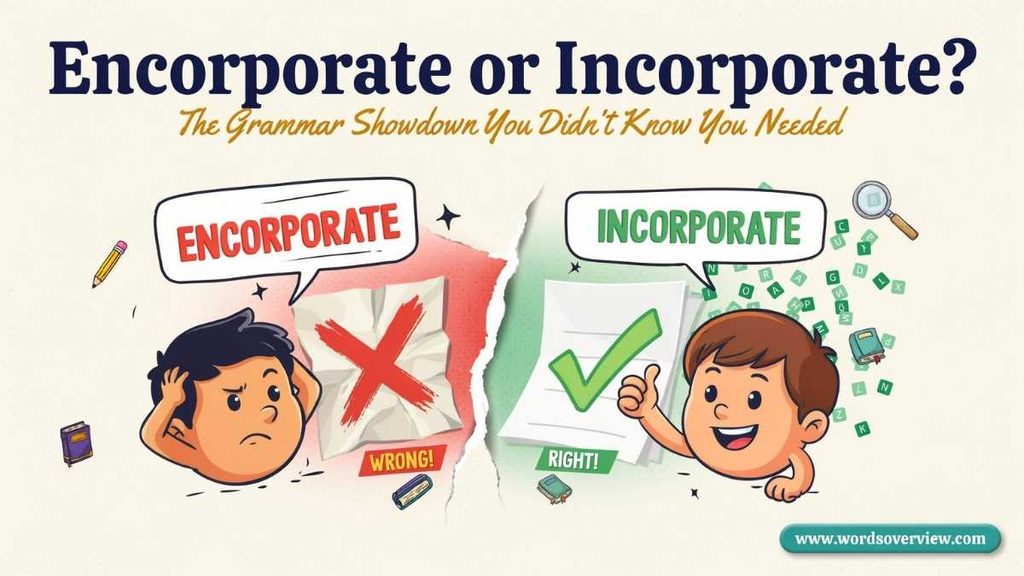
The encorporate misspelling illustrates how pronunciation, spelling patterns and memory can combine to produce an error.
English spelling doesn’t follow a simple sound-to-letter system. Although pronunciation helps you spell many words, it doesn’t always reveal the exact letters you need.
Pronunciation and Sound Confusion
The beginning of incorporate can be difficult to remember if you rely on sound alone. In natural speech, unstressed syllables often receive less emphasis than stressed syllables. As a result, listeners may not clearly distinguish the opening vowel.
A common US English pronunciation is approximately in-KOR-puh-rayt, with the main stress on the second syllable. However, accents can affect the exact vowel sounds.
Regardless of pronunciation, the standard spelling remains incorporate.
Learn the difference between commonly confused words in English
Kinesthesiology or Kinesiology: Differences and Usage
Familiar Words Beginning With En
English contains many familiar verbs that begin with en-, including:
- Encourage
- Enlarge
- Enclose
- Enable
- Enrich
Because these words share a familiar beginning, a writer might mistakenly assume that encorporate follows the same pattern.
However, English spelling depends on each word’s established form. A pattern that works for enrich doesn’t automatically apply to incorporate.
Confusion Between In- and En-
The difference between in- and en- can cause spelling problems because both appear in English words associated with position, movement or change.
The prefix in- has Latin roots and can express meanings related to in or into in certain words. Nevertheless, its role varies throughout the English vocabulary. You can’t reliably choose between in- and en- by applying one universal rule.
For incorporate, the correct spelling comes from its established history and standard usage.
Learn the difference between commonly misused words
Mistery or Mystery: Spelling, Meaning and Examples
Typing Errors and Spellcheck Limitations
Typing quickly can produce an incorrect first letter, especially when you’re writing an unfamiliar word. If you don’t review the text carefully, the mistake may remain.
Spellcheck can help, but it isn’t a substitute for proofreading. Different applications use different dictionaries and correction systems. Consequently, a tool might flag an error, suggest a replacement or overlook a problem depending on its settings and context.
To avoid this common spelling mistake in English, learn the correct form and review important documents before sending them.
Practice Questions
1. The company plans to ______ a new marketing strategy into its business operations.
2. Which spelling is correct: ______ or encorporate?
3. The teacher decided to ______ practical activities into the lesson.
4. You should ______ your research findings into the final report.
5. The business was legally ______ last year.
6. The chef will ______ fresh herbs into the recipe.
7. The noun form of incorporate is ______.
8. A synonym for incorporate is ______.
9. The opposite of incorporate can be ______.
10. The team wants to ______ two separate ideas into one proposal.
11. We are ______ customer feedback into the new design.
12. The past-tense form of incorporate is ______.
13. The report ______ several useful recommendations.
14. The company has ______ environmental goals into its business plan.
15. To ______ means to include something as part of a larger whole.
16. The designer is ______ traditional patterns into modern clothing.
17. Which word means to combine elements so they work together as a unified system: incorporate or ______?
18. Please ______ these changes before submitting your assignment.
19. The correct spelling of the past-tense form is incorporated, not ______.
20. The manager decided to ______ employee suggestions into the new policy.
21. The process of legally forming a corporation is called ______.
22. The company ______ new technology into its daily operations.
23. The team has started ______ additional features into the application.
24. The company chose to include the suggestions rather than ______ them.
25. The correct verb is incorporate, while ______ is its present participle.
Answer Key
Check your answers after completing all 25 questions.
1. Incorporate
2. Incorporate
3. Incorporate
4. Incorporate
5. Incorporated
6. Incorporate
7. Incorporation
8. Include
9. Exclude
10. Combine
11. Incorporating
12. Incorporated
13. Incorporates
14. Incorporated
15. Incorporate
16. Incorporating
17. Integrate
18. Incorporate
19. Encorporated
20. Incorporate
21. Incorporation
22. Incorporates
23. Incorporating
24. Exclude
25. Incorporating
Frequently Asked Questions
Is it encorporate or incorporate?
Incorporate is the correct spelling in standard English. “Encorporate” is a common misspelling and should be avoided in professional writing, academic assignments and business documents.
What does incorporate mean in simple words?
To incorporate means to include something as part of a larger whole. For example, you might incorporate new ideas into a presentation or incorporate fresh ingredients into a recipe.
How do you use incorporate in a sentence?
You can use incorporate when describing the act of including or combining something. For example: “The teacher decided to incorporate practical activities into the lesson.”
What is another word for incorporate?
Common synonyms for incorporate include include, combine, integrate, add, merge, unite and blend. The best choice depends on the context and the relationship between the things being combined.
What is the difference between incorporate and integrate?
Incorporate generally means to include something as part of a larger whole. Integrate emphasizes combining elements so they work together as a unified system. For example, a company might incorporate customer feedback into a report and integrate new software into its existing system.
What is the noun form of incorporate?
The primary noun form of incorporate is incorporation. It describes the act or process of combining elements or, in business, establishing a company as a legal corporation.
What is the opposite of incorporate?
The opposite of incorporate depends on the context. Common antonyms include exclude, separate, remove and omit. For example, if you incorporate suggestions into a report, you include them rather than exclude them.
What is the difference between incorporate and incorporated?
Incorporate is the base form of the verb, while incorporated is its past-tense and past-participle form. For example, “We will incorporate the changes” describes a future action, while “We incorporated the changes” describes a completed action.
What does incorporated mean in business?
In business, incorporated generally means that a company has been legally established as a corporation under applicable law. Incorporation typically creates a legal entity separate from its owners, although the rights and obligations depend on the jurisdiction and business structure.
Is incorporate the same as include?
Not exactly. Include usually means to make something part of a group or list, while incorporate can suggest combining something into a larger whole. For example, you might include a name on a list or incorporate a new strategy into your business plan.
Conclusion
The confusion between encorporate or incorporate may seem small, but one misplaced letter can make your writing look less polished. The good news? You only need to remember one correct spelling: incorporate. Whether you’re incorporating new ideas into an essay, adding ingredients to a recipe or incorporating a business, this is the word you need. Although “encorporate” might look convincing, it doesn’t belong in standard English. So, the next time you face this spelling dilemma, trust the correct form and leave “encorporate” out of the mix. Your grammar will thank you and your spell-checker can finally take a well-deserved break!

Ethan AJS is an experienced blogger and language enthusiast at Words Overview, dedicated to making English easier to understand and use. He writes about grammar, vocabulary, spelling, word meanings and commonly confused words, turning tricky language questions into clear, practical insights. With a passion for effective communication, Ethan creates engaging, readerfocused content that helps readers write accurately, choose the right words and communicate with confidence.




