Have you ever typed “vinal” when you meant “vinyl” and wondered whether your spell-checker had taken the day off? You’re not alone! The vinal vs vinyl confusion can trip up even careful writers because these words look almost identical but have very different meanings. One relates to a specialized synthetic fiber while the other appears everywhere from flooring and wall coverings to music records and stickers. Mixing them up can turn a simple sentence into a spelling mystery. Fortunately, you don’t need a chemistry degree or a record collection to tell them apart. Let’s explore their meanings, differences and correct usage with clear examples.
Vinal vs Vinyl: What’s the Difference?
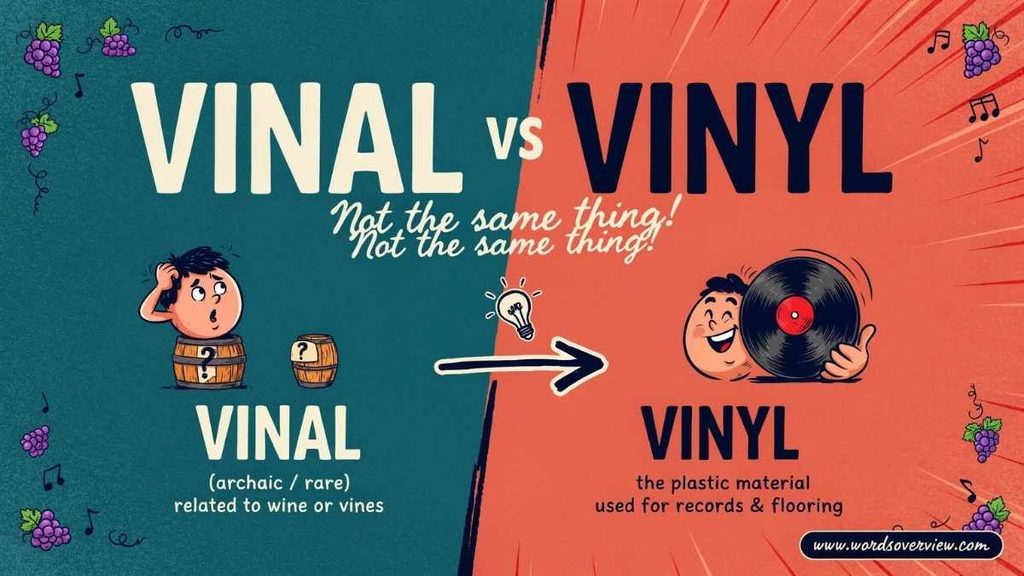
The main difference between vinal and vinyl lies in their meanings and applications. Although the words share several letters, they refer to different material categories.
Vinyl commonly describes synthetic materials associated with vinyl compounds. In everyday English, the word often refers to plastic products made from polyvinyl chloride (PVC). For example, manufacturers use vinyl in flooring, wall coverings, upholstery, records and other consumer products.
Vinal, however, has a specialized meaning in textile terminology. It refers to a manufactured fiber associated with a synthetic polymer containing vinyl alcohol units. Consequently, the word appears more often in technical discussions than in everyday conversation.
The following table summarizes the key differences.
| Feature | Vinal | Vinyl |
| Standard usage | Specialized technical terminology | Everyday and technical terminology |
| Main meaning | A particular type of manufactured fiber | A chemical group or materials associated with vinyl compounds |
| Chemical association | Polyvinyl alcohol-based fiber chemistry | Vinyl compounds including PVC |
| Common examples | Vinal fiber and certain industrial textile applications | Vinyl flooring, records, stickers and upholstery |
| Everyday frequency | Uncommon | Very common |
| Correct for flooring | Generally no | Yes |
| Correct for music records | Generally no | Yes |
This comparison makes one point clear: the words aren’t interchangeable simply because their spellings look alike.
For example, a contractor would normally write, “We installed vinyl flooring.” Meanwhile, a textile specialist might use vinal when discussing a specific manufactured fiber. Both words can be correct, but each belongs in a different context.
What Is the Difference Between Vinal and Vinyl in Everyday English?
In everyday English, vinyl is usually the word you need. You encounter it when shopping for flooring, buying music records, creating stickers or selecting furniture coverings.
Vinal appears much less frequently outside technical terminology. Therefore, if you encounter the word in a sentence about flooring or music, check whether the writer intended to use vinyl.
Consider these examples:
- Correct: The contractor installed vinyl flooring in the kitchen.
- Correct: She bought several vinyl records.
- Correct in a technical context: The report discusses vinal fiber used in industrial textiles.
- Likely spelling error: The store sells vinal stickers for cars.
The surrounding words usually reveal the intended meaning. As a result, understanding the context provides a more reliable guide than relying on spelling alone.
Learn the difference between everyday English mistakes
Slushy or Slushie: Correct Spelling, Meaning and Usage
What Does Vinal Mean? Vinal Definition and Meaning in English
Vinal is a legitimate but uncommon English word with a specialized technical meaning. In textile terminology, it refers to a manufactured fiber whose fiber-forming substance consists primarily of a synthetic polymer containing vinyl alcohol units.
This definition distinguishes vinal from ordinary vinyl plastic. Rather than describing a broad category of consumer products, the term identifies a particular type of synthetic fiber based on its chemical composition.
Technical terminology matters here because similar names don’t necessarily describe identical substances. For example, polyvinyl alcohol and polyvinyl chloride have different chemical structures and properties despite sharing part of their names.
What Is Vinal Fiber Made Of?
Vinal fiber is associated with polyvinyl alcohol (PVA), a synthetic polymer used to manufacture fibers for textile and industrial applications.
In the United States, textile fiber regulations define vinal through specific chemical composition requirements. The definition requires at least 50% by weight of the fiber-forming polymer to consist of vinyl alcohol units. Furthermore, vinyl alcohol units combined with one or more acetal units must account for at least 85% of the fiber’s weight.
These percentages describe the regulatory definition of vinal fiber. They don’t represent universal specifications for every synthetic fiber or every product made from PVA.
Vinal fiber has historical applications in industrial fabrics, lining fabrics and some apparel blends. Depending on its composition and manufacturing process, it can offer useful mechanical properties for particular applications.
Common characteristics associated with suitable vinal fiber formulations include:
- Strength: Certain formulations provide useful resistance to pulling forces.
- Abrasion resistance: Some products withstand friction during regular industrial use.
- Chemical performance: Resistance depends on the formulation and the chemicals involved.
- Industrial versatility: Manufacturers can incorporate suitable fibers into fabrics and other engineered materials.
However, these characteristics don’t apply equally to every vinal product. Fiber properties depend on the polymer composition, manufacturing method and intended application.
It’s also important to distinguish vinal from the broader category of PVA fibers. Polyvinyl alcohol has applications in concrete reinforcement, industrial paper, rubber products and other engineered materials. Nevertheless, not every product containing PVA qualifies as vinal under the relevant technical definition.
Is Vinal Used in Textile Manufacturing?
Yes. Vinal has a recognized place in textile terminology, although most consumers are more familiar with polyester, nylon, acrylic and other synthetic fibers.
Manufacturers develop synthetic fibers to meet specific performance requirements. Depending on the material, those requirements may include tensile strength, flexibility, abrasion resistance and compatibility with other materials.
Vinal belongs to this broader field of manufactured fibers. However, its specialized name doesn’t mean that every textile made from synthetic polymers contains vinal.
For example, a fabric manufacturer might evaluate a particular fiber for industrial use because of its mechanical properties. Another manufacturer might choose polyester or nylon because those materials better meet the requirements of a different product.
Therefore, technical textile terminology should follow the material’s actual composition rather than its general appearance or intended function.
Learn the difference between more words people mix up
Personalise or Personalize: Which Spelling Is Correct?
Vinal vs Vinyl: Why the Chemical Difference Matters
The chemical distinction explains why both spellings can be correct.
Vinal refers to a particular manufactured fiber associated with vinyl alcohol chemistry. Vinyl, on the other hand, has broader chemical meanings and commonly describes materials made from vinyl compounds.
Consider two practical examples. A manufacturer might use PVA-based fibers to reinforce concrete. Meanwhile, a home improvement store might sell PVC-based vinyl flooring. Both products involve synthetic polymer chemistry, but their compositions and purposes differ.
This distinction also matters in technical reports, product specifications and educational writing. Replacing one term with the other without checking its meaning can introduce a factual error.
The key lesson is simple: don’t judge a technical word solely by how closely it resembles a familiar term. In chemistry and textile manufacturing, even a small spelling difference can distinguish separate material categories.
What Does Vinyl Mean? Vinyl Definition and Common Uses
Vinyl has a much broader everyday presence than vinal. In chemistry, the term refers to a specific chemical group. In consumer language, it commonly describes synthetic materials and products associated with vinyl compounds.
Many familiar vinyl products use polyvinyl chloride (PVC), a synthetic polymer valued for its versatility. Manufacturers can formulate PVC for different levels of flexibility, rigidity and durability. Consequently, vinyl appears in a wide range of products.
Vinyl Flooring and Floor Tiles
Vinyl flooring is a popular option for homes, offices, retail spaces and other buildings. Manufacturers produce it in several formats, including sheets, planks and tiles.
Its popularity comes from a combination of practical features:
- Water resistance: Many vinyl flooring products resist water and suit areas where spills occur.
- Design variety: Manufacturers can create patterns that resemble wood, stone and other surfaces.
- Easy maintenance: Routine cleaning generally requires little effort.
- Installation options: Different products use adhesive, click-lock systems or other installation methods.
However, not every vinyl floor offers the same level of water protection. Water can still reach the subfloor through poorly sealed joints or installation defects. Therefore, buyers should check product specifications before choosing a floor covering.
When comparing vinal vs vinyl flooring, the standard expression is vinyl flooring. Product descriptions that use vinal flooring probably contain a spelling error unless they refer to a specifically documented product or name.
For example:
- The landlord replaced the old carpet with vinyl flooring.
- We selected vinyl floor tiles for the laundry room.
- The contractor recommended luxury vinyl planks for the renovation.
Each sentence uses vinyl correctly because it refers to a familiar flooring product.
Vinyl Records and Music
Vinyl also refers to records made from vinyl-based materials. These discs store recorded sound in grooves that a compatible record player reads with a stylus.
Music enthusiasts commonly use expressions such as vinyl records, vinyl collection and listening to vinyl. In this context, the word describes the recording medium rather than just its chemical composition.
For example:
- My father keeps his vinyl records in protective sleeves.
- She bought a jazz album on vinyl.
- The shop sells new releases and used vinyl records.
A vinyl record differs from a record player. The record stores the sound information while the player reads it and converts it into an audio signal.
This distinction matters when discussing music equipment. People sometimes search for a vinyl player when they mean a record player or turntable. Although the intended meaning is usually clear, record player and turntable are common terms for the playback equipment.
Vinyl Stickers, Decals and Signs
Vinyl also plays an important role in adhesive graphics. Businesses use it for storefront lettering, promotional signs, vehicle decals, product labels and decorative designs.
Crafters can also cut adhesive vinyl with machines such as Cricut to create letters, shapes and custom designs. However, different vinyl products serve different purposes.
For example, permanent adhesive vinyl suits many long-term decorative applications. Removable vinyl works better for certain temporary designs. Heat-transfer vinyl allows users to apply designs to suitable fabrics with heat and pressure.
Common examples include:
- She made a custom vinyl sticker for her laptop.
- The shop installed vinyl lettering on its front window.
- We used heat-transfer vinyl to decorate a cotton T-shirt.
These sentences demonstrate correct vinyl usage.
However, if you’re researching Cricut cutting settings, the question concerns material selection rather than spelling. Cutting settings depend on the specific product, its thickness, the cutting machine and the manufacturer’s recommendations.
Vinyl Siding, Upholstery and Pipes
Vinyl products also appear throughout construction and manufacturing.
Vinyl siding provides an exterior covering for buildings. Manufacturers offer different profiles, colors and finishes to suit various architectural styles. Its performance depends on the product’s design, installation quality and exposure to weather.
Vinyl upholstery covers some furniture, vehicle interiors and commercial seating. It provides a surface that people can often clean with a damp cloth. Nevertheless, durability varies according to the formulation, surface coating and product quality.
Vinyl pipes and other PVC-based components serve plumbing, drainage and industrial purposes. However, the correct pipe material depends on the application, pressure rating, temperature requirements and applicable building codes.
These examples demonstrate why vinyl is the correct word in many everyday product descriptions. Its uses extend far beyond flooring and music records.
Learn the difference between more words people mix up
Tapping or Taping: Differences, Spelling and Examples
Vinyl vs Vinal: Understanding the Material Difference
The vinyl vs vinal distinction becomes clearer when you compare the materials themselves rather than their spellings alone.
| Property | Vinal fiber | Vinyl materials |
| Material category | A specific manufactured fiber | A broader group of vinyl-related materials |
| Chemical association | Polyvinyl alcohol-based fiber chemistry | Vinyl compounds including PVC |
| Typical form | Fibers used in textile or industrial applications | Plastic sheets, films, molded products and coatings |
| Example applications | Industrial fabrics and specialized fiber products | Flooring, upholstery, records and signs |
| Main consideration | Fiber composition and mechanical properties | Polymer formulation and intended product use |
Both terms relate to synthetic polymer chemistry. However, they don’t represent two interchangeable names for the same material.
Vinyl vs PVC: Are They the Same?
Not exactly. PVC stands for polyvinyl chloride, a synthetic polymer used in numerous products.
The word vinyl has broader chemical meanings. In everyday product descriptions, however, it often refers to PVC-based plastic.
Think of the distinction this way: PVC identifies a specific polymer while vinyl can describe a wider chemical category or a product made from a vinyl-based material. In casual conversation, the terms may overlap. In technical writing, greater precision helps prevent confusion.
For example, vinyl flooring often contains PVC-based material, although the exact composition varies by product. Similarly, a vinyl sticker may use a PVC film or another formulation designed for its intended application.
Vinyl Alcohol Units and Synthetic Polymers
The phrase vinyl alcohol units appears in the technical definition of vinal fiber. These units form part of a polymer’s chemical structure.
Polyvinyl alcohol, commonly abbreviated as PVA, has properties that differ from those of PVC. For example, PVA has a strong affinity for water. Manufacturers use PVA-based fibers in applications where strength, bonding or other specialized performance characteristics matter.
This distinction explains why a material used as an industrial fiber shouldn’t automatically be treated as identical to the material used in vinyl flooring.
In short, similar chemical names don’t guarantee identical properties. The polymer’s composition and structure determine how a material behaves.
Vinal vs Vinyl Examples: Correct Usage in Sentences
Examples make the spelling distinction easier to understand. The following sentences show how each word works in its appropriate context.
Correct Examples of Vinyl
- The contractor installed vinyl flooring throughout the apartment.
- My brother collects vinyl records from the 1980s.
- We ordered custom vinyl stickers for our business.
- The restaurant replaced its old seats with vinyl upholstery.
- The company manufactures vinyl pipes for suitable plumbing applications.
- She used adhesive vinyl lettering to decorate the shop window.
- The homeowner chose vinyl siding for the exterior renovation.
Each sentence refers to a familiar product or material associated with vinyl.
Correct Examples of Vinal
Because vinal is a specialized term, its examples should reflect the technical meaning rather than everyday vinyl products.
- The textile report describes vinal as a manufactured fiber.
- Researchers examined the properties of vinal fiber for industrial applications.
- The technical document distinguishes vinal fiber from other synthetic textile fibers.
These examples illustrate the word’s specialized usage. They don’t suggest that vinal is a common ingredient in modern consumer textiles.
Incorrect vs Correct Examples
| Incorrect usage | Correct usage | Explanation |
| We bought vinal flooring. | We bought vinyl flooring. | Vinyl is the standard term for this flooring material. |
| He collects vinal records. | He collects vinyl records. | Music records are commonly described as vinyl records. |
| The shop sells vinal stickers. | The shop sells vinyl stickers. | Vinyl is the standard word for this material. |
| The report uses vinyl as another name for vinal fiber. | The report distinguishes vinyl materials from vinal fiber. | The terms describe different material categories. |
The final example highlights a technical distinction rather than a universal rule for every product description. In formal writing, follow the terminology used by the relevant technical standard or manufacturer.
Learn the difference between tricky grammar words
Vain or Vein: Key Difference and Use?
A Practical Example: Choosing Flooring for a Home
Imagine that a homeowner wants to renovate a kitchen. The product catalog lists luxury vinyl planks, vinyl sheet flooring and vinyl floor tiles.
While searching online, the homeowner types vinal flooring because the spelling seems reasonable. Although the search may return useful results, vinyl flooring is the standard search term.
Using the correct spelling makes it easier to find product specifications, installation instructions, cleaning recommendations and manufacturer warranties.
Now consider a different situation. A textile engineer reviews a document about manufactured fibers and encounters the term vinal. In this case, replacing the word automatically with vinyl could change the intended meaning.
The lesson is straightforward: correct spelling depends on the intended word, not simply on which spelling looks more familiar.
Why Do People Confuse Vinal and Vinyl?
The spelling confusion is understandable. Both words begin with vin- and share several letters. Their pronunciation may also seem similar to someone who rarely encounters the technical term vinal.
Several factors can contribute to this mistake.
Similar Pronunciation
People often rely on sound when spelling unfamiliar words. If someone hears a word without seeing it written, they may choose a spelling that seems natural.
This approach works for many familiar words. However, it can fail when two terms sound similar or when one term has a specialized meaning.
Learning a word alongside its definition helps prevent confusion. For example, remembering vinyl flooring as a complete phrase reinforces the correct spelling.
Unfamiliar Spelling Patterns
The ending -al appears in many familiar English words, including natural, formal and general. Someone who hasn’t encountered vinal as a technical term may assume it represents an alternative spelling of vinyl.
However, familiar spelling patterns don’t determine whether a word is correct. A reliable dictionary or technical reference provides stronger evidence.
The same principle applies to other commonly confused words. Writers should consider meaning, context and standard usage before deciding which spelling belongs in a sentence.
Typing Errors and Autocorrect
Typing quickly can produce spelling mistakes, particularly when a word contains an unfamiliar letter sequence. Autocorrect may not catch every error because both letter combinations can occur in legitimate terminology.
A useful habit is to review unusual spellings before publishing an article or sending a professional document. This simple check can prevent confusion in product descriptions, technical reports and educational content.
Second-Language Interference
English spelling can challenge learners because pronunciation doesn’t always reveal the correct written form. A learner might remember the sound of vinyl but write vinal when recalling the word from memory.
The solution is simple: learn the spelling and meaning together. For example, remember the complete phrase vinyl records instead of memorizing the word without context.
Over time, repeated exposure to correct expressions makes the spelling easier to recall.
Learn the difference between similar English words
Sole or Soul: Difference In Meaning And Usage
What Is the Plural of Vinyl?
The plural question requires a little care because English uses vinyl in different ways.
When vinyl refers to the material, it usually functions as an uncountable noun. Therefore, writers normally say some vinyl, a sheet of vinyl or vinyl flooring rather than treating the material itself as a collection of separate countable items.
When referring to multiple music records, the clearest expression is usually vinyl records.
| Expression | Usage | Example |
| Vinyl | Uncountable material noun | The desk has a vinyl covering. |
| Vinyl flooring | Material or product category | We installed vinyl flooring. |
| Vinyl records | Multiple music records | She bought five vinyl records. |
| Vinyls | A plural form used in certain contexts | The shop sells several types of vinyls. |
So, is vinyls a word? Yes. Dictionaries recognize vinyls as a plural form in certain contexts. However, its naturalness depends on what the writer means.
In everyday writing, these choices are usually clearer:
- Write three vinyl records rather than three vinyls.
- Write different types of vinyl when discussing materials.
- Write two sheets of vinyl when describing measurable pieces of material.
The phrase plural of vinyl meme sometimes appears in humorous discussions about record collectors. The joke often comes from treating a material noun as though it were a straightforward countable noun.
Nevertheless, the grammatical question has a practical answer. Vinyls can occur in legitimate usage, but vinyl records often provides a more precise expression when discussing music collections.
How to Remember the Correct Spelling of Vinyl
A simple memory trick can help you avoid this spelling error.
Think of the Y in vinyl when you picture vinyl records or vinyl flooring. Whenever you write about these familiar products, keep the Y in the word.
You can also use this short checklist:
- Are you writing about floor tiles or planks? Use vinyl.
- Are you describing a music collection? Use vinyl.
- Are you discussing stickers, decals or upholstery? Use vinyl.
- Are you reading a textile specification that identifies a manufactured fiber? Check whether vinal is the intended technical term.
For formal writing, verify unfamiliar terminology before changing it. A technical word may look like a spelling error even when the author has used it correctly.
This approach also improves your general spelling and vocabulary skills. Instead of memorizing isolated letter patterns, you learn each word through its meaning and common applications.
Practice Questions
Fill in each blank with vinal or vinyl.
- The homeowner installed ______ flooring in the kitchen.
- My grandfather enjoys collecting vintage ______ records.
- ______ is a specialized synthetic fiber used in textile applications.
- The company produces custom ______ stickers for laptops.
- The textile researcher studied the properties of ______ fiber.
- We chose ______ tiles because they were easy to maintain.
- She bought a rare ______ record from a secondhand music store.
- The technical report discussed the production of ______ fiber.
- The shop owner ordered ______ lettering for the front window.
- Our contractor recommended luxury ______ planks for the bathroom.
- The scientist examined the characteristics of ______ as a textile material.
- He cleaned his favorite ______ record before playing it.
- The business used ______ graphics to decorate its delivery van.
- The manufacturer researched ways to improve ______ fiber production.
- Many music enthusiasts enjoy listening to records made from ______.
- They replaced the old kitchen floor with durable ______ flooring.
- The materials specialist explained the industrial uses of ______ fiber.
- She decorated her water bottle with colorful ______ decals.
- The store sells protective ______ covers for furniture and other products.
- The research paper described the chemical properties associated with ______ fiber.
- My uncle keeps his favorite ______ records in protective sleeves.
- The sign maker printed the business name on a sheet of ______ film.
- The textile company investigated the strength and durability of ______ fiber.
- We selected ______ flooring to give the room a modern appearance.
- When writing about music records, ______ is the correct spelling rather than vinal.
Answer Key
- Vinyl
- Vinyl
- Vinal
- Vinyl
- Vinal
- Vinyl
- Vinyl
- Vinal
- Vinyl
- Vinyl
- Vinal
- Vinyl
- Vinyl
- Vinal
- Vinyl
- Vinyl
- Vinal
- Vinyl
- Vinyl
- Vinal
- Vinyl
- Vinyl
- Vinal
- Vinyl
- Vinyl
Frequently Asked Questions
What is the difference between vinal and vinyl?
Vinal refers to a specialized synthetic fiber associated with polyvinyl alcohol chemistry. Vinyl is the common term for materials and products made using vinyl compounds, including flooring, records and stickers. The correct word depends on the context.
Is vinal a plastic?
Vinal is primarily known as a synthetic textile fiber rather than a general-purpose plastic. Its properties and applications differ from common vinyl plastics, which manufacturers use in flooring, pipes and other products.
What does vinal mean?
Vinal is a technical term for a synthetic fiber associated with polyvinyl alcohol. It appears mainly in specialized textile and materials contexts rather than everyday conversation.
Is vinyl the same as PVC?
No. PVC (polyvinyl chloride) is a specific type of plastic often called vinyl. However, the word vinyl can also refer to other vinyl-based materials and products. PVC is one important member of the broader vinyl family.
What does vinil mean?
Vinil is a spelling used for vinyl in several other languages, including Spanish and Portuguese. In standard American English, vinyl is the correct spelling for records, flooring and related materials.
What material is vinyl made from?
Vinyl products vary by type. Many common vinyl products use PVC, which manufacturers produce from vinyl chloride. They may add plasticizers, stabilizers, pigments and other ingredients to achieve specific levels of flexibility, durability and color.
Is vinyl basically plastic?
Yes, many vinyl products are plastics. Vinyl flooring, pipes and some household items commonly contain PVC. However, vinyl can describe different materials and products, so its exact composition depends on the application.
Is vinyl flooring the same as vinyl records?
No. Vinyl flooring and vinyl records serve completely different purposes. Flooring uses vinyl-based materials designed for durability and foot traffic while records use specialized plastic formulations designed to store and reproduce audio through physical grooves.
How long can vinyl last?
Vinyl’s lifespan depends on the product, material quality, storage conditions and maintenance. Well-maintained vinyl flooring can last for many years while properly stored and handled vinyl records can remain playable for decades or longer.
How can you remember whether to use vinal or vinyl?
Use vinyl for familiar products such as records, flooring and stickers. Use vinal when discussing the specialized synthetic fiber. If you’re writing about music or home improvement, vinyl is almost certainly the word you need.
Conclusion
The difference between vinal vs vinyl comes down to meaning, not just one little letter. Vinyl is the word you need when discussing flooring, record collections, stickers or other everyday products. Vinal, on the other hand, refers to a specialized synthetic fiber used in textile applications. Mix them up and you might turn a conversation about home renovations into an unexpected chemistry lesson!
Fortunately, remembering the distinction is simple: vinyl covers many familiar products while vinal belongs to a more specialized technical world. Before you hit publish order flooring or discuss your favorite records, double-check your spelling. After all, one tiny letter can make a big difference!

Ethan AJS is an experienced blogger and language enthusiast at Words Overview, dedicated to making English easier to understand and use. He writes about grammar, vocabulary, spelling, word meanings and commonly confused words, turning tricky language questions into clear, practical insights. With a passion for effective communication, Ethan creates engaging, readerfocused content that helps readers write accurately, choose the right words and communicate with confidence.