
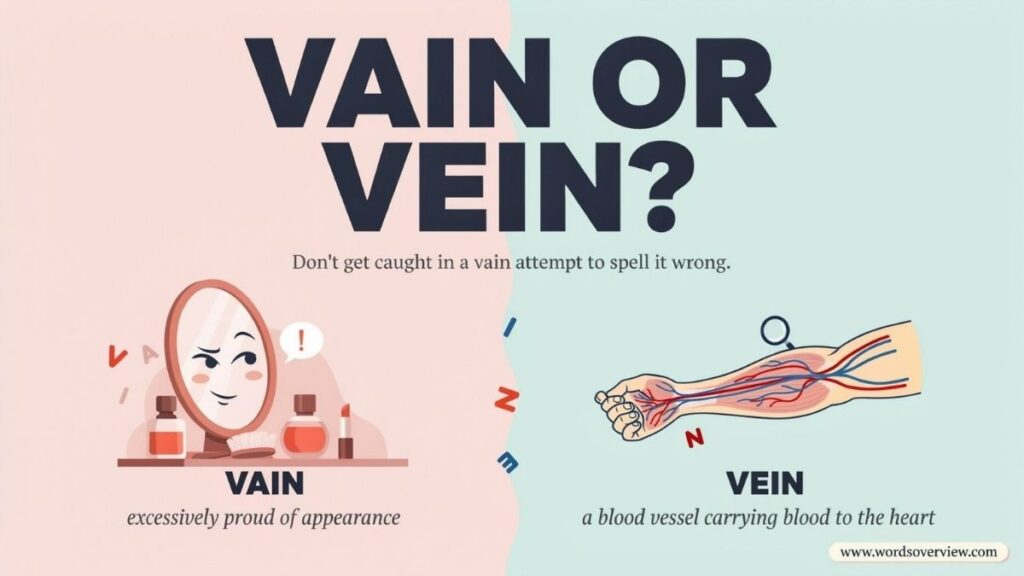
English loves to play tricks on your spelling. One moment you’re writing confidently and the next you’re wondering whether you need vain or vein. These words sound exactly alike yet they can send your sentence in completely different directions. A vain person may spend too much time admiring their reflection while a vein carries blood through the body. Confuse the two and you might accidentally turn a medical sentence into a comment about someone’s ego. Don’t worry, though. This mix-up is common because these homophones share the same pronunciation. Once you understand their meanings, uses and common expressions, choosing the correct word becomes surprisingly simple.
Vain or Vein Which Is Correct?
Both vain and vein are correct English words. However, they have different meanings and grammatical uses.
| Word | Part of Speech | Main Meaning | Example |
| Vain | Adjective | Too proud of appearance or abilities | She is vain about her appearance. |
| Vain | Adjective | Pointless or unsuccessful | Their efforts were in vain. |
| Vein | Noun | A blood vessel | The doctor examined the vein in his arm. |
| Vein | Noun | A style, manner or line of thought | The writer continued in the same vein. |
So, vain or vein which is correct depends on the sentence.
If you mean excessive pride or something unsuccessful then choose vain. If you mean a blood vessel or a particular style or direction then choose vein.
Vain Meaning and Definition
Vain is an adjective with several related meanings. Most commonly, it describes someone who has an excessive sense of pride in their appearance, abilities or achievements.
For example:
She is vain about her appearance.
Here, vain means that she cares too much about how she looks.
However, vain has another important meaning. It can describe an action that produces no useful result. In this sense, something happens without success or without achieving the desired result.
For example:
They searched for hours in vain.
The sentence means that they searched for hours but did not find what they wanted.
Vain as Excessive Pride
When you call someone vain, you usually suggest that the person thinks too highly of their appearance or achievements.
Consider these examples:
- He is vain about his hair.
- She spends hours checking her appearance because she is vain.
- The actor seemed vain about his popularity.
- His vain attitude annoyed his coworkers.
- She has always been somewhat vain about her looks.
In each example, vain describes excessive self-admiration.
Words such as conceited, self-centered, self-admiring and self-important can sometimes have similar meanings. However, they do not always work as exact replacements.
Vain Meaning Pointless or Unsuccessful
Vain can also mean useless, futile or unsuccessful.
For example:
All our efforts were in vain.
This means that the efforts produced no useful result.
Similarly:
He tried in vain to open the locked door.
The person tried to open the door but failed.
Therefore, the expression in vain often carries the idea of failure, wasted effort or an unsuccessful attempt.
Vein Meaning and Definition
Vein is a noun. Its most common literal meaning refers to a blood vessel that carries blood toward the heart.
For example:
The nurse found a vein in his arm.
Your body contains many veins that help return blood to the heart. Veins form an important part of the circulatory system.
However, vein also has figurative meanings. It can describe a particular style, mood, manner or direction of thought.
For example:
The comedian continued in the same vein during the second half of the show.
Here, vein does not refer to a blood vessel. Instead, it describes the same style or manner.
Vein in Medical Contexts
You will often see vein in medical or biological contexts.
Examples include:
- The doctor inserted the needle into a vein.
- The vein in his arm was clearly visible.
- Blood travels through veins toward the heart.
- The nurse searched for a suitable vein.
- Some veins become more visible after exercise.
In these sentences, vein has its literal biological meaning.
Vein in Figurative Contexts
English also uses vein figuratively.
For example:
The article continues in a humorous vein.
Here, vein means a particular style or tone.
You might also see:
- in the same vein
- in a similar vein
- in a different vein
- in a humorous vein
- in a serious vein
These expressions usually describe a style, approach or line of thought.
Learn the difference between confusing more English words
Businesses or Business’s: Which Is Correct?
Vain vs Vein The Main Difference
The simplest way to understand the difference between vain and vein is to connect each word with its core meaning.
Vain relates to excessive pride or unsuccessful effort.
Vein relates to blood vessels or a particular style or manner.
| Feature | Vain | Vein |
| Word type | Adjective | Noun |
| Common meaning | Excessively proud | Blood vessel |
| Another meaning | Pointless or unsuccessful | Style or manner |
| Common expression | In vain | In the same vein |
| Example | He is vain about his appearance. | A vein carries blood toward the heart. |
Because both words sound alike, spelling creates the main challenge.
Vain vs Vein Pronunciation
Vain and vein are homophones in standard English. That means they have the same pronunciation but different spellings and meanings.
They both have the long a sound found in words such as rain and train.
So when someone says either word aloud, you usually cannot determine which spelling they mean from pronunciation alone. You need to use the surrounding context.
For example:
She is vain about her appearance.
The context tells you that vain refers to excessive pride.
Now consider:
The doctor examined the vein.
The context clearly points to the blood vessel.
Therefore, pronunciation cannot always solve the spelling problem. Meaning provides the clue.
Are Vain and Vein Homophones?
Yes. Vain and vein are homophones because they share the same pronunciation while having different spellings and meanings.
This explains why vain or vein spelling can become confusing when you hear the word rather than see it written.
Other common English homophones include:
- right and write
- pair and pear
- flower and flour
- fair and fare
- son and sun
Likewise, vain and vein sound the same but function differently in sentences.
Vain and Vein Grammar
Grammar provides another useful way to separate these words.
Vain works as an adjective.
For example:
He is vain.
Here, vain describes the person.
You can also place it before a noun:
She has a vain attitude.
In contrast, vein works as a noun.
For example:
The vein is visible.
You can also use it with determiners and modifiers:
A vein was visible on his hand.
Because their grammatical roles differ, the words usually appear in very different sentence structures.
Learn the difference between commonly misused words
Palate or Palette: Which Is Correct?
Vain or Vein in a Sentence
Looking at the words in complete sentences makes the difference much easier to understand.
| Word | Sentence | Meaning |
| Vain | She is vain about her appearance. | Excessively proud |
| Vain | His attempt was in vain. | Unsuccessful |
| Vain | They searched in vain for the missing file. | Without success |
| Vein | The nurse located a vein. | Blood vessel |
| Vein | The writer continued in the same vein. | Same style |
| Vein | The speech took a humorous vein. | Particular style or tone |
These examples show why you should never choose between vain and vein based only on pronunciation.
Instead, ask what the word means in the sentence.
Common Expressions With Vain
The expression in vain is one of the most common uses of vain.
In Vain
In vain means without success or without achieving the intended result.
For example:
We tried in vain to contact him.
The sentence means that the attempt failed.
Learn the difference between more words people mix up
Personalise or Personalize: Which Spelling Is Correct?
Take Someone’s Name in Vain
You may also encounter the expression take someone’s name in vain.
It generally means using someone’s name carelessly, disrespectfully or without proper respect. The expression often appears in religious contexts when referring to God’s name.
For example:
The commandment warns against taking God’s name in vain.
The exact interpretation can depend on the religious or cultural context.
Died in Vain or Vein?
The correct expression is died in vain.
For example:
They believed that the soldiers did not die in vain.
Here, vain means that the sacrifice was not pointless. The phrase does not refer to a blood vessel.
Therefore:
Died in vain = correct
Died in vein = incorrect
This is an especially useful example because people sometimes confuse the two words when they hear the phrase aloud.
Learn the difference between everyday English mistakes
Slushy or Slushie: Correct Spelling, Meaning and Usage
Common Expressions With Vein
The word vein appears in several expressions that describe style, manner or direction.
In the Same Vein
In the same vein means in a similar style, manner or direction.
For example:
The second article follows the first one in the same vein.
The sentence means that both articles share a similar style or approach.
In a Similar Vein
This expression has almost the same meaning.
For example:
She told another story in a similar vein.
The second story uses a similar style or tone.
In a Different Vein
This expression means that something changes to a different style, mood or approach.
For example:
The director later moved in a different vein.
The director changed the style or direction.
Vain Sentence Examples
If you want to understand vain examples clearly, focus on the idea of pride or unsuccessful effort.
Here are several examples:
- She is vain about her appearance.
- He became vain after receiving constant praise.
- The vain actor checked his reflection before leaving.
- Her attempts to persuade him were in vain.
- They searched in vain for the missing document.
- He tried in vain to repair the old machine.
- All their efforts proved vain.
- The team fought hard but their efforts were in vain.
Notice that the first three examples focus on excessive pride. The remaining examples focus on unsuccessful effort.
Vein Sentence Examples
For vein sentence examples, look for either a blood vessel or a particular style or direction.
Examples include:
- The doctor examined the vein in his arm.
- The nurse inserted the needle into a vein.
- A prominent vein appeared on his hand.
- Blood travels through veins toward the heart.
- The writer continued in the same vein.
- She made another joke in a similar vein.
- The discussion moved in a different vein.
- The artist worked in a humorous vein.
The first four examples use vein literally. The last four use it figuratively.
Learn the difference between similar English words
Sole or Soul: Difference In Meaning And Usage
Vain vs Vein vs Vane
There is a third word that often joins this confusing group: vane.
All three words sound the same in many varieties of English. However, their meanings differ completely.
| Word | Meaning | Example |
| Vain | Excessively proud or unsuccessful | He is vain about his appearance. |
| Vein | Blood vessel or style | The doctor examined his vein. |
| Vane | A flat object that turns or indicates direction | The weather vane showed the wind direction. |
What Does Vane Mean?
A vane is a flat or blade-like object that responds to wind or helps control movement.
The most familiar example is a weather vane. It rotates in the wind and indicates its direction.
For example:
The weather vane pointed north.
Therefore, remember the three words like this:
- Vain = pride or failure
- Vein = blood vessel or style
- Vane = wind direction or blade
Learn how to use confusing more words correctly
Organiser or Organizer: Which Spelling Is Correct?
Common Mistakes With Vain and Vein
Because the words sound identical, spelling mistakes often occur when someone writes from memory.
Here are some common errors:
| Incorrect | Correct | Reason |
| He is vein about his looks. | He is vain about his looks. | Vain describes excessive pride. |
| The doctor examined his vain. | The doctor examined his vein. | Vein means a blood vessel. |
| They searched in vein. | They searched in vain. | The expression is in vain. |
| He died in vein. | He died in vain. | The phrase refers to a pointless sacrifice. |
| She continued in the same vain. | She continued in the same vein. | Vein means style or manner here. |
| The vain pointed north. | The vane pointed north. | A vane can indicate wind direction. |
The best correction method involves meaning rather than pronunciation.
How to Remember Vain vs Vein
A simple memory trick can make these words much easier.
Think of vain as connected with vanity.
Both words begin with va:
Vain → vanity → excessive pride
Now connect vein with your body:
Vein → blood vessel
For the third word, remember:
Vane → weather vane → wind
This gives you a quick three-word memory system:
Vain = vanity
Vein = blood
Vane = wind
Another useful trick involves common expressions.
Remember:
in vain
but:
in the same vein
Once you learn these fixed expressions, you can often identify the correct spelling automatically.
Learn the difference between similar English words
Invision or Envision Which Spelling Is Correct?
Vain or Vein: How to Choose the Correct Word
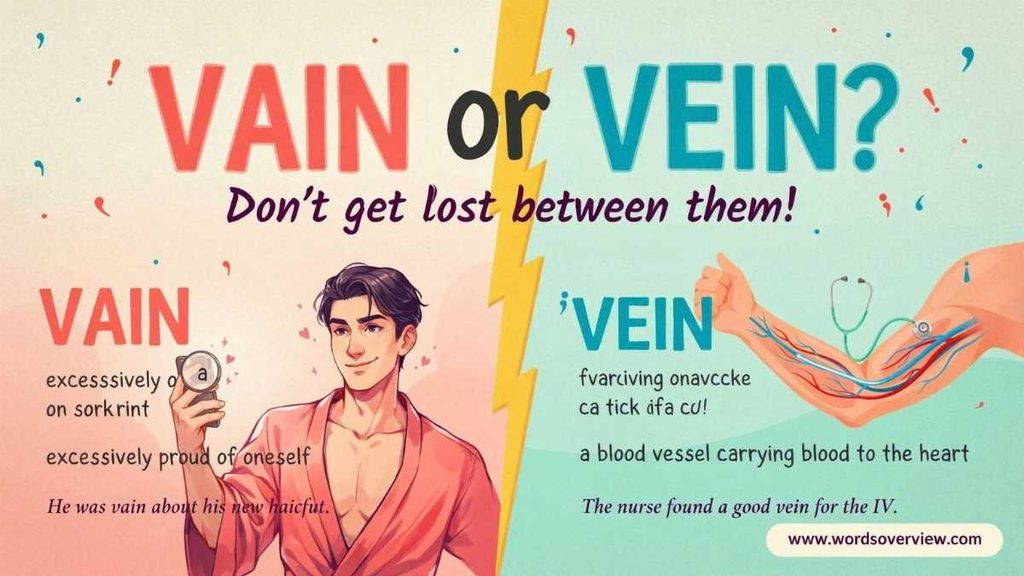
When you aren’t sure whether to use vain or vein, don’t rely on sound. Instead, ask what the sentence means.
1: Use vain when:
- You describe excessive pride.
- You describe someone who admires themselves too much.
- You describe an unsuccessful effort.
- You use the expression in vain.
- You use the expression take someone’s name in vain.
2: Use vein when:
- You mean a blood vessel.
- You discuss blood flow.
- You describe a particular style or manner.
- You use in the same vein.
- You use in a similar vein.
- You use in a different vein.
3: Use vane when:
- You mean a weather vane.
- You describe an object that indicates wind direction.
- You refer to a blade-like structure that moves with air or fluid.
Therefore, the meaning of the sentence should guide your spelling.
Vain or Vein Synonyms
The synonyms also reveal the difference between the two words.
1: For vain meaning excessively proud, possible synonyms include:
- conceited
- self-important
- self-admiring
- boastful
- self-centered
2: For vain meaning unsuccessful, possible synonyms include:
- futile
- pointless
- useless
- unsuccessful
- fruitless
- ineffective
3″ For vein meaning a blood vessel, related terms include:
- blood vessel
- vessel
- circulatory vessel
4: For vein meaning style or manner, related words include:
- style
- manner
- tone
- approach
- direction
However, synonyms do not always work in exactly the same grammatical or contextual way. Therefore, check the sentence before replacing one word with another.
Learn the difference between confusing word pairs
Doggy or Doggie: Which Spelling Is Correct?
Vain and Vein Quick Comparison
| Question | Vain | Vein |
| Is it a real English word? | Yes | Yes |
| Is it usually an adjective? | Yes | No |
| Is it usually a noun? | No | Yes |
| Can it describe pride? | Yes | No |
| Can it describe failure? | Yes | No |
| Can it mean a blood vessel? | No | Yes |
| Can it describe a style? | No | Yes |
| Does it sound like the other word? | Yes | Yes |
Why Are Vain and Vein Confusing Words?
The main reason is simple: they sound the same.
When you hear someone say either word, you receive no spelling clue. The listener must use context to determine the intended meaning.
For example:
His efforts were in vain.
The meaning makes vain obvious because English uses the fixed expression in vain.
However:
The nurse located a vein.
The medical context makes vein obvious.
This pattern appears throughout English. Homophones often create spelling problems because pronunciation cannot distinguish them.
The solution is not to memorize pronunciation. Instead, connect each spelling with its meaning and common expressions.
How to Spell Vain or Vein Correctly
- If you are asking how to spell vain or vein, first identify the meaning.
- If the word describes pride then spell it vain.
- If the word describes a blood vessel then spell it vein.
- If the word appears in in vain then use vain.
- If the word appears in in the same vein then use vein.
- If the word refers to a weather indicator then use vane.
This approach works much better than trying to remember the spelling from sound alone.
Learn the difference between commonly misused words
Fair or Fare: Which Is Correct?
Vain or Vein: Examples in Context
The following examples bring the distinction together.
| Sentence | Correct Word | Meaning |
| She is vain about her appearance. | Vain | Excessively proud |
| His efforts were in vain. | Vain | Unsuccessful |
| They searched in vain for the key. | Vain | Without success |
| The doctor examined the vein. | Vein | Blood vessel |
| The writer continued in the same vein. | Vein | Similar style |
| The weather vane pointed east. | Vane | Wind direction |
These examples cover the most common meanings and expressions.
Practice Session
Fill in each blank with vain, vein or vane.
- She is quite ___ about her appearance.
- The nurse carefully located a ___ in his arm.
- They searched ___ for the missing keys.
- The writer continued in the same ___.
- The weather ___ showed the direction of the wind.
- He tried in ___ to convince his friend.
- The doctor examined the ___ closely.
- His ___ attitude made him difficult to work with.
- The soldiers did not die in ___.
- She wrote another story in a similar ___.
- The ___ turned as the wind changed direction.
- He became ___ after receiving constant praise.
- Blood travels through the ___ toward the heart.
- Their efforts were completely ___.
- The speaker continued in the same ___.
- She spends too much time admiring herself because she is ___.
- A prominent ___ was visible on his hand.
- The weather ___ pointed north.
- They tried in ___ to repair the broken machine.
- The artist worked in a humorous ___.
- He is ___ about his achievements.
- The nurse inserted the needle into a ___.
- The discussion moved in a different ___.
- Her attempt to find the document was in ___.
- The ___ indicated that the wind was coming from the east.
Answer Session
- vain
- vein
- vain
- vein
- vane
- vain
- vein
- vain
- vain
- vein
- vane
- vain
- vein
- vain
- vein
- vain
- vein
- vane
- vain
- vein
- vain
- vein
- vein
- vain
- vane
Frequently Asked Questions
What does the word “vain” mean?
Vain is an adjective that usually describes someone who has excessive pride in their appearance abilities or achievements. It can also mean pointless or unsuccessful as in the phrase “in vain.”
What does it mean if someone calls you vain?
If someone calls you vain they usually mean that you care too much about your appearance or think too highly of yourself. Depending on the context the word can sound critical or insulting.
What is the difference between vain and vein?
Vain usually means excessively proud or unsuccessful. Vein usually means a blood vessel that carries blood toward the heart. Vein can also describe a particular style manner or line of thought.
Which is correct: “in vein” or “in vain”?
The correct expression is “in vain.” It means without success or without achieving the desired result. For example: “She tried in vain to open the door.”
What is the difference between “the bane of my existence” and “vain of my existence”?
The correct phrase is “the bane of my existence.” Bane means something that causes continual trouble annoyance or misery. Vain does not belong in this expression.
What does “in the same vein” mean?
“In the same vein” means in a similar style manner tone or line of thought. For example: “The author wrote another article in the same vein.”
Are vain and vein homophones?
Yes. Vain and vein are homophones because they have the same pronunciation but different spellings and meanings. Context helps you determine which word belongs in a sentence.
What is a vain person like?
A vain person often places excessive importance on their appearance abilities or achievements. They may frequently seek admiration or pay unusual attention to how others perceive them.
What is another word for vain?
When vain means excessively proud possible alternatives include conceited, self-important, self-admiring and self-centered. When vain means unsuccessful alternatives include futile, pointless, fruitless and ineffective.
What does “vane” mean and how is it different from vain and vein?
A vane is a flat or blade-like object that responds to wind or indicates its direction. A weather vane is a familiar example. Therefore vain relates to pride or failure vein relates to blood vessels or style and vane relates to wind or directional movement.
Conclusion
Confusing vain or vein can make even a simple sentence take a surprising detour. Fortunately, the difference becomes easy once you focus on meaning instead of sound. Vain describes excessive pride or something unsuccessful. Vein usually refers to a blood vessel or a particular style or manner. Meanwhile, vane joins the party when you’re talking about wind direction. Remember the simple trick: vain connects with vanity, vein carries blood and vane catches the wind. Because these words sound alike, context matters every time. Master these distinctions and your writing can stay clear without letting one tiny spelling mistake turn confidence into confusion.

Ethan AJS is an experienced blogger and language enthusiast at Words Overview, dedicated to making English easier to understand and use. He writes about grammar, vocabulary, spelling, word meanings and commonly confused words, turning tricky language questions into clear, practical insights. With a passion for effective communication, Ethan creates engaging, readerfocused content that helps readers write accurately, choose the right words and communicate with confidence.




