
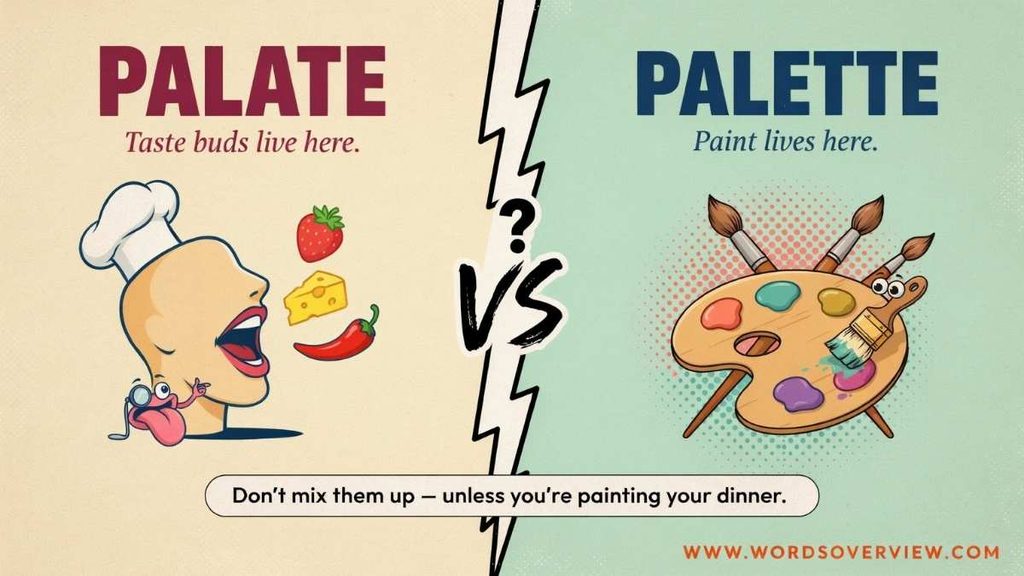
Have you ever written “palette” when you meant your sense of taste? You’re not alone. The confusion between palate or palette can turn a simple sentence about food into an unexpected art lesson. Imagine praising a chef’s colorful dish by saying you have a “vibrant palette” when you actually mean you have a refined palate. Suddenly, you sound more like a painter than a food critic! These words sound alike but carry completely different meanings. One relates to your mouth, taste and food preferences while the other refers to colors, painting and design. Understanding the difference will help you choose the right word every time.
Palate or Palette Quick Answer
The simplest way to understand palate or palette meaning is to connect each word with its subject.
| Word | Meaning | Common Context | Example |
| Palate | The roof of the mouth; a person’s sense or appreciation of taste | Anatomy, food and flavor | The spicy dish pleased her palate. |
| Palette | An artist’s board for mixing paint; a range of colors | Painting, art and design | The designer chose a soft blue palette. |
Therefore:
- Palate = mouth and taste
- Palette = paint and colors
For example:
The chef created a dish that appealed to my palate.
The artist selected a warm palette for the painting.
These words aren’t interchangeable. Although they sound the same, they describe different things.
Palate Meaning and Definition
The palate meaning has two closely connected uses. First, palate describes the structure that forms the roof of the mouth. Second, it can describe someone’s sense of taste or their preference for particular foods and flavors.
This gives the word both a literal and a figurative meaning.
When doctors or other health professionals use palate, they generally mean part of the anatomy of the mouth. When food writers, chefs or wine enthusiasts use it, they often refer to a person’s ability to experience and appreciate flavor.
Palate Definition in Anatomy
The palate definition in anatomy is the roof of the mouth. It separates the oral cavity from the nasal cavity and consists of two main sections: the hard palate and the soft palate.
The hard palate forms the front portion. Because it contains bone, it provides a firm surface inside the mouth.
The soft palate lies behind it. Unlike the hard palate, the soft palate consists mainly of muscle and connective tissue.
The two sections work together during everyday activities such as eating, swallowing and speaking.
So when someone asks, “Is palate the roof of your mouth?”, the answer is yes. More precisely, the palate forms the roof of the mouth and includes both its hard and soft portions.
Hard Palate
The hard palate sits behind the upper teeth and forms the firm front part of the roof of the mouth. Its structure helps separate the oral cavity from the nasal cavity.
It also provides a stable surface that supports several functions related to eating and speaking.
Soft Palate
The soft palate sits farther back in the mouth. It doesn’t contain bone like the hard palate does.
During swallowing, the soft palate moves upward and helps prevent food or liquid from entering the nasal passage. Its movement also contributes to normal speech.
Therefore, the word palate has a genuine anatomical meaning. It doesn’t simply mean “taste.”
Learn how to use confusing more words correctly
Organiser or Organizer: Which Spelling Is Correct?
Palate as Taste and Preference
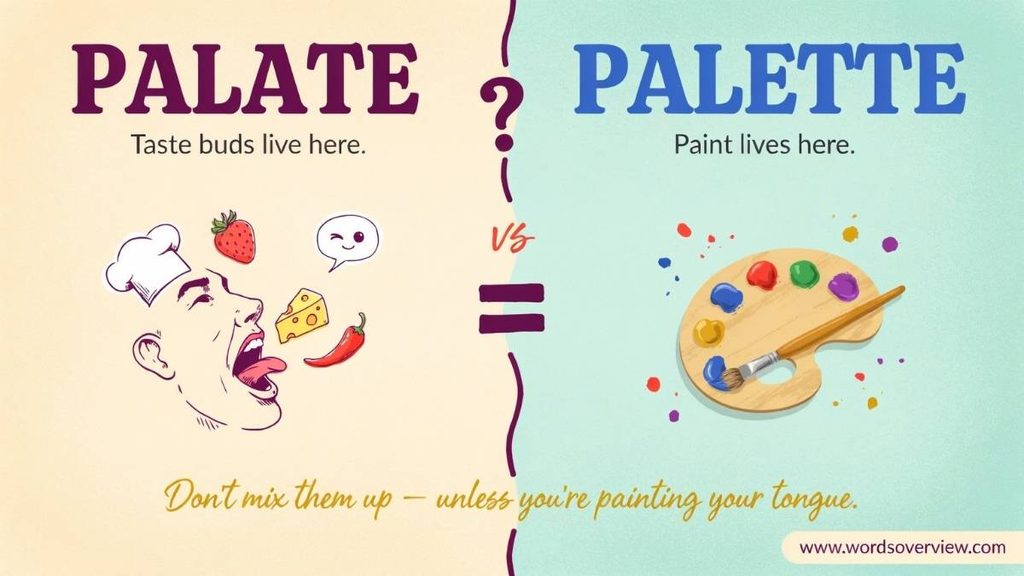
In everyday English, palate often describes someone’s sense of taste and preference.
Consider this sentence:
She has a refined palate and can recognize subtle spices in a dish.
Here, palate doesn’t refer to the physical roof of the mouth. Instead, it describes her ability to notice and appreciate differences in flavor.
This usage appears frequently in discussions about:
- food
- cooking
- wine
- cuisine
- tasting
- flavor
- restaurants
- culinary preferences
You may also see expressions such as refined palate, discerning palate, sophisticated palate, sensitive palate and culinary palate.
A person with a refined palate can often recognize subtle differences in ingredients or preparation. However, the phrase doesn’t mean that the person has a completely different biological sense of taste. Experience also matters.
Repeated tasting can help someone recognize acidity, sweetness, bitterness, spice, texture and other characteristics more accurately. In other words, people can develop a palate through experience.
Palate and Taste Buds Are Not the Same
Learn the difference between commonly confused words in English
Pair or Pare: Meaning, Difference and Use Correctly
It’s useful to distinguish the word palate from taste buds.
Taste buds contain sensory receptors that respond to basic taste qualities. The word palate, when used figuratively, refers more broadly to a person’s appreciation of flavor and food.
Flavor itself involves more than taste buds. Smell also plays a major role in how people experience food.
Therefore, saying that someone has a sophisticated palate describes their developed appreciation of food and drink. It doesn’t mean that their palate itself functions as a special sensory organ.
What Does Palate Mean in Food?
In food writing, palate usually refers to someone’s experience or appreciation of flavor.
For example:
The creamy sauce was too rich for my palate.
The restaurant offers dishes designed for a sophisticated palate.
The wine has a smooth finish on the palate.
The word works especially well when writers discuss subtle characteristics such as sweetness, acidity, bitterness, spice, richness, aroma and balance.
One particularly common expression is palate cleanser.
A palate cleanser is something consumed between foods or courses to refresh the mouth before another flavor. Sorbet is a familiar example in formal dining.
The purpose isn’t simply to provide another taste. Instead, a palate cleanser can help reduce the lingering effect of a previous dish so the next course feels more distinct.
Palette Meaning and Definition
The palette meaning relates primarily to art and color.
Traditionally, a palette is a board or surface that an artist uses to hold and mix paint. Over time, the word developed a broader meaning. Today, palette can also describe a carefully selected range of colors used in an artwork or design.
This broader sense appears throughout modern creative fields.
Palette Definition in Art
The palette definition traditionally refers to an artist’s tool for holding and mixing pigments.
A painter may place several paint colors on a palette before applying them to a canvas. The artist can then mix those colors to create different shades and tones.
For example:
The painter mixed blue and yellow on her palette.
Here, palette describes a physical object.
The expression artist’s palette or painter’s palette therefore refers to the tool associated with painting.
Palette as a Range of Colors
Modern English uses palette far beyond traditional painting.
A designer can create a color palette for a website. An interior designer can choose a neutral palette for a room. A photographer can describe an image as having a warm or muted palette.
In these situations, no physical paint board needs to exist.
Instead, palette describes a deliberate selection of colors.
For example:
The website uses a neutral color palette with gray white and muted blue.
Here, palette means the group of colors chosen for the website’s visual appearance.
What Is a Color Palette?
A color palette is a selected group or range of colors used together in a visual project.
You can find color palettes in:
- graphic design
- websites
- branding
- photography
- fashion
- interior design
- illustration
- painting
- packaging
- advertising
A designer might select a warm color palette containing reds oranges and yellows. Another project might use a cool color palette built around blues and greens.
Other common descriptions include neutral palette, vibrant palette, limited palette, pastel palette and earth-tone palette.
A palette doesn’t require a fixed number of colors. Instead, it describes the colors chosen to create a particular visual style or color scheme.
Learn the difference between confusing English words step by step
Maximise or Maximize: Which Spelling Is Correct?
Palate or Palette What’s the Difference?
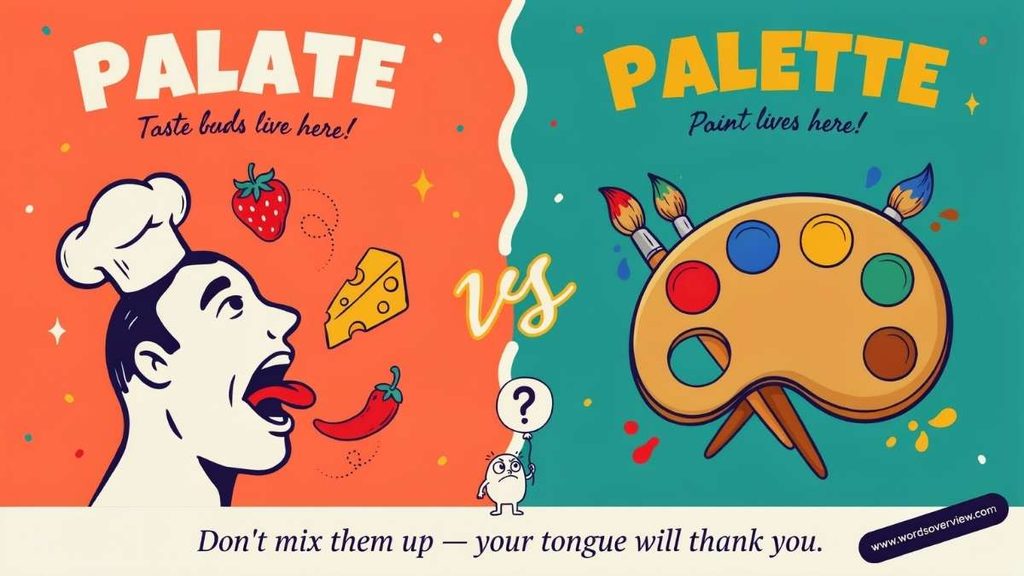
The difference between palate and palette comes down to meaning and context.
Palate relates to the mouth, taste or flavor preference.
Palette relates to painting, colors or visual design.
The following comparison makes the palate or palette meaning easier to see.
| Feature | Palate | Palette |
| Basic meaning | Roof of the mouth | Artist’s board for mixing paint |
| Extended meaning | Sense or appreciation of taste | Range or selection of colors |
| Main fields | Anatomy and food | Art and design |
| Common phrase | Refined palate | Color palette |
| Related concept | Taste and flavor | Hues and shades |
| Example | The soup pleased my palate. | The painting has a vibrant palette. |
The palate and palette difference becomes much clearer when you stop focusing on pronunciation and focus on meaning.
A Simple Rule
If you’re talking about food or taste, choose palate.
If you’re talking about paint or colors, choose palette.
For example:
The chef prepared a dish that suited her palate.
The designer selected a warm palette.
That simple distinction handles most everyday uses.
Are Palate and Palette Homophones?
Yes. In standard US English, palate and palette are homophones because they share the same pronunciation while having different spellings and meanings.
This places them among the many similar sounding words that require context to distinguish correctly.
English contains plenty of words that sound the same yet carry completely different meanings. In writing, spelling becomes the key distinction.
Palate or Palette Spelling
The palate or palette spelling difference is small but important.
Look at the two words:
palate
palette
The second word contains an additional t.
Palate Spelling
The correct palate spelling is:
P-A-L-A-T-E
It refers to the mouth or taste.
Palette Spelling
The correct palette spelling is:
P-A-L-E-T-T-E
It refers to an artist’s color-mixing tool or a selected range of colors.
The easiest visual comparison is:
- palate → one t
- palette → two t’s
However, counting letters alone won’t tell you what the words mean. You still need to connect each spelling with its correct context.
Learn the difference between tricky English words with easy explanations
Congrats or Congratulations: Which One Is Correct?
How to Remember Palate or Palette
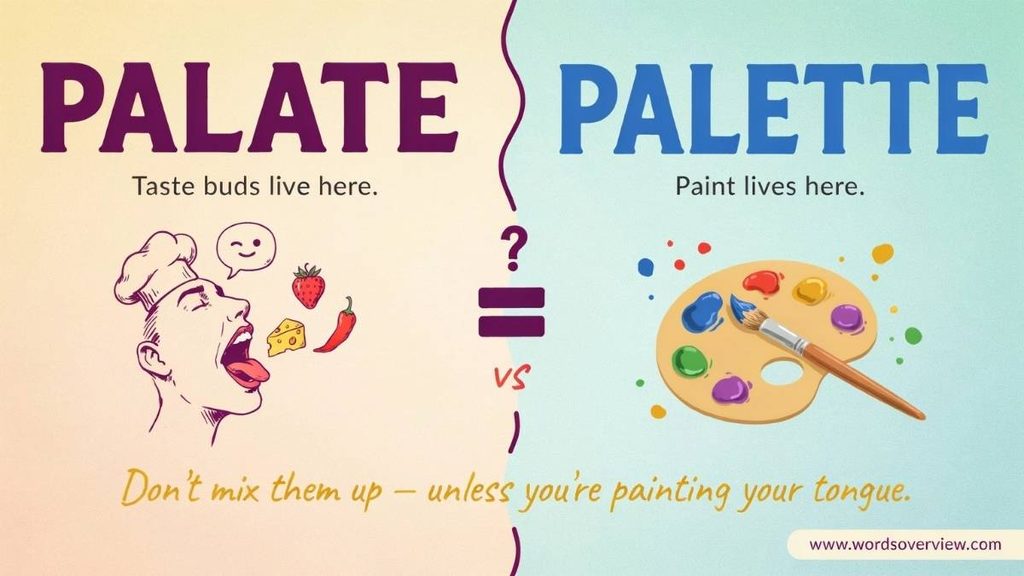
The best how to remember palate or palette strategy is to create a strong mental connection between each word and its meaning.
Palate Memory Trick
Think:
Palate → mouth → taste
When you’re writing about food, flavor or tasting, palate should come to mind.
A useful phrase to remember is:
refined palate
That phrase immediately connects palate with food and taste.
Palette Memory Trick
Think:
Palette → painter → paint → colors
The extra t in palette can serve as a visual reminder that the word belongs to the world of painting and color.
This is simply a memory aid. It isn’t an etymological rule.
Palate or Palette Mnemonic
A practical palate or palette mnemonic is:
Palate tastes. Palette paints.
It’s short and easy to recall.
Another useful association is:
Palate = plate of food. Palette = paint.
Again, this is only a memory trick. It helps connect the spelling with the correct meaning.
Palate or Palette Examples
Context provides the clearest way to master these commonly confused words.
Palate in a Sentence
Here are several examples of palate in a sentence:
- The chef prepared a dish that appealed to a sophisticated palate.
- The strong spices overwhelmed my palate.
- She has a discerning palate for fine wines.
- The dessert offers a balance of flavors that pleases the palate.
- The doctor examined the patient’s palate during the oral examination.
Each example connects palate with the mouth or taste.
Palette in a Sentence
Here are examples of palette in a sentence:
- The artist used a limited palette of colors.
- The designer created a warm color palette for the room.
- The photographer prefers a muted palette.
- The painting uses shades from a cool blue palette.
- The brand uses a neutral palette across its website.
Each example connects palette with colors or visual design.
Palate or Palette in a Sentence
Compare these sentences:
The spicy curry excited my palate.
The artist chose a bright palette.
The pronunciation doesn’t change. The meaning does.
That’s why palate or palette in a sentence questions are best solved through context.
Learn the difference between commonly misused words
Fair or Fare: Which Is Correct?
Palate and Palette in Different Contexts
Context provides one of the strongest clues when choosing between palate and palette.
Food and Taste
Use palate when you’re discussing food flavor or taste preferences.
Correct:
The restaurant serves dishes that suit a sophisticated palate.
Incorrect:
The restaurant serves dishes that suit a sophisticated palette.
The first sentence describes taste. Therefore, palate is correct.
Painting
Use palette when you’re talking about an artist’s colors or painting materials.
Correct:
The painter mixed several pigments on her palette.
Incorrect:
The painter mixed several pigments on her palate.
The second sentence accidentally refers to the roof of the mouth.
Graphic Design
Modern graphic design frequently uses palette to describe a coordinated group of colors.
For example:
The website uses a clean blue and gray color palette.
The term works because the designer has selected a group of colors to create a particular visual identity.
Interior Design
Interior designers also use palette when describing the colors chosen for a room.
For example:
The designer selected a neutral palette with warm beige and soft brown tones.
Here, palette describes the overall color selection.
Photography
Photographers can use palette to describe the colors that dominate an image.
For example:
The photograph has a muted palette of gray green and brown.
This usage connects palette with visual appearance rather than painting materials.
Learn the difference between everyday English mistakes
Slushy or Slushie: Correct Spelling, Meaning and Usage
Common Mistakes with Palate and Palette
Because palate and palette homophones sound alike, spelling mistakes are common.
Using Palette for Taste
Incorrect:
The meal was delightful to my palette.
Correct:
The meal was delightful to my palate.
Food and flavor require palate.
Using Palate for Colors
Incorrect:
The designer chose a warm palate.
Correct:
The designer chose a warm palette.
Colors require palette.
Treating Them as Interchangeable
Similar pronunciation doesn’t make two words interchangeable.
You can’t replace palate with palette simply because they sound alike. These are words with different meanings and words with different spellings.
The same principle applies to many other confusing words in English. Pronunciation may remain identical while meaning changes completely.
Relying Only on Sound
Suppose you hear someone say:
The artist used a beautiful palette.
You can’t determine the spelling from sound alone.
You need the meaning.
That’s why context provides a much more reliable way to solve palate spelling and palette spelling problems.
Learn the difference between tricky words and use them correctly
Many or Meny: Which Spelling Is Correct?
Palate and Palette: Common Expressions

Learning common expressions can make the distinction easier to remember.
Expressions with Palate
Common expressions include:
- refined palate
- discerning palate
- sophisticated palate
- sensitive palate
- culinary palate
- wine palate
- palate cleanser
- please the palate
- appeal to the palate
- cleanse the palate
- develop a palate
What Does “Refined Palate” Mean?
A refined palate describes someone who has developed a sophisticated ability to recognize and appreciate flavors.
For example:
Years of tasting different wines helped her develop a refined palate.
Experience plays an important role here. Someone who regularly tastes different cuisines may become better at noticing differences in ingredients preparation seasoning and balance.
A refined palate doesn’t necessarily mean someone enjoys expensive food. Instead, it describes an ability to recognize and appreciate flavor differences.
What Is a Palate Cleanser?
A palate cleanser is something used to refresh the mouth between foods or courses.
Sorbet is a well-known example. Restaurants may serve it between courses so the next dish doesn’t compete with lingering flavors from the previous one.
The phrase clearly belongs to palate because it concerns taste and the mouth.
Expressions with Palette
Common expressions include:
- artist’s palette
- painter’s palette
- paint palette
- color palette
- warm color palette
- cool color palette
- neutral palette
- limited palette
- vibrant palette
- visual palette
- design palette
What Is an Artist’s Palette?
An artist’s palette traditionally refers to a board or surface used to hold and mix paint.
An artist can place several pigments on the palette and mix them to create new colors or adjust existing ones.
Is Palette Only Used for Painting?
No. Modern English uses palette extensively outside traditional painting.
A website can have a color palette. A clothing collection can have a palette. An interior can have a palette. A photograph can have a visual palette.
The broader meaning simply refers to a selected range of colors.
Palate or Palette Word Origins
The two words may look closely related, but their historical development followed different paths.
Origin of Palate
Palate comes through Middle English and Old French from Latin palatum, which referred to the roof of the mouth.
Its original connection therefore centered on anatomy.
The later taste-related meaning developed naturally because the palate forms part of the mouth involved in eating and drinking. Over time, English speakers began using the word figuratively to describe someone’s appreciation of flavors.
Modern English consequently uses palate for both:
- the anatomical structure
- a person’s sense or appreciation of taste
Origin of Palette
Palette comes from French palette, which referred to a small board or related flat tool and later became associated with the artist’s board for holding and mixing pigments.
English adopted the term in connection with painting.
From there, its meaning expanded. A physical board containing paint led naturally to the idea of a collection of paint colors. That idea eventually broadened into the modern sense of a selected range of colors used in art and design.
The development can be summarized as:
artist’s board → paint colors → selected range of colors
This history explains why palette works naturally in modern graphic design interior design photography and branding.
Palate or Palette Plural Forms
The plural forms are straightforward.
The palate plural is palates.
The palette plural is palettes.
| Singular | Plural | Example |
| palate | palates | Different foods can appeal to different palates. |
| palette | palettes | Designers often test several color palettes. |
The spelling difference remains visible in both forms.
Learn the difference between confusing word pairs
Doggy or Doggie: Which Spelling Is Correct?
Palate or Palette Which One Should You Use?
When you’re unsure about palate or palette which is correct, identify the subject first.
Use Palate When You Mean:
- the roof of the mouth
- taste
- flavor
- food preferences
- wine tasting
- culinary appreciation
- the ability to distinguish flavors
Examples:
She has a discerning palate.
The dish was too spicy for my palate.
Use Palette When You Mean:
- an artist’s painting board
- paint colors
- a group of colors
- a color scheme
- visual design
- graphic design
- interior design
- photography
- branding
Examples:
The artist cleaned her palette.
The designer selected a warm palette.
This distinction answers the question when to use palate and when to use palette without requiring a complicated grammar rule.
Palate or Palette A Practical Decision Test
When the spelling doesn’t immediately come to mind, don’t rely on pronunciation. Instead, ask what the sentence describes.
Step 1: Identify the subject.
Is the sentence about the mouth or taste? If yes, choose palate.
Is it about paint or colors? If yes, choose palette.
Step 2: Look for related words.
Words such as food, flavor, wine, tasting and taste usually point toward palate.
Words such as paint, artist, canvas, colors, hues, design and shades usually point toward palette.
Step 3: Check the meaning.
Ask whether the word describes a taste experience or a visual color selection.
For example:
The chef created a menu for a sophisticated ______.
The sentence concerns taste. Therefore, the answer is palate.
Now consider:
The designer created a sophisticated ______ for the website.
The sentence concerns colors. Therefore, the answer is palette.
The surrounding context provides the answer.
Learn the difference between similar English words
Invision or Envision Which Spelling Is Correct?
Palate or Palette: A Real-World Writing Example
Imagine a restaurant reviewing a new seasonal menu. A writer might say:
The chef created a bold combination of citrus and herbs that challenges the palate.
Here, palate works because the sentence concerns taste.
Now imagine a designer creating the restaurant’s website:
The designer chose a warm palette of cream brown and deep green.
Here, palette works because the sentence concerns visual colors.
The two words can appear in the same broader context without becoming interchangeable.
For example:
The restaurant’s menu appeals to a sophisticated palate while its website uses a warm color palette.
This sentence demonstrates the palate and palette difference clearly. The first word relates to food. The second relates to colors.
Learn the difference between more words people mix up
Personalise or Personalize: Which Spelling Is Correct?
Palate or Palette: Complete Comparison
The following chart brings the main distinction together.
| Category | Palate | Palette |
| Spelling | P-A-L-A-T-E | P-A-L-E-T-T-E |
| Literal meaning | Roof of the mouth | Artist’s board for mixing paint |
| Figurative meaning | Taste or flavor preference | Range or selection of colors |
| Common fields | Anatomy food wine cooking | Art design photography branding |
| Common phrase | Refined palate | Color palette |
| Plural | Palates | Palettes |
| Memory clue | Palate tastes | Palette paints |
This is the core palate or palette meaning that matters in everyday writing.
Palate or Palette Final Memory Guide
If you remember only two things, remember these:
Palate = taste.
Palette = colors.
You can also use the phrase:
Palate tastes. Palette paints.
- When you see refined palate, think about food and flavor.
- When you see color palette, think about visual design.
- When you see palate cleanser, think about refreshing your sense of taste.
- When you see artist’s palette, think about paint and Pigment.
The pronunciation won’t help because these words are homophones in standard US English. Instead, let the meaning guide the spelling.
Practice Session
Fill in each blank with palate or palette.
- The chef has a refined ______ and can detect subtle flavors.
- The artist mixed several colors on her ______.
- This restaurant offers dishes designed for every ______.
- The designer chose a warm color ______ for the living room.
- The doctor examined the roof of the patient’s ______.
- The painter used a wooden ______ to mix the paint.
- A lemon sorbet can work as a ______ cleanser between courses.
- The website uses a neutral ______ of gray, white and beige.
- She has a sophisticated ______ for fine wines.
- The artist created a vibrant ______ for the new painting.
- Spicy foods can be challenging for a sensitive ______.
- The graphic designer selected a limited color ______.
- The soft ______ helps separate the mouth from the nasal cavity.
- The chef wanted to create a dish that would please every ______.
- He cleaned his ______ after tasting several rich dishes.
- The painter’s ______ contained red, blue, yellow and white paint.
- Her ______ has developed through years of tasting different cuisines.
- The interior designer experimented with a cool color ______.
- The dentist explained the difference between the hard and soft ______.
- The illustrator chose a bright ______ for the children’s book.
- Wine experts often develop a discerning ______.
- The artist carefully arranged her paint colors on the ______.
- The restaurant served a light dessert as a ______ cleanser.
- The photographer used a muted color ______ for the entire project.
- His sensitive ______ quickly noticed the extra amount of salt in the soup.
Answer Session
- palate
- palette
- palate
- palette
- palate
- palette
- palate
- palette
- palate
- palette
- palate
- palette
- palate
- palate
- palate
- palette
- palate
- palette
- palate
- palette
- palate
- palette
- palate
- palette
- palate
Frequently Asked Questions
Is it palate or palette?
Palate and palette are both correct words but they have different meanings. Palate relates to the roof of your mouth, your sense of taste or your food preferences. Palette refers to an artist’s board for mixing paint or a range of colors.
What is the difference between palate and palette?
The main difference is meaning. Palate is connected with the mouth and taste while palette is connected with painting, colors and design. They’re pronounced the same in standard US English but their spellings and meanings differ.
What does palate mean in English?
Palate has two common meanings. It can mean the roof of the mouth in anatomy or a person’s sense and appreciation of taste. For example, “She has a refined palate” means she can recognize and appreciate subtle flavors.
What does palette mean?
A palette can mean a flat board that an artist uses to hold and mix paint. It can also mean a particular range or selection of colors used in art, graphic design, fashion or interior design.
Is taste a palate or palette?
Taste is associated with palate, not palette. You can talk about your palate, a refined palate or a sensitive palate when describing your ability to taste and appreciate flavors.
Are palate and palette homophones?
Yes. Palate and palette are homophones in standard US English because they share the same pronunciation while having different spellings and meanings.
What is a color palette?
A color palette is a selected group or range of colors used together in an artwork, design or visual project. For example, a website might use a warm color palette featuring red orange and yellow tones.
What is a palate cleanser?
A palate cleanser is food or drink used between courses to refresh your sense of taste. Common examples include lemon sorbet and sparkling water. The expression can also describe something that provides a refreshing break from a previous experience.
What does it mean to have a refined palate?
Having a refined palate means you have a developed ability to notice and appreciate different flavors. Someone with a refined palate may detect subtle differences in ingredients, spices, textures or aromas.
What is the plural of palate and palette?
The plural of palate is palates. The plural of palette is palettes. For example, “The restaurant offers dishes for different palates” and “The designer tested several color palettes.”
Conclusion
The confusion between palate or palette makes sense because both words sound the same. However, their meanings have nothing to do with each other. Palate relates to the roof of your mouth, your sense of taste or your appreciation of flavors. Palette refers to an artist’s board for mixing paint or a selected range of colors.
A simple memory trick can save you from this spelling trap: palate tastes while palette paints. If you’re talking about food, flavor or taste preferences, choose palate. If you’re discussing painting, colors or design, choose palette.
Once you connect each spelling with its meaning, these commonly confused words become much easier to remember. Your next sentence won’t need an art teacher or a chef to correct it!

Ethan AJS is an experienced blogger and language enthusiast at Words Overview, dedicated to making English easier to understand and use. He writes about grammar, vocabulary, spelling, word meanings and commonly confused words, turning tricky language questions into clear, practical insights. With a passion for effective communication, Ethan creates engaging, readerfocused content that helps readers write accurately, choose the right words and communicate with confidence.




