
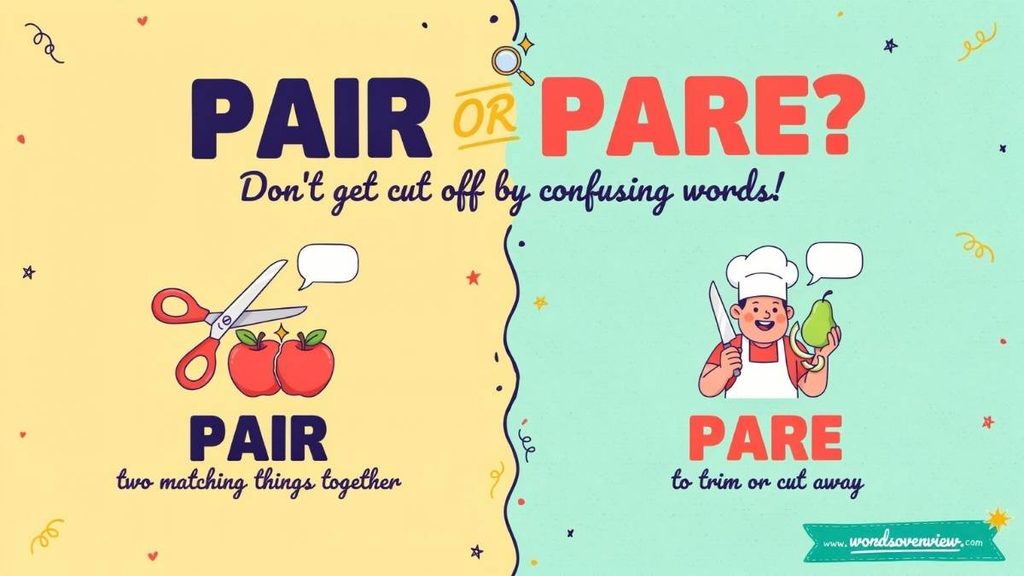
Have you ever written a sentence, reread it and suddenly wondered whether you meant to put two things together or trim something down? That’s exactly where Pair or Pare can cause trouble. These words sound identical, but their meanings couldn’t be more different. One brings things together, while the other cuts things down. A tiny spelling mistake can turn a perfectly clear sentence into a grammar puzzle. Don’t worry, though. Once you understand the difference, choosing the right word becomes surprisingly easy. In this guide, you’ll learn what pair and pare mean, how to use them correctly and simple tricks to remember which one fits your sentence.
Pair or Pare: Quick Answer
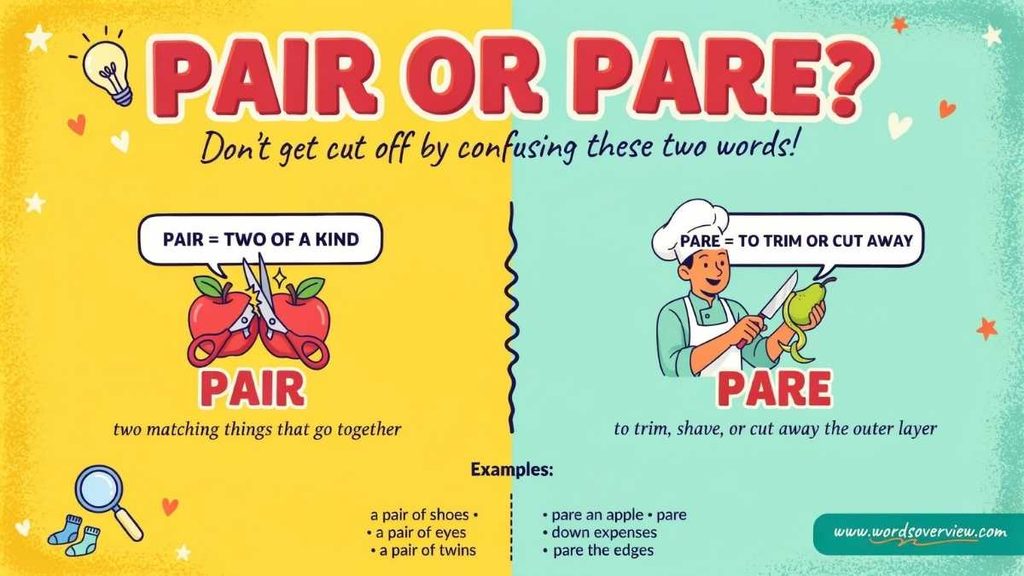
The easiest way to understand pair vs pare is to focus on the central meaning of each word.
| Word | Main meaning | Example |
| pair | Two people or things that belong together or are considered together | I bought a pair of shoes. |
| pare | To cut, trim or reduce something | Please pare the apple. |
| pear | A type of fruit | She ate a ripe pear. |
In simple terms:
- Pair = two or put two things together
- Pare = cut, trim or reduce
- Pear = a fruit
Consider these examples:
The teacher will pair the students for the exercise.
The chef will pare the vegetables.
She packed a pair of socks.
The company needs to pare down the budget.
The first and third sentences involve two people or things. The second and fourth involve cutting or reducing something.
Pair or Pare Examples
Here are a few quick pair or pare examples:
Pair:
I need a new pair of gloves.
Pare:
Use a sharp knife to pare the apple.
Pair:
The instructor decided to pair two students for the project.
Pare:
The editor had to pare down the article.
The pronunciation won’t tell you which spelling to choose. Instead, look at the meaning and context.
What Does Pair Mean?
The basic pair meaning is two people or things that belong together, match, correspond or are considered together.
For instance, shoes normally come as two matching items. Therefore, you can call them a pair of shoes.
The same idea applies to many everyday objects:
- a pair of shoes
- a pair of socks
- a pair of gloves
- a pair of earrings
- a pair of boots
- a pair of glasses
- a pair of binoculars
The word can also describe two people or animals considered together.
The pair of students worked together on the presentation.
Here, pair doesn’t mean that the students look alike. Instead, it simply identifies two students who form a group.
Pair Definition
The pair definition depends slightly on how you use the word. However, its central idea always involves two related or corresponding units.
As a noun, pair can refer to:
- Two matching or corresponding objects
- Two people doing something together
- Two animals considered together
- An object made from two joined parts
- Two things considered as a unit
For example:
The store sells each pair of earrings in a small box.
Here, pair refers to two earrings intended for use together.
The word can also describe people:
A pair of students presented the project.
In this sentence, the two students form a group of two.
Pair as a Noun
Pair as a noun is one of the most common uses of the word.
A common structure is:
a pair of + plural noun
For example:
- a pair of shoes
- a pair of socks
- a pair of gloves
- a pair of earrings
- a pair of students
- a pair of friends
- a pair of birds
Notice that the noun following of normally appears in the plural form.
She bought a pair of shoes.
The word pair tells you that there are two items. The plural noun shoes identifies those two items.
Some objects also use pair even though English treats the complete object as one unit. Examples include a pair of scissors and a pair of glasses.
Pair as a Verb
Pair can also work as a verb. In this form, it means to put two people or things together or arrange them so they work together.
For example:
The teacher will pair students for the speaking exercise.
You can also use pair with when two things complement each other.
This cheese pairs with fresh fruit.
Likewise:
The designer paired the blue shirt with dark trousers.
The verb can therefore describe people, objects, foods, colors, ideas or activities that work well together.
Pair Examples in Sentences
Here are several useful examples of pair in a sentence:
- I bought a pair of shoes for the trip.
- He lost one sock from his favorite pair of socks.
- The teacher asked us to pair two students for the activity.
- The two dancers were paired together for the performance.
- These colors pair well with neutral tones.
- Students worked in pairs during the exercise.
- The store sells each item as a matching pair.
- The coach decided to pair the players according to experience.
These examples show that pair can describe both a physical set of two and the action of bringing two people or things together.
Learn the difference between similar English words
Indecisive or Undecisive Which Word Is Correct?
What Does Pare Mean?
The pare meaning is quite different from the meaning of pair.
Pare means to cut away a thin outer layer from something, especially a fruit or vegetable. It can also mean to reduce the size, amount, number or scope of something by removing parts.
For example:
She pared the apple before cutting it into slices.
In this sentence, she removes part of the apple’s outer layer.
The word can also have a figurative meaning:
The company had to pare back costs.
Here, nobody physically cuts anything. Instead, the company reduces its costs.
Therefore, pare has both a literal and a figurative use. In both cases, however, the central idea involves removing something.
Pare Definition
The pare definition has two main applications.
Literal meaning: to remove an outer layer or cut something away.
Pare the skin from the apple.
Figurative meaning: to reduce something by removing parts of it.
The company pared its expenses.
The same basic idea connects both uses. Something becomes smaller because you remove part of it.
A useful memory rule is:
Pare = remove or reduce.
You can remove the skin from an apple. You can also remove unnecessary expenses from a budget.
Pare as a Verb
Pare functions as a verb in modern English.
Its common forms include:
| Verb form | Example |
| pare | I pare the apple. |
| pares | She pares the potato. |
| pared | He pared the vegetables. |
| paring | She is paring an apple. |
For example:
He pared the potato carefully.
She is paring the fruit.
When the word appears in a sentence, the context usually makes its meaning clear.
Pare Examples in Sentences
Here are useful examples of pare in a sentence:
- She used a knife to pare an apple.
- The cook began to pare the potatoes.
- Remove the damaged parts by paring away the outer layer.
- The editor pared away unnecessary sentences.
- The company decided to pare down costs.
- The team had to pare back its plans.
- The budget was pared down after funding changed.
- The writer pared the article down to its essential points.
These examples demonstrate both major uses of pare: physically cutting something and figuratively reducing something.
Learn the difference between similar English words
Analyses or Analysis Meaning and Correct Usage
Pair or Pare: What Is the Difference?
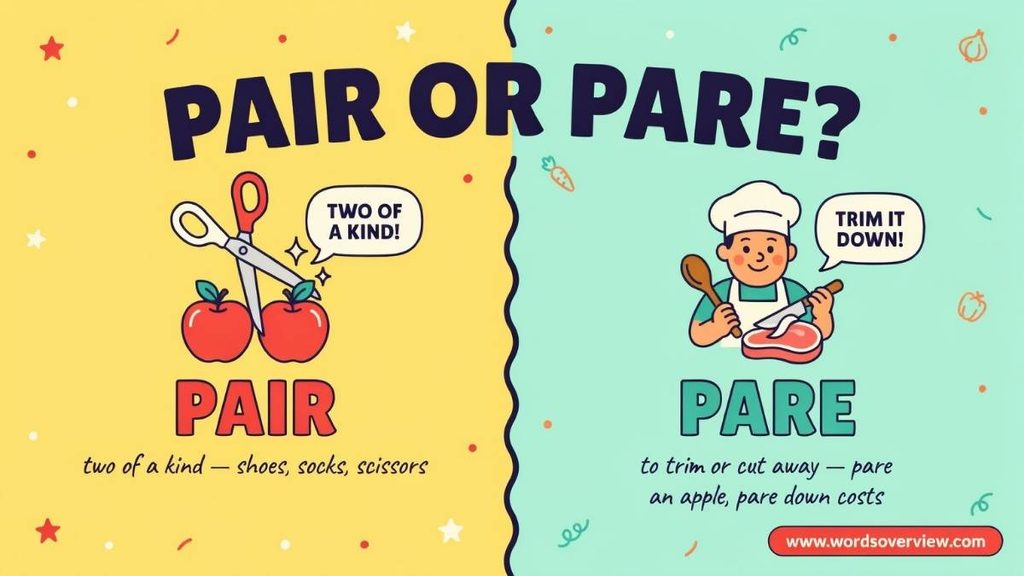
The difference between pair and pare becomes clear when you focus on their central ideas.
Pair concerns two related people or things.
Pare concerns removing, trimming or reducing something.
| Feature | Pair | Pare |
| Main word class | Noun and verb | Verb |
| Core idea | Two things together | Cut, trim or reduce |
| Common object use | Pair of shoes | Pare an apple |
| Common people use | Pair of students | Rare |
| Figurative use | Pair ideas or people | Pare down costs |
| Common expression | Pair up | Pare down |
| Example | Pair the students. | Pare the budget. |
Pair and Pare Difference in Real Sentences
Compare these sentences:
The teacher paired the students.
The teacher put the students into groups of two.
Now consider:
The teacher pared the students.
This sentence does not express the intended meaning. Pare relates to cutting or reducing, not normally to organizing students into groups.
Consider another example:
We need to pair the two devices.
Here, the speaker wants the devices to work together.
However:
We need to pare the two devices.
This sentence suggests cutting or removing something from the devices. Unless that is actually the intended action, pare is the wrong word.
The spelling depends on the meaning.
Learn the difference between confusing English words step by step
Maximise or Maximize: Which Spelling Is Correct?
Pair and Pare Pronunciation
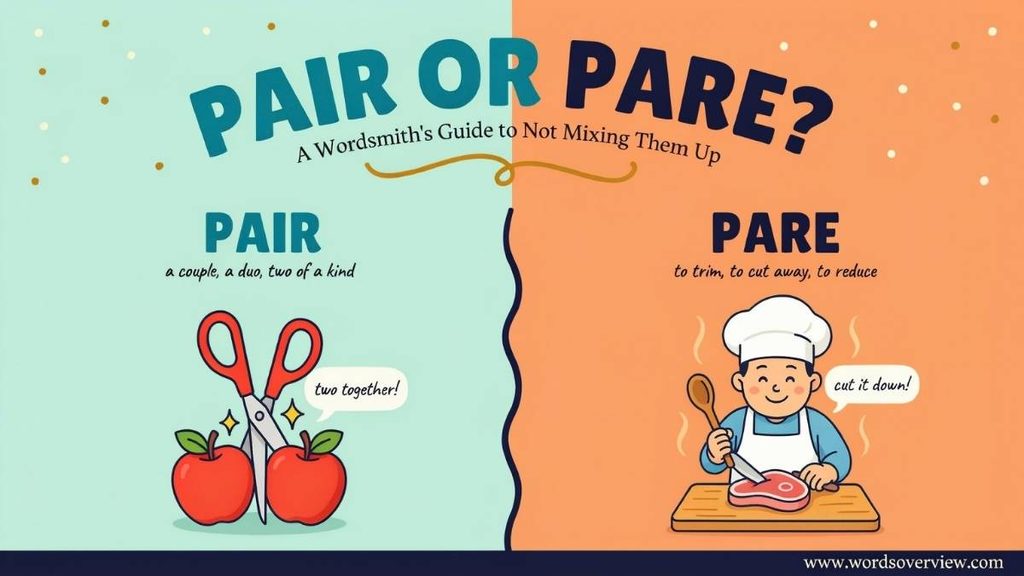
Pronunciation creates much of the confusion between these words.
In standard English, pair and pare are pronounced the same way. This makes them homophones.
The same pronunciation means that listening alone may not tell you which word someone means.
For example, imagine hearing:
“I need to ___ the apples.”
You can’t determine the spelling from the sound alone. However, the meaning gives you the answer:
“I need to pare the apples.”
The sentence describes cutting or removing part of the apples, so pare fits.
Are Pair and Pare Homophones?
Yes. Pair and pare are homophones because they have the same pronunciation but different spellings and meanings.
This relationship explains why people often confuse these words when writing.
For example:
Pair = two things or people considered together
Pare = cut, trim or reduce
The words sound alike, but their meanings have no such similarity.
Pair Pare Homophones
The phrase pair pare homophones refers to this exact sound-alike relationship.
However, the confusion becomes more interesting when pear enters the picture.
The three words are:
- pair — two related things or people
- pare — cut, trim or reduce
- pear — a fruit
Because all three share the same pronunciation in standard English, you need to use context to choose the correct spelling.
Pair, Pare and Pear: Don’t Mix Them Up
The pair vs pare vs pear distinction is one of the more memorable examples of English words that sound alike.
| Word | Part of speech | Meaning | Example |
| pair | Noun, verb | Two things together; put two things together | I bought a pair of gloves. |
| pare | Verb | Cut, trim, remove or reduce | Pare the apple before slicing it. |
| pear | Noun | A type of fruit | The pear was sweet. |
A simple memory system makes all three easier to remember:
Pair → two
Pare → trim
Pear → fruit
- If the sentence involves two matching items, choose pair.
- If something needs cutting, trimming or reducing, choose pare.
- If you’re talking about the fruit, choose pear.
Pair Pear Pare Meaning
The pair pear pare meaning becomes much easier when you connect each word to a visual idea.
Think about a pair of shoes. You have two shoes that belong together.
Then picture a knife being used to pare an apple. The knife removes part of the fruit.
Finally, picture a pear sitting in a fruit bowl.
The meanings are completely different even though the words sound alike.
Learn the difference between commonly mixed-up more words
Foward or Forward: Which Spelling Is Correct?
Common Expressions With Pair
Several common expressions use pair naturally.
Pair With
Pair with means to combine two people or things because they work well together.
For example:
This cheese pairs with fresh fruit.
The phrase can also describe people:
The teacher paired each student with a partner.
You can use it for food, colors, clothing, ideas, activities and people.
Pair Up
Pair up means to form a group of two or bring two people together.
Please pair up with a classmate.
The coach paired up the players for practice.
The expression remains connected to the central meaning of pair: two people or things together.
Pair Off
Pair off also means to form pairs.
The students paired off for the exercise.
The phrase often describes people dividing themselves into groups of two.
A Pair Of
A pair of is one of the most common noun structures in English.
Examples include:
- a pair of shoes
- a pair of socks
- a pair of gloves
- a pair of earrings
- a pair of scissors
- a pair of glasses
The phrase works particularly well for objects that naturally come in twos or contain two corresponding parts.
Common Expressions With Pare
The most useful expressions with pare involve cutting, removing or reducing.
Pare Down
Pare down means to reduce something by removing unnecessary parts.
For example:
The company needs to pare down the budget.
The editor pared down the report.
The team pared down the list to five candidates.
This expression explains why pair it down or pare it down is such a common spelling question.
When you mean “reduce it,” use pare it down.
Pare Back
Pare back also means to reduce something.
For example:
The organization had to pare back spending.
The company decided to pare back its expansion plans.
The designer pared back the decoration to create a simpler look.
Although pare down and pare back have similar meanings, the surrounding context can determine which expression sounds more natural.
Pare Away
Pare away means to remove material gradually or carefully.
For example:
The sculptor pared away excess material.
The editor pared away unnecessary details.
The physical image is straightforward: something becomes smaller because you remove material from it.
The expression can also work figuratively when someone removes unnecessary information.
Pair Up or Pare Down? Avoiding Common Confusion
These expressions can sound similar when spoken, but their meanings are completely different.
Pair Up Means Form a Group of Two
The instructor asked the students to pair up.
The students form groups of two.
Pare Down Means Reduce
The manager decided to pare down the budget.
The budget becomes smaller because someone removes expenses or other parts.
A simple question can help you choose the correct expression:
Are two people or things coming together?
Use pair.
Is something being removed or reduced?
Use pare.
Pair Back or Pare Back?
If you mean reduce, cut or scale back, use pare back.
The company had to pare back costs.
The writer pared back the introduction.
The organization pared back its spending.
The spelling pair back does not express this standard meaning.
The same principle applies to pare down:
We need to pare down the budget.
Not:
We need to pair down the budget.
The mistake occurs because both words sound alike. However, their meanings point in opposite directions: pair brings two things together, while pare removes something.
Learn the difference between tricky English words with easy explanations
Congrats or Congratulations: Which One Is Correct?
Pair or Pare Grammar
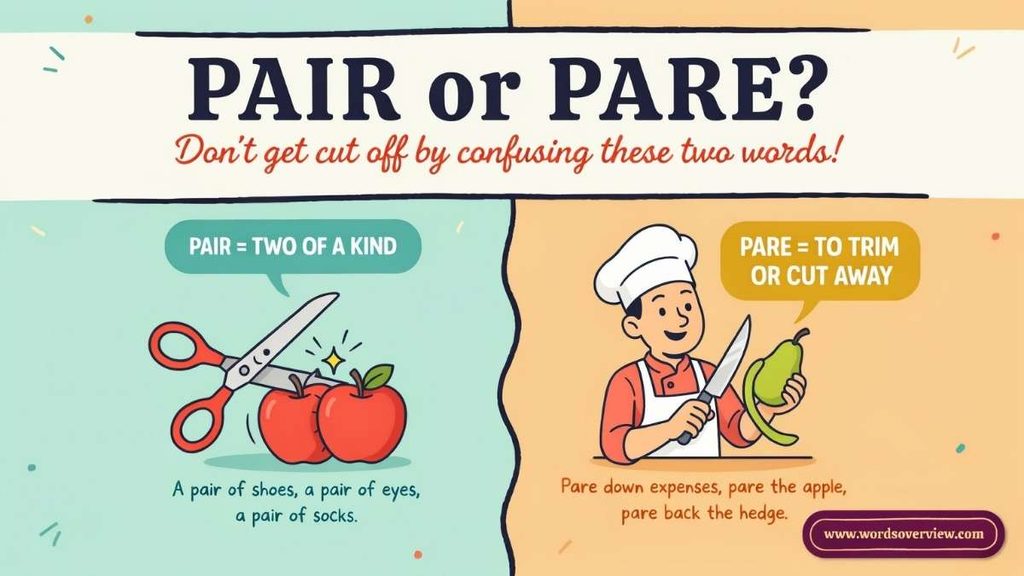
Understanding pair or pare grammar becomes easier once you identify each word’s grammatical role.
Pair can function as both a noun and a verb.
Pare functions as a verb.
| Word | Noun | Verb | Example |
| pair | Yes | Yes | a pair / pair the students |
| pare | No in standard modern use | Yes | pare an apple |
| pear | Yes | No | a pear |
Is Pair a Noun or Verb?
Pair can be either a noun or a verb.
As a noun:
- I bought a pair of shoes.
As a verb:
- Please pair the students.
The grammatical role depends on how the sentence uses the word.
Is Pare a Noun or Verb?
Pare functions as a verb.
For example:
She pared the apple.
Its common forms include pare, pares, pared and paring.
He pared the potato.
She is paring the fruit.
The word therefore follows normal verb patterns while retaining its core meaning of cutting, removing or reducing.
Pair or Pare: Common Mistakes
Because these words have the same pronunciation, writers sometimes choose the wrong spelling.
Pair Down or Pare Down
Incorrect:
We need to pair down the budget.
Correct:
We need to pare down the budget.
The sentence means “reduce the budget,” so pare is correct.
Pair Up or Pare Up
Correct:
The teacher asked the students to pair up.
The students form groups of two. Therefore, pair is the correct word.
Pair an Apple or Pare an Apple
Incorrect:
Please pair the apple before cutting it.
Correct:
Please pare the apple before cutting it.
The action involves removing the apple’s skin, so pare fits the meaning.
Pair Students or Pare Students
Correct:
The teacher will pair the students.
The teacher is putting students into groups of two.
Using pare would suggest cutting or reducing them, which is obviously not the intended meaning.
Learn the difference between basic English word mistakes
This Is She or This Is Her: Which Is Correct?
Pair or Pare Spelling: A Simple Memory Trick
The pair or pare spelling becomes much easier when you associate each word with a short mental cue.
Remember Pair With Two
Think:
Pair = two.
That works for:
- pair of shoes
- pair of socks
- pair of gloves
- pair of students
- pair of earrings
If you can replace the word with “two” or “put into groups of two,” pair is probably the right choice.
Remember Pare With Cutting
Think:
Pare = trim or reduce.
That works for:
- pare an apple
- pare vegetables
- pare away excess material
- pare down costs
- pare back spending
If you can replace the word with “cut,” “trim,” or “reduce,” choose pare.
Remember Pear With Food
Finally:
Pear = fruit.
This simple three-word association covers most pair vs pare vs pear spelling mistakes.
Pair or Pare Usage in Everyday Writing
The correct pair or pare usage depends on what the sentence describes.
In Cooking
Use pair when you combine foods that complement each other.
The chef paired the cheese with fresh fruit.
Use pare when you remove the skin or another outer layer.
The chef pared the apples.
The two words describe completely different actions.
In Education
Use pair when you put students together.
The teacher paired students for the speaking task.
You can also say:
Students worked in pairs.
Use pare only when the sentence genuinely describes cutting or reducing something.
In Business
Use pare when you reduce costs, expenses or plans.
The company plans to pare back expenses.
Use pair when you combine people or ideas.
The manager paired two employees on the project.
In Writing and Editing
Pare often appears in discussions about concise writing.
For example:
The editor pared down the introduction.
This means the editor removed unnecessary words or details.
Therefore, the figurative meaning of pare works naturally in writing, business, planning, design and other areas where people remove unnecessary elements.
Learn the difference between tricky grammar words
Studying or Studing: Which Spelling Is Correct?
Pair or Pare: How to Choose the Correct Word
If you’re still asking pair or pare which is correct, use the meaning-first approach.
Choose Pair When You Mean:
- two people
- two things
- matching items
- corresponding things
- a matching set of two
- putting two people together
- combining two things
- working with a partner
- something that works well with another thing
Choose Pare When You Mean:
- cut
- trim
- peel
- remove an outer layer
- cut away
- reduce in size
- reduce in number
- reduce an amount
- simplify
- remove unnecessary details
This gives you a practical answer to when to use pair or pare.
Ask yourself one question:
Am I bringing two things together or am I taking something away?
If you’re bringing two things together, choose pair.
If you’re taking something away, choose pare.
Pair or Pare: Practical Usage Test
When you’re unsure about the spelling, replace the word with a simpler phrase.
Suppose you write:
We need to ___ the expenses.
Try the word reduce.
We need to reduce the expenses.
Because the intended meaning involves reduction, pare fits:
We need to pare the expenses.
Now consider:
The teacher will ___ the students.
Try:
The teacher will put the students into groups of two.
That meaning points to pair:
The teacher will pair the students.
This method works because it focuses on meaning instead of pronunciation.
Pair and Pare Examples: Side-by-Side
The following table brings the most common uses together:
| Meaning | Correct word | Example |
| Two matching objects | pair | I found a matching pair of socks. |
| Two people working together | pair | The teacher paired two students. |
| Combine two things | pair | Pair the sauce with the vegetables. |
| Cut fruit skin | pare | Pare the apple before cooking it. |
| Remove material | pare | Pare away the damaged surface. |
| Reduce expenses | pare | The company must pare down costs. |
| Reduce a plan | pare | The team pared back its proposal. |
| A fruit | pear | She sliced a ripe pear. |
These pair and pare examples show why pronunciation alone cannot determine spelling. The context supplies the answer.
Learn the difference between tricky words and use them correctly
Many or Meny: Which Spelling Is Correct?
Pair and Pare Homonyms: Are They Homonyms?
The terms homophone and homonym can overlap depending on the definition a source uses. However, homophone is the more precise term for pair and pare.
A homophone is a word that sounds the same as another word but has a different meaning or spelling.
Therefore:
Pair and pare are homophones.
The same relationship applies to:
Pair, pare and pear
All three words sound alike in standard English, but they have different spellings and meanings.
Some broader definitions of homonym include words that share a pronunciation or spelling while having different meanings. That broader terminology explains why you may see the phrase pair pare Homonym in some discussions.
For clear English grammar and vocabulary writing, however, homophones provides the most specific description.
Learn the difference between confusing word pairs
Emigrate or Immigrate Difference, Meaning and Usage
Pair or Pare in British and American English
The pair or pare spelling does not change between standard British and American English.
Both varieties use:
- pair
- pare
- pear
Therefore, this isn’t a regional spelling issue.
Some pronunciation details differ between British and American accents. Nevertheless, speakers in both varieties distinguish the words through context when writing.
For example:
I bought a pair of shoes.
works in both American and British English.
Likewise:
Please pare the apple.
works in both varieties.
The main lesson is simple: meaning determines the spelling, not the variety of English.
Practice Session: Pair or Pare
Fill in each blank with pair or pare. Read each sentence carefully because both words sound the same.
- I bought a new ______ of shoes for the wedding.
- Please ______ the potatoes before cooking them.
- The teacher asked the students to ______ up for the activity.
- We need to ______ down the list to the most important items.
- She bought a ______ of earrings to match her dress.
- The chef used a knife to ______ the apple.
- These two colors ______ well together.
- The company decided to ______ back its unnecessary expenses.
- I need a ______ of scissors to cut this paper.
- You should ______ the excess fat from the meat.
- The coach told the players to ______ off for the exercise.
- We need to ______ the report down before submitting it.
- He lost one shoe from his favorite ______.
- The designer decided to ______ away some unnecessary details.
- Please ______ these students according to their skill levels.
- She used a small knife to ______ the skin from the fruit.
- A ______ of gloves was lying on the table.
- The manager wants to ______ back the project costs.
- These shoes ______ perfectly with my jacket.
- The editor had to ______ the article down to 1,000 words.
- I need another ______ of socks before my trip.
- The cook began to ______ the vegetables carefully.
- The two dancers were asked to ______ up for the performance.
- We should ______ the proposal to its essential points.
- The stylist chose a ______ of shoes that would ______ well with the outfit.
Answer Session
- pair
- pare
- pair
- pare
- pair
- pare
- pair
- pare
- pair
- pare
- pair
- pare
- pair
- pare
- pair
- pare
- pair
- pare
- pair
- pare
- pair
- pare
- pair
- pare
- pair, pair
Frequently Asked Questions
What does “pare” mean?
“Pare” means to cut away the outer layer of something or to reduce something by removing unnecessary parts. For example, you can pare an apple or pare down a long report.
Is “pare it back” or “pair it back” correct?
“Pare it back” is correct when you mean to reduce, simplify or scale something down. “Pair it back” is incorrect in this context because “pair” relates to two things being joined or matched.
Is it “pare down” or “pair down”?
The correct expression is “pare down.” It means to reduce something by removing unnecessary parts. For example, “We need to pare down the budget.”
Is “pare back” or “pair back” correct?
“Pare back” is the standard expression when you mean to reduce or make something less extensive. “Pair back” does not have this meaning.
Is “pare” a word?
Yes. Pare is a standard English verb. It means to trim, cut away or reduce something. For example, “She pared the recipe down to five ingredients.”
Are “pare” and “pair” homophones?
Yes. In standard English pronunciation, pare and pair are homophones because they sound the same but have different spellings and meanings. Pear, the fruit, is also pronounced the same way.
What do “pair,” “pare,” and “pear” mean?
Pair refers to two things considered together or to joining two things. Pare means to trim, cut or reduce. Pear is a type of fruit. Although all three words sound alike, their meanings and spellings are different.
How do you use “pare” in a sentence?
You can use pare when talking about trimming, cutting or reducing something. For example: “He decided to pare down his presentation to the most important points.”
What is another word for “pare”?
Depending on the context, synonyms for pare include trim, cut, reduce, prune, shorten and abridge. The best synonym depends on whether you mean physically removing part of something or making something smaller or simpler.
What is the difference between “pair” and “pare”?
Pair means two things together or the act of putting things together. Pare means to cut, trim or reduce. A simple memory trick is: pair brings things together, while pare takes something away.
Conclusion
The Pair or Pare confusion may seem small, but one letter can completely change your meaning. Pair is about two things coming together, while pare means to trim, cut or reduce something. Think of it this way: you pair your socks before leaving the house, but you pare down your luggage when the suitcase refuses to close. Simple, right?
When you see these words, focus on the action you want to describe. If you’re joining or matching things, choose pair. If you’re cutting or reducing something, choose pare. Once you connect each spelling with its meaning, this homophone mix-up becomes much easier to avoid.

Ethan AJS is an experienced blogger and language enthusiast at Words Overview, dedicated to making English easier to understand and use. He writes about grammar, vocabulary, spelling, word meanings and commonly confused words, turning tricky language questions into clear, practical insights. With a passion for effective communication, Ethan creates engaging, readerfocused content that helps readers write accurately, choose the right words and communicate with confidence.




