
Have you ever typed a simple word and suddenly wondered, “Wait, is it many or meny?” You’re not alone. English spelling has a talent for turning tiny letters into surprisingly big headaches. Swap the a in many for an *e and suddenly you have a word that looks plausible but doesn’t belong in standard English when you mean “a large number.” That little vowel can cause confusion in emails, assignments, messages and even careful writing. Fortunately, the solution is simple. This guide clears up the many or meny confusion, explains the grammar behind many and shows you how to use the correct spelling with confidence.
Many or Meny Quick Answer
If you’re wondering is it many or meny, the correct spelling is many.
Many is the standard English word used to refer to a large number of people or things. Meny is not the standard spelling of this word.
For example:
- Many students attended the class.
- She owns many books.
- We saw many cars on the road.
- Many people enjoy traveling.
- I have many questions about the topic.
In each sentence, replacing many with meny would create a spelling error.
| Spelling | Standard English? | Meaning |
| many | Yes | A large number of people or things |
| meny | No, when intended to mean many | Usually a misspelling |
Therefore, if you’re looking for the many or meny correct spelling, choose many.
What Does Many Mean?
The many meaning relates to quantity. More specifically, many refers to a large or indefinite number of people or things.
Consider this sentence:
Many students joined the competition.
The sentence doesn’t tell you exactly how many students joined. It simply tells you that the number was large enough to describe as many.
This makes many useful when you want to discuss quantity without giving an exact figure.
The word commonly describes:
- people
- students
- books
- cars
- animals
- houses
- questions
- ideas
- countries
- opportunities
For example, you can say:
Many people use smartphones every day.
Here, many tells the reader that a large number of people use smartphones. It doesn’t provide an exact count.
Many Definition
A simple many definition is:
Many refers to a large or indefinite number of people or things and normally occurs with plural countable nouns.
The word can serve different grammatical roles. It often works as a determiner before a noun:
Many students completed the assignment.
It can also function as a pronoun when the noun is understood:
Many applied, but only a few were selected.
In addition, English uses many in common structures such as many of, how many, too many, so many and many more.
Is Meny a Word in English?
If you’re searching is meny a word, the answer depends on what you mean by the spelling.
For the ordinary English meaning “a large number,” meny is not the standard spelling. You should use many instead.
People can still type or publish meny online. However, an incorrect spelling can appear in websites, messages, comments or documents without becoming a standard English word.
For example:
❌ Meny people attended the meeting.
The standard version is:
✅ Many people attended the meeting.
Likewise:
❌ How meny books did you buy?
should be:
✅ How many books did you buy?
So, if you’re asking is meny a real word in the sense of being the standard English equivalent of many, the answer is no.
Meny Meaning
The search meny meaning often comes from someone who has encountered the spelling meny and wants to know whether it carries a separate meaning.
When someone writes meny in a sentence such as:
Meny people visited the museum.
the intended word is almost certainly many.
In standard English, meny does not replace many to express a large number.
That distinction matters because online appearances don’t automatically establish standard vocabulary. A misspelled word can show up repeatedly and still remain a misspelling.
Learn the difference between confusing English words step by step
Maximise or Maximize: Which Spelling Is Correct?
Many vs Meny: What’s the Difference?
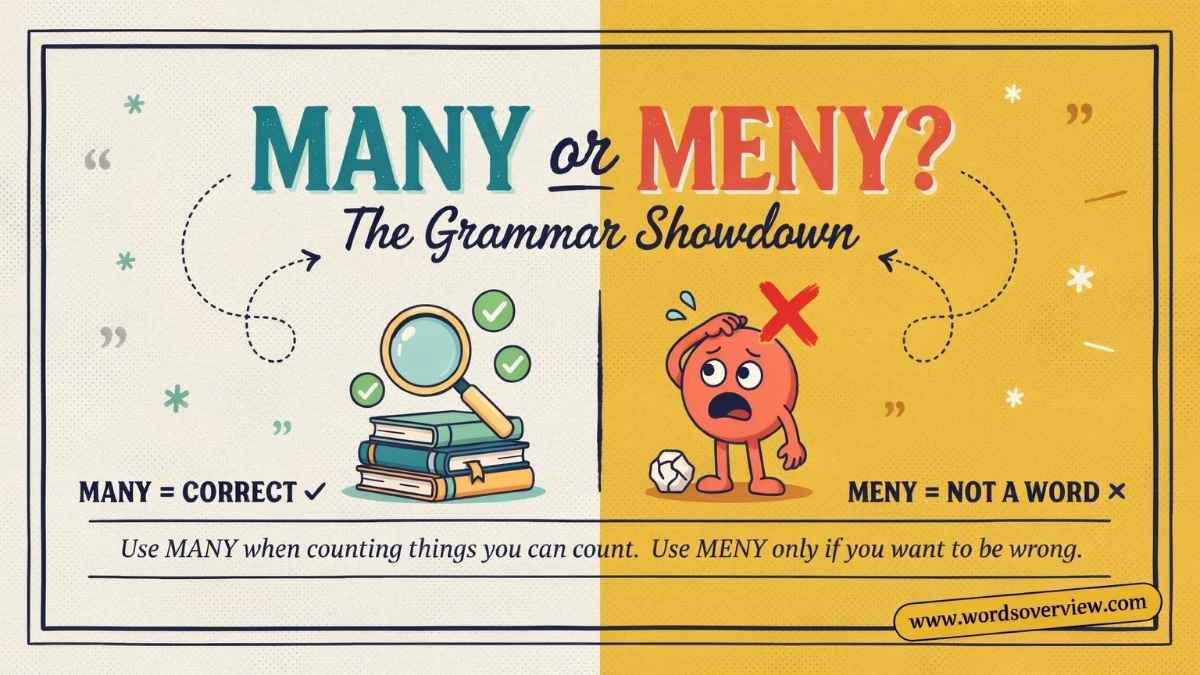
The many vs meny difference is mainly a spelling issue rather than a difference in meaning.
Many is a standard English word. It expresses an indefinite or large quantity and normally modifies plural countable nouns.
Meny, when used as an attempted spelling of many, is incorrect.
| Feature | Many | Meny |
| Standard English spelling | Yes | No |
| Means a large number | Yes | No |
| Used with plural countable nouns | Yes | No |
| Correct in formal writing | Yes | No |
| Standard British English | Yes | No |
| Standard American English | Yes | No |
| Common spelling error | No | Yes |
For that reason, many vs meny isn’t like a pair such as accept and except. Those words have different meanings and grammatical uses. Instead, meny normally represents an incorrect attempt to spell many.
Learn the difference between commonly mixed-up more words
Foward or Forward: Which Spelling Is Correct?
Many or Meny Spelling in British and American English
British and American English have several well-known spelling differences. However, many is not one of them.
Both varieties use:
many
They don’t use meny as a regional alternative.
For example, British English can use:
Many people visit London each year.
American English can use:
Many people visit New York each year.
The spelling stays the same.
This distinction matters because learners sometimes assume that every unusual spelling must belong to a different English variety. That’s not the case here.
Consider established differences such as:
| British English | American English |
| colour | color |
| centre | center |
| organise | organize |
| travelling | traveling |
Those differences have established usage patterns. Many vs meny does not.
Therefore, whether you’re writing for readers in the UK or the US, use many.
Why Do People Spell Many as Meny?
English spelling doesn’t always match pronunciation perfectly. As a result, learners sometimes choose letters based on how a word sounds rather than how standard English spells it.
That can help explain why someone might type meny instead of many. However, the exact reason varies from person to person.
Common causes of spelling mistakes include:
- fast typing
- unfamiliarity with a word
- phonetic spelling habits
- keyboard errors
- language-learning difficulties
- simple slips while writing
For example, someone might type:
Meny people agree with this idea.
The writer may know exactly what the sentence means but accidentally choose e instead of a.
That mistake doesn’t create a new spelling. It simply creates an incorrect form.
Think of it like typing becuase instead of because. The incorrect version may look surprisingly familiar, but standard English still uses because.
Many Grammar: How to Use Many Correctly
Understanding many grammar makes the spelling issue even clearer.
The most useful rule is straightforward:
Use many with plural countable nouns.
A countable noun refers to something you can count as individual units.
For example:
- one book → two books → many books
- one student → two students → many students
- one car → two cars → many cars
- one question → two questions → many questions
This pattern explains why the following examples work:
- Many books are available.
- Many students joined the course.
- Many questions remain unanswered.
Many With Plural Nouns
The basic structure is:
many + plural countable noun
Here are some common combinations:
- many books
- many people
- many houses
- many ideas
- many animals
- many companies
- many questions
- many opportunities
Because many normally refers to more than one item, the noun usually appears in its plural form.
Therefore:
❌ many book
should become:
✅ many books
Similarly:
❌ many student
should become:
✅ many students
This is one of the most important many grammar rules to remember.
Many of + Noun or Pronoun
English also frequently uses many of.
The usual pattern is:
many of + determiner/pronoun + plural noun
For example:
- Many of the students passed the exam.
- Many of the books were damaged.
- Many of them agreed with the proposal.
- Many of these problems are easy to solve.
Notice the difference between:
Many students passed.
and:
Many of the students passed.
The first sentence talks about students generally. The second refers to a particular group of students.
Learn the difference between basic English word mistakes
This Is She or This Is Her: Which Is Correct?
How to Use Many in a Sentence
If you’re searching how to use many in a sentence, begin by identifying the noun.
Ask whether you can count the items individually. If you can, many may fit naturally when you’re referring to a large or indefinite number.
For example:
one student → two students → many students
That gives you a clear grammatical pattern.
Many in a Sentence
Here are practical many examples:
- Many students study online.
- Many people enjoy reading.
- Many companies offer remote work.
- Many countries use English in education.
- Many books contain useful information.
- Many businesses rely on digital marketing.
- Many families enjoy traveling together.
Each sentence uses many before a plural countable noun.
Learn the difference between tricky English words with easy explanations
Congrats or Congratulations: Which One Is Correct?
Many vs Much: An Important Grammar Difference
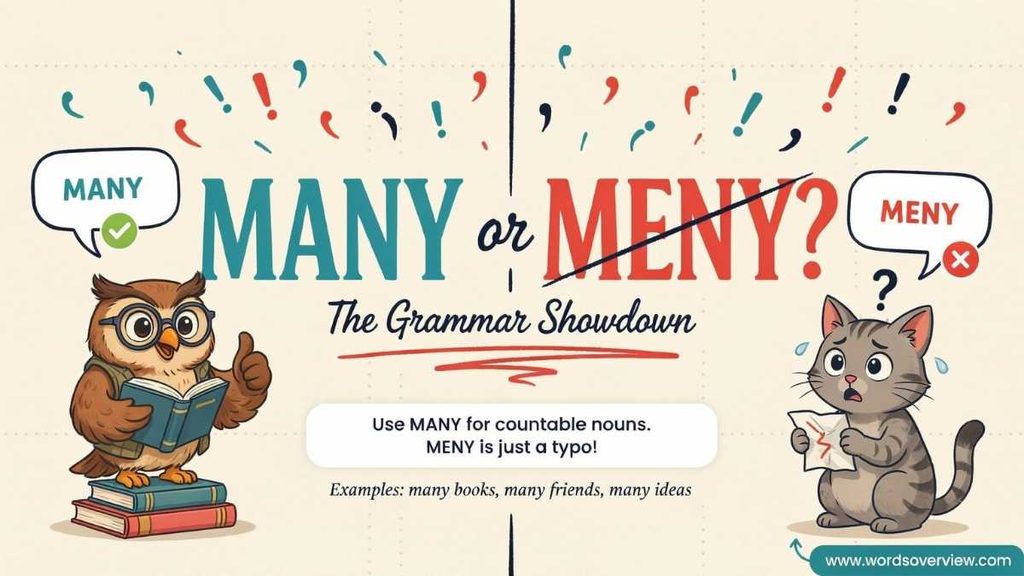
The many vs much distinction causes another common problem for English learners.
Both words express quantity. However, they usually work with different types of nouns.
Use many with plural countable nouns.
Use much with uncountable nouns.
| Countable nouns | Uncountable nouns |
| many books | much information |
| many cars | much water |
| many students | much money |
| many questions | much time |
| many problems | much work |
For example:
I don’t have many books.
But:
I don’t have much time.
You can count books individually:
one book, two books, three books
However, time generally works as an uncountable noun in this structure.
Many Countable or Uncountable?
If you’re asking many countable or uncountable, the answer is clear:
Many normally modifies plural countable nouns.
Common countable noun examples include:
- books
- chairs
- students
- apples
- cars
- questions
- problems
Common uncountable noun examples include:
- water
- information
- money
- advice
- furniture
- knowledge
- time
So you would normally write:
many questions
but:
much information
You can also write:
many cars
but:
much money
This distinction plays an important role in standard English grammar.
Learn the difference between commonly confused words in English
Pair or Pare: Meaning, Difference and Use Correctly
Can Many Be Used With Uncountable Nouns?
In standard English, many normally goes with plural countable nouns rather than uncountable nouns.
For example:
❌ many information
The standard form is:
✅ much information
Likewise:
❌ many money
should become:
✅ much money
However, English nouns can sometimes change their grammatical behavior depending on meaning and context. Therefore, you shouldn’t treat every noun as permanently locked into one category.
For everyday writing, though, the practical rule remains useful:
Many → plural countable nouns
Much → uncountable nouns
Learn the difference between tricky grammar words
Studying or Studing: Which Spelling Is Correct?
Common Mistakes With Many or Meny
The spelling question often connects with several other grammar mistakes.
Writing Meny Instead of Many
This is the most obvious error.
❌ There are meny reasons to learn English.
✅ There are many reasons to learn English.
The correction requires only one letter, but that letter determines whether the spelling matches standard English.
Using Many With a Singular Noun
Because many expresses a quantity greater than one, it normally takes a plural noun.
❌ many student
✅ many students
❌ many book
✅ many books
❌ many car
✅ many cars
Confusing Many and Much
Compare:
many questions
with:
much information
The first noun is countable and plural. The second is generally uncountable.
Therefore:
❌ I have many information.
becomes:
✅ I have much information.
Assuming Meny Is a Regional Variant
Meny isn’t the British spelling of many. It isn’t the American spelling either.
Both varieties use many.
Trusting Autocorrect Without Checking
Autocorrect can catch some spelling errors. However, it doesn’t replace proofreading.
If you type meny, your software might correct it automatically. Yet the result can depend on your application, language settings or context.
Therefore, when accuracy matters, check the word yourself.
Many or Meny in Everyday Writing
The correct spelling matters across different types of writing.
Emails
You might write:
Many thanks for your help.
This is a common and natural expression.
Writing:
❌ Meny thanks for your help.
would introduce a clear spelling error.
Academic Writing
Academic writing frequently uses many to describe quantities.
For example:
Many studies examine the relationship between sleep and academic performance.
Here, studies is a plural countable noun, so many fits naturally.
Business Writing
A professional sentence might read:
Many customers prefer flexible payment options.
Again, customers is plural and countable.
Social Media
Informal posts often contain spelling mistakes. However, informal writing doesn’t change the standard spelling.
For example:
❌ So meny people came!
The standard form remains:
✅ So many people came!
Formal Writing
Formal writing should follow standard spelling and grammar conventions.
For example:
Many factors contributed to the change.
Using meny would make the sentence contain an unnecessary spelling error.
Learn the difference between confusing word pairs
Emigrate or Immigrate Difference, Meaning and Usage
Many or Meny Sentences: Correct and Incorrect Examples
A direct comparison can make the many or meny sentences question much easier.
| Incorrect | Correct |
| Meny people attended. | Many people attended. |
| She has meny books. | She has many books. |
| How meny students came? | How many students came? |
| There are meny reasons. | There are many reasons. |
| We saw meny cars. | We saw many cars. |
| Meny of them agreed. | Many of them agreed. |
| I have meny questions. | I have many questions. |
| There were meny problems. | There were many problems. |
The pattern is consistent. When the intended meaning is “a large number,” choose many.
Many Examples You Can Use
Different sentence structures can help you understand many usage more naturally.
1: Basic Examples
- Many people enjoy music.
- Many students use laptops.
- Many birds migrate during winter.
- Many companies hire remote workers.
- Many books contain useful information.
2: Questions
- How many students are in your class?
- How many books have you read?
- How many people attended the event?
- How many cars are parked outside?
3: With “Of”
- Many of the students completed the task.
- Many of the questions were difficult.
- Many of them arrived early.
- Many of these examples show the same pattern.
4: With “Too”
- There are too many advertisements.
- You made too many changes.
- We received too many applications.
5: With “So”
- So many people attended that the room became crowded.
- She had so many questions that the discussion lasted an hour.
6: With “More”
- Many more students joined the second session.
- We need many more examples before reaching a conclusion.
How to Spell Many Correctly
If you’re searching how to spell many or how do you spell many, the answer is:
M-A-N-Y
The many correct spelling contains an a, not an e.
Therefore:
many ✓
meny ✗
The word doesn’t need an extra consonant or a different vowel.
Correct Spelling of Many
The correct spelling of many is simply:
many
Common incorrect forms include:
- meny
- menny
- maney
- manny
These spellings don’t replace the standard form.
When you mean a large number, use:
many
Learn the difference between more words people mix up
Swifty or Swiftie: Spelling, Usage and Correct Word
Why the Spelling of Many Can Be Confusing
English contains many words whose spelling doesn’t perfectly match their pronunciation. Consequently, learners sometimes try to spell unfamiliar words according to the sounds they hear.
That approach can produce errors.
The safest approach with many is to learn its standard written form directly:
M-A-N-Y
English spelling has developed through centuries of linguistic change. Words have entered English from languages such as Old English, French, Latin, Greek and Norse. As a result, modern English contains many spelling patterns that don’t follow a perfectly predictable sound-to-letter system.
However, many doesn’t need an elaborate explanation to remember. Simply recognize its standard form and use it consistently.
Is Many a Word?
Yes. Many is a standard English word.
If you’re searching is many a word, the answer is unquestionably yes.
Many appears in standard English dictionaries and has established grammatical functions. It commonly works as a determiner or pronoun and expresses an indefinite quantity.
Consider:
Many students attended.
The word many tells us something about the number of students without specifying an exact figure.
That’s one reason the word appears so frequently in everyday English.
Many in English: Meaning and Usage
The phrase many in English usually points to the word’s meaning, grammar, spelling or usage.
In standard English, many serves as an important quantifier. It allows speakers and writers to describe quantity without stating an exact number.
Compare:
57 students attended.
with:
Many students attended.
The first sentence gives an exact number. The second gives a general quantity.
Both can communicate useful information. However, they serve different purposes.
The word many therefore appears naturally in:
- everyday conversation
- academic writing
- journalism
- business communication
- education
- formal documents
- online writing
Many Usage: When Should You Use Many?
Use many when you want to describe a large or indefinite number of plural countable people or things.
A simple test can help.
Ask: Can I Count Them?
If you can count the items individually, many may work naturally.
For example:
Books
one book → two books → many books
Students
one student → two students → many students
Cars
one car → two cars → many cars
By contrast, uncountable nouns generally take much in the same type of quantity structure:
- much water
- much money
- much information
- much time
This test won’t explain every possible grammatical construction. Nevertheless, it works well for everyday many usage.
Case Study: Choosing Many or Much
Consider this sentence:
“The website contains many useful information and meny examples.”
It contains two separate problems.
First, meny should be many.
Second, information is generally an uncountable noun, so many information doesn’t follow standard English grammar.
A better version is:
The website contains much useful information and many examples.
Now each quantity word matches the noun:
- much information → uncountable
- many examples → plural countable
This example shows why accurate English involves more than spelling. A word also needs to fit the grammar of the sentence.
Learn the difference between tricky words and use them correctly
Genious or Genius: Which Spelling Is Correct?
Many or Meny: A Simple Rule to Remember
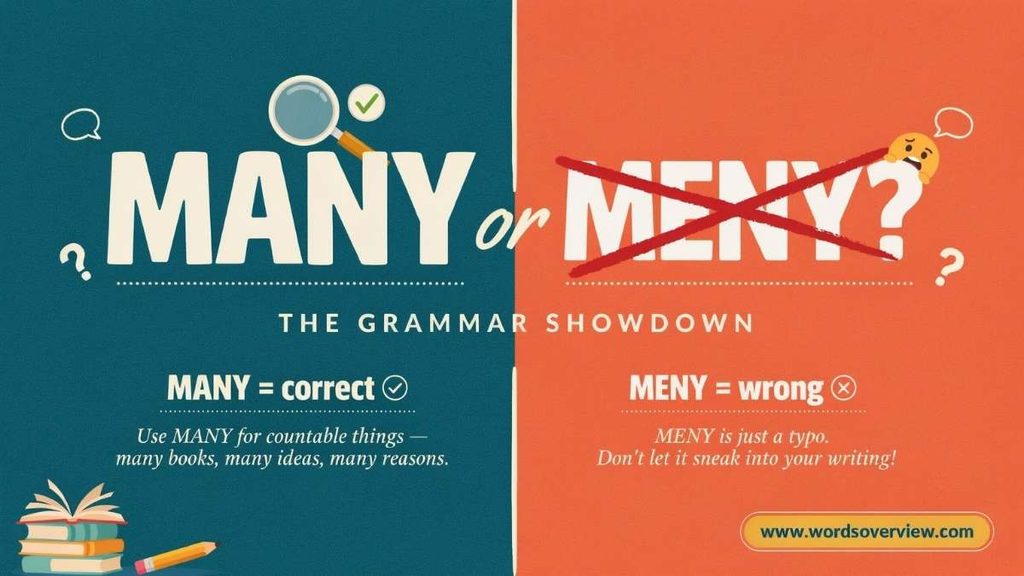
When you’re stuck between many or meny, don’t make the problem more complicated than it needs to be.
Use this rule:
If you mean a large number of people or things, use many.
Remember the spelling:
M-A-N-Y
Then apply it naturally:
- many people
- many books
- many students
- many questions
- many ideas
Don’t replace the a with e simply because the pronunciation creates Uncertainty.
Many or Meny: Quick Comparison
| Question | Answer |
| Which is correct, many or meny? | Many |
| What does many mean? | A large or indefinite number |
| Is meny correct? | No, not as the standard spelling of many |
| Is meny a word? | Not as the standard English equivalent of many |
| How do you spell many? | M-A-N-Y |
| Is many used in British English? | Yes |
| Is many used in American English? | Yes |
| Does British English use meny? | No |
| Does American English use meny? | No |
| Can many modify plural nouns? | Yes |
| Can many normally modify uncountable nouns? | No |
| What usually works with uncountable nouns instead? | Much |
Practice Session
Fill in each blank with the correct word or phrase.
Word bank: many, much, many of, how many, too many, so many, numerous
- There are ______ students in the classroom today.
- She has ______ books on her desk.
- ______ people attended the wedding?
- We don’t have ______ information about the project yet.
- He made ______ spelling mistakes in his essay.
- ______ the students completed the assignment on time.
- There were ______ cars on the road during rush hour.
- I have ______ questions about this grammar rule.
- How ______ apples did you buy?
- There are ______ reasons to learn correct English spelling.
- She has ______ friends in her university class.
- Don’t eat ______ sweets before dinner.
- We received ______ messages after publishing the article.
- ______ people believe that English spelling can be confusing.
- There isn’t ______ money left in my wallet.
- He has ______ useful ideas for improving the website.
- ______ students were absent from the class?
- I have seen this mistake ______ times.
- There were ______ examples in the grammar book.
- She has ______ experience in web development.
- ______ the questions were easy to answer.
- The teacher gave us ______ exercises to complete.
- Why are there ______ errors in this sentence?
- We don’t need ______ water for this recipe.
- There are ______ ways to remember the spelling of many.
Answers
- many
- many
- How many
- much
- many
- Many of
- numerous
- many
- many
- many
- many
- too many
- many
- Many
- much
- many
- How many
- many
- many
- much
- Many of
- many
- so many
- much
- many
Frequently Asked Questions
Is it many or meny?
The correct spelling is many when you mean “a large number.” Meny is not the standard English spelling for this meaning. For example, write “Many people attended the event,” not “Meny people attended the event.”
What does many mean in English?
Many means a large or indefinite number of people or things. It usually appears before plural countable nouns, such as “many books,” “many students,” or “many questions.”
How do you spell many correctly?
The correct spelling is M-A-N-Y: many. Common incorrect forms include “meny,” “menny,” and “manny” when the intended word means “a large number.”
Is meny a word in English?
Meny is not the standard English spelling of many. People may use “meny” as a spelling mistake or typing error, but standard English uses many to express a large number.
When should you use many?
Use many when you talk about a large or indefinite number of countable things or people. For example, you can say “many students,” “many cars,” and “many opportunities.”
How do you use many in a sentence?
Use many before a plural countable noun or in structures such as many of, how many, too many and so many. For example, “She has many books,” and “How many people are coming?”
Is many grammatically correct?
Yes. Many is a grammatically correct English word. It commonly functions as a determiner or pronoun and refers to a large or indefinite number of people or things.
Can you use many with singular nouns?
Normally, no. Many generally takes a plural countable noun, so you should write “many students,” not “many student.” However, the expression many a is a special construction that takes a singular noun, as in “many a time.”
Is it many or much money?
The correct phrase is much money, because money is generally treated as an uncountable noun in English. Use many with plural countable nouns, such as “many dollars” or “many coins.”
What is another word for many?
Depending on the context, alternatives to many include numerous, several, a lot of, a large number of and countless. The best choice depends on the sentence and the exact quantity you want to express.
Conclusion
When it comes to many or meny, one tiny vowel creates all the confusion. Fortunately, the correct choice is easy: many is the standard English spelling when you mean “a large number.” The spelling meny may look convincing for a split second, but it doesn’t become correct just because English likes to keep spelling learners on their toes.
Remember the simple rule: use many with plural countable nouns, such as many books, many students and many questions. For uncountable nouns, much usually takes its place, as in much water or much information. Most importantly, don’t let a quick typing mistake become a permanent spelling habit. When in doubt, choose many and move on with confidence.

Ethan AJS is an experienced blogger and language enthusiast at Words Overview, dedicated to making English easier to understand and use. He writes about grammar, vocabulary, spelling, word meanings and commonly confused words, turning tricky language questions into clear, practical insights. With a passion for effective communication, Ethan creates engaging, readerfocused content that helps readers write accurately, choose the right words and communicate with confidence.




