
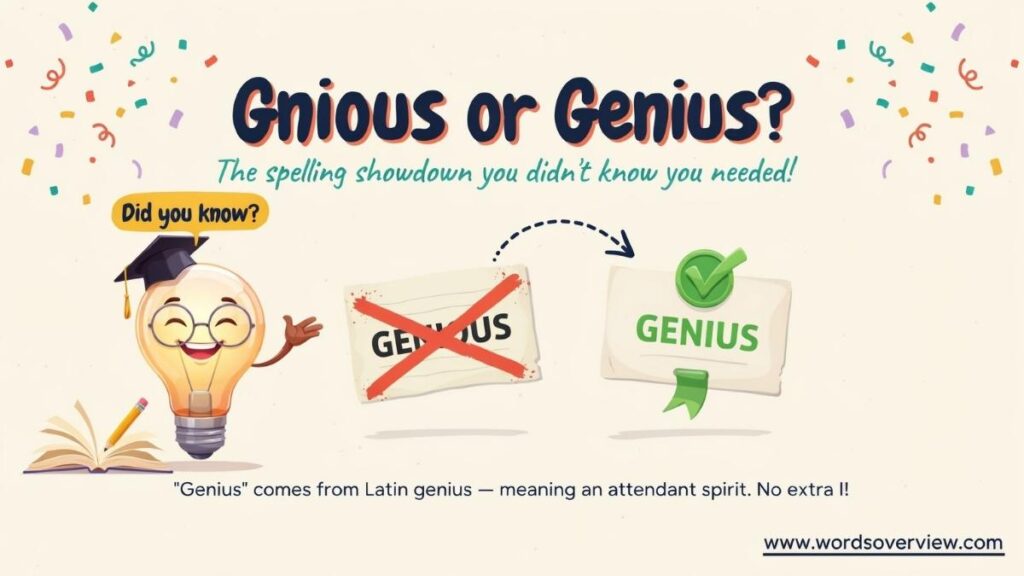
Have you ever typed a word confidently, only to discover that one tiny letter has sent your spelling into a tailspin? The confusion over genious or genius is a perfect example. At first glance, “genious” looks reasonable, especially because English loves words ending in “-ious.” Unfortunately, English doesn’t always play fair. The correct spelling is genius, while “genious” is a common spelling mistake. In this guide, you’ll learn why this confusion happens, what genius means, how to pronounce it and how to use it correctly in a sentence. By the end, you’ll spell genius confidently, without giving that extra “o” another chance.
Quick Answer Genius or Genious?
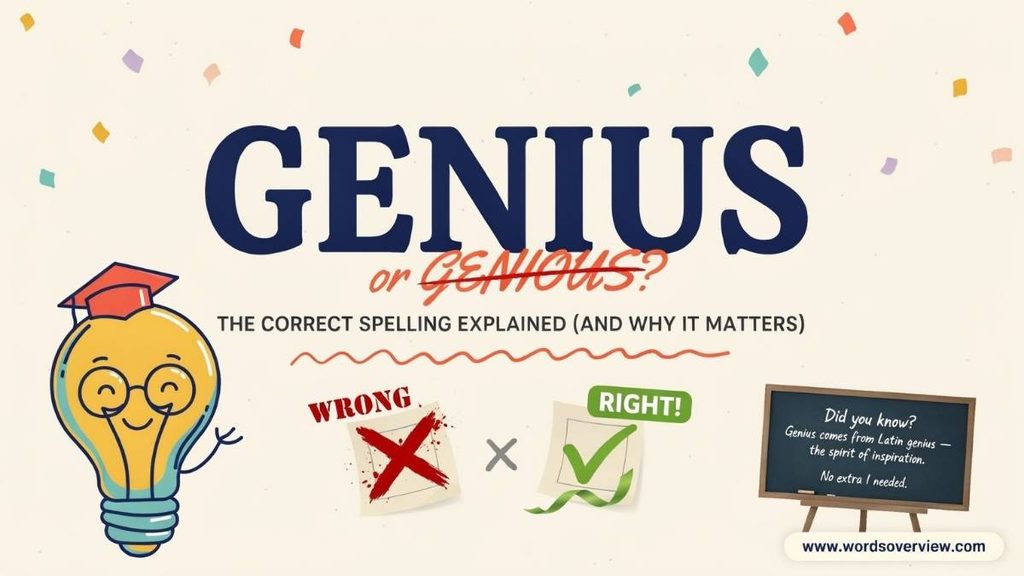
So, is it genius or genious?
The answer is genius.
| Spelling | Correct? | Meaning |
| genius | Yes | A person with exceptional ability or intelligence or exceptional ability itself |
| genious | No | A common misspelling of genius |
Consider these examples:
- Correct: Marie is a genius at mathematics.
- Incorrect: Marie is a genious at mathematics.
- Correct: That was a genius idea.
- Incorrect: That was a genious idea.
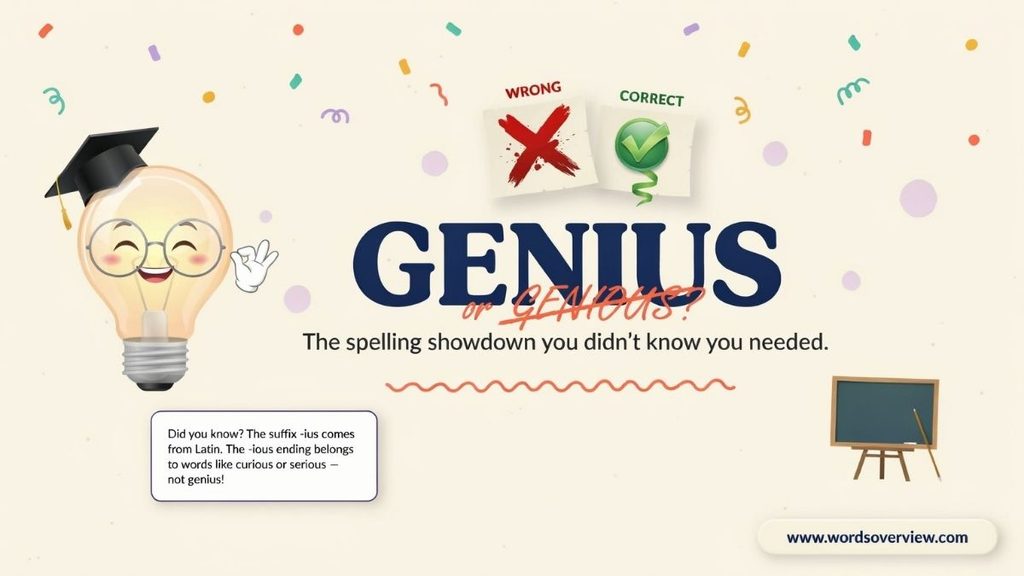
The problem with genious comes from the extra o. The correct sequence is -ius, not -ious.
Therefore, if you’re looking for the correct spelling of genius, remember these six letters:
G-E-N-I-U-S
There is no o between the i and u.
What Is the Correct Spelling of Genius?
The genius correct spelling is genius.
You can break the word into two easy parts:
GEN + IUS
The common error changes this pattern to:
GEN + IOUS
That additional o makes genious incorrect when you intend to use the word genius.
How to Spell Genius Correctly
If you’re wondering how to spell genius, focus on its letter pattern rather than trying to reproduce every sound you hear.
The correct spelling is:
G-E-N-I-U-S
Not:
G-E-N-I-O-U-S
A simple memory aid is:
GEN-IUS = genius
Once you memorize that sequence, the spelling becomes much easier to recognize.
Is Genious a Word?
A common question is is genious a word?
In standard modern English, genious isn’t the accepted spelling for the noun genius. When you want to describe exceptional intelligence, talent or ability, the correct word is genius.
The same answer applies to questions such as is genious a real word and is genious a word in English. In ordinary standard English usage, genius is the correct form.
Learn the difference between more words people mix up
Swifty or Swiftie: Spelling, Usage and Correct Word
Genius Meaning and Definition
The genius meaning centers on exceptional intelligence, ability, talent or creativity.
The word can describe the exceptional quality itself or a person who demonstrates an unusually high level of ability. As a result, its meaning changes slightly depending on the context.
Genius as Exceptional Ability
When genius refers to a quality, it describes extraordinary intellectual, artistic, scientific or creative ability.
For example:
- Her mathematical genius became clear at an early age.
- The invention demonstrates remarkable genius.
- His creative genius transformed the project.
In these examples, genius doesn’t refer to a specific person. Instead, it describes an exceptional level of ability.
Genius as a Person
You can also use genius as a noun for someone who demonstrates extraordinary ability.
For example:
- Einstein was a genius.
- She is a mathematical genius.
- He became known as a musical genius.
- The young inventor showed the qualities of a scientific genius.
In this sense, a genius person has exceptional intellectual, creative, artistic, scientific or technical ability.
Genius as Informal Praise
However, English speakers also use genius more casually.
Someone might say:
“That was genius!”
In this context, the speaker doesn’t necessarily mean that the person has exceptional intelligence in every area. Instead, the word praises one particularly clever idea, decision or solution.
For example:
Moving the pantry closer to the kitchen was genius.
Here, genius means extremely clever or practical.
This informal use appears frequently in everyday conversation.
Genius Definition: What Does Genius Actually Describe?
A useful genius definition should distinguish between the person and the ability.
| Use | Meaning | Example |
| Person | Someone with exceptional ability or intelligence | She is a genius. |
| Quality | Exceptional intellectual or creative ability | His genius changed the field. |
| Specific ability | Exceptional skill in a particular area | She has a genius for languages. |
| Informal praise | An exceptionally clever idea or action | That was a genius solution. |
Therefore, genius can relate to intelligence, creative ability, natural talent or an unusually effective approach to a problem.
However, the word generally carries a stronger meaning than simply calling someone intelligent, skilled or talented.
Someone can certainly be intelligent without being called a genius. Likewise, someone can have impressive skill in one area without the word genius necessarily being appropriate.
Where Does the Word Genius Come From?
The history of genius is surprisingly different from its modern meaning.
The word ultimately comes from Latin genius, which referred to a spirit or guiding presence associated with a person. Over time, the meaning developed from an attendant spirit toward ideas of a person’s natural qualities, abilities or distinctive character.
Eventually, English developed the modern sense of extraordinary intellectual or creative ability.
This long development explains why the word can refer both to an exceptional person and to exceptional ability.
From Guiding Spirit to Exceptional Ability
The earliest meaning didn’t simply describe someone who possessed extraordinary intelligence.
Instead, the word referred to an attendant or guardian spirit. Later, the meaning became associated with an individual’s characteristic nature, natural inclination or ability.
Over time, that sense developed into the modern idea of exceptional intellectual or creative ability.
The development can be summarized as:
guiding spirit → characteristic nature → natural ability → exceptional ability
Although the modern meaning feels straightforward, the word therefore carries a long history of semantic change.
Learn the difference between confusing English words step by step
Personel or Personnel Correct Spelling and Difference
Why Do People Spell Genius as Genious?
The genius spelling mistake doesn’t usually happen without a reason. Several features of English spelling make genious look plausible.
Familiar Words Encourage the ious Error
English contains many familiar words ending in -ious, including:
- curious
- serious
- various
- obvious
- mysterious
- delicious
Because this spelling pattern appears so often, someone who hears the ending of genius may naturally expect -ious.
That produces:
genious
It looks convincing at first glance. Nevertheless, it isn’t the standard spelling.
Genius and Ingenious Look Similar
Another source of confusion is the word ingenious.
Compare these forms:
- genius
- ingenious
They share several letters and have a historical relationship. Nevertheless, they have different meanings and grammatical roles.
For example:
She is a genius.
She developed an ingenious solution.
The first sentence describes a person with exceptional ability. The second describes something clever or inventive.
Because ingenious contains -ious, some writers accidentally transfer that spelling pattern to genius.
Genius or Genious A Simple Comparison
The genius or genious question becomes much easier when you compare the two forms directly.
| Feature | Genius | Genious |
| Standard spelling | Yes | No |
| Standard English word for exceptional ability | Yes | No |
| Contains an “o” after “i” | No | Yes |
| American English | Correct | Incorrect |
| British English | Correct | Incorrect |
| Common spelling error | No | Yes |
| Standard form for this meaning | Yes | No |
Therefore, genious or genius isn’t a comparison between two accepted spelling variants.
Instead, it compares the correct form with a common misspelling.
Genius Spelling UK or Genius Spelling US
Does British English spell the word differently from American English?
No.
The genius spelling UK is genius and the genius spelling US is also genius.
Unlike spelling differences such as colour and color or centre and center, genius doesn’t change between these varieties.
| Variety | Correct spelling |
| American English | genius |
| British English | genius |
| Canadian English | genius |
| Australian English | genius |
So, writing genious doesn’t make the word British. It simply creates an incorrect spelling.
Genius Pronunciation and Spelling
The pronunciation of genius can contribute to spelling confusion.
The standard pronunciation is approximately:
/ˈdʒiː.ni.əs/
The word begins with the sound found at the beginning of jump and continues through two additional syllables.
Importantly, genious pronunciation isn’t a separate standard pronunciation that supports the spelling genious. If you mean the word describing exceptional ability, the spelling remains genius.
A Useful Spelling Reminder
Rather than trying to reconstruct the spelling entirely from its sound, remember the visual pattern:
GEN + IUS = GENIUS
That simple pattern is more reliable when you’re writing quickly.
Learn the difference between tricky English words with easy explanations
Finalise or Finalize: Difference, Spelling and Usage
Genius or Ingenious What’s the Difference?
One of the most useful distinctions in this topic involves genius or ingenious.
These words share a historical connection, but they don’t mean the same thing.
| Word | Part of speech | Meaning | Example |
| genius | Noun | Exceptional ability or a person with exceptional ability | She is a programming genius. |
| ingenious | Adjective | Clever, inventive or skillfully designed | She created an ingenious solution. |
An ingenious idea is a clever or inventive idea.
A genius is either a person with exceptional ability or exceptional ability itself.
Consider the difference:
The scientist was a genius.
The scientist developed an ingenious experiment.
The first sentence focuses on the person’s ability. The second focuses on the clever design of the experiment.
This distinction also explains why genious looks so tempting. Writers may unintentionally combine genius with ingenious and create a spelling that doesn’t belong to standard English.
Learn the difference between more words people mix up
Tier or Teir? Which Spelling Is Correct?
Genius or Intelligent, Brilliant, Talented and Gifted
The word genius belongs to a group of words associated with intelligence and ability. However, these words don’t have exactly the same meaning.
Genius or Intelligent
Intelligent describes a strong ability to understand, reason, learn or solve problems.
Genius, however, generally suggests an exceptionally high level of ability.
For example:
Daniel is intelligent and learns quickly.
That statement doesn’t necessarily mean:
Daniel is a genius.
The second statement makes a much stronger claim.
Genius or Brilliant
Brilliant can describe exceptional intelligence or ability. It can also describe an idea, performance or piece of work.
For example:
She gave a brilliant presentation.
This sentence doesn’t automatically mean that she is a genius.
Genius or Talented
Talented usually refers to natural ability or strong skill in a particular area.
For example:
He is a talented musician.
You could describe him as a musical genius if his musical ability reaches an exceptionally high level. However, talented and genius aren’t interchangeable in every context.
Genius or Gifted
Gifted often describes someone with unusually strong natural ability, particularly in educational contexts.
A gifted student may demonstrate exceptional ability without necessarily being described as a child genius.
These distinctions matter because precise vocabulary helps you communicate exactly what you mean.
Genius Noun or Adjective?
The question genius noun or adjective can cause some grammatical confusion.
The most common grammatical role of genius is a noun.
Examples include:
- He is a genius.
- Her genius was obvious.
- They admired his genius.
- She has a genius for organization.
However, genius can also function as an informal adjective.
For example:
That’s a genius idea.
Here, genius modifies the noun idea.
Therefore, the answer to is genius a noun or adjective is that it can function as both, although the noun use is the traditional and most common one.
Genius as a Noun
As a noun, genius can refer to:
- a person with exceptional ability
- exceptional intellectual or artistic ability
- a special or remarkable skill
Genius as an Informal Adjective
As an informal adjective, genius can describe something exceptionally clever.
For example:
That was a genius move.
In more formal writing, ingenious may sometimes provide greater precision when you mean “clever” or “inventive.”
What Is the Plural of Genius?
If you’re asking about the plural of genius, the standard modern English plural is:
geniuses
For example:
The two scientists were widely regarded as geniuses.
Several musical geniuses influenced the genre.
The plural geniuses works naturally when you’re talking about exceptionally talented or intelligent people.
Is Genii the Plural of Genius?
Genii also appears in English, but it has a more specialized history and use.
Genii comes from the Latin plural associated with genius. It can appear in historical, literary or specialized contexts, particularly when writers discuss the older sense of genius as a spirit or supernatural being.
For ordinary modern English, however, geniuses is the straightforward plural when referring to exceptionally talented people.
| Form | Use |
| genius | Singular |
| geniuses | Standard modern English plural |
| genii | Latin-derived plural used in particular historical or literary contexts |
| genious | Incorrect spelling of genius |
So, if you’re searching for how to spell genius plural, the answer you normally need is geniuses.
Learn the difference between everyday English mistakes
Girly or Girlie Correct Usage and Difference
Genius or Genious Meaning: Are They the Same?
Searches for genious or genius meaning can cause confusion because both forms may appear online.
However, seeing genious on websites, social media posts or user-generated content doesn’t make it a standard English word.
The standard genius meaning includes:
- exceptional intelligence
- exceptional intellectual ability
- extraordinary creative ability
- exceptional skill
- a person with unusually great ability
By contrast, genious meaning generally reflects a search for the meaning of a misspelled form.
In practical terms:
genius = correct word
genious = common misspelling
Genius or Genious Synonym: Which Words Are Related?
If you’re searching for a genious or genius synonym, start with the correct form, genius.
Depending on the context, related words include:
- brilliant
- gifted
- intelligent
- talented
- exceptional
- mastermind
- prodigy
- expert
- scholar
- innovator
- great thinker
However, these terms don’t have identical meanings.
For example, prodigy often describes a young person whose abilities are unusually advanced for their age. Expert emphasizes knowledge or skill developed through study and experience. Brilliant can describe a person, idea, performance or piece of work.
Therefore, the best synonym depends on the exact meaning you want to express.
Genius in Different Contexts
The word appears in many fields because exceptional ability can take different forms.
Mathematical Genius
A person with extraordinary mathematical ability may be described as a mathematical genius.
For example:
The mathematician became known for solving problems that had challenged researchers for years.
Here, the phrase emphasizes exceptional intellectual and analytical ability.
Scientific Genius
A scientific genius demonstrates extraordinary ability in scientific reasoning, research, discovery or theory.
The expression focuses on intellectual achievement within science.
Musical Genius
A musical genius may demonstrate extraordinary ability in composition, performance, musical theory or another area of music.
The term can describe both exceptional natural ability and outstanding creative achievement.
Artistic Genius
Artistic genius describes exceptional creative or artistic ability.
For example:
Her artistic genius transformed the way audiences viewed the medium.
The phrase emphasizes creativity originality and exceptional artistic achievement.
Creative Genius
Creative genius focuses on extraordinary originality and creative ability.
For example:
His creative genius turned a simple concept into an innovative design.
Genius in Everyday Conversation
The word doesn’t always carry such a serious meaning.
Someone might say:
“You’re a genius!”
after a friend finds a clever way to solve a small problem.
In this situation, the speaker uses genius as enthusiastic praise rather than making a formal claim about the person’s overall intellectual ability.
Genius or Genious Examples
These genious or genius examples demonstrate how the correct word works in different contexts.
Correct Examples With Genius
- She is a genius at solving mathematical problems.
- His invention demonstrated remarkable genius.
- That was a genius idea.
- The composer was considered a musical genius.
- Her solution was a stroke of genius.
- He has a genius for explaining difficult concepts.
- The scientist demonstrated exceptional intellectual ability.
- They called the young programmer a coding genius.
- The designer created an ingenious solution.
- Several geniuses contributed to the project.
Incorrect Examples With Genious
- She is a genious at mathematics.
- He had a genious idea.
- The painter was a creative genious.
- They called him a genious.
Corrected Versions
- She is a genius at mathematics.
- He had a genius idea.
- The painter was a creative genius.
- They called him a genius.
The pattern remains consistent: use genius, not genious, when you mean exceptional ability or intelligence.
Learn the difference between everyday English mistakes
Devide or Divide Correct Spelling and Usage
Common Mistakes When Spelling Genius
Several errors appear repeatedly when people write this word.
Adding an O
The most common error is:
genious
The correct form is:
genius
The extra o doesn’t belong in the word.
Confusing Genius With Ingenious
These words have related meanings but different grammatical roles.
He is a genius.
He designed an ingenious device.
The first sentence describes the person. The second describes the clever quality of the device.
Assuming Genious Is British English
It isn’t.
Both British English and American English use:
genius
Therefore, genious isn’t a regional variation.
Treating Online Frequency as Proof
You may encounter genious online. However, frequency doesn’t determine whether a spelling is standard.
Typos can spread quickly. Someone may copy an incorrect spelling, another person may repeat it and the same error can eventually appear across many pages.
For that reason, a reliable dictionary provides stronger evidence than the number of times a spelling appears in casual online content.
Confusing Genius With Genie
Genius and genie have different meanings.
A genius is associated with exceptional ability.
A genie is a magical spirit commonly found in traditional stories and popular culture.
For example:
She is a mathematical genius.
The story features a magical genie.
Although the words look somewhat similar, they aren’t spelling variants.
Learn the difference between basic English word mistakes
This Is She or This Is Her: Which Is Correct?
How to Remember the Spelling of Genius
If genious keeps appearing in your writing, a simple visual technique can help.
Remember GEN-IUS
Think:
GEN + IUS = GENIUS
Don’t insert an o.
| Correct | Incorrect |
| GENIUS | GENIOUS |
| IUS | IOUS |
The important sequence is I-U-S.
Connect the Spelling With the Meaning
When you think about intelligence, talent, creativity or exceptional ability, connect those ideas with:
GENIUS
This association can make the spelling easier to remember.
Keep Genius and Ingenious Separate
Don’t try to make genius follow the spelling pattern of ingenious.
Remember:
genius → exceptional person or exceptional ability
ingenious → clever or inventive
Once you separate these meanings, the spelling becomes much clearer.
A Simple Case Study: Why the Extra O Appears
Consider a student writing an essay about a famous scientist.
The student knows the word when speaking but hasn’t memorized its spelling. While writing, the student thinks about familiar words such as serious, curious and mysterious. Those words all contain -ious.
The student writes:
“The scientist was a genious.”
The sentence makes sense, but the spelling contains an unnecessary o.
The correct sentence is:
“The scientist was a genius.”
This example shows why spelling often depends on visual memory as much as pronunciation. English contains many spelling patterns that don’t map perfectly onto pronunciation.
Learn the difference between confusing word pairs
Emigrate or Immigrate Difference, Meaning and Usage
Is Genius a Formal or Informal Word?
Genius works in both formal and informal contexts.
In academic or professional writing, you may encounter phrases such as:
- intellectual genius
- mathematical genius
- creative genius
- artistic genius
- scientific genius
In everyday conversation, people commonly use expressions such as:
- You’re a genius!
- That was genius.
- What a genius idea!
The context determines how strongly the word should be interpreted.
Calling someone a genius during a casual conversation may simply mean that they found an excellent solution. In an academic discussion, however, the term can communicate a much stronger claim about exceptional ability.
Learn the difference between similar English words
Families or Family’s Correct Usage and Difference
When Should You Use Genius?
Use genius when you want to communicate an unusually high level of intellectual, creative, artistic, scientific or technical ability.
However, choose a more precise word when another term better matches the situation.
| What you mean | Suitable word |
| Strong reasoning ability | Intelligent |
| Exceptional skill | Talented |
| Advanced natural ability | Gifted |
| Clever or inventive | Ingenious |
| Deep knowledge in a field | Expert |
| Very advanced young talent | Prodigy |
| Exceptional overall ability | Genius |
These words aren’t interchangeable in every sentence. Instead, each one emphasizes a different quality.
For precise writing, choose the word that best communicates the ability, achievement or characteristic you want to describe.
Is Genious a Real Word?
The answer is straightforward: not as the standard spelling of the intended word.
If someone writes genious while referring to an exceptionally intelligent or talented person, the correct form is genius.
Therefore, searches such as:
- is genious a real word
- is genious a word
- is genious or genius correct
- which is correct genius or genious
- genius or genious which is correct
all lead to the same practical conclusion:
Genius is the correct standard spelling.
How to Spell Genius: A Final Memory Check
Before you finish writing, look at the middle of the word.
Is it:
GEN-IUS or:
GEN-IOUS?
Choose the first.
Correct
genius
Incorrect
genious
The word contains six letters:
G – E – N – I – U – S
That sequence is worth memorizing because the incorrect version looks convincing at first glance.
Genius Correct Spelling and Usage at a Glance
| Question | Answer |
| What is the correct spelling of genius? | genius |
| Is genious a word? | Not as the standard spelling of genius |
| Is genius a word? | Yes |
| What does genius mean? | Exceptional intelligence, skill, talent or ability; also a person with such ability |
| Is genius a noun? | Yes |
| Can genius be an adjective? | Yes, informally |
| What is the plural of genius? | geniuses in ordinary modern English |
| Is genii used as a plural? | Yes, particularly in historical or literary contexts |
| Is genius spelled differently in the UK? | No |
| Is genius spelled differently in the US? | No |
| Is ingenious the same as genius? | No |
| What is the common spelling mistake? | genious |
Practice Session
Fill in each blank with the correct word or form.
- The correct spelling is __________, not “genious.”
- Albert Einstein is often described as a scientific __________.
- The student showed exceptional __________ in mathematics.
- The plural form of genius is __________.
- The two __________ developed an impressive solution.
- “Genious” is a common spelling __________ of “genius.”
- She came up with an __________ solution to the difficult problem.
- The word __________ refers to exceptional intelligence or ability.
- He is considered a musical __________ because of his extraordinary talent.
- The correct spelling contains no letter __________ between the “n” and “i.”
- “Genius” is primarily used as a __________.
- The phrase “two __________” is grammatically correct.
- His __________ idea saved the company a great deal of money.
- The standard modern plural of “genius” is __________.
- The word “genious” is not the standard __________ spelling.
- A person with exceptional intellectual ability may be called a __________.
- The scientist demonstrated remarkable intellectual __________.
- “Ingenious” means clever or __________.
- The student’s __________ approach impressed her teacher.
- “Genius” and “ingenious” have related-looking spellings but different __________.
- Remember the spelling pattern: GEN + __________ = GENIUS.
- The artist was recognized for her creative __________.
- Several mathematical __________ attended the conference.
- If you mean exceptionally intelligent, use __________ rather than “genious.”
- The sentence “He is a genius” uses “genius” as a __________.
Answer Session
- genius
- genius
- intelligence
- geniuses
- geniuses
- mistake
- ingenious
- genius
- genius
- o
- noun
- geniuses
- ingenious
- geniuses
- English
- genius
- ability
- inventive
- ingenious
- meanings
- IUS
- genius
- geniuses
- genius
- noun
Frequently Asked Questions
What is the difference between “genius” and “genious”?
Genius is the correct English spelling. Genious is a common misspelling and isn’t the standard spelling of the word. Genius refers to exceptional intelligence, ability, talent or a person with remarkable intellectual or creative ability.
How do you spell genius correctly?
The correct spelling is genius: G-E-N-I-U-S. A useful way to remember it is GEN + IUS = GENIUS. The spelling does not contain an “o” before the “u.”
Is “genius” or “genious” the correct spelling?
Genius is the correct spelling. “Genious” is an incorrect spelling that commonly occurs because people associate the word with other English words ending in “-ious.”
What is the correct plural of genius?
The standard modern plural of genius is geniuses. For example, you can say, “The university attracted several geniuses.” The older plural genii also exists, particularly in historical or literary contexts.
Is genius a noun or an adjective?
Genius is primarily a noun. It can describe an exceptionally intelligent or talented person or exceptional intellectual ability. In informal English, people also use genius attributively, as in “a genius idea,” although ingenious may be more precise when you mean cleverly inventive.
What does genius mean?
Genius means exceptional intellectual ability, creativity, talent or skill. It can describe a person with extraordinary ability, such as a mathematical genius or an exceptional idea or achievement in informal usage.
What is the difference between genius and ingenious?
Genius is mainly a noun referring to exceptional ability or a person with exceptional ability. Ingenious is an adjective meaning clever, inventive or skillful at solving problems. For example, “She is a genius” describes the person, while “She created an ingenious solution” describes the solution.
Why do people spell genius as “genious”?
People often spell genius as “genious” because its pronunciation can make the spelling difficult to remember. The familiar pattern of words ending in “-ious” may also encourage the incorrect spelling. However, genius has no “o” before the “u.”
Is “genious” a real English word?
No. Genious is not the standard English spelling of the word meaning an exceptionally intelligent or talented person. In standard English, the correct form is genius. If you see “genious,” it is usually a spelling mistake.
Is it “two genius” or “two geniuses”?
The correct plural expression is “two geniuses.” Because genius is a countable noun when referring to people, it takes the plural form geniuses. For example, “The two geniuses developed an innovative solution.”
Conclusion
The genious or genius confusion may look like a tiny spelling problem, but that extra “o” can quickly turn a correct word into a typo. The correct spelling is genius, not “genious,” in both American and British English. Genius refers to exceptional intelligence, ability, talent or a person who demonstrates remarkable skill. Remember the simple pattern: GEN + IUS = GENIUS. Also, don’t let “ingenious” trick you into adding an “o.” Although the two words look similar, they have different meanings and grammatical roles. So, the next time you describe someone as a genius, leave that unnecessary “o” behind. Your spelling will look brilliant, too.

Ethan AJS is an experienced blogger and language enthusiast at Words Overview, dedicated to making English easier to understand and use. He writes about grammar, vocabulary, spelling, word meanings and commonly confused words, turning tricky language questions into clear, practical insights. With a passion for effective communication, Ethan creates engaging, readerfocused content that helps readers write accurately, choose the right words and communicate with confidence.




