English spelling can be a little mischievous and few words prove it better than personnel. If you’ve ever typed “personel” and hoped Grammarly wouldn’t notice, you’re certainly not alone. The confusion gets even trickier when personal joins the party, because these words look similar but carry completely different meanings. So, when you’re wondering about personel or personnel, which spelling belongs in your email, report or resume? The answer is surprisingly simple once you understand the pattern. In this guide, you’ll learn the correct spelling, meaning, pronunciation, usage and differences between these commonly confused words. By the end, personnel should cause far fewer spelling headaches.
Personel or Personnel Quick Answer
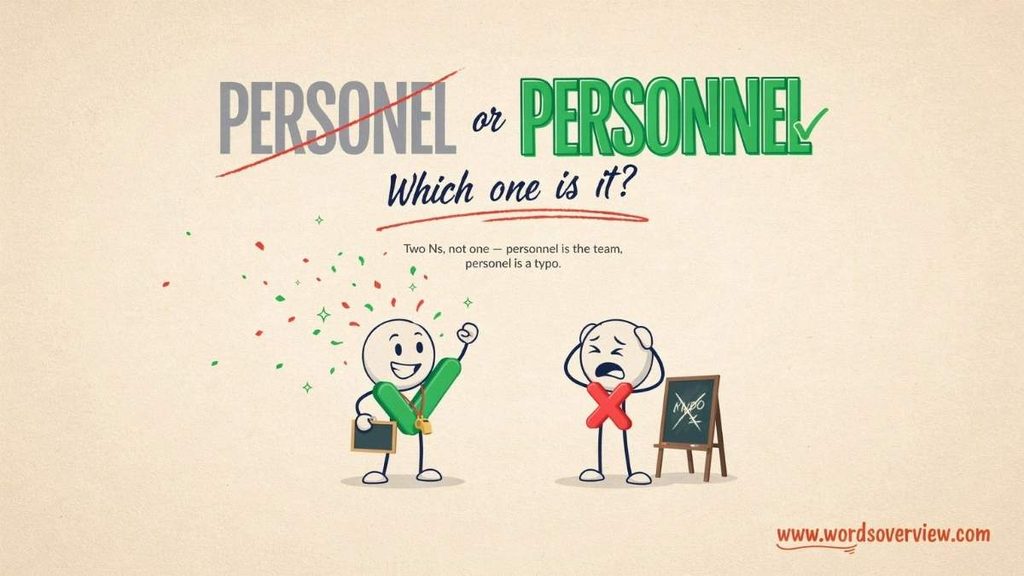
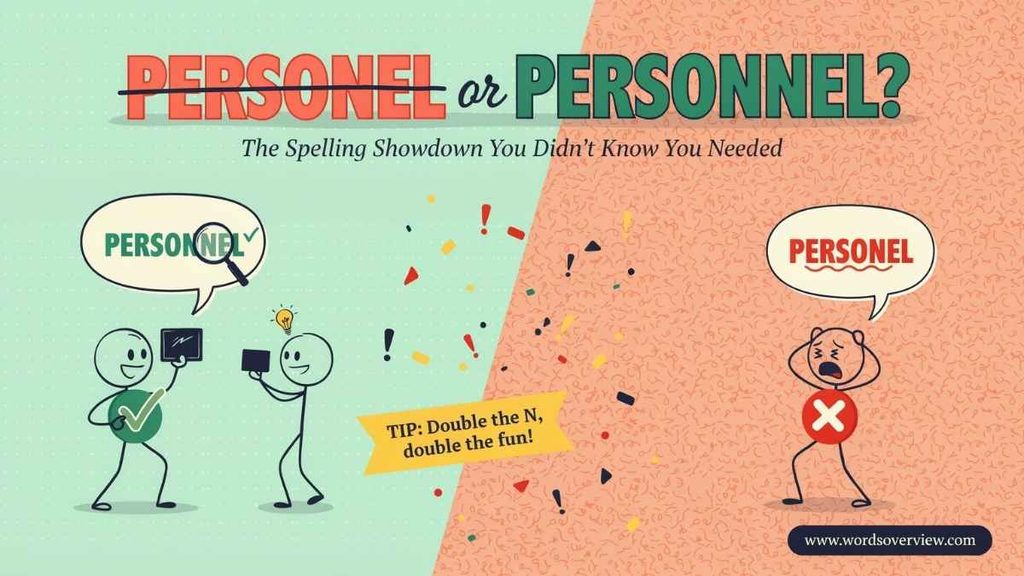
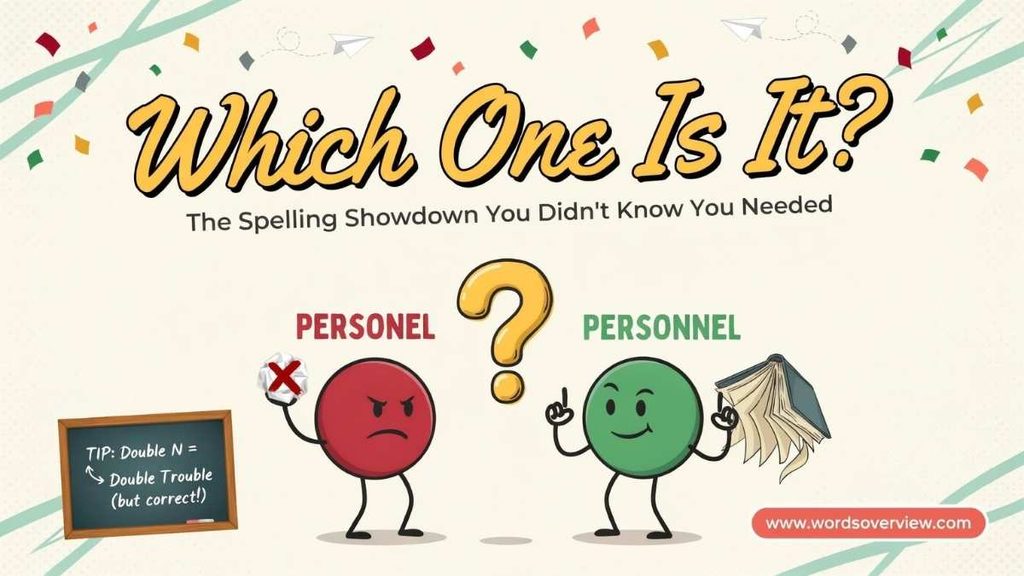
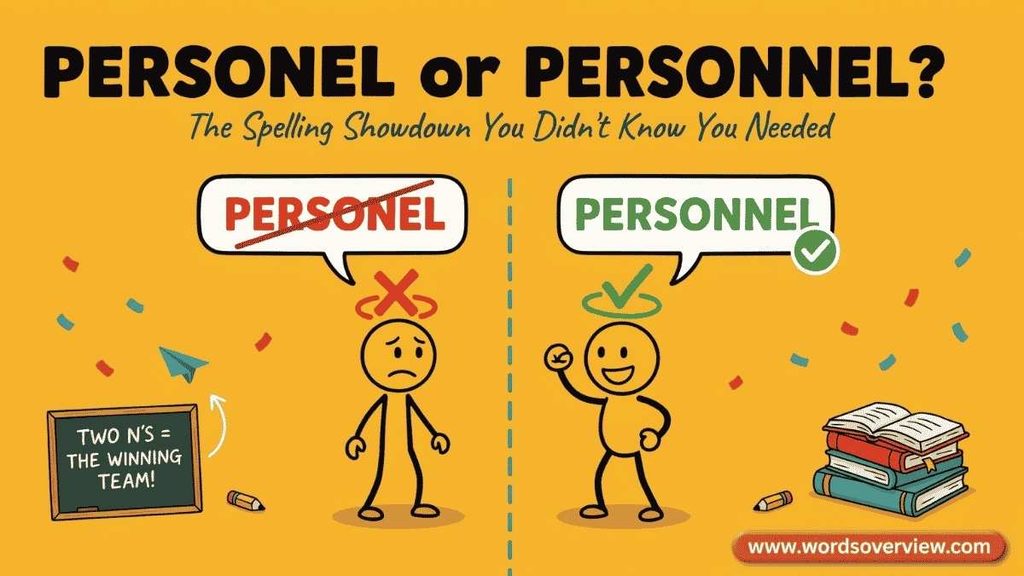
The correct spelling is personnel, with two n’s:
- Correct: personnel
- Incorrect: personel
- Correct but different word: personal
Personnel is a noun that generally refers to the people who work for or serve an organization, company, institution, military unit or other group.
For example:
All company personnel must complete the training by Friday.
Here, personnel means the people who work for the company.
By contrast:
Please keep your personal information secure.
In this sentence, personal describes information related to an individual.
Learn the difference between similar English words
Families or Family’s Correct Usage and Difference
Personel or Personnel Examples
| Incorrect | Correct |
| The company hired new personel. | The company hired new personnel. |
| All personel must report at 8 a.m. | All personnel must report at 8 a.m. |
| The personel department handles recruitment. | The personnel department handles recruitment. |
Therefore, if you’re asking “personel or personnel which is correct?” the answer is personnel.
Personnel Meaning
The word personnel refers to the people who work for, serve or belong to an organization or institution.
A practical personnel definition is the people employed by an organization or engaged in a particular service or activity.
For example:
The hospital has enough personnel to handle the increased number of patients.
In this sentence, personnel refers collectively to the people working at the hospital.
Learn the difference between commonly mixed-up more words
Foward or Forward: Which Spelling Is Correct?
Personnel Meaning in English
In everyday English, personnel often appears in professional organizational, military, government and institutional contexts.
Common expressions include:
- company personnel
- office personnel
- military personnel
- security personnel
- medical personnel
- emergency personnel
- personnel department
- personnel management
- personnel records
- personnel file
The exact group depends on the context.
For example, military personnel means members of the armed forces. Similarly, security personnel refers to people responsible for security duties. Emergency personnel can include professionals who respond to emergencies.
Personnel Definition in English
A simple personnel definition in English is:
Personnel means the people who work for or serve an organization, institution or group.
Personnel functions as a noun. It identifies people as a group rather than describing a quality or characteristic.
For example:
The manager called a meeting for all personnel.
The sentence refers to the organization’s workers collectively.
Personel Meaning
The word personel usually has no standard English meaning when someone uses it as an alternative spelling of personnel.
In most cases, the personel meaning is simply the meaning the writer intended for personnel. However, the spelling remains incorrect.
For example:
The company needs more personel.
The intended sentence is:
The company needs more personnel.
Therefore, personel isn’t a standard alternative spelling that you should use in professional or academic English.
Is Personel a Word?
Is personel a word? In standard English, you shouldn’t use personel to mean employees or staff.
When you mean people working for an organization, use personnel.
This distinction matters particularly in:
- Resumes
- Business emails
- Reports
- Academic writing
- Job applications
- HR documents
- Company policies
- Government documents
A single missing letter may look minor. However, repeated spelling errors can make formal writing appear less polished.
Learn the difference between similar English words
Analyses or Analysis Meaning and Correct Usage
Personel or Personnel What’s the Difference?
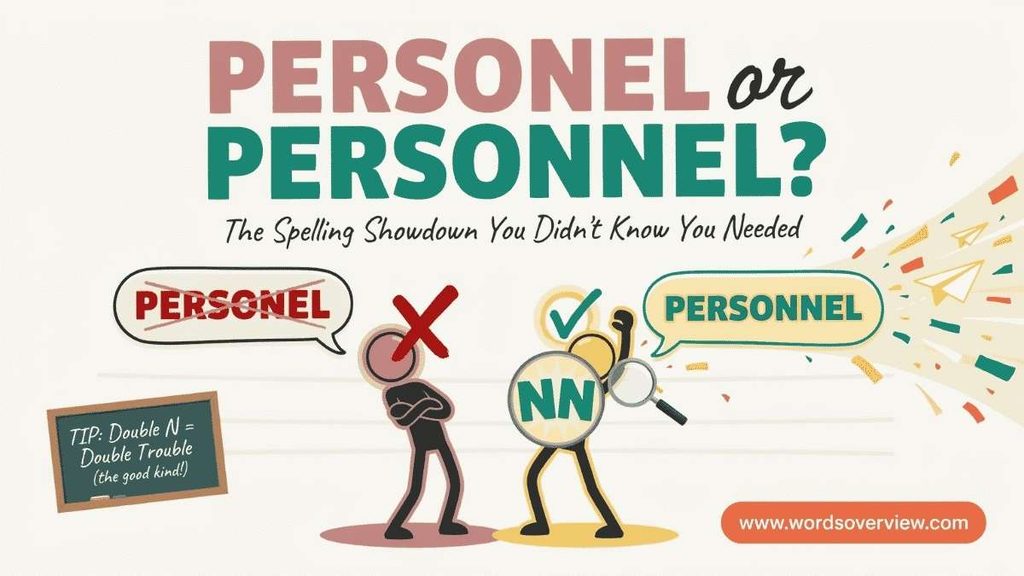
The personel or personnel comparison has a straightforward answer: personnel is correct, while personel is a misspelling.
There isn’t a difference in meaning between two legitimate English words in this case.
| Form | Status | Meaning |
| personnel | Correct | People working for or serving an organization |
| personel | Incorrect | Common misspelling of personnel |
The same answer applies to personnel or personel.
Personnel or Personel Examples
Incorrect:
The hospital hired additional personel.
Correct:
The hospital hired additional personnel.
Incorrect:
All personel must wear an identification badge.
Correct:
All personnel must wear an identification badge.
Therefore, the difference concerns spelling rather than meaning. The standard English word is personnel.
How to Spell Personnel
If you’re wondering how to spell personnel, use:
P-E-R-S-O-N-N-E-L
The part that causes the most trouble is the double n in the middle:
personnel
Not:
personel
Is Personnel Spelled With Two N’s?
Yes. Personnel is spelled with two n’s.
You can visually break the word down as:
person + nel = personnel
The two n’s appear next to each other:
personnel
This spelling is fixed in standard English, so you shouldn’t remove one n simply because the pronunciation doesn’t make the double consonant obvious.
Why Is Personnel Spelled With Two N’s?
The spelling comes from the word’s history. Personnel entered English through French personnel and ultimately traces back to Latin persona, meaning a person or character.
English retained the established spelling, including the double n.
Consequently, there isn’t a simple modern spelling rule that explains every letter. The best approach is to learn personnel as a whole word and reinforce it through regular use.
Personnel Spelling An Easy Way to Remember It
The easiest way to remember personnel spelling is to connect the word visually with person and then remember the extra n.
Think:
person + nel = personnel
You can also associate it with familiar workplace phrases:
- personnel department
- personnel manager
- personnel file
- personnel records
This method works because you learn the spelling in context rather than memorizing an isolated string of letters.
How to Remember the Spelling of Personnel
Keep this simple visual reminder in mind:
- Incorrect: personel
- Correct: personnel
The correct form contains two n’s.
If you frequently write workplace documents, remember the phrase personnel department. Once the correct spelling becomes familiar, the extra n starts to look natural instead of strange.
Learn the difference between commonly confused words in English
Grayscale or Greyscale: Which Is Correct?
Personal or Personnel The Important Difference
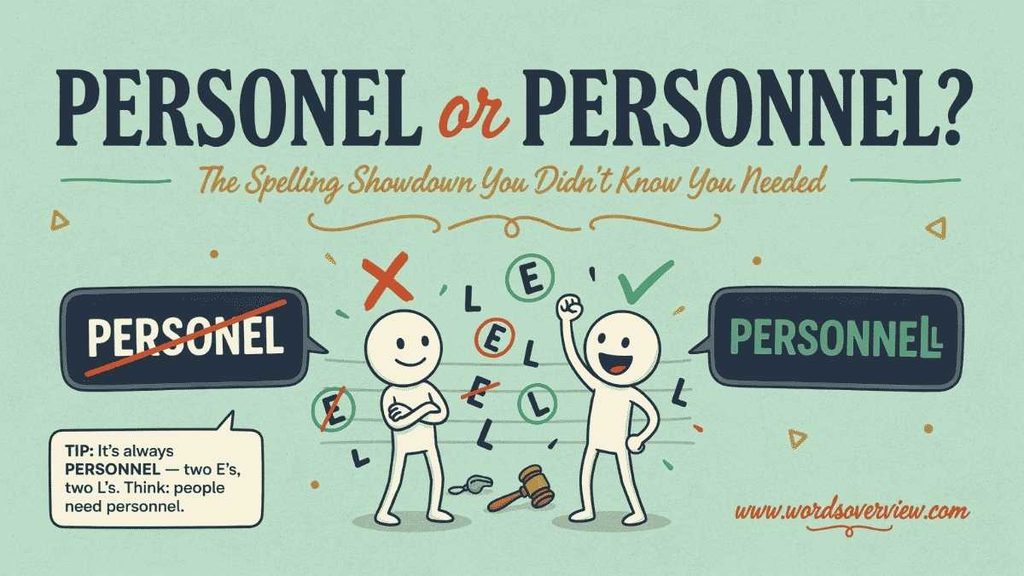
The personal or personnel distinction causes another common spelling problem because both words are legitimate English terms.
However, they don’t mean the same thing.
Personal Meaning
Personal is an adjective. It describes something relating to an individual, that person’s private life, experiences, opinions, belongings or identity.
Common examples include:
- personal information
- personal belongings
- personal opinion
- personal experience
- personal choice
- personal responsibility
- personal preferences
For example:
She kept her personal belongings in a locker.
Here, personal means belonging to or associated with an individual.
Personnel Meaning
Personnel is a noun that refers to people working for or serving an organization.
For example:
The company provided new equipment for its personnel.
Here, personnel refers to the people working for the company.
Personal or Personnel Difference
The personal or personnel difference becomes much easier to remember with one simple rule:
Personal describes something related to an individual. Personnel refers to people working for or serving an organization.
That distinction solves most cases of personal or personnel confusion.
Personal or Personnel Which One Should You Use?
When you’re deciding between personal or personnel, focus on the meaning of the sentence.
Use personal when you’re describing something connected to one person.
Please don’t share my personal information.
Use personnel when you’re referring to people who work for an organization.
The company asked all personnel to attend the meeting.
Personal and Personnel Examples
| Personal | Personnel |
| personal information | company personnel |
| personal belongings | office personnel |
| personal opinion | military personnel |
| personal experience | security personnel |
| personal choice | emergency personnel |
| personal responsibility | personnel department |
The words also have different grammatical roles.
Personal is normally an adjective.
Personnel is a noun.
Therefore, the surrounding words can often help you identify the correct choice.
Is Personnel Singular or Plural?
The question “is personnel singular or plural?” can be confusing because personnel refers to a group of people but doesn’t normally take a regular plural ending.
In practical usage, personnel functions as a collective noun or a noun referring collectively to people.
For example:
All personnel must complete the safety training.
You don’t need to add -s to indicate multiple people.
Learn the difference between everyday English mistakes
Girly or Girlie Correct Usage and Difference
Personnel Singular or Plural
Personnel normally refers collectively to people.
Compare:
The company hired an employee.
with:
The company hired additional personnel.
The first sentence identifies one individual. The second refers to workers collectively.
Can Personnel Be Singular?
Can personnel be singular? In ordinary English, personnel isn’t normally used as a countable noun for one employee.
Instead, use:
- employee
- worker
- staff member
- team member
For example:
Incorrect: One personnel arrived early.
Better:
One employee arrived early.
Or:
One staff member arrived early.
What Is the Plural of Personnel?
The personnel plural form is normally personnel itself.
For example:
All personnel must wear protective equipment.
The word doesn’t need an added -s.
You generally shouldn’t write:
The company hired several personnels.
Instead, write:
The company hired several employees.
Or:
The company hired additional personnel.
Personnel as a Collective Noun
Understanding personnel as a collective noun helps explain its grammar.
A company might employ hundreds of people. Collectively, those people can be described as the company’s personnel.
For example:
The airline increased its personnel during the busy travel season.
The sentence refers to the workforce as a group rather than identifying individual workers.
Personnel behaves differently from a simple countable noun such as employee. You can say one employee or five employees. However, you generally don’t say one personnel or five personnels in ordinary English.
When you need to identify individuals, employee, worker or staff member usually provides clearer wording.
Learn the difference between similar English words the easy way
Uncapable or Incapable: Which Spelling Is Correct?
Personnel or Employees What’s the Difference?
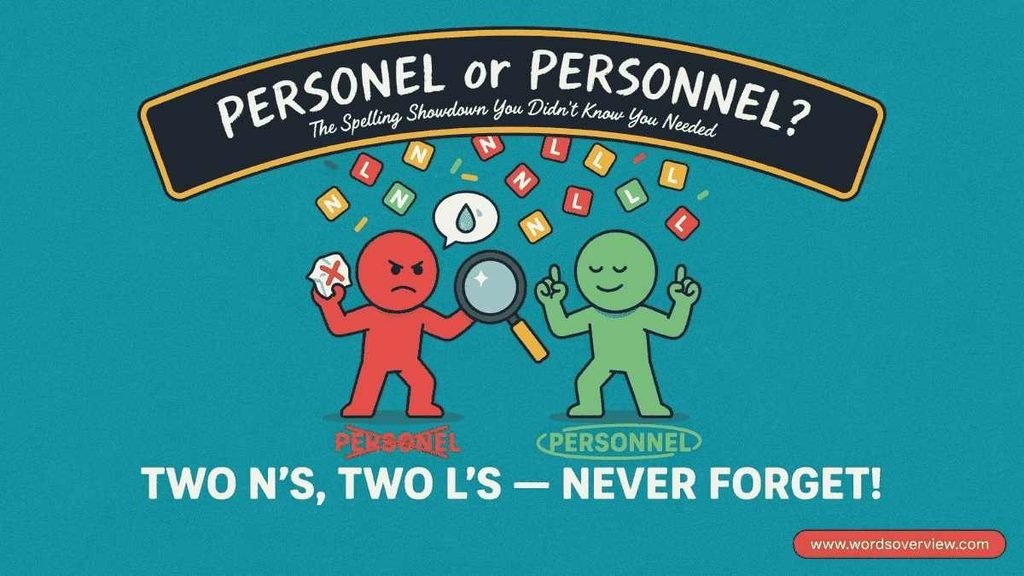
The question “what is the difference between personnel and employees?” has a useful practical answer.
Employees are people employed by an organization. Personnel can refer more broadly to people working for or serving an organization or institution.
In many workplace contexts, the terms overlap.
| Word | Typical focus |
| Employee | One person employed by an organization |
| Employees | Multiple people employed by an organization |
| Personnel | People working for or serving an organization collectively |
| Staff | Employees or workers considered as a group |
| Workforce | The overall body of workers |
For example:
The company has 500 employees.
This statement emphasizes individual workers and their number.
By contrast:
The company needs additional personnel.
This statement emphasizes the organization’s need for more people to perform its work.
Therefore, the words can overlap without being identical in every context.
Common Uses of Personnel
Personnel appears frequently in professional and institutional language.
Personnel Department
A personnel department traditionally refers to the part of an organization responsible for employee-related matters. Today, many organizations use human resources department or HR department instead.
Typical responsibilities can include:
- Hiring
- Employee records
- Workplace policies
- Training
- Compensation administration
- Employee relations
Personnel Management
Personnel management refers to managing employees and employment-related matters within an organization.
The term has a long history in business administration and remains understandable today, although many organizations now use human resources management as the preferred term.
Personnel File
A personnel file is a collection of employment-related records maintained about an employee.
Depending on the organization and applicable rules, it may contain information about:
- Employment history
- Job position
- Performance documentation
- Training
- Compensation
- Workplace actions
The exact contents and access rules vary by organization and jurisdiction.
Personnel Records
Personnel records generally refer to records connected with employees or staff.
For example:
The HR department maintains personnel records for current employees.
Military Personnel
Military personnel means people serving in the armed forces.
For example:
Military personnel participated in the training exercise.
The term can apply to members of different branches of the armed forces depending on the context.
Security Personnel
Security personnel refers to people responsible for security duties.
For example:
Security personnel checked visitors before allowing them into the building.
Learn the difference between similar English words
Indecisive or Undecisive Which Word Is Correct?
Personnel Examples in Sentences
Seeing personnel in different contexts makes its usage easier to understand.
Workplace Examples
The company hired additional personnel during its expansion.
All personnel must complete the annual safety course.
The manager met with personnel from the finance department.
Office personnel received updated security badges.
Medical Examples
Medical personnel arrived at the scene within minutes.
Hospital personnel followed the emergency procedure.
Military Examples
Military personnel received specialized training.
The base restricted access to authorized personnel.
Emergency Examples
Emergency personnel responded quickly to the accident.
Only authorized personnel may enter the restricted area.
Formal Business Examples
The organization needs additional personnel to manage the new project.
Personnel records must be stored securely.
The personnel department issued a new workplace policy.
Across these personnel examples, the meaning remains consistent: the word refers to people connected with an organization, institution, service or activity.
Learn the difference between more words people mix up
Tier or Teir? Which Spelling Is Correct?
Personel and Personnel in Everyday Writing
The personel spelling mistake often appears in informal writing because people spell the word according to how they remember its sound.
However, the error can become more noticeable when it appears in professional communication.
Emails
Incorrect:
Please forward this message to all personel.
Correct:
Please forward this message to all personnel.
Reports
Incorrect:
The company requires additional personel.
Correct:
The company requires additional personnel.
Workplace Notices
Incorrect:
All personel must wear an ID badge.
Correct:
All personnel must wear an ID badge.
Academic Writing
Incorrect:
The study included hospital personel.
Correct:
The study included hospital personnel.
Therefore, checking the spelling matters whenever the word appears in formal or professional writing.
Common Mistakes With Personnel
Several mistakes appear repeatedly when writers use this word.
Dropping One N
This is the classic error:
Incorrect: personel
Correct: personnel
If you remember only one spelling fact, remember the double n.
Confusing Personnel With Personal
This mistake changes the meaning of the sentence.
Incorrect: Please protect your personnel information.
If you mean information belonging to an individual, write:
Please protect your personal information.
However:
The company trained its personnel.
Here, personnel refers to workers.
Using Personnel for One Person
Don’t normally use personnel as though it means one employee.
Incorrect: One personnel answered the phone.
Better:
One employee answered the phone.
Or:
One staff member answered the phone.
Adding s to Personnel
Because personnel refers to multiple people, writers sometimes create the form personnels.
In ordinary English, that form isn’t normally necessary.
Incorrect: The company has several personnels.
Correct: The company has several employees.
Or:
Correct: The company has several personnel.
Personnel Synonyms
The best synonym depends on the context.
Staff
Staff is one of the closest everyday alternatives.
The hotel hired more staff.
Employees
Employees works well when the people are specifically employed by an organization.
The company provides health insurance to its employees.
Workers
Workers is broader and can refer to people performing work in many settings.
The factory employs hundreds of workers.
Workforce
Workforce often emphasizes the overall body of workers.
The company expanded its workforce.
Team Members
Team members works when you’re referring to people who belong to a particular team.
All team members must attend the meeting.
These terms aren’t perfect substitutes in every sentence. For example, staff can be broader or more natural in everyday workplace language, while employees specifically emphasizes an employment relationship.
Learn the difference between tricky English words with easy explanations
Finalise or Finalize: Difference, Spelling and Usage
Personnel or Staff or Employees
These terms overlap, but each has a slightly different emphasis.
| Term | Meaning | Typical context |
| Personnel | People working for or serving an organization | Formal or institutional |
| Staff | Employees considered collectively | General workplace |
| Employees | People employed by an organization | Business and employment |
| Workers | People who perform work | Broad/general |
| Workforce | Overall body of workers | Business and economics |
For example:
- The hospital needs more personnel.
- The hospital needs more staff.
- The hospital needs more employees.
All three can make sense. However, the context and intended emphasis determine which term sounds most natural.
Personnel often sounds more formal or institutional. Staff is common in everyday workplace English, while employees focuses specifically on people employed by an organization.
British English or American English Personnel Spelling
The correct spelling of personnel doesn’t change between American and British English.
| English variety | Spelling |
| American English | personnel |
| British English | personnel |
| Canadian English | personnel |
| Australian English | personnel |
Therefore, personel isn’t a British spelling alternative.
Some English words genuinely have different spellings across varieties, such as color and colour or center and centre. Personnel isn’t one of them.
Is Personnel the Correct Spelling?
Yes.
If you’re asking, “Is personnel the correct spelling?” the answer is yes when you mean people working for an organization.
If you’re asking, “Is personel a correct spelling?” the answer is no in standard English for this meaning.
Remember the three forms:
personnel = people working for an organization
personal = relating to an individual
personel = misspelling
This simple distinction handles most situations involving these commonly confused words.
How to Use Personnel in a Sentence
The easiest way to use personnel correctly is to ask yourself one question:
Am I referring to people who work for or serve an organization?
If the answer is yes, personnel may be the right word.
For example:
The company notified all personnel about the policy change.
Here, personnel refers to the company’s workers.
However, if you’re talking about something belonging to one individual, use personal:
She packed her personal belongings.
A Simple Sentence Test
Compare these two sentences:
The company updated its personnel records.
The records concern employees.
Now consider:
He updated his personal records.
The records concern an individual.
Therefore, one letter sequence can make a major difference in meaning.
Learn the difference between more words people mix up
13rd or 13th: Which Is Correct?
Personel or Personnel Quick Comparison
Here’s the complete comparison at a glance:
| Question | Answer |
| Is personnel correct? | Yes |
| Is personel correct? | No, not for the standard meaning of employees or staff |
| Does personnel have two n’s? | Yes |
| What does personnel mean? | People working for or serving an organization |
| Is personnel normally used for one person? | No |
| Is personnels the normal plural? | No |
| Is personal a different word? | Yes |
| Does personal mean employees? | No |
| Does personnel change spelling in American English? | No |
| Does personnel change spelling in British English? | No |
Practice Session Fill in the Blanks
Choose the correct word: personnel, personel or personal.
- The company requires all ______ to attend the safety meeting.
- Please keep your ______ belongings in the locker.
- The correct spelling is ______, not “personel.”
- The hospital hired additional medical ______ for the new department.
- Do not share your ______ information with strangers.
- All military ______ must follow the updated regulations.
- “Personel” is a common spelling ______ of “personnel.”
- The manager spoke with the office ______ about the new policy.
- She keeps her ______ documents in a secure folder.
- The company has trained its ______ to handle customer complaints.
- Please remove all ______ items from the conference room.
- The personnel department maintains employee ______.
- The supervisor asked the maintenance ______ to inspect the equipment.
- He prefers to keep his ______ opinions separate from his professional duties.
- The organization provides training for its new ______.
- Is “personel” the correct ______ of the word?
- The security ______ checked every visitor’s identification.
- Your ______ preferences may differ from those of your coworkers.
- The manager thanked the entire ______ for their hard work.
- The company keeps a separate ______ file for each employee.
- The correct spelling of ______ contains two n’s.
- The hospital needs more nursing ______ during the busy season.
- Please do not use company equipment for ______ purposes.
- The director held a meeting with senior ______ members.
- Understanding the difference between ______ and personal can prevent a common spelling mistake.
Answer Session
- personnel
- personal
- personnel
- personnel
- personal
- personnel
- mistake
- personnel
- personal
- personnel
- personal
- records
- personnel
- personal
- personnel
- spelling
- personnel
- personal
- personnel
- personnel
- personnel
- personnel
- personal
- personnel
- personnel
Frequently Asked Questions
How do you spell personnel when referring to staff?
The correct spelling is personnel. It refers to the people who work for an organization, company, institution or other group.
What does “personnel” mean in simple words?
Personnel simply means employees, staff members or workers. For example, “Company personnel must wear identification badges.”
What does “personal” mean?
Personal is an adjective that describes something connected to a particular person. Examples include personal information, personal belongings and personal opinions.
Is personnel one person?
Usually, no. Personnel normally refers to a group of people who work for or serve an organization. For one person, use employee, worker or staff member.
Is “personel” the correct spelling?
No. Personel is a common spelling mistake. The correct form is personnel, with two n’s.
What is the difference between personnel and employees?
Both words can refer to people who work for an organization. However, employees usually refers specifically to people employed by a company, while personnel can have a broader and more formal meaning that includes staff serving an organization or institution.
Are staff and personnel the same?
They often have the same meaning when referring to employees or workers. However, staff is more common in everyday workplace language, while personnel often sounds more formal.
What is another word for personnel?
Depending on the context, alternatives include staff, employees, workers, workforce, team members and company staff. The best choice depends on what you specifically want to describe.
Is HR the same as personnel?
Not exactly. Personnel refers to the people working for an organization. HR or human resources, usually refers to the department or function responsible for managing employees, including hiring, records, benefits and workplace policies.
How can you use personnel in a sentence?
You can use personnel to refer to an organization’s staff or workers. For example: “All personnel must complete the required safety training before entering the facility.”
Conclusion
English spelling loves to set small traps and “personel” is one of its sneakiest. However, the confusion becomes much easier once you remember that personnel is the correct spelling when you mean employees, staff members or people working for an organization. The extra “n” may look unnecessary, but it belongs there.
Meanwhile, personal has a completely different job. It describes something related to one person, such as personal information, personal belongings or personal opinions. Therefore, if you’re choosing between personel or personnel, go with personnel when you’re talking about staff.
A quick spelling check can save you from an awkward typo. After all, you want your personnel department discussing employees not discussing why “personel” lost an “n” along the way.

Ethan AJS is an experienced blogger and language enthusiast at Words Overview, dedicated to making English easier to understand and use. He writes about grammar, vocabulary, spelling, word meanings and commonly confused words, turning tricky language questions into clear, practical insights. With a passion for effective communication, Ethan creates engaging, readerfocused content that helps readers write accurately, choose the right words and communicate with confidence.