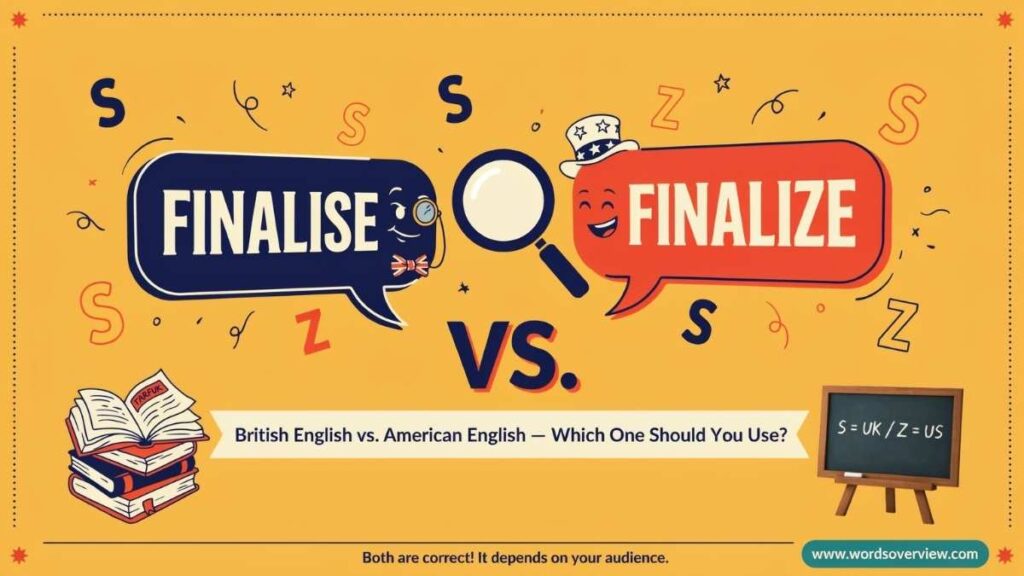
English has a funny habit of making one simple decision feel like a committee meeting. Take “Finalise or Finalize”: both spellings are correct, yet choosing between them can make even confident writers pause before hitting “submit.” If you’ve ever stared at these two words and wondered whether one belongs in a grammar textbook and the other in a typo bin, you’re not alone. The good news? The difference isn’t about meaning, pronunciation or grammatical correctness. It’s mainly about regional spelling conventions. In this guide, you’ll learn when to use “finalise” or “finalize,” what each form means and how to avoid mixing them in professional writing.
Finalise or Finalize What’s the Difference?
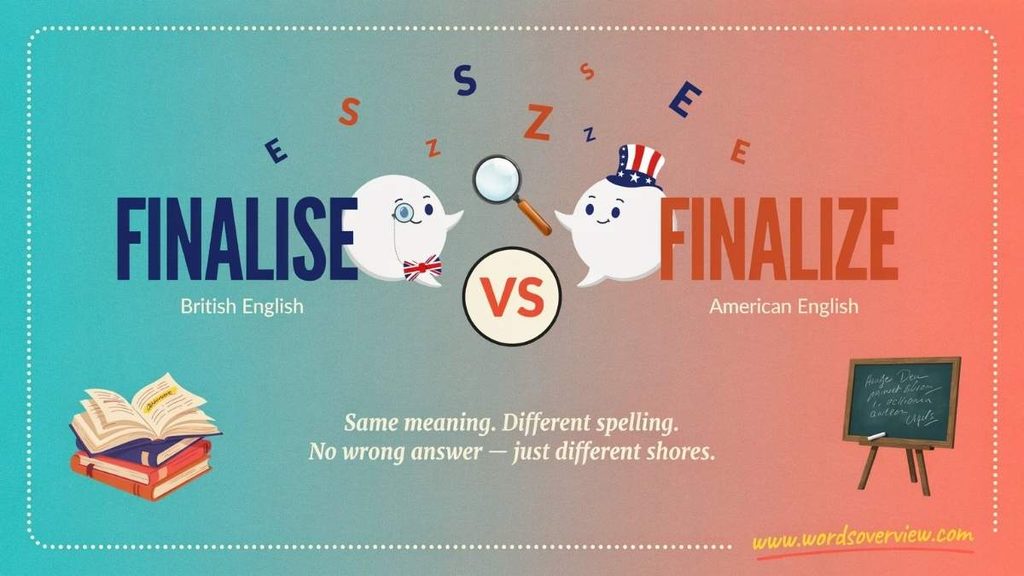
The finalise or finalize question concerns spelling rather than meaning.
Both words mean to make something final, settle its remaining details or reach a final decision. For example, these sentences communicate exactly the same idea:
- We need to finalize the project schedule.
- We need to finalise the project schedule.
The only difference is the spelling of the final syllable.
| Form | Spelling pattern | Common usage |
| Finalize | -ize | American English; also used by some British styles |
| Finalise | -ise | British English and other varieties that favor -ise |
Consequently, neither spelling automatically indicates a different meaning, pronunciation or level of formality.
What Does Finalize Mean?
The finalize meaning is to make something final by settling the remaining details or reaching a definite decision.
A practical finalize definition is:
To complete the final decisions, changes or arrangements concerning something so that it can be regarded as final.
The verb commonly takes a direct object. For example:
- The manager will finalize the schedule tomorrow.
- We need to finalize the contract before Friday.
- The committee finalized its decision after reviewing the evidence.
- The design team is finalizing the new layout.
In each case, the subject takes action to make something final.
What Does Finalise Mean?
The finalise meaning is the same as the meaning of finalize.
A useful finalise definition is:
To make something final, settle its remaining details or reach a final decision about it.
The only change is the spelling:
- finalise uses -ise
- finalize uses -ize
For example:
The committee will finalise the proposal tomorrow.
In American English, the same sentence would normally use finalize.
Finalise or Finalize in a Sentence
If you’re looking for finalise or finalize in a sentence examples, consider these:
- We need to finalize the budget before the meeting.
- The organizers will finalise the arrangements next week.
- Please finalize the document before sending it to the client.
- The company has finalized the agreement.
- The committee has finalised the proposal.
- We’re finalizing the details of the event.
The meaning remains unchanged. However, the spelling should match the English variety used throughout the surrounding text.
Finalise or Finalize Meaning and Examples
The word becomes easier to understand when you examine the situations in which people actually use it.
Finalize a Project
To finalize a project means to settle its remaining details and prepare it for completion, approval, delivery or release.
For example:
The development team will finalize the project after testing the last feature.
Here, finalize doesn’t simply mean that the team has stopped working. Instead, it suggests that the remaining decisions or details have reached their final stage.
In a British English style that uses -ise, you could write:
The development team will finalise the project after testing the last feature.
Finalize a Document
When you finalize a document, you complete the final edits, corrections, approvals or formatting decisions before treating the document as complete.
For example:
Please review the report one more time before we finalize the document.
This usage appears frequently in professional writing because reports, proposals, contracts and other documents often go through several drafts before someone approves the final version.
Finalize a Decision
To finalize a decision means to settle it after considering the relevant information, alternatives or recommendations.
For example:
The board will finalize its decision after reviewing the financial report.
In a British English style that uses -ise:
The board will finalise its decision after reviewing the financial report.
The word works especially well when people have already discussed a decision but haven’t yet made it definitive.
Finalize a Plan
A plan can remain flexible until its final details become settled. At that point, you can finalize the plan.
For example:
We have chosen the location, but we still need to finalize the schedule.
This usage differs slightly from simply saying:
We need to finish the schedule.
The first sentence emphasizes settling the remaining details. The second emphasizes completing the work itself.
Learn the difference between confusing more English words
Tie or Tye: Meaning, Difference and Usage
Finalize or Finish Are They the Same?

Although finalize and finish overlap, they don’t always express exactly the same idea.
Finish generally means to bring an activity or task to an end. Finalize, on the other hand, emphasizes the point at which something becomes settled, definite or ready to treat as final.
| Sentence | What it emphasizes |
| I need to finish the report. | Completing the work |
| I need to finalize the report. | Settling the remaining details |
| She finished the presentation. | Completing the presentation |
| She finalized the presentation. | Making the final decisions or edits |
| We finished the project. | Completing the project |
| We finalized the project plan. | Settling the plan’s remaining details |
Therefore, finish is often broader, while finalize is more specific when you want to emphasize a final stage of decision-making, editing or approval.
Still, the two words can overlap in everyday communication. Context determines which one sounds more precise.
The Origin of Finalize and Finalise
The history of finalize helps explain why English has two common spellings.
The verb finalize developed from final + -ize in the 19th century. The related finalise spelling represents the same verb with the -ise ending.
The word final has a much older history. English received it through French from Late Latin, where it related to an ending, boundary or limit. The Latin word ultimately connects with the idea of an end.
The suffix -ize also has a long history. It traces through Latin and French to the Greek verb-forming element associated with -izein. English adopted many words containing this ending over time.
Why Are There -ize and -ise Spellings?
The difference between -ize and -ise developed through the history of English spelling.
English absorbed vocabulary from several languages, including French, Latin and Greek. As English developed different regional and editorial conventions, writers adopted different spellings for certain word endings.
That history produced pairs such as:
- organize / organise
- recognize / recognise
- realize / realise
- modernize / modernise
- finalize / finalise
American English developed a strong preference for -ize in this group. Meanwhile, many British publications adopted -ise.
However, there’s an important qualification: British English doesn’t universally require -ise. Some British dictionaries, publishers and style systems accept or prefer -ize.
Therefore, the simple rule “American uses -ize and British uses -ise” works as a useful starting point, but it doesn’t describe every British spelling system.
Learn the difference between similar English words the easy way
Uncapable or Incapable: Which Spelling Is Correct?
Finalise or Finalize in British and American English
The finalise or finalize distinction becomes clearer when you separate the language variety from the particular style guide.
American English Spelling
In American English, finalize is the standard form.
The same preference appears in related verbs such as:
- organize
- recognize
- realize
- modernize
- centralize
- standardize
- finalize
For example:
Please finalize the report before the meeting.
If you’re writing for a US audience, finalize is normally the correct spelling choice.
British English Spelling
In British English, finalise is widely used.
For example:
Please finalise the report before the meeting.
Many British writers and publications prefer -ise spellings across words of this type. However, British English also includes established -ize usage.
As a result, finalize isn’t automatically wrong in British English.
Australian and New Zealand English
Australian English and New Zealand English have strong British spelling influences. Consequently, -ise forms are common in many contexts.
However, individual publishers, institutions, businesses and style guides may establish their own preferences.
Therefore, if you’re writing specifically for an Australian or New Zealand audience, follow the organization’s preferred dictionary or style guide when one exists.
This approach is more reliable than assuming that every English-speaking country follows exactly the same spelling rules.
Which Spelling Should You Use?
The question “which is correct finalise or finalize?” has a practical answer.
| Writing context | Appropriate choice |
| Standard US English | finalize |
| British English using -ise | finalise |
| British English using an -ize style | finalize |
| Australian or New Zealand English | Follow the relevant style guide |
| Company or publication with a house style | Follow its specified spelling |
| International website | Choose one English variety and remain consistent |
So, should I use finalise or finalize?
- If you write in American English, choose finalize.
- If you follow a British English style that uses -ise, choose finalise.
- If your organization provides a style guide, follow that guide even if its preference differs from your personal habit.
Use Finalize for American English
For finalise or finalize American English, the answer is generally finalize.
Examples include:
- finalize a contract
- finalize a schedule
- finalize a proposal
- finalize an agreement
- finalize a decision
- finalize a project
The related forms also retain the z:
- finalized
- finalizing
- finalization
Use Finalise for British English
For finalise or finalize British English, finalise is a common choice under the -ise convention.
Its related forms are:
- finalised
- finalising
- finalisation
For example:
The team has finalised the agreement.
However, remember that some British style systems use -ize. Therefore, the presence of finalize doesn’t automatically make a British document incorrect.
What About Global Content?
International websites face a slightly different problem.
A global audience doesn’t necessarily require you to mix British and American spelling. In fact, switching between regional varieties can make your content look inconsistent.
Instead, choose a clear regional variety of English.
For example, a website using US English might consistently use:
- finalize
- organize
- recognize
- realize
A website using a British -ise convention might use:
- finalise
- organise
- recognise
- realise
The key is spelling consistency.
Learn the difference between more words people mix up
Inconsolable or Unconsolable Which Is Correct?
Finalise or Finalize Spelling Common Patterns
The finalise spelling and finalize spelling follow a broader pattern that appears in many English verbs.
| -ise form | -ize form |
| organise | organize |
| recognise | recognize |
| realise | realize |
| modernise | modernize |
| centralise | centralize |
| standardise | standardize |
| finalise | finalize |
These pairs demonstrate common regional spelling differences.
However, don’t assume that you can mechanically change every s to z. English contains many words ending in -ise that don’t belong to this spelling pattern.
For example:
- advise
- advertise
- exercise
- revise
- supervise
- surprise
You can’t turn these into advize, advertize, exercize, revize, supervize or surprize simply because American English often favors -ize.
That’s why actual dictionary usage and established language conventions matter.
Is Finalise a Word?
Yes. Is finalise a word? Absolutely.
Finalise is an established English verb and an accepted spelling variant of finalize. It commonly appears in British English and other varieties that use the -ise convention.
For example:
The committee will finalise the proposal tomorrow.
This isn’t an informal version or a spelling mistake. It is a legitimate form of the verb.
Is Finalize a Word?
Yes. Is finalize a word? It is a standard English verb and the normal spelling in American English.
For example:
The committee will finalize the proposal tomorrow.
The form also appears in British English styles that favor -ize spellings.
Therefore, both forms belong to standard English vocabulary. The difference lies primarily in spelling preference and editorial convention.
Is Finalise Correct?
Yes. Is finalise correct? Yes, when it matches the spelling system you’re following.
For example:
The company will finalise the agreement next week.
This sentence works naturally in a British English context that follows the -ise convention.
Is Finalize Correct?
Yes. Is finalize correct? It is the standard American English form and also appears in British English styles that prefer -ize.
For example:
The company will finalize the agreement next week.
The spelling doesn’t make the verb more or less formal. It simply reflects the selected English convention.
Learn the difference between commonly mixed-up more words
Foward or Forward: Which Spelling Is Correct?
Finalize and Finalise Related Forms
The spelling difference continues when you change the grammatical form of the verb.
| Grammatical form | -ise spelling | -ize spelling |
| Base form | finalise | finalize |
| Past tense | finalised | finalized |
| Past participle | finalised | finalized |
| Present participle | finalising | finalizing |
| Noun | finalisation | finalization |
This consistency matters in longer documents.
For example, a document that uses the -ize convention should normally say:
The team will finalize the proposal after it has finalized the budget.
A document using the -ise convention can say:
The team will finalise the proposal after it has finalised the budget.
Both systems work. What matters is keeping the chosen system intact.
Learn the difference between commonly misused words
Blackout or Backout: Difference and Usage
Common Mistakes With Finalise and Finalize
Mixing the Two Spellings
One of the most common problems occurs when writers switch between finalise and finalize in the same document.
For example:
The team will finalize the proposal after the committee has finalised its comments.
The reader can understand the sentence. However, the mixed spelling may look careless when the document otherwise follows one regional style.
A consistent version would be:
The team will finalize the proposal after the committee has finalized its comments.
Or:
The team will finalise the proposal after the committee has finalised its comments.
Assuming Finalise Is Incorrect
Writers who primarily use American English sometimes mistake finalise for a spelling error
That assumption is incorrect.
The same issue appears with organise, recognise and realise. These forms are standard in English varieties and style systems that use -ise.
Assuming Finalize Is Always American
This claim is also too broad.
Although finalize is the standard American English form, some British English style systems use -ize.
Therefore, finalize can occur in British writing without being a spelling mistake.
Thinking -ise Is Informal
The -ise ending doesn’t make a word informal.
For example:
The parties have finalised the agreement.
That sentence can appear in formal business or administrative writing.
Likewise:
The parties have finalized the agreement.
The spelling doesn’t determine the level of formality.
Changing Spelling Within One Document
A polished document should normally follow one consistent spelling system.
If you use American English, don’t randomly introduce British spellings halfway through the document. Likewise, if you’ve selected a British -ise convention, maintain it throughout.
Consistency helps readers focus on the content instead of noticing unnecessary spelling shifts.
Learn the difference between more words people mix up
Tier or Teir? Which Spelling Is Correct?
Finalise or Finalize in Everyday Writing
The word appears naturally in many professional and practical contexts.
Business Emails
Both forms work:
Please finalize the meeting schedule before noon.
or:
Please finalise the meeting schedule before noon.
The correct choice depends on the organization’s English variety.
Reports and Documents
Reports often pass through multiple drafts before someone approves the final version.
For example:
Please review the report once more before we finalize the document.
Here, finalize tells the reader that the remaining changes need to be settled before the document becomes definitive.
Agreements and Contracts
The verb commonly appears with words such as agreement, contract, terms and deal.
Examples include:
The two companies are working to finalize the agreement.
The legal team has finalised the contract.
In both sentences, the verb indicates that the parties are settling the remaining details.
Plans and Arrangements
The verb also works naturally with:
- finalize plans
- finalise plans
- finalize arrangements
- finalise arrangements
- finalize details
- finalise details
- finalize a schedule
- finalise a schedule
For example:
We have selected the venue, but we still need to finalize the arrangements.
The word works particularly well when something has reached its final stage but still requires confirmation.
Learn the difference between more words people mix up
13rd or 13th: Which Is Correct?
Finalise or Finalize Synonym What Can You Use Instead?
If you’re searching for a finalise or finalize synonym, the best alternative depends on what you want to express.
| Alternative | Meaning or emphasis |
| Complete | Bring something to a finished state |
| Finish | Bring an activity or task to an end |
| Settle | Resolve remaining details or uncertainty |
| Confirm | Establish that something is agreed or certain |
| Conclude | Bring a process or matter to an end |
| Approve | Formally accept something |
| Resolve | Settle an issue or disagreement |
For example, finalize and settle can overlap:
We need to finalize the arrangements.
We need to settle the arrangements.
However, the words don’t always carry identical meanings. Approve, for instance, implies formal acceptance, while finalize can refer to completing the details before approval.
Therefore, don’t replace the word simply to avoid repetition. Choose the alternative that expresses the intended idea most precisely.
Finalise or Finalize Comparison Table
| Feature | Finalise | Finalize |
| Part of speech | Verb | Verb |
| Meaning | Make something final | Make something final |
| Basic definition | Settle the final details | Settle the final details |
| Pronunciation | Generally the same | Generally the same |
| Ending | -ise | -ize |
| Common association | British English | American English |
| US English | Not the usual standard form | Standard form |
| British English | Very common | Also used by some style systems |
| Past tense | finalised | finalized |
| Present participle | finalising | finalizing |
| Noun | finalisation | finalization |
| Example | Finalise the report. | Finalize the report. |
The important takeaway is that finalise and finalize don’t represent two different meanings. They represent different spelling conventions for the same verb.
Finalise or Finalize Oxford Spelling
The question “finalise or finalize Oxford spelling” requires a little care because different Oxford-related style resources can make different choices.
The University of Oxford’s general style guidance favors -ise/-yse/-isation spellings. It explains that this approach reflects common British usage.
However, Oxford University Press materials can use -ize where that form is available. Therefore, “Oxford spelling” doesn’t always produce one universal answer for every publication.
This distinction illustrates a broader principle: a style guide is more useful than a vague assumption about regional English.
If a university, publisher, journal or employer gives you a style guide, follow its stated convention. That rule takes priority over personal preference.
Can You Use Finalize in British English?
Yes.
The question “can you use finalize in British English?” doesn’t have a simple no answer.
British English includes both -ise and -ize spelling traditions. Many writers and publications prefer finalise, while some British style systems use finalize.
Therefore, finalize is not automatically incorrect in British English.
If you’re writing for a specific British publication, check its style guide. That approach removes ambiguity and keeps the document consistent.
Can You Use Finalise in American English?
In standard American English, finalize is the normal spelling.
You may encounter finalise in American writing because writers use different regional conventions or quote material from British sources. However, if you’re deliberately writing in US English, finalize is the appropriate standard choice.
For example:
We will finalize the report tomorrow.
This fits standard American spelling.
Learn the difference between basic English word mistakes
Where or When: Usage and Classic Song
Finalise or Finalize A Practical Case Study
Consider a company with offices in London and New York. Both offices need to describe the same business process.
The London office follows a British -ise style:
The legal department will finalise the agreement on Monday.
The New York office follows American English:
The legal department will finalize the agreement on Monday.
The meaning remains identical.
Now imagine that the company’s website randomly alternates between the two forms:
We will finalize the project in March.
The team will finalise the next stage in April.
Our managers will finalize the agreement.
The legal team has finalised the contract.
Nothing becomes grammatically incomprehensible. Nevertheless, the inconsistent spelling makes the site’s writing style less coherent.
A better approach is to establish one editorial standard.
US English:
finalize → finalized → finalizing → finalization
British -ise style:
finalise → finalised → finalising → finalisation
That small editorial decision can prevent many inconsistencies across a large website.
Learn the difference between commonly confused words in English
Grayscale or Greyscale: Which Is Correct?
Finalise or Finalize in Formal Writing
Neither spelling is inherently more formal.
This point deserves emphasis because writers sometimes assume that finalise sounds more formal because it appears frequently in British professional writing, while finalize sounds more modern because of its widespread American use.
Neither assumption has a grammatical basis.
Compare:
The committee will finalize the agreement.
and:
The committee will finalise the agreement.
Both sentences can appear in formal writing. The spelling simply reflects the selected language convention.
For professional writing, pay closer attention to:
- precise word choice
- clear sentence structure
- accurate grammar
- consistent spelling
- appropriate terminology
- logical organization
- careful proofreading
The final s or z is only one small part of effective writing.
Learn the difference between confusing English words step by step
Personel or Personnel Correct Spelling and Difference
Practice Session Finalise or Finalize
Choose finalise, finalize, finalised, finalized, finalising, finalizing, finalisation or finalization to complete each sentence. Pay attention to the regional spelling and grammatical form required.
Fill in the Blanks
- We need to ________ the contract before the meeting begins.
- The team has ________ all the details of the project.
- She is ________ the report before sending it to the client.
- The ________ of the agreement took several days.
- The manager asked us to ________ the schedule by Friday.
- The British-style document used “________” instead of “finalize.”
- We have nearly ________ the plans for the new website.
- The company is currently ________ its annual budget.
- The ________ of the project depends on a few remaining decisions.
- Please ________ your application before submitting it.
- The committee ________ the proposal yesterday.
- They are ________ the contract with the legal team.
- We need to complete the ________ of the documents this week.
- The designer has ________ the final version of the logo.
- Before we publish the article, we must ________ the content.
- The manager is ________ the last few changes to the report.
- The ________ process involved several rounds of discussion.
- The company ________ its plans after reviewing the feedback.
- Please make sure you ________ all the details before the deadline.
- The team is ________ the presentation for tomorrow’s meeting.
- The contract was ________ after both parties agreed to the terms.
- The editor is ________ the article before publication.
- The ________ of the deal required approval from both departments.
- Once we ________ the design, we can send it to the printer.
- The final version has been ________, so no further changes are expected.
Answer Session
- finalize
- finalized
- finalizing
- finalization
- finalize
- finalise
- finalized
- finalizing
- finalization
- finalize
- finalized
- finalizing
- finalization
- finalized
- finalize
- finalizing
- finalization
- finalized
- finalize
- finalizing
- finalized
- finalizing
- finalization
- finalize
- finalized
Frequently Asked Questions
Is it finalise or finalize?
Both “finalise” and “finalize” are correct spellings of the same verb. “Finalize” is standard in American English, while “finalise” is commonly used in British English. Some British style guides also use “finalize,” so follow the style guide required for your audience.
What does finalize mean?
“Finalize” means to complete something by settling the remaining details or making a final decision. For example, “We need to finalize the contract before Friday” means the parties need to settle the remaining details and make the contract final.
What does finalise mean?
“Finalise” has the same meaning as “finalize.” It means to complete, settle or make something definite. The difference is spelling rather than meaning, with “finalise” commonly associated with British English.
What is the difference between finalised and finalized?
“Finalised” and “finalized” are the past-tense and past-participle forms of “finalise” and “finalize.” They have the same meaning. “Finalized” follows the -ize spelling, while “finalised” follows the -ise spelling.
Which is correct finalisation or finalization?
Both are correct. “Finalization” is the standard American English spelling, while “finalisation” is commonly used in British English. Your choice should match the spelling convention used throughout your writing.
Is “finalize” spelled correctly in British English?
Yes. “Finalize” is an established spelling in British English, although “finalise” is also widely used. British spelling varies among dictionaries, publishers and style guides, so check the specific style standard you need to follow.
Is “finalize” spelled correctly in Australia?
Yes. “Finalize” is a recognized spelling in Australian English, although “finalise” is also commonly seen. The preferred form can depend on the dictionary organization or style guide being followed.
What is another word for finalize?
Depending on the context, alternatives to “finalize” include “complete,” “settle,” “conclude,” “confirm,” “approve,” and “finish.” However, these words aren’t always interchangeable because “finalize” specifically emphasizes settling the remaining details and making something definite.
What does finalizing mean?
“Finalizing” means completing or settling the last details of something. For example, “We’re finalizing the project schedule” means the team is making the remaining decisions before considering the schedule complete.
Is finalization a real word?
Yes. “Finalization” is a standard noun meaning the act or process of finalizing something. For example, “The finalization of the agreement took several days” describes the process of settling the agreement and making it final.
Conclusion
When it comes to “finalise” or “finalize,” there’s no spelling villain hiding behind the curtain. Both forms are correct and both carry the same meaning. The real difference comes down to English spelling conventions. American English generally uses “finalize,” while British English commonly uses “finalise,” although some British style guides also prefer “finalize.”
So, before you accuse your keyboard of making a grammar mistake, check your regional style guide first. More importantly, stay consistent throughout your writing. Once you choose “finalise” or “finalize,” stick with it. That small decision keeps your writing clear, professional and confidently finished.

Ethan AJS is an experienced blogger and language enthusiast at Words Overview, dedicated to making English easier to understand and use. He writes about grammar, vocabulary, spelling, word meanings and commonly confused words, turning tricky language questions into clear, practical insights. With a passion for effective communication, Ethan creates engaging, readerfocused content that helps readers write accurately, choose the right words and communicate with confidence.