
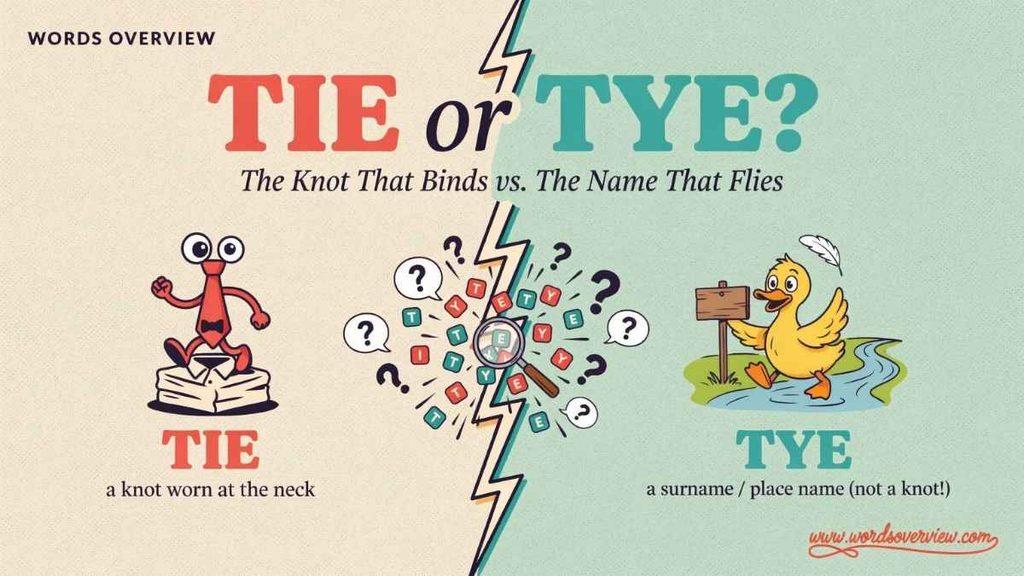
English spelling loves creating tiny traps and “tie or tye” is a perfect example. You know the word, you know how it sounds and yet those three little letters can suddenly make you question everything you learned in school. Should you write “tie your shoes,” “wear a tie,” or reach for the mysterious “tye”? The confusion gets even trickier because tye isn’t completely imaginary it appears in historical, regional, nautical and specialized contexts. So, calling it an outright mistake can muddy the waters. In this guide, you’ll learn the difference between tie and tye, discover when each spelling applies and avoid embarrassing spelling mistakes with confidence.
Tie or Tye: Which Is Correct?
The short answer is simple:
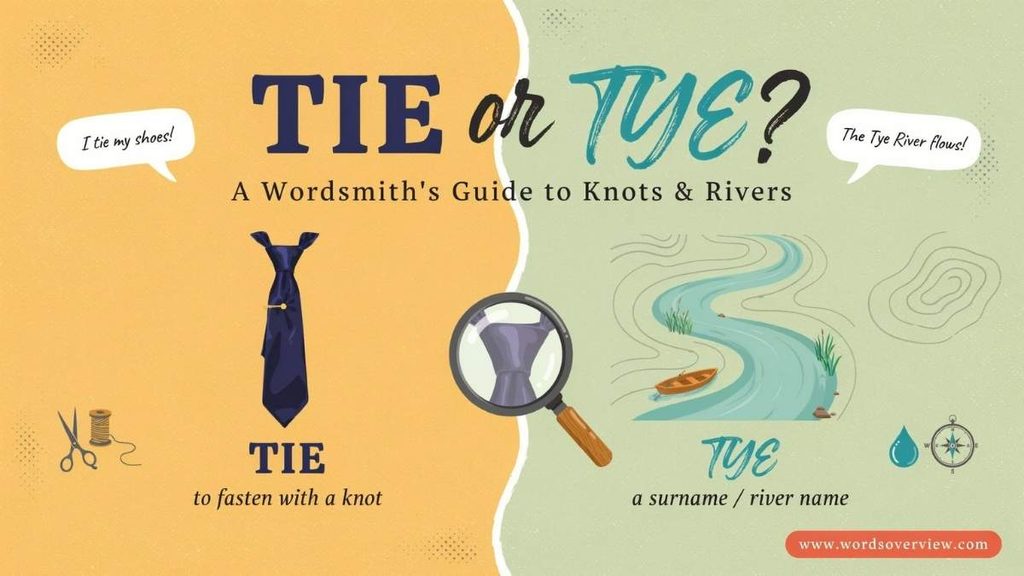
Tie is the standard spelling in modern English. Tye is an uncommon historical or specialized word.
| Word | Modern everyday use | Main meanings |
| Tie | Very common | Fasten, connect, knot, neckwear, equal score, relationship |
| Tye | Rare | Historical spelling, nautical term, mining term, regional term, surname or place-related usage |
For normal communication, choose tie.
For example:
- Tie your shoes before you leave.
- She wore a blue tie to the interview.
- Please tie the rope securely.
- The final score was a tie.
- They have a strong family tie.
- He learned how to tie a knot.
By comparison, you’re unlikely to encounter tye in ordinary modern English unless you’re reading historical material, studying dialects, researching surnames or working with specialized terminology.
Therefore, if you’re asking, “Is it tie or tye?” for everyday English, the answer is tie.
Learn the difference between commonly misused words
Blackout or Backout: Difference and Usage
What Does Tie Mean?
Tie is a common English word that works as both a noun and a verb. Its meaning changes according to the context, but its central idea involves fastening, connecting, securing or creating a relationship between things.
As a result, the word appears in many everyday expressions.
Tie as a Verb
As a verb, tie means to fasten or secure something with a knot, string, rope, cord or another material.
For example:
- Tie your shoes before you run.
- She tied the package with a piece of string.
- He tied the rope around the pole.
- Please tie the bag tightly.
- They tied the branches together.
In each case, something becomes secure or connected.
The verb can also describe connecting two things more generally.
For example:
The evidence ties the two events together.
Here, tie does not involve a physical knot. Instead, it means to establish a connection.
Likewise, you might say:
- The story ties several ideas together.
- Her research ties language and culture together.
- The two companies have strong business ties.
Therefore, tie can describe both physical fastening and abstract connections.
Learn the difference between confusing English words step by step
Chears or Cheers Which Spelling Is Correct?
Tie as a Noun
As a noun, tie can refer to a physical connection, a relationship, a piece of clothing or an equal result in a competition.
For example:
- He wore a red tie.
- The two teams finished in a tie.
- They have close family ties.
- The tie between the communities remains strong.
The surrounding words tell you which meaning applies.
Tie for Clothing and Neckwear
One of the most familiar meanings of tie refers to a piece of clothing worn around the neck.
For example:
He wore a black tie with his white shirt.
In this context, tie means a necktie or another similar piece of neckwear.
Therefore, the correct spelling is:
tie
Not:
tye
You should write:
- He bought a new tie.
- She helped him choose a tie for the wedding.
- His tie matched his shirt.
- The company requires employees to wear a tie.
You might occasionally see someone write “tye” when they mean neckwear, but that spelling does not represent the standard modern word for this clothing accessory.
Is It Tie or Tye for a Shirt?
If you’re talking about a necktie worn with a shirt, the correct spelling is tie.
For example:
He wore a blue tie with a white shirt.
The same spelling applies whether the tie is formal, casual, patterned, solid-colored, narrow or wide.
So, when you’re writing about clothing, remember:
tie = correct
tye = not the standard spelling for neckwear
Tie for a Knot or Fastening
When you secure something with a knot, use tie.
For example:
- Tie a knot in the rope.
- Tie the package securely.
- Tie the string around the box.
- Tie your shoelaces.
- Tie the balloon to the chair.
Therefore, the correct expression is tie a knot, not tye a knot.
This distinction also applies to common phrases such as:
- tie your shoes
- tie a rope
- tie a string
- tie a bow
- tie a package
- tie your hair
- tie the ends together
These are all ordinary examples of modern English, so tie is the appropriate spelling.
Tie in Sports and Games
The word tie also has an important meaning in sports and competitions.
A tie occurs when two competitors or teams finish with the same score or result.
For example:
- The game ended in a tie.
- The teams finished with a 2–2 tie.
- Neither team could break the tie.
- The match remained tied until the final whistle.
In some varieties of English, especially British English, draw often describes an equal result in a sporting event. American English commonly uses tie in many such situations.
However, the spelling remains tie, not tye.
Tie Score
A tie score means that competitors have the same number of points.
For example:
The teams entered the final quarter with a tie score.
You could also say:
The score was tied at 3–3.
Notice the relationship between these forms:
- tie = noun or verb
- tied = past tense or adjective
- tye = not the standard spelling for this meaning
Therefore, if you’re discussing an equal score, choose tie.
Learn the difference between confusing English words step by step
Insight or Insite What’s the Correct English Word?
Tie-Dye or Tye-Dye?
Another common spelling question involves tie-dye.
The standard spelling is:
tie-dye
The term refers to a method of coloring fabric by tying sections of the material before applying dye. The tied areas resist the dye and create distinctive patterns.
For example:
- She bought a colorful tie-dye shirt.
- We learned how to make tie-dye shirts.
- Tie-dye clothing became popular again.
The word comes from the process itself: you tie sections of fabric before dyeing them.
Therefore, in standard modern English, write tie-dye, not tye-dye.
What Does Tye Mean?
Now we reach the more unusual spelling.
Tye is a real English word, but it has limited and specialized uses.
Unlike tie, it does not normally function as the everyday spelling for fastening, clothing, knots or equal scores.
Historical dictionaries and specialized sources record several meanings for tye. These include older forms related to tie, nautical terminology, mining terminology and regional meanings connected with common land.
Consequently, calling every use of tye “wrong” would be too broad.
Instead, it’s more accurate to say that tye is rare, specialized or historical in modern English.
Tye as an Archaic or Historical Form
In older forms of English, spelling was much less standardized than it is today.
As a result, writers sometimes used forms such as tye where modern English would normally use tie.
Historical texts may therefore contain spellings that look unusual to modern readers.
For example, an old document might use tye in a context where modern English would use tie.
This doesn’t mean that modern writers should replace tie with tye. Instead, it shows how English spelling has changed over time.
Therefore, when you encounter tye in an old text, consider the historical period and context before calling it a spelling mistake.
Tye as a Nautical Term
The word tye also appears in historical nautical terminology.
In older sailing language, a tye could refer to a rope or chain arrangement associated with raising or supporting a yard or similar piece of a sailing vessel’s rigging.
Historical nautical dictionaries record specialized terms such as jib-tye and peak-tye.
These terms belong to a technical vocabulary associated with traditional sailing ships. Consequently, they don’t represent ordinary modern English.
For most readers, this distinction is straightforward:
tie is the everyday English word.
tye can appear as a historical nautical term.
Therefore, if you’re writing about tying your shoes, you don’t need the nautical spelling.
Tye as a Mining Term
Another specialized meaning of tye appears in historical mining vocabulary.
In this context, a tye referred to a trough or similar arrangement used in processing material to separate valuable substances from waste or dross.
The related verb could describe the process of separating valuable material from unwanted material using such an arrangement.
This meaning has a very different history from the modern everyday verb tie.
Because mining terminology changes over time, modern readers may rarely encounter this sense outside historical dictionaries, mining records or specialized research.
Therefore, tye can be legitimate in this context even though it looks like an unusual spelling of tie.
Tye as a Regional Word
Historical dialect sources also record tye as a regional term for an area of common pasture or common land.
In older British dialect usage, a tye could refer to an extensive common pasture.
This meaning helps explain why Tye also appears in some English place names and surnames.
Again, context matters.
If you see Tye in a historical place name or family name, you shouldn’t automatically assume that someone misspelled tie.
Tye as a Name
Tye can also appear as a personal name, surname or part of a place name.
Proper names follow their established spelling. Therefore, if someone’s name is Tye, you should preserve that spelling.
For example:
Tye submitted the application on Monday.
Here, Tye functions as a name rather than the ordinary English word tie.
This distinction matters because spelling rules for common vocabulary do not allow you to change someone’s established name simply because another spelling looks more familiar.
Learn the difference between similar English words the easy way
Access or Acess Which Spelling Is Correct?
Tie or Tye: The Main Difference
The simplest way to understand the difference between tie and tye is to look at frequency and context.
| Feature | Tie | Tye |
| Standard modern English | Yes | Rare |
| Everyday vocabulary | Yes | No |
| Clothing | Yes | No |
| Knots and fastening | Yes | No |
| Equal score | Yes | No |
| Connections or relationships | Yes | Limited historical use |
| Tie-dye | Yes | No |
| Historical spelling | Yes | Yes, in some contexts |
| Nautical terminology | Possible | Yes, historically |
| Mining terminology | No | Yes, historically |
| Regional common land | No | Yes, historically |
| Personal name | Possible | Yes |
Thus, the choice usually depends on whether you’re writing ordinary modern English or dealing with a specialized historical context.
Tie or Tye: Common Examples
Examples make the distinction much easier to remember.
Correct Uses of Tie
Clothing:
He wore a blue tie to the ceremony.
Knot:
Tie a knot at the end of the rope.
Shoes:
Please tie your shoes before running.
Fastening:
She tied the package with string.
Connection:
The two families have strong ties.
Sports:
The game ended in a tie.
Tie-dye:
She bought a colorful tie-dye shirt.
In every example above, tie is the standard spelling.
Specialized Uses of Tye
Historical spelling:
The old document uses the spelling “tye.”
Nautical terminology:
The historical text refers to a ship’s tye.
Mining terminology:
The technical dictionary defines a tye as a mining trough.
Regional usage:
The dialect source records “tye” for common pasture.
Personal name:
Tye attended the meeting.
These examples show why tye deserves a little more respect than simply calling it a typo. It has legitimate documented uses, even though those uses are uncommon today.
Learn the difference between confusing English words step by step
Bosses or Boss’s? Which One Is Correct?
Why Do People Write Tye Instead of Tie?
Several factors can cause people to write tye when they mean tie.
First, English spelling contains many words with unpredictable relationships between letters and sounds. Learners sometimes create spellings based on pronunciation rather than standard spelling.
Second, people may encounter Tye as a surname or name and assume that it represents another standard spelling of tie.
Third, historical examples can create confusion. A reader who encounters tye in an old text might assume that the spelling remains equally common today.
Finally, simple typing errors can produce tye instead of tie.
However, the safest approach remains simple: use tie for ordinary modern English.
Is Tye a Correct Spelling?
Yes, but only in specific contexts.
- If you mean the common verb to tie, the standard spelling is tie.
- If you mean the clothing accessory, use tie.
- If you mean a knot, use tie.
- If you mean an equal score, use tie.
However, tye can be correct when it represents a documented historical, regional, nautical, mining or proper-name usage.
Therefore, the answer depends on the meaning.
| Meaning | Correct spelling |
| Fasten something | tie |
| Wear neckwear | tie |
| Make a knot | tie |
| Secure a rope | tie |
| Equal sports result | tie |
| Tie-dye | tie-dye |
| Historical nautical term | tye may be correct |
| Historical mining term | tye may be correct |
| Regional common pasture | tye may be correct |
| Personal name | Tye, if that is the established name |
Is Tye an English Word?
Yes. Tye is an English word with documented historical and specialized meanings.
However, that answer needs an important qualification.
Being an English word doesn’t mean that tye works as a general replacement for tie.
For example, you wouldn’t normally write:
Please tye your shoes.
Standard modern English uses:
Please tie your shoes.
Likewise, you should write:
He wore a tie.
Not:
He wore a tye.
Therefore, tye exists, but its existence doesn’t make it interchangeable with tie.
Is Tye an Archaic Word?
In some contexts, yes.
Historical sources record tye as an older spelling related to tie, while other sources record separate specialized meanings.
As a result, you can encounter tye in historical documents, dialect dictionaries, older technical vocabulary and proper names.
However, not every use of tye is necessarily just an archaic spelling of tie. Some meanings developed within specific technical or regional vocabulary.
That distinction matters because it prevents an overly simple rule such as “tye always means old-fashioned tie.”
Learn the difference between confusing word pairs
Directer or Director Which Spelling Is Correct?
When Should You Use Tie or Tye?
Use tie whenever you’re writing ordinary modern English.
Choose tie for:
- clothing
- neckwear
- knots
- ropes
- shoelaces
- fastening
- connecting
- relationships
- equal scores
- tie-dye
- everyday conversation
- academic writing
- business writing
- general online content
Use tye only when the context specifically requires that spelling, such as:
- a historical text
- a documented dialect term
- a specialized nautical term
- a historical mining term
- a surname
- a place name
- another established proper name
In other words, meaning and context determine the correct choice.
Learn the difference between basic English word mistakes
Where or When: Usage and Classic Song
Tie or Tye: A Simple Decision Guide
When you’re unsure, ask yourself one question:
Am I talking about an ordinary modern English meaning?
If the answer is yes, use tie.
You can remember the process like this:
Do you mean fastening, clothing, a knot, a connection,
an equal score or tie-dye?
YES: TIE
Is the word part of a historical, regional, nautical,
mining, surname or place-name context?
YES: TYE
may be appropriate
This simple rule will solve almost every everyday tie or tye spelling question.
Learn the difference between confusing English words step by step
Gos or Goes Which Spelling Is Correct?
Common Mistakes With Tie and Tye
Mistake: Tye Your Shoes
Incorrect for standard modern English:
Tye your shoes.
Correct:
Tie your shoes.
Mistake: Wear a Tye
Incorrect:
He wore a red tye.
Correct:
He wore a red tie.
Mistake: Tye a Knot
Incorrect:
Tye a knot in the rope.
Correct:
Tie a knot in the rope.
Mistake: Tye-Dye
Incorrect in standard modern usage:
She bought a tye-dye shirt.
Correct:
She bought a tie-dye shirt.
Mistake: The Game Was a Tye
Incorrect for the ordinary sports meaning:
The game ended in a tye.
Correct:
The game ended in a tie.
These mistakes usually come from treating tye as an alternative modern spelling. In most everyday contexts, it isn’t.
Tie or Tye in Formal Writing
Formal writing requires consistent standard spelling. Therefore, use tie for ordinary meanings.
For example:
The findings tie the two factors together.
The teams finished the competition in a tie.
The employee wore a formal tie.
Researchers identified a strong tie between the two variables.
However, if your subject specifically involves historical vocabulary, dialects, nautical terminology or mining terminology, you should preserve tye when the source or technical context requires it.
In that situation, changing tye to tie could actually introduce an error.
Learn the difference between more words people mix up
Inconsolable or Unconsolable Which Is Correct?
Tie or Tye in Everyday English
Everyday English strongly favors tie.
You’ll encounter it in common phrases such as:
- tie your shoes
- tie a knot
- tie your hair
- tie a rope
- tie a package
- wear a tie
- break a tie
- the game was a tie
- tie the two ideas together
- strong family ties
- tie-dye shirt
Because these expressions occur frequently, learning the standard spelling is worthwhile.
A useful memory trick is to connect the spelling with familiar phrases:
tie your shoes → wear a tie → tie a knot → tie a game
Once you remember those four examples, most everyday spelling questions become easy.
Tie or Tye: Case Study
Imagine that you’re editing a school article about clothing.
The draft says:
“Students should tye their shoes and wear a formal tye.”
At first glance, both words may look plausible because tye resembles tie.
However, the correct revision is:
“Students should tie their shoes and wear a formal tie.”
Why?
The first word describes fastening shoelaces. The second refers to neckwear. Both meanings use the standard modern word tie.
Now imagine a historian studying an old nautical dictionary and finding the term tye.
In that case, changing the term to tie could distort the historical terminology.
Therefore, the same spelling should not receive the same treatment in every context. Context determines whether the unusual spelling is an error or a legitimate specialized term.
Learn the difference between similar English words
Honored or Honoured Which Spelling Is Correct?
Quick Comparison: Tie and Tye
| Question | Answer |
| Is tie a word? | Yes. It is a very common modern English word. |
| Is tye a word? | Yes, but it is uncommon and specialized. |
| Is tie the standard spelling? | Yes, for ordinary modern meanings. |
| Is tye the British spelling of tie? | No. It is not simply a British alternative spelling. |
| Is it tie a knot or tye a knot? | Tie a knot. |
| Is it tie your shoes or tye your shoes? | Tie your shoes. |
| Is it tie or tye for clothing? | Tie. |
| Is it tie or tye for a shirt? | Tie, when referring to neckwear. |
| Is it tie-dye or tye-dye? | Tie-dye. |
| Is it tie or tye for an equal score? | Tie. |
| Can tye be correct? | Yes, in documented specialized, historical, regional or proper-name contexts. |
| Should you normally use tye instead of tie? | No. |
Practice Session: Tie or Tye
Fill in each blank with the correct word: tie or tye.
- Please ______ your shoes before you leave.
- He wore a blue ______ to the wedding.
- She used a rope to ______ the boxes together.
- The game ended in a ______ after both teams scored equally.
- This fabric is perfect for a colorful ______ design.
- Can you ______ this ribbon into a neat bow?
- I need to ______ my hair before cooking.
- The teacher asked the students to ______ their papers with string.
- The word ______ has specialized historical and regional uses.
- A ______ can refer to a piece of neckwear worn with a shirt.
- The sailor used a specialized ______ in the rigging.
- In everyday English, ______ is the standard spelling.
- The two players finished with a ______ score.
- Please ______ the package securely.
- She learned how to ______ a knot during the camping trip.
- The museum displayed an old document containing the word ______.
- He bought a new ______ to match his formal suit.
- You should ______ the shoelaces tightly.
- The mining text used the specialized term ______.
- They decided to ______ the branches together.
- The correct spelling for ______-dye is “tie-dye.”
- A historical dictionary may record ______ as a rare word.
- The coach said the teams were in a ______.
- She used a piece of string to ______ the parcel.
- When you mean to fasten something, use ______ rather than “tye.”
Answer Session
- tie
- tie
- tie
- tie
- tie
- tie
- tie
- tie
- tye
- tie
- tye
- tie
- tie
- tie
- tie
- tye
- tie
- tie
- tye
- tie
- tie
- tye
- tie
- tie
- tie
Here’s a trusted source for clear more words Comparison:
Grammar Update
Frequently Asked Questions
Is it “tie” or “tye”?
Tie is the standard spelling in modern English. Use it for a necktie, a knot, fastening something, an equal score or tie-dye. Tye is a rare word found mainly in historical, regional, nautical, mining or name-related contexts.
Is “tye” a word?
Yes, tye is a real English word, but it is uncommon. Historical and specialized dictionaries record meanings related to mining, nautical terminology and regional land. It shouldn’t normally replace tie in everyday English.
What is the meaning of “tye”?
Tye has several specialized or historical meanings. In mining terminology, it can refer to a trough used to separate valuable material from waste. It also appears in older nautical and regional usage.
What is the difference between “tie” and “tye”?
The main difference is modern usage. Tie is the standard spelling used in everyday English, while tye is rare and usually appears in historical, regional, nautical, mining or proper-name contexts.
Is it “tie up” or “tye up”?
The correct expression in modern everyday English is “tie up.” For example, you can say, “Please tie up the package” or “I need to tie up a few loose ends.” “Tye up” is not the standard spelling.
Is it “tie” or “tye” shoes?
The correct phrase is “tie your shoes.” Use tie when you mean to fasten shoelaces with a knot. For example, “I learned how to tie my shoes when I was five.”
Is it “tie” or “tye” for clothing?
Use tie. A tie is the standard word for the long piece of cloth worn around the neck with formal or business clothing. Tye is not the standard spelling for this clothing accessory.
Is it “tie-dye” or “tye-dye”?
The standard spelling is tie-dye. The expression comes from the process of tying sections of fabric before applying dye. Tye-dye is a misspelling in standard modern English.
Is “tye” a correct spelling of “tie”?
Not in ordinary modern English. Tye is a legitimate word in certain specialized or historical contexts, but it is not the standard spelling of tie. Therefore, use tie for common meanings such as fastening, neckwear, knots and equal scores.
How do you spell “tie” correctly?
The standard spelling is T-I-E: tie. You use it in phrases such as tie your shoes, wear a tie, tie a knot and the game ended in a tie. The spelling tye should only be used when a specific historical, regional or specialized meaning requires it.
Conclusion
English spelling has a funny habit of making simple words look suspicious and “tie or tye” is a perfect example. For everyday English, the choice is easy: tie is the standard spelling for a necktie, a knot, fastening something, an equal score or tie-dye. You can tie your shoes, tie a ribbon or wear a tie without giving the spelling a second thought.
Tye, however, isn’t simply a misspelling waiting to be corrected. It appears in historical, regional, nautical, mining and name-related contexts. That makes it a genuine word, but not the spelling you should normally use in modern everyday writing.So, the next time you wonder whether to write “tie” or “tye,” don’t let three letters start a spelling crisis. In ordinary English, tie is the safe and correct choice. Save tye for the specialized contexts where its history and meaning actually belong.

Ethan AJS is an experienced blogger and language enthusiast at Words Overview, dedicated to making English easier to understand and use. He writes about grammar, vocabulary, spelling, word meanings and commonly confused words, turning tricky language questions into clear, practical insights. With a passion for effective communication, Ethan creates engaging, readerfocused content that helps readers write accurately, choose the right words and communicate with confidence.




