
Have you ever typed honored or honoured and suddenly wondered whether that tiny “u” could make your sentence look wrong? Don’t worry. English spelling has a talent for creating confusion with surprisingly small differences.
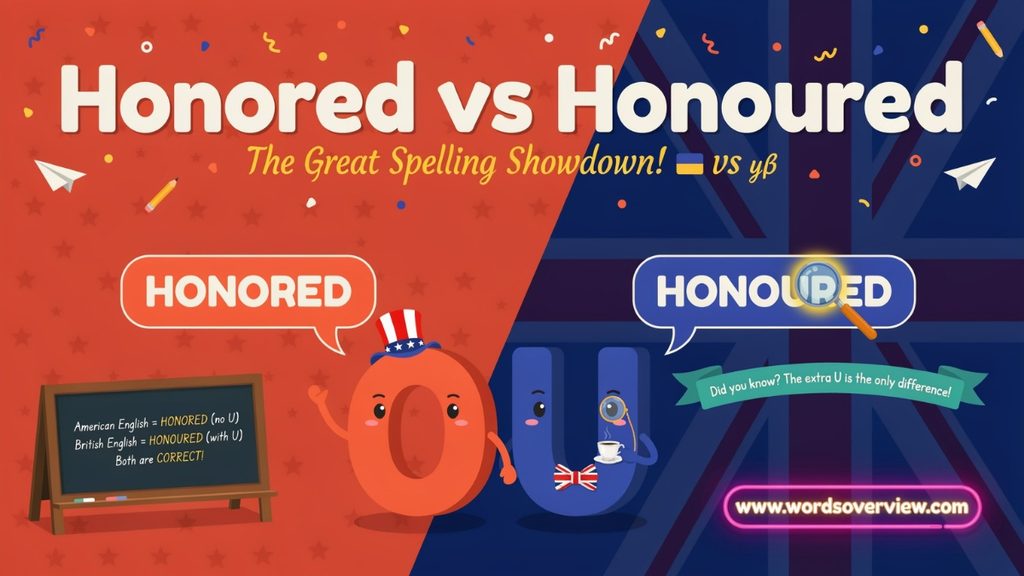
Both honored and honoured are correct. However, they belong to different varieties of English. American English generally favors honored, while British English favors honoured.
The spelling changes, but the meaning and pronunciation generally stay the same. The main difference is regional spelling.
In this guide, you’ll learn what honored and honoured mean, when to use each spelling, why British English keeps the extra “u,” and how to avoid mixing American and British spelling in the same piece of writing.
Honored or Honoured Quick Answer
The choice is straightforward once you know which variety of English you are using.
| Spelling | Common English variety | Example |
|---|---|---|
| honored | American English | The award made me feel honored. |
| honoured | British English | The award made me feel honoured. |
Both forms come from the same word family. Honor means respect, recognition, distinction or a feeling of pride or privilege. Therefore, neither spelling is universally more correct than the other.
Instead, choose the spelling that matches your audience, publication, institution or style guide.
The simple rule
- Use honored in American English.
- Use honoured in British English.
- Keep your spelling consistent throughout the same document.
So, if you write honor, you would normally use honored. Likewise, if you write honour, you would normally use honoured.
What Does Honored Mean?
Honored is the American English spelling of the past tense and past participle of honor.
The word can express respect, recognition, pride, gratitude or a sense of privilege. In many situations, it describes how someone feels after receiving an important opportunity, invitation, award or form of recognition.
For example:
- The award made me feel honored.
- She felt honored to represent her university.
- We feel honored to welcome our guests.
- The organization honored him for his contribution to the community.
In these examples, honored shows that someone feels proud or privileged because of a particular opportunity or recognition.
However, the word can also describe an action performed to show respect or recognition.
For example:
The organization honored the teacher for 30 years of service.
Here, honored functions as a past-tense verb. The organization gave the teacher recognition for a long period of service.
What Does Honoured Mean?
Honoured has the same meaning as honored, but it follows British English spelling conventions.
For example:
- The award made me feel honoured.
- She felt honoured to represent her university.
- We feel honoured to welcome our guests.
- The organization honoured him for his contribution to the community.
Consequently, if you are writing in British English, honoured usually fits the style.
Adding the u does not change the meaning. Instead, it reflects a regional spelling difference between American and British English.
Learn the difference between similar English words the easy way
Access or Acess Which Spelling Is Correct?
Honored or Honoured What Is the Difference?
The main difference between honored and honoured is their spelling.
American English uses:
honor → honored
British English uses:
honour → honoured
Both forms carry the same basic meaning. In addition, they normally have the same pronunciation.
The same regional pattern appears in several related words:
| American English | British English |
|---|---|
| honor | honour |
| honored | honoured |
| honoring | honouring |
| honorable | honourable |
Therefore, remembering the base word makes the past form much easier to spell.
If you use honor, use honored.
If you use honour, use honoured.
Is Honored Correct?
Yes, honored is correct.
It is the standard American English spelling of the word. Therefore, use it when your writing follows US English conventions.
For example:
I would be honored to attend the ceremony.
You can use honored in American business writing, academic writing, professional communication, websites, emails and general publications that follow US English.
However, if your publication or institution follows British English, honoured will usually fit better.
Is Honoured Correct?
Yes, honoured is also correct.
It is the standard British English spelling of the word. You will commonly see it in British writing and in other varieties that use British-style spelling conventions.
For example:
We feel honoured to receive this recognition.
Therefore, honoured is not a misspelling of honored. The extra u simply reflects a different regional spelling convention.
Why Does British English Use Honoured?
The difference comes from broader spelling patterns between American and British English.
British English generally retains the u in words such as:
- honour
- colour
- favour
- labour
American English often uses:
- honor
- color
- favor
- labor
As a result, the difference continues into related forms.
| American English | British English |
|---|---|
| honor → honored | honour → honoured |
| color → colored | colour → coloured |
| favor → favored | favour → favoured |
| labor → labored | labour → laboured |
However, spelling differences between American and British English do not always follow one universal rule. Some differences developed through historical and conventional usage.
Therefore, rather than changing spellings mechanically, learn the common patterns and follow the style guide required for your writing.
Why Is Honored Spelled Without a U?
American English generally uses honor instead of honour.
Consequently, its related forms also omit the u:
- honored
- honoring
- honorable
British English, by contrast, generally retains the letter:
- honoured
- honouring
- honourable
This difference became established as American English developed its own spelling conventions. Today, both systems remain standard within their respective varieties.
Learn the difference between confusing word pairs
Directer or Director Which Spelling Is Correct?
Honored or Honoured in American English
If you are writing for an American audience, use honored.
For example:
- I am honored to meet you.
- We feel honored to announce the winner.
- The organization honored her for her achievements.
- He felt honored by the invitation.
- They honored the scientist for his work.
Using honoured in an otherwise American English document may create an inconsistent spelling style.
For example, consider this sentence:
The company honored its employees and celebrated their achievements with a colourful ceremony.
The word honored follows American English, while colourful follows British English. The sentence remains understandable, but mixing spelling systems can make the writing look less consistent.
Therefore, choose one variety and follow it throughout your document.
Honored or Honoured in British English
If you are writing in British English, use honoured.
For example:
- I am honoured to meet you.
- We feel honoured to announce the winner.
- The organization honoured her for her achievements.
- He felt honoured by the invitation.
- They honoured the scientist for his work.
Similarly, consistency matters here. If your document follows British spelling, use honour, honoured, honouring and honourable consistently.
Learn the difference between confusing more English words
Tie or Tye: Meaning, Difference and Usage
What About Canadian English?
Canadian English can use spelling conventions associated with both American and British English.
For this word, Canadian usage commonly follows the British-style spelling honour, with forms such as honoured and honouring also appearing in standard Canadian usage.
However, Canadian usage can vary according to context, institution, publication and style guide.
Therefore, if you are writing specifically for Canadian readers, check the required style rather than assuming that Canadian English always follows either American or British spelling.
Does Honored Mean the Same as Honoured?
Yes.
Honored and honoured have the same basic meaning. Both can describe respect, recognition, distinction, appreciation or a special opportunity.
Compare these sentences:
Meeting the author made me feel honored.
Meeting the author made me feel honoured.
The meaning remains the same. Only the spelling changes.
Likewise:
We feel honored to welcome you.
We feel honoured to welcome you.
Both sentences communicate the same idea.
Learn the difference between confusing English words step by step
Bosses or Boss’s? Which One Is Correct?
“I Would Be Honored” or “I Would Be Honoured”?
Both forms are correct. However, your choice depends on the English variety you are using.
American English
I would be honored to attend the ceremony.
British English
I would be honoured to attend the ceremony.
The expression “I would be honored” often appears in polite or formal situations. It can show that you consider an invitation, opportunity, request or responsibility important and meaningful.
For example:
- I would feel honored to accept the invitation.
- I would feel honored to speak at the event.
- I would feel honored to join your team.
- I would feel honored to represent the organization.
- I would feel honored to meet your family.
In British English, simply replace honored with honoured.
“We Are Honored” or “We Are Honoured”?
Again, both forms are correct.
Use we are honored in American English and we are honoured in British English.
For example:
We feel honored to have you with us.
Or:
We feel honoured to have you with us.
Businesses, universities, charities and event organizers often use this expression when welcoming guests or recognizing someone important.
For example:
We feel honored to welcome our new members.
The British version would be:
We feel honoured to welcome our new members.
Honored or Honoured to Accept
The phrase “honored to accept” expresses appreciation for receiving something important, such as an award, position, invitation or responsibility.
American English
I am honored to accept this award.
British English
I am honoured to accept this award.
Both sentences are grammatically correct.
You can also write:
- I am honored to accept this position.
- She felt honored to accept the award.
- We feel honored to accept this recognition.
- He felt honored to accept the invitation.
For British English, change honored to honoured.
Honored or Honoured to Be Invited
Both versions work in this expression as well.
American English
I feel honored to receive the invitation to the conference.
British English
I feel honoured to receive the invitation to the conference.
The phrase communicates gratitude and appreciation for receiving an invitation.
Because this expression often appears in professional communication, make sure your spelling matches the rest of your document.
Honored or Honoured to Meet You
You can use either spelling depending on your variety of English.
American English
I am honored to meet you.
British English
I am honoured to meet you.
The phrase expresses respect or pleasure at meeting someone.
However, everyday conversation may call for a simpler expression, such as:
It’s nice to meet you.
Or:
It’s a pleasure to meet you.
Therefore, choose the expression that matches the formality of the situation.
Learn the difference between confusing English words step by step
Chears or Cheers Which Spelling Is Correct?
Honored or Honoured to Participate

Both forms work here as well.
American English
I am honored to participate in this event.
British English
I am honoured to participate in this event.
This phrase often appears in formal speeches, professional announcements, academic events, conferences and public ceremonies.
| Common phrase | American English | British English |
|---|---|---|
| Would be honored/honoured | I would be honored to attend. | I would be honoured to attend. |
| Feel honored/honoured | I feel honored to be here. | I feel honoured to be here. |
| Honored/honoured to accept | I am honored to accept this award. | I am honoured to accept this award. |
| Honored/honoured to meet | I am honored to meet you. | I am honoured to meet you. |
| Honored/honoured to participate | I am honored to participate in this event. | I am honoured to participate in this event. |
Grammar of Honored and Honoured
Both honored and honoured can function as the past tense and past participle of their respective verbs, honor and honour.
Past Tense
When you describe an action that happened in the past, use the word as a past-tense verb.
American English:
The university honored the professor last year.
British English:
The university honoured the professor last year.
In both sentences, the word describes a completed action.
Past Participle
The same form can appear after auxiliary verbs.
For example:
The university honored her for her research.
Or:
The university honoured her for her research.
Similarly:
The sports organization has honored the athlete for his achievements.
Or:
The sports organization has honoured the athlete for his achievements.
The grammatical function stays the same even though the regional spelling changes.
Adjectival Use
The word can also describe someone’s emotional state or situation.
For example:
I feel honored to be here.
Or:
I feel honoured to be here.
Here, the word describes how the speaker feels.
| Grammatical use | American English | British English |
|---|---|---|
| Past tense | The university honored the professor. | The university honoured the professor. |
| Past participle | The sports organization has honored the athlete. | The sports organization has honoured the athlete. |
| Adjectival use | I feel honored to be here. | I feel honoured to be here. |
Honored or Honoured Sentence Examples
The following examples show how both spellings work in everyday and professional writing.
| American English | British English |
|---|---|
| I am honored to be here. | I am honoured to be here. |
| The organization honored her for her work. | The organization honoured her for her work. |
| We feel honored to welcome you. | We feel honoured to welcome you. |
| He felt honored by the invitation. | He felt honoured by the invitation. |
| They honored the teacher. | They honoured the teacher. |
| I would be honored to participate. | I would be honoured to participate. |
| The committee honored her with an award. | The committee honoured her with an award. |
| We feel honored by your support. | We feel honoured by your support. |
Notice the pattern. The sentence structure and meaning remain the same. Only the regional spelling changes.
Learn the difference between more words people mix up
Inconsolable or Unconsolable Which Is Correct?
Honor or Honour
To understand honored or honoured, you first need to understand honor or honour.
Honor is the American English spelling.
Honour is the British English spelling.
For example:
American English: It is an honor to meet you.
British English: It is an honour to meet you.
The same difference appears in the past forms:
American English: I was honored.
British English: I was honoured.
It also appears in related forms:
- American: honoring
- British: honouring
- American: honorable
- British: honourable
Therefore, remembering honor = American and honour = British makes the difference between honored and honoured much easier to remember.
Learn the difference between confusing English words step by step
Persuing or Pursuing Which Spelling Is Correct?
Honored or Honour Are They the Same?
Not exactly.
Honored and honour belong to different grammatical forms.
Honored functions as a past-tense or past-participle form.
Honour functions as the British English base form of the verb and also as a noun.
For example:
I honor my parents.
Here, honor is the American base verb.
I honored my parents.
Here, honored is the American past tense.
The British versions are:
I honour my parents.
I honoured my parents.
Therefore, you should not treat honored and honour as interchangeable forms. They differ in both spelling and grammatical form.
Learn the difference between confusing English words step by step
Gos or Goes Which Spelling Is Correct?
Common Mistakes With Honored and Honoured
Because the two forms look almost identical, writers can easily mix them up. Fortunately, the main mistakes are simple to avoid.
Mixing American and British Spellings
One common mistake involves switching between spelling systems within the same document.
For example:
The company honored its employees and celebrated their achievements with a colourful ceremony.
Here, honored follows American spelling, while colourful follows British spelling.
The reader can still understand the sentence. However, consistent spelling creates a cleaner and more professional impression.
Adding the U to the American Form
If you’re following American English, write:
honored
not:
honoured
Likewise, use honor rather than honour when following standard American spelling.
Removing the U From the British Form
If you’re following British English, write:
honoured
rather than:
honored
Similarly, use honour rather than honor when following British spelling.
Assuming One Form Is a Misspelling
Another common mistake involves assuming that one spelling must be wrong.
That isn’t the case.
English speakers have established both honored and honoured. The important point is to choose the version that matches your selected variety of English.
Which Spelling Should You Use?
Your audience should guide your choice.
If you’re writing for readers in the United States, honored is usually the appropriate choice.
If you’re writing for readers in the United Kingdom, writers generally prefer honoured.
For an international audience, first check whether your publication organization or website follows American or British English.
In academic and professional writing, a style guide may already answer the question. For example, a university can require a particular English variety, while a company may have an editorial style guide that specifies American or British spelling.
Once you choose a spelling system, stick with it throughout the document.
Honored or Honoured in Different Types of Writing
The spelling choice remains the same across different writing situations. However, the style requirements may vary.
Academic Writing
Academic institutions often follow a specific style guide. Therefore, check the required spelling system before submitting an assignment, paper, thesis or dissertation.
Business Writing
Businesses should maintain consistent spelling across emails, reports, websites, presentations and official documents.
Formal Invitations
Formal invitations can use expressions such as “honored to invite,” “honored to welcome,” or “honored to host.”
Social Media
Social media posts can use either spelling. However, your choice should match your usual writing style and the spelling used by your organization.
News and Publishing
Professional publications typically follow an established style guide, so writers should follow the publication’s preferred variety of English.
| Writing context | American English | British English |
|---|---|---|
| Academic writing | honored | honoured |
| Business writing | honored | honoured |
| Formal invitations | honored | honoured |
| Social media | honored | honoured |
| News and publishing | honored | honoured |
For example, an American business might write “We feel honored to work with your organization,” while a British organization might write “We feel honoured to work with your organization.” The spelling changes with the selected English variety, not with the type of writing.
How Do You Spell Honored?
In American English, spell the word:
honored
Its base form is:
honor
Its past form is:
honored
For example:
I am honored to receive this recognition.
Remember that American English does not use the u in this word family.
How Do You Spell Honoured?
In British English, spell the word:
honoured
The spelling follows:
honour → honoured
For example:
I am honoured to receive this recognition.
The additional u does not change the basic meaning or normally change the pronunciation.
Learn the difference between commonly misused words
Blackout or Backout: Difference and Usage
Honored and Honoured Pronunciation
Despite their different spellings, speakers generally pronounce honored and honoured the same.
The same principle applies to honor and honour.
Therefore, the spelling difference does not normally create a difference in spoken English.
This is one reason the distinction can seem confusing. You may hear the word clearly but still hesitate when you need to write it.
A useful memory trick is:
American English drops the U: honor, honored.
British English keeps the U: honour, honoured.
Once you connect the base word with its past form, the spelling becomes much easier to remember.
Honored Synonyms
Depending on the context, you can replace honored or honoured with several related words.
Possible synonyms include:
- respected
- esteemed
- recognized
- admired
- celebrated
- privileged
- distinguished
- appreciated
- praised
- revered
However, these words are not always perfect substitutes.
For example, respected focuses on admiration or high regard, while honored can also express a feeling of privilege or gratitude.
Compare these sentences:
I am honored to receive this award.
This emphasizes that the speaker feels privileged and grateful.
On the other hand:
I am respected by my colleagues.
This describes how other people regard the speaker.
Therefore, choose a synonym according to the exact meaning you want to communicate.
Learn the difference between basic English word mistakes
Where or When: Usage and Classic Song
A Simple Way to Remember Honored or Honoured
If you often forget which spelling to use, remember the base forms first.
American English
honor → honored → honoring → honorable
British English
honour → honoured → honouring → honourable
The easiest shortcut is:
No U = American English
U = British English
This shortcut works well for this particular word family, although it does not apply to every English spelling difference.
Honored or Honoured: At-a-Glance Comparison
| Feature | Honored | Honoured |
|---|---|---|
| Common variety | American English | British English |
| Base form | honor | honour |
| Meaning | Same | Same |
| Pronunciation | Generally the same | Generally the same |
| Past tense | honored | honoured |
| Past participle | honored | honoured |
| Present participle | honoring | honouring |
| Related adjective | honorable | honourable |
| Main difference | Spelling | Spelling |
The table highlights the central point: honored and honoured have the same meaning, but they follow different regional spelling conventions.
Final Comparison: Honored or Honoured?
The choice between honored and honoured becomes simple once you identify the English variety you are using.
Use honored for American English:
I am honored to receive this award.
Use honoured for British English:
I am honoured to receive this award.
Both forms are correct. Neither changes the basic meaning and neither is simply a misspelling of the other.
Ultimately, consistency matters more than choosing one form universally. If your document follows American English, use honor, honored, honoring and honorable. If it follows British English, use honour, honoured, honouring and honourable.
Once you know which spelling system your audience expects, the decision becomes easy.
Learn the difference between confusing English words step by step
Insight or Insite What’s the Correct English Word?
Practice Session: Fill in the Blanks
Test your understanding by choosing honored or honoured for each sentence.
1. The university ________ the professor for her outstanding research.
2. I feel ________ to receive this award.
3. The committee ________ him for his years of service.
4. We feel ________ to welcome you to the ceremony.
5. The committee ________ her with a national award.
6. The British newspaper wrote that the organization ________ the actor for his contribution.
7. I would feel ________ to accept your invitation.
8. The organization ________ several volunteers for their dedication.
9. He felt ________ by the opportunity to speak at the event.
10. The school ________ the retired teacher last Friday.
11. We feel ________ to have you here tonight.
12. The ceremony ________ those who served the community.
13. The university ________ her for her scientific achievements.
14. The American company said it felt ________ to partner with the organization.
15. The university ________ the professor with a prestigious title.
16. I would feel ________ to represent my university.
17. The city ________ the firefighters for their bravery.
18. The British institution announced that it had ________ the researcher for her work.
19. He felt ________ to meet the famous author.
20. The committee ________ the winner during the ceremony.
21. We feel ________ to participate in this important event.
22. The American university ________ its top students at the annual ceremony.
23. She felt ________ to receive such a warm welcome.
24. The organization ________ him for twenty years of dedicated service.
25. I felt ________ about the invitation to the conference.
Answer Session
1. honored
2. honored
3. honored
4. honored
5. honored
6. honoured
7. honored
8. honored
9. honored
10. honored
11. honored
12. honored
13. honored
14. honored
15. honored
16. honored
17. honored
18. honoured
19. honored
20. honored
21. honored
22. honored
23. honored
24. honored
25. honored
Here’s a trusted source for clear more words Comparison:
Grammar Update
Frequently Asked Questions
Is “honored” or “honoured” correct?
Both honored and honoured are correct. Honored is the standard spelling in American English, while honoured is the standard British English form. The meaning remains the same.
When should I use “honored” or “honoured”?
Use honored when writing in American English. On the other hand, use honoured when following British English spelling conventions. Above all, keep your spelling consistent throughout the document.
What does “honored” mean?
Honored can mean respected, recognized, privileged or pleased because of an important opportunity or form of recognition. For example, “I am honored to receive this award” expresses gratitude and a sense of privilege.
What does “honoured” mean?
Honoured has the same meaning as honored. It is the British English spelling and can describe receiving recognition, showing respect or feeling privileged.
Is “I would be honored” correct?
Yes. “I would be honored” is grammatically correct in American English. In British English, write “I would be honoured.” The expression commonly shows appreciation for an invitation, opportunity or responsibility.
Is “I feel honored” or “I am honored” correct?
Both expressions are grammatically correct. “I am honored” directly describes your current state, while “I feel honored” places more emphasis on your personal emotion. Both sound natural in appropriate contexts.
How do you use “honored” in a sentence?
You can use honored to express appreciation, respect, recognition or a sense of privilege. For example, “I am honored to represent my university at the conference.” In British English, use honoured instead.
Is “honored” the American spelling?
Yes. Honored is the standard American spelling. British English uses honoured. The same regional distinction appears in honor/honour and honoring/honouring.
How do you spell “honored” in Canadian English?
Canadian English commonly uses honoured, although Canadian usage can vary according to context, institution, publication and style guide. Therefore, check the specific style requirements when writing for a Canadian audience.
Are “honored” and “honoured” pronounced differently?
Generally, no. Honored and honoured normally have the same pronunciation. The main difference appears in writing, where American English drops the u and British English retains it.
Conclusion
The honored or honoured confusion may look like a tiny spelling battle, but fortunately, nobody has to lose. Both spellings are correct because they belong to different varieties of English.American English uses honored, while British English uses honoured. Although the spelling changes, the meaning stays the same and the pronunciation is generally unchanged.
The easiest way to avoid mistakes is to choose your English variety first and then stay consistent. If you’re writing for an American audience, use honored. For a British audience, choose honoured.Once you remember that honor becomes honored in American English and honour becomes honoured in British English, the extra “u” no longer needs to cause confusion.In short, the spelling depends on your variety of English, but clear and consistent writing works everywhere.

Ethan AJS is an experienced blogger and language enthusiast at Words Overview, dedicated to making English easier to understand and use. He writes about grammar, vocabulary, spelling, word meanings and commonly confused words, turning tricky language questions into clear, practical insights. With a passion for effective communication, Ethan creates engaging, readerfocused content that helps readers write accurately, choose the right words and communicate with confidence.




