
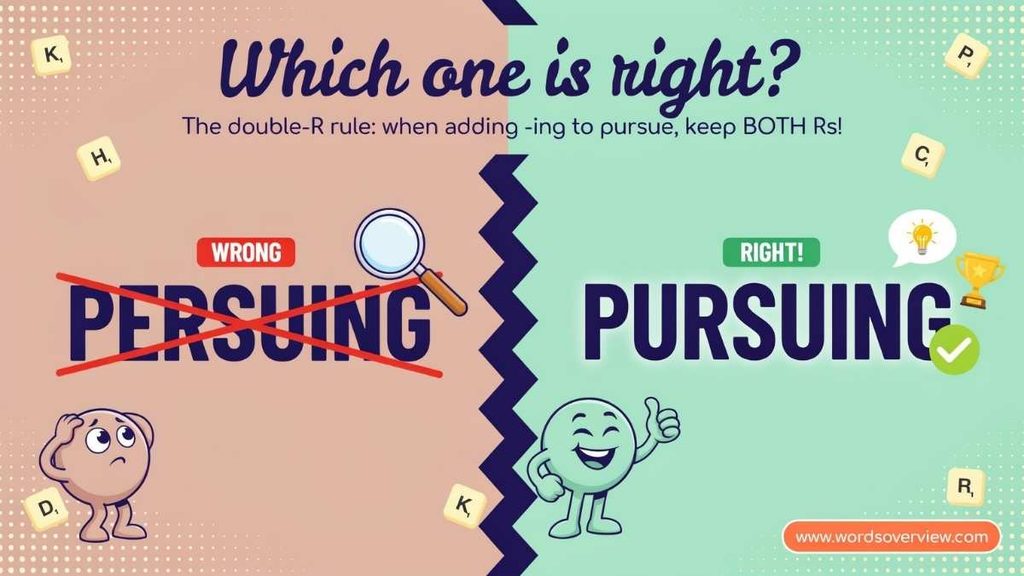
Have you ever typed persuing or pursuing and suddenly wondered whether English had secretly changed its spelling rules? You’re not alone. This tiny spelling trap catches students, professionals and even fast typists who trust pronunciation more than spelling. The correct answer is pursuing, while persuing is a common mistake. The confusion usually starts with the pronunciation of pursue, which can make the first part sound different from how it looks on the page. Fortunately, the solution is simple: remember the root word pursue, then form pursuing by adding ing after dropping the final e. Once you spot the pattern, this spelling headache becomes surprisingly easy to fix.
Persuing or Pursuing Quick Answer
If you’re searching for persuing or pursuing spelling, here’s the answer:
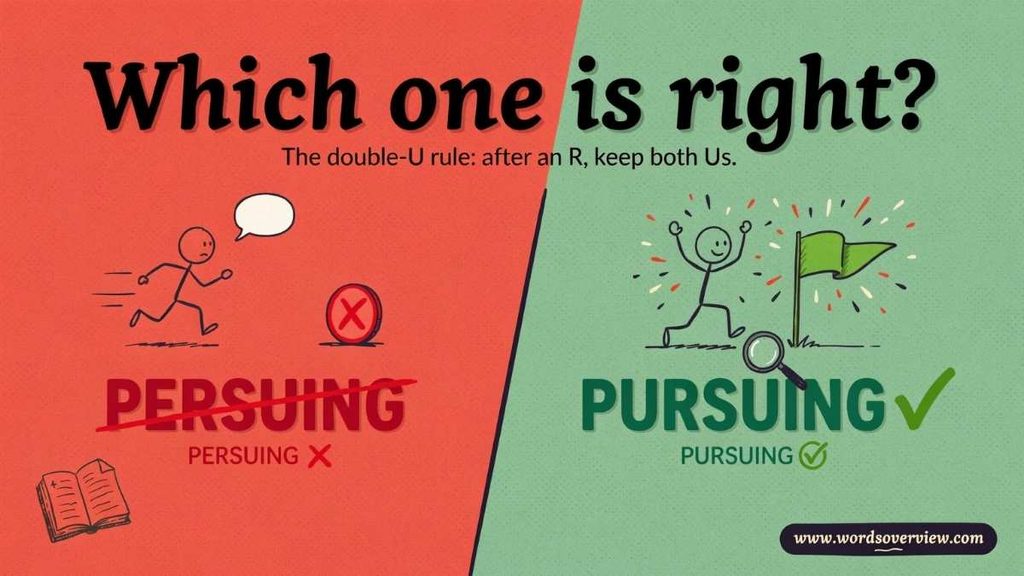
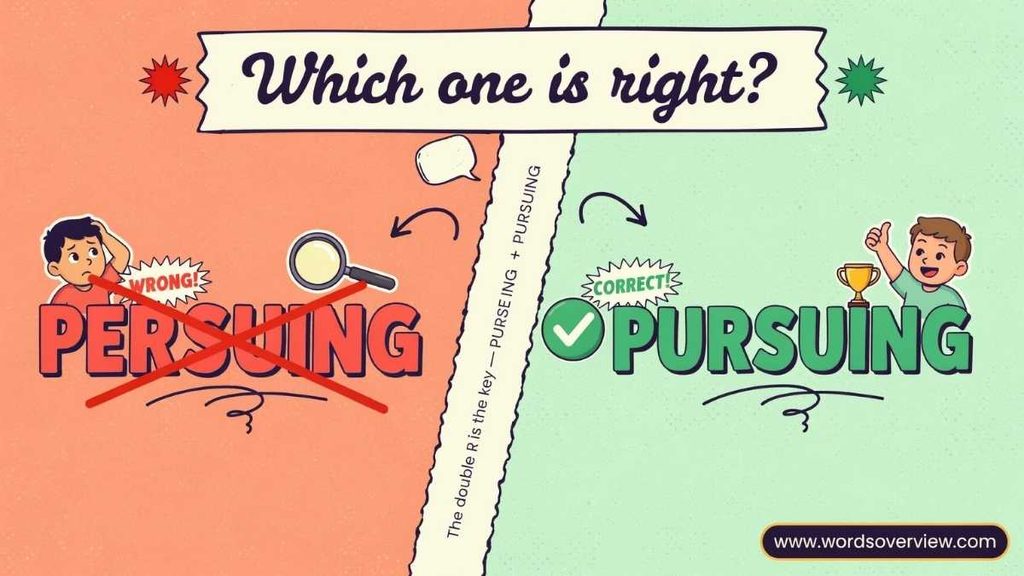
Pursuing is correct. Persuing is incorrect.
| Spelling | Correct? | Meaning or use |
| pursuing | Yes | Following, seeking or working toward something |
| persuing | No | Common misspelling of pursuing |
| pursing | Yes, but different | The ing form of purse |
The confusion becomes much easier once you identify the root word. Pursuing comes from pursue, not from an imaginary verb called persue.
Therefore:
- pursue → pursuing
- pursue → pursued
- pursue → pursues
- purse → pursing
That distinction solves most spelling problems immediately.
Persuing or Pursuing Meaning
The persuing or pursuing meaning question really asks what pursuing means and how you use it in English.
Pursuing generally means following, chasing, seeking or working toward something.
For example:
The police were pursuing the vehicle.
Here, pursuing means following or chasing.
Now consider:
She is pursuing a degree in computer science.
In this sentence, she isn’t physically chasing a degree. Instead, she is working toward earning one.
Likewise:
He is pursuing a career in software development.
Here, pursuing means actively working toward a professional career.
The meaning changes slightly with the context, but the central idea remains the same: you actively follow, seek or work toward something.
Pursuing Definition and Word Meaning
Pursuing is the present participle and gerund form of the verb pursue.
The verb can describe several related actions:
- Following or chasing someone or something
- Seeking an opportunity
- Working toward a goal
- Developing a career
- Continuing an interest
- Studying toward a qualification
- Working to achieve an ambition
- Trying to develop a relationship
For instance:
Maria is pursuing a degree in software engineering.
The phrase means that Maria is studying and working toward obtaining that degree.
Similarly:
The company is pursuing new opportunities.
This means the company is actively seeking opportunities that could benefit its business.
Therefore, the meaning of pursuing depends on what follows the word. A person can pursue a vehicle, a degree, a career, a goal, an opportunity or even a dream.
Is Persuing a Word?
If you’re asking “Is persuing a word?”, the answer is no in standard English when you intend the verb form of pursue.
You may still see persuing in online posts, informal messages, résumés, student assignments or other writing. People often make spelling mistakes, especially with words whose pronunciation doesn’t clearly reveal their spelling.
However, standard English uses:
pursuing
For example:
❌ I am persuing my studies.
✅ I am pursuing my studies.
❌ She is persuing a career in finance.
✅ She is pursuing a career in finance.
So, if a spell checker marks persuing as incorrect, it isn’t making an arbitrary change. It recognizes that the standard form is pursuing.
Why Do People Spell Pursuing as Persuing?
The spelling mistake usually comes from the relationship between pronunciation and spelling.
In American English, pursue has a pronunciation that can make its first syllable sound closer to “per” than the spelling suggests. As a result, some writers naturally type persue instead of pursue.
Once the base word becomes persue, the same mistake carries into the ing form:
persue → persuing
Unfortunately, that entire spelling pattern is incorrect.
The correct pattern starts with pursue:
pursue → pursuing
A useful memory trick is to remember the first four letters:
P-U-R-S
Whenever you write the verb or one of its forms, keep that sequence in mind.
Pursuing Spelling How Do You Spell Pursuing?
The correct spelling of pursuing is:
P-U-R-S-U-I-N-G
The word comes from pursue.
When you add ing to pursue, English spelling removes the final silent e:
pursue + ing → pursuing
Notice what stays the same. The internal spelling pursu- remains intact.
That’s why the result is pursuing, not persuing.
You can see a similar pattern in other English verbs:
| Base verb | ing form |
| pursue | pursuing |
| use | using |
| make | making |
| write | writing |
| move | moving |
The final e disappears, but the rest of the root spelling remains recognizable.
Therefore, don’t try to spell the word from its pronunciation alone. Instead, remember its base form.
pursue → pursuing
Learn the difference between confusing English words step by step
Chears or Cheers Which Spelling Is Correct?
Pursue or Persue Which Is Correct?
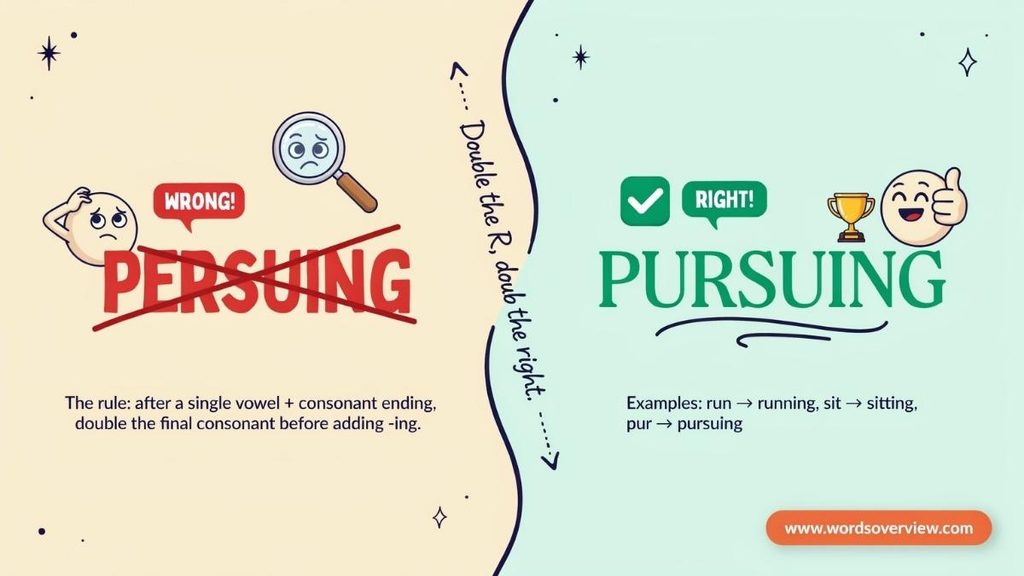
The correct spelling is pursue.
Persue is an incorrect spelling when you mean the English verb pursue.
| Word | Status | Example |
| pursue | Correct | I want to pursue my goals. |
| persue | Incorrect | I want to persue my goals. |
If you’re wondering “persue or pursue”, remember that pursue contains pur at the beginning.
Is Persue a Word?
No, persue is not the standard spelling of the English verb.
The correct word is:
pursue
For example:
She wants to pursue a career in medicine.
Not:
She wants to persue a career in medicine.
The same spelling rule affects related forms:
- pursue
- pursues
- pursued
- pursuing
- pursuit
This word family provides a useful visual reminder of the correct spelling.
Pursue Meaning in English
The pursue meaning in English changes slightly according to context, but the main ideas remain connected.
Pursue means to follow or chase
You can pursue someone or something physically.
The police pursued the suspect.
Here, pursue means to follow or chase.
Pursue means to seek
You can pursue an opportunity, solution or objective.
The company is pursuing a new business opportunity.
Here, pursue means to actively seek.
Pursue means to work toward
You can pursue a goal, dream, ambition or career.
She is pursuing her goal of becoming a software engineer.
Here, pursue means to work toward achieving something.
Pursue means to continue an interest
You can also pursue an interest or activity.
He decided to pursue his interest in photography.
In this context, pursue means to continue, develop or devote effort to something.
Because of these meanings, pursue works naturally in both everyday and professional English.
Learn the difference between confusing English words step by step
Insight or Insite What’s the Correct English Word?
Pursue Pronunciation and Pursuing Pronunciation
Pronunciation often contributes to the persuing or pursuing confusion.
In American English, pursue is commonly pronounced:
/pərˈsuː/
The stress falls on the second syllable.
Pursuing is commonly pronounced:
/pərˈsuːɪŋ/
The spelling may seem surprising when you first encounter it. However, the pronunciation doesn’t change the standard written form.
If you’re learning English, don’t rely only on sound to spell this word. Instead, connect its pronunciation with its visual form:
pursue → pursuing
That association will help you avoid the common persue and persuing mistakes.
Learn the difference between similar English words the easy way
Boxes or Boxs Which Spelling Is Correct?
Pursuing or Pursing What’s the Difference?
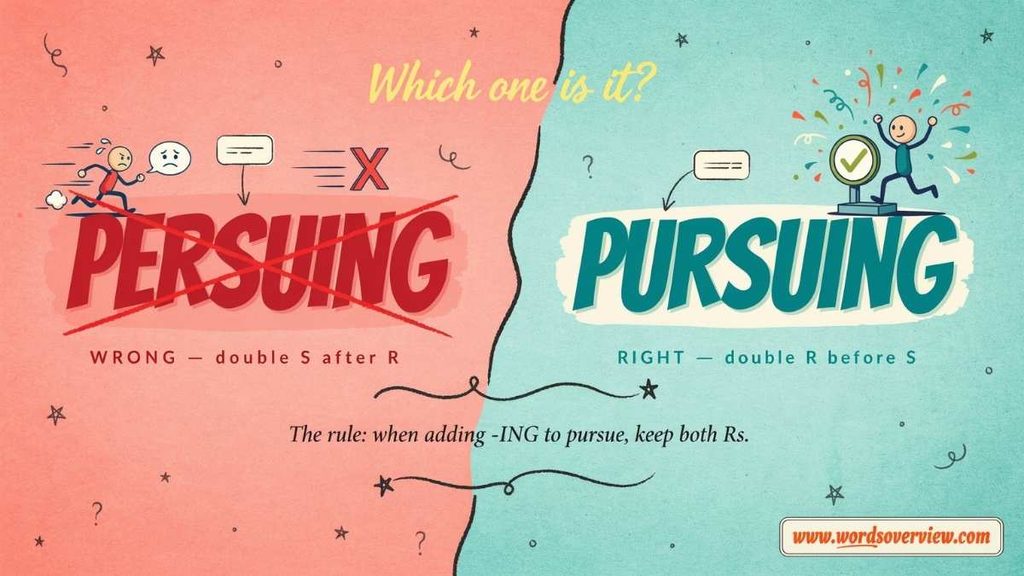
This is another important distinction because pursuing and pursing are both legitimate English words.
However, they come from different root words and have different meanings.
Pursuing
Pursuing comes from pursue.
It means following, seeking or working toward something.
He is pursuing a master’s degree.
Pursing
Pursing comes from purse.
It often describes tightening or bringing the lips together.
She was pursing her lips while thinking.
The difference looks small, but the meaning changes completely.
| Word | Root word | Meaning | Example |
| pursuing | pursue | Following, seeking or working toward | She is pursuing a degree. |
| pursing | purse | Tightening or bringing together | He was pursing his lips. |
So, if you’re talking about education, careers, goals, dreams or opportunities, you probably need pursuing.
Pursue + ing Understanding the Grammar
Understanding the grammar behind pursuing spelling makes the word easier to remember.
Pursue is the base form of the verb. When you add ing, it becomes pursuing.
The present participle appears in continuous verb forms:
She is pursuing a degree.
It can also function as a gerund:
Pursuing a degree requires commitment.
In the first sentence, pursuing forms part of the verb phrase. In the second, pursuing a degree acts as a noun-like phrase.
Pursue Verb Forms
| Verb form | Word | Example |
| Base form | pursue | I want to pursue this career. |
| Third-person singular | pursues | She pursues her goals. |
| Past tense | pursued | He pursued a degree abroad. |
| Present participle | pursuing | They are pursuing new opportunities. |
| Noun | pursuit | Her pursuit of knowledge continues. |
| Person noun | pursuer | The pursuer followed the target. |
Once you recognize the word family, persuing starts to look obviously wrong.
Pursuing a Degree Meaning
Pursuing a degree means working toward obtaining a college or university degree.
For example:
I am pursuing a bachelor’s degree in computer science.
This sentence means that the speaker currently studies or works toward completing that degree.
You can also say:
- pursuing a degree
- pursuing a bachelor’s degree
- pursuing a master’s degree
- pursuing a doctoral degree
- pursuing higher education
- pursuing further education
- pursuing studies in computer science
Pursue a Degree or Pursuing a Degree
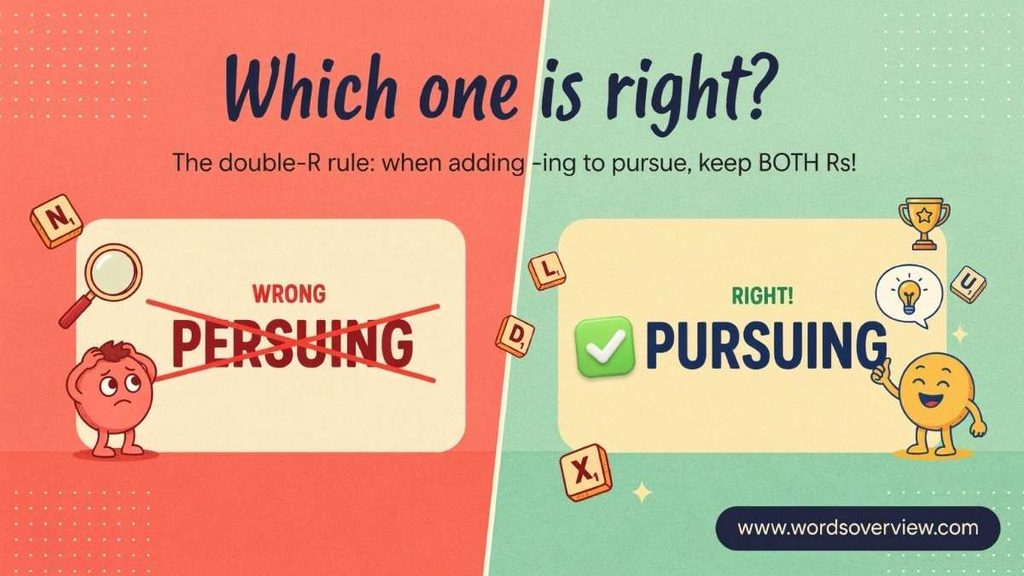
Both forms are correct. The surrounding grammar determines which one you need.
Use pursue after to:
I want to pursue a degree in computer science.
Use pursuing after forms of be in continuous constructions:
I am pursuing a degree in computer science.
The difference becomes clearer when you compare:
I want to study computer science.
I am studying computer science.
Likewise:
I want to pursue a degree.
I am pursuing a degree.
Learn the difference between similar English words
Honored or Honoured Which Spelling Is Correct?
Pursuing a Career Meaning
Pursuing a career means actively working toward a professional path.
For example:
She is pursuing a career in software development.
The phrase doesn’t necessarily mean that she has already established her entire career. Instead, it emphasizes the steps she takes toward that professional goal.
Those steps may include:
- Earning a degree
- Learning professional skills
- Completing training
- Building experience
- Applying for jobs
- Creating a portfolio
- Attending interviews
- Developing professional connections
Therefore, pursuing a career works well when you describe someone’s professional direction.
Pursuing a Goal Meaning
Pursuing a goal means actively working toward an objective.
For example:
He is pursuing his goal of becoming a professional programmer.
The word pursuing highlights continued effort. A person doesn’t merely want the goal. They take action to achieve it.
Compare these sentences:
She has a goal of starting a business.
She is pursuing her goal of starting a business.
The second sentence focuses more strongly on the process and effort.
You can also write:
- pursuing goals
- pursuing a personal goal
- pursuing a professional goal
- pursuing a long-term goal
- pursuing an ambitious goal
Pursuing Education Meaning
Pursuing education means actively studying or seeking further education.
For example:
Many students are pursuing higher education after high school.
You can also say:
He is pursuing further education in artificial intelligence.
The phrase appears naturally in academic, professional and career-related writing.
However, context determines whether pursuing education, pursuing a degree or studying sounds most natural.
For a specific qualification, pursuing a degree often provides more information.
Pursuing Opportunities Meaning
Pursuing opportunities means actively looking for opportunities that may lead to a desired result.
For example:
The graduate is pursuing opportunities in web development.
That could involve applying for internships, attending interviews, improving technical skills or contacting employers.
Likewise:
The company is pursuing new business opportunities.
Here, the company actively seeks ways to expand its activities.
The word pursuing therefore works well when the subject takes deliberate action instead of simply waiting for something to happen.
Pursuing a Dream Meaning
Pursuing a dream means actively working toward something you strongly want to accomplish.
For example:
She is pursuing her dream of becoming a writer.
The phrase often suggests determination, effort and long-term commitment.
You can also use:
- pursuing your dreams
- pursuing an ambition
- pursuing your passion
- pursuing your interests
- pursuing your aspirations
These expressions connect a desired outcome with the effort required to reach it.
Learn the difference between similar English words the easy way
Access or Acess Which Spelling Is Correct?
Pursuing Meaning in a Relationship
The verb pursue can also appear in relationship contexts.
In this setting, pursuing someone can mean actively trying to develop a romantic relationship with that person.
For example:
He decided to pursue a relationship with her.
The sentence means that he actively tried to develop a romantic relationship.
However, context matters. The word doesn’t automatically describe the relationship’s status. Depending on the situation, simpler wording may communicate the idea more clearly:
He asked her out.
They started dating.
She wanted to get to know him better.
So, choose pursue when you want to emphasize the idea of actively seeking or developing a relationship.
Pursuing in a Sentence Examples
Learning how to use pursuing in a sentence becomes easier when you see several contexts.
Education
I am pursuing a degree in computer science.
She is pursuing higher education after completing high school.
He is pursuing further studies in artificial intelligence.
Career
She is pursuing a career in medicine.
He is pursuing opportunities in software development.
They are pursuing professional growth.
Goals and ambitions
She is pursuing her long-term goals.
He is pursuing his dream of becoming an entrepreneur.
They remain committed to pursuing their ambitions.
Opportunities
The company is pursuing new business opportunities.
The team is pursuing a possible solution.
He is actively pursuing new opportunities.
Literal pursuit
The police were pursuing the vehicle.
The dog ran after the rabbit while its owner pursued them.
These examples show why pursuing can work in both literal and figurative contexts.
Common Spelling Mistakes With Pursuing
The main mistake is persuing, but several related errors deserve attention.
Persuing
❌ I am persuing a degree.
✅ I am pursuing a degree.
Persue
❌ She wants to persue her dream.
✅ She wants to pursue her dream.
Persued
❌ He persued a career in engineering.
✅ He pursued a career in engineering.
Pursing
This word isn’t automatically wrong. Instead, it has a different meaning.
She was pursing her lips.
If you mean working toward something, use pursuing:
She was pursuing her goal.
The key is to identify the root word before choosing the spelling.
Case Study A Student Writing a Résumé
Consider this résumé sentence:
❌ I am currently persuing a bachelor’s degree in computer science.
The sentence communicates the intended meaning, but the spelling contains a common error
The corrected version is:
✅ I am currently pursuing a bachelor’s degree in computer science.
Why does pursuing work?
Because the base verb is pursue:
pursue → pursuing
The student isn’t using a separate verb called persue. The spelling mistake happened because the sound of the first syllable can lead writers toward the wrong vowel.
This small correction matters in professional writing. Résumés, cover letters, academic applications and LinkedIn profiles should use standard spelling.
Case Study Literal Pursuit
Now consider a completely different sentence:
The police were pursuing the vehicle.
Here, pursuing describes physical movement. The police followed or chased the vehicle.
Compare that with:
The student was pursuing a degree.
The second sentence describes progress toward an objective rather than physical movement.
Although the situations differ, the central idea remains similar: someone actively follows something they want to reach, obtain or catch.
Learn the difference between similar English words the easy way
Alternately or Alternatively Meaning and Difference
Persuing or Pursuing Synonym
If you’re looking for a persuing or pursuing synonym, choose the replacement according to context.
| Context | Possible synonym |
| Pursuing a person | following, chasing |
| Pursuing a goal | working toward, seeking |
| Pursuing an opportunity | seeking, exploring |
| Pursuing a career | working toward, developing |
| Pursuing education | studying, undertaking |
| Pursuing an interest | exploring, developing |
| Pursuing a dream | striving for, working toward |
| Pursuing a solution | seeking, working toward |
For example:
She is pursuing a career in technology.
You could write:
She is working toward a career in technology.
However, pursuing often sounds more concise in formal and professional writing.
American and British English Spelling
Some English words have different spellings in American and British English. For example, writers may use color in American English and colour in British English.
However, pursuing does not create that kind of regional spelling difference.
Both American and British English use:
pursuing
Therefore, you don’t need to change the spelling based on your audience.
Whether you’re writing an American English article, a British English assignment or an international résumé, pursuing remains the standard form.
How to Remember the Correct Spelling of Pursuing
A simple memory trick can prevent this spelling mistake.
Remember the root word
Start with:
pursue
Then add ing:
pursuing
Don’t replace the u with e.
Remember the spelling pattern
Think of the word family:
pursue → pursued → pursuing → pursuit
The pursu- pattern gives you a visual reminder.
Connect it with education
If you’re a student, remember the familiar phrase:
pursuing a degree
That phrase appears frequently in résumés, academic profiles, applications and professional biographies.
Don’t spell from sound alone
English contains many words whose pronunciation doesn’t reveal every letter.
If you hear the word and immediately write persuing, stop for a second.
Ask yourself:
What is the root word?
The answer is pursue.
Then the correct ing form becomes much easier:
pursue → pursuing
Learn the difference between confusing English words step by step
Bosses or Boss’s? Which One Is Correct?
Persuing or Pursuing Complete Comparison
| Feature | Persuing | Pursuing |
| Standard spelling | No | Yes |
| Root word | Incorrect form | Pursue |
| Grammar role | — | Present participle/gerund |
| Meaning | — | Following, seeking or working toward |
| Academic use | Avoid | Appropriate |
| Career use | Avoid | Appropriate |
| Goal-related use | Avoid | Appropriate |
| Example | I am persuing a degree. | I am pursuing a degree. |
The difference is only a few letters, but those letters determine whether the spelling follows standard English.
Learn the difference between confusing word pairs
Directer or Director Which Spelling Is Correct?
Pursue or Pursuing Quick Grammar Guide
Use pursue when the grammar requires the base form.
I want to pursue a degree.
Use pursuing when you need the present participle.
I am pursuing a degree.
Use pursues with a singular third-person subject in the simple present.
She pursues her goals.
Use pursued for the past tense.
He pursued a career in engineering.
So, the main pattern is:
| Form | Example |
| pursue | I want to pursue my goal. |
| pursues | She pursues her interests. |
| pursued | He pursued a career in finance. |
| pursuing | They are pursuing new opportunities. |
Once you understand these forms, both spelling and grammar become easier.
Learn the difference between confusing English words step by step
Gos or Goes Which Spelling Is Correct?
Practice Session: Fill in the Blanks
Choose the correct word to complete each sentence.
- She is ________ a degree in computer science.
- The correct spelling is ________, not “persuing.”
- He decided to ________ a career in medicine.
- They are ________ new business opportunities.
- Maria ________ her dream of becoming a writer.
- I am currently ________ my studies at university.
- The company is ________ several new projects.
- He wants to ________ higher education after graduation.
- She is ________ her goal with determination.
- The past tense of pursue is ________.
- “Pursing” is related to the noun ________.
- He is ________ a master’s degree in engineering.
- The students are ________ their academic goals.
- You should ________ your interests with confidence.
- “Persuing” is a common spelling ________.
- She is ________ a career in software development.
- The correct verb is ________, not “persue.”
- He ________ a degree in business administration last year.
- They are ________ an opportunity to expand the company.
- “Pursuing” is the present participle of the verb ________.
- She is ________ her dream despite many challenges.
- He decided to ________ a new professional path.
- The student is ________ qualifications for a teaching career.
- She was ________ a difficult but rewarding goal.
- pursue + ing becomes ________.
Answer Session
- pursuing
- pursuing
- pursue
- pursuing
- pursued
- pursuing
- pursuing
- pursue
- pursuing
- pursued
- purse
- pursuing
- pursuing
- pursue
- mistake
- pursuing
- pursue
- pursued
- pursuing
- pursue
- pursuing
- pursue
- pursuing
- pursuing
- pursuing
Here’s a trusted source for clear more words Comparison:
Grammar Update
Frequently Asked Questions
Is it “pursuing” or “persuing”?
Pursuing is the correct spelling. Persuing is a common misspelling. For example, “She is pursuing a degree in computer science.”
What does “pursuing” mean?
Pursuing means actively following, seeking or working toward something. You can be pursuing a goal, career, education, opportunity or personal ambition.
What is the meaning of “pursue”?
Pursue means to follow or chase something, either literally or figuratively. For example, “He decided to pursue a career in engineering.”
How do you spell “pursuing” correctly?
The correct spelling is pursuing: p-u-r-s-u-i-n-g. It comes from the verb pursue with the final e removed before adding ing.
What is the difference between “pursuing” and “pursing”?
Pursuing comes from pursue and means following, seeking or working toward something. Pursing comes from purse and commonly describes tightening or drawing together, as in “pursing your lips.”
Is “pursuing a degree” grammatically correct?
Yes. Pursuing a degree is a standard and natural expression that means working toward obtaining an academic degree. For example, “I am pursuing a degree in computer science.”
What does “I am pursuing” mean?
I am pursuing means that you are currently following, seeking or working toward something. For example, “I am pursuing a career in software development” means you are actively working toward that career.
What is the past tense of “pursue”?
The past tense of pursue is pursued. For example, “She pursued her goal despite several challenges.”
What can you say instead of “pursuing”?
Depending on the context, alternatives to pursuing include seeking, following, working toward, aiming for, chasing and working on. The best choice depends on the meaning of the sentence.
How do you use “pursuing” in a sentence?
You can use pursuing to describe an ongoing effort to reach or obtain something. For example, “They are pursuing new opportunities in the technology industry.”
Conclusion
The persuing or pursuing confusion may look like a tiny spelling problem, but one missing u can send your sentence in the wrong direction. The correct spelling is pursuing, while persuing is a common spelling mistake. Remember that the root word is pursue, so when you add ing, you get pursuing.
Whether you’re pursuing a degree, pursuing a career, pursuing a goal or pursuing a dream, keep that u in place. Also, don’t confuse pursuing with pursing, which has a completely different meaning. Once you connect pursue → pursuing → pursuit, this tricky spelling becomes much easier to remember. English may enjoy hiding surprises in plain sight, but this one doesn’t have to chase you around forever!

Ethan AJS is an experienced blogger and language enthusiast at Words Overview, dedicated to making English easier to understand and use. He writes about grammar, vocabulary, spelling, word meanings and commonly confused words, turning tricky language questions into clear, practical insights. With a passion for effective communication, Ethan creates engaging, readerfocused content that helps readers write accurately, choose the right words and communicate with confidence.




