Have you ever typed “chears” with complete confidence only to reread it and think, “Wait, did English just change the rules?” You’re not alone. The confusion between chears or cheers is surprisingly common because both spellings look almost identical. One tiny vowel, however, makes a big difference. While cheers is the correct modern spelling, chears can sneak into messages, emails and social posts like an uninvited guest at a celebration. Even more confusing, the historical spelling chear really did exist. So, before you raise a glass, thank someone or say goodbye, let’s clear up this spelling mystery once and for all.
Chears or Cheers Quick Answer
Is It Chears or Cheers?
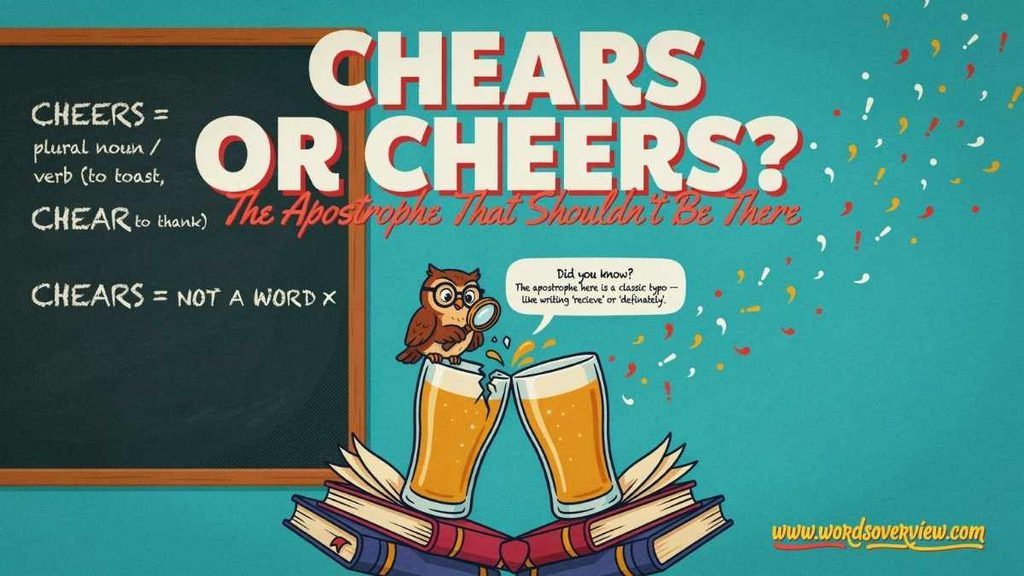
Cheers is the correct spelling in standard modern English.
| Spelling | Modern Standard English? | Main Use |
| cheers | Yes | Toast, thanks, farewell, support and approval |
| chears | No, when intended as modern cheers | Usually a spelling mistake |
| chear | Historical/obsolete spelling | Older form of cheer |
| cheer | Yes | Noun and verb with several meanings |
For example, if you raise a glass and say “Cheers!”, you’re using the standard spelling. On the other hand, if you write “Chears!”, most modern readers will understand it as a spelling error
The chears or cheers spelling question usually comes down to one letter. The modern form uses ee, not ea.
What Is the Correct Spelling of Cheers?
The correct spelling of cheers is:
C-H-E-E-R-S
Not:
C-H-E-A-R-S
The easiest way to remember it is to start with the base word cheer and add -s:
cheer → cheers
Therefore, you don’t need to change the second e into an a.
Chears or Cheers Meaning What Does “Cheers” Mean?

The chears or cheers meaning question can cause confusion because cheers has several established uses.
Depending on the context, cheers can express:
- Good wishes before drinking
- Gratitude or thanks
- Goodbye
- Encouragement
- Approval
- Celebration
- Support
As a result, you can’t determine the exact meaning of cheers from the word alone. You need to consider the surrounding conversation.
Cheers as a Toast
The most familiar use of cheers appears during a toast.
When people raise a glass before drinking, someone may say:
“Cheers!”
In this situation, cheers expresses good wishes, goodwill or celebration.
For example:
Cheers to your new job!
Everyone raised a glass and said, “Cheers!”
Cheers to another successful year.
This is the classic cheers as a toast expression.
Although many people associate the expression with alcoholic drinks, the word can also appear when people celebrate with other beverages. The important point is the social act of making a toast rather than the specific drink.
Cheers as Thank You
Here’s where regional usage becomes especially interesting.
In informal British English, cheers can mean thank you. This use often appears in casual conversations between friends, coworkers or acquaintances.
For example:
“I saved you a seat.”
“Cheers, mate.”
In this situation, nobody needs to raise a glass. The speaker simply expresses appreciation.
You might also hear:
- Cheers for helping me.
- Cheers for sending the file.
- Cheers, I really appreciate it.
Therefore, if you ask “does cheers mean thank you?”, the answer is yes. In informal British English, cheers can function as a casual way to say thank you.
Cheers as Goodbye
Cheers can also function as an informal farewell.
For example:
“See you tomorrow. Cheers!”
You might hear this expression at the end of a casual conversation:
All right, cheers!
Cheers, see you later.
Okay, cheers. Bye!
In this context, cheers can mean goodbye. Sometimes it can carry both meanings at once. A speaker may use it to show appreciation while also ending the conversation.
Cheers as a Greeting
People sometimes search for cheers as a greeting, but this use needs some clarification.
Cheers does not normally function as a direct replacement for hello in everyday American English. Instead, it commonly expresses a toast, thanks or farewell.
However, you may see it in informal expressions such as:
Cheers, everyone!
Here, the speaker addresses a group in a friendly way. Still, you shouldn’t automatically replace hello with cheers.
Context makes the difference.
Cheers Definition and Grammar
The cheers definition depends partly on how you use the word grammatically.
First, Cheers! can work as an interjection. In this form, it stands alone as an expression.
Cheers!
Second, cheers can serve as the plural form of the noun cheer.
The crowd erupted in cheers.
Third, cheers can act as the third-person singular present-tense form of the verb cheer.
She cheers for her favorite team.
Therefore, cheers does not always represent the same grammatical form.
| Form | Grammar | Example |
| cheer | Noun | The crowd gave a loud cheer. |
| cheer | Verb | We cheer for our team. |
| cheers | Plural noun | The stadium filled with cheers. |
| cheers | Third-person singular verb | She cheers for the home team. |
| Cheers! | Interjection | Cheers! |
| Cheers | Informal expression | Cheers for your help. |
This distinction makes the cheer or cheers question much easier to understand.
Learn the difference between confusing English words step by step
Gos or Goes Which Spelling Is Correct?
Cheer or Cheers What’s the Difference?
The words cheer and cheers share the same base. However, they can perform different grammatical jobs.
Cheer as a Noun
As a noun, cheer can refer to happiness, encouragement, good spirits or a shout of support.
For example:
The team’s victory brought good cheer to the town.
You can also use it to describe a single shout of support:
The fans gave a loud cheer when the goal was scored.
When you need the plural, use cheers:
The players heard cheers from the crowd.
So, the plural of cheer is cheers.
Cheer as a Verb
As a verb, cheer can mean to encourage, support or make someone happier.
For example:
We cheer for our school team.
The crowd cheered when she entered.
Her friends cheered her up.
The verb follows a regular present-tense pattern:
I cheer.
You cheer.
We cheer.
They cheer.
He cheers.
She cheers.
Consequently, cheers serves as the third-person singular present-tense form of cheer.
Cheer Up Meaning
The phrasal verb cheer up means to become happier or to make someone happier.
For example:
Cheer up! Tomorrow could be a better day.
You can also use it when one thing improves another person’s mood:
The good news cheered him up.
This meaning connects naturally with the older sense of cheer associated with a person’s mood and spirits.
Is Chears a Word?
The answer needs a little nuance.
If you’re asking “is chears a word?” because you want to write a normal modern English sentence, the practical answer is no, not as the standard modern form of cheers.
You should not use chears as a modern substitute for cheers.
However, some specialized or historical word resources contain forms connected with the obsolete spelling chear. That historical evidence explains why someone might encounter chears in an unusual linguistic context.
Still, historical or specialized records do not make chears the standard spelling used in contemporary English.
Is Chears a Correct Spelling?
No, not when you mean the modern expression cheers.
Use:
Cheers for your help. ✅
Not:
Chears for your help. ❌
Likewise, use:
Cheers! ✅
Not:
Chears! ❌
For everyday English, schoolwork, professional communication and general online writing, cheers is the form you should choose.
Learn the difference between confusing English words step by step
Insight or Insite What’s the Correct English Word?
Is Chear a Word?
This question has a more interesting answer because chear has a genuine historical connection to modern English.
Is Chear an English Word?
Chear appears in historical English as an obsolete spelling of cheer.
Therefore, if you encounter chear in an old poem, historical document or older edition of a book, you may be looking at a genuine historical spelling rather than a simple typo.
For modern writing, however, use cheer.
Chear Definition
The historical chear definition relates to meanings associated with modern cheer, including happiness, spirit, encouragement and related ideas.
English spelling did not always follow the standardized patterns that modern writers use today. Over time, dictionaries, printing practices, education and editorial conventions helped establish more consistent spellings.
As a result, older texts can contain forms that look unusual today.
That explains why chear can exist historically while cheer remains the standard modern spelling.
Is Chear an Obsolete Word?
More precisely, chear is an obsolete spelling of cheer.
That distinction matters. The underlying word and its meanings did not disappear. Instead, the spelling changed.
Think of the relationship this way:
Historical spelling: chear
Modern spelling: cheer
Therefore, modern writers generally shouldn’t use chear unless they are discussing historical English, quoting an old source or intentionally reproducing an older spelling.
Is Chear a Scrabble Word?
If you’re asking “is chear a Scrabble word?”, the answer is no according to Merriam-Webster’s Scrabble Word Finder.
This distinction matters because historical recognition and word-game eligibility are not the same thing.
A historical spelling can appear in linguistic records without qualifying as a playable word in a modern word game.
| Word | Modern English | Scrabble Status |
| cheer | Yes | Playable |
| cheers | Yes | Playable |
| chear | Historical/obsolete | Not playable |
| chears | Not the standard modern form | Not the standard form of cheers |
Therefore, if you’re playing a word game and considering chear, don’t assume that its historical use makes it acceptable on the board.
Learn the difference between confusing English words step by step
Persuing or Pursuing Which Spelling Is Correct?
Chears or Cheers Why Does the Mistake Happen?
The chears or cheers confusion makes sense when you consider English spelling patterns.
Pronunciation Can Cause Confusion
The pronunciation of cheers does not automatically reveal its spelling.
English learners often rely on sound when they write unfamiliar words. Unfortunately, English spelling doesn’t always provide a perfect one-to-one relationship between sounds and letters.
That can make chears look plausible.
However, pronunciation does not change the standard written form.
The Word “Chear” Adds More Confusion
Historical chear creates another possible source of confusion.
Someone who encounters the older spelling may assume that chears represents another acceptable modern form.
It doesn’t.
Historical spellings belong to their own linguistic context. Modern standard English follows the established spelling cheer, which produces cheers when you add the plural or third-person singular ending.
English Has Many Similar Spelling Patterns
Consider familiar words such as:
- hear
- near
- year
- fear
- clear
Because these words use -ear, the spelling chears may look natural at first glance.
However, the established pattern for this word is:
cheer → cheers
That simple connection provides the most reliable spelling rule.
Chears or Cheers Pronunciation
The chears or cheers pronunciation question does not create a separate standard pronunciation because chears is not the standard modern spelling intended in this context.
For cheers, English pronunciation varies somewhat by region.
British English commonly uses a pronunciation represented as /tʃɪəz/, while American English commonly uses /tʃɪrz/.
The spelling remains cheers in both varieties.
Cheers Pronunciation in American English
In American English, cheers commonly has the pronunciation /tʃɪrz/.
The final sound connects closely with the pronunciation of the word cheer.
Cheers Pronunciation in British English
In British English, cheers commonly has the pronunciation /tʃɪəz/.
Although the vowel and ending can sound slightly different from the American form, the written spelling remains unchanged.
As a result, regional pronunciation does not justify writing chears.
Learn the difference between similar English words
Honored or Honoured Which Spelling Is Correct?
Is “Cheers” British or American English?
A common question is “is cheers British or American English?”
The spelling cheers belongs to both British and American English. However, the two varieties differ somewhat in how they use the expression in casual conversation.
Cheers Meaning in British English
British English uses cheers in several informal ways.
It can function as:
- A drinking toast
- A casual way to say thank you
- An informal farewell
For example:
“Here’s the document you needed.”
“Cheers!”
In this context, cheers means thank you.
You might also hear:
Right, cheers! See you tomorrow.
Here, cheers works as a casual farewell.
Cheers Meaning in American English
American English commonly uses cheers as a toast:
Cheers to the newlyweds!
Americans also recognize the expression in other contexts. However, the informal British uses meaning thank you or goodbye have stronger associations with British English.
Therefore, the spelling stays the same even though regional usage can differ.
Common Mistakes With Cheers
Learning the correct spelling solves the main problem. However, several other mistakes can still cause confusion.
Writing “Chears” Instead of “Cheers”
This is the most direct spelling mistake.
Incorrect:
Chears for your help.
Correct:
Cheers for your help.
The easiest rule remains:
cheer + s = cheers
Confusing Cheer and Cheers
Although the words share the same base, context determines whether you need cheer or cheers.
Compare:
The crowd gave a cheer.
with:
The crowd gave three cheers.
The first sentence refers to one expression of support. The second refers to multiple expressions.
Likewise:
We cheer for our team.
but:
She cheers for our team.
Here, the difference comes from grammar rather than meaning.
Using Cheers in Formal Writing
Cheers can sound perfectly natural in a casual email:
Cheers,
James
However, the same sign-off may sound too informal in a formal business letter, academic document, legal communication or official application.
In those situations, alternatives such as Best regards, Sincerely or Regards may fit the tone more naturally.
The issue isn’t grammatical correctness. Instead, it’s a matter of register.
Assuming Cheers Always Means a Toast
This mistake can lead to misunderstandings.
Consider:
Cheers!
This could indicate a toast.
However:
Cheers for fixing the printer.
can mean thanks, particularly in British English.
Likewise:
Cheers, see you Monday.
can function as a farewell.
In other words, context does the heavy lifting.
Learn the difference between similar English words the easy way
Boxes or Boxs Which Spelling Is Correct?
Chears or Cheers Examples in Everyday English
These chears or cheers examples demonstrate how the correct spelling works in different situations.
| Context | Example | Meaning |
| Toast | Cheers! | Good wishes before drinking |
| Celebration | Cheers to your success! | Celebration and good wishes |
| Thanks | Cheers for helping me. | Thank you |
| Farewell | Cheers, see you tomorrow. | Goodbye |
| Support | The team received loud cheers. | Shouts of approval |
| Verb | She cheers for the home team. | Supports |
| Cheers, David | Informal sign-off |
Notice that the spelling stays the same throughout these examples. Only the context changes the meaning.
When to Use “Cheers” Instead of “Thank You”
Both cheers and thank you can express gratitude. However, they don’t always create the same tone.
Use “Thank You” When:
- You need a neutral expression.
- You’re writing formally.
- You’re speaking to someone you don’t know well.
- You’re writing academic or official material.
- You want your appreciation to sound explicit.
For example:
Thank you for your assistance with the report.
This sentence works well in a professional setting.
Use “Cheers” When:
- You’re having a casual conversation.
- You’re writing to a friend.
- You’re communicating informally with someone familiar.
- The surrounding conversation already has a relaxed tone.
- You’re using British-style informal English.
For example:
Cheers for sending that over.
The point isn’t that one expression always works better than the other. Instead, you should match the expression to the situation.
Learn the difference between similar English words the easy way
Access or Acess Which Spelling Is Correct?
When Should You Say “Cheers”?
You can say cheers whenever the context supports one of its established meanings.
Say “Cheers” as a Toast
Cheers to the new year!
Here, the expression communicates celebration and good wishes.
Say “Cheers” as Thanks
Cheers for picking me up.
This use sounds particularly natural in informal British English.
Say “Cheers” as Goodbye
Right, cheers! See you next week.
Again, this use works as an informal farewell.
Say “Cheers” to Show Support
As a noun, cheers can describe expressions of support:
The crowd’s cheers grew louder.
Here, cheers has nothing to do with saying thank you or goodbye. Instead, it refers to enthusiastic sounds from the crowd.
“Cheers” in Emails, Texts and Social Media
Modern communication has made cheers especially useful because the expression can perform several conversational functions with very few words.
Cheers in Emails
A casual workplace email might end with:
Thanks for sending the figures. Cheers, Sam
This sign-off sounds relaxed and friendly.
For a formal professional message, however, Best regards or Sincerely may create a more appropriate tone.
Cheers in Text Messages
A short text might say:
Got it. Cheers!
Here, cheers means something close to thanks.
Another message might end with:
I’ll see you at 7. Cheers!
In that situation, the expression can work as a friendly closing.
Cheers on Social Media
On social platforms, cheers often appears in celebratory expressions:
Cheers to the weekend!
You might also see:
Cheers to everyone who helped make this happen.
In these examples, the expression can communicate celebration, appreciation or good wishes without necessarily referring to alcohol.
The History Behind “Cheer”
The history of cheer helps explain why the modern word has such a broad range of meanings.
The noun cheer dates back to medieval English. Historical sources trace its early development through Anglo-French and Old French forms associated with the face, expression or countenance.
Over time, the meaning expanded. It came to describe a person’s mood, spirit or state of mind. Later, positive associations with happiness and good spirits became prominent.
The verb developed related meanings as well. It came to describe actions such as encouraging someone, improving someone’s mood and expressing support.
This development gives us a useful semantic chain:
face → expression → mood → good spirits → encouragement → support
Language rarely changes in a single step. Instead, meanings often branch and develop gradually. Cheer provides a good example of that process.
Learn the difference between confusing word pairs
Directer or Director Which Spelling Is Correct?
Historical “Chear” or Modern “Cheer”
Older English spelling could vary considerably. Before modern spelling conventions became firmly established, writers sometimes used forms that now look unusual.
Chear belongs to that historical story.
It appears as an obsolete spelling of cheer. Therefore, finding chear in an old text does not necessarily indicate a spelling mistake.
Instead, the form may reflect the spelling conventions of the period.
Historical records can also contain forms related to chears. However, those records should not lead modern writers to treat chears as an alternative spelling of contemporary cheers.
The distinction is simple:
Historical form: chear
Modern form: cheer
Consequently, modern English uses cheer, not chear.
Chears or Cheers What Does the Online Confusion Show?
People who search “chears or cheers” may want to see how other speakers discuss the spelling in everyday conversations.
Online discussions can provide useful examples of how people encounter or question unusual spellings. However, informal discussions do not establish the standard spelling of an English word.
For that purpose, established dictionaries and recognized word references provide stronger evidence.
The main distinction remains clear:
- Cheers is the standard modern form.
- Chear is an obsolete historical spelling of cheer.
- Chears is not the standard modern spelling of cheers.
- Historical or specialized records may contain related forms.
- Historical recognition does not automatically make a form suitable for modern writing.
Therefore, if an online discussion claims that chears looks correct, that claim does not change the standard modern spelling.
A Simple Way to Remember the Correct Spelling
When you’re unsure how to spell the word, return to its base form:
cheer + s = cheers
You can also connect it with related words:
- cheer
- cheered
- cheering
- cheerful
- cheers
Each form preserves cheer.
The spelling chears breaks that pattern.
Another useful memory trick is the familiar phrase:
Cheers to that!
So, the next time chears looks tempting, mentally return to cheer. Then add s.
Learn the difference between similar English words the easy way
Alternately or Alternatively Meaning and Difference
Chears or Cheers Quick Comparison
| Question | Answer |
| What is the correct spelling? | Cheers |
| Is chears a standard modern English form of cheers? | No |
| Is chear a word? | It exists as an obsolete spelling of cheer |
| Is chear a Scrabble word? | No, according to Merriam-Webster’s Scrabble Word Finder |
| Can cheers mean thank you? | Yes, especially in UK informal English |
| Can cheers mean goodbye? | Yes, especially in UK informal English |
| Can cheers mean a toast? | Yes |
| Can cheers describe audience support? | Yes, as the plural noun cheer |
| Is cheers British or American? | Both use the spelling, although some meanings differ by region |
| Is cheers formal? | It is usually informal when used as thanks, farewell or a sign-off |
Commonly Confused Forms
Understanding related forms makes the spelling much easier to remember.
| Form | Meaning | Example |
| cheer | Happiness, encouragement or a shout of support | The crowd gave a cheer. |
| cheers | Plural of cheer | The cheers filled the stadium. |
| cheer | Verb meaning to encourage or support | We cheer for our team. |
| cheers | Third-person singular of cheer | She cheers for the team. |
| cheerful | Happy or positive | He has a cheerful personality. |
| cheer up | Become or make happier | Cheer up! |
| chear | Obsolete spelling of cheer | Historical usage |
| chears | Not the standard modern spelling of cheers | Usually incorrect today |
Final Examples Correct or Incorrect
A few direct comparisons can settle the spelling question quickly.
| Incorrect | Correct |
| Chears! | Cheers! |
| Chears for your help. | Cheers for your help. |
| Chears to your success! | Cheers to your success! |
| The crowd gave loud chears. | The crowd gave loud cheers. |
| Chears, see you tomorrow. | Cheers, see you tomorrow. |
| Everyone raised their glasses and said chears. | Everyone raised their glasses and said cheers. |
The pattern stays consistent: when you mean the modern word, spell it cheers.
Learn the difference between confusing English words step by step
Bosses or Boss’s? Which One Is Correct?
Practice Session Fill in the Blanks
Choose the correct word to complete each sentence.
- The correct modern spelling is ________.
- “Chears” is not the standard modern spelling of ________.
- Everyone raised their glasses and said, “________!”
- In informal British English, “cheers” can mean ________.
- The historical spelling ________ is an obsolete form of “cheer.”
- We shouted three loud ________ for the winning team.
- She gave me a quick “________” before leaving the office.
- “Cheers!” can be used as a casual way to say ________ in British English.
- The verb “cheer” means to encourage or make someone feel more ________.
- The plural noun of “cheer” is ________.
- He said “cheers” after his friend helped him carry the ________.
- “Chears” is a common spelling ________ of “cheers.”
- Before taking a drink, the guests raised their glasses and said ________.
- The word “cheers” can express thanks, farewell or a ________.
- In modern English, you should write “cheers” rather than ________.
- The old spelling “chear” may appear in ________ English texts.
- The coach tried to ________ the players after their difficult loss.
- “Cheers for your help!” is an informal way to say “________ for your help!”
- The crowd gave the singer several loud ________.
- When making a toast, people often raise their glasses and say ________.
- “Cheer up” means to become or make someone feel more ________.
- The spelling ________ should be used in modern English when you mean “cheers.”
- “Cheers” can function as an interjection, a noun or a ________.
- If you want to thank someone formally, “thank you” is more appropriate than the informal ________.
- Cheers has two ________ after the “h.”
Answer Session
- cheers
- cheers
- Cheers
- thank you
- chear
- cheers
- cheers
- thank you
- cheerful
- cheers
- bags
- mistake
- cheers
- toast
- chears
- historical
- cheer
- thanks
- cheers
- cheers
- happy
- cheers
- verb
- cheers
- e’s
Here’s a trusted source for clear more words Comparison:
Grammar Update
Frequently Asked Questions
Is it “chears” or “cheers”?
Cheers is the correct modern spelling. Chears is not the standard spelling when you mean the word “cheers.”
Is “chear” a word?
Yes. Chear is an obsolete spelling of cheer that appears in older English texts. It isn’t the standard spelling used in modern English.
What does “cheers” mean?
Cheers can express a toast, thanks, goodbye, encouragement or celebration, depending on the context. For example, you might say “Cheers!” when raising a glass or thanking someone informally.
Is it good to say “cheers”?
Yes. Cheers is a natural and widely used expression in informal English. Its meaning depends on the situation, so it can function as a toast, a casual thank-you or a farewell.
When should I say “cheers”?
You can say cheers when making a toast, thanking someone informally, saying goodbye or showing support. For example, “Cheers for your help!” means “Thanks for your help!” in informal British English.
Can Americans say “cheers”?
Yes. Americans use cheers, especially when making a toast or celebrating. However, the informal use of cheers to mean “thank you” or “goodbye” is more strongly associated with British English.
What is “cheers” short for?
Cheers isn’t normally an abbreviation or shortened form of another word. It is the plural form of cheer and also works as an interjection in expressions such as “Cheers!”
What is another word for “cheers”?
The best alternative depends on the meaning.
- For a toast, you can use to your health.
- For thanks, use thanks or thank you.
- For a farewell, goodbye or see you may work.
Why do people say “cheers” before drinking?
People say cheers before drinking as a traditional toast that expresses goodwill, celebration or good wishes. It’s commonly used when people raise their glasses before taking a drink.
How do you spell “cheers” correctly?
The correct spelling is C-H-E-E-R-S: cheers. If you’re choosing between chears and cheers, use cheers in modern English.
Conclusion
So, chears or cheers? The answer is simple: cheers is the correct modern spelling. Whether you’re raising a glass, thanking someone, saying goodbye or showing support, cheers is the word you want. Writing chears may look like a harmless spelling slip, but it can make your sentence look as if it took a wrong turn on the way to the dictionary.
The confusion becomes even more interesting because chear was once used as an older spelling of cheer. However, that historical form doesn’t make chears the standard spelling today. Therefore, if you’re writing an email, article, message or social post, stick with cheers.
In short, remember the ee in cheers. Your spelling will be correct, your meaning will stay clear and your grammar won’t need a little cheer-up afterward. Cheers to that!

Ethan AJS is an experienced blogger and language enthusiast at Words Overview, dedicated to making English easier to understand and use. He writes about grammar, vocabulary, spelling, word meanings and commonly confused words, turning tricky language questions into clear, practical insights. With a passion for effective communication, Ethan creates engaging, readerfocused content that helps readers write accurately, choose the right words and communicate with confidence.