
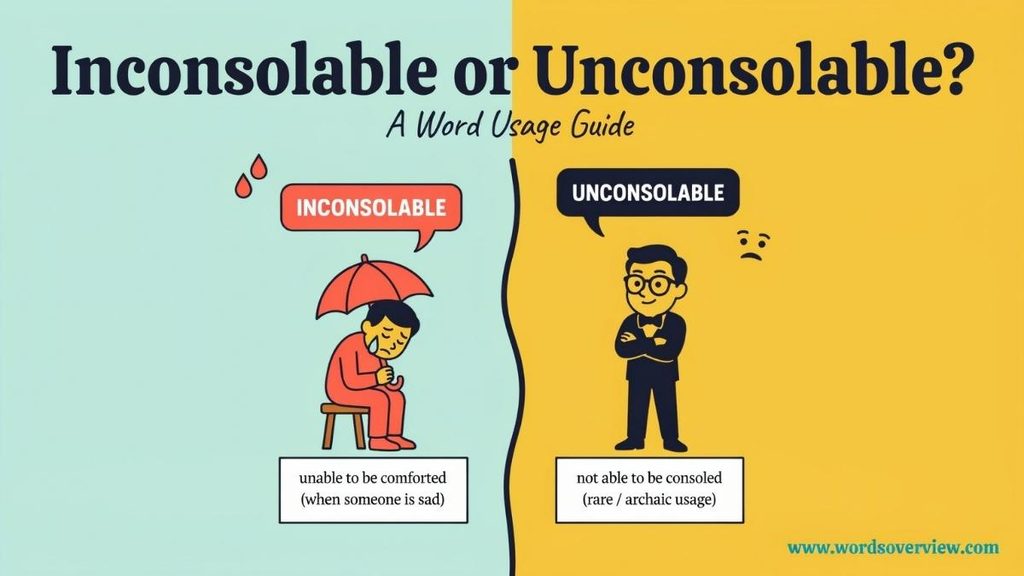
English has a funny habit of making two words look equally correct, then leaving you wondering which one belongs in your sentence. The confusion around inconsolable or unconsolable is a perfect example. Both words relate to someone who cannot easily be comforted, especially during intense grief, sadness or emotional distress. However, they don’t appear with the same frequency in modern English. So, should you write “inconsolable” or “unconsolable”? Is one wrong or does English simply enjoy keeping you on your toes? Don’t worry. This guide breaks down their meanings, differences, spelling, usage and examples so you can choose the right word confidently.
Inconsolable or Unconsolable Quick Answer
So, inconsolable or unconsolable which is correct? Both forms exist, but inconsolable is the standard and more widely used choice.
The word inconsolable describes someone who feels such intense sadness or distress that other people cannot easily comfort them. It commonly appears in situations involving grief, loss, disappointment or overwhelming emotion.
Unconsolable carries essentially the same meaning. However, it is less frequent and usually isn’t the first choice in modern writing.
| Word | Status | Meaning | Usual choice |
| Inconsolable | Established and common | Unable or extremely difficult to comfort | Preferred |
| Unconsolable | Established but less common | Unable to be comforted | Less common |
Therefore, the inconsolable or unconsolable distinction is mainly about usage and frequency. It isn’t a straightforward American-versus-British spelling difference.
Inconsolable or Unconsolable Meaning
The inconsolable or unconsolable meaning is essentially the same. Both words describe a person who cannot easily receive comfort because their emotional distress feels overwhelming.
For example:
After hearing the devastating news, she was inconsolable.
This sentence describes much more than ordinary sadness. The person feels such intense grief or emotional pain that normal attempts to comfort her don’t seem to work.
What Does Inconsolable Mean?
The inconsolable meaning centers on the idea of being unable to find comfort.
A simple inconsolable definition is:
Extremely sad, distressed or upset and unable to be comforted.
The adjective often describes strong emotional reactions. For example, someone may become inconsolable after the death of a loved one, a tragic loss, devastating news or a deeply painful disappointment.
However, the word doesn’t mean simply “sad.” It usually suggests a much stronger emotional state.
Inconsolable as an Adjective
Inconsolable functions as an adjective. It can describe a person, emotional state or expression of grief.
Common combinations include:
- inconsolable child
- inconsolable parent
- inconsolable grief
- inconsolable sorrow
- inconsolable sadness
- inconsolable crying
- inconsolable tears
For instance:
The child was inconsolable after losing her favorite toy.
The sentence doesn’t merely say that the child felt sad. Instead, it emphasizes that the child remained extremely upset despite attempts to provide comfort.
Learn the difference between commonly misused words
Blackout or Backout: Difference and Usage
Inconsolable Does Not Simply Mean Sad

This distinction matters because writers often use emotional adjectives interchangeably when they don’t have exactly the same force.
Someone can feel sad without being inconsolable. Likewise, someone can feel disappointed without being inconsolable.
Consider this rough progression:
sad → upset → deeply distressed → inconsolable
The exact intensity depends on the context. Nevertheless, inconsolable generally communicates a much stronger emotional reaction than ordinary sadness.
Why Is Inconsolable the Standard Form?
The structure of the word becomes clearer when you examine its related forms.
The verb console means to comfort someone who feels sad, distressed or disappointed. From this word, English forms several related terms:
- console — to comfort someone
- consolation — comfort offered to someone experiencing sadness or difficulty
- consolable — capable of being consoled
- inconsolable — unable to be consoled
The relationship is straightforward:
consolable → inconsolable
Historically, inconsolable developed from the idea of being unable to receive consolation. The prefix in- contributes a negative meaning, while the root relates to consolation and comfort.
That established history helps explain why inconsolable became the familiar form.
Learn the difference between confusing English words step by step
Chears or Cheers Which Spelling Is Correct?
Why “Unconsolable” Seems Logical
At first glance, unconsolable looks perfectly reasonable. English frequently uses un- to create negative adjectives.
For example:
- happy → unhappy
- fair → unfair
- kind → unkind
- certain → uncertain
- comfortable → uncomfortable
Because this pattern occurs so often, a writer may naturally create unconsolable from consolable.
However, English word formation doesn’t always follow one simple formula. Some negative adjectives use in-, some use un- and some words have competing forms with different levels of acceptance or frequency.
That explains why unconsolable can look completely natural even though inconsolable remains the more common choice.
Is Unconsolable a Word?
If you’re asking is unconsolable a word, the answer is yes.
Major English dictionaries recognize unconsolable as an adjective. It carries essentially the same meaning as inconsolable: someone who feels extremely sad and cannot easily accept or receive comfort.
However, recognizing a word doesn’t mean that every form has equal frequency.
This distinction matters. A word can appear in dictionaries and still remain less common than another word with the same meaning. That’s exactly what happens here.
Unconsolable Definition
The unconsolable definition can be expressed simply:
Extremely sad or distressed and unable to be comforted.
For example:
The child became unconsolable after losing her beloved pet.
The meaning is clear. Nevertheless, most writers would more naturally choose:
The child became inconsolable after losing her beloved pet.
The second version uses the more familiar form.
Is Unconsolable Correct?
The answer depends on what you mean by “correct.”
If you mean, “Does this form exist in English and can readers understand it?” then yes.
If you mean, “Is this the most common form I should use in standard modern writing?” then inconsolable is generally the better choice.
Therefore, calling unconsolable completely wrong would oversimplify the issue. A more accurate description is a less common alternative to inconsolable.
Inconsolable or Unconsolable What’s the Difference?
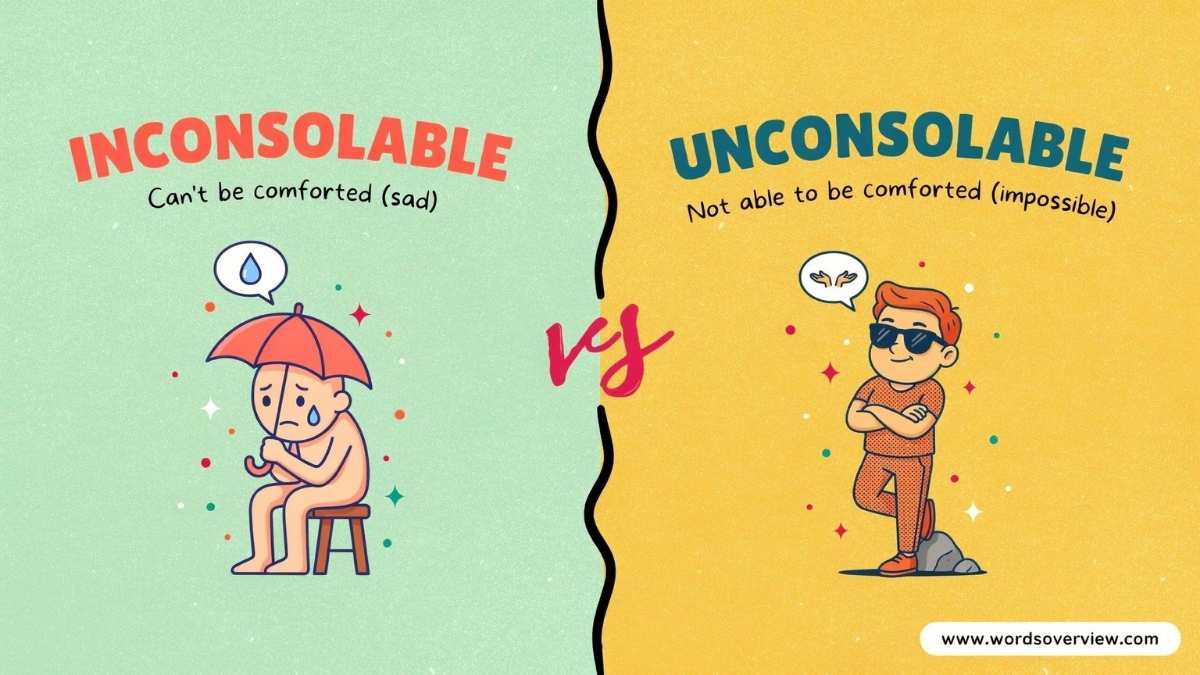
The inconsolable or unconsolable difference is mainly a matter of frequency and preferred usage.
Both words communicate the idea that someone cannot easily be comforted. However, readers are more likely to encounter inconsolable in ordinary modern English.
| Feature | Inconsolable | Unconsolable |
| Part of speech | Adjective | Adjective |
| Core meaning | Unable to be comforted | Unable to be comforted |
| Dictionary recognition | Yes | Yes |
| Frequency | More common | Less common |
| Standard usage | Well established | Less common alternative |
| Meaning difference | Little to none | Little to none |
| General writing | Preferred | Usually avoid when the common form works |
Thus, the inconsolable or unconsolable difference in meaning is minimal. The more noticeable difference concerns how frequently people use each form.
Learn the difference between confusing English words step by step
Insight or Insite What’s the Correct English Word?
Does Unconsolable Mean the Same as Inconsolable?
Yes. In most contexts, unconsolable and inconsolable express the same basic idea.
For example:
She was inconsolable after the loss.
and:
She was unconsolable after the loss.
Both sentences tell the reader that she experienced intense grief and could not be comforted.
However, the first sentence sounds more familiar to most readers because inconsolable is the more established and frequent form.
Learn the difference between similar English words the easy way
Access or Acess Which Spelling Is Correct?
Is Inconsolable Different in American and British English?
The inconsolable or unconsolable spelling question sometimes creates another misconception: that one form belongs to American English while the other belongs to British English.
That’s not the case.
In American English
Inconsolable is a standard word in American English. Writers can use it naturally in both everyday and formal contexts.
For example:
The family was inconsolable after the tragic loss.
In British English
British English also uses inconsolable.
Therefore, you shouldn’t treat unconsolable as the British spelling of inconsolable. The relationship isn’t comparable to genuine regional spelling differences such as color/colour or favorite/favourite.
Is Unconsolable a British Spelling?
No. Unconsolable isn’t simply the British version of inconsolable.
American and British writers can both use inconsolable. Likewise, the less common form unconsolable doesn’t become the standard choice merely because the audience uses British English.
So, when you’re deciding between the two, focus on word usage, not nationality.
Inconsolable or Unconsolable Which Is Better?
If you’re wondering inconsolable or unconsolable which is better, choose inconsolable for most writing.
This recommendation doesn’t mean that unconsolable has no legitimate use. Instead, it reflects the difference in frequency and familiarity.
Use inconsolable when you’re writing:
- School assignments
- Blog posts
- Articles
- Professional documents
- Formal writing
- Business communication
- Educational content
- General web content
- Stories and personal narratives
Meanwhile, unconsolable can still appear when you’re discussing the word itself, quoting a source or examining a particular piece of historical or literary writing.
A Simple Rule to Remember
When you’re unsure, use this rule:
When you mean “unable to be comforted,” choose “inconsolable.”
It’s familiar, concise and widely understood.
Inconsolable or Unconsolable Usage in Sentences
Seeing the words in context makes the distinction much easier to understand.
Inconsolable in a Sentence
Here are several natural inconsolable examples:
- The child was inconsolable after her parents told her that the family dog had died.
- He became inconsolable after hearing the news of his friend’s death.
- She was inconsolable with grief after the tragic loss.
- The player was inconsolable after missing the decisive penalty.
- The mother found her baby inconsolable despite trying several ways to calm him.
- The family remained inconsolable after the devastating news.
Each example emphasizes intense emotional distress rather than ordinary sadness.
Learn the difference between confusing English words step by step
Bosses or Boss’s? Which One Is Correct?
Unconsolable in a Sentence
If you’re searching for unconsolable in a sentence, the form works grammatically:
- The child was unconsolable after the accident.
- She became unconsolable when she learned what had happened.
- His grief left him unconsolable for several days.
- The young girl seemed unconsolable after losing her beloved pet.
However, because inconsolable occurs more often, it would usually be the more natural choice in edited writing.
How to Use Inconsolable in a Sentence
A useful test is to replace the adjective with the phrase unable to be comforted.
For example:
She was inconsolable.
means:
She was unable to be comforted.
If that meaning fits your sentence, inconsolable is likely the right word.
Inconsolable Examples by Context
The word works in several situations. Although the context changes, the core idea remains the same.
Grief and Mourning
Grief is one of the most natural contexts for inconsolable.
The family was inconsolable after the sudden death of their father.
Here, the adjective emphasizes the family’s intense sorrow and inability to find comfort.
Deep Disappointment
The word can also describe severe disappointment.
After months of preparation, the athlete was inconsolable after the final loss.
The person isn’t necessarily grieving a death. Instead, overwhelming disappointment has produced an emotional reaction that ordinary reassurance cannot quickly ease.
Children
Parents often use the word when a child cries continuously and refuses or cannot accept comfort.
The toddler was inconsolable after waking from a frightening dream.
The word works particularly well here because it communicates more than simple crying. It suggests that attempts to calm the child aren’t working.
Emotional Shock
A person may also become inconsolable after receiving devastating news.
She was inconsolable after learning about the accident.
The adjective captures the intensity of the person’s emotional suffering.
Inconsolable or Similar Words
Searching for an inconsolable synonym can produce several possibilities. However, synonyms rarely carry exactly the same shade of meaning.
Inconsolable or Distraught
Distraught means extremely upset, worried or emotionally troubled.
She was distraught after the accident.
This sentence tells you that she was deeply upset.
By contrast:
She was inconsolable after the accident.
This sentence emphasizes that comfort could not ease her emotional state.
Inconsolable or Heartbroken
Heartbroken usually describes severe emotional pain caused by loss, separation, rejection or disappointment.
He was heartbroken after the relationship ended.
The word emphasizes emotional pain. Inconsolable, however, emphasizes the inability to receive comfort.
Inconsolable or Devastated
Devastated describes someone who feels extremely upset or emotionally overwhelmed.
She was devastated by the news.
A devastated person may still respond to comfort. Someone described as inconsolable is specifically portrayed as beyond ordinary consolation.
Inconsolable or Disconsolate
Disconsolate is another word associated with deep sadness and lack of comfort.
He looked disconsolate after hearing the news.
This word can sound more formal or literary than inconsolable. Both can describe profound sadness, but they don’t always fit exactly the same situations.
Learn the difference between confusing English words step by step
Gos or Goes Which Spelling Is Correct?
Inconsolable Synonyms
Useful inconsolable synonyms include:
| Synonym | Main idea |
| Distraught | Extremely upset or worried |
| Heartbroken | Deep emotional pain |
| Devastated | Overwhelming emotional shock |
| Disconsolate | Deep sadness and lack of comfort |
| Despairing | Loss of hope |
| Grief-stricken | Severe grief after a loss |
| Desolate | Extreme loneliness or sadness |
Choose the synonym that matches the emotional situation rather than replacing inconsolable mechanically.
Learn the difference between basic English word mistakes
Where or When: Usage and Classic Song
Unconsolable Synonyms and Alternatives

Because unconsolable generally expresses the same idea, its synonyms overlap with those of inconsolable.
Common unconsolable synonyms include:
- Inconsolable
- Distraught
- Heartbroken
- Devastated
- Disconsolate
- Grief-stricken
- Despairing
If you’re looking for an unconsolable synonym in polished writing, inconsolable itself often provides the simplest alternative.
For example:
The grieving father was unconsolable.
can become:
The grieving father was inconsolable.
The meaning remains essentially unchanged. However, the second version uses the more familiar form.
Common Mistakes With Inconsolable and Unconsolable
Assuming “Un-” Must Always Be Correct
English prefixes don’t work like fixed mathematical formulas.
Although un- forms many negative adjectives, you can’t automatically create the preferred English word by attaching un- to every adjective.
For example, the fact that happy becomes unhappy doesn’t mean that every word requires the same pattern.
That’s why unconsolable can look perfectly logical while inconsolable remains the more common choice.
Treating the Forms as American and British Variants
This mistake comes from assuming every spelling difference has a regional explanation.
In this case, it doesn’t.
Both American and British English use inconsolable. Therefore, choosing unconsolable isn’t a matter of switching to British spelling.
Calling Unconsolable Completely Wrong
Another common mistake is to claim that unconsolable isn’t a word at all.
That statement ignores dictionary evidence. English dictionaries recognize the form, even though it occurs less frequently than inconsolable.
A more precise explanation is:
Unconsolable is a recognized but less common alternative to inconsolable.
That description gives readers a clearer picture of actual usage.
Learn the difference between similar English words
Honored or Honoured Which Spelling Is Correct?
Assuming Online Occurrence Proves Preferred Usage
A word can appear online for many reasons. People publish informal posts, comments, personal stories, historical quotations and unedited material every day.
Therefore, finding unconsolable on a website doesn’t automatically mean that it has the same frequency or status as inconsolable.
For word choice, established dictionaries and broader usage patterns provide better guidance than a handful of search results.
A Practical Case Study Choosing the Right Word
Imagine that you’re writing the following sentence:
The child was ___ after losing her mother.
You could choose either form:
The child was inconsolable after losing her mother.
or:
The child was unconsolable after losing her mother.
Both sentences communicate the intended meaning. However, inconsolable provides the more familiar and conventional word choice.
Now consider a third version:
The child was extremely sad and unable to be comforted after losing her mother.
This version explains the meaning directly, but it takes considerably more words.
Therefore, inconsolable offers a useful combination of precision and economy.
The example highlights an important principle of English vocabulary: the most logical-looking formation isn’t always the most established form. Usage history matters.
Is Inconsolable a Word?
Yes. Inconsolable is an established English adjective.
If you’re asking is inconsolable a word, is inconsolable correct or is inconsolable a correct word, the answer is yes.
The word appears in major English dictionaries and has a clear meaning related to severe sadness and the inability to receive comfort.
It also has related forms, including:
- inconsolably — in an inconsolable manner
- inconsolability — the state or quality of being inconsolable
- inconsolableness — the quality of being inconsolable
These related forms demonstrate that inconsolable belongs to an established English word family rather than functioning as an isolated expression.
Learn the difference between confusing more English words
Tie or Tye: Meaning, Difference and Usage
Correct Spelling of Inconsolable or Unconsolable
If you’re looking for the correct spelling of inconsolable, write:
inconsolable
If you’re checking the correct spelling of unconsolable, the answer requires more explanation. Unconsolable is a recognized word, but it is less common than inconsolable.
The following table makes the distinction clear:
| Question | Answer |
| Is inconsolable a word? | Yes |
| Is inconsolable correct? | Yes |
| Is unconsolable a word? | Yes |
| Is unconsolable understandable? | Yes |
| Is unconsolable as common as inconsolable? | No |
| Which form is more frequent? | Inconsolable |
| Which form should most writers prefer? | Inconsolable |
Therefore, the inconsolable or unconsolable spelling question has a practical answer: use inconsolable when you want the more familiar and widely used form.
Learn the difference between confusing word pairs
Directer or Director Which Spelling Is Correct?
How to Choose Between Inconsolable and Unconsolable
When you’re writing and suddenly wonder, should I use inconsolable or unconsolable, don’t overthink it.
Choose inconsolable when:
- You want the most familiar form.
- You’re writing for a broad audience.
- You’re preparing formal content.
- You’re writing an academic assignment.
- You’re creating educational material.
- You’re publishing professional content.
- You want your sentence to sound natural to most readers.
Consider unconsolable only when the context specifically calls for it, such as discussing the word itself or preserving a quotation.
A Quick Memory Trick
Think about the related word consolation.
When someone cannot receive consolation, they are inconsolable.
That connection makes the preferred spelling easier to remember:
consolation → console → consolable → inconsolable
Learn the difference between confusing English words step by step
Persuing or Pursuing Which Spelling Is Correct?
Practice Session
Fill in each blank with the most appropriate word: inconsolable or unconsolable.
- After hearing the heartbreaking news, she became completely __________.
- The child was __________ after losing his beloved pet.
- The grieving father seemed __________ despite everyone’s efforts to comfort him.
- The mother found her crying baby almost __________.
- After the tragic accident, the family was __________ with grief.
- The little girl remained __________ for several hours.
- His sadness was so intense that he appeared __________.
- The coach tried to comfort the disappointed player, but he remained __________.
- After receiving the devastating news, she was __________.
- The child became __________ when his parents left.
- The grieving widow was __________ after her husband’s death.
- No words seemed capable of comforting the __________ woman.
- The boy was __________ after his favorite toy broke.
- She was so overwhelmed with sorrow that she became __________.
- The family struggled to comfort their __________ relative.
- The crying infant seemed completely __________.
- After the heartbreaking farewell, he was __________.
- The young child remained __________ despite his parents’ attempts to calm him.
- Her overwhelming grief left her __________.
- The mourners described him as __________ after the loss.
- Which word is generally preferred in modern English: __________ or unconsolable?
- Which word is recognized but much less common: inconsolable or __________?
- If someone cannot be comforted because of extreme grief, they may be described as __________.
- For formal writing, __________ is usually the safer and more familiar choice.
- Although both words can describe someone who cannot be comforted, __________ is far more common.
Answer Session
- inconsolable
- inconsolable
- inconsolable
- inconsolable
- inconsolable
- inconsolable
- inconsolable
- inconsolable
- inconsolable
- inconsolable
- inconsolable
- inconsolable
- inconsolable
- inconsolable
- inconsolable
- inconsolable
- inconsolable
- inconsolable
- inconsolable
- inconsolable
- inconsolable
- unconsolable
- inconsolable
- inconsolable
- inconsolable
Here’s a trusted source for clear more words Comparison:
Grammar Update
Frequently Asked Questions
Which is correct, unconsolable or inconsolable?
Inconsolable is the more common and preferred form in modern English. Unconsolable is also a recognized word, but it appears much less frequently. For most formal, academic and everyday writing, inconsolable is the better choice.
Is unconsolable a word?
Yes. Unconsolable is a valid English adjective that describes someone who cannot be comforted or consoled. However, it is considerably less common than inconsolable, which remains the standard choice in most contexts.
What does inconsolable mean?
Inconsolable means unable to be comforted because of intense sadness, grief, distress or another overwhelming emotion. For example, someone who continues crying after receiving comfort may be described as inconsolable.
Does inconsolable mean extremely sad?
Yes, but inconsolable expresses more than ordinary sadness. It describes a person who feels such intense grief or distress that comfort does not seem to help. Therefore, “extremely sad and unable to be comforted” captures its meaning well.
What is the difference between inconsolable and unconsolable?
The main difference is usage and frequency rather than meaning. Both words describe someone who cannot be comforted. However, inconsolable is much more common, while unconsolable is a less frequently used alternative.
What type of word is inconsolable?
Inconsolable is an adjective. It describes a person, feeling or emotional state that cannot be comforted or consoled. For example, you can describe someone as “an inconsolable child” or refer to “inconsolable grief.”
What is a synonym for inconsolable?
Common synonyms for inconsolable include distraught, heartbroken, devastated, disconsolate, grief-stricken and overwhelmed. The best synonym depends on the specific emotional context and the intensity you want to express.
Can inconsolable describe someone who is crying?
Yes. Inconsolable can describe someone who is crying intensely and cannot be comforted. For example, “The child was inconsolable after losing her favorite toy.” However, the word focuses on the inability to find comfort rather than crying itself.
What is the opposite of inconsolable?
The opposite of inconsolable is generally consolable, meaning capable of being comforted. Depending on the context, related expressions such as comforted, calm, reassured or content may also convey the opposite emotional state.
How do you use inconsolable in a sentence?
You can use inconsolable before a noun or after a linking verb. For example: “The grieving mother was inconsolable after the tragic news.” Here, the adjective shows that her emotional distress was so intense that others could not comfort her.
Conclusion
English has once again managed to turn a simple spelling choice into a tiny vocabulary puzzle. Inconsolable and unconsolable both describe someone who cannot be comforted, so the confusion is understandable. However, inconsolable is the more common and widely preferred form in modern English. Unconsolable is also recognized, but you’ll encounter it far less often.
If you’re writing an email, article, story, academic assignment or everyday sentence, inconsolable is the safer choice. It clearly communicates intense grief, sadness or distress without making your reader stop and wonder about the spelling.So, when someone is crying and no amount of comfort seems to help, remember the easier choice: they’re inconsolable. English may enjoy creating confusion, but at least this one has a straightforward solution.

Ethan AJS is an experienced blogger and language enthusiast at Words Overview, dedicated to making English easier to understand and use. He writes about grammar, vocabulary, spelling, word meanings and commonly confused words, turning tricky language questions into clear, practical insights. With a passion for effective communication, Ethan creates engaging, readerfocused content that helps readers write accurately, choose the right words and communicate with confidence.




