English has a funny way of turning two simple words into a surprisingly tricky puzzle. The confusion around where or when usually starts when you need to ask a question but aren’t sure whether you’re looking for a place or a time. Should you ask, “Where did you meet?” or “When did you meet?” One word points to a location, while the other points to a moment, date or occasion. Mix them up and your sentence can suddenly sound like it lost its calendar and map. Fortunately, the difference is easy to understand once you know what each word actually asks.
Where or When Quick Answer
The basic where or when difference is simple:
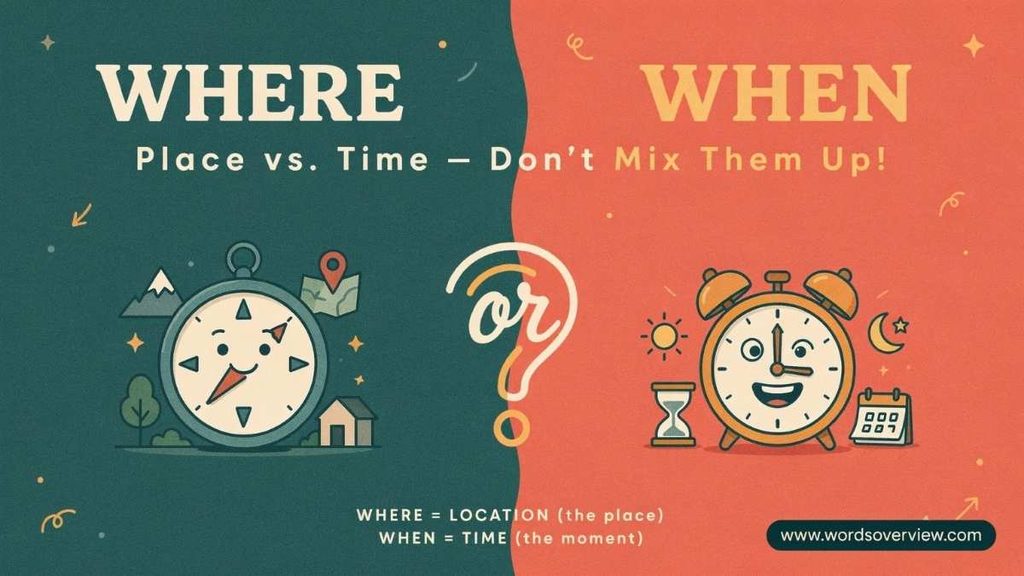
- Where refers to a place, location, position or destination.
- When refers to a time, date, period or occasion.
A quick memory trick makes the distinction easy:
Where = place
When = time
For example:
| Word | What It Asks About | Example |
| Where | Place or location | Where do you live? |
| When | Time or occasion | When will you arrive? |
| Where | Location of an event | Where did the meeting happen? |
| When | Time of an event | When did the meeting happen? |
The simplest test is to consider the answer you expect. If the answer names a city, building, room, street, country or other location, use where. If the answer gives a date, hour, year, period or occasion, use when.
What Does Where Mean?
Where primarily refers to location. It can ask about the place where something exists, happens, begins, ends or moves.
For example:
Where is your phone?
The expected answer identifies a location:
It’s on the desk.
The same principle applies to many everyday questions:
- Where do you live?
- Where did you park?
- Where does she work?
- Where are the keys?
- Where should we meet?
Although these sentences describe different situations, they all request information about place.
Where in Direct Questions
In a direct question, where usually asks the listener to identify a location.
- Where do you live?
- Where did the train stop?
- Where can I find the admissions office?
- Where are they going?
The location doesn’t always represent a permanent place. In fact, where can also identify a destination.
Compare these questions:
Where are you?
This asks about your current location.
Where are you going?
This asks about your destination.
Where did you come from?
This asks about your place of origin.
In each case, the question concerns location.
Where in Indirect Questions
Where can also appear inside an indirect question.
I don’t know where she lives.
Can you tell me where the station is?
We need to find out where the meeting will take place.
The word order changes when a direct question becomes an indirect question.
Compare:
Where is the station?
with:
Do you know where the station is?
The second sentence doesn’t use the question order “where is the station” after the introductory phrase. Instead, English uses statement-style word order: where + subject + verb.
This pattern appears frequently in everyday English.
I don’t know where he went.
She asked where we had parked.
Tell me where you bought it.
Learn the difference between confusing English words step by step
Insight or Insite What’s the Correct English Word?
Where in Relative Clauses
Where can introduce a relative clause connected to a place.
This is the house where I grew up.
That’s the restaurant where we had dinner.
Paris is the city where they met.
Here, where doesn’t ask a question. Instead, it connects a place with information about something that happened there.
In some contexts, you can replace where with a preposition and which:
This is the house in which I grew up.
However, the version with where usually sounds more natural in everyday English.
What Does When Mean?
When refers to time. It can identify an exact moment, date, year, period, occasion or point in someone’s experience.
For example:
When does the movie start?
The expected answer could be:
It starts at 7:30 p.m.
Because the question requests information about time, when is the correct word.
When in Direct Questions
Use when to ask about the timing of an event or action.
- When does school start?
- When did you arrive?
- When will the results come out?
- When are you leaving?
- When should we meet?
The answer can take several forms:
- At 5 p.m.
- Tomorrow
- Next week
- In July
- After lunch
- During the summer
Although the answers look different, they all provide information about time.
When in Indirect Questions
Like where, when can appear inside an indirect question.
I don’t know when he will arrive.
Can you tell me when the store opens?
She asked when the meeting would begin.
Again, English uses statement-style word order after the introductory expression.
Compare:
When does the store open?
with:
Do you know when the store opens?
This distinction matters because learners sometimes carry direct-question word order into indirect questions.
When in Time Clauses
When also introduces time clauses.
Call me when you get home.
I’ll start cooking when they arrive.
She smiled when she saw the gift.
In these sentences, when doesn’t ask a question. Instead, it establishes a time relationship between two actions.
That makes when particularly useful when you want to show that one event happens at the time another event occurs.
Learn the difference between confusing more English words
Tie or Tye: Meaning, Difference and Usage
Where or When The Main Difference
The clearest where or when difference appears when you compare two nearly identical questions.
Where did the event happen?
This question asks about the location.
When did the event happen?
This question asks about the time.
The event hasn’t changed. Only the information being requested has changed.
| Question | Information Requested |
| Where did they meet? | Location |
| When did they meet? | Time |
| Where did the concert take place? | Location |
| When did the concert take place? | Time |
| Where was the accident? | Location |
| When was the accident? | Time |
This distinction becomes especially useful when you need both pieces of information.
Where and when will the ceremony take place?
The question requests two separate facts: the location and the time.
Where Asks About Place
Use where when you want to know:
- what location something occupies
- where an event happens
- where someone goes
- where something begins or ends
- where something can be found
For example:
- Where should we park?
- Where did you buy that laptop?
- Where will the interview take place?
- Where does this road lead?
When Asks About Time
Use when when you want to know:
- at what time something happens
- on what date something happens
- in what year something happened
- during what period something occurred
- on what occasion something happened
For example:
- When should we leave?
- When did you buy the laptop?
- When will the interview take place?
- When did the road open?
The same verb can work with either word. However, the question changes because the information you want changes.
Where or When in Questions
A useful way to understand where or when usage is to focus on the information each word requests.
Suppose someone says:
The meeting happened yesterday at the library.
You can ask:
Where did the meeting happen?
The answer is:
At the library.
You can also ask:
When did the meeting happen?
The answer is:
Yesterday.
The original sentence contains both facts. However, where identifies the location while when identifies the time.
Questions About Location
Use where for places, destinations, positions and locations.
- Where is your office?
- Where did the team practice?
- Where can I submit the form?
- Where will the ceremony take place?
Questions About Time
Use when for times, dates, years, periods and occasions.
- When is the deadline?
- When did the company open?
- When does the semester begin?
- When will the ceremony take place?
Questions That Use Both Where and When
Sometimes a sentence legitimately needs both words.
Where and when did you meet?
Where and when will the event take place?
Can you tell me where and when the interview is scheduled?
These questions aren’t repetitive. Instead, each word requests a different type of information.
Learn the difference between similar English words the easy way
Access or Acess Which Spelling Is Correct?
Where or When as Relative Words
The distinction becomes more interesting when where and when introduce relative clauses.
Where After Place Nouns
Where commonly follows nouns that represent places.
the house where I grew up
the city where she works
the restaurant where we met
the school where he studied
In these structures, where connects the place noun with an action or situation associated with that place.
When After Time Nouns
When can follow nouns that represent time.
the day when we met
the year when she graduated
the moment when everything changed
the time when people used typewriters more often
However, English often allows you to omit when after certain time expressions.
For example:
The day we met was unforgettable.
This sentence works just as well as:
The day when we met was unforgettable.
The shorter version often sounds more natural.
Can You Omit Where or When?
Sometimes you can omit when, but you can’t treat where in exactly the same way.
Consider:
The day when we met was unforgettable.
You can say:
The day we met was unforgettable.
However:
This is the restaurant where we met.
doesn’t normally become:
This is the restaurant we met.
The second sentence doesn’t clearly preserve the intended location relationship.
You can restructure it as:
This is the restaurant in which we met.
Therefore, where and when may look parallel, but their grammatical behavior isn’t always identical.
Learn the difference between confusing word pairs
Directer or Director Which Spelling Is Correct?
Where or Whe Common Grammar Patterns
Several patterns make the meaning of where or when easier to recognize.
Where + Clause
I remember where we met.
Nobody knows where he went.
That’s where she works.
Each example connects where with information about a location.
When + Clause
I remember when we met.
Nobody knows when he left.
That’s when everything changed.
Here, when connects the clause with information about time.
Notice how similar these sentences look:
I remember where we met.
I remember when we met.
The verb remains the same, but the type of information changes.
Where and When in Related Expressions
English also has related forms such as wherever and whenever.
Wherever generally refers to any place that fits the situation:
You can sit wherever you like.
Whenever generally refers to any time that fits the situation:
Call me whenever you need help.
These forms build on the same basic distinction between place and time.
Where or When Common Mistakes
Most mistakes happen because writers lose track of the type of information the sentence needs.
Using Where for Time
Consider:
Where does the movie start?
This normally asks about the place associated with the beginning of the movie or event.
If you want to ask about the starting time, write:
When does the movie start?
The difference may look small, but the meaning changes completely.
Using When for Place
Now compare:
When did the accident happen?
This asks about time.
If you’re asking for the location, write:
Where did the accident happen?
Both questions can describe the same accident. However, they request different information.
Confusing Place and Time in Similar Sentences
Consider these two questions:
Where were you?
When were you there?
The first asks for a location. The second asks for a time.
One answer can provide both:
I was at the library yesterday.
In that answer, at the library gives the where information, while yesterday gives the when information.
Learn the difference between confusing English words step by step
Bosses or Boss’s? Which One Is Correct?
Adding Where or When When It Isn’t Needed
English doesn’t require where or when in every sentence involving place or time.
For example:
I visited the city where she lives.
This sentence works naturally.
However:
I visited the city where she lives in.
doesn’t work because where already provides the location relationship. Adding in creates an unnecessary extra preposition.
The same problem can occur with when:
I remember the day when we met.
is correct.
However:
I remember the day when we met on.
is not.
The practical rule is simple: don’t add a preposition when the relative word already performs that grammatical job.
Where or When in Everyday English
The distinction appears constantly in everyday communication.
Conversations
Where are you?
I’m at home.
When are you coming?
Around six.
These short exchanges demonstrate the entire rule.
Work and Emails
At work, you might ask:
Where will the meeting take place?
Or:
When will the meeting begin?
When you need both details, you can ask:
Where and when is the client meeting?
A slightly fuller version is:
Where and when will the client meeting take place?
Academic and Formal Writing
The same distinction applies to academic writing.
Researchers examined where the samples were collected.
Here, where identifies a location.
Researchers examined when the samples were collected.
Here, when identifies a time.
Historical writing often uses both:
Historians investigate where the battle occurred and when it took place.
The sentence establishes both location and chronology.
Online Messages and Social Media
Short digital messages often make the distinction obvious:
Where are we meeting?
When are we meeting?
If you need both pieces of information, use:
Where and when are we meeting?
The structure is simple, direct and natural.
Learn the difference between more words people mix up
Inconsolable or Unconsolable Which Is Correct?
Where or When Comparison Table
| Feature | Where | When |
| Core meaning | Place or location | Time or occasion |
| Main question | Where? | When? |
| Expected answer | A location | A time |
| Direct question | Where is the office? | When is the meeting? |
| Indirect question | I know where he lives. | I know when he arrived. |
| Relative use | The place where we met | The day when we met |
| Clause use | Go where you feel comfortable. | Call me when you arrive. |
| Common error | Using it for time | Using it for place |
How to Choose Between Where and When
When you’re unsure, use the answer test.
Use Where When the Answer Is a Location
Ask yourself:
Would the answer be a place?
If yes, where will usually work.
Where does she work?
Answer: At a hospital.
Where did they travel?
Answer: To New York.
Where did you put the documents?
Answer: On the desk.
Use When When the Answer Is a Time
Ask yourself:
Would the answer be a time or occasion?
If yes, use when.
When does the class begin?
Answer: At 9 a.m.
When did they travel?
Answer: Last summer.
When did you put the documents there?
Answer: This morning.
Use Both When You Need Place and Time
If you need two different pieces of information, use both words.
Where and when did they meet?
A complete answer might be:
They met at a café in New York in 2024.
Now the sentence provides both dimensions:
Where? At a café in New York.
When? In 2024.
Learn the difference between confusing English words step by step
Gos or Goes Which Spelling Is Correct?
Where or When Real-World Examples
The following examples show how the distinction works in common situations.
| Situation | Where Example | When Example |
| School | Where is your classroom? | When does class start? |
| Work | Where is the interview? | When is the interview? |
| Travel | Where are you staying? | When are you leaving? |
| Shopping | Where did you buy it? | When did you buy it? |
| Events | Where is the concert? | When is the concert? |
| History | Where did the battle occur? | When did the battle occur? |
| Meetings | Where will we meet? | When will we meet? |
| Personal plans | Where are you going? | When are you going? |
The pattern remains consistent: where locates, while when dates or identifies time.
Where or When in Historical and Descriptive Writing
Historical writing often needs both location and chronology.
For example:
Where did the battle occur?
This asks for a location.
Then:
When did the battle occur?
This asks for the date or period.
The distinction also matters in biographies, journalism, research papers and historical summaries. Strong explanations often establish where, when, who and what happened.
The same principle works in descriptive writing:
The village where the family lived had changed dramatically by the time they returned.
Here, where establishes the setting.
The year when they returned marked the beginning of a new chapter.
Here, when establishes the time.
Learn the difference between commonly misused words
Blackout or Backout: Difference and Usage
Where or When Song The Classic Rodgers and Hart Meaning
The phrase where or when song also refers to a famous composition by Rodgers and Hart.
“Where or When” features music by Richard Rodgers and lyrics by Lorenz Hart. The song appeared in their 1937 Broadway musical Babes in Arms.
The original Broadway production opened at the Shubert Theatre in New York on April 14, 1937. The show later moved to the Majestic Theatre and completed 289 performances. The original production introduced several songs that later became standards, including “Where or When,” “My Funny Valentine,” and “The Lady Is a Tramp.”
The original production featured Ray Heatherton as Val LaMar and Mitzi Green as Billie Smith. They introduced “Where or When” on the Broadway stage.
Therefore, the answer to what musical is Where or When from? is Babes in Arms.
Where or When Original Song
When people search for the where or when original song, they may actually be looking for the original composer original performers or original recording.
Those are separate questions.
| Detail | Information |
| Song | Where or When |
| Composer | Richard Rodgers |
| Lyricist | Lorenz Hart |
| Musical | Babes in Arms |
| Broadway year | 1937 |
| Original Broadway performers | Ray Heatherton and Mitzi Green |
| Film adaptation | Babes in Arms |
| Film year | 1939 |
| Studio | Metro-Goldwyn-Mayer |
| Main theme | Déjà vu, romance and memory |
The song wasn’t originally a Frank Sinatra or Ella Fitzgerald composition. Those artists recorded later versions.
Where or When Broadway Song
The where or when Broadway song connection is direct because the song originated in the Broadway musical Babes in Arms.
The 1937 musical came from the songwriting team of Richard Rodgers and Lorenz Hart. Its story follows young performers who attempt to put on their own show after their parents leave on a vaudeville tour.
The song’s placement within that musical gives it an important theatrical context. It wasn’t originally written as a standalone jazz number. Instead, it emerged from musical theater before later performers carried it into the worlds of jazz and popular music.
Where or When 1937 Musical
The where or when 1937 musical connection refers to Babes in Arms, which opened on Broadway on April 14, 1937.
The production ran for 289 performances. Its original cast included several notable performers, while the score introduced songs that eventually outlived the original production.
That history helps explain why the song remains recognizable even among listeners who have never seen the musical.
Where or When 1939 Film
The song also appeared in the 1939 film adaptation of Babes in Arms from Metro-Goldwyn-Mayer, commonly known as MGM.
The movie starred Judy Garland and Mickey Rooney. MGM changed much of the stage musical for the screen, but “Where or When” remained part of the film’s musical material.
The film therefore created another important stage in the song’s history:
1937 Broadway musical → 1939 MGM film → later recordings and interpretations
Learn the difference between similar English words
Honored or Honoured Which Spelling Is Correct?
Where or When Lyrics Meaning
The where or when lyrics meaning centers on a powerful feeling of recognition.
The speaker encounters someone and feels that the same interaction has happened before. The words, emotions, expressions and romantic connection seem familiar. Yet the speaker can’t identify the earlier place or time.
That’s the central idea behind the where or when song meaning: a person can feel certain that something is familiar without being able to explain why.
The song therefore connects several themes:
- déjà vu
- memory
- romance
- emotional recognition
- uncertainty about the past
- the relationship between time and memory
Where or When Song Meaning and Déjà Vu
The song’s central idea resembles the everyday experience of déjà vu: the sensation that a current situation has happened before even when you can’t identify the earlier event.
The idea can be represented simply:
Present encounter
↓
Something feels familiar
↓
A sense of recognition appears
↓
Memory searches for the earlier moment
↓
Where? → Unclear
When? → Unclear
↓
The mystery remains
That uncertainty gives the song much of its emotional appeal.
The speaker doesn’t simply say, “I remember you.” Instead, the feeling is more mysterious: the present feels like a memory even though the memory itself remains out of reach.
Learn the difference between confusing English words step by step
Chears or Cheers Which Spelling Is Correct?
Who Wrote Where or When?
Richard Rodgers composed the music, while Lorenz Hart wrote the lyrics.
Together, they formed the songwriting partnership known as Rodgers and Hart, one of the most influential teams in American musical theater.
Therefore:
- Who composed Where or When? Richard Rodgers.
- Who wrote the lyrics to Where or When? Lorenz Hart.
- Who wrote Where or When? Rodgers and Hart.
- What musical is it from? Babes in Arms.
Who Originally Sang Where or When?
Ray Heatherton and Mitzi Green introduced “Where or When” in the original Broadway production of Babes in Arms.
This distinction matters because the song has accumulated many recordings over the decades.
Consequently, the question who sang Where or When? doesn’t have only one answer unless you specify the recording or performance.
The original Broadway performers, the 1939 film performers and later recording artists represent different stages in the song’s history.
Where or When Ella Fitzgerald and Frank Sinatra Versions
The where or when Ella Fitzgerald and where or when Frank Sinatra searches refer to later interpretations of the Rodgers and Hart composition.
Ella Fitzgerald recorded the song in 1956, while Sinatra recorded it during the 1940s. Their versions helped demonstrate how easily the Broadway composition could move into traditional pop and jazz-oriented performance.
Other major artists have also recorded the song, including Nat King Cole, Peggy Lee, Barbra Streisand and Count Basie.
As a result, searches for where or when cover, where or when recording, where or when singer and where or when version can refer to very different performances.
The song’s history follows a broad path:
Broadway → film → traditional pop → jazz → modern interpretations
Where or When Laufey Version
The where or when Laufey version brought the Rodgers and Hart composition to a newer generation of listeners.
Laufey released her recording in 2024. Her interpretation places the song within a contemporary jazz-pop setting while preserving the original composition and its central theme of romantic familiarity and déjà vu.
Because Laufey’s recording uses the existing Rodgers and Hart composition, it represents a cover version, not the where or when original.
This distinction matters when researching the song’s history. The composition dates to 1937, while individual recordings belong to much later periods.
Is Where or When a Jazz Standard?
Yes. “Where or When” became an American standard and a widely performed jazz standard, even though it began as a Broadway show tune.
This transition isn’t unusual in American music. Successful musical-theater songs often move beyond their original productions. Jazz musicians and popular singers can reinterpret the melody, harmony, rhythm and vocal approach without changing the underlying composition.
Over time, Where or When entered that broader musical tradition.
Its recording history includes artists from multiple generations. Consequently, listeners can encounter the same composition through a Broadway performance, a film version, a traditional pop recording or a jazz interpretation.
Where or When Song History at a Glance
| Year | Event |
| 1937 | Babes in Arms opens on Broadway |
| 1937 | Ray Heatherton and Mitzi Green introduce “Where or When” |
| 1937 onward | The song begins appearing in recordings |
| 1939 | MGM releases the film adaptation of Babes in Arms |
| 1940s–1960s | Major singers and jazz performers record the composition |
| Later decades | The song continues as an American and jazz standard |
| 2024 | Laufey releases a modern recording |
The song’s longevity comes partly from its central idea. A new moment can feel strangely familiar even when memory can’t explain it.
Learn the difference between confusing English words step by step
Persuing or Pursuing Which Spelling Is Correct?
Practice Session Where or When
Fill in each blank with where or when.
- ______ did you leave your phone?
- Do you remember ______ we first met?
- ______ is the nearest grocery store?
- I’ll call you ______ I arrive home.
- Can you tell me ______ the meeting will take place?
- ______ did the concert begin?
- This is the restaurant ______ we had dinner last week.
- I remember the day ______ we graduated.
- ______ are you going after work?
- Please tell me ______ the train leaves.
- Do you know ______ Sarah lives?
- I’ll never forget the moment ______ I heard the news.
- ______ did you buy that jacket?
- We visited the town ______ my grandfather was born.
- ______ should we meet tomorrow?
- She smiled ______ she saw her old friend.
- Can you remember ______ you put the documents?
- That was the year ______ everything changed.
- ______ does the movie start?
- This is the place ______ they filmed the scene.
- ______ did you first hear this song?
- Tell me ______ you want to go for dinner.
- I still remember the evening ______ we talked for hours.
- ______ were you yesterday afternoon?
- Let me know ______ you are available for the interview.
Answer Session
- Where
- When
- Where
- When
- Where
- When
- Where
- When
- Where
- When
- Where
- When
- Where
- Where
- Where
- When
- Where
- When
- When
- Where
- When
- Where
- When
- Where
- When
Here’s a trusted source for clear more words Comparison:
Grammar Update
Frequently Asked Questions About Where or When
What is the difference between “where” and “when”?
Where asks about a place or location, while when asks about a time, date, period or occasion. For example, “Where did you meet?” asks about a location, whereas “When did you meet?” asks about the time.
When should you use “where” or “when”?
Use where when you need information about a place and when when you need information about time. For example, “Where is the meeting?” asks about its location, while “When is the meeting?” asks about its scheduled time.
What do “where” and “when” mean?
Where means “in, at or to what place,” while when refers to a particular time or period. Both words commonly introduce questions, although they can also connect clauses in a sentence.
What kind of words are “where” and “when”?
Where and when can function as adverbs, particularly in questions and clauses. They can also introduce relative or subordinate clauses. Their grammatical role depends on how each word functions within a sentence.
How do you use “where” in a sentence?
Use where to ask about or identify a location. For example, “Where did you leave your keys?” asks about the location of the keys. You can also use it in sentences such as, “This is the restaurant where we met.”
How do you use “when” in a sentence?
Use when to ask about or refer to a time. For example, “When does the movie start?” asks about the starting time. You can also use when to connect events, as in, “Call me when you arrive.”
Is “Where or When” a song?
Yes. “Where or When” is a classic song by Richard Rodgers and Lorenz Hart. It comes from the 1937 Broadway musical Babes in Arms and later became a popular standard recorded by numerous singers.
Who originally sang “Where or When”?
The original Broadway production of Babes in Arms featured Ray Heatherton and Mitzi Green performing “Where or When.” The song later gained wider recognition through numerous recordings and performances by other artists.
Who wrote “Where or When”?
Richard Rodgers composed the music for “Where or When,” while Lorenz Hart wrote the lyrics. The songwriting team, commonly known as Rodgers and Hart, created the song for the 1937 Broadway musical Babes in Arms.
What does the song “Where or When” mean?
The song “Where or When” explores the strange feeling that two people have met before, even though they cannot remember exactly where or when. Its lyrics connect romance, memory, creating a sense of familiarity between the two characters.
Conclusion
The where or when confusion may seem small, but one little word can send your sentence in a completely different direction. Where asks about a place, while when asks about a time, date or occasion. So, if you’re asking about a location, choose where. If you’re asking about a moment, choose when. It’s really that simple—no map, calendar or grammar emergency required.
The phrase also has a fascinating musical history. “Where or When” by Rodgers and Hart became a memorable Broadway song from Babes in Arms, exploring love, memory and the strange feeling of déjà vu. Whether you’re solving a grammar puzzle or enjoying the classic song, knowing the difference between where and when helps you keep both meaning and context right where they belong.

Ethan AJS is an experienced blogger and language enthusiast at Words Overview, dedicated to making English easier to understand and use. He writes about grammar, vocabulary, spelling, word meanings and commonly confused words, turning tricky language questions into clear, practical insights. With a passion for effective communication, Ethan creates engaging, readerfocused content that helps readers write accurately, choose the right words and communicate with confidence.