trap. If you’ve ever stared at tier or teir and wondered which one belongs in your sentence, you’re certainly not alone. The confusion often comes from switching the “i” and “e,” especially when you’re writing quickly. Unfortunately, teir may look convincing, but standard English gives the winning spot to tier. Whether you’re talking about a stadium, pricing plan, cake, ranking or gaming tier list, the correct spelling matters. In this guide, you’ll learn the difference, meaning, pronunciation, common mistakes and easy ways to remember tier without second-guessing yourself.
Quick Answer Tier or Teir?
| Word | Correct? | Meaning |
| Tier | Yes | A level, row, layer, rank or category |
| Teir | No | Incorrect spelling of tier in standard English |
| Tiered | Yes | Arranged in levels, rows or layers |
| Tier list | Yes | A list that places items into different ranking levels |
The correct spelling
Tier
The incorrect spelling
Teir
For example:
- The stadium has several tiers of seating.
- This subscription belongs to the premium tier.
- The game uses a tier system to classify characters.
- She reached the top tier of the competition.
- The wedding cake has three tiers.
You should not write:
- The stadium has several teirs of seating.
- This is the highest teir.
- She reached the top teir.
Those sentences contain a spelling error
Tier Meaning
The basic tier meaning is a level, row or layer within a larger arrangement.
A tier usually forms part of a structure that contains multiple levels. Think of a wedding cake with several layers. Each layer represents a tier. Now imagine a stadium with seats arranged at different heights. Each section can also represent a tier.
The same idea works in less physical contexts.
For example, a company might divide its customers into three service levels:
- Basic tier
- Standard tier
- Premium tier
Here, tier doesn’t describe a physical layer. Instead, it describes a level within a system.
That makes the word particularly useful when you need to explain different levels within an organized structure.
Tier Definition
A simple tier definition is:
Tier: one of several levels, rows, layers or categories that form part of an organized arrangement.
The word can describe both physical and abstract structures.
For example:
- A seating tier is a row or level of seats.
- A pricing tier is a level within a pricing structure.
- A ranking tier is a level within a classification system.
- A management tier is a level within an organizational hierarchy.
- A tier list places items into different ranking categories.
In other words, the central idea remains the same: one level within a larger system.
Tier in English
The word tier functions primarily as a noun.
You can use it when talking about a level, category, row or layer.
For example:
The stadium’s upper tier offers a wide view of the field.
Here, tier refers to a physical level of seating.
You can also use the word in an abstract sense:
The company created a new premium tier for business customers.
In this sentence, tier means a category or service level.
The word can also function as a verb, although this use appears less often in everyday conversation. To tier something means to arrange it in tiers.
For example:
The designer tiered the shelves to improve visibility.
However, the noun form is much more common in ordinary English.
Tier in Business and Services
Business writing uses tier frequently because organizations often divide products, services, customers or employees into levels.
For example, a company might offer:
| Tier | Typical Description |
| Basic | Essential features |
| Standard | More features and greater flexibility |
| Premium | Advanced features and additional benefits |
| Enterprise | Extensive features and business-level support |
These categories create a tier system.
The word helps businesses explain differences without describing every package as a completely separate product.
For example:
Our standard tier includes email support, while the premium tier includes priority support.
Similarly, an organization might describe employees or management positions using different tiers:
The company has several management tiers between entry-level supervisors and senior executives.
In this context, tier communicates hierarchy.
Tier in Pricing and Subscriptions
One of the most familiar modern uses of tier appears in pricing.
You’ve probably seen services divided into several subscription levels. Each level offers a different combination of features, limits or benefits.
For example:
Basic Tier
The basic tier might include essential features at a lower price.
Standard Tier
The standard tier could add more storage, tools or usage limits.
Premium Tier
The premium tier might provide advanced features, priority support or higher limits.
The exact features depend on the service. However, the word tier always communicates the idea of a distinct level within the pricing structure.
For example:
The premium tier includes additional storage and advanced reporting tools.
Or:
Customers can move to a higher tier when they need more features.
This is why phrases such as pricing tier, subscription tier, premium tier and free tier appear frequently in business and technology writing.
Learn the difference between everyday English mistakes
Girly or Girlie Correct Usage and Difference
Tier in Gaming and Tier Lists
Gaming has made the word tier especially common in online discussions.
A tier list ranks characters, weapons, teams, abilities or other game elements by perceived performance or usefulness.
A typical tier list might contain categories such as:
- S tier
- A tier
- B tier
- C tier
- D tier
The exact system varies from game to game.
For example:
Character A belongs to the top tier because of its strong abilities and versatility.
Or:
Players often debate whether this weapon deserves a higher tier.
The important point is that tier describes a ranking category.
You’ll also see phrases such as:
- top tier
- high tier
- mid tier
- low tier
- upper tier
- lower tier
What Does Tier List Mean?
A tier list is a classification or ranking system that groups items according to a chosen standard.
For example, a player might create a tier list of characters based on competitive performance.
The list could look like this:
| Tier | General Position |
| S Tier | Exceptional |
| A Tier | Very strong |
| B Tier | Solid |
| C Tier | Average |
| D Tier | Weak |
These labels aren’t universal rules. Their meaning depends on the person, community, game, competition or criteria used to create the list.
Therefore, tier list meaning depends partly on context.
Tier in Rankings and Classification
You don’t need to play video games to encounter a tier system.
Organizations use tiers to classify products, services, schools, suppliers, risks, customers or other groups.
For example:
The organization placed the suppliers into three tiers based on performance.
Here, each tier represents a classification level.
Similarly:
The first tier contains the highest-priority cases.
The word can therefore overlap with terms such as level, rank, grade, class and category.
However, these words aren’t always interchangeable.
A level often describes position or degree.
A rank usually describes relative position within an ordered hierarchy.
A category groups things according to shared characteristics.
A tier often combines these ideas by creating distinct levels within an organized system.
Physical Tier Rows, Layers and Structures
The original idea behind tier works especially well with physical arrangements.
Imagine a large stadium.
The seats don’t all sit at the same height. Instead, several sections rise above one another. Those sections form different tiers of seating.
For example:
Fans in the upper tier had a clear view of the entire field.
You can also use tier for other physical arrangements.
Stadium Seating
The stadium has three tiers of seating.
Wedding Cakes
The wedding cake had four tiers.
Shelves
The books were arranged in tiers.
Platforms
The display used several tiers to showcase the products.
In each example, the objects occupy separate rows, layers or levels.
That’s the core tier word meaning in its most concrete form.
Tier in Cakes
Cake terminology provides one of the easiest ways to understand the word.
A multi-level wedding cake can contain several tiers.
For example:
The baker created a three-tier wedding cake.
Each tier represents a separate level of the cake.
Notice the spelling:
three-tier cake
Not:
three-teir cake
You can also use the plural:
The cake had three tiers decorated with flowers.
This example makes the spelling easier to remember because the visual structure matches the meaning.
Learn the difference between tricky English words with easy explanations
Finalise or Finalize: Difference, Spelling and Usage
Upper Tier, Lower Tier and Top Tier
You’ll often see tier paired with descriptive words.
Upper Tier
Upper tier means a higher level or category.
Example:
The upper tier of seats provides a broader view of the stadium.
It can also describe status:
The company competes with upper-tier brands.
Lower Tier
Lower tier refers to a lower level within a system.
Example:
The lower tier includes basic services.
Top Tier
Top tier generally describes the highest or most highly regarded level within a particular system.
For example:
The university attracts top-tier researchers.
The expression top tier has become especially common in business, sports, entertainment, education and online discussions.
Middle Tier
A middle tier sits between higher and lower levels.
For example:
The company created a middle tier for customers who need more than the basic package but fewer features than the premium package.
Tier Pronunciation
The tier pronunciation can vary slightly between British and American English.
In American English, tier is commonly pronounced like a single syllable with the vowel sound found in words such as “near.”
The standard US pronunciation is represented as:
/tɪr/
In British English, you may hear a pronunciation closer to:
/tɪə/
Despite the slight difference, both pronunciations refer to the same word.
The spelling remains tier in both American and British English.
Learn the difference between similar English words
Analyses or Analysis Meaning and Correct Usage
Tier or Tear
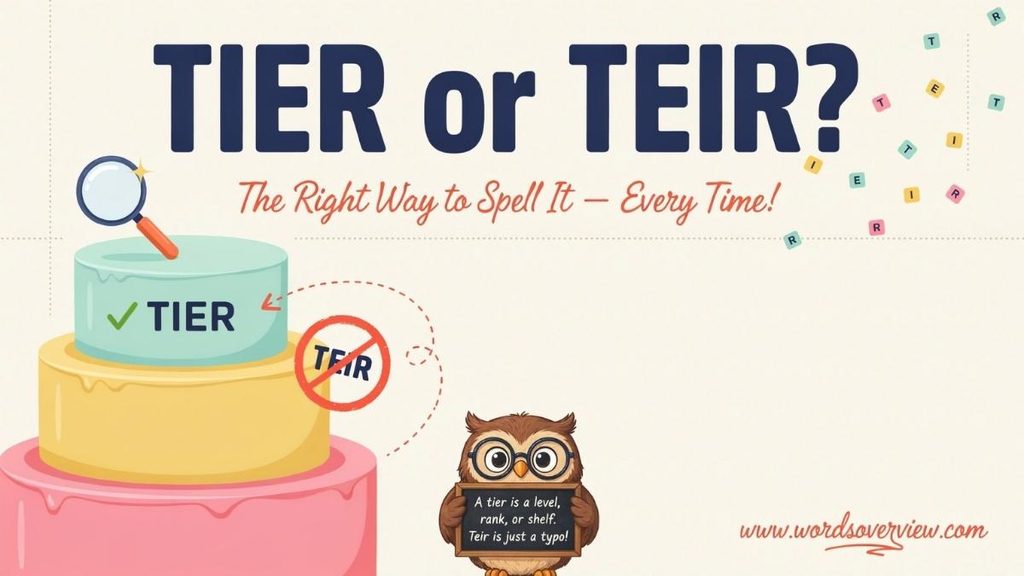
Don’t confuse tier with tear.
These words have different meanings, although pronunciation can make them confusing.
Tier means a level, row, layer, rank or category.
Example:
The stadium has an upper tier.
Tear can refer to a drop of liquid from the eye.
Example:
A tear rolled down her cheek.
Tear can also function as a verb meaning to rip something.
Example:
Be careful not to tear the paper.
So, when discussing levels or rows, use tier, not tear.
Tier or Tear Pronunciation
The pronunciation of tier and tear can depend on the particular meaning and regional accent.
When tear means a drop from the eye, it usually has the same vowel sound found in words such as “near” in many varieties of English.
However, when tear means to rip, it has a different pronunciation.
For that reason, context matters.
The spelling also matters. If you’re describing a level in a structure, the correct word is always tier.
Learn the difference between similar English words
Families or Family’s Correct Usage and Difference
Tier or Teir What Is the Difference?
The difference between tier and teir is straightforward.
| Word | Status | Meaning |
| Tier | Correct | Level, row, layer, rank or category |
| Teir | Incorrect in standard English for this meaning | Common spelling error |
Consider these examples:
Correct:
This product belongs to the premium tier.
Incorrect:
This product belongs to the premium teir.
Another example:
Correct:
The stadium has three tiers.
Incorrect:
The stadium has three teirs.
Therefore, when you’re deciding between tier or teir, choose tier.
Is Teir a Word?
If you’re asking “is teir a word in English?”, the answer for standard modern English usage is no, not as the spelling of the word meaning a level, row or category.
In ordinary English writing, teir is treated as a misspelling of tier.
You might encounter teir in usernames, names, informal online posts or accidental spelling errors. Those appearances don’t make it the standard English spelling of the word.
For school assignments, professional documents, websites, reports and formal communication, use tier.
Common Error
The premium teir includes extra features.
Correct Version
The premium tier includes extra features.
The mistake often happens because writers remember the sound but reverse the letters.
Why Do People Write Teir Instead of Tier?
The spelling error usually comes from the arrangement of the letters.
English contains many words in which ei and ie appear in different patterns. Because of that, writers sometimes hesitate when spelling a word such as tier.
The word also sounds different from what some learners expect when they first encounter it.
Another reason is simple typing speed. When you write quickly, teir can appear before you notice the error
However, you don’t need a complicated spelling rule to remember it.
Think about the word as:
T + IER = TIER
The correct spelling starts with ti, not te.
Learn the difference between confusing English words step by step
Personel or Personnel Correct Spelling and Difference
How to Spell Tier Correctly

If you’re wondering how do you spell tier correctly, remember this:
TIER
A useful memory trick is to connect the spelling with the phrase:
TIER = Three letters after T: I-E-R
You can also connect the word with familiar expressions:
- tier list
- tier system
- top tier
- upper tier
- lower tier
- premium tier
- first tier
- second tier
The more often you see the correct spelling in meaningful phrases, the easier it becomes to remember.
Spelling Practice
Complete each sentence with tier or teir:
- The stadium has an upper ___.
- The company introduced a premium ___.
- The cake has three ___.
- This character belongs in the top ___.
- Customers can upgrade to another ___.
The answer is tier in every sentence.
Learn the difference between commonly confused words in English
Grayscale or Greyscale: Which Is Correct?
Tier or Level or Rank or Category
These words overlap, but they aren’t identical.
| Word | Main Idea | Example |
| Tier | A level within an organized system | Premium tier |
| Level | A degree, stage or position | Advanced level |
| Rank | Relative position in an ordered hierarchy | First rank |
| Category | A group based on shared characteristics | Product category |
| Grade | A quality, standard or classification | High grade |
A tier often acts as a bridge between level and category.
For example:
The service has three pricing tiers.
You could describe these as three levels of service. However, tiers emphasizes the structure that separates customers into distinct groups.
Similarly:
The players were divided into competitive tiers.
Here, the tiers create categories based on performance or ranking.
Tier Synonyms and Related Words
The best synonym depends on context.
Possible alternatives include:
- level
- layer
- row
- rank
- grade
- class
- category
- group
- stage
- division
- section
However, don’t replace tier automatically.
For example, layer works well for a cake or physical structure:
The cake has several layers.
But tier sounds more natural when you’re discussing a structured ranking or pricing system:
The company offers three pricing tiers.
Likewise, rank works well when position matters:
She achieved a high rank.
But tier works better when several groups exist within a classification:
The competitors were divided into different tiers.
Learn the difference between similar English words
Indecisive or Undecisive Which Word Is Correct?
Tier Examples in Everyday English
Seeing the word in context is one of the easiest ways to understand tier word usage.
Here are practical examples:
The stadium’s upper tier was almost full.
We chose the standard pricing tier.
The restaurant offers several service tiers.
The cake has four decorative tiers.
The product belongs to the premium tier.
The game has a competitive tier system.
The company operates across multiple management tiers.
She moved into the top tier of performers.
The lower tier includes fewer benefits.
Customers can upgrade to a higher tier.
The tournament separates players into different tiers.
The books were arranged in a tiered display.
Each sentence uses tier to describe a level, layer, category or position within a larger arrangement.
Tier in a Sentence
If you’re learning how to use tier in a sentence, start with the basic structure:
Subject + tier + context
For example:
The stadium has three tiers.
You can then add more information:
The stadium has three tiers of seating for different sections of the audience.
For abstract meanings:
The company introduced a new premium tier for business customers.
For rankings:
The player moved into the top tier after several strong performances.
For physical structures:
The baker decorated each tier of the cake with fresh flowers.
These examples demonstrate how flexible the word can be.
Learn the difference between similar English words the easy way
Uncapable or Incapable: Which Spelling Is Correct?
A Simple Case Study Three-Tier Pricing
Consider a fictional software company that wants to serve different types of customers.
Instead of charging everyone the same price, the company creates three tiers:
| Tier | Intended Customer | Main Purpose |
| Basic | Individuals | Essential tools |
| Professional | Small teams | More features and higher limits |
| Enterprise | Larger organizations | Advanced business features |
The company can now say:
Customers can choose the tier that fits their needs.
This example shows why tier works so well in business language. It describes distinct levels without suggesting that every level represents an entirely different product.
The same concept appears in many areas, including memberships, subscriptions, services, support plans and access levels.
Tiered The Related Adjective
The word tiered comes directly from tier.
It describes something arranged into several levels, rows or layers.
For example:
- tiered seating
- tiered cake
- tiered pricing
- tiered structure
- tiered system
- tiered service
Consider this sentence:
The theater uses tiered seating so people in the back can see the stage.
Here, tiered tells you that the seats rise in levels.
The word can also describe an abstract structure:
The company uses a tiered support system.
In this case, different levels of support exist for different needs.
First Tier, Second Tier and Third Tier
You can identify individual levels using ordinal numbers.
For example:
- first tier
- second tier
- third tier
- fourth tier
Consider a support system:
First-tier support handles basic customer questions.
Second-tier support handles more complex technical problems.
Third-tier support handles highly specialized issues.
This usage appears frequently in business and technical environments.
The word tier therefore works naturally with numbers as well as descriptive adjectives.
Learn the difference between tricky grammar words
Studying or Studing: Which Spelling Is Correct?
Formal and Informal Use of Tier
Tier works in both formal and informal English.
In formal writing, you might see:
The organization established a three-tier administrative structure.
In business writing:
Customers can select from three pricing tiers.
In technical writing:
The application uses a multi-tier architecture.
In casual conversation:
That restaurant is definitely top tier.
The expression top tier is especially common in informal speech and online discussions.
The key is context. The word itself is standard English, so you can use it confidently in professional writing when the meaning fits.
Common Tier Spelling Mistakes
Several mistakes appear when people write this word.
Mistake Teir
Incorrect:
The company offers three teirs.
Correct:
The company offers three tiers.
Mistake Confusing Tier With Tear
Incorrect:
The stadium has three tears.
Correct:
The stadium has three tiers.
Mistake Using Tier When You Mean Layer
Sometimes the issue isn’t spelling but word choice.
For example, if you’re describing the thin physical material inside a sandwich, layer may fit better.
However, if you’re describing distinct levels in a structured arrangement, tier may be more appropriate.
Good writing depends on both correct spelling and correct word choice.
Learn the difference between more words people mix up
13rd or 13th: Which Is Correct?
Tier or Teir Spelling Quick Comparison
| Feature | Tier | Teir |
| Standard English spelling | Yes | No |
| Means a level | Yes | No |
| Means a row | Yes | No |
| Means a layer | Yes | No |
| Used in tier list | Yes | No |
| Used in pricing | Yes | No |
| Used in rankings | Yes | No |
| Standard dictionary form | Yes | No |
| Recommended in formal writing | Yes | No |
If you only remember one thing, remember this:
Tier is correct Teir is incorrect.
Quick Reference Tier or Teir
| Question | Answer |
| Correct spelling | Tier |
| Incorrect spelling | Teir |
| Basic meaning | Level, row, layer, rank or category |
| Part of speech | Mainly noun; also verb |
| Plural | Tiers |
| Adjective | Tiered |
| Common phrase | Top tier |
| Ranking phrase | Tier list |
| Business phrase | Pricing tier |
| Physical example | Stadium seating tier |
| Cake example | Three-tier cake |
| US pronunciation | tɪr |
Practice Session Fill in the Blanks
Complete each sentence with the correct word or form: tier, tiers, tiered, teir, tear or tears.
- The stadium has several ______ of comfortable seating.
- The premium ______ includes additional features and benefits.
- She chose the top ______ of the subscription plan.
- The wedding cake had three beautiful ______.
- The company uses a three-______ pricing structure.
- The word meaning a level, row or category is spelled ______.
- “Teir” is an incorrect ______ of “tier.”
- The seats are arranged in ______ to give everyone a clear view.
- This service belongs to the highest ______ of support.
- The gaming community created a ______ list to rank the characters.
- The restaurant offers different pricing ______ for its customers.
- The upper ______ of the stadium has a wider view of the field.
- He accidentally wrote “______” instead of “tier.”
- A ______ system can organize products according to quality or price.
- The cake has several ______ arranged one above another.
- She moved into a higher ______ of management.
- The word “tier” can describe a row, layer, level or ______.
- The child began to ______ after saying goodbye to her parents.
- Be careful not to confuse tier with ______, which can mean to rip something.
- His eyes filled with ______ when he heard the emotional story.
- The company introduced a new ______ of membership for frequent customers.
- The stadium features ______ seating with each row at a different height.
- “Top ______” describes something belonging to the highest level or category.
- When discussing rankings, each ______ represents a particular level.
- If you mean a level or rank, always choose ______, not “teir.”
Answer Session
- tiers
- tier
- tier
- tiers
- tiered
- tier
- spelling
- tiers
- tier
- tier
- tiers
- tier
- teir
- tier
- tiers
- tier
- category
- tear
- tear
- tears
- tier
- tiered
- tier
- tier
- tier
Frequently Asked Questions
What does “tier” mean?
“Tier” means one of several levels, rows, layers, ranks or categories within a larger system. For example, a company may offer different pricing tiers.
Is “teir” a word?
No. “Teir” is not the standard English spelling of the word meaning a level, row, layer or rank. The correct spelling is tier.
How do you spell tier correctly?
The correct spelling is T-I-E-R: tier. A simple way to remember it is to keep the “i” before the “e.”
What is the difference between “tier” and “teir”?
“Tier” is the correct English word, while “teir” is a spelling mistake. You should use tier when referring to a level, rank, row, layer or category.
What does “Tier 1,” “Tier 2” and “Tier 3” mean?
These terms describe different levels within a ranking or classification system. Tier 1 usually identifies the highest or first level, followed by Tier 2 and Tier 3, although the exact meaning depends on the system.
What does “top tier” mean?
“Top tier” means the highest level or category in a particular system. For example, “She joined a top-tier university” means the university belongs to a highly ranked or upper-level group.
What is a tier list?
A tier list is a ranking system that organizes people, products, characters, options or other items into different levels based on a chosen standard. For example, a gaming tier list may place characters into S, A, B and C tiers.
How do you pronounce “tier”?
“Tier” is generally pronounced like “teer.” In US English, Cambridge gives the pronunciation as /tɪr/. The word sounds similar to “tear” when “tear” means a drop from the eye.
What is the difference between “tier” and “tear”?
“Tier” refers to a level, row, layer or rank. “Tear” has different meanings, including a drop produced by the eye and the act of ripping something. Although they can sound alike, their meanings and spellings are different.
What does “tiered” mean?
“Tiered” means arranged in several levels, rows or layers. For example, tiered seating has rows positioned at different heights, while a tiered cake has multiple stacked levels.
Conclusion
The tier or teir confusion may involve only four letters, but those letters can certainly cause a surprising amount of trouble. The correct spelling is tier, while teir is a common spelling mistake when you mean a level, row, layer, rank or category.
Remember the correct order: T-I-E-R. Whether you’re describing a stadium seating arrangement, a wedding cake, a pricing plan or a gaming tier list, tier is the word you need.
So, the next time teir tries to sneak into your sentence, don’t give it a promotion. Choose tier instead. Once you remember the spelling and meaning, this little English trap becomes much easier to avoid.

Ethan AJS is an experienced blogger and language enthusiast at Words Overview, dedicated to making English easier to understand and use. He writes about grammar, vocabulary, spelling, word meanings and commonly confused words, turning tricky language questions into clear, practical insights. With a passion for effective communication, Ethan creates engaging, readerfocused content that helps readers write accurately, choose the right words and communicate with confidence.