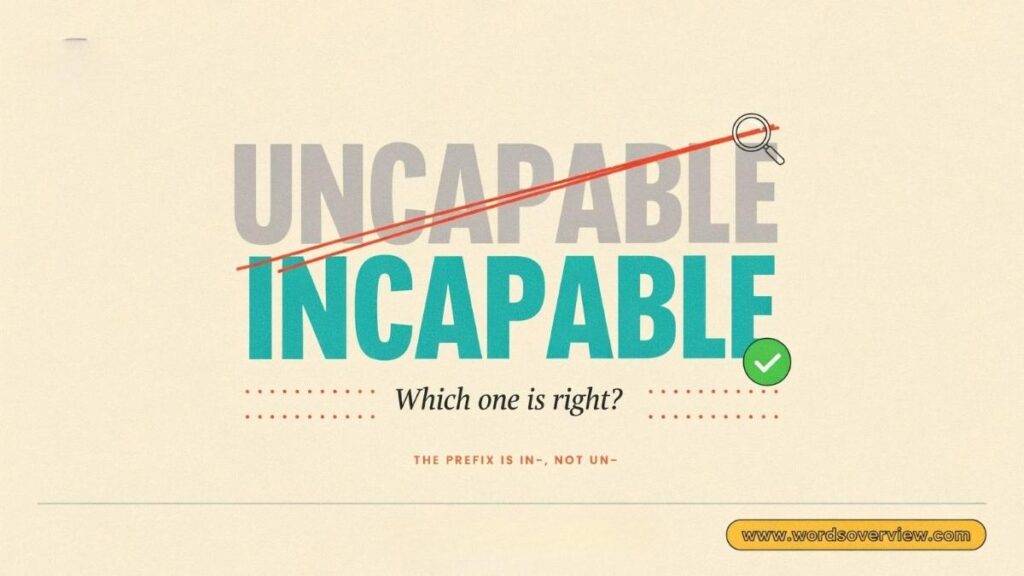
English spelling has a funny habit of making simple words look suspicious. One extra prefix can turn a perfectly familiar word into something that feels almost right. That’s exactly what happens with uncapable or incapable. At first glance, “uncapable” seems logical because “capable” becomes “incapable,” so why not “uncapable”? English, however, doesn’t always follow the neat little rules we expect. If you’ve ever paused before typing this word, you’re not alone. In this guide, you’ll discover which form is standard, what “incapable” means, whether “uncapable” is a real word and how to use the correct spelling confidently in everyday and formal writing.
Uncapable or Incapable Quick Answer
Incapable is the standard modern spelling.
The word incapable describes someone or something that lacks the ability, capacity, power or qualification to do something. For example, you might say:
The old computer is incapable of processing the file.
The word uncapable has a documented history and can appear in older texts. However, modern writers rarely use it. In contemporary standard English, incapable is the natural and widely accepted choice.
| Word | Modern status | Meaning | Recommended use |
| Incapable | Standard | Unable or lacking ability or capacity | Use it |
| Uncapable | Rare and historical | Essentially the same as incapable | Usually avoid it |
So, if you’re writing an email, essay, report, article, application or professional document, use incapable.
Incapable Examples
Here are several natural examples:
- The machine is incapable of handling such a large workload.
- She was incapable of making the decision alone.
- The damaged battery is incapable of holding a full charge.
- The system is incapable of processing the new file format.
- He seemed incapable of understanding the instructions.
- The small team was incapable of handling the sudden increase in demand.
Notice the common grammatical pattern: incapable of + noun or -ing form.
What Does Incapable Mean?
The incapable meaning is simple: someone or something does not have the ability, capacity, power or qualification required to do something.
A useful incapable definition is:
Incapable means lacking the ability, capacity, power or qualification to perform a particular action or function.
The exact meaning depends on the context.
For example, a person can be incapable of performing a task because they lack the necessary skill. A machine can be incapable of performing a function because its design doesn’t support it. An organization can be incapable of handling a workload because it lacks enough resources.
Therefore, incapable doesn’t always mean incompetent. Sometimes it simply describes a limitation.
Consider these examples:
The printer is incapable of printing 100 pages per minute.
Here, the word refers to capacity.
The student is incapable of solving the problem without assistance.
Here, it refers to ability.
The organization was incapable of responding quickly enough.
Here, it refers to operational capacity.
The word stays the same, but the surrounding context tells you what kind of limitation you mean.
Is Incapable a Word?
Yes. Incapable is a standard English word.
The word entered English in the late 16th century. Its history connects it to French and Medieval Latin forms built around the idea of lacking capacity or ability.
Today, incapable appears throughout modern English. You can find it in everyday conversation as well as technical, academic, legal and professional writing.
For example:
- I’m incapable of remembering every password.
- The device is incapable of operating without external power.
- The software is incapable of handling the requested format.
- The organization was incapable of meeting the deadline.
- The model is incapable of explaining the observed result.
Consequently, if you’re asking is incapable a word, there is no real uncertainty. It is a well-established part of modern English vocabulary.
Is Uncapable a Word?
This question requires a little more care.
Uncapable is an attested English word. In other words, historical writers genuinely used it. It isn’t accurate to say that nobody has ever used the word or that it has never appeared in English.
Historical dictionaries and dictionary databases record uncapable with essentially the same meaning as incapable. The word appeared in English around the late 16th century and historical texts contain examples of its use.
However, historical existence doesn’t automatically make a word a normal choice in modern English.
That’s the crucial distinction.
If you’re asking is uncapable a word, the most accurate answer is:
Uncapable has a documented history in English, but incapable is the standard modern form.
This distinction matters because English contains many words that once appeared regularly but later became rare, obsolete, archaic or restricted to historical contexts.
Uncapable Meaning
The uncapable meaning is essentially the same as incapable.
It can mean:
- unable to do something
- lacking ability
- lacking capacity
- lacking power
- not capable of performing an action
Historical English used constructions such as uncapable of in much the same way modern English uses incapable of.
However, contemporary writers generally choose incapable instead.
Therefore, if you encounter uncapable in a sentence while reading an older book, don’t automatically assume the author made a spelling error. The word had genuine historical usage.
For modern writing, however, replace it with incapable.
Learn the difference between confusing English words step by step
Personel or Personnel Correct Spelling and Difference
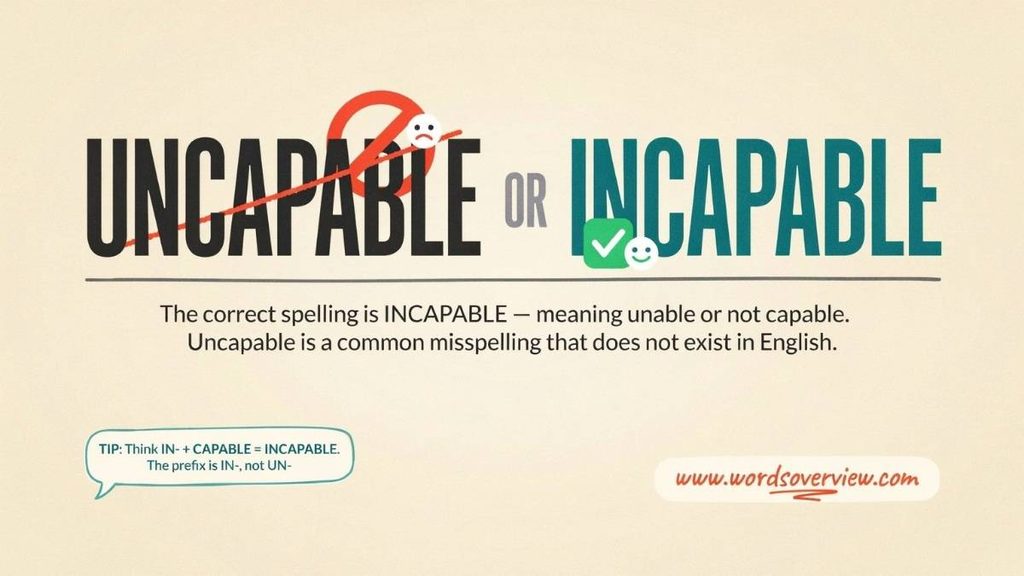
Uncapable or Incapable Why Is Incapable the Standard Form?
The difference becomes easier to understand when you look at the history of the two words.
The adjective capable entered English around the late 16th century. It ultimately connects to Latin roots associated with the idea of being able to hold, receive or contain.
English then developed the negative form incapable with the prefix in-, which can express a negative meaning such as “not.”
So the relationship looks like this:
capable → incapable
At the same time, English also created uncapable by attaching the negative prefix un- to capable.
Both forms therefore have a logical structure. Yet English doesn’t preserve every logically possible formation as an equally common modern word.
Over time, incapable became the established form in standard English, while uncapable became rare and eventually obsolete in much of its historical usage.
This is an important lesson about English vocabulary: word formation isn’t always a simple mathematical formula.
You can’t assume that adding “un-” to any adjective will automatically produce the standard negative form.
Consider these examples:
| Positive word | Standard negative form |
| able | unable |
| happy | unhappy |
| clear | unclear |
| fair | unfair |
| capable | incapable |
| competent | incompetent |
| possible | impossible |
| legal | illegal |
As you can see, English uses different negative prefixes. Historical development determines which form becomes standard.
Capable or Incapable
The easiest way to understand capable and incapable is to treat them as opposites.
| Word | Meaning | Example |
| Capable | Having the ability or capacity to do something | She is capable of solving the problem. |
| Incapable | Lacking the ability or capacity to do something | She is incapable of solving the problem. |
For example:
The system is capable of processing the data.
This means the system has the required capacity.
However:
The system is incapable of processing the data.
This means the system lacks that capacity.
The contrast works with people, machines organizations, systems and other subjects.
Learn the difference between commonly confused words in English
Grayscale or Greyscale: Which Is Correct?
Incapable or Unable What’s the Difference?
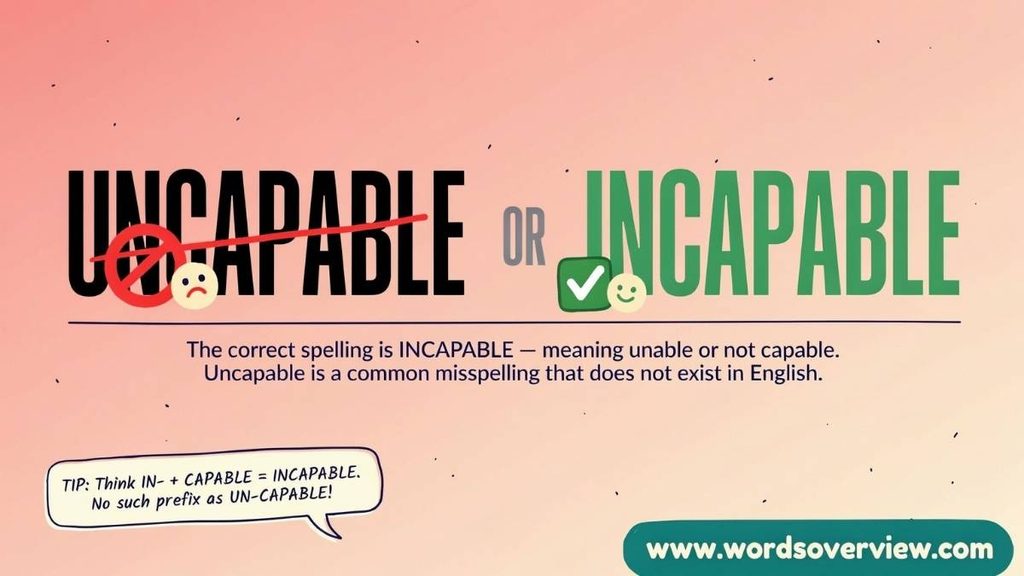
They often overlap. Nevertheless, they don’t always carry exactly the same emphasis.
Unable generally means that someone or something cannot perform an action.
For example:
She was unable to attend the meeting.
This sentence simply tells you that she couldn’t attend.
Incapable can place greater emphasis on an underlying lack of ability, capacity or function.
The damaged system was incapable of processing the request.
Here, the system lacks the necessary function or capacity.
The grammatical patterns also differ.
| Word | Common structure | Example |
| Unable | unable to + verb | He was unable to finish the task. |
| Incapable | incapable of + noun/-ing | He was incapable of finishing the task. |
The distinction becomes particularly useful when you write formal or technical English.
When to Use Incapable
Use incapable when you want to emphasize a lack of:
- ability
- skill
- capacity
- power
- function
- qualification
- potential to perform a particular task
For example:
The device is incapable of operating without an external power source.
When to Use Unable
Use unable when you simply need to say that someone or something cannot perform an action.
For example:
The technician was unable to repair the machine.
Both words can work in some situations. However, the surrounding context determines which one sounds more natural.
Learn the difference between everyday English mistakes
Devide or Divide Correct Spelling and Usage
Incapable of Doing Something Grammar and Usage
One of the most important grammar rules involving incapable concerns the word that follows it.
The standard pattern is:
incapable of + noun
or:
incapable of + verb-ing
For example:
- incapable of working
- incapable of understanding
- incapable of performing
- incapable of making a decision
- incapable of completing the task
- incapable of handling the workload
Consider this sentence:
The software is incapable of processing the file.
The phrase incapable of processing follows the standard grammatical pattern.
A common English mistake occurs when writers copy the structure of unable to and write incapable to.
Incorrect:
The machine is incapable to process the file.
Correct:
The machine is incapable of processing the file.
This distinction is worth remembering:
unable to do
but
incapable of doing
Once that pattern becomes familiar, the grammar becomes much easier.
Incapable in a Sentence
If you’re searching for incapable in a sentence, context provides the clearest explanation.
People and Skills
The trainee was incapable of completing the task without supervision.
Here, the sentence describes a lack of ability.
Technology
The laptop is incapable of running the latest software.
Here, the limitation involves technical capacity.
Organizations
The small department was incapable of handling the sudden increase in requests.
Here, the word describes limited organizational capacity.
Understanding
He seemed incapable of understanding the warning.
Here, the limitation concerns comprehension.
Physical Function
The damaged motor was incapable of producing enough power.
Here, the word describes a physical limitation.
These incapable examples show why context matters. The word doesn’t automatically mean “bad” or “incompetent.” It simply identifies a lack of ability or capacity in the situation being discussed.
Uncapable in a Sentence
Historical writing provides genuine examples of uncapable in a sentence.
Older writers used the word to express the idea of being unable or lacking capacity. Historical dictionary evidence shows that the form appeared in English texts from the late 16th century onward.
For modern readers, however, these examples mainly matter when studying historical English or reading older literature.
If an older text says someone is uncapable of doing something, the author isn’t necessarily making an obvious spelling mistake. The word had a place in earlier English usage.
For contemporary writing, use:
The employee was incapable of completing the task.
rather than:
The employee was uncapable of completing the task.
That small change brings the sentence into line with modern standard English.
Learn the difference between more words people mix up
Tier or Teir? Which Spelling Is Correct?
Common Mistakes With Incapable or Uncapable
Several mistakes repeatedly appear when writers confuse these words.
Using Uncapable by Analogy
The first mistake comes from a perfectly understandable pattern.
English uses:
- able → unable
- willing → unwilling
- clear → unclear
- known → unknown
Therefore, capable → uncapable seems logical.
However, the established modern word is incapable.
Confusing Incapable With Unable
Both words describe inability, but their grammatical structures differ.
She was unable to complete the assignment.
She was incapable of completing the assignment.
The meaning overlaps, but the construction changes.
Using Incapable to Instead of Incapable Of
This error appears frequently because unable uses to.
Incorrect:
He is incapable to understand the instructions.
Correct:
He is incapable of understanding the instructions.
Remember that incapable of doing is the standard pattern.
Assuming Every Dictionary Word Is Equally Common
A dictionary can record a word because it has historical, regional, specialized or rare usage.
Therefore, dictionary inclusion doesn’t automatically mean that two words have equal status in contemporary English.
Uncapable demonstrates this perfectly. It has genuine historical documentation, yet incapable dominates modern standard usage.
Uncapable or Incapable in British and American English
There is no standard British-versus-American spelling difference between the two major forms of English.
Both British English and American English use:
incapable
So you don’t need to change the spelling based on your audience.
| Variety | Standard spelling | Example |
| American English | incapable | The system is incapable of handling the load. |
| British English | incapable | The system is incapable of handling the load. |
The situation surrounding uncapable is more complicated because dictionaries and historical sources document it differently. However, it would be misleading to present uncapable simply as a British or American spelling variant of incapable.
The main issue is modern versus historical usage, not a standard US-versus-UK spelling difference.
Learn the difference between more words people mix up
13rd or 13th: Which Is Correct?
The Origin of Incapable and Uncapable
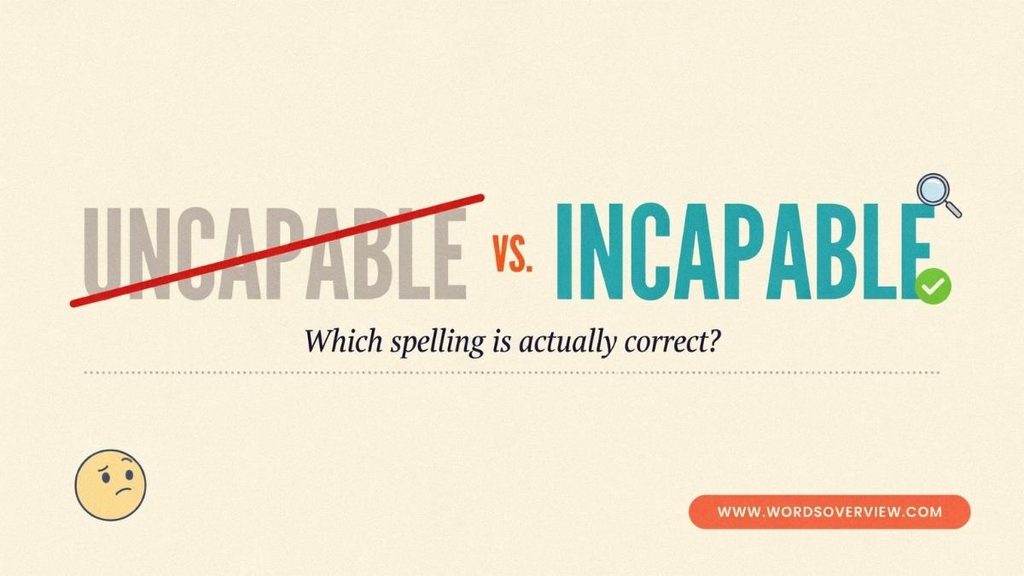
The history of these words explains why the spelling question exists in the first place.
The Origin of Incapable
Incapable entered English around the late 16th century. Its history connects English with French and Medieval Latin forms.
The prefix in- carries a negative sense, while the rest of the word connects with the idea of capability or capacity.
The resulting meaning is essentially “not capable.”
The Origin of Uncapable
Uncapable also appeared in English around the late 16th century. It combines un- with capable.
Historical writers genuinely used this construction.
However, language changes. As English developed, incapable became the established form in standard modern English, while uncapable became much less common.
This history explains why uncapable correct spelling can be a misleading search phrase. If “correct” means historically attested, the word has evidence behind it. If “correct” means the normal spelling for modern standard English, incapable is the answer.
Incapable Synonyms and Related Words
The best incapable synonyms depend on the exact meaning you want to express.
| Word | Main idea | Example |
| Unable | Cannot do something | She was unable to attend. |
| Incompetent | Lacks sufficient skill or ability | He was incompetent at the task. |
| Unqualified | Lacks a required qualification | She was unqualified for the position. |
| Powerless | Lacks power or control | They were powerless to intervene. |
| Helpless | Unable to help or control a situation | The passengers felt helpless. |
| Inept | Lacks skill or effectiveness | His inept handling caused delays. |
These words aren’t interchangeable in every sentence.
For instance, unqualified focuses on requirements or credentials. Incompetent focuses on poor skill or performance. Powerless focuses on a lack of control.
By contrast, incapable has a broader meaning. It can describe a lack of ability, capacity, function or power.
Learn the difference between confusing word pairs
Masonary or Masonry: Which Spelling Is Correct?
Incapable Antonym
The direct incapable antonym is capable.
Other opposites can work depending on context:
- able
- competent
- qualified
- skilled
- effective
- powerful
For example:
The technician is capable of repairing the system.
is the direct opposite of:
The technician is incapable of repairing the system.
However, qualified isn’t always a direct opposite because someone can have the required qualification but still lack the practical ability to perform a task.
That’s why capable remains the clearest antonym.
Incapability or Inability
Two related nouns often cause confusion: incapability and inability.
Incapability describes the condition or quality of being incapable.
The system’s incapability of handling large files created problems.
Inability describes the state of being unable to do something.
Her inability to access the database delayed the project.
Both nouns can describe a lack of ability. However, inability is often the more natural everyday choice when discussing a specific failure to perform an action.
Meanwhile, incapability can sound more formal and can emphasize an inherent or functional limitation.
The adjective forms make the relationship easier to see:
capable → incapable → incapability
and:
able → unable → inability
These word families also explain why incapable and inability don’t have exactly the same grammatical behavior.
Why Does Uncapable Look Correct?
The spelling looks convincing because English has trained readers to recognize un- as a negative prefix.
Consider:
- happy → unhappy
- known → unknown
- fair → unfair
- clear → unclear
- able → unable
The brain sees capable and naturally suggests uncapable.
That isn’t surprising. It follows a familiar pattern.
However, English contains several competing negative prefixes. For example:
- capable → incapable
- competent → incompetent
- possible → impossible
- legal → illegal
- complete → incomplete
- happy → unhappy
Therefore, you can’t always create the correct negative word by attaching the most familiar prefix.
Historical usage decides which forms become established.
In this case, incapable became the standard modern form.
Learn the difference between tricky English words with easy explanations
Finalise or Finalize: Difference, Spelling and Usage
Uncapable or Incapable Spelling A Simple Memory Rule
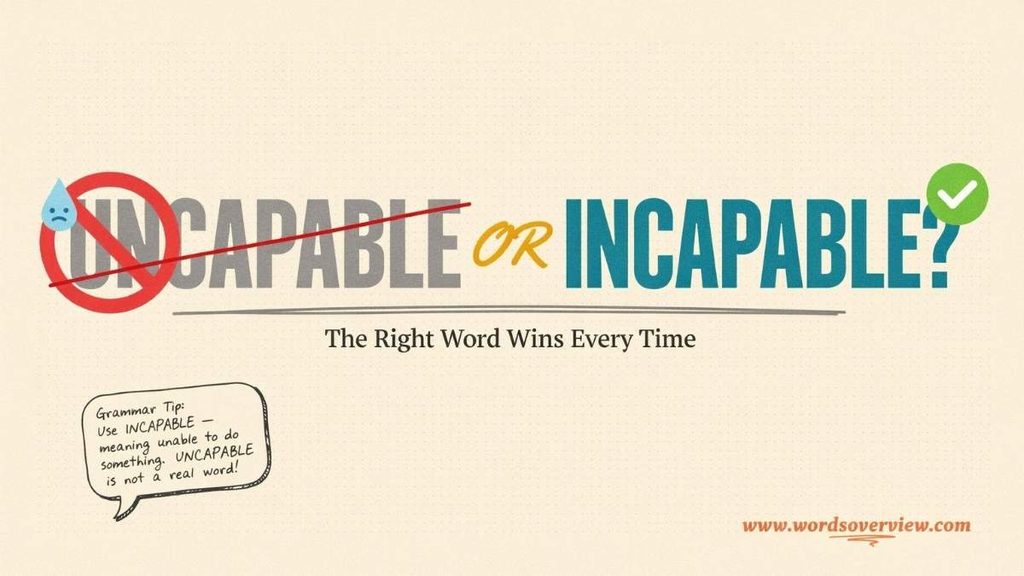
If you’re unsure about the uncapable or incapable spelling, remember this pair:
capable → incapable
Think of incapable as the standard negative form of capable.
A second useful pattern is:
incapable of doing
For example:
The device is incapable of performing the operation.
Avoid creating the form uncapable simply because un- often makes negative adjectives.
English spelling rewards familiarity more than mathematical logic. Sometimes the dictionary wins the argument.
Uncapable or Incapable Comparison Table
Here’s the complete uncapable or incapable comparison in one place:
| Feature | Uncapable | Incapable |
| Has existed in English? | Yes | Yes |
| Historical usage | Documented | Documented |
| Meaning | Unable or lacking ability | Unable or lacking ability |
| Common in modern English | No | Yes |
| Standard modern choice | No | Yes |
| Appears in historical texts | Yes | Yes |
| Suitable for formal modern writing | Generally avoid | Yes |
| Common modern construction | Rare | incapable of |
| Negative prefix | un- | in- |
| Best choice today | Avoid in normal modern writing | Use |
This comparison answers both incapable or uncapable and uncapable or incapable without pretending that historical English never used uncapable.
Is Uncapable Grammatically Correct?
The answer depends on what you mean by “correct.”
Historically, writers did use uncapable as an adjective. Therefore, the word has genuine grammatical and historical evidence behind it.
However, if you’re writing contemporary standard English, incapable is the appropriate choice.
So:
Historical usage: uncapable can be found.
Modern standard usage: incapable is preferred.
This distinction prevents an overly simple answer.
Language isn’t frozen. Words can move from common usage to rare usage, from standard usage to obsolete usage or from one region to another.
How to Spell Incapable Correctly
If you’re wondering how to spell incapable, remember:
I-N-C-A-P-A-B-L-E
The word begins with in-, followed by capable.
A useful visual pattern is:
IN + CAPABLE = INCAPABLE
That makes the correct spelling of incapable easier to remember.
Also remember the related forms:
- capable
- incapable
- capability
- incapability
- capably
The spelling becomes much easier once you recognize the shared word family.
Learn the difference between similar English words
Analyses or Analysis Meaning and Correct Usage
Frequently Confused Forms
The following mistakes often appear because English spelling encourages people to build words from familiar patterns.
| Incorrect or less suitable form | Standard modern form |
| uncapable | incapable |
| incapable to do | incapable of doing |
| incapable for doing | incapable of doing |
| uncapability | incapability |
| not capable of to do | not capable of doing |
The last point also highlights another useful construction. You can say:
She is not capable of completing the task.
or:
She is incapable of completing the task.
Both are grammatical, although incapable provides the more compact negative adjective.
Learn the difference between similar English words
Indecisive or Undecisive Which Word Is Correct?
Final Word Choice Incapable or Uncapable?
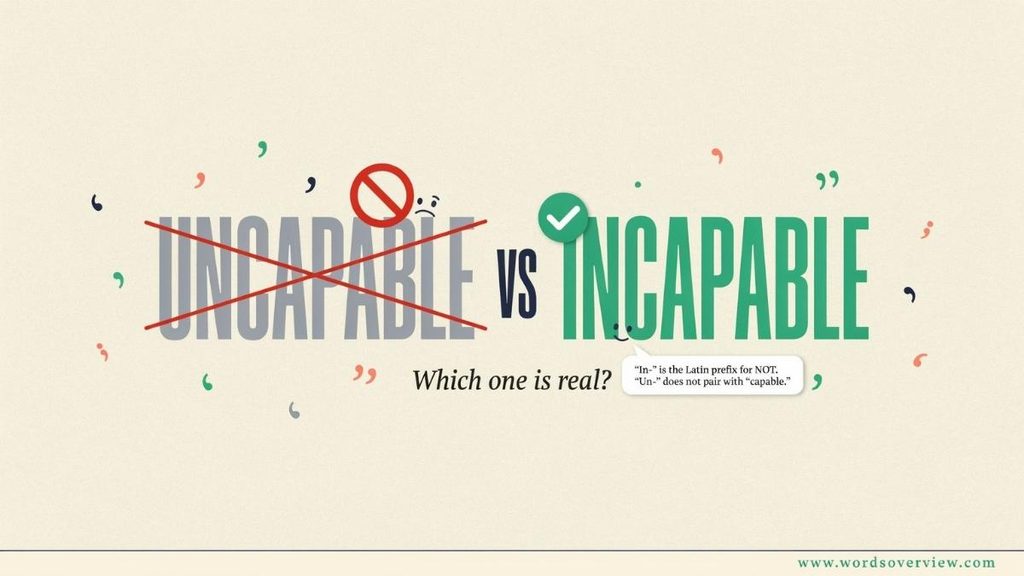
When modern English gives you a choice, the decision is straightforward.
Use incapable when you mean:
- unable to do something
- lacking ability
- lacking capacity
- lacking power
- lacking a required capability
- unable to perform a particular function
Use uncapable only when you are discussing or preserving historical, obsolete or unusual usage.
That distinction matters because uncapable correct spelling and incapable correct spelling answer two slightly different questions. Historically, uncapable has evidence. In contemporary standard English, incapable is the established form.
Practice Session Fill in the Blanks
Choose the correct word or phrase to complete each sentence.
- The outdated computer is ________ of running the latest software.
- She was ________ of completing the task without assistance.
- The team proved that it was fully ________ of handling the project.
- He was ________ to attend the meeting because of a scheduling conflict.
- The machine is ________ of producing the required level of precision.
- “Incapable” means lacking the ________ or ability to do something.
- The manager considered him ________ of making an independent decision.
- The employee was ________ to finish the report before the deadline.
- The word ________ is the standard form in modern English.
- “Uncapable” is a rare form that appears mainly in ________ or unusual usage.
- She is ________ of understanding complex technical instructions.
- The device is not ________ of storing enough data for the project.
- The opposite of “incapable” is ________.
- His ________ to adapt to changing conditions caused difficulties.
- The student was ________ of solving the problem after reviewing the instructions.
- The injured player was ________ to continue the game.
- The company needs someone ________ of managing several projects at once.
- Use “incapable ________” when the following word is a noun or an -ing form.
- Use “unable ________” when it is followed by a base-form verb.
- The phrase “incapable of working” means ________ to work.
- The old printer was ________ of producing high-quality images.
- The word “incapability” is a ________ that refers to a lack of ability or capacity.
- In formal modern writing, choose ________ instead of “uncapable.”
- The child was ________ of reaching the shelf without help.
- Although “uncapable” has historical usage, ________ is the preferred form in contemporary English.
Answer Session
- incapable
- incapable
- capable
- unable
- incapable
- ability
- incapable
- unable
- incapable
- historical
- incapable
- capable
- capable
- inability
- capable
- unable
- capable
- of
- to
- unable
- incapable
- noun
- incapable
- incapable
- incapable
Frequently Asked Questions
Is “incapable” or “uncapable” correct?
Incapable is the standard word in modern English. “Uncapable” has appeared in historical English and still occurs occasionally, but it is rare and generally nonstandard in contemporary writing. For formal, academic and professional communication, use incapable.
What does “incapable” mean?
Incapable means unable to do something or lacking the ability, skill, capacity or power required for a particular task. For example, “The old computer is incapable of running the new software” means the computer does not have the capacity to run it.
Is “uncapable” a real word?
Yes, uncapable is a documented English word, particularly in older usage. However, it is uncommon in modern English and can look like a spelling mistake. In contemporary writing, incapable is the normal and preferred form.
What does “uncapable” mean?
“Uncapable” has essentially the same basic sense as incapable: lacking the ability or capacity to do something. However, because it is rare in modern English, readers may find it unusual. Use incapable when writing for a modern audience.
How do you use “incapable” in a sentence?
You normally use incapable with “of” followed by a noun or an -ing form. For example: “The machine is incapable of processing large files.” You can also say, “He was incapable of making a decision under pressure.”
What is the difference between “incapable” and “unable”?
Both words describe a lack of ability, but their grammar differs slightly. Incapable commonly takes of + noun or -ing form, as in “incapable of working.” Unable commonly takes to + verb, as in “unable to work.” The choice often depends on the sentence structure and intended emphasis.
What is the opposite of “incapable”?
The most direct opposite of incapable is capable. If someone is capable, they have the ability, skill or capacity to do something. For example, “She is capable of managing the project independently.”
What are common synonyms for “incapable”?
Common synonyms include unable, powerless, incompetent, ineffective, unqualified and incompetent, depending on the context. However, these words do not always have exactly the same meaning. “Unable” focuses on a lack of ability, while “unqualified” usually refers to lacking the required qualifications.
What does “incapability” mean?
Incapability is the noun form related to incapable. It refers to a lack of ability, capacity, power or competence to perform something. For example, “His incapability to adapt quickly affected the project” describes his lack of ability to adapt.
How can you remember the correct spelling of “incapable”?
A simple memory trick is to connect capable with its standard negative form: capable → incapable. When you need the modern English word, choose incapable rather than “uncapable.” Remembering this pair can help you avoid a surprisingly common spelling trap.
Conclusion
English loves creating spelling traps and uncapable or incapable is a classic example. Although “uncapable” appears in historical English and may still show up occasionally, incapable is the standard form in modern English. Use “incapable” when you mean unable to do something, lacking ability or lacking the capacity to perform a task. For example, “She was incapable of solving the problem” is clear and grammatically standard. So, when your fingers hesitate between the two, remember the modern pairing: capable incapable. That small spelling choice can keep your writing polished, precise and free from an unnecessary English-language plot twist.

Ethan AJS is an experienced blogger and language enthusiast at Words Overview, dedicated to making English easier to understand and use. He writes about grammar, vocabulary, spelling, word meanings and commonly confused words, turning tricky language questions into clear, practical insights. With a passion for effective communication, Ethan creates engaging, readerfocused content that helps readers write accurately, choose the right words and communicate with confidence.