Ever typed “grayscale” and then stared at “greyscale” as if the dictionary had started a family argument? You’re not alone. The grayscale or greyscale debate looks tiny, yet it can make even careful writers second-guess a perfectly simple word. One spelling uses “gray,” the other uses “grey,” and suddenly your spell checker feels like a courtroom judge. The good news is that neither form is automatically wrong. The difference mainly comes down to regional English conventions. American English prefers “grayscale,” while British English generally favors “greyscale.” Understanding that small spelling difference can help you avoid awkward mistakes and keep your writing consistent, polished and professional.
Grayscale or Greyscale Quick Answer
The grayscale or greyscale spelling depends mainly on the variety of English you use.
| Spelling | Main usage | Related spelling | Meaning |
| Grayscale | American English | Gray | A range of tones from black to white |
| Greyscale | British English | Grey | A range of tones from black to white |
The easiest rule to remember is:
American English → grayscale
British English → greyscale
The difference does not normally indicate two different image formats. Instead, it reflects a regional spelling variation.
For example:
The designer converted the photo to grayscale.
A British English writer might write:
The designer converted the photo to greyscale.
Both sentences communicate the same idea.
Therefore, when someone asks, “is grayscale or greyscale correct?” the answer depends on the intended variety of English. Neither spelling is universally wrong.
Learn the difference between confusing more English words
Tie or Tye: Meaning, Difference and Usage
What Does Grayscale or Greyscale Mean?
The grayscale definition refers to a range of tones between black and white that does not use ordinary chromatic colors such as red, blue or green.
The greyscale definition carries the same meaning. The only major difference is the regional spelling of the word “gray” or “grey.”
Imagine a strip that begins with pure black and gradually becomes lighter until it reaches pure white. Every shade between those two extremes represents a different tonal level.
Black → dark gray → medium gray → light gray → white
That range forms a grayscale spectrum or greyscale spectrum.
In digital imaging, the concept becomes more precise. A grayscale image represents visual information through pixel intensity rather than through the full range of chromatic color information found in a color image.
For example, an 8-bit grayscale image can represent up to 256 intensity levels, ranging from 0 for black to 255 for white.
| Pixel value | General appearance |
| 0 | Black |
| 64 | Dark gray |
| 128 | Middle gray |
| 192 | Light gray |
| 255 | White |
The exact appearance can vary depending on the display and image-processing system. Still, the basic principle remains the same: lower values represent darker tones, while higher values represent lighter tones.
Grayscale Meaning in Everyday English
The grayscale meaning usually becomes obvious from context. When someone says that a photograph is in grayscale, they generally mean that the photograph no longer displays its original colors.
For example:
The photographer converted the portrait to grayscale.
The British version would use:
The photographer converted the portrait to greyscale.
In both cases, the photograph contains different shades between black and white instead of its original color information.
Grayscale Color and Tonal Range
The phrase grayscale color can sound unusual because grayscale doesn’t use color in the same way as a conventional palette. Instead, it represents different levels of lightness.
A typical color palette might contain:
- Red
- Blue
- Green
- Yellow
- Purple
A grayscale palette contains neutral tones that move from black to white.
Designers often use a grayscale palette to study:
- Contrast
- Brightness
- Shadows
- Highlights
- Visual hierarchy
- Depth
- Tonal balance
Consequently, grayscale can reveal weaknesses in a design that bright colors might hide.
Learn the difference between more words people mix up
Inconsolable or Unconsolable Which Is Correct?
Why Are There Two Spellings Grayscale and Greyscale?
The answer begins with the words gray and grey.
Both spellings exist in English, but different varieties of English developed different preferences. American English generally favors “gray,” while British English generally favors “grey.”
That difference naturally carries into compound words.
Gray + scale = grayscale
Grey + scale = greyscale
This explains the grayscale or greyscale spelling difference without treating either form as an error
The Gray or Grey Difference
American English commonly uses:
- Gray
- Grayish
- Grayscale
British English commonly uses:
- Grey
- Greyish
- Greyscale
This pattern resembles other well-known differences between American English and British English.
| American English | British English |
| Gray | Grey |
| Color | Colour |
| Favorite | Favourite |
| Center | Centre |
| Grayscale | Greyscale |
Of course, English spelling varies in more ways than this table shows. However, it demonstrates why the two forms exist.
How the Compound Word Is Formed
The word combines the color term with “scale.”
American English:
gray + scale → grayscale
British English:
grey + scale → greyscale
In modern general usage, both forms normally appear as one word.
Therefore, if you’re wondering is grayscale one word or two, the usual answer is one word: grayscale.
Likewise, if you’re asking is greyscale one word or two, the standard modern form is greyscale.
Is One Spelling More Correct?
Neither spelling is universally more correct.
Instead, the preferred spelling depends on the regional variety of English.
For American English, grayscale is the natural choice. For British English, greyscale is the natural choice.
This distinction matters because regional spelling is a normal feature of the English language. A British writer doesn’t make an error by choosing “greyscale,” just as an American writer doesn’t make an error by choosing “grayscale.”
The key is consistency.
Learn the difference between more words people mix up
Tier or Teir? Which Spelling Is Correct?
Grayscale or Greyscale in American and British English
The grayscale or greyscale distinction follows the same regional pattern as “gray” and “grey.”
Grayscale American English
Grayscale American English follows the standard US spelling of “gray.”
You’ll commonly see phrases such as:
- Grayscale image
- Grayscale photography
- Grayscale mode
- Grayscale conversion
- Grayscale design
- Grayscale printing
- Grayscale image processing
For example:
The software converts the photograph to grayscale before processing it.
If your article, website, academic paper or business document follows US English, grayscale spelling in American English is the appropriate choice.
Greyscale British English
Greyscale British English follows the British spelling of “grey.”
Common phrases include:
- Greyscale image
- Greyscale photography
- Greyscale mode
- Greyscale conversion
- Greyscale design
- Greyscale printing
For example
The software converts the photograph to greyscale before processing it.
The meaning doesn’t change. Only the regional spelling changes.
What About Canadian English?
Canadian English deserves some attention because its spelling conventions sometimes overlap with American and British English.
Canadian usage can vary depending on the word, institution, publication and style guide. In particular, dictionary references commonly identify “greyscale” as a Canadian form.
Therefore, grayscale spelling in Canada shouldn’t automatically be assumed to follow American usage simply because Canada borders the United States.
When writing for Canadian readers, the safest approach is to follow the publication’s established style guide.
What About Australian English and Commonwealth English?
Australian English generally has strong historical connections with British spelling conventions. As a result, greyscale is a natural form in Australian and broader Commonwealth English contexts.
However, usage can vary between organizations and technical communities.
A software company may use terminology established by its product interface. A newspaper may follow its own editorial style. An academic institution may use a different style guide.
Therefore, the intended audience and the applicable style guide should determine your choice.
Is Grayscale a Word?
Yes. Grayscale is a word.
It functions as an established term in photography, graphic design, digital imaging, printing and image processing.
For example:
The printer supports grayscale printing.
Here, “grayscale” describes the type of printing.
You might also write:
The image contains a wide range of grayscale values.
The term appears regularly in technical discussions because grayscale provides a useful way to describe images that represent intensity without full chromatic information.
Therefore, the answer to is grayscale a word is an uncomplicated yes.
Is Greyscale a Word?
Yes. Greyscale is also a word.
It isn’t simply a misspelling that appears because someone forgot the American spelling. Instead, it represents the British spelling of the same established term.
For example:
The photographer edited the image in greyscale.
The American English equivalent would use “grayscale.”
Consequently, the answer to is greyscale a word is also yes.
Gray Scale or Grey Scale Which Is Correct?
The question gray scale or grey scale can cause additional confusion because older sources and specialized terminology sometimes use the expression as two words.
For modern general writing, however, the closed compounds are usually preferable:
- Grayscale in American English
- Greyscale in British English
The forms “gray scale” and “grey scale” can still appear in historical or specialized contexts. However, they aren’t normally the first choice when you’re simply describing a grayscale image.
| Form | Typical modern usage |
| Grayscale | Standard American English |
| Greyscale | Standard British English |
| Gray scale | Less common open form |
| Grey scale | Less common open form |
Therefore, if you’re deciding between grayscale or grey scale, use “grayscale” when following US English.
If you’re deciding between greyscale or grey scale, use “greyscale” when following British English.
Should Grayscale Be One Word?
Yes. In ordinary modern usage, grayscale should normally appear as one word.
Should Greyscale Be One Word?
Yes. Greyscale should normally appear as one word as well.
The closed compound is especially common in technical writing, digital imaging, photography and design.
Learn the difference between commonly misused words
Blackout or Backout: Difference and Usage
Grayscale or Black and White Are They the Same?
People often use “grayscale” and “black and white” interchangeably. In casual conversation, that rarely causes confusion. Technically, however, the two concepts can differ.
A grayscale image can contain numerous intermediate tones.
A one-bit black-and-white image contains only two possible values:
Black + white
There are no intermediate gray tones.
By contrast, a grayscale image can contain:
Black → dark gray → medium gray → light gray → white
This distinction matters in digital image processing.
| Feature | Grayscale image | One-bit black-and-white image |
| Black | Yes | Yes |
| White | Yes | Yes |
| Intermediate tones | Yes | No |
| Typical tonal levels | Many | Two |
| Tonal detail | High | Limited |
| Common applications | Photography, scanning, image processing | Line art, masks, binary graphics |
Therefore, the difference between grayscale and black and white isn’t merely a matter of wording. In technical contexts, the number of available intensity levels can affect how an image stores and displays information.
Grayscale or Monochrome
Grayscale and monochrome are related, but they aren’t always identical.
Monochrome is a broader term. It generally describes an image or visual system that uses one color or one tonal family.
Grayscale represents one specific type of monochromatic image because it uses neutral tones from black through gray to white.
However, a monochromatic image doesn’t have to use gray.
For example, an image made entirely from different shades of blue can be monochromatic without being grayscale.
That gives you a useful distinction:
Grayscale is monochromatic, but monochromatic does not always mean grayscale.
This difference becomes useful in photography, digital graphics and visual design.
Grayscale in Photography and Visual Design
Grayscale photography removes the distraction of chromatic color and puts greater emphasis on tonal relationships.
Photographers can use this approach to draw attention to:
- Texture
- Shape
- Lighting
- Contrast
- Shadows
- Highlights
- Composition
- Facial structure
Color can sometimes dominate a photograph. Once you remove it, the viewer may notice details that were previously hidden behind bright hues.
For example, a portrait with strong light and shadow can become more dramatic in grayscale because the viewer focuses on the subject’s expression and facial structure rather than the colors of clothing or surroundings.
Grayscale Design
Designers also use grayscale design during the development process.
A designer might temporarily remove color from a website interface to determine whether the layout has enough visual hierarchy.
If every element has a similar tonal value, important buttons or headings may disappear into the page. If the hierarchy remains clear without color, the underlying structure is probably doing its job.
This technique can help designers evaluate:
- Contrast
- Hierarchy
- Accessibility
- Spacing
- Typography
- Composition
- Emphasis
In other words, grayscale can act like a stress test for visual design.
Grayscale Mode and Image Editing
Modern image-editing software provides several ways to remove or reduce color information.
A grayscale mode typically represents an image using intensity levels rather than separate color channels.
For example, an 8-bit grayscale image can contain up to 256 possible intensity values. This allows the image to preserve substantial tonal information while removing chromatic information.
However, converting an image to grayscale can change the information available for later editing.
If you convert a color image into grayscale, you generally lose the original color-channel information. If you then convert the image into a one-bit bitmap, you lose the intermediate tonal values as well.
That means these operations aren’t merely cosmetic.
They can affect the underlying image data.
Grayscale Conversion
A grayscale conversion transforms a color image into a representation based on intensity.
The simplest approach might average the red, green and blue channel values. However, professional image-processing systems often use weighted calculations because human vision doesn’t perceive every color channel with equal brightness sensitivity.
That distinction matters when accurate tonal reproduction is important.
For instance, two pixels with different RGB combinations can appear to have similar perceived brightness even though their raw channel values differ substantially.
Therefore, grayscale conversion involves more than simply “removing color”
Learn the difference between basic English word mistakes
Where or When: Usage and Classic Song
Common Mistakes With Grayscale or Greyscale
The spelling itself is straightforward. Most mistakes happen when writers mix regional conventions or confuse technical terms.
Treating Greyscale as a Misspelling
One of the most common mistakes is assuming that “greyscale” must be wrong because American English uses “grayscale.”
That’s not accurate.
Greyscale is an established British English form.
Likewise, American writers shouldn’t assume that “grayscale” becomes incorrect when they encounter British writing.
Learn the difference between more words people mix up
13rd or 13th: Which Is Correct?
Mixing Gray and Grey
Another problem occurs when writers mix regional spellings without a clear reason.
For example:
The image uses a gray background and a greyscale palette.
The meaning remains clear. However, the sentence mixes American “gray” with British “greyscale.”
For consistent US English, write:
The image uses a gray background and a grayscale palette.
For consistent British English, write:
The image uses a grey background and a greyscale palette.
Assuming the Meaning Changes
The grayscale or greyscale meaning doesn’t normally change because the spelling changes.
The terms describe the same basic concept.
Therefore, choosing one spelling doesn’t mean choosing a different type of image.
Adding an Unnecessary Hyphen
Modern general writing usually doesn’t need:
- Gray-scale
- Grey-scale
Instead, use:
- Grayscale
- Greyscale
Confusing Grayscale With One-Bit Black and White
A grayscale image can contain many intermediate tones. A one-bit black-and-white image cannot.
This distinction matters particularly in:
- Image processing
- Document scanning
- OCR
- Digital printing
- Computer vision
- Graphic design
Learn the difference between tricky grammar words
Studying or Studing: Which Spelling Is Correct?
Grayscale or Greyscale in Real-World Examples
The best way to understand the distinction is to see it working naturally in different contexts.
Photography
American English:
The photographer converted the portrait to grayscale to emphasize texture and contrast.
British English:
The photographer converted the portrait to greyscale to emphasize texture and contrast.
Graphic Design
American English:
The designer tested the logo in grayscale before choosing the final colors.
British English:
The designer tested the logo in greyscale before choosing the final colours.
Notice that the regional spelling can extend beyond the target word itself. The British sentence uses “colours,” while the American version uses “colors.”
Image Processing
American English:
The application converts each digital image to grayscale before analysis.
British English:
The application converts each digital image to greyscale before analysis.
Printing
American English:
Select grayscale mode when the document doesn’t require color
British English:
Select greyscale mode when the document doesn’t require colour.
Education
American English:
A grayscale image contains different shades between black and white.
British English:
A greyscale image contains different shades between black and white.
The spelling changes, but the underlying concept remains the same.
Learn the difference between similar English words the easy way
Uncapable or Incapable: Which Spelling Is Correct?
A Practical Case Study Choosing the Right Spelling for a Website
Consider a US-based educational website that follows American English throughout its content.
Its style guide uses:
- Color
- Gray
- Favorite
- Center
- Organize
The logical choice is therefore:
- Grayscale
- Grayscale image
- Grayscale conversion
- Grayscale mode
Now consider a UK publication that follows British English.
Its style guide uses:
- Colour
- Grey
- Favourite
- Centre
- Organise
The natural choice becomes:
- Greyscale
- Greyscale image
- Greyscale conversion
- Greyscale mode
Neither publication needs to treat the other spelling as an error
The important factor is consistency with the chosen variety of English.
Learn the difference between tricky English words with easy explanations
Finalise or Finalize: Difference, Spelling and Usage
Grayscale or Greyscale Which One Should You Use?
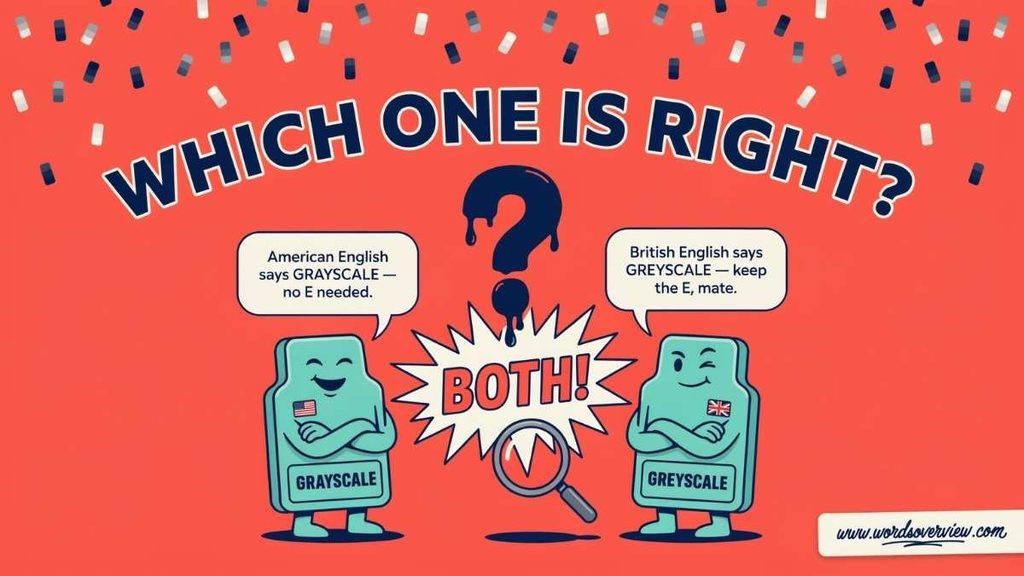
The answer depends on your audience and style guide.
Use Grayscale for US English
Choose grayscale when you’re writing primarily for an American audience.
It fits naturally in:
- US websites
- American academic papers
- Business documents
- Software documentation
- Educational content
- Technical articles
- American publications
If your content already uses “gray” and “color,” then “grayscale” keeps the spelling consistent.
Use Greyscale for British English
Choose greyscale when you’re writing according to British English conventions.
It works naturally alongside:
- Grey
- Colour
- Favourite
- Centre
- Organise
This creates a consistent regional style throughout the document.
What If Your Audience Is International?
International content requires a practical approach.
If most readers come from the United States, American English may make more sense. If your primary audience is in the UK or another region that follows British spelling conventions, British English may fit better.
However, there’s no universal requirement to choose one form for every English-speaking reader.
Instead, select a consistent editorial style and follow it throughout the article.
If a product name organization, official title or technical specification uses a particular spelling, preserve that official form rather than changing it simply to match your preferred regional style.
Grayscale or Greyscale Comparison Table
| Question | Grayscale | Greyscale |
| Is it a real word? | Yes | Yes |
| Is it a standard spelling? | Yes | Yes |
| Main regional association | American English | British English |
| Related color word | Gray | Grey |
| Basic meaning | Range of tones from black to white | Range of tones from black to white |
| Used for digital images? | Yes | Yes |
| Used in photography? | Yes | Yes |
| Used in image processing? | Yes | Yes |
| Normally one word? | Yes | Yes |
| Usually used in US English? | Yes | No |
| Usually used in British English? | No | Yes |
| Can it describe a grayscale image? | Yes | Yes |
| Does the spelling change the meaning? | No | No |
The table highlights the central point: grayscale or greyscale is primarily a regional spelling difference.
Learn the difference between confusing English words step by step
Personel or Personnel Correct Spelling and Difference
Practice Session Grayscale or Greyscale
Fill in each blank with the correct word or phrase. Try to answer without checking the answer section first.
- In American English, the preferred spelling is __________.
- In British English, the preferred spelling is __________.
- Both “grayscale” and “greyscale” have the same basic __________.
- The spelling difference comes from the regional forms “gray” and __________.
- A grayscale image contains different shades between black and __________.
- An 8-bit grayscale image can represent up to __________ intensity levels.
- Grayscale images generally remove __________ color information.
- A grayscale image can contain many __________ tones between black and white.
- The standard American spelling uses “gray,” while the British spelling uses __________.
- Grayscale is commonly used in photography, graphic design, printing and image __________.
- The term “greyscale” is commonly associated with __________ English.
- The term “grayscale” is commonly associated with __________ English.
- Grayscale is normally written as __________ word.
- Greyscale is also normally written as __________ word.
- A one-bit black-and-white image contains only __________ possible values.
- Grayscale is a specific type of __________ image.
- A monochromatic image can use shades of a single __________.
- In a grayscale image, pixel intensity determines how __________ or light a pixel appears.
- The correct US English phrase is “grayscale __________.”
- The correct British English phrase is “greyscale __________.”
- “Gray scale” is generally less common than the closed compound __________ in modern US English.
- “Grey scale” is generally less common than the closed compound __________ in modern British English.
- Writers should avoid mixing regional spellings such as “gray” and “greyscale” without a clear __________.
- The difference between grayscale and greyscale is primarily a __________ difference.
- If you’re writing for a US audience, you should normally choose __________.
Answer Session
- grayscale
- greyscale
- meaning
- grey
- white
- 256
- chromatic
- intermediate
- grey
- processing
- British
- American
- one
- one
- two
- monochrome
- color
- dark
- image
- image
- grayscale
- greyscale
- reason
- spelling
- grayscale
Frequently Asked Questions
Is it grayscale or greyscale?
Both grayscale and greyscale are correct spellings. American English generally uses grayscale, while British English generally uses greyscale. The meaning remains the same.
What is meant by grayscale?
Grayscale refers to an image or visual system that represents tones from black through intermediate gray shades to white rather than using a full range of colors. An 8-bit grayscale image can represent up to 256 intensity levels.
Is grayscale a real thing?
Yes. Grayscale is a real and widely used imaging concept in photography, graphic design, printing, digital graphics and image processing. It represents visual information through different levels of brightness or pixel intensity.
What is another name for grayscale?
A closely related term is monochrome, although the two words aren’t always interchangeable. Grayscale specifically uses neutral tones from black to white, while monochrome can describe an image based on a single color or tonal family.
Does grayscale mean black and white?
Not exactly. A grayscale image can contain many intermediate shades between black and white. By contrast, a one-bit black-and-white image contains only two values: black and white. In everyday conversation, however, people often use “black and white” to describe grayscale images.
What are the colors in grayscale?
Grayscale doesn’t contain conventional colors such as red, blue or green. Instead, it contains shades of gray ranging from black to white, including dark gray, medium gray and light gray.
What does a grayscale image represent?
A grayscale image represents visual information primarily through pixel intensity rather than chromatic color information. Darker pixels represent lower intensity values, while lighter pixels represent higher values.
Is monochrome the same as grayscale?
No. Grayscale is a type of monochrome image, but monochrome has a broader meaning. A monochromatic image can use different shades of a single color, such as blue, whereas grayscale uses neutral tones between black and white.
What is grayscale color?
Grayscale color refers to neutral tones that range from black to white, including all the intermediate gray tones. In digital imaging, these tones correspond to different intensity values rather than different color hues.
How does grayscale work?
Grayscale works by representing an image through different levels of brightness instead of full color information. For example, an 8-bit grayscale image can assign each pixel one of 256 intensity values, ranging from black at the lowest value to white at the highest.
Conclusion
The grayscale or greyscale confusion may look like a tiny spelling battle, but English loves turning tiny differences into surprisingly big questions. Fortunately, the answer is simple: grayscale is the standard American English spelling, while greyscale is the standard British English spelling. Neither form is a mistake when you use it in the appropriate regional context.
So, before your grammar checker starts waving a tiny red flag, check your audience first. Writing for US readers? Choose grayscale. Following UK English? Choose greyscale. Both words describe the same range of tones from black through gray or grey to white.
The real mistake isn’t choosing the “wrong” spelling. It’s mixing regional spellings without a reason. Pick your English variety, stay consistent and let this particular spelling headache fade gracefully into shades of gray.

Ethan AJS is an experienced blogger and language enthusiast at Words Overview, dedicated to making English easier to understand and use. He writes about grammar, vocabulary, spelling, word meanings and commonly confused words, turning tricky language questions into clear, practical insights. With a passion for effective communication, Ethan creates engaging, readerfocused content that helps readers write accurately, choose the right words and communicate with confidence.