
Numbers usually behave themselves, but 13 seems determined to cause trouble. If you’ve ever paused while writing a date, birthday or ranking and wondered whether to use 13rd or 13th, you’re certainly not alone. The confusion often comes from familiar patterns such as 1st, 2nd and 3rd. So, it’s easy to assume that 13 should follow the same rule. Unfortunately, English has a small surprise waiting here. In the 13rd or 13th debate, only one form follows standard English grammar. This guide explains why 13th is correct, why 13rd is incorrect and how a simple suffix rule can save you from this surprisingly sneaky spelling mistake.
13rd or 13th Quick Answer
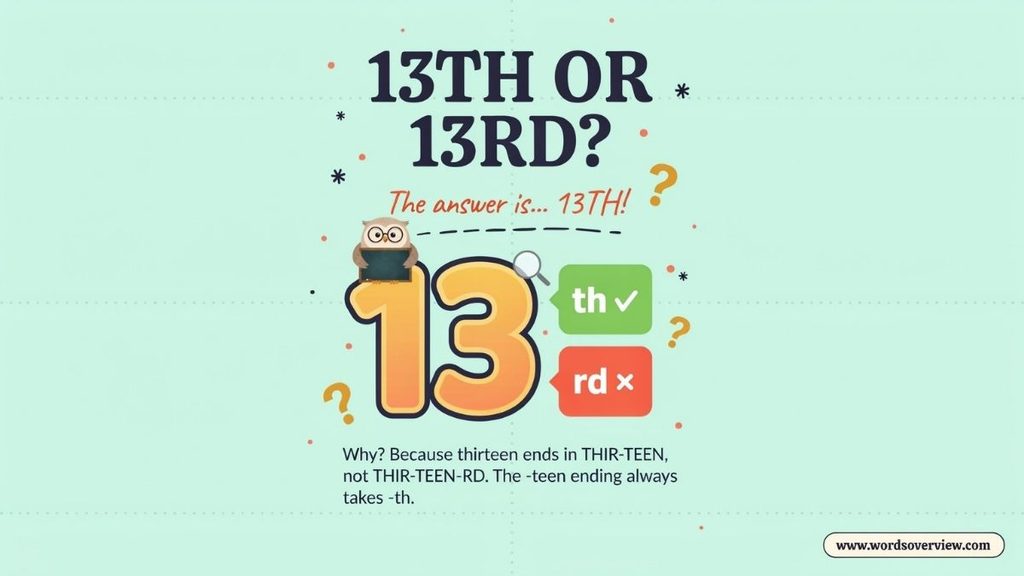
If you’re wondering 13rd or 13th, use 13th.
| Form | Correct? | Written form | Example |
| 13th | Yes | thirteenth | The meeting is on the 13th. |
| 13rd | No | — | Incorrect: The meeting is on the 13rd. |
| 3rd | Yes | third | She finished 3rd. |
| 23rd | Yes | twenty-third | He finished 23rd. |
| 33rd | Yes | thirty-third | The team ranked 33rd. |
The confusion usually starts when someone applies the 3rd rule to every number ending in 3. However, English treats 13 differently because it belongs to the special teen-number group.
The essential rule
Remember this sequence:
1st → 2nd → 3rd → 4th
Then notice the exception:
11th → 12th → 13th → 14th
After that, the familiar pattern returns:
21st → 22nd → 23rd → 24th
So, if you’re asking “is it 13th or 13rd?”, the answer is 13th.
What Does “13th” Mean?
The 13th meaning is the thirteenth position in a sequence or order.
The number 13 is a cardinal number because it tells you how many. In contrast, 13th is an ordinal number because it tells you where something occurs in a sequence.
For example:
- 13 students attended the class. → quantity
- The 13th student arrived late. → position
- She bought 13 books. → quantity
- She opened the 13th book. → position
Therefore, the difference between 13 and 13th isn’t merely a matter of spelling. The two forms perform different grammatical functions.
Cardinal or ordinal numbers
| Cardinal number | Ordinal number | Written form |
| 1 | 1st | first |
| 2 | 2nd | second |
| 3 | 3rd | third |
| 4 | 4th | fourth |
| 11 | 11th | eleventh |
| 12 | 12th | twelfth |
| 13 | 13th | thirteenth |
| 14 | 14th | fourteenth |
Cardinal numbers answer “How many?” Meanwhile ordinal numbers answer “Which one in order?”
You can see this distinction in everyday writing. We use ordinal numbers for dates, rankings, floors, chapters, birthdays, anniversaries, competitions and many other situations involving sequence or position.
What is 13 in ordinal form?
The 13 in ordinal form is 13th.
When you write it out, the form is thirteenth.
Therefore:
13 → thirteen → 13th → thirteenth
So, if someone asks for the correct ordinal for 13, 13th is the numerical form, while thirteenth is the written form.
Learn the difference between confusing English words step by step
Personel or Personnel Correct Spelling and Difference
Thirteenth or 13th Which Form Should You Use?
Both thirteenth and 13th are correct. They simply represent the same ordinal number in different forms.
Use thirteenth when you want to write the number in words:
She came in thirteenth place.
Use 13th when numerical notation suits the context:
She came in 13th place.
Likewise, you can write:
The 13th chapter is unusually short.
Or:
The thirteenth chapter is unusually short.
Similarly:
The company celebrated its 13th anniversary.
Or:
The company celebrated its thirteenth anniversary.
The meaning remains the same.
How do you spell 13th?
The 13th written out is thirteenth.
The spelling is:
T-H-I-R-T-E-E-N-T-H
Therefore, if you’re asking “how do you spell 13th?”, the answer is thirteenth.
A common spelling mistake occurs when writers try to construct the ordinal mechanically from the final digit. However, English does not form thirteenth by adding the suffix used in third to the number 13.
Why Is 13th Correct and 13rd Incorrect?
Here’s where the confusion usually begins.
English ordinal numbers commonly use four suffixes:
- st
- nd
- rd
- th
At first, the pattern appears straightforward:
- 1 → 1st
- 2 → 2nd
- 3 → 3rd
- 4 → 4th
That pattern continues for many numbers:
- 21st
- 22nd
- 23rd
- 24th
However, 11, 12 and 13 create an important exception.
They all use th:
- 11th
- 12th
- 13th
Therefore, 13rd is incorrect because it applies the rd ending to a number that belongs to the 11–13 exception group.
Why “3rd” doesn’t become “13rd”
The mistake becomes understandable when you focus only on the final digit.
Because:
3 → 3rd
someone might assume:
13 → 13rd
However, English doesn’t select the ordinal suffix by looking only at the final digit. Instead, you must consider the number as a whole, particularly its final two digits.
Compare:
3rd → third
with:
13th → thirteenth
Then compare:
23rd → twenty-third
and:
33rd → thirty-third
Thus, 13 behaves differently from 23 and 33 even though all three numbers end in 3.
Learn the difference between similar English words
Families or Family’s Correct Usage and Difference
Why the last digit can mislead you
The last digit works for many numbers, but it doesn’t work for 11, 12 and 13.
For example:
| Number | Correct ordinal |
| 3 | 3rd |
| 13 | 13th |
| 23 | 23rd |
| 33 | 33rd |
| 43 | 43rd |
| 113 | 113th |
| 123 | 123rd |
Notice the pattern. Numbers ending in 13 use th, while numbers ending in 23 use rd.
Consequently, the better rule is not “look at the last digit.” Instead, check the last two digits first.
The Special Rule for 11, 12 and 13
The easiest way to understand the 13th ordinal number rule is to remember one short sequence:
11th, 12th and 13th all use th.
This becomes especially clear when you place them in order:
| Number | Ordinal | Written form |
| 10 | 10th | tenth |
| 11 | 11th | eleventh |
| 12 | 12th | twelfth |
| 13 | 13th | thirteenth |
| 14 | 14th | fourteenth |
The important point is that 13th isn’t an isolated exception. Instead, it belongs to the same suffix pattern as 11th and 12th.
Why do we use “th” in 13th?
English uses th in thirteenth because 13 belongs to the special group of teen numbers that includes 11 and 12.
Therefore, the numerical form follows the written ordinal:
thirteen → thirteenth → 13th
You shouldn’t build the ordinal by taking 3rd and placing 1 in front of it. That shortcut produces 13rd, which isn’t the standard English form.
The 12th or 13th connection
The comparison 12th or 13th reinforces the pattern:
- 12 → 12th
- 13 → 13th
Neither number takes nd or rd.
Therefore, writing 13rd because 3 normally takes rd ignores the special rule that governs the teen numbers.
Learn the difference between everyday English mistakes
Girly or Girlie Correct Usage and Difference
Ordinal Suffix Rules: The Practical Version
You don’t need to memorize hundreds of ordinal numbers. A small set of rules handles most cases.
| Number ending | Suffix | Example |
| 1 | st | 21st |
| 2 | nd | 22nd |
| 3 | rd | 23rd |
| Other endings | th | 24th |
However, there’s an essential exception:
Numbers ending in 11, 12or 13 use th.
That gives you:
- 11th not 11st
- 12th not 12nd
- 13th not 13rd
- 111th not 111st
- 112th not 112nd
- 113th not 113rd
This is one of the most useful English number rules because the same principle applies to larger numbers.
13th or 23rd
The comparison 13th or 23rd makes the rule particularly clear.
| Number | Last two digits | Correct form |
| 13 | 13 | 13th |
| 23 | 23 | 23rd |
| 33 | 33 | 33rd |
| 43 | 43 | 43rd |
| 53 | 53 | 53rd |
| 113 | 13 | 113th |
| 123 | 23 | 123rd |
So, the 23rd ordinal is correct because the number ends in 23, not 13.
This distinction explains why 23rd or 13th produces two different answers even though both numbers end in the digit 3.
The Larger-Number Exception: 111th, 112th and 113th
The same rule continues beyond 100.
Consider:
- 101st
- 102nd
- 103rd
- 104th
Now compare them with:
- 111th
- 112th
- 113th
- 114th
The final two digits determine whether the special teen exception applies.
Examples
111th is correct because the number ends in 11.
112th is correct because the number ends in 12.
113th is correct because the number ends in 13.
However:
121st is correct because the number ends in 21.
122nd is correct because the number ends in 22.
123rd is correct because the number ends in 23.
Therefore, when applying ordinal suffix rules, checking the final two digits provides a much safer method than looking only at the final digit.
Learn the difference between similar English words the easy way
Uncapable or Incapable: Which Spelling Is Correct?
13th or 13rd Comparison Table
The difference becomes obvious when the forms appear side by side.
| Expression | Status | Reason |
| 13th | Correct | Standard ordinal form |
| 13rd | Incorrect | Incorrectly applies -rd |
| thirteenth | Correct | Written-out ordinal |
| 13 | Correct | Cardinal number |
| 3rd | Correct | Ordinal form of 3 |
| 23rd | Correct | Ordinal form of 23 |
| 113th | Correct | Ends in 13 |
If you’re comparing 13th or 13rd, remember that 13th follows the teen-number exception.
13th in Dates
Dates provide one of the most common places where this spelling mistake appears.
When a date uses an ordinal form, write 13th:
- 13th June
- 13th July
- 13th March
- 13th February
For example:
The event will take place on July 13th.
Not:
The event will take place on July 13rd.
Therefore, if you’re asking 13th or 13rd for a date, choose 13th whenever you use an ordinal date form.
However, American English also commonly writes dates without ordinal suffixes:
July 13, 2026
This style is also correct. The difference concerns date formatting rather than the underlying ordinal rule.
13th June or June 13th
Both 13th June and June 13th can appear in English.
For example:
The conference begins on 13th June.
Or:
The conference begins on June 13th.
In American English, formal writing often uses:
June 13, 2026
without the ordinal suffix.
The important point is that when you choose the ordinal form, it must be 13th, not 13rd.
Is it 13th or 13rd June?
The correct ordinal form is:
13th June
The following forms are incorrect:
13rd June
June 13rd
Likewise:
- 13th July
- 13th March
- 13th February
The month doesn’t affect the ordinal suffix.
13th in Birthdays and Anniversaries
The same rule applies to milestones and celebrations.
Correct examples include:
- 13th birthday
- 13th anniversary
- 13th wedding anniversary
- 13th year
- 13th edition
For example:
She celebrated her 13th birthday with her family.
You could also write:
The organization celebrated its 13th anniversary.
Therefore, questions such as 13th or 13rd anniversary and 13th or 13rd birthday have the same answer: 13th.
The noun following the ordinal doesn’t change the suffix.
Learn the difference between tricky English words with easy explanations
Finalise or Finalize: Difference, Spelling and Usage
13th in Rankings and Positions
Ordinal numbers describe rank and position, so 13th appears frequently in sports, competitions, academic results and lists.
Examples include:
- 13th place
- 13th position
- 13th overall
- 13th in the ranking
- 13th seed
- 13th chapter
- 13th floor
- 13th attempt
Consider this sentence:
The athlete finished in 13th place.
Here, 13th identifies the athlete’s position in the sequence.
By contrast:
The athlete scored 13 points.
Here, 13 expresses quantity rather than position.
That tiny distinction explains why one sentence needs an ordinal number while the other needs a cardinal number.
Common Mistakes With 13th
Applying the 3rd Rule to 13
This is probably the most common mistake.
Someone knows:
3rd = correct
Then they assume:
13rd = correct
However, the teen-number exception prevents that formation.
Correct: 13th
Incorrect: 13rd
Forgetting the 11–13 Exception
Another mistake occurs when writers remember an oversimplified rule:
Numbers ending in 1 use -st, numbers ending in 2 use -nd and numbers ending in 3 use -rd.
That explanation sounds useful, but it leaves out a critical exception.
A more accurate rule is:
Numbers ending in 11, 12or 13 use th. Otherwise, numbers ending in 1, 2or 3 generally use st, nd or rd respectively.
That small addition makes the rule far more reliable.
Looking Only at the Last Digit
The last digit works for many numbers, but it doesn’t work for numbers ending in 11, 12or 13.
Compare:
- 3rd
- 13th
- 23rd
- 33rd
- 103rd
- 113th
- 123rd
The numbers 13 and 113 use th because their last two digits are 13.
Meanwhile, 23 and 123 use rd because their last two digits are 23.
Therefore, always check the final two digits when a number ends in 1, 2or 3.
Learn the difference between similar English words
Analyses or Analysis Meaning and Correct Usage
Assuming “13rd” Is an Alternative Spelling
You may occasionally see 13rd in informal posts, messages or typing errors. However, its appearance doesn’t make it a standard alternative spelling.
If you’re asking “is 13rd a word?”, the practical answer is no as the standard ordinal form of 13.
Use:
13th
And when you write the number in full:
thirteenth
13rd Meaning or 13th Meaning
The 13th meaning refers to the thirteenth position in a sequence or order.
By contrast, 13rd meaning doesn’t represent a separate standard ordinal meaning. The form 13rd results from an incorrect application of the rd suffix.
For example:
The 13th player entered the field.
Here, 13th identifies the player’s position.
Writing 13rd doesn’t create a different meaning. Instead, it introduces a spelling and grammar error.
Is 13th the Correct Ordinal Number?
Yes.
The correct ordinal for 13 is:
13th
The word form is:
thirteenth
The corresponding cardinal number is:
13 thirteen
This gives you the complete relationship:
| Type | Form |
| Cardinal numeral | 13 |
| Cardinal word | thirteen |
| Ordinal numeral | 13th |
| Ordinal word | thirteenth |
This distinction answers several common questions immediately:
- How do you write 13 in ordinal form? → 13th
- What is the ordinal form of 13? → 13th
- What is 13th called? → An ordinal number, read as “thirteenth”
- How do you spell thirteenth? → thirteenth
- How do you spell 13th? → thirteenth when written out
13th Pronunciation and Spelling
The pronunciation of 13th corresponds to the word thirteenth.
The word can be challenging because several consonant sounds occur close together. As a result, some English learners find the thirteenth spelling and pronunciation harder than shorter ordinal forms such as third or fourth.
Nevertheless, the written relationship remains simple:
thirteen → thirteenth → 13th
Don’t construct the ordinal by attaching rd to 13. The standard numerical abbreviation already uses th.
Learn the difference between more words people mix up
Tier or Teir? Which Spelling Is Correct?
13th or 3rd: Why the Forms Differ
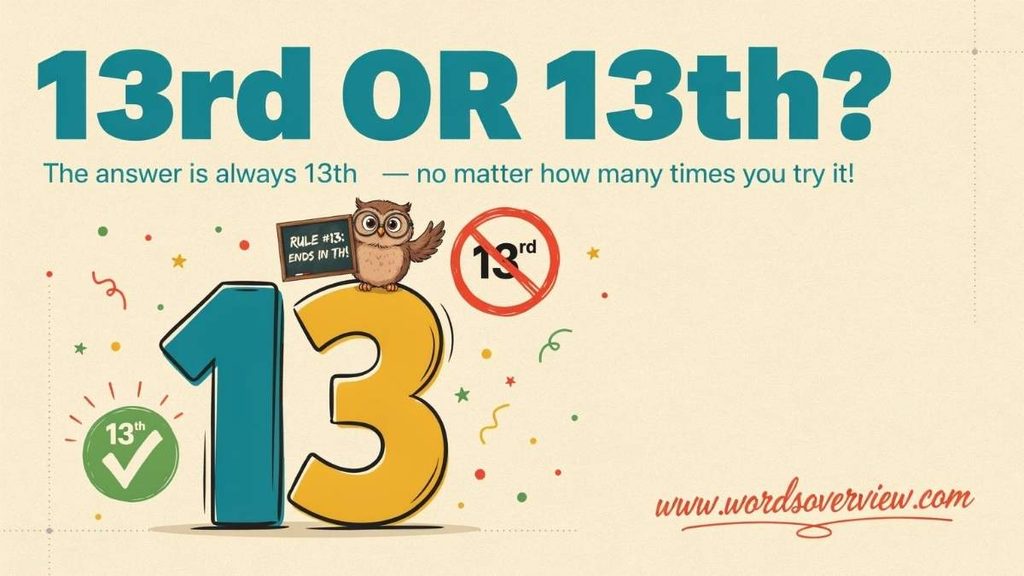
The comparison 13th or 3rd reveals the central rule.
| Number | Ordinal | Word |
| 3 | 3rd | third |
| 13 | 13th | thirteenth |
| 23 | 23rd | twenty-third |
| 33 | 33rd | thirty-third |
Notice that 13 is the only number in this group that uses -th.
That’s because 13 belongs to the 11–13 exception group.
Therefore, if someone asks “why is 13rd incorrect?”, the clearest answer is:
Because 13 belongs to the group of numbers ending in 11, 12or 13, which use the -th ordinal suffix.
23rd or 13th: A Useful Comparison
The comparison between 23rd and 13th is especially helpful because both numbers end in 3.
| Number | Correct form | Reason |
| 13 | 13th | Ends in 13 |
| 23 | 23rd | Ends in 23 |
| 33 | 33rd | Ends in 33 |
| 43 | 43rd | Ends in 43 |
| 113 | 113th | Ends in 13 |
| 123 | 123rd | Ends in 23 |
This explains why the question “23rd or 13th?” has two different answers.
The final digit isn’t enough. Check the final two digits first.
What About “23th or 13rd”?
Neither 23th nor 13rd is the correct standard form.
The correct forms are:
- 23rd
- 13th
Both incorrect forms result from applying the wrong ordinal suffix.
23th incorrectly applies th to 23.
13rd incorrectly applies rd to 13.
Therefore, the correct ordinal suffix depends on the number itself rather than on a simple visual pattern.
Learn the difference between commonly confused words in English
Grayscale or Greyscale: Which Is Correct?
Is 13rd Grammatically Correct?
No. 13rd is not the standard English ordinal numeral for 13.
The correct form is 13th.
This rule applies across ordinary contexts, including:
- dates
- birthdays
- anniversaries
- rankings
- chapters
- floors
- positions
- editions
- competitions
Although the surrounding sentence can change, the ordinal suffix doesn’t.
How to Write 13th Correctly
If you’re unsure how to write 13th, you have two standard options.
Numerical form:
13th
Written form:
thirteenth
For example:
The 13th chapter contains the answer.
Or:
The thirteenth chapter contains the answer.
Both forms communicate the same ordinal number.
Avoid:
13rd
That form incorrectly combines the number 13 with the suffix used by 3rd, 23rd and similar numbers.
A Simple Memory Trick
Here’s the easiest way to remember the rule:
11, 12, 13 all take TH.
Say the sequence together:
11th → 12th → 13th
Then return to the familiar pattern:
21st → 22nd → 23rd
Think of 11–13 as a small grammatical speed bump. Once you pass it, the ordinary pattern continues.
Another useful method is to check the last two digits rather than looking only at the final digit.
For example:
- 113 → 13 → 113th
- 123 → 23 → 123rd
This approach works better than memorizing individual numbers.
Learn the difference between similar English words
Indecisive or Undecisive Which Word Is Correct?
Quick Reference English Ordinal Numbers
| Number | Ordinal numeral | Written form |
| 1 | 1st | first |
| 2 | 2nd | second |
| 3 | 3rd | third |
| 4 | 4th | fourth |
| 5 | 5th | fifth |
| 6 | 6th | sixth |
| 7 | 7th | seventh |
| 8 | 8th | eighth |
| 9 | 9th | ninth |
| 10 | 10th | tenth |
| 11 | 11th | eleventh |
| 12 | 12th | twelfth |
| 13 | 13th | thirteenth |
| 14 | 14th | fourteenth |
| 20 | 20th | twentieth |
| 21 | 21st | twenty-first |
| 22 | 22nd | twenty-second |
| 23 | 23rd | twenty-third |
| 24 | 24th | twenty-fourth |
The table makes the exception easy to spot. 13th sits with 11th and 12th, not with 23rd.
A Practical Case Study Choosing the Correct Date
Imagine you’re preparing an event invitation for July 13.
You might consider three forms:
- July 13th
- July 13rd
- July 13
The first and third can both work depending on the chosen date style. However, July 13rd is incorrect.
If the invitation uses an ordinal date, write:
Join us on July 13th.
If the publication follows a formal American date style that omits ordinal suffixes, write:
Join us on July 13, 2026.
The important lesson isn’t that every date must contain th. Instead, remember that when 13 appears as an ordinal, its correct form is 13th.
Another Case Study Ranking a Competition
Imagine that 30 participants compete in an event.
The results include:
- Participant A — 3rd
- Participant B — 13th
- Participant C — 23rd
- Participant D — 33rd
Although all four positions end with the digit 3, they don’t all use the same suffix.
Why?
Because:
- 3 → 3rd
- 13 → 13th
- 23 → 23rd
- 33 → 33rd
Once again, 13 is the exception.
This example shows why the rule matters beyond grammar exercises. You can apply it to rankings, competition results, academic positions and other real-world writing.
Practice Session 13rd or 13th
Fill in each blank with the correct word or number form.
- The school will hold its ______ annual sports day next month.
- She finished in ______ place in the competition.
- My birthday is on the ______ of July.
- The correct ordinal form of 13 is ______.
- “Thirteenth” is written numerically as ______.
- The number 13 is a ______ number because it shows quantity.
- The number 13th is an ______ number because it shows position.
- The ______ day of the month is often written as 13th.
- The correct spelling is ______, not “thirteenth” with a missing “t.”
- The company celebrated its ______ anniversary.
- The sequence is 11th, 12th, ______, 14th.
- Numbers ending in 11, 12 and 13 normally use the ______ suffix.
- The correct form of 23 is ______.
- The correct form of 33 is ______.
- The date can be written as July ______, 2026 in standard American date style without an ordinal suffix.
- If you use an ordinal suffix in “July 13th,” the number should end in ______.
- “13rd” is considered a common number ______.
- The word form of 13 is “thirteen,” while the word form of 13th is “______.”
- She received the ______ award in the annual competition.
- The correct sequence is 21st, 22nd, 23rd and ______.
- The number 113 should be written as ______ when used as an ordinal.
- The number 123 should be written as ______ when used as an ordinal.
- The ______ suffix is used for 13 because its last two digits are 13.
- “He came in 13th place” describes his ______ in the competition.
- When you’re unsure whether to write 13rd or 13th, remember: 11th, 12th and ______.
Answer Session
- 13th
- 13th
- 13th
- 13th
- 13th
- cardinal
- ordinal
- 13th
- thirteenth
- 13th
- 13th
- -th
- 23rd
- 33rd
- 13
- th
- mistake
- thirteenth
- 13th
- 24th
- 113th
- 123rd
- -th
- position
- 13th
Frequently Asked Questions
Is it 13th or 13rd anniversary?
The correct form is 13th anniversary. The number 13 is an ordinal number and ordinal numbers from 11 through 13 use the th suffix. Therefore, write “13th anniversary,” not “13rd anniversary.”
What is the ordinal form of 13?
The ordinal form of 13 is 13th, which is written out as thirteenth. It describes the position of something that comes after the twelfth and before the fourteenth.
Why is 13th correct instead of 13rd?
13th is correct because 13 belongs to the special group of numbers ending in 11, 12 and 13. These numbers use -th, regardless of their final digit. For example, 11th, 12th and 13th are all correct.
How do you spell 13th in words?
The word form of 13th is thirteenth. It is spelled T-H-I-R-T-E-E-N-T-H. The cardinal form, 13, is spelled thirteen.
Is 13rd grammatically correct?
No. 13rd is not the standard English ordinal form of 13. The correct form is 13th. The suffix rd applies to numbers such as 3rd, 23rd and 33rd, but not to 13.
What is the difference between 13 and 13th?
13 is a cardinal number that tells you how many. 13th is an ordinal number that tells you position or order. For example, “She has 13 books” gives a quantity, while “She finished in 13th place” gives a position.
Should you write 13th or 13rd for a date?
Use 13th when you choose to write a date with an ordinal suffix. For example, “July 13th” is correct, while “July 13rd” is incorrect. In formal American date formats, you can also write “July 13, 2026” without an ordinal suffix.
What suffix does the number 13 use?
The number 13 uses the th ordinal suffix. The correct form is 13th, just as 11 becomes 11th and 12 becomes 12th. This is an important exception to the general pattern for numbers ending in 1, 2or 3.
How do you pronounce 13th?
You pronounce 13th as thirteenth. It follows twelfth and comes before fourteenth in the sequence of English ordinal numbers.
Is 13th the same as thirteenth?
Yes. 13th and thirteenth represent the same ordinal number. The first is the numerical form, while the second is the written-out form. For example, “the 13th day” and “the thirteenth day” have the same meaning.
Conclusion
The 13rd or 13th confusion becomes much easier once you remember one small rule: 13th is correct, while 13rd is incorrect in standard English. Although numbers such as 1st, 2nd and 3rd use different suffixes, 11, 12 and 13 make their own little grammatical club and all take th. So, whether you’re writing a 13th birthday, 13th anniversary, 13th place or 13th June, choose 13th. Think of it as English giving you one final plot twist: 13 looks like it should follow the “3 = rd” pattern, but it refuses to play along. Remember 11th, 12th, 13th and this mistake will stay behind you.

Ethan AJS is an experienced blogger and language enthusiast at Words Overview, dedicated to making English easier to understand and use. He writes about grammar, vocabulary, spelling, word meanings and commonly confused words, turning tricky language questions into clear, practical insights. With a passion for effective communication, Ethan creates engaging, readerfocused content that helps readers write accurately, choose the right words and communicate with confidence.




