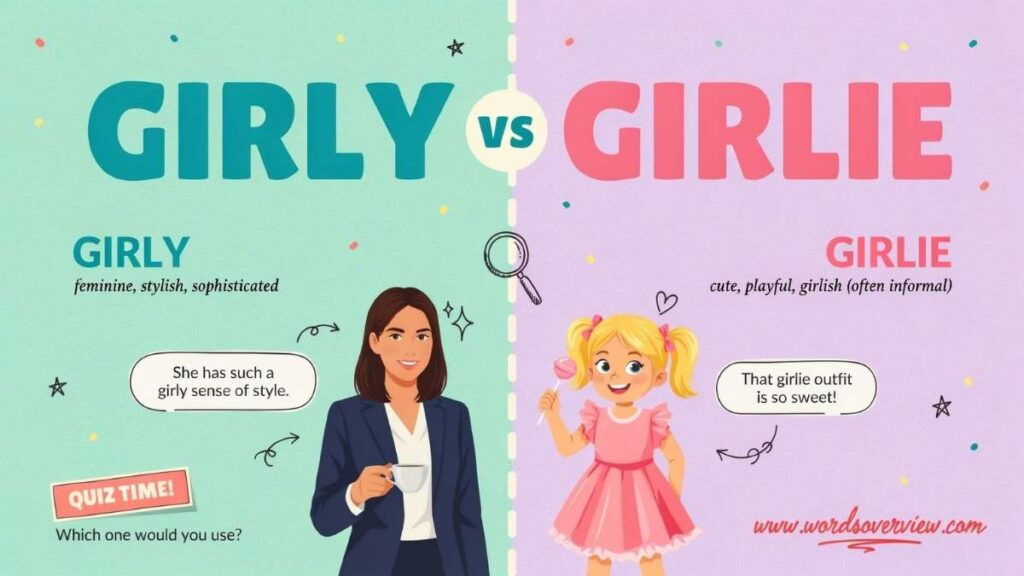
Girly or girlie? English can turn one tiny spelling difference into a surprisingly big headache. You write girly and wonder whether girlie was the better choice. Then you write girlie and suddenly girly starts looking suspicious. Grammar has a talent for creating these little identity crises. Fortunately, the girly or girlie confusion is easier to solve than it looks. Both words are real, but they can differ in grammatical function, tone and context. Whether you’re describing fashion, greeting a friend or writing for social media, choosing the right form matters. Let’s untangle these two lookalikes before your keyboard starts questioning every sentence you write.
Girly or Girlie Quick Answer
If you need a quick rule, use girly when you’re primarily using the word as an adjective to describe something associated with girls or traditionally feminine qualities.
Use girlie when the context calls for its established adjective form or one of its informal noun and conversational uses.
| Feature | Girly | Girlie |
| Main grammatical role | Adjective | Adjective and noun |
| Basic meaning | Associated with girls or femininity | Similar adjective meaning with additional noun uses |
| Common example | She has a girly style. | She has a girlie style. |
| Informal noun | Possible, but often marked informal or potentially offensive | Possible, often informal or potentially offensive |
| Direct address | Less typical | Common in informal expressions such as “Hey, girlie” |
| Formal writing | Possible depending on context | Usually avoid informal direct-address uses |
| Online use | Common | Especially common in informal expressions |
| Tone | Descriptive and context-dependent | Often playful online, although context matters |
Both forms have established English usage. However, their grammatical functions and modern conversational patterns aren’t identical.
Simple Rule to Remember
Think of the distinction this way:
- Girly usually describes something.
- Girlie can describe something too.
- Girlie can also refer to a person or function as an informal form of address.
- Girlies is the plural form commonly seen in modern online language.
- Neither spelling is automatically the “correct” choice in every sentence.
Therefore, the answer to which is correct girly or girlie depends on grammar, meaning, tone and context.
What Is the Girly Meaning in English?
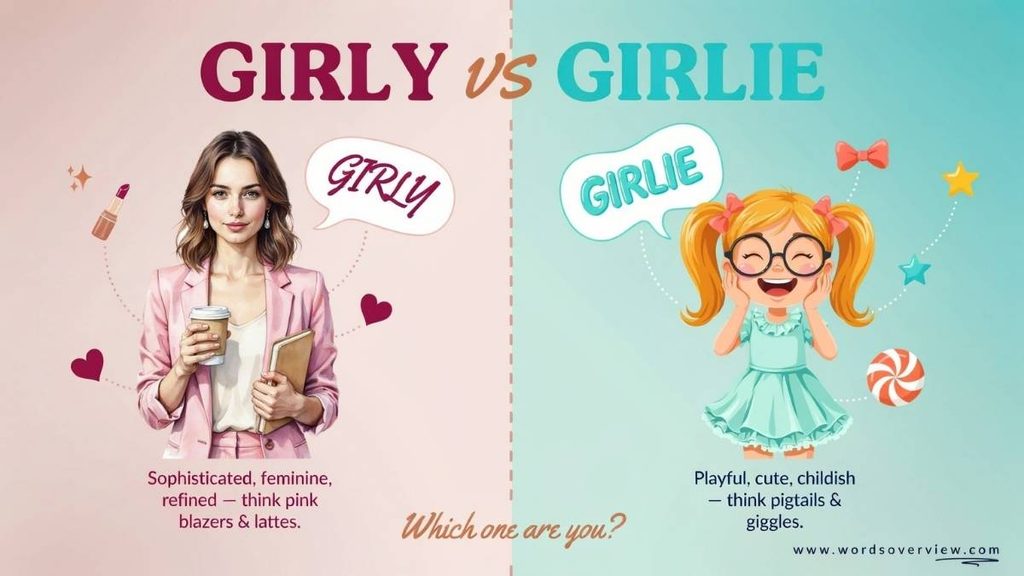
The basic girly meaning relates to characteristics, interests, styles or things traditionally associated with girls or women.
A straightforward girly definition is:
Girly means associated with girls or women, especially in a way traditionally viewed as feminine.
For example, you might describe something as:
- a girly dress
- a girly bedroom
- girly colors
- a girly hairstyle
- girly fashion
- a girly aesthetic
- a girly voice
- girly hobbies
However, the word doesn’t automatically communicate approval or criticism. Instead, context determines the tone.
Is Girly an Adjective?
Yes. Girly is an adjective and this remains its most important grammatical function.
You can place it before a noun to describe a characteristic or quality:
- She bought a girly dress.
- The room has a girly design.
- They chose a girly color palette.
- Her outfit has a girly aesthetic.
In each example, girly modifies the noun that follows it.
Does Girly Mean Feminine?
Often, yes. However, girly and feminine aren’t perfect synonyms.
Feminine is broader and often sounds more neutral or formal. By contrast, girly tends to emphasize qualities associated with girls. Those qualities may include youthfulness, cuteness, pink colors, traditionally feminine fashion or interests that society commonly associates with girls.
Compare these examples:
- Feminine style suggests a broad traditionally feminine appearance.
- Girly style suggests a more informal, youthful or stereotypically feminine appearance.
This distinction matters in professional writing. For example, if you’re describing a fashion collection, feminine may communicate the concept more precisely when you don’t want a youthful or playful implication.
Is Girly Informal?
Yes. Girly is generally informal.
That doesn’t mean you can never use it in writing. Informal vocabulary appears naturally in blogs, magazines, advertisements, conversations, product descriptions and lifestyle content.
However, formal writing may require a more precise alternative.
For example:
The collection uses a feminine color palette.
This sounds more formal than:
The collection uses a girly color palette.
Neither sentence is grammatically wrong. Instead, they communicate different levels of formality and different shades of meaning.
How to Use Girly in a Sentence
Here are several natural examples:
- She prefers a girly style with soft colors and floral patterns.
- Her bedroom has a distinctly girly aesthetic.
- The brand uses a playful but girly color palette.
- She doesn’t consider herself particularly girly.
- They described the collection as feminine rather than girly.
In each example, the word describes a person, style, appearance, object or quality. Therefore, these examples demonstrate the typical role of the girly adjective.
Learn the difference between confusing English words step by step
Personel or Personnel Correct Spelling and Difference
What Is the Girlie Meaning in English?
The girlie meaning overlaps substantially with girly, but the spelling has additional uses.
A useful girlie definition is:
Girlie can describe something considered typical of girls or traditionally feminine and it can also function as an informal noun referring to a girl or young woman.
As a result, girlie can work in more than one grammatical role.
Is Girlie an Adjective?
Yes. Girlie is an adjective.
For example:
- a girlie dress
- a girlie room
- a girlie outfit
- a girlie style
In these sentences, girlie describes the noun that follows it. Therefore, it performs the same basic grammatical function as girly.
This is one reason the two spellings can appear interchangeable in descriptive sentences.
Is Girlie an Adjective or Noun?
It can be either, depending on the sentence.
As an adjective:
She chose a girlie dress.
Here, girlie modifies dress.
As a noun or direct form of address:
Hey, girlie, how have you been?
Here, girlie refers directly to the person being addressed.
That grammatical distinction helps explain an important part of the difference between girly and girlie. Although the words overlap as adjectives, girlie has additional informal uses that make it especially common in conversational English.
Is Girlie a Noun?
Yes. Girlie can function as a noun.
However, this use requires some caution. Traditional dictionary usage includes noun meanings that can sound offensive, dismissive or objectifying. Therefore, you shouldn’t assume that every use of girlie will sound friendly.
Modern social-media users may use the word affectionately. Nevertheless, the listener’s interpretation depends on the relationship, setting and tone.
Consider the difference:
This is a girlie aesthetic.
Here, girlie describes an aesthetic.
Hey, girlie!
Here, girlie addresses a person.
The first sentence is descriptive. The second is conversational and interpersonal. Consequently, the context changes the function and tone of the word.
Learn the difference between tricky words and use them correctly
Genious or Genius: Which Spelling Is Correct?
Girly or Girlie What Is the Difference?
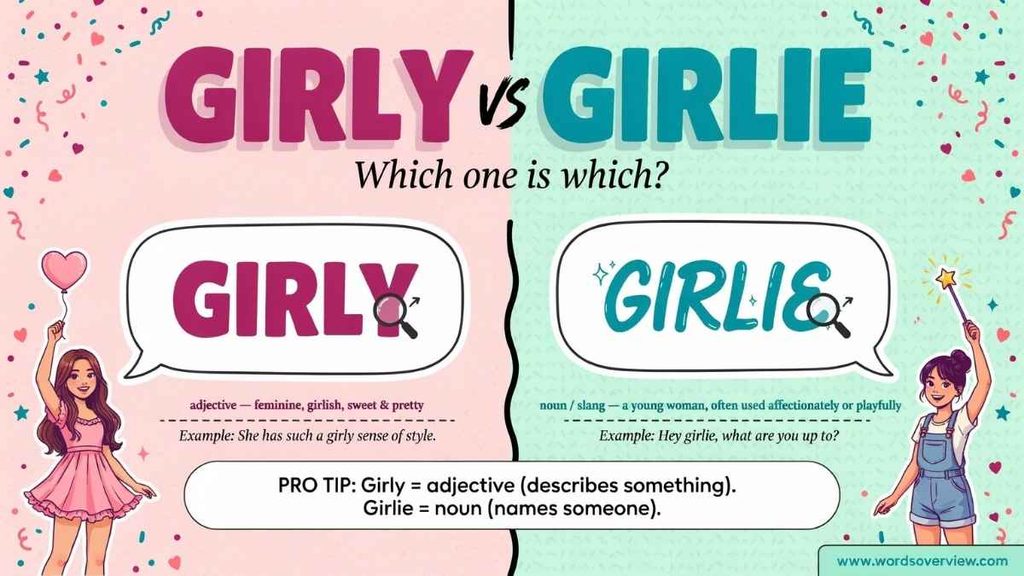
The girly or girlie difference isn’t simply a spelling difference.
Both words can function as adjectives with closely related meanings. However, girlie has additional noun and informal-address uses. As a result, it appears especially often in conversational English and social-media language.
Learn the difference between similar English words
Indecisive or Undecisive Which Word Is Correct?
Girly or Girlie: Meaning Comparison
As adjectives, the meanings overlap considerably.
For example:
- girly clothes means clothes associated with girls or traditional femininity.
- girlie clothes can communicate essentially the same idea.
The same pattern appears with:
- girly style
- girlie style
- girly fashion
- girlie fashion
- girly aesthetic
- girlie aesthetic
However, the tone can differ slightly. Girly often sounds more straightforward, while girlie can sound more playful or conversational.
Girly or Girlie: Grammatical Function
Grammar provides a clearer distinction.
| Sentence | Word | Function |
| She bought a girly dress. | girly | Adjective |
| She bought a girlie dress. | girlie | Adjective |
| Hey, girlie! | girlie | Noun/direct address |
| She likes girly colors. | girly | Adjective |
| The girlies went shopping. | girlies | Plural noun |
Therefore, the girly or girlie difference becomes most obvious when girlie functions as a noun or informal form of address.
Girly Spelling or Girlie Spelling
The girly spelling is straightforward: girly.
The girlie spelling uses -ie: girlie.
Both spellings are established in English. Therefore, if you’re asking is girly or girlie the correct spelling, the answer depends on how you’re using the word.
If you’re describing something, girly is often the most straightforward choice. If you’re addressing someone informally, girlie may fit more naturally.
Tone Can Change
Although dictionary meanings overlap, modern usage can give girlie a more playful or conversational tone.
For example:
She bought a girly handbag.
This sounds primarily descriptive.
Thanks, girlie!
This sounds like direct, informal address.
The distinction therefore comes partly from grammatical function, not simply from spelling.
Is Girly a Real Word?
Yes. Girly is a real English word.
It is an established adjective used to describe things associated with girls, women or traditionally feminine qualities. Dictionaries also recognize noun usage.
So the answer to is girly a word is an uncomplicated yes.
Girly Definition and Traditional Usage
The word traditionally describes things viewed as feminine or associated with girls.
Examples include:
- girly clothes
- girly behavior
- girly colors
- girly interests
- girly voice
- girly fashion
It can also describe a person who enjoys things traditionally associated with girls.
However, girly can carry a negative or dismissive tone in some contexts. Therefore, you shouldn’t assume that the word always communicates approval.
For example:
She loves the girly floral design.
Here, girly expresses appreciation.
By contrast:
He thinks the design looks too girly.
Here, the same word expresses a personal judgment.
The meaning depends heavily on the speaker and context.
Is Girlie a Real Word?
Yes. Girlie is a real English word, not merely a typo for girly.
The word has established dictionary uses and can function as both an adjective and a noun. Therefore, the answer to is girlie a word is clearly yes.
Established Dictionary Uses
As an adjective, girlie can describe something associated with girls or traditional femininity.
For example:
She bought a girlie dress.
It can also appear in older expressions such as girlie magazine, referring historically to publications featuring photographs of nude or scantily clad women.
As a noun, girlie can refer to a girl or young woman. However, this usage can sound offensive or objectifying in modern English.
Therefore, context matters greatly.
Modern Usage Is Broader
Contemporary online English has made several informal expressions highly visible:
- hey girlie
- the girlies
- gym girlie
- skincare girlie
- pop girlie
- fashion girlies
- girlie pop
These expressions often use girlie as a friendly label, identity marker or form of address rather than relying on its older meanings.
Learn the difference between similar English words
Families or Family’s Correct Usage and Difference
Girlie or Girly Slang: How the Internet Uses Them
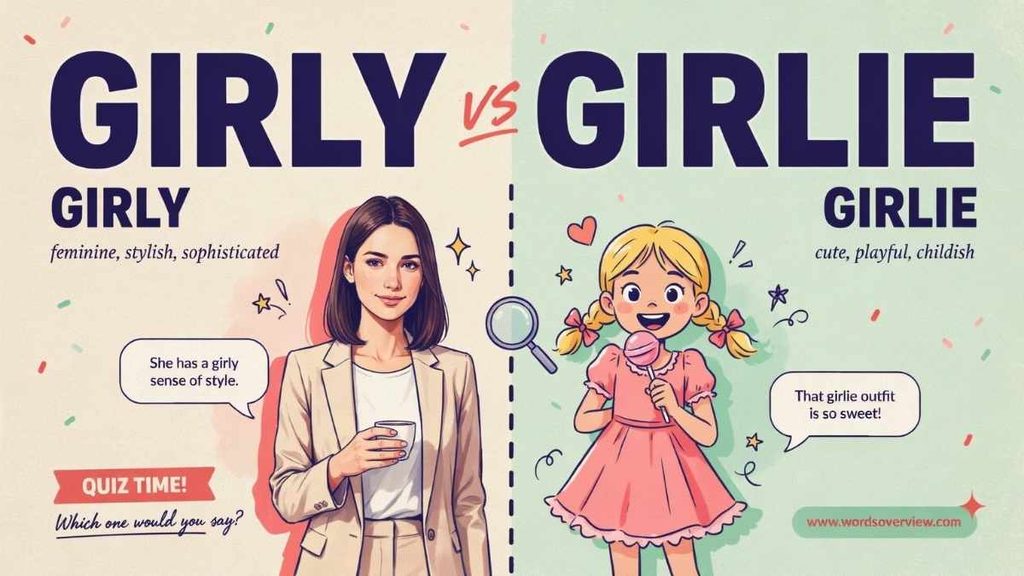
The internet has made girlie especially visible in everyday informal language.
Social-media communities frequently use girlie as a playful way to refer to women, female friends or people who share a particular interest.
However, the internet didn’t invent the word girlie. Instead, online communities have expanded its conversational uses.
What Does Girlie Mean in Slang?
The answer to what does girlie mean in slang depends on the context.
In modern casual language, girlie can function as:
- a friendly term for a female friend
- an informal form of address
- a playful label for a woman
- an identity label connected to an interest
- a term used within a female-centered online community
For example:
My skincare girlie routine is getting expensive.
Here, girlie forms part of an informal identity label.
Another example is:
Hey girlie, did you see the new collection?
Here, girlie functions as a friendly form of address.
What Does Girly Mean in Slang?
The girly slang meaning generally remains close to its ordinary adjective meaning.
It can describe something as:
- feminine
- cute
- traditionally associated with girls
- soft or playful
- strongly connected with a feminine aesthetic
For example:
That’s so girly!
Depending on the situation, the speaker might refer to pink colors, makeup, dresses, cute accessories or another feminine-coded aesthetic.
The tone can be approving, teasing, neutral or critical.
Learn the difference between similar English words
Analyses or Analysis Meaning and Correct Usage
Girlie or Girly on Social Media
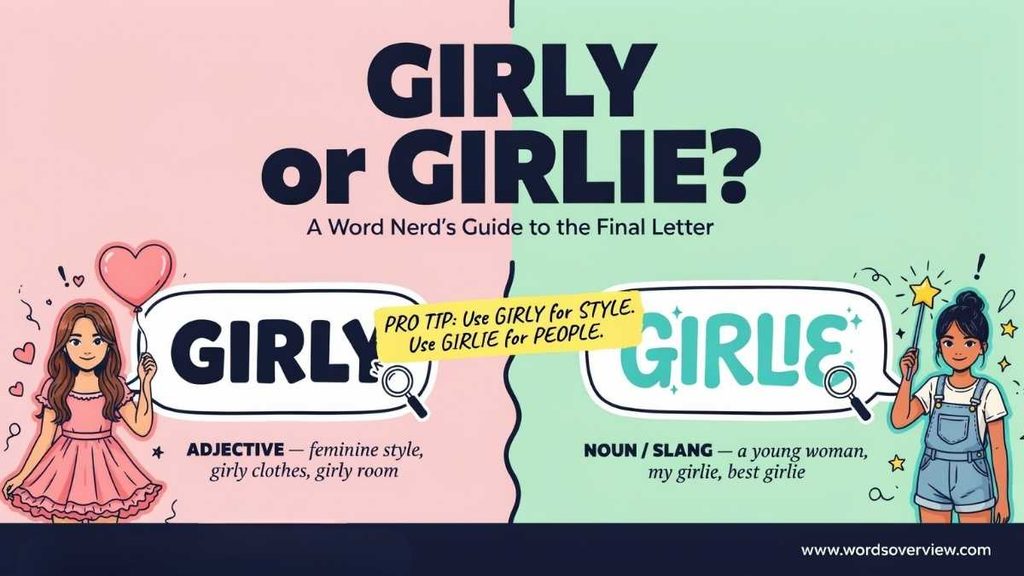
Online language often turns ordinary nouns and adjectives into identity labels.
A person might describe themselves as:
- a gym girlie
- a book girlie
- a coffee girlie
- a skincare girlie
- a fashion girlie
- a theater girlie
- a pop girlie
These expressions combine girlie with an interest or activity. As a result, the word becomes a playful identity label rather than simply a description of femininity.
Girlie or Girly on TikTok
The question of girlie or girly on TikTok is primarily a question of tone and usage.
TikTok and similar platforms favor short, expressive, conversational language. Therefore, girlie fits naturally into captions, comments, hashtags and casual dialogue.
For example:
Corporate girlie
is an informal identity label.
A formal alternative might be:
A woman working in a corporate environment.
The first expression is shorter and more playful. The second is more neutral and precise.
Therefore, TikTok usage shouldn’t automatically become a rule for formal English.
Girlies as a Modern Plural
Girlies is particularly common in online group references.
For example:
The girlies are going out tonight.
Here, girlies functions as a plural noun.
You can also see the pattern in expressions such as:
- pop girlies
- theater girlies
- fashion girlies
- book girlies
- fitness girlies
These phrases create a sense of shared identity and community.
Nevertheless, the audience still matters. A word that sounds affectionate among friends can sound patronizing when used by a stranger.
“Hey Girlie” Is It Correct?
Yes, “Hey, girlie!” is understandable and grammatically functional as informal direct address.
The comma matters because girlie directly addresses the person.
Compare:
Hey, Sarah!
and:
Hey, girlie!
The structure is the same. In both cases, the speaker addresses another person directly.
Is “Hey Girlie” Formal English?
No. “Hey, girlie!” is informal conversational English.
You wouldn’t normally use it in:
- a business letter
- an academic paper
- a formal complaint
- a professional report
- a legal document
However, you might naturally use it in:
- a text message
- a casual social-media comment
- a message to a friend
- informal online conversation
Can You Call Someone Girlie?
Yes, but whether you should depends on the relationship and context.
Modern online usage can make girlie sound affectionate. However, other dictionary-recorded uses can sound dismissive or offensive.
Therefore, don’t assume that everyone will interpret girlie positively.
If you don’t know how someone feels about the term, using their name or a neutral greeting is safer.
“Thanks, Girly” or “Thanks, Girlie”?
Both expressions can appear in informal conversation. However, “Thanks, girlie!” fits the modern direct-address pattern more clearly.
Compare:
Thanks, girlie! You saved me.
with:
Thanks, girly!
The first clearly treats girlie as an informal form of address.
By contrast, girly normally functions as an adjective:
Thanks for the girly-themed gift.
Therefore, the grammatical purpose helps determine the more natural spelling.
Learn the difference between confusing word pairs
Masonary or Masonry: Which Spelling Is Correct?
Girly Girl or Girlie Girl
Both girly girl and girlie girl can appear in English.
The basic idea is a girl or woman who strongly identifies with traditionally feminine interests, appearance, behavior or style.
For example:
She has always been a girly girl who loves dresses and floral patterns.
The expression can sound affectionate, neutral, playful or stereotypical depending on the context.
Importantly, the phrase doesn’t mean that every woman who enjoys traditionally feminine things is a “girly girl.” Instead, it describes a perceived style or identity.
Girlie Pop: What Does It Mean?
Girlie pop is an informal internet expression.
It isn’t simply another dictionary definition of girlie. Instead, it combines girlie with pop to create a playful expression associated with feminine-coded online language and pop-culture conversation.
For example:
Okay, girlie pop, tell us everything.
or:
The girlie pop playlist is ready.
The exact meaning depends on the context and speaker.
Therefore, girlie pop should be treated as a casual expression rather than a formal English term.
Girly or Girlie for a Product Description?
If you’re writing a product description, choose the word according to the brand’s intended tone.
Use Girly When:
- You need a familiar adjective.
- You’re describing a feminine aesthetic.
- The product has traditionally feminine styling.
- You want straightforward language.
Example:
A playful, girly phone case featuring floral patterns and pastel colors.
Use Girlie When:
- The brand deliberately uses conversational internet language.
- The audience understands informal online expressions.
- You’re creating a playful lifestyle identity.
- The wording appears in a casual campaign or social-media caption.
Example:
Your new favorite accessory for every coffee run, brunch date and girlie day.
The second example sounds more like brand language than neutral product terminology.
For professional product catalogs, alternatives such as feminine, floral, romantic, delicate or playful may provide greater precision.
Girly or Girlie for a Brand Description?
Brand voice can change the answer.
A traditional fashion company might write:
The collection combines feminine silhouettes with modern tailoring.
A playful social-media brand might write:
For every girlie who treats getting ready as an event.
Both sentences are understandable. However, they communicate different personalities.
This distinction matters for girly or girlie for a brand description because the choice isn’t purely grammatical. It also affects audience perception and brand positioning.
A Practical Brand-Voice Test
Before choosing the word, ask:
- Is the sentence formal or conversational?
- Am I describing a product or addressing a person?
- Does the brand normally use internet slang?
- Could the word sound childish or patronizing?
- Would feminine communicate the idea more precisely?
If the final answer is yes, feminine may be the better choice.
Girly or Girlish or Girlie
These three words are related, but they aren’t identical.
| Word | Main function | General idea |
| girly | Adjective | Associated with girls or traditionally feminine qualities |
| girlie | Adjective and noun | Similar adjective meaning with additional informal noun uses |
| girlish | Adjective | Like a girl or characteristic of a girl |
The distinction can be useful.
She has a girly style.
This focuses on a feminine-coded style.
She gave a girlish laugh.
This emphasizes a quality perceived as characteristic of a girl.
Hey, girlie!
This addresses a person informally.
Therefore, the three words overlap, but you shouldn’t treat them as perfect synonyms.
Learn the difference between tricky English words with easy explanations
Finalise or Finalize: Difference, Spelling and Usage
Formal or Informal Use of Girly and Girlie
Context matters more than many learners realize.
| Situation | Appropriate approach |
| Academic writing | Use precise terminology such as feminine when appropriate |
| Professional report | Prefer precise descriptive vocabulary |
| Casual conversation | Girly or girlie may work |
| Text message | Girlie can work as informal address |
| Social-media caption | Either can work depending on tone |
| Product description | Choose according to brand voice |
| Fashion content | Either can work depending on meaning |
| Direct address | Girlie is common in informal usage |
| Formal correspondence | Avoid slang-like direct-address uses |
This doesn’t mean girly is forbidden in professional writing. Instead, choose the word for its exact meaning and intended register.
Common Mistakes With Girly and Girlie
Mistake: Thinking Girlie Is a Misspelling
This is one of the most basic errors.
Girlie is not simply a misspelling of girly. It is an established English word with documented adjective and noun uses.
Mistake: Assuming the Words Are Completely Interchangeable
They overlap as adjectives, but girlie has additional noun and direct-address functions.
Compare:
a girly outfit
and:
Hey, girlie!
The grammatical roles differ.
Mistake: Treating Girlie as Always Positive
Modern social media often uses girlie warmly. However, traditional noun uses can carry negative or objectifying meanings.
Therefore, context and audience remain important.
Mistake: Treating Girly as Always Negative
Girly can be approving:
I love the girly floral design.
It can be neutral:
The room has a girly color scheme.
It can also be disapproving:
He thinks the design looks too girly.
The word itself doesn’t determine the attitude. The surrounding context does.
Mistake: Using Internet Slang in Formal Writing
Expressions such as:
- girlie pop
- gym girlie
- the girlies
- hey girlie
belong primarily to casual or conversational environments.
They’re useful when the intended tone calls for them. However, they aren’t automatically suitable for every form of English.
Learn the difference between everyday English mistakes
Devide or Divide Correct Spelling and Usage
Girly or Girlie: Comparison Table
| Point | Girly | Girlie |
| Standard word | Yes | Yes |
| Adjective | Yes | Yes |
| Noun | Possible in informal usage | Yes, with contextual limitations |
| Describes femininity | Yes | Yes |
| Common in casual English | Yes | Yes |
| Common in social-media expressions | Yes | Especially common |
| Direct address | Less common | Common in informal usage |
| Plural noun | Girlies | Girlies |
| Formal register | Use carefully | Use carefully |
| Main modern role | Description | Description, address and identity label |
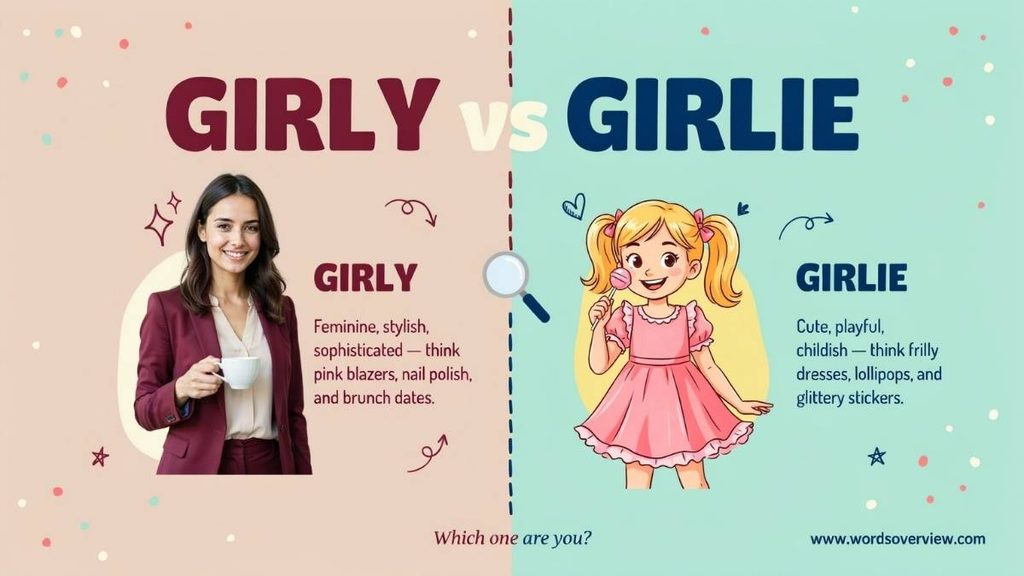
The table shows why girly or girlie isn’t simply a matter of right versus wrong.
How to Choose Between Girly and Girlie
If you’re still wondering should I use girly or girlie, follow this practical decision process.
Choose Girly When You Are Describing Something
Use girly when the word functions naturally as an adjective:
- girly fashion
- girly clothes
- girly colors
- girly bedroom
- girly style
- girly aesthetic
Choose Girlie When the Informal Noun or Address Fits
Use girlie in expressions such as:
- Hey, girlie!
- Thanks, girlie!
- the girlies
- gym girlie
- book girlie
- skincare girlie
These uses are particularly common in casual online language.
Choose Feminine When You Need Precision
If you’re writing formally, feminine can often replace girly when you mean characteristics traditionally associated with women or femininity.
For example:
The designer created a feminine aesthetic.
This is more precise than:
The designer created a girly aesthetic.
Neither sentence is inherently grammatically wrong. However, the intended register and meaning differ.
Girly or Girlie in Modern English
The girly or girlie in modern English distinction shows how vocabulary develops through everyday use.
Traditional dictionary meanings remain important. At the same time, social media has encouraged new combinations such as:
- gym girlie
- theater girlie
- pop girlie
- skincare girlie
- fashion girlies
- book girlie
These expressions combine girlie with an activity, interest, profession or identity.
As a result, the word can now function as a playful identity marker in informal communities.
This doesn’t mean older meanings have disappeared.
Instead, modern English contains several overlapping layers:
Traditional usage → informal usage → internet usage → community-specific usage
That progression is a normal feature of language change.
Girly or Girlie in American English
For girly or girlie in American English, both forms are established.
The adjective girly remains common in descriptions of traditionally feminine qualities. Meanwhile, girlie appears both as an adjective and in modern informal expressions.
Therefore, American English doesn’t support the simplistic rule that “girly is correct and girlie is wrong.”
A more accurate rule is:
Both are established words, but their grammatical functions and contexts can differ.
Is Girlie a Slang Word?
The answer depends on the specific use.
The word itself isn’t simply slang because dictionaries recognize it independently. However, modern uses such as girlie as a friendly form of address or gym girlie as an identity label are clearly informal.
Therefore:
- Girlie as an established adjective: not simply slang
- Girlie as a noun: informal and potentially offensive depending on usage
- Girlie as online identity language: informal internet language
- Girlie pop: playful informal expression
This distinction between the word itself and a particular slang usage is essential.
Is Girly or Girlie Correct?
The most accurate answer is:
Both “girly” and “girlie” are correct words, but the correct choice depends on how you use them.
Use girly when you want a straightforward adjective describing something associated with girls or traditional femininity.
Use girlie when its adjective form fits or when you’re using an informal noun, direct address or modern conversational expression.
If you’re asking is girly or girlie the correct spelling, don’t treat the question as a simple spelling contest.
Instead, think about grammar first.
Describing something? Use girly as a straightforward adjective.
Addressing someone informally? Girlie is common.
Talking about a group online? Girlies is common.
Writing formally? Consider feminine or another precise description.
Learn the difference between more words people mix up
Swifty or Swiftie: Spelling, Usage and Correct Word
Practice Session: Fill in the Blanks
Choose the correct form: girly, girlie, girlies or feminine
- She loves wearing ______ dresses with floral patterns.
- “Hey, ______! How have you been?” she asked her friend.
- The ______ are planning a shopping trip this weekend.
- The designer created a soft and ______ aesthetic.
- Her bedroom has a very ______ color scheme.
- “Thanks, ______!” she replied after receiving the gift.
- She prefers a more ______ style for formal events.
- The social-media post was written for all the fitness ______.
- He described the pink decorations as too ______ for his taste.
- “Okay, ______, tell me everything!” she said playfully.
- The brand uses a ______ design with pastel colors and floral details.
- The phrase “gym ______” is common in informal online language.
- The collection has a delicate, ______ appearance.
- The ______ went out for coffee after work.
- She doesn’t consider herself particularly ______.
- The room has a playful and ______ atmosphere.
- “Good luck, ______!” she wrote in the message.
- The advertisement targets fashion ______ who enjoy colorful accessories.
- The designer wanted to create a more ______ look rather than a youthful one.
- Calling someone “______” can sound friendly or patronizing depending on the context.
- The phrase “book ______” describes someone who identifies with a love of books in informal online language.
- She chose a ______ handbag decorated with small flowers.
- The word ______ is commonly used as an adjective to describe traditionally feminine qualities.
- In “Hey, girlie!”, the word ______ functions as an informal form of direct address.
- If you need a more formal alternative to “girly,” ______ may be a better choice.
Answer Session
- girly
- girlie
- girlies
- feminine
- girly
- girlie
- feminine
- girlies
- girly
- girlie
- girly
- girlie
- feminine
- girlies
- girly
- girly
- girlie
- girlies
- feminine
- girlie
- girlie
- girly
- girly
- girlie
- feminine
Frequently Asked Questions
Is it spelled “girly” or “girlie”?
Both girly and girlie are correct English words. Girly commonly works as an adjective, while girlie can also function as an informal noun or form of direct address.
What does “girlie” mean in English?
“Girlie” can describe something traditionally associated with girls or femininity. In informal English, it can also refer to a girl or woman or address someone affectionately.
Is “girlie” considered slang?
“Girlie” itself is an established English word, so it isn’t simply slang. However, expressions such as “hey girlie,” “gym girlie,” and “girlie pop” are informal and especially common in modern online language.
Can you call someone “girlie”?
Yes, you can call someone “girlie” in informal conversation. However, the term can sound affectionate, playful, patronizing or offensive depending on the relationship, tone and context.
What does “girly” mean in slang?
In informal or online language, girly can describe something cute, feminine, playful or strongly associated with traditionally feminine interests and aesthetics. The exact tone depends on context.
What is the difference between “girly girl” and “girlie girl”?
Both expressions can describe a girl or woman associated with traditionally feminine interests, appearance or behavior. “Girly girl” is the more familiar expression in general English, while “girlie girl” can sound more playful or informal.
What is another word for “girly”?
Depending on the intended meaning, alternatives include feminine, womanly, feminine-coded, delicate, pretty, cute or playful. The best replacement depends on the specific context.
What is the opposite of “girly”?
There isn’t one universal opposite of girly. Depending on context, possible contrasts include masculine, boyish, rugged or gender-neutral. These words describe different qualities rather than serving as exact opposites.
What does “girly girl” mean in slang?
A girly girl generally refers to a girl or woman who embraces traditionally feminine styles, interests or behaviors. The expression can sound affectionate, neutral, playful or stereotypical depending on how someone uses it.
Is “girly” a real English word?
Yes. Girly is an established English word that commonly functions as an adjective. It describes something associated with girls or traditionally feminine qualities, although its tone can vary with context.
Conclusion
The girly or girlie debate may look like a tiny spelling puzzle, but context solves it faster than a grammar detective with a magnifying glass. Girly usually works as an adjective for describing something associated with girls or traditional femininity. Girlie can also work as an adjective, but it appears more often in informal expressions, direct address and modern online language. So, don’t panic when these two words start competing for attention. Instead, check the sentence’s meaning, grammatical function, tone and audience. If you’re describing something, girly often fits naturally. If you’re saying “Hey, girlie!” or talking about “the girlies,” girlie makes more sense. In English, context usually gets the final vote.

Ethan AJS is an experienced blogger and language enthusiast at Words Overview, dedicated to making English easier to understand and use. He writes about grammar, vocabulary, spelling, word meanings and commonly confused words, turning tricky language questions into clear, practical insights. With a passion for effective communication, Ethan creates engaging, readerfocused content that helps readers write accurately, choose the right words and communicate with confidence.