
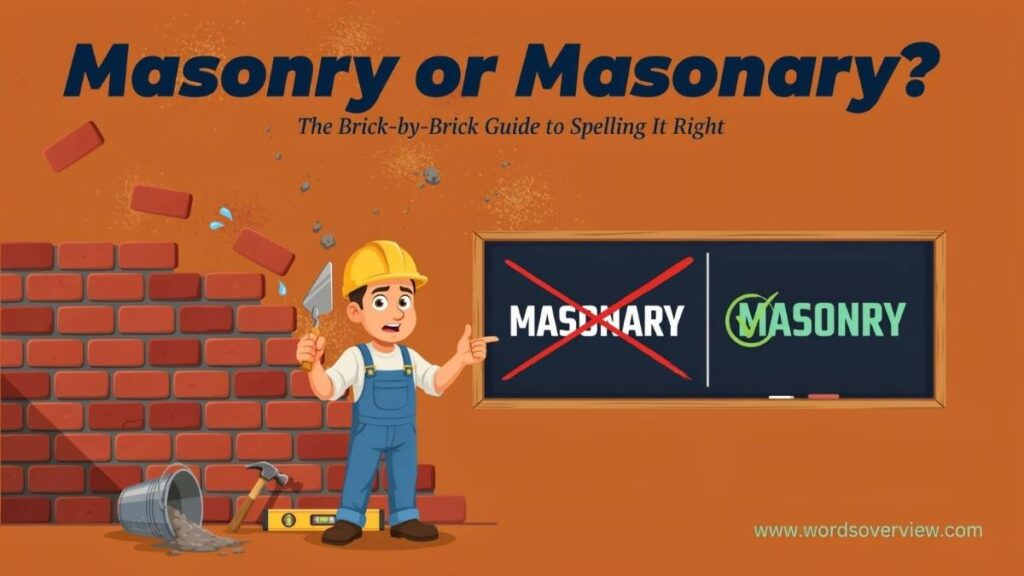
English spelling can turn a construction term into a tiny grammar headache. If you’ve searched for masonry or masonary, you’re not alone. One extra “a” sneaks into masonary, making it look convincing enough to fool a hurried writer or an autocorrect that clearly needs a hardhat. However, masonry is the correct spelling, whether you’re discussing brickwork, stonework or a contractor’s project. Understanding the difference helps you avoid awkward mistakes in reports, websites and everyday writing. So, before you build a sentence around masonary, put that extra letter back in the toolbox where it belongs. Your walls may need mortar; your spelling needs masonry.
Masonary or Masonry Which One Is Correct?
When you compare masonary or masonry, you aren’t choosing between two accepted spellings. Masonry is the standard English form.
If you’re asking, “Is masonry the correct spelling?”, the answer is yes. Dictionaries classify masonry as a noun and define it in connection with building materials, construction and the skill or work of building with materials such as brick and stone.
By contrast, masonary functions as a common misspelling of masonry. It may appear in online searches, informal writing, advertisements or user-generated content. However, frequent use doesn’t make an incorrect spelling standard.
Masonry Correct Spelling
The masonry correct spelling is:
M-A-S-O-N-R-Y
Not:
M-A-S-O-N-A-R-Y
A useful way to remember it is:
MASON + RY = MASONRY
That simple pattern can stop the extra “a” from sneaking into your writing.
What Does Masonry Mean?
The masonry meaning depends slightly on the context, but the central idea remains the same. Masonry relates to the craft, work or construction of structures and building elements with masonry units.
In everyday English, masonry can describe brickwork, stonework or a building structure made from those materials. In technical construction language, however, the term can have a broader meaning.
Masonry may involve:
- Bricks
- Natural stone
- Manufactured stone
- Concrete masonry units
- Concrete brick
- Mortar
- Grout
- Reinforcement
- Other approved masonry units
Therefore, masonry isn’t simply another word for brick.
For example, a brick wall represents masonry, but so does a properly constructed stone wall. Likewise, a concrete block wall can form part of a masonry system.
Masonry Definition in Simple English
A practical masonry definition is:
Masonry is the craft, work or construction of building with individual units such as brick, stone or concrete masonry units, commonly assembled with mortar, grout or another accepted method.
The exact technical definition can vary according to the construction standard or context. Nevertheless, the basic concept remains consistent: individual masonry units form a larger building assembly.
Learn the difference between tricky words and use them correctly
Genious or Genius: Which Spelling Is Correct?
What Is Masonry in Construction?
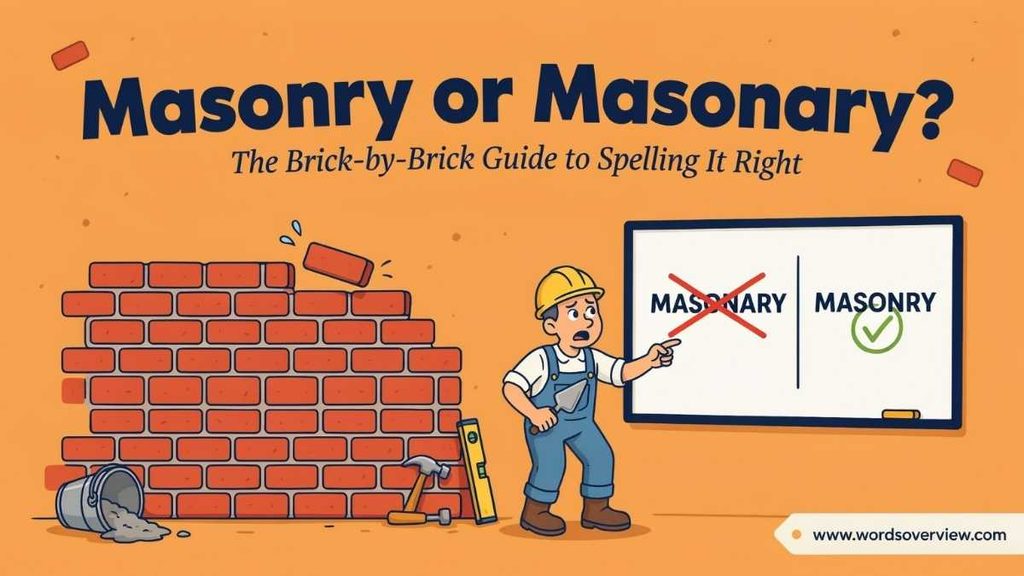
If you’re wondering what is masonry in construction, think beyond a simple pile of bricks.
Masonry construction uses individual building units to create walls, structures, surfaces and other building elements. Each unit occupies a specific position within the overall assembly. Meanwhile, joints, bonding patterns, mortar, grout, reinforcement and other components help the assembly perform as intended.
For example, consider a brick wall. Hundreds or thousands of individual bricks form one larger structure. Mortar commonly occupies the joints between those bricks, while the arrangement of the units creates the wall’s bond and overall pattern.
Some masonry systems also incorporate grout and reinforcement. Grout can fill designated cores or cavities, while reinforcement can improve the structural behavior of reinforced masonry.
Consequently, masonry construction involves much more than simply stacking bricks.
Common Masonry Materials
| Material | Common use or function |
| Brick | Walls, facades, partitions and architectural features |
| Stone | Walls, facades, foundations, retaining structures and decorative work |
| Concrete masonry units | Structural and nonstructural walls and partitions |
| Concrete brick | Brick-like masonry applications |
| Mortar | Commonly bonds masonry units and forms joints |
| Grout | Fills designated spaces and can surround reinforcement |
The exact materials depend on the building design, structural requirements, climate, applicable codes and intended use.
Why Do People Misspell Masonry as “Masonary”?
The masonary spelling mistake isn’t difficult to understand. At first glance, the incorrect form looks reasonable.
The word begins with mason, which makes writers naturally expect the longer word to follow a familiar pattern. Someone may therefore write masonary instead of masonry.
Pronunciation can add to the confusion. In normal conversation, the middle sounds of masonry can pass quickly. As a result, a listener may imagine an extra vowel that doesn’t appear in the written word.
However, English spelling doesn’t always follow pronunciation perfectly.
The established form is:
masonry
Not:
masonary
Why Is Masonary Wrong?
The issue isn’t that readers can’t understand masonary. Most people can figure out the intended meaning from context.
The problem is that masonary isn’t the standard spelling of the construction term. Therefore, formal and professional writing should use masonry.
This distinction matters in:
- Construction reports
- Building specifications
- Contracts
- Academic assignments
- Architecture documents
- Property descriptions
- Business websites
- Resumes
- Technical articles
- Job descriptions
A small spelling error can look especially noticeable when it appears repeatedly in professional material.
Is Masonary a Word?
The question “is masonary a word?” often appears because the spelling occurs online. However, online visibility doesn’t automatically make a spelling standard.
Masonary is generally treated as a misspelling of masonry, rather than an accepted alternative spelling of the construction term.
So, the answers are straightforward:
- Is masonary a word? Not as the standard spelling of the construction term.
- Is masonary correct? No.
- Is masonary a real word? It can appear as a misspelling or as part of an intentional proper name, but it isn’t the standard spelling.
- What does masonary mean? In construction writing, it normally represents the intended word masonry.
Learn the difference between similar English words
Analyses or Analysis Meaning and Correct Usage
Masonary Meaning or Masonry Meaning
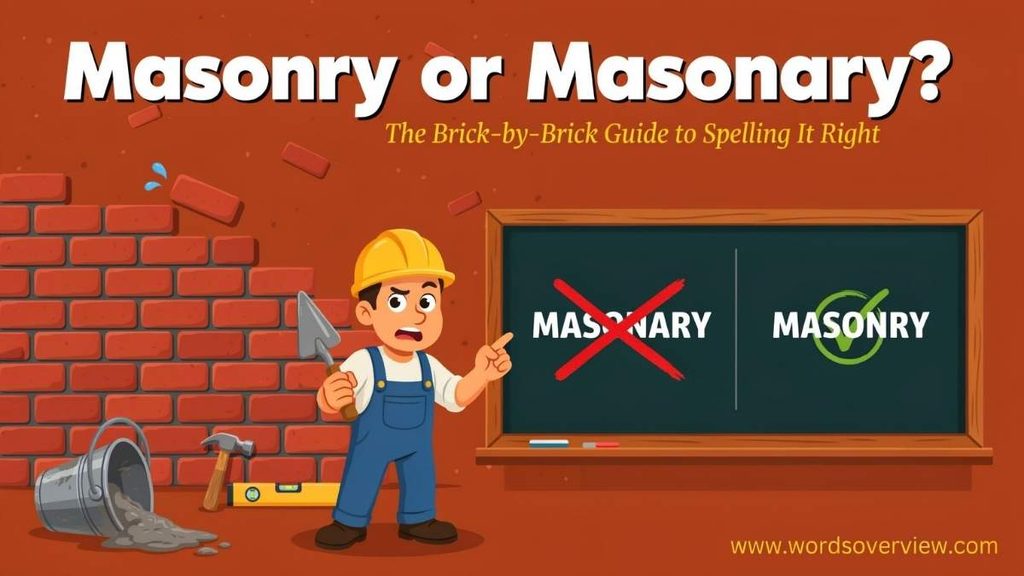
There isn’t a separate standard masonary meaning that competes with the meaning of masonry.
For example:
The building has attractive masonary work.
The intended sentence is:
The building has attractive masonry work.
The second version uses the standard construction term.
Is Masonry a Word?
Yes. Masonry is a standard English word and a noun.
The word has established meanings in dictionaries and in the construction industry. In ordinary usage, it can describe the craft or work of building with materials such as brick and stone. In technical contexts, it can refer to a specific construction assembly.
Therefore, if you’re asking “is masonry a word?”, the answer is an unequivocal yes.
Masonry as a Noun
Masonry normally functions as a noun.
For example:
- The masonry needs repair.
- The contractor inspected the masonry wall.
- The building contains original stone masonry.
- The project uses reinforced concrete masonry.
- The architect specified masonry construction.
Notice that masonry usually refers to a general material, craft or construction system rather than individual pieces.
You wouldn’t normally say:
I bought three masonries.
Instead, you would specify the individual units:
I bought three masonry units.
Likewise, you might say:
The building contains several types of masonry.
How Do You Spell Masonry?
If you’re searching for how to spell masonry or how do you spell masonry, remember the sequence:
M-A-S-O-N-R-Y
The most important point is simple: there is no “a” between the “n” and the “r.”
| Correct | Incorrect |
| masonry | masonary |
| masonry wall | masonary wall |
| masonry work | masonary work |
| brick masonry | brick masonary |
| stone masonry | stone masonary |
| masonry construction | masonary construction |
An Easy Way to Remember the Spelling
Think about the relationship between the person and the craft:
A mason performs masonry.
The first word is mason.
The second is masonry.
This connection provides a much better memory aid than trying to memorize the entire spelling letter by letter.
Masonry Pronunciation Why It Can Cause Confusion
The masonry pronunciation can make the spelling less obvious.
In American English, the word is commonly pronounced approximately as:
MAY-sən-ree
The first syllable carries the main stress.
Because speakers often pronounce the middle sounds quickly, listeners may imagine an additional vowel. That imagined vowel can then appear in writing as the extra a in masonary.
In other words, pronunciation may explain the mistake, but it doesn’t change the spelling.
This distinction matters when you’re learning written English. Some words sound different from what their spelling might lead you to expect. Masonry is one of those words where remembering the written form proves more useful than trying to spell it entirely from sound.
Learn the difference between everyday English mistakes
Girly or Girlie Correct Usage and Difference
The Origin and History of the Word “Masonry”
The history of masonry connects directly with the word mason.
The word masonry developed from historical French forms related to maçon, meaning a mason. English later adopted related forms referring to the work or craft of a mason.
That history explains why masonry has its established spelling. It isn’t simply a modern combination of mason and an independently added -ary ending.
The relationship is clearer when you compare the two words:
Mason → the worker
Masonry → the craft or work
A mason works with building materials such as brick and stone. Masonry describes the associated trade, craft, work or construction.
Mason and Masonry
Consider these sentences:
The mason repaired the wall.
Here, mason refers to the person.
The masonry required repairs.
Here, masonry refers to the construction or material.
That distinction makes the relationship much easier to remember.
Masonry in a Sentence
Seeing the word in context can make its usage much clearer.
Here are natural examples of masonry in a sentence:
- The contractor inspected the masonry wall for cracks.
- The historic building contains original stone masonry.
- The workers repaired damaged brick masonry.
- The architect specified a durable masonry facade.
- Moisture had damaged part of the building’s masonry.
- The project uses reinforced concrete masonry.
- The engineer reviewed the design of the masonry structure.
- The homeowner hired a masonry contractor to repair the chimney.
Notice how naturally masonry combines with other construction terms.
Examples With the Incorrect Spelling
Incorrect:
The contractor specializes in masonary work.
Correct:
The contractor specializes in masonry work.
Incorrect:
The old building has beautiful stone masonary.
Correct:
The old building has beautiful stone masonry.
Incorrect:
We need to inspect the masonary wall.
Correct:
We need to inspect the masonry wall.
The correction remains the same regardless of the sentence: replace masonary with masonry.
Learn the difference between everyday English mistakes
Devide or Divide Correct Spelling and Usage
Common Masonry Types in Construction
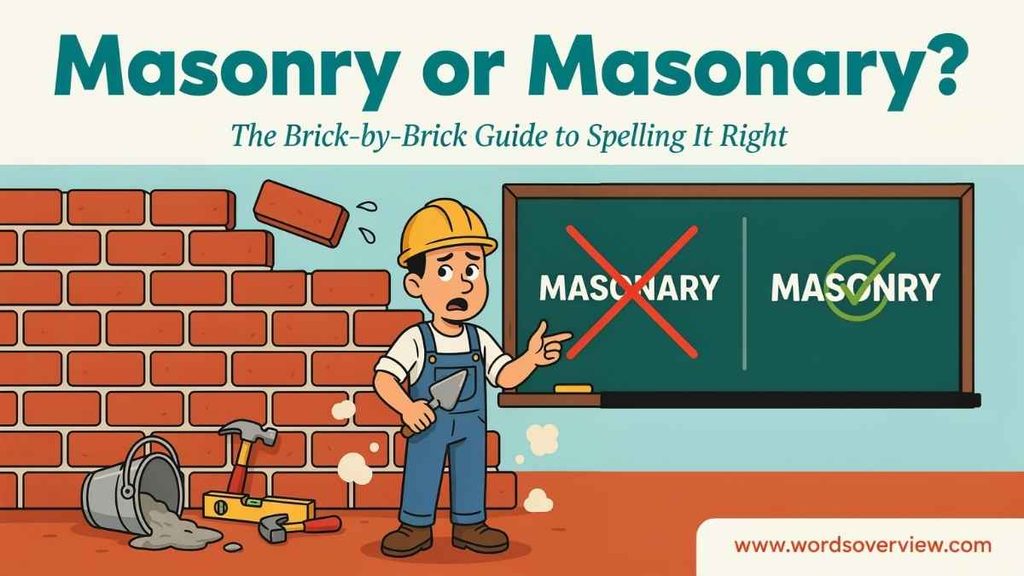
Once the spelling question is settled, the construction meaning becomes easier to understand. Masonry covers several materials and construction systems, so the term has a broader meaning than brickwork alone.
Brick Masonry
Brick masonry uses brick units to construct walls and other architectural or structural elements.
Brickwork can serve practical and visual purposes. Depending on the design, brick may contribute to structural performance, weather protection, appearance or several of these functions at once.
A skilled mason must consider factors such as unit placement, mortar joints, bonding patterns, alignment and detailing.
Stone Masonry
Stone masonry uses natural or manufactured stone units.
Stonework appears in:
- Exterior walls
- Retaining walls
- Foundations
- Facades
- Landscape structures
- Historic buildings
- Architectural features
Stone varies considerably in size, shape, density, texture and absorption. Therefore, proper material selection and construction techniques matter.
Concrete Masonry
Concrete masonry commonly uses concrete masonry units, often called CMUs.
CMUs may be solid or hollow. Builders use them in both structural and nonstructural applications.
Concrete masonry can form:
- Exterior walls
- Interior partitions
- Foundation walls
- Fire-rated assemblies
- Retaining structures
- Commercial building components
The appropriate system depends on the project’s structural and architectural requirements.
Veneer Masonry
Masonry veneer functions as a facing system supported by an appropriate backing or support arrangement.
That distinction matters because a masonry veneer wall isn’t automatically the same as a solid structural masonry wall.
Veneer can provide an attractive exterior appearance while working with another structural system behind it. Depending on the design, the veneer may use different attachment and support methods.
Common Masonry Materials
Masonry construction involves much more than bricks and stones.
Masonry Units
A masonry unit is an individual component used to create a masonry assembly.
Common examples include:
- Bricks
- Concrete blocks
- Concrete brick
- Natural stone
- Manufactured stone
- Glass masonry units
Each type has different physical properties and appropriate applications.
Mortar
Mortar commonly joins masonry units and forms the joints between them.
However, mortar does more than simply hold bricks together. Its properties influence bonding, joint performance, moisture behavior, appearance and the interaction between masonry units.
Different masonry applications require appropriate mortar characteristics. Therefore, choosing mortar based only on appearance isn’t enough.
Grout
Grout has a different role from mortar.
In masonry construction, grout can fill designated cores, cavities and spaces. In reinforced masonry, it can surround reinforcement and help transfer forces between the reinforcement and surrounding masonry.
Therefore, it’s useful to remember:
Mortar commonly bonds masonry units, while grout fills designated spaces and can work with reinforcement.
Using the terms interchangeably can create confusion in technical writing.
Learn the difference between more words people mix up
Swifty or Swiftie: Spelling, Usage and Correct Word
Masonry or Bricklaying: What’s the Difference?
Masonry is the broader term, while bricklaying focuses specifically on work involving bricks.
A bricklayer may therefore perform masonry work, but masonry includes much more than bricklaying.
| Masonry | Bricklaying |
| Broad construction craft or trade | Specific brick-focused work |
| Can involve brick, stone, concrete units and other masonry units | Primarily involves brick |
| Includes several construction systems | Represents one specialized area |
| Can have structural and architectural applications | Focuses on laying and constructing with brick |
For example, stonework falls within the broader field of masonry, even though it isn’t bricklaying.
This distinction becomes particularly useful when reading construction job descriptions or technical documents.
Learn the difference between similar English words
Families or Family’s Correct Usage and Difference
Masonry Construction Techniques and Terms
Professional masonry construction uses a specialized vocabulary. Understanding a few common terms can make technical documents much easier to follow.
- Bond: The arrangement and connection of masonry units within an assembly.
- Course: A horizontal layer of masonry units.
- Bed joint: A horizontal joint between masonry units.
- Head joint: A vertical joint between masonry units.
- Wythe: A continuous vertical section of a wall that is one masonry unit thick.
- Reinforced masonry: Masonry that incorporates reinforcement designed to work with the masonry.
- Unreinforced masonry: Masonry that doesn’t rely on structural reinforcement in the same way reinforced masonry does.
- Veneer: Masonry used as a facing system.
- Grouted masonry: Masonry in which specified spaces are filled with grout.
These terms show why masonry represents a genuine building trade, not merely the act of placing bricks next to one another.
Learn the difference between similar English words
Indecisive or Undecisive Which Word Is Correct?
Advantages and Limitations of Masonry Construction
Masonry has remained important in construction because it offers several useful characteristics. However, like every construction system, it also has limitations.
Durability
Properly designed and constructed masonry can provide a long service life.
Historic masonry buildings demonstrate the potential durability of well-built masonry. Nevertheless, durability depends on several factors, including material selection, workmanship, moisture management, exposure conditions, detailing and maintenance.
A masonry wall doesn’t become durable simply because it contains brick or stone. The entire assembly matters.
Fire Resistance
Many masonry assemblies provide significant resistance to fire exposure.
However, the actual fire-resistance rating depends on the materials, wall configuration, thickness, aggregate type, assembly details and applicable testing or building-code requirements.
Therefore, you shouldn’t assume that every masonry wall has the same fire rating.
Thermal and Acoustic Performance
Masonry’s mass can contribute to thermal and acoustic performance.
Still, the word masonry alone doesn’t tell you how well a wall performs. Wall thickness, material density, insulation, air spaces, finishes, openings and the overall assembly all influence performance.
Weight
Masonry can be heavy.
That weight can provide useful mass and stability, but structural designers must account for it when designing foundations, supporting elements, connections and other building components.
Skilled Labor
Quality masonry requires appropriate workmanship.
Alignment, joint tooling, mortar selection, unit placement, reinforcement, flashing, drainage and other details can affect the final performance of a masonry assembly.
As a result, masonry work often requires trained and experienced workers rather than simple manual labor.
Masonry Terms You Should Know
| Term | Simple meaning |
| Mason | A person who works with masonry |
| Masonry | The craft, work or construction involving masonry units |
| Masonry unit | An individual unit used in masonry construction |
| Mortar | Material commonly used to bond masonry units |
| Grout | Material used to fill designated spaces and, in reinforced systems, surround reinforcement |
| Brick masonry | Masonry constructed with brick units |
| Stone masonry | Masonry constructed with stone |
| Concrete masonry | Masonry using concrete masonry units |
| Masonry wall | A wall constructed as a masonry assembly |
| Masonry veneer | A masonry facing supported by an appropriate backing or support system |
| Reinforced masonry | Masonry incorporating reinforcement that works with the assembly |
Common Masonry Spelling Mistakes
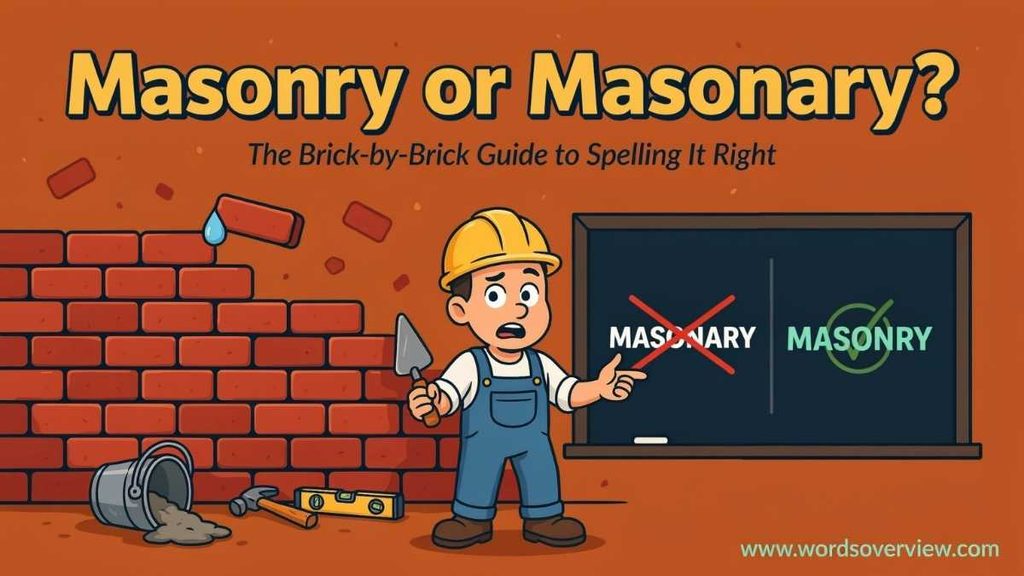
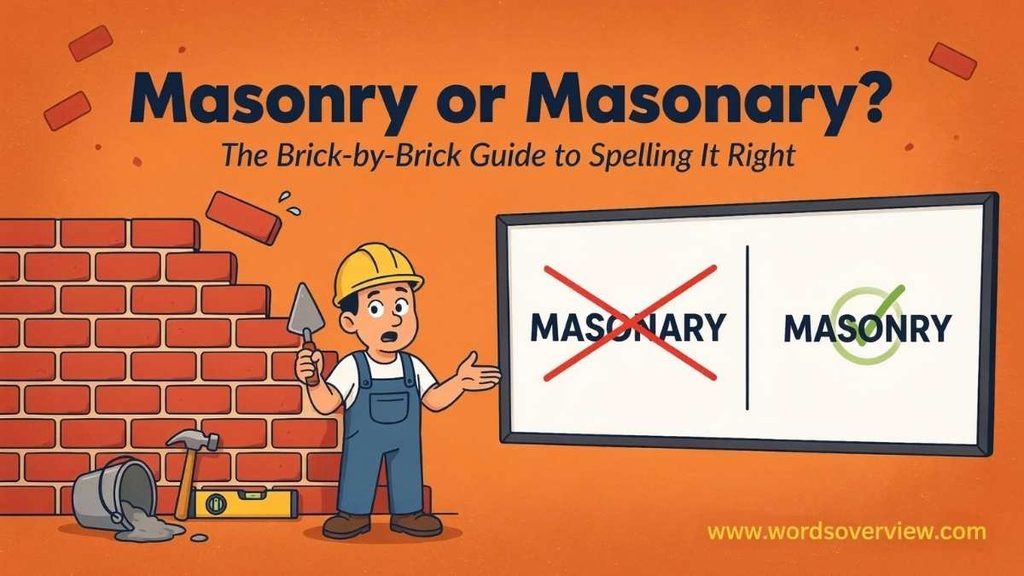
The most obvious masonry spelling mistake is adding an extra a:
❌ masonary
The standard spelling is:
✅ masonry
Another incorrect form sometimes appears as:
❌ masonery
Again, the standard form remains:
✅ masonry
Correct and Incorrect Examples
| Incorrect spelling | Correct spelling |
| masonary | masonry |
| masonery | masonry |
| masonary work | masonry work |
| masonary wall | masonry wall |
| masonary construction | masonry construction |
| masonary contractor | masonry contractor |
If you’re proofreading construction content, searching specifically for masonary and masonery can help you catch repeated errors quickly.
Learn the difference between more words people mix up
13rd or 13th: Which Is Correct?
Is “Masonary” Ever Acceptable?
For standard English construction writing, masonary isn’t the accepted spelling of masonry.
There is one useful distinction, however. A company, website, product, username or other proper name might intentionally use Masonary as part of its name.
That doesn’t change the standard English spelling.
For ordinary writing, use:
masonry
rather than:
masonary
A proper name can preserve its chosen spelling, but standard English prose should use the established form.
American or British English: Masonry Spelling
Unlike words that change spelling between American and British English, masonry generally keeps the same spelling in both varieties.
The standard form is:
masonry
Not:
masonary
This isn’t a situation like:
- American: color | British: colour
- American: center | British: centre
You don’t switch from masonry to masonary depending on your variety of English.
Masonry or Masonary Spelling Rule
A simple rule works in both American and British English:
Write masonry, not masonary.
That’s the spelling to use in formal writing, everyday writing and professional construction documents.
Masonry and Freemasonry: Are They Related?
The word Masonry can cause another kind of confusion because capitalized Masonry may refer to Freemasonry in certain contexts.
The construction meaning and the fraternal meaning are different.
Construction Masonry
Lowercase masonry commonly refers to:
- Brickwork
- Stonework
- Masonry construction
- Masonry walls
- Masonry work
- Masonry structures
- The masonry trade
Freemasonry
Freemasonry refers to a fraternal organization and tradition. In that context, terms such as Masonic, Mason and Masonry can carry meanings connected with the organization.
Context usually makes the intended meaning clear.
For example:
The engineer inspected the masonry wall.
Here, the meaning clearly relates to construction.
By contrast:
He joined a Masonic organization.
Here, the context clearly concerns Freemasonry.
Therefore, construction masonry and Freemasonry shouldn’t be treated as the same subject simply because they share historical terminology.
What Does a Mason Do?
A mason is a skilled worker whose trade involves building, repairing or working with masonry materials.
Depending on the specialization, a mason may work with:
- Brick
- Stone
- Concrete masonry units
- Mortar
- Grout
- Reinforcement
- Masonry veneer systems
A brick mason focuses primarily on brickwork, while a stonemason specializes in stonework.
The broader relationship is easy to remember:
Mason → person
Masonry → craft, work or construction
So, if someone asks “what does a mason do?”, the answer goes beyond simply “builds walls.” A mason can construct, repair, maintain or finish masonry elements depending on the trade and project.
What Is Masonry Work?
Masonry work includes the construction, repair, alteration, maintenance or finishing of masonry assemblies.
Common examples include:
- Building brick walls
- Constructing concrete block walls
- Installing stone masonry
- Repairing damaged mortar joints
- Constructing masonry veneer
- Building masonry chimneys
- Repairing masonry facades
- Installing masonry features
- Restoring historic masonry
The exact work depends on the project.
For example, a residential masonry contractor might repair a chimney or construct a brick feature wall. Meanwhile, a commercial masonry contractor may work on large structural walls, facades, partitions or other building components.
Learn the difference between similar English words the easy way
Uncapable or Incapable: Which Spelling Is Correct?
A Practical Case Study: Correcting a Masonary Spelling Mistake
Imagine a construction company creates a service page titled:
Professional Masonary Contractor Services
The intended meaning is obvious. Nevertheless, the spelling is incorrect.
The corrected heading would be:
Professional Masonry Contractor Services
Now imagine that the same mistake appears throughout the company’s website:
- Service pages
- Job advertisements
- Company brochures
- Project descriptions
- Email templates
- Construction proposals
One spelling mistake can quickly become a repeated editorial problem.
The solution is straightforward. Establish masonry as the standard spelling, then search the website and documents for common variants such as masonary and masonery.
The lesson is practical:
When a technical term appears repeatedly in professional content, correcting its spelling once can prevent the same mistake from appearing everywhere else.
Masonry Facts Worth Knowing
The spelling question may be simple, but the construction term itself has considerable depth.
Here are several useful facts:
- Masonry is a noun. It can describe a craft, type of work, material category or construction system.
- Masonry isn’t limited to brick. Stone and concrete masonry units also form important masonry systems.
- Mortar and grout have different functions. They shouldn’t be treated as interchangeable materials.
- Concrete masonry units can be hollow or solid.
- Masonry can incorporate reinforcement.
- Masonry veneer isn’t automatically the same as a solid structural masonry wall.
- Masonry can refer to more than one concept depending on context. Construction is one meaning, while Freemasonry provides another context.
- The word has historical roots connected with the mason trade.
- Masonry construction requires attention to materials, joints, detailing, workmanship and structural requirements.
These facts also explain why masonry remains a useful technical term across construction, architecture, engineering and property-related writing.
Masonary or Masonry: Quick Reference
| Question | Answer |
| What is the correct spelling of masonry? | Masonry |
| Is masonary correct? | No, not as the standard spelling of the construction term |
| Is masonary a word? | It is commonly treated as a misspelling of masonry |
| Is masonry a word? | Yes |
| What does masonry mean? | The craft, work or construction involving masonry units |
| What is masonry in construction? | Construction involving masonry units assembled into walls, structures or other building elements |
| How do you spell masonry? | M-A-S-O-N-R-Y |
| How do you pronounce masonry? | Approximately MAY-sən-ree in American English |
| What does a mason do? | A mason works with materials such as brick and stone in construction |
| What is brick masonry? | Masonry constructed with brick units |
| What is stone masonry? | Masonry constructed with stone |
| Is masonry related to Freemasonry? | The terms share historical roots, but their modern meanings differ |
Practice Session Masonry or Masonary
Fill in each blank with the correct word or phrase. Pay close attention to spelling, meaning and construction terminology.
Questions
- The correct spelling is __________, not masonary.
- The contractor specializes in __________ construction.
- The historic building has beautiful stone __________.
- A skilled __________ can work with brick and stone.
- The workers repaired the damaged __________ wall.
- __________ is a common misspelling of masonry.
- Brick, stone and concrete masonry units can all be used in __________ construction.
- The correct spelling of the word is masonry, with no extra __________ between the “n” and “r.”
- Brick __________ uses brick units to construct walls and other building elements.
- Stone __________ uses stone units in construction.
- Mortar commonly helps __________ masonry units together.
- A concrete masonry unit is commonly abbreviated as __________.
- The word masonry is normally used as a __________.
- The person who works with brick and stone is called a __________.
- The sentence “The building needs masonary repairs” contains a __________ mistake.
- The correct phrase is “masonry __________,” not “masonary work.”
- __________ is the broader term because it can include brick, stone and concrete masonry units.
- Brickwork is one type of __________ work.
- The correct pronunciation of masonry begins approximately with the sound __________.
- The word masonry is historically connected with the word __________.
- A wall constructed with concrete masonry units is an example of __________ masonry.
- A person who specializes in working with stone may be called a __________.
- In the phrase “masonry wall,” masonry describes the type of __________.
- “Masonary” should generally be replaced with __________ in formal writing.
- A simple way to remember the spelling is MASON + __________ = MASONRY.
Answer Session
- masonry
- masonry
- masonry
- mason
- masonry
- Masonary
- masonry
- a
- masonry
- masonry
- bond
- CMU
- noun
- mason
- spelling
- work
- Masonry
- masonry
- MAY-sən-ree
- mason
- concrete
- stonemason
- construction
- masonry
- RY
Frequently Asked Questions
Is it spelled “masonry” or “masonary”?
Masonry is the correct spelling. Masonary is a common misspelling and should be avoided in standard English and professional construction writing.
What does “masonry” mean?
Masonry refers to the craft, work or construction involving materials such as brick, stone and concrete masonry units. It can describe both the construction process and the resulting masonry assembly.
Is “masonary” a word?
Masonary is not the standard spelling of the construction term. It commonly appears as a spelling mistake for masonry, so professional writing should use masonry.
How do you spell “masonry” correctly?
The correct spelling is M-A-S-O-N-R-Y: masonry. A simple way to remember it is mason + ry = masonry, without an extra “a.”
What is masonry in construction?
In construction, masonry refers to assemblies made from masonry units such as bricks, stones or concrete masonry units. Depending on the system, mortar, grout and reinforcement may also form part of the assembly.
What is the difference between masonry and brickwork?
Masonry is the broader term because it can include brick, stone, concrete masonry units and other masonry materials. Brickwork specifically refers to construction or work involving bricks.
Is brick considered masonry?
Yes. Brick is a type of masonry unit and structures constructed with brick can form brick masonry. However, masonry isn’t limited to brick because it can also involve stone and concrete masonry units.
Is concrete considered masonry?
Concrete itself isn’t automatically synonymous with masonry. However, concrete masonry units (CMUs) are masonry units and construction using those units is known as concrete masonry. Cast-in-place concrete represents a different construction system.
What is the difference between a mason and masonry?
A mason is a skilled worker who works with materials such as brick and stone. Masonry refers to the craft, work, materials or construction associated with that trade. In simple terms, a mason performs masonry.
Why is “masonary” commonly misspelled as “masonry”?
Actually, the reverse is the common mistake: writers often spell masonry as masonary. The error likely occurs because the pronunciation can make an extra vowel seem natural. Remembering mason + ry = masonry helps prevent the mistake.
Conclusion
The masonry or masonary confusion may look like a tiny spelling problem, but that extra “a” can make your writing wobble like a poorly built wall. Masonry is the correct spelling, while masonary is a common misspelling. Whether you’re writing about brick masonry, stone masonry, masonry construction or masonry work, stick with the standard form. The easiest trick is to remember mason + ry = masonry. Once you lock that pattern into memory, there’s no need to let the extra “a” sneak onto the construction site again. After all, good masonry needs strong materials and good writing needs correct spelling.

Ethan AJS is an experienced blogger and language enthusiast at Words Overview, dedicated to making English easier to understand and use. He writes about grammar, vocabulary, spelling, word meanings and commonly confused words, turning tricky language questions into clear, practical insights. With a passion for effective communication, Ethan creates engaging, readerfocused content that helps readers write accurately, choose the right words and communicate with confidence.




