
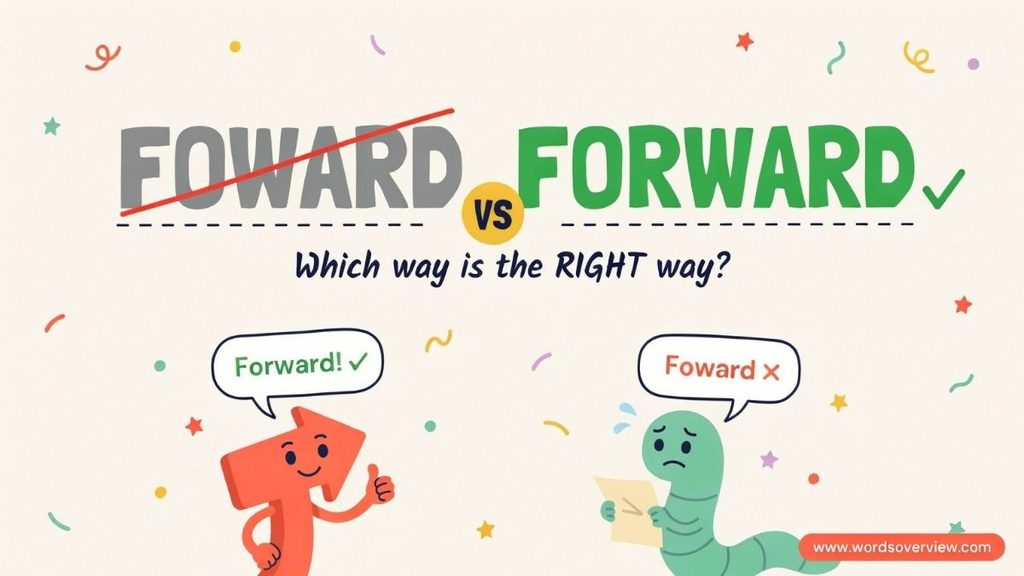
Have you ever typed “foward” so quickly that you didn’t notice the missing “r”? You’re not alone. The confusion around forward vs foward catches plenty of people, especially when they’re typing fast or relying on how the word sounds. At first glance, the two spellings look almost identical, so that tiny missing letter can easily slip past your eyes. However, only one is the standard spelling in modern English. In this guide, you’ll learn which form is correct, what “forward” means, why “foward” appears so often and how to remember the spelling without giving your keyboard another chance to betray you.
Foward vs Forward Quick Answer
When comparing forward vs foward, only one spelling is correct in standard English:
| Spelling | Correct? | Meaning | Example |
| forward | Yes | Toward the front, ahead, onward or sent onward | “Please move forward.” |
| foward | No | Incorrect spelling of “forward” | “Please move foward.” ❌ |
Therefore, if you’re asking, “is it forward or foward?” choose forward.
The same rule applies to searches such as foward vs forward, forward or foward and forward vs foward which is correct.
Correct: forward
Incorrect: foward
A simple spelling pattern can help you remember it:
FOR + WARD = FORWARD
The word begins with for, not fow. So, when you ask how to spell forward, remember the complete form:
F-O-R-W-A-R-D
Learn the difference between basic English word mistakes
This Is She or This Is Her: Which Is Correct?
What Does “Forward” Mean?
The forward meaning depends on how you use the word. It can describe direction, position, progress, communication or a person’s position in certain sports.
The word can function as an adverb, adjective, verb and noun. As a result, its exact meaning changes slightly according to the sentence.
Forward as an Adverb
As an adverb, forward usually describes movement toward the front or ahead.
For example:
- “Take one step forward.”
- “The car moved forward.”
- “She leaned forward to hear him.”
- “The children ran forward.”
- “Please move forward.”
In each example, forward describes direction. Something moves or shifts toward the front or ahead.
For instance, imagine standing in a line. If you move closer to the person at the front, you move forward.
Learn the difference between commonly confused words in English
Pair or Pare: Meaning, Difference and Use Correctly
Forward as an Adjective
Forward can also function as an adjective. In this role, it describes something positioned toward the front or something associated with future progress.
Consider these examples:
- “The forward seats were already occupied.”
- “The aircraft’s forward section contains additional equipment.”
- “The company adopted a forward-looking approach.”
The exact meaning depends on the context. When forward describes physical position, it generally means toward the front. However, in expressions related to planning or progress, it can refer to the future.
Forward as a Verb
You’ll often see forward used as a verb in digital communication.
To forward something means to send it onward to another person or destination.
For example:
- “Please forward the email to me.”
- “She forwarded the message to her manager.”
- “Can you forward the document?”
- “I’ll forward the information this afternoon.”
This meaning has become especially common because email and messaging platforms make forwarding information easy.
Forward as a Noun
Forward can also function as a noun in specific contexts. Sports provide a familiar example.
In several team sports, a forward refers to a player who generally operates toward the attacking end of the field or court.
For example:
- “The team’s forward scored twice.”
- “The coach moved the forward into a more attacking position.”
Although this use differs from the directional meaning, the spelling remains the same: forward.
Why Do People Write “Foward”?
If foward isn’t the correct spelling, why does the error appear so often?
Usually, the explanation is quite simple. Writers accidentally omit the first r.
The correct spelling contains:
f-o-r-w-a-r-d
The misspelled version contains:
f-o-w-a-r-d
That small omission creates foward.
The Missing Letter
The most common explanation for the foward spelling mistake is a missing letter.
When people write a familiar word quickly, they may remember its general shape without consciously checking every letter. Consequently, one character can disappear.
For example:
“I look foward to hearing from you.”
The intended word is obvious, but the spelling remains incorrect.
The correct version is:
“I look forward to hearing from you.”
Fast Typing Can Cause the Error
Typing quickly can also produce the foward typo.
When your fingers move rapidly across a keyboard, an occasional letter may be skipped. Familiar words can cause this problem because your brain often anticipates the completed word before you finish typing it.
That makes foward a typical keyboard spelling error rather than a separate English word.
Pronunciation Can Add to the Confusion
Pronunciation can create another layer of confusion.
In natural spoken English, speakers don’t always pronounce every sound with equal strength. Fast speech can make certain sounds less noticeable, especially when a word appears inside a longer sentence.
As a result, someone may hear forward and remember a simplified sound pattern.
However, pronunciation doesn’t change the standard written form. Even when the spoken word sounds less distinct, the correct spelling remains forward.
How to Remember the Correct Spelling of Forward
Fortunately, you don’t need a complicated spelling rule to remember forward.
Break it into two recognizable parts:
FOR + WARD = FORWARD
This method highlights the first r immediately.
Another useful approach involves focusing on the first four letters:
F-O-R-W
The word starts with FOR, not FOW.
Remember the Two R’s
The complete spelling is:
f-o-r-w-a-r-d
It contains two r’s.
The first appears after “fo”:
fo-r
The second appears after “wa”:
wa-r
Therefore, when you need the correct way to spell forward, remember that the word contains two r’s.
Tier or Teir? Which Spelling Is Correct?
Foward vs Forward Comparison Table
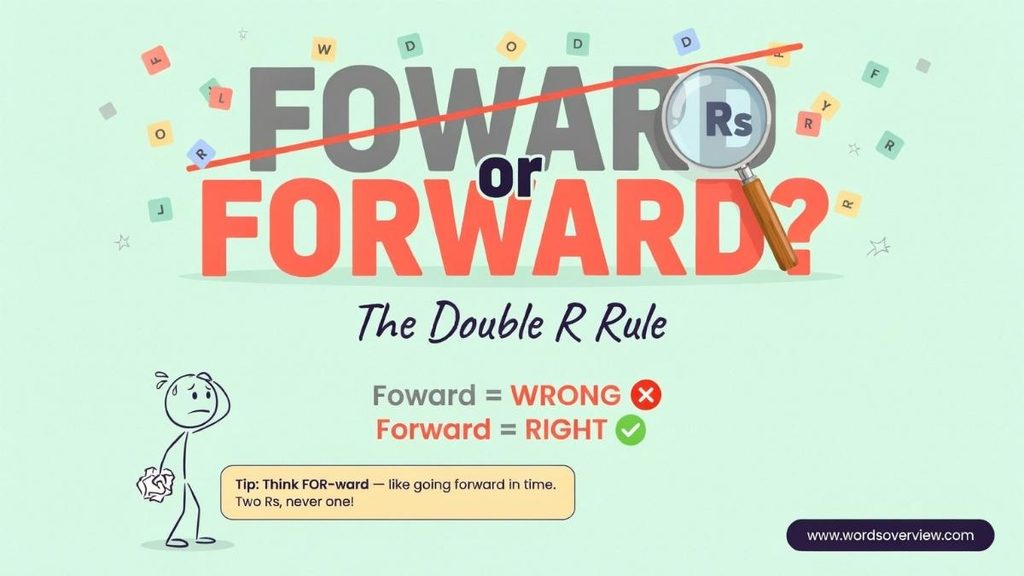
The difference between foward and forward involves spelling rather than meaning.
| Feature | Forward | Foward |
| Standard English spelling | Yes | No |
| Standard word form | Yes | No |
| Meaning | Has several established meanings | No standard meaning as the intended spelling of “forward” |
| Contains two r’s | Yes | No |
| Can function as a verb | Yes | No |
| Can function as an adverb | Yes | No |
| Used in “look forward to” | Yes | No |
| Used for email forwarding | Yes | No |
| Appropriate in formal writing | Yes | No |
Therefore, the answer to “is foward correct?” is no.
On the other hand, “is forward correct?” has a clear answer: yes.
How to Use “Forward” in a Sentence
Understanding the different uses of forward makes the word easier to remember and use correctly.
Forward for Movement
Use forward when something moves toward the front or ahead.
Examples include:
- “The child took a step forward.”
- “The bus moved forward.”
- “Please lean forward.”
- “The hikers continued forward.”
- “The vehicle slowly moved forward.”
Here, the word describes forward movement.
Forward for Progress
You can also use forward when discussing progress.
For example:
- “The project is moving forward.”
- “We need to move forward with the plan.”
- “The company decided to move forward with the proposal.”
- “The team is moving forward after completing the review.”
In these sentences, forward doesn’t describe physical movement. Instead, it represents progress or continuation.
Therefore, moving forward can mean continuing toward a goal or proceeding to the next stage.
Forward for Direction
Forward can describe physical direction as well.
For example:
- “Look forward.”
- “The passengers moved forward.”
- “The dog ran forward.”
- “The cyclist leaned forward.”
The central idea remains the same: movement or orientation toward the front.
Learn the difference between confusing word pairs
Emigrate or Immigrate Difference, Meaning and Usage
Forward for Email and Messages
Modern communication has made the verb forward especially common.
For example:
- “Please forward the email to the finance department.”
- “I’ll forward the message to Sarah.”
- “Can you forward the attachment?”
- “He forwarded the email to his team.”
- “She forwarded the information to the client.”
In this context, forward means to send information onward.
“Look Forward To” vs “Look Foward To”
The phrase look forward to deserves special attention because it appears frequently in emails and professional communication.
If you’re searching for looking forward or foward, looking foward or forward or looking forward vs looking foward, the correct form is:
looking forward
For example:
- “I’m looking forward to the weekend.”
- “We’re looking forward to meeting you.”
- “She is looking forward to the event.”
- “They’re looking forward to hearing the results.”
The incorrect form is:
- “I’m looking foward to the weekend.” ❌
The missing r makes the spelling incorrect.
Look Forward To + ing
There’s also an important grammatical point.
When a verb follows look forward to, use the ing form.
Correct:
“I look forward to hearing from you.”
Incorrect:
“I look forward to hear from you.” ❌
Similarly:
“We look forward to meeting you.”
Here, to functions as a preposition rather than the infinitive marker. Therefore, a following verb takes the gerund form.
This distinction matters in formal emails, cover letters, applications and other professional writing.
Learn the difference between tricky grammar words
Studying or Studing: Which Spelling Is Correct?
Common “Forward” Spelling Mistakes
The foward spelling mistake is the most obvious error, but several habits can contribute to it.
Dropping the First R
The basic error looks like this:
foward ❌
Instead, write:
forward ✅
The missing r creates the misspelled word.
Relying Only on Pronunciation
English spelling doesn’t always match pronunciation perfectly.
Therefore, spelling a word purely according to the sounds you hear can lead to errors. Fast speech can make individual sounds less noticeable, but the written form remains fixed.
When you’re unsure, remember:
F-O-R-W-A-R-D
Typing Too Quickly
Fast typing can produce a keyboard spelling error.
For example:
“Please foward the document.”
A quick review changes it to:
“Please forward the document.”
This is why proofreading matters, particularly in professional communication.
Repeating the Same Error
Repeated exposure can make a misspelled word look familiar.
If you see foward often enough, you might start wondering whether it’s an accepted spelling. However, familiarity doesn’t make an incorrect form standard.
The correct word remains forward.
Forward in Common Expressions
Because forward has several meanings, it appears in many established expressions.
Look Forward To
Look forward to means to feel positive anticipation about something expected to happen.
For example:
“I’m looking forward to the concert.”
The expression also appears frequently in professional correspondence:
“I look forward to hearing from you.”
Move Forward
Move forward can describe physical movement or progress.
Physical example:
“Move forward two steps.”
Figurative example:
“The company decided to move forward with the proposal.”
Moving Forward
Moving forward often means from this point onward or as the situation develops.
For example:
“Moving forward, the team will review the process each month.”
The expression appears frequently in business and workplace English.
Forward-Thinking
Forward-thinking describes an approach that considers future needs, developments or opportunities.
For example:
“The company introduced a forward-thinking approach to technology.”
Forward Motion
Forward motion means movement toward the front or ahead.
For example:
“The vehicle needs enough traction to maintain forward motion.”
The phrase can also describe progress in a figurative context.
Learn the difference between commonly confused words in English
Grayscale or Greyscale: Which Is Correct?
Forward Pronunciation: British and American English
The forward pronunciation can vary slightly among speakers and accents. However, both American and British English use the same spelling:
forward
The pronunciation difference doesn’t create a second standard spelling.
Forward Pronunciation American
In American English, forward is commonly pronounced as a two-syllable word.
The exact vowel sounds can vary between regional accents. In addition, natural speech can reduce or blend sounds, which may make the word seem less distinct than its written form.
Therefore, someone learning forward pronunciation American should focus on the overall sound and syllable pattern rather than trying to pronounce each written letter separately.
Forward Pronunciation British
The forward pronunciation British speakers use can also vary because British English includes many regional accents.
Nevertheless, the standard written form remains:
forward
Accent differences affect pronunciation. They don’t turn foward into an accepted spelling.
Forward vs Foward Pronunciation
There isn’t a standard pronunciation contrast between forward and foward because foward isn’t the standard spelling of a separate English word.
When someone asks why do people say foward instead of forward, the question usually concerns how the word sounds in rapid or casual speech.
Fast speech can make some sounds less prominent. However, that doesn’t remove the corresponding letter from the written form.
So, when considering forward vs foward pronunciation, remember that the spelling issue comes from a missing letter rather than a legitimate pronunciation variant.
How to Pronounce Forward Correctly
When learning how to pronounce forward, listen to the word as a complete unit rather than trying to pronounce every letter separately.
The written form is:
f-o-r-w-a-r-d
Different accents may produce slightly different vowel qualities or sound patterns. Still, the standard spelling remains unchanged.
Is “Foward” a Word?
Many people ask, “is foward a word?” because the spelling looks plausible.
In standard modern English, foward should not be used as the spelling for the ordinary word forward.
Therefore:
- Is foward a word? No, not as the standard form of “forward.”
- Is foward a correct spelling? No.
- Is foward an English word? It isn’t the standard form of “forward.”
- Is foward a misspelling of forward? Yes.
- Is foward correct? No.
For formal, academic, workplace and everyday written English, use forward.
Why Is “Foward” Misspelled?
The question “why is foward misspelled?” has a practical explanation.
Usually, the writer knows which word they intend but accidentally leaves out the first r.
Several factors can contribute to this common spelling error:
- A missing letter
- Fast typing
- Keyboard mistakes
- Familiarity with the word
- Rapid speech
- Unclear sound perception
- Memory of the word’s general shape
- Repeated exposure to the misspelling
Importantly, there’s no separate spelling rule that changes forward to foward.
The standard form is simply:
forward
Learn the difference between more words people mix up
13rd or 13th: Which Is Correct?
American vs British English: Is the Spelling Different?
Unlike color/colour or center/centre, forward doesn’t have separate standard American and British spellings.
| Variety | Correct spelling | Example |
| American English | forward | “I look forward to hearing from you.” |
| British English | forward | “I look forward to hearing from you.” |
Therefore, the English spelling of forward stays the same in both varieties.
The pronunciation may vary by accent. The spelling does not.
Why Correct Spelling Matters
A single missing letter might seem insignificant. However, repeated spelling errors can distract readers and make professional writing appear less polished.
Compare:
“I look foward to your response.”
with:
“I look forward to your response.”
The second sentence uses the correct spelling and removes the distraction immediately.
Accurate spelling matters particularly in:
- Job applications
- Resumes
- Cover letters
- Business emails
- Academic assignments
- Reports
- Websites
- Professional documents
- Formal correspondence
Casual communication doesn’t require perfection at every moment. Still, knowing the standard form helps you communicate clearly when accuracy matters.
Forward Spelling and Related Forms
Once you know the forward correct spelling, its related forms become easier to recognize.
| Form | Example |
| forward | “Please move forward.” |
| forwards | “The car moved forwards.” |
| forwarded | “She forwarded the email.” |
| forwarding | “He is forwarding the document.” |
| forward-looking | “It was a forward-looking approach.” |
| forward-thinking | “They developed a forward-thinking strategy.” |
Usage can vary by grammatical context and regional preference. Nevertheless, the base word remains forward.
Learn the difference between similar English words
Invision or Envision Which Spelling Is Correct?
Forward Examples in Everyday English
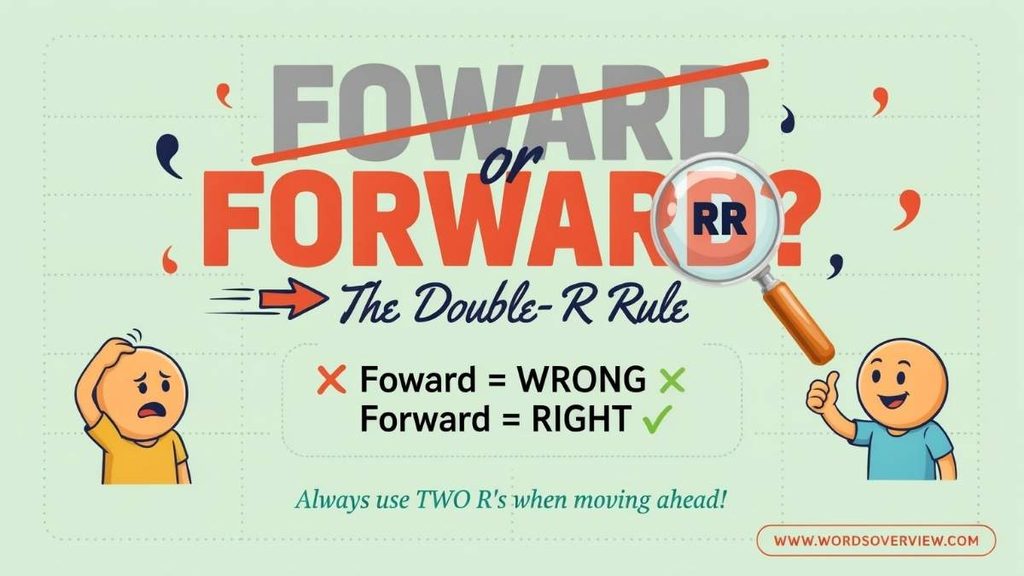
Seeing forward in different contexts can reinforce both its meaning and spelling.
Everyday English
- “Please step forward.”
- “The line moved forward.”
- “She leaned forward.”
- “The dog ran forward.”
- “Keep moving forward.”
Workplace English
- “I’ll forward the email.”
- “Please forward the document.”
- “We need to move forward with the project.”
- “I look forward to your response.”
- “The team is moving forward with the proposal.”
Technology
- “Tap the forward button.”
- “Please forward the message.”
- “The browser moved forward to the next page.”
- “He forwarded the attachment to the group.”
Academic Writing
- “The research points forward toward new possibilities.”
- “The student moved forward with the research project.”
- “The discussion helped the class move forward.”
Incorrect and Correct Examples
A side-by-side comparison makes the foward spelling mistake easy to identify.
| Incorrect | Correct |
| “I look foward to meeting you.” | “I look forward to meeting you.” |
| “Please move foward.” | “Please move forward.” |
| “Can you foward the email?” | “Can you forward the email?” |
| “The project is moving foward.” | “The project is moving forward.” |
| “She stepped foward.” | “She stepped forward.” |
| “I’m looking foward to the event.” | “I’m looking forward to the event.” |
Notice the consistent pattern. Each incorrect example removes the same letter: the first r.
Therefore:
foward → forward
How to Check the Spelling Quickly
When you’re unsure about forward or foward spelling, use a simple mental check.
First, ask whether the word begins with for.
If it does, you’re already halfway there:
FOR + WARD = FORWARD
Next, check the complete spelling:
F-O-R-W-A-R-D
If you’ve written F-O-W-A-R-D, you’ve dropped an r.
This quick check can help when you’re typing forward quickly in an email or writing the word from memory.
Learn the difference between similar English words the easy way
Uncapable or Incapable: Which Spelling Is Correct?
Foward vs Forward: The Key Difference
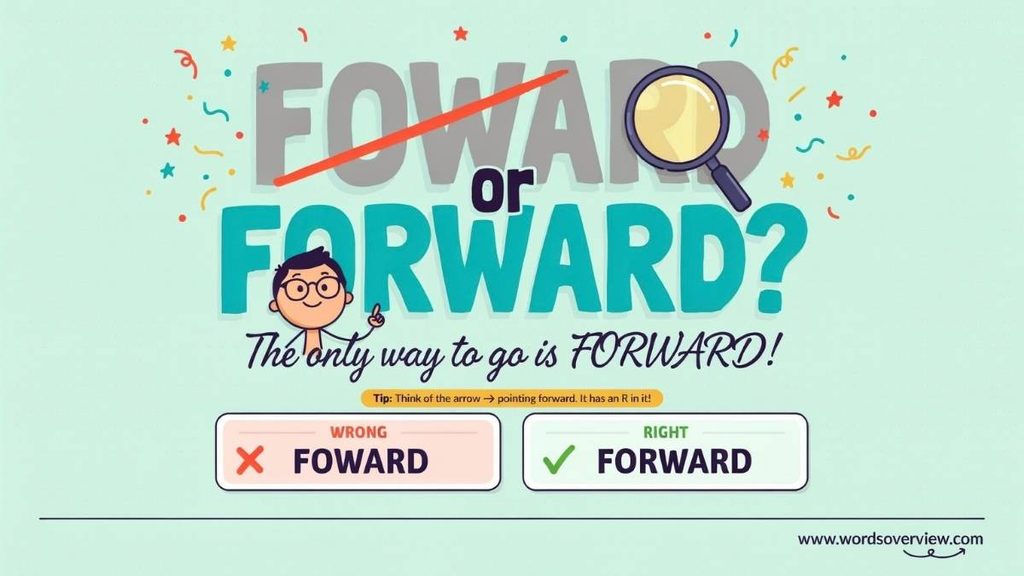
The difference between forward and foward isn’t a difference between two standard English words.
Instead, it is the difference between a correct spelling and a common misspelling.
Forward is the standard English word.
Foward is the incorrect form created by dropping an r.
Practice Session: Fill in the Blanks
Fill in each blank with the correct word or form.
- Please move ________ and take your seat.
- The correct spelling is ________, not “foward.”
- I’m looking ________ to hearing from you.
- She decided to move ________ with her plans.
- Could you ________ this email to the manager?
- He accidentally typed “______” instead of “forward.”
- We need to keep moving ________ despite the challenges.
- I look ________ to meeting you next week.
- The company is making ________ progress.
- Please ________ the message to everyone on the team.
- “Foward” is a common spelling ________ of “forward.”
- She leaned ________ to get a better view.
- I’m looking forward to ________ from you soon.
- The correct spelling of the word contains two ________.
- The word “forward” can describe movement toward the ________.
- He ________ the email to his colleague yesterday.
- We should look ________ rather than focus only on past mistakes.
- Is “I look forward to meet you” correct or should it be “I look forward to ________ you”?
- The word “forward” can be used as an adverb, adjective, verb and ________.
- She stepped ________ when the teacher called her name.
- Please check your spelling before you ________ the email.
- “Looking foward” contains a common spelling ________.
- I’m really looking forward to ________ the new project.
- The team wants to move ________ with the updated plan.
- Remember: FOR + WARD = ________.
Answer Session
- forward
- forward
- forward
- forward
- forward
- foward
- forward
- forward
- forward
- forward
- mistake
- forward
- hearing
- r’s
- front
- forwarded
- forward
- meeting
- noun
- forward
- forward
- mistake
- starting
- forward
- forward
Frequently Asked Questions
Is it spelled foward or forward?
Forward is the correct standard spelling in modern English. Foward is a common misspelling caused by typing quickly, overlooking the second r or spelling the word based on its pronunciation.
Is “looking forward” or “looking foward” correct?
Looking forward is correct. For example, you can say, “I’m looking forward to the weekend.” The spelling foward is incorrect in standard modern English.
What is the correct spelling of forward?
The correct spelling is forward, written f-o-r-w-a-r-d. It contains two r’s, which makes foward a common spelling mistake.
What does forward mean?
Forward generally means toward the front or in the direction ahead. It can also describe progress, future movement, communication or sending something onward. For example, “Please forward the email to Sarah.”
Why do people spell forward as foward?
People often spell forward as foward because the word can sound as though it has only one noticeable r in fast speech. Typing quickly can also cause someone to accidentally leave out the second r.
Do you pronounce the r in forward?
Yes, the spelling of forward contains two r’s, but pronunciation varies by accent and speaking style. In many varieties of English, the first r may sound less noticeable, especially in rapid speech.
Is “I look forward to” grammatically correct?
Yes. “I look forward to” is grammatically correct and commonly introduces something you anticipate. For example, “I look forward to hearing from you.” In this structure, to functions as a preposition, so it is followed by a noun, pronoun or ing form.
Is it “I look forward to meet you” or “I look forward to meeting you”?
“I look forward to meeting you” is correct. Because to acts as a preposition in this expression, it should be followed by the ing form, not the base verb. Therefore, say “I look forward to meeting you,” not “I look forward to meet you.”
Is “I’m looking forward to seeing you” grammatically correct?
Yes. “I’m looking forward to seeing you” is grammatically correct and natural. The phrase looking forward to expresses anticipation, while seeing correctly follows the preposition to.
Is “forwarded” grammatically correct?
Yes. Forwarded is the correct past tense and past participle of the verb forward. For example, “I forwarded the email to the manager.” The form can describe sending an email, message or other information onward.
Conclusion
The forward vs foward confusion comes down to one small but important letter: the second r. Forward is the standard spelling in modern English, while foward is a common misspelling that often appears because people type quickly or spell the word the way they hear it. Once you remember FOR + WARD = FORWARD, the mistake becomes much easier to avoid.
Whether you’re talking about moving forward, looking forward to an event, forwarding an email or making progress, the correct spelling stays the same. So, before “foward” sneaks into your sentence again, give that second r a quick check. Your keyboard may forgive the mistake, but your grammar deserves better!

Ethan AJS is an experienced blogger and language enthusiast at Words Overview, dedicated to making English easier to understand and use. He writes about grammar, vocabulary, spelling, word meanings and commonly confused words, turning tricky language questions into clear, practical insights. With a passion for effective communication, Ethan creates engaging, readerfocused content that helps readers write accurately, choose the right words and communicate with confidence.




