
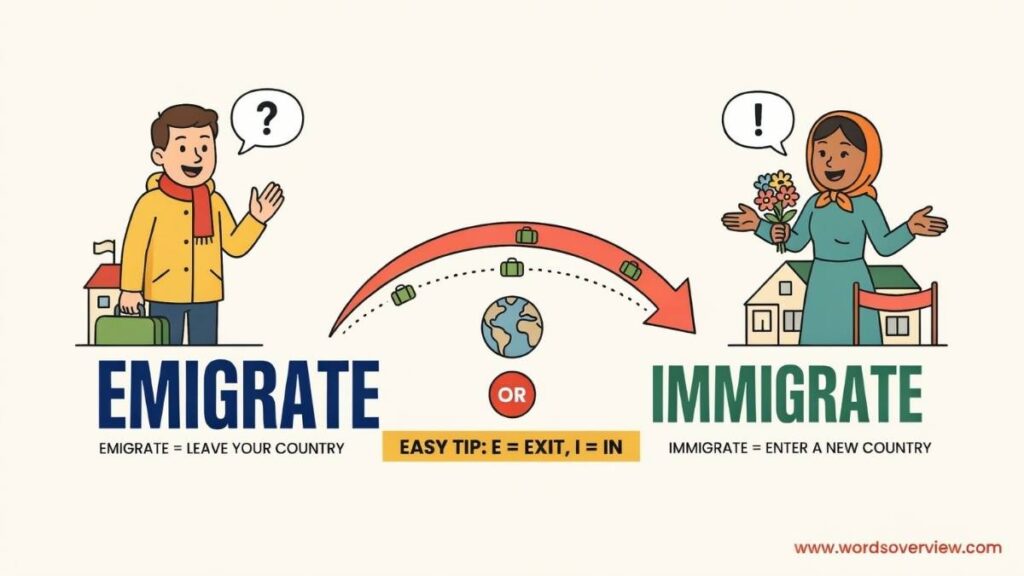
Moving to another country sounds simple until English asks a surprisingly tricky question: should you say emigrate or immigrate? One tiny prefix can make your sentence point in a completely different direction. If you say someone “immigrated from Canada,” you might leave readers wondering which side of the border you mean. Meanwhile, “emigrated to Canada” can also make your wording feel less precise. Don’t worry, English isn’t trying to make your international move harder than it already is! The key is perspective. Emigrate focuses on leaving a country, while immigrate focuses on moving into one. Once you understand that difference, these commonly confused words become much easier to use.
Emigrate or Immigrate Quick Answer
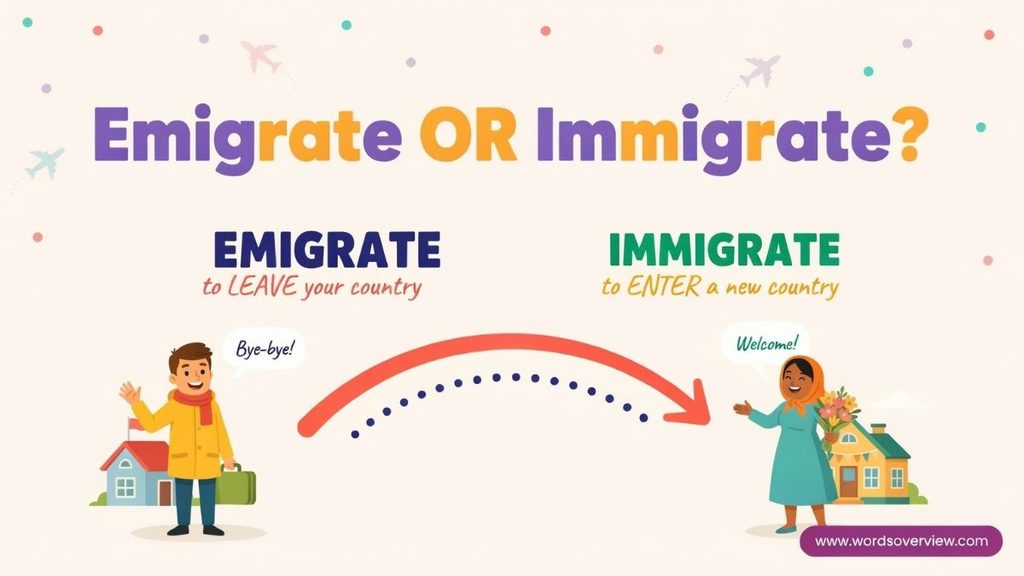
The easiest way to understand the difference between emigrate and immigrate is to focus on direction:
| Word | Main idea | Common pattern | Example |
| Emigrate | Leave a country to live elsewhere | emigrate from | She emigrated from Poland. |
| Immigrate | Move into another country to live there | immigrate to | She immigrated to the United States. |
| Migrate | Move from one place to another | migrate to/from | Many people migrate to cities for work. |
A simple memory trick can make the difference easier:
Emigrate = exit
Immigrate = enter
The prefix e- in emigrate can remind you of moving out, while im- in immigrate can remind you of moving into a new country.
However, remember that these words describe the same international move from two different perspectives.
What Does Emigrate Mean?
Emigrate means to leave one country and move to another country to live there, usually permanently.
When you use emigrate, you focus on the country a person leaves. Therefore, the word often appears with from.
For example:
- Maria emigrated from Mexico.
- His grandparents emigrated from Italy.
- Thousands of people emigrated from the country during that period.
- They decided to emigrate from their home country.
- She plans to emigrate from Australia next year.
The noun form is emigration. It describes the process of leaving a country to settle elsewhere.
Emigrate, Emigrated and Emigrating
The verb changes form depending on the sentence:
| Form | Example |
| Emigrate | They plan to emigrate from France. |
| Emigrated | His family emigrated from Germany. |
| Emigrating | She is considering emigrating from her home country. |
| Emigration | Emigration increased during that period. |
So, if your sentence focuses on leaving a country, emigrate usually fits the meaning.
What Does Immigrate Mean?
Immigrate means to move to another country to live there. Unlike emigrate, this word focuses on the country a person enters or chooses as a new place of residence.
For that reason, immigrate to is the most useful pattern to remember.
Examples include:
- Her family immigrated to Canada.
- They immigrated to the United States in 2015.
- His parents immigrated to Australia.
- Many people immigrate to countries with more employment opportunities.
- She wants to immigrate to another country after graduation.
The noun form is immigration, which refers to the process of moving into another country to live there.
Immigrate, Immigrated and Immigrating
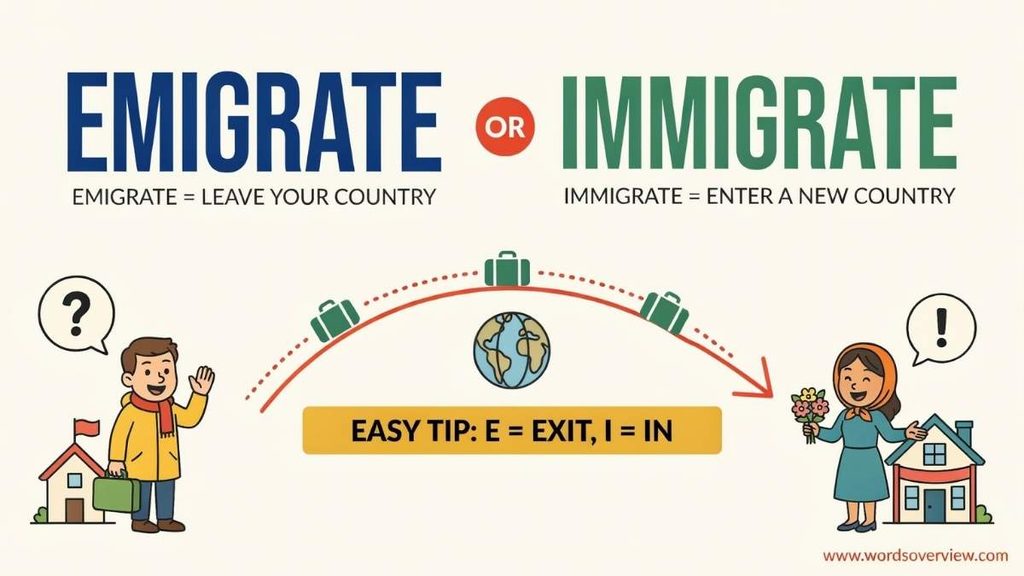
Here are the main forms of the verb:
| Form | Example |
| Immigrate | They plan to immigrate to Canada. |
| Immigrated | His parents immigrated to the United States. |
| Immigrating | She is considering immigrating to Australia. |
| Immigration | Immigration has shaped many countries. |
Therefore, when your sentence focuses on moving into a new country, immigrate usually expresses the intended meaning.
Emigrate vs Immigrate: What Is the Difference?
The main difference between emigrate and immigrate comes down to perspective.
Emigrate focuses on leaving.
Immigrate focuses on entering.
Consider a person who moves from Poland to the United States. From Poland’s perspective, that person emigrated from Poland. From the United States’ perspective, the same person immigrated to the United States.
So, both statements can describe the same move:
- Adam emigrated from Poland.
- Adam immigrated to the United States.
Neither word describes a completely different journey. Instead, each verb highlights a different side of the journey.
Emigrate From vs Immigrate To
The most practical patterns are:
Emigrate from + country
- She emigrated from India.
- They emigrated from Spain.
- His family emigrated from Ireland.
Immigrate to + country
- She immigrated to Canada.
- They immigrated to the United States.
- His family immigrated to New Zealand.
These patterns make the distinction much easier to remember.
At the same time, English can use additional complements with these verbs in context. Therefore, you shouldn’t treat from and to as absolute grammatical restrictions. Instead, use them as the clearest patterns for expressing the usual meanings.
Learn the difference between more words people mix up
Swifty or Swiftie: Spelling, Usage and Correct Word
Emigrate and Immigrate Can Describe the Same Person
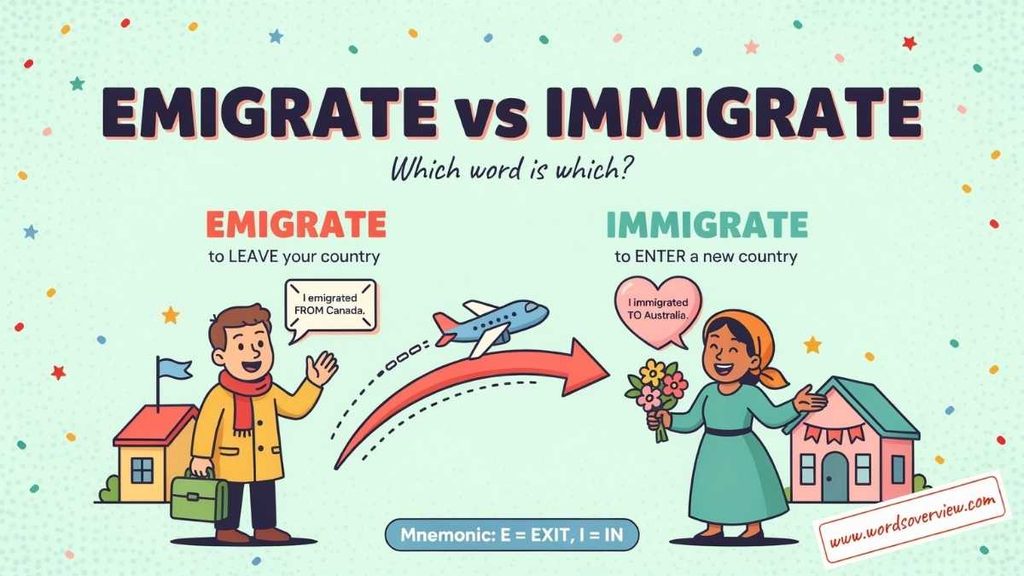
One of the easiest ways to understand these words is to imagine a traveler standing between two countries.
Suppose Sara leaves Pakistan and settles in Canada.
From Pakistan’s point of view:
Sara emigrated from Pakistan.
From Canada’s point of view:
Sara immigrated to Canada.
The person didn’t make two separate international moves. She made one move, but English gives us two useful verbs for describing it.
This distinction becomes especially useful when you discuss migration, immigration records, family history or international relocation.
Emigrate vs Immigrate vs Migrate
The word migrate has a broader meaning than emigrate and immigrate.
Migrate means to move from one place to another. It doesn’t necessarily mean that someone permanently leaves one country or settles in another.
People, animals and even some populations can migrate.
For example:
- Birds migrate south during certain seasons.
- Workers may migrate to cities for employment.
- Some families migrate from rural areas to urban areas.
- People may migrate from one country to another.
By contrast, emigrate and immigrate specifically focus on international relocation and the perspective of leaving or entering a country.
| Word | Meaning | Main focus |
| Migrate | Move from one place to another | Movement |
| Emigrate | Leave one country to live elsewhere | Departure |
| Immigrate | Move into another country to live there | Arrival or settlement |
Therefore, migrate is the broader term, while emigrate and immigrate provide more specific perspectives on international movement.
Learn the difference between confusing word pairs
Masonary or Masonry: Which Spelling Is Correct?
Is Migrate the Same as Emigrate?
Not exactly.
Migrate can describe many types of movement. For example, animals migrate between habitats and people can migrate between regions within the same country.
Emigrate, however, specifically emphasizes leaving one country to settle in another.
So, you can use migrate in situations where emigrate would not fit.
Is Migrate the Same as Immigrate?
Again, not exactly.
Immigrate focuses on moving into another country to live there. Migrate simply describes movement and doesn’t necessarily identify a destination country or permanent settlement.
For example:
Many birds migrate every winter.
You wouldn’t normally replace migrate with immigrate because birds aren’t immigrating to a new country as human residents.
Learn the difference between similar English words
Families or Family’s Correct Usage and Difference
A Simple Way to Remember Emigrate and Immigrate
The prefixes provide a useful memory aid.
Think:
E = Exit
I = In
So:
Emigrate = exit a country
Immigrate = move in to another country
For example:
- He emigrated from Brazil.
- He left Brazil.
- He immigrated to Portugal.
- He moved into Portugal as his new country of residence.
This trick isn’t a complete explanation of the words’ history, but it provides a quick way to remember their modern distinction.
Common Grammar Patterns
Choosing the right preposition can make your sentence much clearer.
Emigrate From
Use emigrate from when you identify the country someone leaves.
Examples:
- She emigrated from Italy.
- They emigrated from Poland.
- His parents emigrated from Ireland.
- Many families emigrated from the region.
Immigrate To
Use immigrate to when you identify the country someone moves into.
Examples:
- She immigrated to Canada.
- They immigrated to the United States.
- His parents immigrated to Australia.
- Many families immigrated to the country.
Can You Use Emigrate With To?
Yes. In some contexts, emigrate to can identify the destination as well as the act of leaving.
For example:
Millions of Germans emigrated from Europe to America in the 19th century.
Here, from Europe identifies the place of departure, while to America identifies the destination.
However, if you want to emphasize the destination, immigrate to often provides the clearest choice.
Can You Use Immigrate With From?
Yes, English can also use immigrate from when the context focuses on a person’s origin.
For example:
Many immigrants from India have settled in the United States.
In ordinary usage, however, immigrate to remains the easiest pattern to remember when you want to emphasize the destination.
Learn the difference between basic English word mistakes
This Is She or This Is Her: Which Is Correct?
Emigrant vs Immigrant
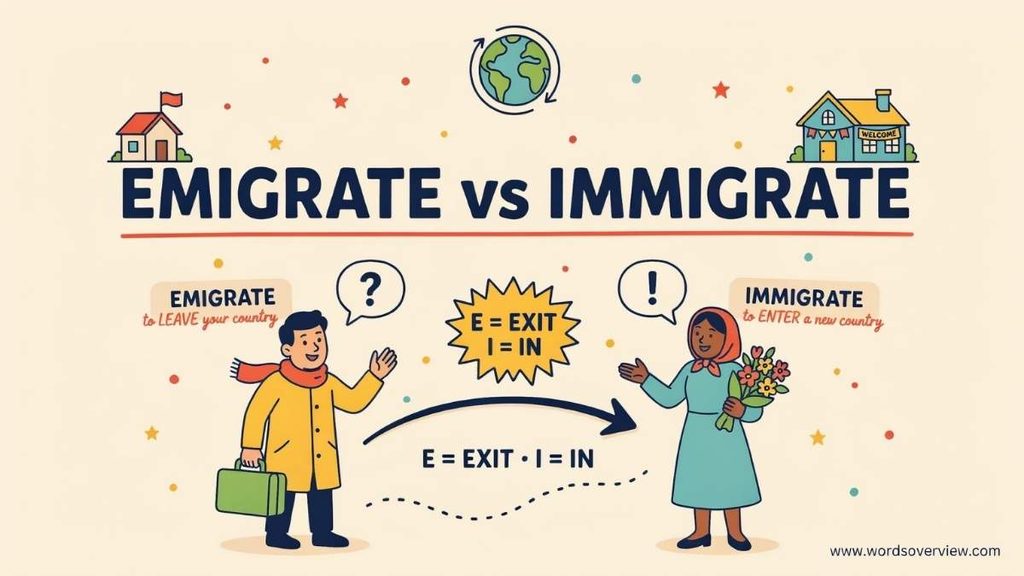
The nouns emigrant and immigrant follow the same distinction as the verbs.
An emigrant is a person who leaves their country to settle somewhere else.
An immigrant is a person who moves into another country to live there.
For example:
Omar was an emigrant from Egypt.
This sentence views Omar from Egypt’s perspective.
Omar was an immigrant to Canada.
This sentence views Omar from Canada’s perspective.
Again, the same person can be both an emigrant and an immigrant.
The difference depends on which country or perspective you emphasize.
Emigration vs Immigration
The nouns emigration and immigration also follow the same pattern.
Emigration refers to the process of leaving a country to live elsewhere.
Immigration refers to the process of moving into another country to live there.
For example:
- High emigration reduced the country’s population.
- Immigration increased the population of the destination country.
- The government studied patterns of emigration.
- The country changed its immigration policies.
The distinction becomes clearer when you connect each noun to a direction:
Emigration → leaving
Immigration → entering
Learn the difference between tricky words and use them correctly
Genious or Genius: Which Spelling Is Correct?
Emigrate or Immigrate Examples
The following examples show how context determines the correct word.
Examples With Emigrate
- My uncle emigrated from Pakistan in 1998.
- Her grandparents emigrated from Italy.
- They decided to emigrate from their home country.
- Many workers emigrated from the region.
- He is planning to emigrate after finding a job abroad.
Examples With Immigrate
- My uncle immigrated to Canada in 1998.
- Her grandparents immigrated to Australia.
- They decided to immigrate to the United States.
- Many workers immigrated to the country.
- He plans to immigrate to New Zealand.
Emigrate and Immigrate in the Same Sentence
You can use both words together when you want to show both sides of an international move.
For example:
When Daniel emigrated from Spain, he immigrated to Argentina.
Another example is:
Her family emigrated from Poland and immigrated to the United States.
These sentences clearly show the starting country and the destination country.
Learn the difference between tricky grammar words
Studying or Studing: Which Spelling Is Correct?
Common Mistakes With Emigrate and Immigrate
Because these words look and sound similar, people often switch them accidentally.
Mistake: Using Immigrate for Leaving
Incorrect in the intended departure-focused meaning:
She immigrated from Canada to France.
If you want to emphasize that she left Canada, say:
She emigrated from Canada to France.
Mistake: Using Emigrate for Entering
If your focus is the destination, use immigrate:
She immigrated to France.
The sentence highlights France as the new country of residence.
Mistake: Treating the Words as Perfect Synonyms
Although both words describe international movement, they aren’t interchangeable in every sentence.
For example:
He emigrated from India.
The sentence focuses on India as the country he left.
He immigrated to Canada.
The sentence focuses on Canada as the country he entered and settled in.
Therefore, the surrounding context determines which verb works best.
Emigrate or Immigrate in Everyday English
You may encounter these words in news reports, government documents, history books, family records and discussions about international movement.
For example:
Historical context:
Many Europeans emigrated from their home countries during periods of economic hardship.
Destination-focused context:
Large numbers of people immigrated to North America during different periods of history.
Personal context:
My grandparents emigrated from their home country and immigrated to another country many years ago.
In everyday conversation, people also use simpler expressions such as move abroad, move to another country or leave the country.
However, emigrate and immigrate provide more precise language when the direction of movement matters.
Learn the difference between commonly mixed-up more words
Foward or Forward: Which Spelling Is Correct?
British English vs American English
The distinction between emigrate and immigrate works in both American English and British English.
The spelling doesn’t change between the two varieties.
For example:
- emigrate
- immigrate
- emigrant
- immigrant
- emigration
- immigration
Therefore, you don’t need a separate British or American spelling when choosing between these words.
Pronunciation can vary slightly between British and American English. Nevertheless, the meaning and basic distinction remain the same.
Emigrate vs Immigrate Pronunciation
The two words look similar, but their first syllables sound different.
Emigrate begins with the sound represented by the letter e.
Immigrate begins with the short i sound.
Their pronunciation also varies slightly between British and American English. Still, the spelling provides a useful visual distinction.
Because both words contain -migrate, learners often recognize the shared movement idea. The prefixes then help distinguish the direction.
The Origin of Emigrate and Immigrate
The similarity between these words isn’t accidental. Both trace back to Latin roots related to movement.
Emigrate comes from Latin emigrare, formed from a prefix meaning “out” and a root meaning “to move.”
Immigrate comes from Latin immigrare, formed from a prefix meaning “into” and the same movement-related root.
As a result, the basic contrast has remained useful:
Emigrate → move out
Immigrate → move in
The related word migrate comes from the same Latin movement root. That connection explains why all three words share similar spelling and meaning.
Which Word Should You Use?
Choose emigrate when you want to emphasize leaving a country.
Example:
She decided to emigrate from Ireland.
Choose immigrate when you want to emphasize moving into another country.
Example:
She decided to immigrate to Canada.
If you simply want to describe movement without emphasizing departure or arrival, migrate may be more appropriate.
Example:
Many people migrate from rural areas to cities for work.
Therefore, the choice depends on what part of the movement your sentence emphasizes.
Learn the difference between everyday English mistakes
Devide or Divide Correct Spelling and Usage
Quick Comparison: Emigrate or Immigrate or Migrate
| Feature | Emigrate | Immigrate | Migrate |
| Core meaning | Leave a country to live elsewhere | Move into another country to live | Move from one place to another |
| Main perspective | Departure | Arrival or destination | Movement |
| Common preposition | From | To | To or from |
| Can describe people? | Yes | Yes | Yes |
| Can describe animals? | Not normally | No | Yes |
| Usually suggests international movement? | Yes | Yes | Not necessarily |
| Usually focuses on permanent relocation? | Yes | Yes | Not necessarily |
How to Use Emigrate and Immigrate Correctly
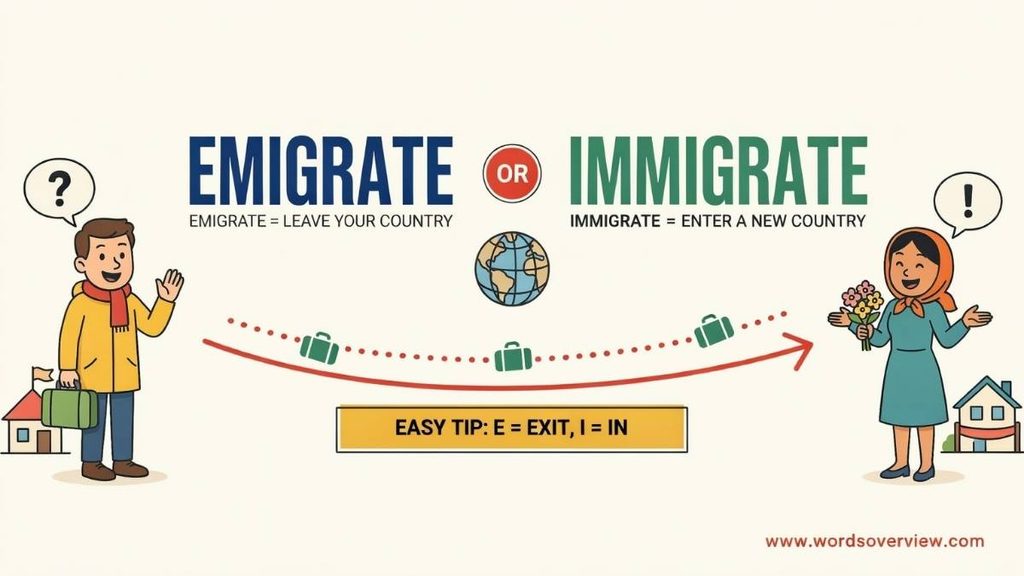
When you aren’t sure which word to use, don’t focus on the spelling first. Instead, ask yourself one simple question:
Am I talking about leaving or entering?
If the sentence focuses on leaving, choose emigrate.
He emigrated from Germany.
If the sentence focuses on entering or settling in a new country, choose immigrate.
He immigrated to Canada.
If the sentence simply describes movement, choose migrate.
The population migrated to nearby cities.
This three-way distinction solves most common problems.
Emigrate or Immigrate: A Practical Memory Chart
| If you mean… | Use… | Example |
| Leave a country | Emigrate | She emigrated from France. |
| Move into a country | Immigrate | She immigrated to Canada. |
| Move generally | Migrate | People migrate for many reasons. |
| Person who leaves | Emigrant | He became an emigrant from Spain. |
| Person who arrives to settle | Immigrant | She became an immigrant to Canada. |
| Process of leaving | Emigration | Emigration affected the population. |
| Process of entering | Immigration | Immigration changed the population. |
Learn the difference between everyday English mistakes
Girly or Girlie Correct Usage and Difference
Practice Session
Fill in each blank with the correct word.
- She decided to ______ from Italy and start a new life abroad.
- Her family ______ to Canada several years ago.
- Many people ______ from their home countries for better opportunities.
- Daniel ______ from Poland and settled in the United States.
- Maria ______ to Australia after receiving her visa.
- Birds ______ to warmer regions during the winter.
- He plans to ______ from his home country next year.
- Her grandparents ______ to the United States in the 1960s.
- The country experienced significant ______ after an economic crisis.
- The government introduced new ______ policies.
- An ______ is a person who leaves their country to live somewhere else.
- An ______ is a person who moves into another country to live there.
- They chose to ______ from their home country because of limited job opportunities.
- She ______ to New Zealand and has lived there for more than a decade.
- Many workers ______ to major cities in search of employment.
- His parents ______ from Ireland before he was born.
- The family is considering ______ to another country.
- The number of people ______ to the region increased during the year.
- From Italy’s perspective, the family ______ from the country.
- From Canada’s perspective, the family ______ to the country.
- ______ focuses on leaving a country, while immigration focuses on entering one.
- ______ refers to the process of moving into another country to live.
- A person can be both an ______ and an ______, depending on the perspective.
- If you simply mean movement from one place to another, ______ is usually the broader term.
- The easiest memory trick is E = exit for ______ and I = in for ______.
Answers
- Emigrate
- Immigrated
- Emigrate
- Emigrated
- Immigrated
- Migrate
- Emigrate
- Immigrated
- Emigration
- Immigration
- Emigrant
- Immigrant
- Emigrate
- Immigrated
- Migrate
- Emigrated
- Emigrating
- Immigrating
- Emigrated
- Immigrated
- Emigration
- Immigration
- Emigrant, immigrant
- Migrate
- Emigrate, immigrate
Frequently Asked Questions
What is the difference between emigrate and immigrate?
Emigrate means to leave your country to live in another country, while immigrate means to move into another country to live there. For example, someone can emigrate from Italy and immigrate to Canada.
Do you emigrate or immigrate to another country?
It depends on the perspective. You emigrate from your home country and immigrate to your new country. Both words can describe the same international move from different perspectives.
What does emigrate actually mean?
Emigrate means to leave one country and move to another country to live there, usually permanently. The word focuses on the country the person leaves.
What does immigrate mean?
Immigrate means to move to another country to live there. The word focuses on the destination country and the person’s new place of residence.
What is the difference between immigration and emigration?
Immigration describes the process of moving into another country to live, while emigration describes the process of leaving a country to settle elsewhere. Therefore, immigration focuses on arrival, whereas emigration focuses on departure.
What is the difference between an emigrant and an immigrant?
An emigrant is someone who leaves their country to live elsewhere. An immigrant is someone who moves into another country to live there. The same person can be both, depending on which country you are discussing.
Is migration the same as immigration?
No. Migration is the broader term for moving from one place to another, while immigration specifically refers to moving into another country to live there. Migration can describe people, animals, temporary movement or permanent relocation.
Do humans migrate or emigrate?
Humans can migrate, emigrate or immigrate, depending on the situation. Migrate describes movement more generally, while emigrate emphasizes leaving a country and immigrate emphasizes moving into another country.
Can you use emigrate and immigrate together?
Yes. You can use both words to describe the same international move from two perspectives. For example, “She emigrated from Poland and immigrated to the United States.”
How can you remember the difference between emigrate and immigrate?
Use the simple memory trick E = exit and I = in. Emigrate focuses on leaving a country, while immigrate focuses on moving into another country. This quick association can help you choose the correct word.
Conclusion
The emigrate or immigrate confusion becomes much easier once you stop staring at the similar spelling and start thinking about direction. If someone leaves a country, they emigrate from it. If they move into another country to live, they immigrate to it. So, a person can emigrate from Italy and immigrate to Canada without making two international moves!
When you simply mean moving from one place to another, migrate works as the broader term. Likewise, emigrant focuses on the person who leaves, while immigrant focuses on the person who enters a new country.Remember the simple trick: E = exit, I = in. Once that little memory aid sticks, these two confusing words won’t have you packing your grammatical bags twice!

Ethan AJS is an experienced blogger and language enthusiast at Words Overview, dedicated to making English easier to understand and use. He writes about grammar, vocabulary, spelling, word meanings and commonly confused words, turning tricky language questions into clear, practical insights. With a passion for effective communication, Ethan creates engaging, readerfocused content that helps readers write accurately, choose the right words and communicate with confidence.




