
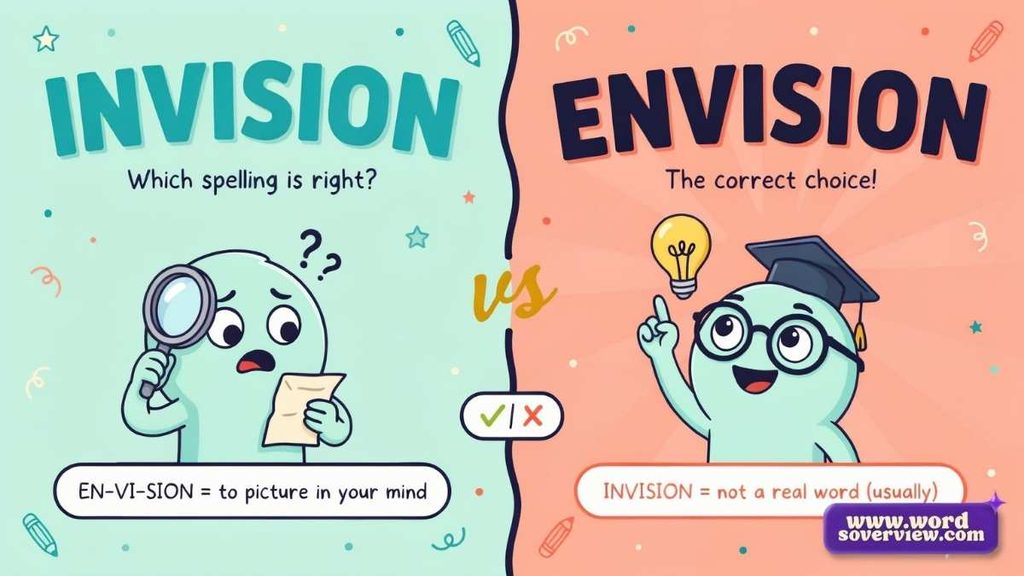
English spelling can sometimes feel like a prank with excellent grammar. The confusion over invision or envision proves the point. At first glance, both spellings look reasonable because they contain the familiar word “vision.” Say them aloud and the mistake becomes even easier to make. However, English has chosen one as the standard verb: envision. Using “invision” in an essay, email or professional document can make a simple spelling error stand out quickly. So, why does this confusion happen and how can you avoid it? Let’s clear up the difference, explore the meaning and usage of each form and give your spelling mistakes fewer opportunities to celebrate.
Invision or Envision Quick Answer
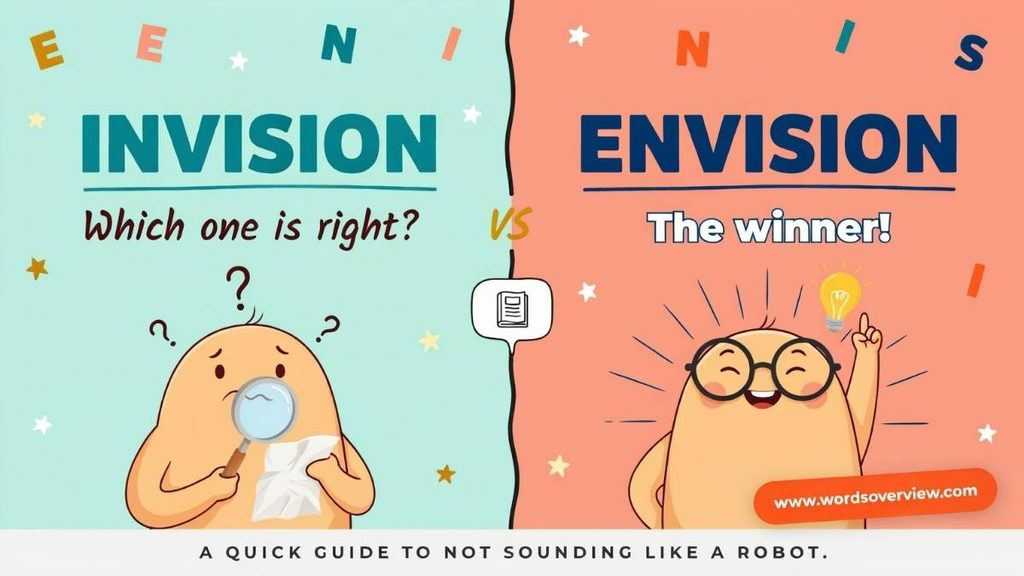
The correct word for the ordinary English verb is envision.
The word means to imagine something mentally, especially a situation that may happen in the future. It can describe a future goal, possibility, plan, outcome or situation.
Consider these examples:
- I envision a better future for my family.
- She envisioned herself becoming a doctor.
- The team envisions a new approach to the problem.
- We envision several possible outcomes.
- He can envision how the project might develop.
In contrast, these sentences contain the common invision spelling mistake:
- I invision a better future.
- She invisioned herself becoming a doctor.
- They invision a different outcome.
The correction is straightforward. Replace invision with envision.
However, the situation changes when InVision appears with a capital I and V. In that case, it can refer to the former design software company and its products. The proper name should not be confused with the ordinary English envision word.
Envision Meaning
The envision meaning centers on imagining or mentally picturing something. The word often describes an idea about the future rather than something you can see at the moment.
For example:
She envisions a peaceful life near the ocean.
She isn’t literally looking at the ocean. Instead, she has created a mental image of that future situation.
Similarly:
The company envisions a new approach to customer service.
Here, the company has a particular idea about what its future approach could look like.
This explains why envision often appears with words such as:
- future
- possibility
- outcome
- goal
- plan
- solution
- scenario
- change
- success
- opportunity
Learn the difference between confusing more English words
Businesses or Business’s: Which Is Correct?
What Does Envision Mean in a Sentence?
The exact meaning depends on the context. Still, the central idea remains the same: someone imagines something or forms an idea of what it could be.
For example:
- I envision a future with more flexible work options.
- She envisions herself leading the project.
- They envision a solution that benefits everyone.
- We envision several possible outcomes.
- He envisioned the finished building before construction began.
In each example, someone creates a mental picture or develops an idea of a situation.
The word works especially well when you think about the future, establish goals or describe a desired outcome.
Envision as a Verb
Envision is a verb. It normally takes an object because you envision something rather than simply “envision” in isolation.
Here are several common sentence patterns:
| Pattern | Example |
| Envision + noun | We envision a better system. |
| Envision + person + -ing | I envision her leading the team. |
| Envision + yourself + -ing | He envisions himself running a business. |
| Envision + future situation | They envision a different future. |
| Envision + outcome | The team envisions a positive outcome. |
The main forms of the verb are also easy to remember:
| Form | Word | Example |
| Base form | envision | We envision success. |
| Third-person singular | envisions | She envisions success. |
| Past tense | envisioned | They envisioned success. |
| Past participle | envisioned | The outcome was envisioned earlier. |
| Present participle | envisioning | They are envisioning success. |
So, if you’re looking for the envision past tense, the answer is envisioned.
Likewise, the envision present participle is envisioning.
Invision Meaning
The invision meaning can cause confusion because invision is not the standard spelling of the English verb meaning “imagine.”
When someone writes:
I invision a better future.
they normally intend to write:
I envision a better future.
As a result, invision generally represents a misspelling of envision when it appears in an ordinary English sentence.
This distinction answers several common spelling questions:
- Is invision a word? Not as the standard verb meaning “imagine.”
- Is invision correct? Not when you mean “imagine” or “picture mentally.”
- Is invision a real word? It can appear in proper names or specialized names, but that doesn’t make it the standard spelling of the verb.
- Is invision a misspelling? Yes when someone uses it instead of the standard verb envision.
- Is invision the correct spelling? No for the ordinary English verb.
The key is context. A lowercase invision used as a verb normally signals a spelling error. A capitalized InVision may refer to a proper name.
Learn the difference between commonly confused words in English
Pair or Pare: Meaning, Difference and Use Correctly
Envision or Invision Key Difference
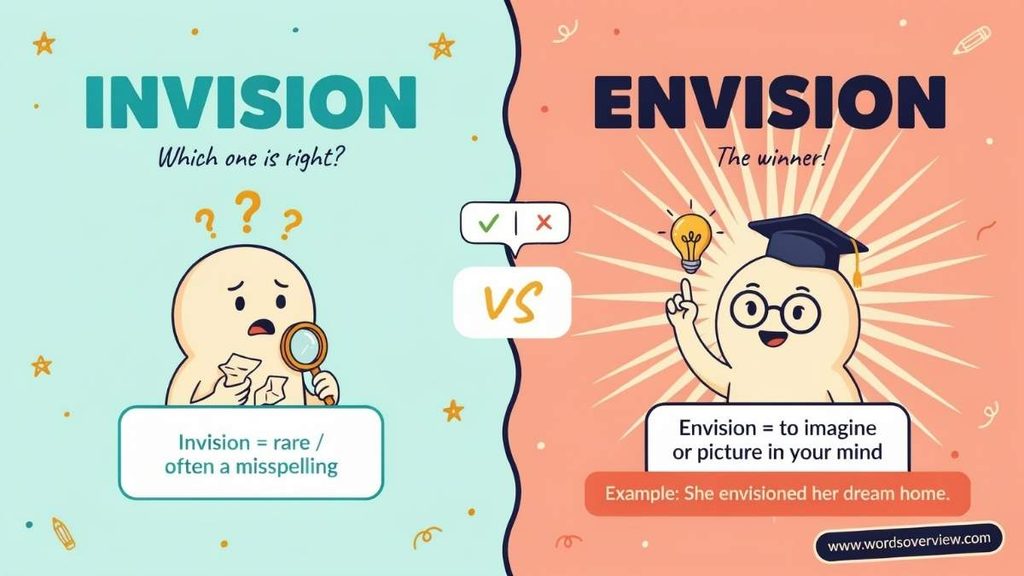
The envision vs invision difference becomes much easier to understand when you separate ordinary English vocabulary from proper names.
| Term | Standard English verb? | Meaning | Typical use |
| Envision | Yes | Imagine or mentally picture something | Normal English writing |
| Invision | No as the standard verb | Not the standard spelling of envision | Usually a spelling mistake |
| InVision | Proper name | Name associated with a former design software company | Company or software references |
The important point is that envision and invision aren’t two ordinary spelling variants.
You shouldn’t choose between them according to personal preference. If your sentence means “imagine” then envision is the appropriate spelling.
Is Invision the British Spelling of Envision?
No. Invision isn’t the British spelling of envision.
This confusion probably comes from the real differences between British and American English. Some English words do have different forms in the two varieties. However, invision vs envision isn’t one of those spelling differences.
There is a more relevant British-American distinction involving envision and envisage.
Envision is particularly common in American English. Envisage is especially common in British English. Both forms can describe imagining or considering a future situation.
| Meaning | American English | British English |
| Imagine a future situation | Envision | Envisage is especially common |
| Alternative form | Envisage also occurs | Envision also occurs |
Therefore, don’t assume that invision represents British usage.
Envision in American English
In American English, envision is a standard verb.
Examples include:
- We envision a larger community center.
- She envisions a successful career.
- The company envisions expanding its services.
- I can’t envision that happening soon.
The word sounds natural in everyday writing as well as business, academic and professional contexts.
Envision in British English
British English also uses envision. However, envisage often appears in British writing.
For example:
- They envision a major change.
- They envisage a major change.
Both sentences communicate the general idea of imagining or considering a future change.
The crucial point is that neither sentence requires invision.
Learn the difference between commonly misused words
Fair or Fare: Which Is Correct?
Why Do People Confuse Invision and Envision?
The common spelling mistake invision is understandable because several factors make the incorrect form look plausible.
The Similar Sound
When people hear envision instead of seeing it written, the first part may not immediately reveal whether the word starts with en- or in-.
English contains many familiar words that begin with in-. As a result, some writers instinctively choose invision.
However, pronunciation doesn’t always provide enough information to determine English spelling.
The Prefix “In-”
English contains many words beginning with in-, including:
- include
- inform
- inspect
- invent
- invite
- involve
That familiar spelling pattern can make invision look reasonable.
Yet the standard word is envision.
English spelling often preserves established word forms even when another spelling might seem logical at first glance.
The Word “Vision”
There’s a much easier way to remember the correct spelling of envision.
The word contains vision:
en + vision = envision
The connection also makes sense semantically. When you envision something, you create a kind of mental vision of it.
So if you’re trying to remember how to spell envision, think about the word vision.
Envision = imagine a vision in your mind.
That simple association can help prevent the invision spelling mistake.
The InVision Brand Name
There is another practical reason for the confusion.
InVision became a recognizable technology brand associated with digital design and prototyping. People who encountered the name regularly could reasonably assume that invision was also an ordinary English word.
However, a company name doesn’t change the standard spelling of an unrelated English verb.
This distinction is similar to many other situations where a brand name resembles a common word. Context determines whether you’re looking at vocabulary or a proper name.
When to Use Envision
Use envision when you want to describe imagining a situation, forming a mental picture or considering a possible future.
Envisioning the Future
The phrase envision the future is especially common because the verb naturally fits discussions about future possibilities.
Examples include:
- She envisions a brighter future for her children.
- The organization envisions a future with greater access to education.
- He envisions himself working overseas.
- The company envisions a different future for the industry.
These sentences focus on possibilities that don’t necessarily exist yet.
Learn the difference between confusing English words step by step
Maximise or Maximize: Which Spelling Is Correct?
Envisioning an Idea or Outcome
You can also use envision with ideas, solutions and results.
For example:
- The engineers envisioned a simpler solution.
- The designer envisioned a cleaner interface.
- The team envisioned a successful launch.
- We envisioned several possible outcomes.
- She envisioned a new approach to the problem.
In each case, the person mentally considers what something could become.
Envision in Professional Writing
Professional writers often use envision when discussing strategy, planning and long-term goals.
For example:
The organization envisions expanding its services across several new markets.
This sentence describes a possible future direction. It doesn’t necessarily claim that the expansion will happen.
Another example is:
The leadership team envisions a more efficient workflow.
Here, envisions communicates an idea about the desired future state.
Envision in Academic Writing
Academic writing can use envision when discussing future research, potential developments or theoretical scenarios.
For example:
Researchers envision new applications for artificial intelligence in education.
The word works because the sentence describes a future possibility.
However, writers should choose it because it fits the meaning rather than simply because it sounds formal.
When Not to Use Invision
Don’t use invision as a substitute for envision in ordinary writing.
| Incorrect | Correct |
| I invision a better future. | I envision a better future. |
| She invisioned the final result. | She envisioned the final result. |
| They are invisioning a new approach. | They are envisioning a new approach. |
| Can you invision the outcome? | Can you envision the outcome? |
| He invisions himself as a leader. | He envisions himself as a leader. |
This applies to essays, reports, emails, applications, websites and academic assignments.
Whenever you mean imagine, choose envision.
InVision as a Name or Brand
The spelling becomes different when InVision refers to a proper name.
This distinction matters because the InVision company became well known in the digital design industry.
What Was InVision Software?
InVision software was a digital design collaboration and prototyping platform.
Designers used the platform to create interactive prototypes and share design concepts with clients, developers and other team members.
The company became particularly prominent during the growth of collaborative digital product design. Its platform helped teams move beyond static screen images by allowing them to demonstrate how users could interact with proposed interfaces.
Therefore, a sentence such as:
The designer created the prototype in InVision.
uses InVision as a proper name.
It doesn’t mean that invision is an alternative spelling of the verb envision.
What Happened to the InVision Company?
The history of the InVision company also helps explain why readers may encounter the name in older technology articles.
InVision announced in 2024 that it would discontinue its design collaboration services. Its core design collaboration services ended on December 31, 2024.
The company had previously become a major name in digital product design. At its peak, InVision had reached a reported valuation of about $1.9 billion in 2019.
The company therefore represents a genuine use of InVision as a proper name. It doesn’t provide evidence that invision is the standard English spelling of the verb.
Learn how to use confusing more words correctly
Organiser or Organizer: Which Spelling Is Correct?
Envision or Vision
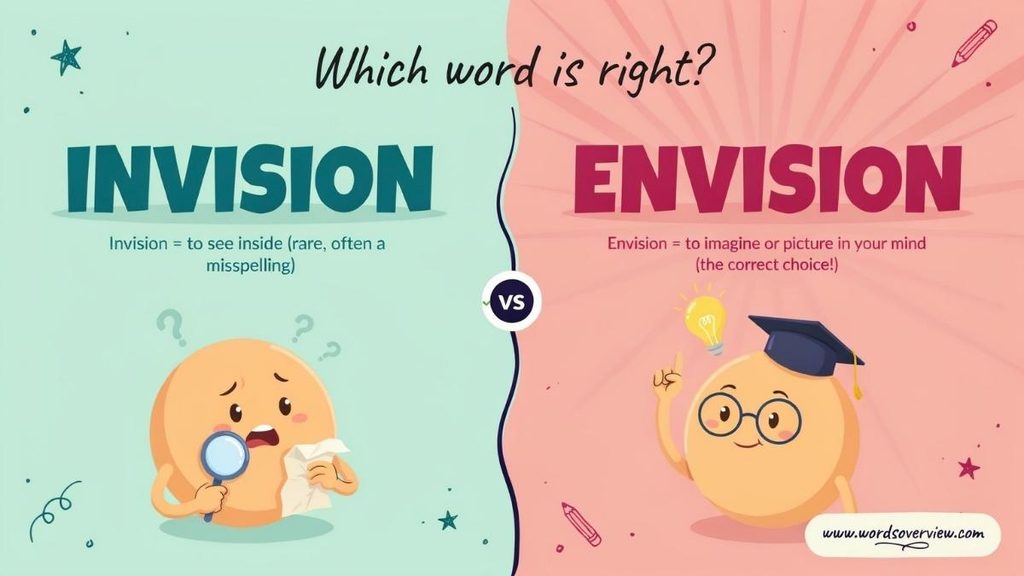
The envision vs vision difference mainly involves grammar.
Envision is a verb.
Vision is a noun.
| Word | Part of speech | Basic meaning |
| Envision | Verb | Imagine or mentally picture something |
| Vision | Noun | A sight, mental image or idea of a future state |
Compare these sentences:
She envisions a successful business.
Her vision is to build a successful business.
The first sentence describes an action. She mentally imagines the business.
The second sentence describes the idea or goal itself.
Learn the difference between tricky English words with easy explanations
Congrats or Congratulations: Which One Is Correct?
Envision and Vision in Sentences
Another useful comparison makes the distinction even clearer:
The architect envisions a modern building.
The architect has a vision for a modern building.
The two words are closely connected. Nevertheless, they perform different grammatical jobs.
You envision something.
You have a vision for something.
Envision or Imagine
The envision or imagine comparison is slightly more complicated because the words overlap.
Imagine is the broader term. You can imagine almost anything, whether it’s real, fictional, present, past or future.
Envision often focuses on a future situation, possibility or intended outcome.
| Word | Main idea | Example |
| Imagine | Form an idea or mental picture | Imagine living beside the ocean. |
| Envision | Imagine a possible or intended situation | She envisions living beside the ocean. |
Consider another pair:
Imagine finding a wallet full of money.
This sentence presents an imagined event.
Now compare:
The founders envision building a global company.
Here, the word suggests a future goal or possibility.
So imagine or envision isn’t always a matter of choosing a correct and incorrect word. Both can work in some contexts. The intended meaning determines which one fits naturally.
Envision or Visualize
The envision vs visualize distinction is also subtle.
Both words can involve creating a mental image, but visualize places more emphasis on seeing something mentally.
| Word | Main emphasis |
| Envision | Imagine a possible or intended situation |
| Visualize | Form a mental picture |
| Picture | Imagine something as a scene or image |
For example:
The company envisions a new approach to customer service.
This sentence focuses on a future direction.
Now consider:
The designer visualizes the finished interface before creating it.
This sentence places more emphasis on the mental picture of the finished design.
The meanings overlap. Still, the words aren’t always interchangeable.
Learn the difference between commonly misused words
Palate or Palette: Which Is Correct?
Envision Synonyms and Related Words
An envision synonym can replace the word in some contexts. However, each synonym carries its own shade of meaning.
Useful synonyms for envision include:
- Imagine — form an idea or mental picture.
- Visualize — create a mental image.
- Picture — imagine something as a scene or image.
- Foresee — anticipate something that may happen.
- Conceive — form an idea or concept.
- Anticipate — expect something to happen.
- Contemplate — think carefully about something.
- Dream — imagine an attractive or desired possibility.
For example:
She envisions becoming a doctor.
The sentence describes a future goal.
You could replace envisions with imagines, but the tone changes slightly:
She imagines becoming a doctor.
Both sentences work. However, envisions gives the idea a stronger connection to a future goal or intended outcome.
Likewise:
He visualized the finished product.
focuses more strongly on the mental image.
This is why an envision synonym and antonym list needs context. No single synonym works perfectly in every sentence.
Envision in Spanish
People searching for envision in Spanish may encounter several possible translations because English meaning depends on context.
Possible Spanish equivalents include:
- imaginar
- visualizar
- concebir
- contemplar
For example, a sentence about imagining a better future may use a form of imaginar.
A sentence about considering a future plan may use a different Spanish expression.
Therefore, translating envision requires attention to the surrounding sentence rather than choosing one fixed equivalent every time.
Envision Sentence Examples
The best way to understand envision usage is to see the word in different situations.
Everyday Examples
- I can envision spending my retirement near the ocean.
- Can you envision living in another country?
- She envisioned a peaceful weekend at home.
- It’s difficult to envision life without the internet.
- He can easily envision the situation.
Work and Business Examples
- The company envisions expanding its services.
- The manager envisioned a more efficient workflow.
- The team is envisioning a new approach to customer support.
- The founders envision a global audience for the product.
- We envision a solution that reduces unnecessary costs.
Education Examples
- Students can envision how the concept applies to real life.
- The teacher asked the class to envision the historical scene.
- Researchers envision new possibilities for online education.
- The students envisioned several possible solutions.
Goals and Future Plans
- She envisions herself leading a successful team.
- He envisions a future in which he owns his own business.
- They envision a better future for their community.
- I envision myself achieving this goal within a few years.
- She envisions success after years of preparation.
These examples of envision show why the word frequently appears alongside future, goal, plan, possibility, outcome, solution, success and vision.
Learn the difference between confusing word pairs
Doggy or Doggie: Which Spelling Is Correct?
How to Use Envision in a Sentence
Learning a few sentence patterns makes the correct usage of envision in English much easier.
Envision Something
They envision a larger facility.
Here, something is the object of the verb.
Envision Someone Doing Something
I can envision her managing the entire project.
This construction describes a person imagining another person performing an action.
Envision Yourself Doing Something
He envisions himself working internationally.
This pattern works particularly well when discussing goals and aspirations.
Envision a Future
The organization envisions a different future for the community.
The word naturally fits future planning.
Envision an Outcome
The team envisioned a positive outcome.
Here, the verb describes the result that the team imagined or expected.
Envision a Possibility
Can you envision a possibility that solves both problems?
This structure works well when discussing alternatives and creative thinking.
Envision Spelling: How to Remember It
The simplest way to remember the envision spelling is to focus on the word vision.
Envision contains vision.
That gives you:
en + vision = envision
If you’re wondering how to spell envision correctly, don’t replace en- with in-.
The standard spelling is:
E-N-V-I-S-I-O-N
The incorrect form commonly seen in ordinary writing is:
I-N-V-I-S-I-O-N
The first letter sequence creates the entire difference.
Remember: envision contains vision.
That small spelling trick can prevent a surprisingly common error.
A Practical Case Study: Envision or InVision?
Consider two sentences that look similar but have completely different meanings.
Sentence One
The project team envisioned a solution that would reduce costs.
Here, envisioned means imagined or mentally pictured.
The team thought about what the solution could look like.
Sentence Two
The designer previously used InVision to create interactive prototypes.
Here, InVision functions as a proper name.
The sentence refers to the software platform rather than the English verb.
The difference becomes clear when context enters the picture:
| Sentence | Meaning |
| The team envisioned a new solution. | The team imagined a solution. |
| The designer used InVision. | The designer used a software platform. |
This comparison explains why someone might encounter both spellings without either one being a simple alternative spelling of the other.
Learn the difference between tricky words and use them correctly
Many or Meny: Which Spelling Is Correct?
Common Mistakes With Invision and Envision
Mistake: Using Invision as a Verb
The most common error occurs when writers use invision to mean “imagine.”
Incorrect:
I invision myself becoming successful.
Correct:
I envision myself becoming successful.
Mistake: Calling Invision the British Spelling
British English may use envisage more frequently than American English. However, invision isn’t the British spelling of envision.
Mistake: Confusing a Brand Name With a Common Word
InVision appeared frequently in technology and design contexts.
That proper name doesn’t change the spelling of the ordinary verb envision.
Mistake: Changing the Verb Forms
Once you’ve learned envision, keep the same opening letters in its other forms:
- envision
- envisions
- envisioned
- envisioning
Don’t write:
- invision
- invisions
- invisioned
- invisioning
when you mean the standard English verb.
Envision or Invision: Final Comparison
| Feature | Envision | Invision | InVision |
| Standard English verb | Yes | No | No |
| Means “imagine” | Yes | Not as a standard verb | No |
| Used for future possibilities | Yes | No | No |
| Proper name | No | Usually not | Yes |
| Common spelling in normal writing | Yes | No | Only in proper-name context |
| Related to mental imagery | Yes | Not as the standard verb | No |
The table captures the central distinction.
If you’re writing about a goal, possibility, plan, outcome, future event or mental image, choose envision.
If you’re referring to the former design platform, InVision is the proper name.
Practice Session: Fill in the Blanks
Complete each sentence with the correct word or form: envision, envisioned, envisioning, vision, imagine, visualize, or InVision.
- She can ______ herself working as a successful software developer.
- The company hopes to ______ a better future for its customers.
- He ______ a world where everyone has access to clean energy.
- Try to ______ the scene in your mind before you describe it.
- The team is ______ a new approach to solve the problem.
- Her long-term ______ is to build a successful business.
- Can you ______ what your life might look like five years from now?
- The architect ______ the completed building before construction began.
- Many students ______ themselves graduating with excellent results.
- You can ______ your goal by creating a clear mental picture of success.
- The organization ______ a future with fewer environmental problems.
- She is ______ a solution that could save both time and money.
- His ______ for the project includes a modern and user-friendly website.
- I can ______ how difficult that situation would be.
- They ______ a successful launch for the new product.
- The manager asked employees to ______ their ideal workplace.
- We should ______ the possible outcome before making a decision.
- The students are ______ their future careers after graduation.
- She ______ herself speaking confidently in front of a large audience.
- The word ______ means to imagine or picture something mentally.
- “Invision” is commonly used as a spelling mistake for ______.
- ______ was the name of a design software company and platform, so it should not be confused with the ordinary verb “envision.”
- If you want to describe a future possibility, you can say, “I ______ a better solution.”
- The coach encouraged the players to ______ themselves achieving their goal.
- Before starting the project, the team tried to ______ the final result.
Answer Session
- envision
- envision
- envisioned
- visualize
- envisioning
- vision
- imagine
- envisioned
- envision
- visualize
- envisioned
- envisioning
- vision
- imagine
- envisioned
- envision
- envision
- envisioning
- envisioned
- envision
- envision
- InVision
- envision
- envision
- envision
Frequently Asked Questions
Is “envision” the correct spelling?
Yes. Envision is the standard English spelling of the verb meaning to imagine or picture something, especially a future situation or outcome. “Invision” is generally a misspelling when used as this verb.
Is “invision” a word?
“Invision” is not the standard spelling of the English verb envision. However, InVision can appear as a proper name associated with a former design software company and platform. Therefore, context matters.
What does “envision” mean in simple words?
Envision means to imagine or picture something in your mind. You can envision a future event, a goal, a solution or a possible outcome before it happens.
What is the difference between envision and imagine?
Both words involve forming an idea in your mind. Imagine has a broader meaning and can describe thoughts about almost anything. Envision often focuses on a future situation, desired result or possibility.
What is the difference between envision and vision?
Envision is a verb that means to imagine or picture something mentally. Vision is usually a noun that refers to the ability to see, a mental image or an idea about a future goal. For example, “I envision a better future” uses the verb while “Her vision is clear” uses the noun.
What is the difference between envision and visualize?
Envision means to imagine or picture something, often a future possibility or outcome. Visualize places stronger emphasis on creating a mental image. For example, you can envision your future career and visualize yourself working in that role.
How do you use “envision” in a sentence?
You can use envision to describe something you imagine or expect. For example: “She can envision herself leading the project.” Another example is “They envision a future where clean energy is widely available.”
What are synonyms for “envision”?
Common synonyms for envision include imagine, visualize, picture, foresee, conceive and anticipate. The best synonym depends on the context because each word carries a slightly different meaning.
What is the past tense of “envision”?
The past tense of envision is envisioned. For example: “The team envisioned a simpler solution.” The present participle is envisioning, as in “She is envisioning her future career.”
How do you pronounce “envision”?
Envision is commonly pronounced approximately as in-VIZH-un. The stress falls on the second syllable, and the middle sound resembles the “zh” sound in words such as “vision.”
Conclusion
The invision or envision confusion may look like a tiny spelling problem, but it can easily sneak into emails, essays and professional writing. The good news is that the solution is simple: envision is the standard English verb meaning to imagine or picture something, especially a future possibility, plan or outcome. Invision is not the standard spelling of this verb, although InVision can appear as a proper name for the former design software company and platform. Remember the connection between “envision” and “vision,” and this spelling mistake becomes much easier to avoid. Once you know the difference, you can confidently envision clearer writing without letting “invision” crash the grammar party.

Ethan AJS is an experienced blogger and language enthusiast at Words Overview, dedicated to making English easier to understand and use. He writes about grammar, vocabulary, spelling, word meanings and commonly confused words, turning tricky language questions into clear, practical insights. With a passion for effective communication, Ethan creates engaging, readerfocused content that helps readers write accurately, choose the right words and communicate with confidence.




