
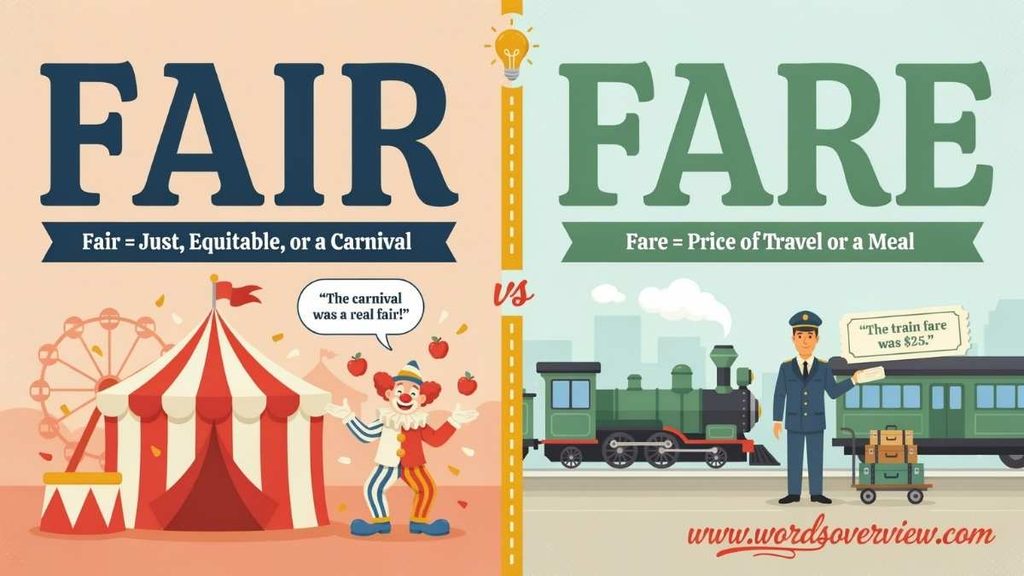
Have you ever typed “fair” when you meant “fare” and wondered why English decided to make two completely different words sound like twins? You’re not alone. The confusion around fair or fare catches students, travelers and even experienced writers off guard. One tiny letter can change the meaning from a reasonable decision to the price of a bus ticket. Meanwhile, a fair can mean a public event while fare can describe food or how someone performs. Sounds confusing? It doesn’t have to be. Once you understand their meanings, grammar and common uses, choosing the correct word becomes much easier. Let’s clear up this classic English mix-up.
Fair or Fare Quick Answer
The simplest fair or fare meaning depends on what you want to say.
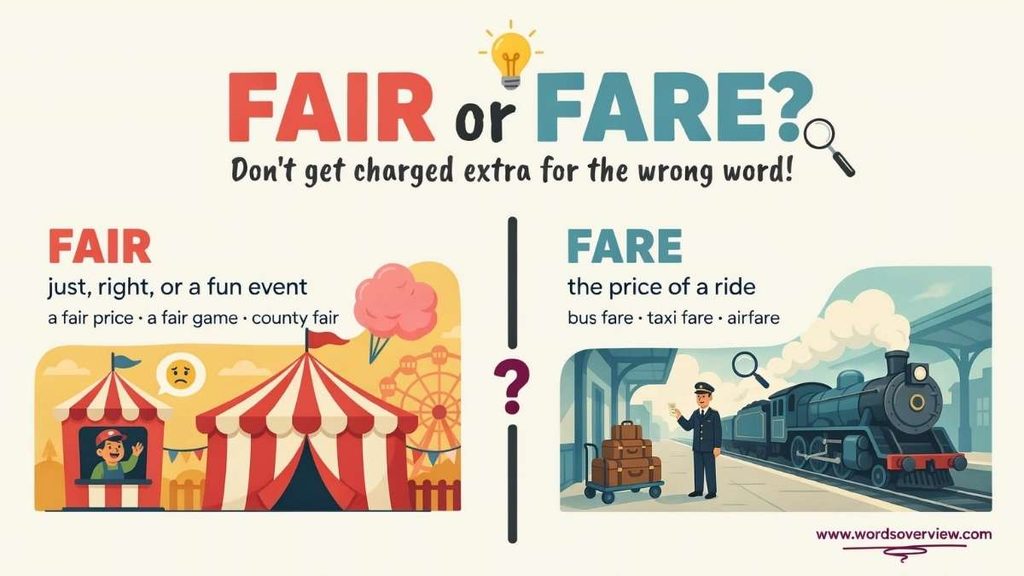
- Fair usually means just, reasonable, impartial, attractive, light-colored or a public event.
- Fare usually means the price of transportation, a paying passenger, food or how someone performs or progresses.
| Word | Main Meaning | Example |
| Fair | Just or reasonable | The teacher gave everyone a fair chance. |
| Fair | Public event | We went to the school fair. |
| Fair | Light-colored | She has fair hair. |
| Fare | Transportation cost | The bus fare increased this year. |
| Fare | Food or cuisine | The restaurant serves traditional fare. |
| Fare | Perform or progress | How did you fare in the interview? |
| Fare | Paying passenger | The taxi driver picked up a fare. |
The key difference between fair and fare involves meaning rather than British or American spelling.
Fair and Fare Examples
These short examples show the distinction clearly:
- The rules are fair to everyone.
- We visited the county fair.
- The train fare increased last month.
- The restaurant serves traditional local fare.
- How did you fare on your exam?
- The taxi driver picked up a new fare.
A useful rule is simple: fair often relates to justice or an event while fare often relates to travel, food or performance.
What Does Fair Mean in English?
The fair meaning changes according to context. The word can function as an adjective, noun or adverb in established expressions.
The most common fair definition describes something as just, reasonable or impartial. However, English uses fair in several other ways.
Fair Meaning “Just” or “Reasonable”
When fair describes treatment, rules, decisions or opportunities, it usually means just or reasonable.
For example:
- The judge made a fair decision.
- Every student deserves a fair chance.
- The company provides fair treatment.
- Both teams received a fair opportunity.
- That doesn’t seem fair.
In these examples, fair describes something that meets a reasonable standard of justice or equality.
As a result, expressions such as fair competition, fair judgment and fair treatment all carry the idea of impartial or reasonable behavior.
Fair Meaning “Honest” or “Impartial”
Fair can also describe someone who avoids unreasonable favoritism.
For example:
- The referee was fair to both teams.
- The manager gave an impartial and fair judgment.
- A good teacher should treat every student fairly.
Therefore, fair often appears when people discuss decisions or treatment that should remain balanced and unbiased.
Fair Meaning “Public Event”
Another common fair meaning refers to an organized public event.
A fair can include games, food, entertainment, rides, competitions, exhibitions or vendors selling goods. The exact activities depend on the type of fair.
Common examples include:
- school fair
- county fair
- state fair
- fun fair
- trade fair
- street fair
For example:
The school is organizing a fair to raise money for new equipment.
Here, fair refers to the event itself. It doesn’t describe transportation costs or food.
This distinction answers the common question “fair or fare for an event?” The correct word is fair.
Fair Meaning “Light in Color”
The word fair can also describe a light color. English commonly uses this meaning when talking about hair or skin.
Examples include:
- She has fair hair.
- He has fair skin.
- The character has fair features.
This meaning has no connection with justice or public events. Instead, the surrounding words make the intended meaning clear.
Fair as a Noun
The fair noun commonly refers to an organized event.
For example:
The annual county fair begins Friday.
A fair can serve a community purpose, provide entertainment or promote products and services. Trade fairs often focus on businesses and industries while local fairs may emphasize food, games and community activities.
Fair as an Adjective
The fair adjective has several common uses.
It can describe:
- a fair decision
- a fair price
- fair treatment
- fair competition
- fair weather
- fair hair
The meaning depends on the noun or situation.
For instance, fair price means a reasonable price while fair competition means competition that follows accepted rules without improper advantages.
Fair as an Adverb
Although less common than its adjective and noun uses, fair can function as an adverb in established expressions.
For example:
- Play fair.
- Fight fair.
In these sentences, fair describes the manner of the action.
Learn the difference between tricky words and use them correctly
Many or Meny: Which Spelling Is Correct?
What Does Fare Mean in English?
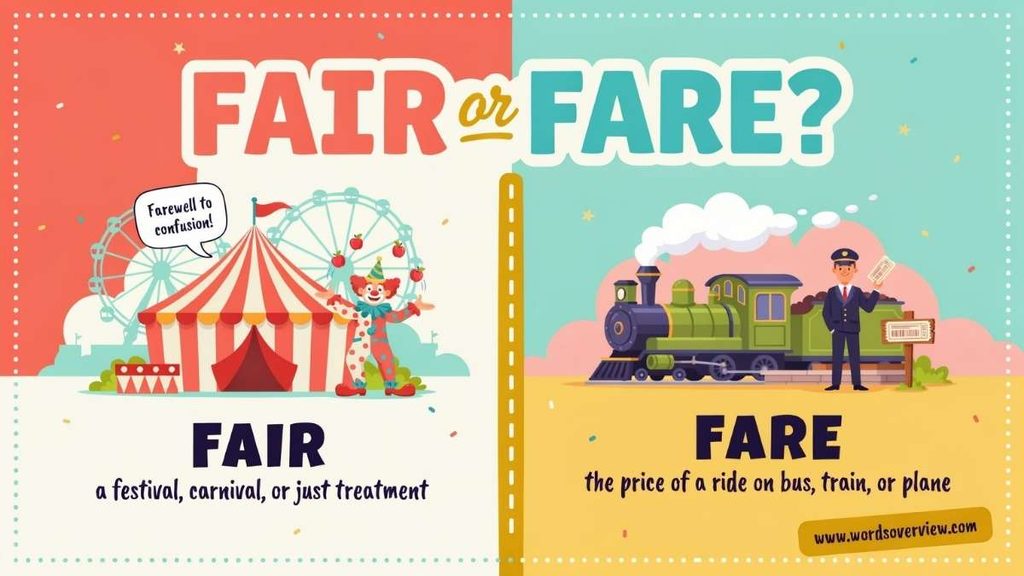
The fare meaning differs significantly from the main meanings of fair.
The fare definition includes several uses. As a noun, fare can mean a transportation charge, a passenger or food. As a verb, it can describe how someone or something performs or progresses.
Fare Meaning “Transportation Cost”
The most familiar fare meaning refers to the amount charged for transportation.
You may encounter:
- bus fare
- train fare
- taxi fare
- airfare
- subway fare
- travel fare
For example:
The bus fare increased this year.
Here, fare means the amount a passenger pays for transportation.
That’s why you should write bus fare rather than bus fair.
The same rule applies to:
- train fare
- taxi fare
- airfare
- subway fare
Fare Meaning “Cost” or “Ticket Price”
In travel contexts, fare can refer to the amount charged for a journey.
For example:
We checked the train fare before buying our tickets.
Transportation providers may offer different fares based on factors such as route, class, timing or ticket conditions.
The important point remains the same: fare refers to a transportation charge. It doesn’t describe whether that charge seems reasonable.
Consider this sentence:
The fare is expensive but the price seems fair.
The first word refers to the transportation cost. The second describes whether that cost seems reasonable.
Fare Meaning “A Paying Passenger”
Fare has another noun meaning that sometimes surprises English learners. It can refer to a passenger who pays for transportation.
For example:
The taxi driver picked up a fare outside the hotel.
This usage appears especially often in contexts involving taxis and commercial transportation.
In this sentence, fare doesn’t mean the price of the journey. Instead, it refers to the passenger who pays for the journey.
Fare Meaning Food
The word fare can also mean food or a particular type of cuisine.
For example:
The restaurant serves traditional Mexican fare.
You may encounter expressions such as:
- local fare
- traditional fare
- regional fare
- vegetarian fare
- simple fare
This meaning appears frequently in descriptions of restaurants, travel destinations and regional cuisine.
For example:
Visitors enjoyed the local fare at the festival.
Here, fare refers to the food rather than the event.
Fare as a Verb
The fare verb means to perform, progress or manage in a particular situation.
For example:
How did you fare on the exam?
This question asks about someone’s performance.
You can also use fare in several common expressions:
- The team fared well.
- The company fared badly during the downturn.
- How are you faring?
- The product fared better than expected.
Therefore, the expression “how did you fare?” means something similar to “how did you do?” or “how did you perform?”
Learn the difference between similar English words
Invision or Envision Which Spelling Is Correct?
Fair vs Fare What’s the Difference?
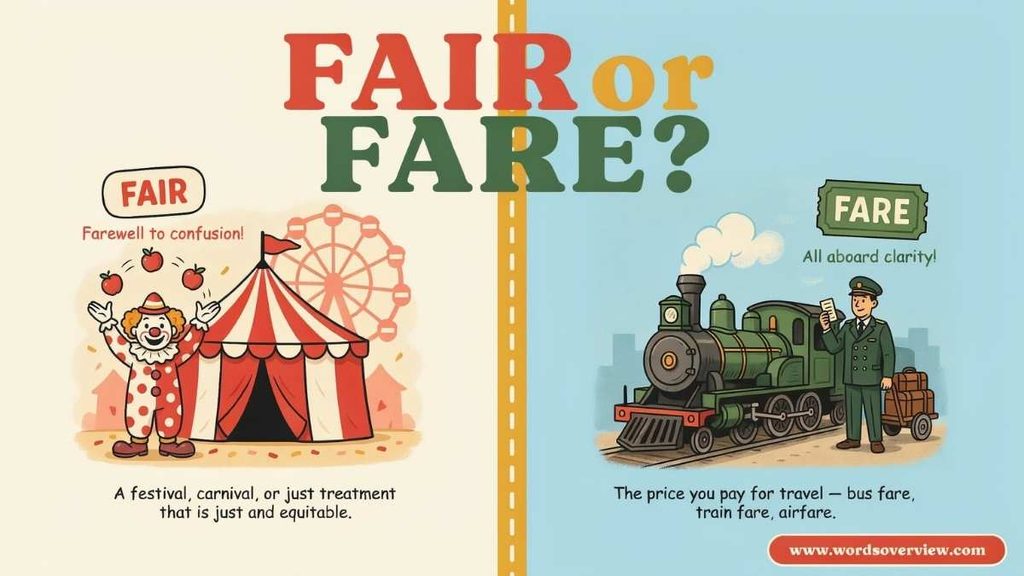
The fair or fare distinction becomes much easier when you compare their main meanings.
| Meaning | Correct Word | Example |
| Just or impartial | fair | The decision was fair. |
| Reasonable | fair | That’s a fair price. |
| Public event | fair | We attended a school fair. |
| Light-colored | fair | She has fair hair. |
| Transportation cost | fare | The taxi fare was high. |
| Paying passenger | fare | The driver picked up a fare. |
| Food or cuisine | fare | The restaurant serves local fare. |
| Perform or progress | fare | How did you fare? |
The fair and fare difference becomes obvious when you focus on meaning instead of pronunciation.
Fair or Fare Grammar
The two words also have different grammatical functions.
Fair can function as:
- an adjective
- a noun
- an adverb in certain expressions
Fare can function as:
- a noun
- a verb
This distinction can help when you’re unsure about the fair spelling or fare spelling.
For example, in “The price is fair”, the word describes the price. In “The fare is $5”, the word identifies the transportation cost.
Fair and Fare Homophones: Do They Sound the Same?
Yes. Fair and fare homophones have the same pronunciation in standard English.
A homophone is a word that sounds like another word but has a different spelling and meaning.
Therefore, fair and fare homophones meaning can be summarized simply: they sound alike while carrying different meanings.
This makes them classic English homophones and commonly confused words.
Are Fair and Fare Homophones?
Yes, fair and fare are homophones.
They belong to a larger group of words that sound the same but have different spellings and meanings.
Other familiar English homophones include:
- right / write
- sea / see
- flower / flour
- pair / pear
- brake / break
Like these pairs, fair and fare require context when you encounter them in writing.
Fair Pronunciation and Fare Pronunciation
The fair pronunciation and fare pronunciation are the same in standard English.
The spelling changes but the spoken form does not.
That creates the main source of confusion. When someone says either word aloud, you need the surrounding context to determine which spelling belongs in writing.
For this reason, learning the meanings and common phrases associated with each word provides a more reliable strategy than relying on pronunciation.
Learn the difference between confusing English words step by step
Maximise or Maximize: Which Spelling Is Correct?
Fair or Fare for an Event?
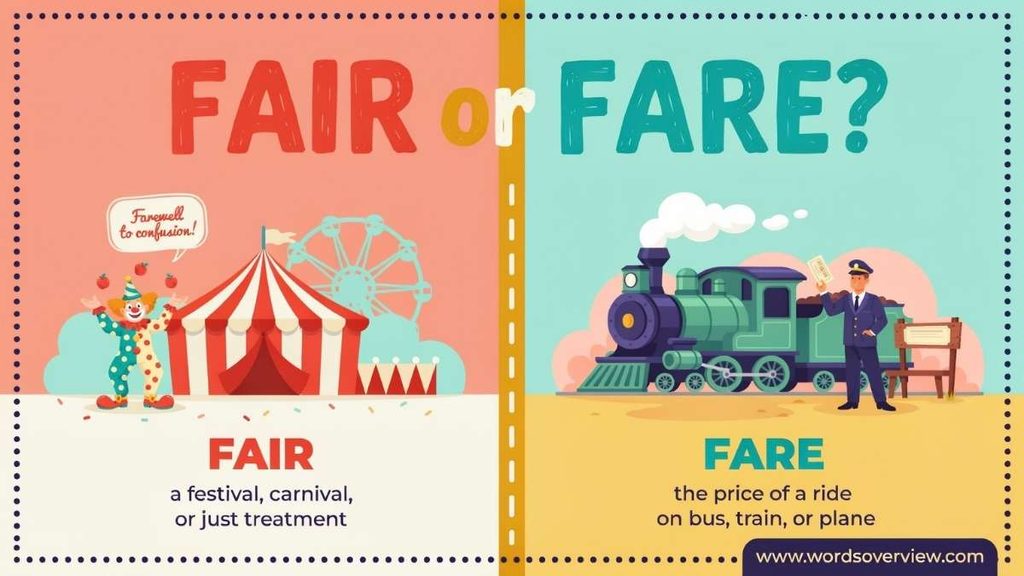
When you mean an event, use fair.
This applies to several types of events:
- school fair
- county fair
- state fair
- fun fair
- trade fair
- street fair
For example:
The school is holding a fair on Saturday.
Thousands of people attended the county fair.
The company displayed its products at a trade fair.
Therefore, if you’re asking “is it fair or fare for an event?”, choose fair.
However, fare can appear in the same sentence when you discuss food.
The fair offered traditional local fare.
Here, fair identifies the event while fare identifies the food.
Fair or Fare for Transportation?
When you mean the amount charged for a journey, use fare.
Bus Fare Meaning
Bus fare means the amount you pay to travel by bus.
The bus fare is $2.
Not:
The bus fair is $2.
The word fare identifies the transportation cost.
Train Fare Meaning
Train fare means the cost of traveling by train.
We checked the train fare before buying our tickets.
Again, fare describes the transportation charge.
Taxi Fare Meaning
Taxi fare refers to the amount charged for a taxi journey.
The taxi fare depends on the distance traveled.
The passenger pays the fare while the driver provides the transportation service.
Airfare Meaning
Airfare means the price charged for air travel.
The airfare was lower when we booked several weeks in advance.
The word can appear as one word in airfare.
These examples make the fare or fair travel meaning straightforward. When you’re talking about the cost of transportation, choose fare.
Learn the difference between confusing more English words
Businesses or Business’s: Which Is Correct?
Fair or Fare in Food and Cooking
Food creates another interesting point of confusion.
Fare can mean food or a particular style of cuisine. This use often appears in restaurant descriptions, travel writing and discussions of regional dishes.
For example:
The restaurant serves traditional Italian fare.
Visitors enjoyed the local fare.
The festival featured regional fare.
In contrast, fair generally refers to the event.
Consider this sentence:
The fair served local fare.
The first word identifies the event. The second identifies the food.
This distinction also explains why fare as food appears in descriptions of traditional cuisine.
Fair or Fare in “How Did You ___?”
One of the most common mistakes involves this question:
How did you fare?
Here, fare is a verb meaning to perform, progress or manage.
You might ask:
- How did you fare on the test?
- How did you fare in the interview?
- How did the company fare during the difficult period?
The related expression fare well means to perform or progress successfully.
For example:
The students fared well on the exam.
The opposite expression is fare badly.
The team fared badly in the final.
You can also use the continuous form:
How are you faring in your new job?
So, if you need to ask about someone’s performance or progress, fare is the correct choice.
Learn the difference between tricky English words with easy explanations
Congrats or Congratulations: Which One Is Correct?
Fair or Fare Common Mistakes
Because the two words sound alike, spelling mistakes can easily appear in everyday writing.
“The Bus Fair Is Too Expensive”
Incorrect:
The bus fair is too expensive.
Correct:
The bus fare is too expensive.
Fare refers to the cost of transportation.
“That’s Not Fare!”
Incorrect:
That’s not fare!
Correct:
That’s not fair!
Here, fair means just or reasonable.
“We Enjoyed the Food Fair”
This sentence can be correct if food fair means an event focused on food.
However, if you mean the food itself, fare is the better choice.
We enjoyed the local fare.
The context determines the intended meaning.
“How Did You Fair in the Test?”
Incorrect:
How did you fair in the test?
Correct:
How did you fare on the test?
The verb fare means to perform or progress.
Fair or Fare Common Expressions
Learning common phrases can make the fair or fare distinction much easier.
Common Expressions With Fair
Some common expressions include:
- fair chance
- fair price
- fair treatment
- fair decision
- fair competition
- fair judgment
- fair game
- fair enough
- fair play
- school fair
- county fair
- state fair
- trade fair
For example:
Everyone deserves a fair chance.
The store offers a fair price.
The referee ensured fair competition.
Common Expressions With Fare
Common expressions include:
- bus fare
- train fare
- taxi fare
- airfare
- travel fare
- local fare
- traditional fare
- fare well
- fare badly
- how did you fare?
For example:
The airfare was cheaper than expected.
The restaurant serves local fare.
The students fared well in the competition.
Learn the difference between commonly confused words in English
Pair or Pare: Meaning, Difference and Use Correctly
Fair vs Fare British and American English
One important point deserves attention: fair and fare aren’t alternative British and American spellings.
Both American English and British English use fair and fare as separate words with their own meanings.
Therefore, the correct choice doesn’t depend on whether your audience lives in the United States or the United Kingdom.
For example:
- fair price works in both varieties of English.
- bus fare works in both varieties.
- school fair works in both varieties.
- train fare works in both varieties.
- how did you fare? works in both varieties.
So, don’t choose fair because you’re writing for an American audience or fare because you’re writing for a British audience. Choose the word that matches the meaning.
Fair or Fare How to Choose the Right Word
When you’re uncertain, focus on the meaning of the sentence.
Use fair if you mean:
- just
- reasonable
- impartial
- honest
- an event
- light-colored
- fair play or fair treatment
Use fare if you mean:
- transportation cost
- ticket price
- paying passenger
- food or cuisine
- perform or progress
A quick decision process can help.
Does it mean just or reasonable?
Use fair.
Does it describe an event?
Use fair.
Does it describe a transportation price?
Use fare.
Does it mean food or cuisine?
Use fare.
Does it describe someone’s performance or progress?
Use fare.
This approach works better than memorizing isolated spellings because it connects each word with its actual meaning.
Fair vs Fare A Simple Memory Trick
The easiest way to remember fair vs fare is to connect each word with one strong example.
Think:
FAIR → fair treatment or a fair event
FARE → bus fare or train fare
Once these associations become familiar, the other meanings become easier to recognize.
For example:
The fare was expensive but the price seemed fair.
The first word refers to transportation cost. The second describes whether the cost seems reasonable.
Another useful example is:
The fair offered delicious local fare.
Here, fair means the event while fare means the food.
These examples provide an easy way to remember fair fare homophones without relying on a complicated mnemonic.
Learn how to use confusing more words correctly
Organiser or Organizer: Which Spelling Is Correct?
Fair and Fare Examples in Sentences
Context makes the fair and fare examples in sentences much easier to understand.
Sentences Using Fair
- The teacher gave every student a fair chance.
- The price seems fair.
- Everyone deserves fair treatment.
- The judge made a fair decision.
- We visited the state fair.
- The children enjoyed the school fair.
- The company attended a trade fair.
- She has fair hair.
- Please play fair.
- That’s a fair point.
Sentences Using Fare
- The bus fare increased this month.
- We checked the train fare online.
- The taxi fare was higher than expected.
- Airfare can vary depending on the route and date.
- The restaurant serves traditional local fare.
- How did you fare on the exam?
- The company fared well last year.
- The team fared badly in the final.
- The driver picked up a new fare.
- How are you faring in your new role?
A Sentence With Fair and Fare
The fair offered local fare and the prices seemed fair.
This sentence demonstrates three important uses:
- fair = event
- fare = food
- fair = reasonable
It provides a practical example of the fair and fare difference in one sentence.
Fair vs Fare Fair and Fare Grammar
Grammar provides another useful clue when you need to distinguish these commonly confused words.
| Word | Part of Speech | Example |
| Fair | Adjective | That is a fair decision. |
| Fair | Noun | We visited the fair. |
| Fair | Adverb | Play fair. |
| Fare | Noun | The bus fare increased. |
| Fare | Noun | The restaurant serves local fare. |
| Fare | Noun | The driver picked up a fare. |
| Fare | Verb | How did you fare? |
The grammatical role doesn’t determine the answer in every situation. Still, it gives you another useful clue.
For example, if you see “How did you ___?”, the verb fare makes sense when the question asks about performance or progress.
Likewise, if a word describes a price, treatment or decision, fair often fits because it expresses reasonableness or impartiality.
Fair or Fare Synonyms
The correct fair synonym depends on the meaning.
1: When fair means just or reasonable, possible synonyms include:
- just
- impartial
- reasonable
- equitable
- unbiased
- honest
2: When fair means an event, related words can include:
- exhibition
- festival
- carnival
- market
- show
The correct fare synonym also depends on context.
3: When fare means transportation cost, related terms include:
- charge
- cost
- ticket price
- transportation cost
4: When fare means food, related terms include:
- food
- cuisine
- dishes
- provisions
5: When fare functions as a verb, related expressions include:
- perform
- progress
- manage
- get along
Therefore, neither word has one universal synonym. Context determines the closest alternative.
Learn the difference between confusing word pairs
Doggy or Doggie: Which Spelling Is Correct?
Fair or Fare Fair and Fare Difference With Examples
The following comparison addresses several common spelling mistakes.
| Confusing Phrase | Correct Phrase | Reason |
| bus fair | bus fare | Fare means transportation cost. |
| train fair | train fare | Fare means ticket price. |
| taxi fair | taxi fare | Fare means transportation charge. |
| that’s not fare | that’s not fair | Fair means just or reasonable. |
| fair well | fare well | Fare means perform or progress. |
| how did you fair? | how did you fare? | Fare functions as a verb meaning perform. |
| fair price | fair price | Fair means reasonable. |
| school fare | school fair | Fair means an event. |
| traditional fair | traditional fare | Fare can mean food or cuisine. |
These examples cover many situations in which writers confuse fair vs fare spelling.
Fair or Fare School, Business and Travel
The context often makes the correct word obvious.
School
School-related writing can use both words because they serve different purposes.
For example:
- school fair
- fair grade
- fair treatment
- fair chance
- how students fared on an exam
Consider:
The school organized a fair to raise money.
Then:
Most students fared well on the test.
The first sentence uses fair as a noun. The second uses fare as a verb.
Business
Business writing frequently uses fair when discussing prices, treatment or competition.
The company offered a fair price.
However, business writing can also use fare when discussing performance.
The new product fared well in the market.
Trade events provide another example:
The company exhibited its products at an international trade fair.
Therefore, both words can appear in professional writing without meaning the same thing.
Travel
Travel writing often uses fare for transportation costs:
- airfare
- bus fare
- train fare
- taxi fare
- travel fare
However, fair can also appear in travel-related sentences.
The airline offered a fair price.
Here, fare would refer to the transportation charge while fair would describe the price as reasonable.
Fair or Fare What Does Each Word Mean at an Event?
The phrase fair or fare for a festival can cause confusion because both words may appear when discussing the same event.
Consider:
The fair featured traditional local fare.
This sentence uses both words correctly.
Fair identifies the event.
Fare identifies the food.
Likewise:
Visitors enjoyed the fair and sampled regional fare.
This distinction answers the question “what does fair mean at an event?” It refers to the organized event itself.
Meanwhile, fare can describe the food available there.
Learn the difference between commonly misused words
Palate or Palette: Which Is Correct?
Fair or Fare Quick Reference Chart
| If You Mean… | Use |
| Just | fair |
| Reasonable | fair |
| Honest or impartial | fair |
| A public event | fair |
| A carnival-like event | fair |
| Light-colored | fair |
| Transportation cost | fare |
| Ticket price | fare |
| Paying passenger | fare |
| Food or cuisine | fare |
| Perform or progress | fare |
The quickest rule is straightforward: fair usually connects with justice, reasonableness or events. Fare commonly connects with travel, food or performance.
Practice Session: Fair or Fare
Fill in each blank with fair or fare.
Fill in the Blanks
- The bus ______ costs $2 during the week.
- The teacher gave every student a ______ chance.
- We went to the county ______ with our friends.
- How did you ______ in your final examination?
- The restaurant serves delicious traditional ______.
- The judge made a ______ decision after hearing both sides.
- What is the taxi ______ to the airport?
- The children enjoyed the rides at the school ______.
- It isn’t ______ to judge someone without knowing the facts.
- She hopes to ______ well in her new position.
- The airline offers a lower ______ during the winter.
- They attended a large trade ______ last month.
- Every employee deserves ______ treatment.
- How did your team ______ in the tournament?
- We couldn’t believe how expensive the train ______ was.
- The festival featured local food and entertainment at the ______.
- Is it ______ to give everyone the same opportunity?
- He didn’t ______ well during the difficult interview.
- Our school holds a charity ______ every year.
- The passenger asked about the train ______ before buying a ticket.
- The manager promised to treat all workers ______.
- The hotel serves excellent seafood ______.
- I wonder how she will ______ in her new role.
- The street ______ attracted hundreds of visitors.
- The bus ______ increased because of higher operating costs.
Answer Session
- fare
- fair
- fair
- fare
- fare
- fair
- fare
- fair
- fair
- fare
- fare
- fair
- fair
- fare
- fare
- fair
- fair
- fare
- fair
- fare
- fair
- fare
- fare
- fair
- fare
Frequently Asked Questions
What is the main difference between fair and fare?
Fair usually means just, reasonable or impartial. It can also refer to a public event such as a school fair or county fair. Fare commonly means the price of transportation, such as a bus fare or train fare. It can also mean food or describe how someone performs.
Is it fair enough or fare enough?
The correct phrase is “fair enough.” It means that something seems reasonable, acceptable or understandable. For example, “Fair enough, I understand your point.”
How do you use fare in a sentence?
You can use fare as a noun or verb. As a noun, it can refer to a transportation cost: “The bus fare is $3.” As a verb, it can describe how someone performs: “She fared well in the interview.”
What does fair mean at an event?
At an event, fair means a public gathering that offers entertainment, activities, exhibits, food or products. Examples include a school fair, county fair, state fair, trade fair and fun fair.
Is it food fare or food fair?
Food fare is correct when you mean the food served or offered at a particular place or event. Fair refers to an event rather than the food itself. For example, “The restaurant offers traditional Italian fare.”
What does “how did you fare?” mean?
“How did you fare?” means “How did you do?” or “How did things go for you?” You might ask this after an exam, interview, trip or difficult experience. For example, “How did you fare on your final exam?”
What does fair mean in “fair treatment”?
In “fair treatment,” fair means just, reasonable and impartial. The phrase suggests that someone receives treatment without unfair discrimination or favoritism. For example, “Every employee deserves fair treatment.”
What does fare mean when traveling?
When traveling, fare usually means the amount of money you pay for transportation. Common examples include bus fare, train fare, taxi fare and airfare. For example, “The train fare increased this month.”
Are fair and fare homophones?
Yes. Fair and fare are homophones because they have the same pronunciation but different spellings and meanings. Their shared pronunciation often causes confusion, but their meanings depend on the context.
How can you remember the difference between fair and fare?
A simple memory trick is to connect fare with payment and performance. You pay a fare when you travel and you can fare well when you perform well. Fair covers meanings such as reasonable, impartial or a public event.
Conclusion
The fair or fare confusion may look like a tiny spelling problem, but these two homophones have completely different jobs. Fair usually describes something just, reasonable or impartial. It can also refer to a public event such as a school fair, county fair or trade fair. Fare, on the other hand, commonly means the cost of transportation, such as a bus fare, train fare or taxi fare. It can also describe food or someone’s performance, as in “She fared well.”
Here’s the easiest way to remember the difference: fair can describe what is reasonable while fare often involves what you pay or how you do. Once you connect each word with its meaning, this confusing pair becomes much easier to handle. So next time you wonder whether it’s fair or fare, don’t let that extra “e” take you for a ride!

Ethan AJS is an experienced blogger and language enthusiast at Words Overview, dedicated to making English easier to understand and use. He writes about grammar, vocabulary, spelling, word meanings and commonly confused words, turning tricky language questions into clear, practical insights. With a passion for effective communication, Ethan creates engaging, readerfocused content that helps readers write accurately, choose the right words and communicate with confidence.




