
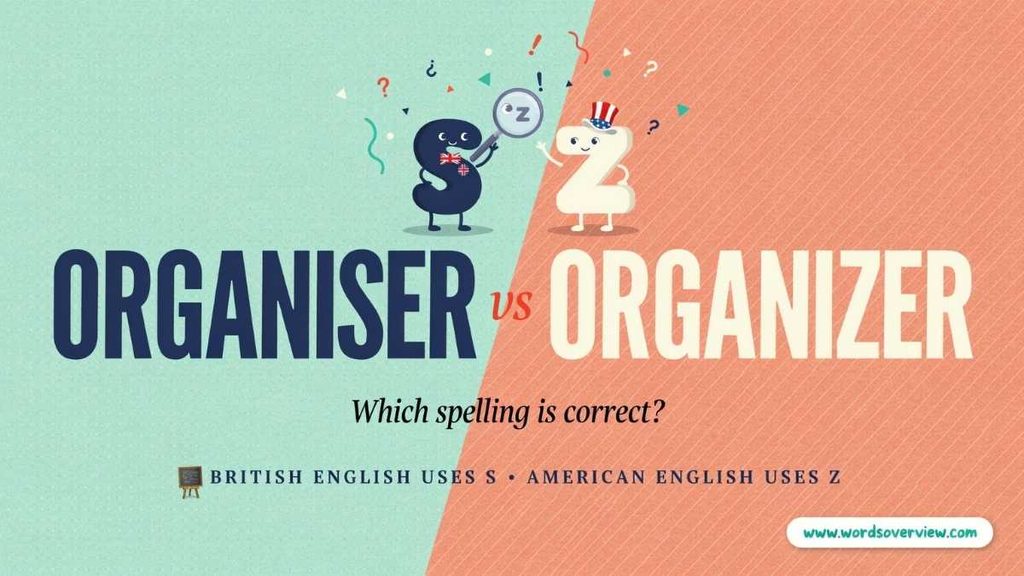
English spelling can sometimes feel like it has a secret rulebook that nobody gave you. One day you write “organizer” with a z and everything looks perfectly normal. Then you see “organiser” with an s and suddenly you wonder whether your keyboard has started making decisions for you. Don’t worry. The organiser or organizer confusion has a simple explanation: both spellings are correct, but they belong to different regional spelling conventions. American English generally uses “organizer” while British English commonly uses “organiser.” Understanding this small difference can help you avoid spelling mistakes and choose the right form for your audience.
Organiser or Organizer What’s the Difference?
For example, an event organizer might arrange a conference venue, contact speakers and manage registrations. In British English, that same person would usually be called an event organiser.
The word can also describe an object that helps you arrange or store things. A desk organizer might contain separate compartments for pens, documents and stationery. In British English, you’ll often see desk organiser instead.
So, the organiser vs organizer comparison doesn’t involve two separate meanings. Instead, it shows how different English varieties spell the same word.
Organizer
Organizer is the standard American spelling of the noun. It describes a person who plans or coordinates an event, activity, project or other undertaking.
For example:
The event organizer confirmed the venue yesterday.
The conference organizer contacted all the speakers.
The community organizer arranged a meeting with local residents.
The word can also describe a physical storage product. For instance, a desk organizer can help you keep office supplies tidy and easy to find.
Organiser
Organiser is the usual British spelling of the same noun.
For example:
The event organiser confirmed the venue yesterday.
The conference organiser contacted all the speakers.
The community organiser arranged a meeting with local residents.
The meaning doesn’t change when the spelling changes. Instead, the spelling reflects the regional English convention.
Learn the difference between confusing word pairs
Doggy or Doggie: Which Spelling Is Correct?
Is Organizer or Organiser Correct?
Both forms can be correct.
The important question is where and for whom you’re writing.
| English variety | Preferred form | Example |
| American English | organizer | The organizer confirmed the details. |
| British English | organiser | The organiser confirmed the details. |
| US professional writing | organizer | The event organizer sent an email. |
| UK professional writing | organiser | The event organiser sent an email. |
| US academic writing | organizer | The conference organizer collected the data. |
| UK academic writing | organiser | The conference organiser collected the data. |
Consequently organizer correct spelling and organiser correct spelling can both describe a correct form. The appropriate choice depends on the regional convention you’re following.
One detail deserves attention, however. British spelling doesn’t always follow a simple rule in which every American ize word becomes ise. Different British dictionaries, institutions and publishers can follow different style policies.
For this particular word, though organiser remains a familiar and widely used British form while organizer is firmly established in American English.
Learn the difference between confusing more English words
Businesses or Business’s: Which Is Correct?
Organizer vs Organiser in American and British English
The organizer vs organiser spelling difference comes from the larger ize vs ise pattern found across English.
American English commonly uses the ize spelling:
- organize
- organizer
- organized
- organizing
- organization
British English commonly uses the ise spelling:
- organise
- organiser
- organised
- organising
- organisation
This pattern helps explain why the organizer spelling contains a z while the organiser spelling contains an s.
Organizer in American English
The form organizer American English is straightforward. American writing normally uses organize as the verb and organizer as the related noun.
For example:
The organizer planned the conference six months in advance.
The event organizer created a detailed schedule.
Several organizers attended the planning meeting.
This same spelling appears in business writing, school assignments, websites, newspapers and everyday communication across the United States.
Organiser in British English
The form organiser British English follows the common British ise convention.
For example:
The organiser planned the conference six months in advance.
The event organiser created a detailed schedule.
Several organisers attended the planning meeting.
As a result, writers working with UK English should normally choose organiser when their style guide follows the common British convention.
Organizer and Organiser Meaning
The organizer meaning and organiser meaning are essentially the same.
The noun usually refers to a person who plans, coordinates or arranges something. It can also refer to a physical item that helps arrange or store objects.
The word can therefore appear in two major contexts:
- A person who coordinates an event or activity
- A container or system used to keep items arranged
The surrounding sentence usually makes the intended meaning obvious.
Organizer Definition: A Person
The organizer definition most commonly refers to someone responsible for planning or coordinating something.
An organizer may work with:
- events
- meetings
- conferences
- weddings
- community activities
- campaigns
- projects
- groups
For example:
The wedding organizer created a detailed timeline for the ceremony.
Here organizer means a person responsible for planning and coordination.
The role can overlap with terms such as planner, coordinator, facilitator or manager. However, these words aren’t always interchangeable. An organizer focuses on bringing arrangements together while a manager may have broader responsibility for people, resources or operations.
Organiser Definition: A Person
The organiser definition works in the same way.
A British English sentence might say:
The conference organiser arranged transportation for the speakers.
The person handles planning and coordination. Only the spelling differs from the American version.
Organizer as a Storage Item
The word also has a practical physical meaning.
A storage organizer is an item designed to keep objects separated and orderly. Depending on its purpose, it might contain compartments, drawers or sections.
Common examples include:
- desk organizer
- drawer organizer
- home organizer
- storage organizer
- stationery organizer
- closet organizer
- document organizer
For example:
The desk organizer keeps pens, clips and notebooks in separate compartments.
British English can use the corresponding forms desk organiser, drawer organiser and home organiser.
Learn the difference between commonly misused words
Palate or Palette: Which Is Correct?
When Should You Use Organizer or Organiser?
The easiest rule is to match your spelling to your audience and language variety.
If you’re writing for people in the United States, use organizer. If you’re writing for a British audience, use organiser unless the publication or organization follows another specific style.
Consistency matters because regional spelling works across entire word families.
Use Organizer for a US Audience
Choose organizer when your content targets:
- US customers
- American businesses
- US schools
- American publications
- US websites
- American readers
- US professional audiences
For example:
The event organizer will send the final schedule tomorrow.
The organizer US spelling fits naturally because the sentence follows American English.
Use Organiser for a UK Audience
Choose organiser when your content targets:
- UK customers
- British businesses
- British publications
- UK schools
- British readers
- UK professional audiences
For example:
The event organiser will send the final schedule tomorrow.
The organiser UK spelling fits the common British convention.
Learn the difference between similar English words
Invision or Envision Which Spelling Is Correct?
The ize vs ise Spelling Pattern
Understanding ize vs ise makes this spelling choice much easier.
The noun organizer comes from organize. Likewise organiser comes from organise.
The related forms follow the same pattern.
| US English | British English |
| organize | organise |
| organizes | organises |
| organized | organised |
| organizing | organising |
| organizer | organiser |
| organization | organisation |
This connection explains why changing only one word can create an inconsistent sentence.
For example:
The organisation organized the event with a British organiser.
The sentence mixes British and American spellings.
If you’re following American English, write:
The organization organized the event with an American organizer.
If you’re following the common British convention, write:
The organisation organised the event with a British organiser.
The exact wording can change according to context. The key principle remains the same: follow one spelling convention consistently.
Words Ending in ize
American English uses many familiar words ending in ize, including:
- organize
- recognize
- realize
- specialize
- modernize
British English commonly uses corresponding ise forms:
- organise
- recognise
- realise
- specialise
- modernise
However, this isn’t a universal conversion rule. Some words have fixed spellings or different historical patterns. Therefore, check the specific word rather than changing every z to s automatically.
Words Ending in ise
The ise spelling appears frequently in British English.
For example:
British English commonly uses organise.
The company organised the meeting.
The organisers prepared the venue.
American English normally uses:
The company organized the meeting.
The organizers prepared the venue.
This makes organizer with z or organiser with s a regional spelling question rather than a question of pronunciation or meaning.
Learn the difference between tricky grammar words
Vain or Vein: Key Difference and Use?
Organizer or Organiser in Different Contexts

The correct form stays the same across different contexts. What changes is the regional spelling.
Event Organizer vs Event Organiser
An event organizer plans and coordinates an event in American English.
An event organiser performs the same role in British English.
Typical responsibilities can include:
- venue arrangements
- scheduling
- guest communication
- registration
- supplier coordination
- transportation
- event logistics
For example:
US: The event organizer confirmed the guest list.
UK: The event organiser confirmed the guest list.
Community Organizer vs Community Organiser
A community organizer works with people to coordinate activities, meetings or community initiatives in American English.
In British English, the same role is commonly called a community organiser.
For example:
US: The community organizer arranged a public meeting.
UK: The community organiser arranged a public meeting.
The role can involve communication, planning, leadership and participation. However, the exact responsibilities depend on the organization and project.
Wedding Organizer vs Wedding Organiser
Wedding planning often requires detailed coordination. A wedding organizer may work with venues, caterers, photographers, decorators and guests.
British English commonly uses wedding organiser for the same role.
For example:
US: The wedding organizer created the reception schedule.
UK: The wedding organiser created the reception schedule.
Desk Organizer vs Desk Organiser
The word also describes a physical storage solution.
A desk organizer can hold pens, pencils, clips, stationery and small accessories. A desk organiser provides the same function in British spelling.
Likewise, you’ll find:
- drawer organizer / drawer organiser
- home organizer / home organiser
- storage organizer / storage organiser
- organizer box / organiser box
These products can contain compartments, trays or drawers that help keep supplies tidy.
Learn the difference between similar English words
Sole or Soul: Difference In Meaning And Usage
Organizer vs Organiser Examples

Real examples make the spelling distinction easier to remember.
| US English | British English |
| The event organizer confirmed the date. | The event organiser confirmed the date. |
| The conference organizer contacted the speakers. | The conference organiser contacted the speakers. |
| The wedding organizer created the schedule. | The wedding organiser created the schedule. |
| The community organizer arranged the meeting. | The community organiser arranged the meeting. |
| The desk organizer has several compartments. | The desk organiser has several compartments. |
| The drawer organizer keeps supplies tidy. | The drawer organiser keeps supplies tidy. |
| The group organizer sent the invitation. | The group organiser sent the invitation. |
These examples show the organizer vs organiser usage clearly. The sentence structure and meaning remain the same while the regional spelling changes.
Learn the difference between tricky words and use them correctly
Many or Meny: Which Spelling Is Correct?
Organizer and Organiser Word Family
A strong understanding of the word family helps prevent spelling mistakes.
The American pattern is:
organize → organizes → organized → organizing → organizer → organization
The common British pattern is:
organise → organises → organised → organising → organiser → organisation
Because these words share the same root, writers should avoid mixing forms without a reason.
For instance:
The organiser organized several activities.
This sentence combines British spelling for the noun with American spelling for the verb.
A consistent American version would use organizer.
A consistent British version would use organiser and organised.
This matters particularly in longer articles, reports and professional documents. One inconsistent word can look like a simple typo even when the writer understands the language perfectly.
Organizer vs Organiser Pronunciation
The organizer vs organiser pronunciation is not significantly different because of the spelling.
Both forms represent the same underlying English word. The most noticeable pronunciation differences usually come from regional accents rather than the z or s written in the word.
American and British speakers may pronounce the word differently because their accents use different vowel and consonant patterns. However, the spelling difference itself doesn’t create two separate words.
Therefore, don’t assume that organiser with s has a different pronunciation simply because it uses a different letter.
Organizer Plural and Organiser Plural
The plural forms are simple.
The organizer plural is organizers.
The event organizers arrived early.
The organiser plural is organisers.
The event organisers arrived early.
| Singular | Plural |
| organizer | organizers |
| organiser | organisers |
Both plurals follow the normal English plural pattern. There is no irregular form to memorize.
Learn the difference between commonly misused words
Fair or Fare: Which Is Correct?
Organizer vs Organiser: Usage in International English
English doesn’t belong to only one country. As a result, spelling conventions vary across different English-speaking regions.
The United States strongly favors organizer. The United Kingdom commonly uses organiser. Other countries can show a mixture of British and American influences.
Australian and New Zealand English
Australian and New Zealand English generally retain many British spelling conventions. Therefore organiser is commonly encountered.
However, local style guides and organizations can establish their own preferences.
Canadian English
Canadian English sits between British and American influences in many areas. As a result, spelling choices can vary depending on the word and context.
For professional writing, follow the preferred dictionary or style guide rather than assuming that every Canadian spelling must match either US or UK English exactly.
Indian and Philippine English
Indian English and Philippine English have developed through their own linguistic histories. Writers may encounter both British and American influences depending on the institution, publication or audience.
Consequently, the safest approach remains practical: identify the intended audience and follow its accepted spelling convention.
Common Mistakes With Organizer and Organiser
Mixing Organizer and Organiser
The most obvious mistake involves using both forms in the same document without a clear reason.
For example:
The event organiser worked with the American organizer.
This sentence isn’t necessarily grammatically wrong because the two words can refer to different people. However, if both words refer to the same role within one regional writing system, inconsistent spelling can look careless.
Assuming One Form Is Always Wrong
Another common mistake is believing that organiser is simply a misspelling of organizer.
It isn’t.
Likewise organizer isn’t automatically wrong just because the surrounding text uses British English. British spelling practices vary between style systems.
Therefore, always consider the relevant spelling convention, audience and editorial policy.
Changing Only the Noun
A writer might change organizer to organiser but leave the rest of the word family in American spelling.
For example:
The organiser organized the organisation.
This sentence mixes conventions.
A consistent version could be:
The organiser organised the organisation.
Or, in American English:
The organizer organized the organization.
The best choice depends on the English variety you’re using.
Organizer or Organiser in Professional Writing
Professional writing benefits from consistent spelling because documents often represent a company, institution or publication.
Suppose a US company prepares a conference proposal. It would normally write:
The conference organizer will coordinate registration and scheduling.
A UK company would commonly write:
The conference organiser will coordinate registration and scheduling.
The role remains identical.
For resumes, cover letters, reports and business websites, use the spelling expected by the employer, client or audience. If a specific style guide exists, follow it.
Organizer or Organiser in Academic Writing
Academic writing follows the same regional principle.
An American university assignment may use:
The event organizer collected responses from participants.
A British university assignment may use:
The event organiser collected responses from participants.
The most important point is consistency. Don’t switch between American spelling and British spelling simply because both forms appear in different sources.
If you’re quoting a source, however, preserve the original spelling when appropriate. A British source may use organiser while an American source may use organizer.
Learn the difference between tricky English words with easy explanations
Congrats or Congratulations: Which One Is Correct?
Organizer or Organiser in Emails and Online Content
Everyday writing follows the same rule.
For a US audience:
The organizer will send the meeting details this afternoon.
For a UK audience:
The organiser will send the meeting details this afternoon.
The difference may seem small. Nevertheless, regional spelling helps readers recognize the language variety behind the content.
For websites, the audience becomes especially important. A US-focused site should normally use organizer throughout its content. A UK-focused site should normally use organiser if it follows the common British convention.
Organizer vs Organiser: Quick Comparison

| Feature | Organizer | Organiser |
| Main association | American English | British English |
| Related verb | organize | organise |
| Related noun | organization | organisation |
| Person meaning | Yes | Yes |
| Storage-item meaning | Yes | Yes |
| Singular | organizer | organiser |
| Plural | organizers | organisers |
| Written US English | Preferred | Usually not preferred |
| Common British form | Less common | Preferred in many contexts |
| Basic meaning | Same | Same |
The comparison makes the answer to organizer or organiser which spelling is correct clear: both forms work within appropriate regional conventions.
Learn the difference between confusing English words step by step
Maximise or Maximize: Which Spelling Is Correct?
Which Spelling Should You Use?
When deciding should I use organizer or organiser, start with your readers.
Use organizer if your content follows standard American English.
Use organiser if your content follows the common British English convention.
If you’re writing for an international audience, choose a clear editorial standard and apply it consistently. Don’t switch forms randomly from one paragraph to another.
The same principle applies to related words. Once you choose organizer, forms such as organize organized and organization should normally follow the same US convention.
If you choose organiser, forms such as organise organised and organisation should normally follow the British convention you’re using.
Practice Session: Fill in the Blanks
- In American English, the correct spelling is __________.
- In British English, the usual spelling is __________.
- Both “organizer” and “organiser” have the same __________.
- An __________ is someone who plans or coordinates an event.
- The plural of “organizer” is __________.
- The plural of “organiser” is __________.
- American English commonly uses the __________ spelling in “organizer.”
- British English commonly uses the __________ spelling in “organiser.”
- The verb related to “organizer” is commonly spelled __________ in American English.
- The British English form of “organize” is commonly spelled __________.
- Someone who plans a wedding can be called a wedding __________.
- Someone who coordinates a community activity can be called a community __________.
- A person who helps arrange events may be called an event __________.
- A container with compartments for keeping items arranged can be called an __________.
- “Organizer” and “organiser” are different __________ of the same word.
- In the sentence “The event organizer welcomed the guests,” organizer refers to a __________.
- The spelling “organizer” is associated with __________ English.
- The spelling “organiser” is commonly associated with __________ English.
- A professional __________ helps people arrange spaces and systems efficiently.
- “Organizes” is the American English form while “__________” is the common British English form.
- “Organized” is the American English form while “__________” is the common British English form.
- “Organization” is commonly used in American English while “__________” is common in British English.
- The spelling difference between organizer and organiser is mainly a __________ difference.
- If your audience is in the United States, choose __________.
- If your audience follows common British English spelling, choose __________.
Answer Session
- organizer
- organiser
- meaning
- organizer
- organizers
- organisers
- z
- s
- organize
- organise
- organizer
- organizer
- organizer
- organizer
- spellings
- person
- American
- British
- organizer
- organises
- organised
- organisation
- regional
- organizer
- organiser
Frequently Asked Questions
What does “organiser” mean?
“Organiser” means a person who plans, arranges or coordinates an event, activity, group or project. It can also refer to a tool or container used to keep items arranged.
Is “organiser” or “organizer” correct?
Both are correct spellings. Organizer is the standard American English spelling while organiser is the usual British English spelling. The choice depends on your target variety of English.
How do you spell “organiser” in British English?
In British English, the word is commonly spelled organiser with an s. For example: “The event organiser contacted all the guests.”
How do you spell “organizer” in American English?
In American English, the standard spelling is organizer with a z. For example: “The event organizer contacted all the guests.”
What do you call a person who organizes events?
A person who organizes events can be called an event organizer, event planner or event coordinator. The best term depends on the person’s specific responsibilities.
What is the plural of “organiser”?
The plural of organiser is organisers. For example: “The organizers prepared the venue” uses the American spelling while “The organisers prepared the venue” uses the British spelling.
What is the difference between an organizer and a host?
An organizer plans or coordinates an event or activity while a host welcomes guests or leads the event. One person can perform both roles but the terms describe different responsibilities.
What are the different types of organizers?
Common types include event organizers, community organizers, wedding organizers, professional organizers, group organizers and conference organizers. Each type focuses on a particular area of planning or coordination.
What is a professional organizer?
A professional organizer helps people or businesses arrange spaces, systems or tasks more efficiently. They may organize homes, offices, documents, schedules or storage areas.
What is another word for “organizer”?
Depending on the context, alternatives include planner, coordinator, facilitator, manager and administrator. For example, “event planner” can describe someone who organizes events.
Conclusion
The organiser or organizer debate sounds bigger than it really is. Thankfully, nobody needs to organize a spelling emergency. Organizer is the standard American English spelling while organiser is the usual British English spelling. Both words have the same meaning and pronunciation in normal use.
The key is consistency. If you’re writing for a US audience, choose organizer. If your readers use British English organiser will usually fit better. The same regional pattern appears in words such as organize/organise and organization/organisation.
So which spelling wins? Neither. Your audience does. Once you know the regional convention, choosing the right spelling becomes as easy as organizing your desk—assuming your desk is actually organized.

Ethan AJS is an experienced blogger and language enthusiast at Words Overview, dedicated to making English easier to understand and use. He writes about grammar, vocabulary, spelling, word meanings and commonly confused words, turning tricky language questions into clear, practical insights. With a passion for effective communication, Ethan creates engaging, readerfocused content that helps readers write accurately, choose the right words and communicate with confidence.




