
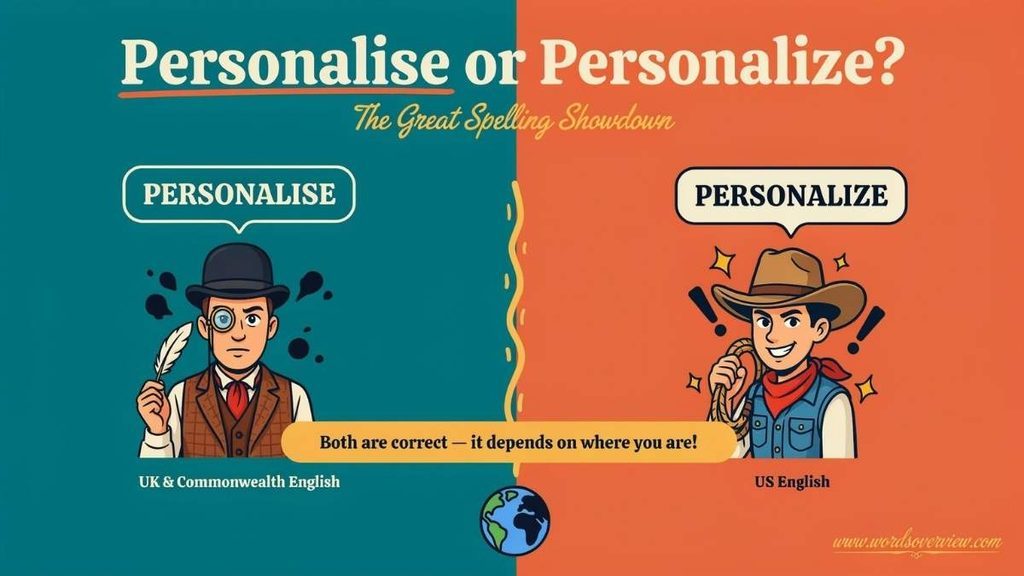
Have you ever typed personalise or personalize and suddenly wondered whether your keyboard has started a spelling argument? You’re not alone. This tiny spelling difference can cause surprising confusion, especially when American and British English follow different conventions. One version uses ize while the other uses ise, yet both words carry the same meaning. That makes the choice less about right versus wrong and more about knowing your audience. Whether you’re writing an email, editing website content or creating a personalized product description, choosing the appropriate spelling matters. In this guide, you’ll learn the difference between personalise or personalize, discover where each form belongs and avoid this common spelling mistake.
Personalise or Personalize Quick Answer
Personalize and personalise mean the same thing. Both words function as verbs that describe the act of adapting something for a particular person.
For example:
US English: You can personalize your profile with a photo and custom settings.
UK English: You can personalise your profile with a photo and custom settings.
The meaning stays exactly the same. Only the spelling changes.
So if you’re wondering is it personalize or personalise, consider your intended audience first.
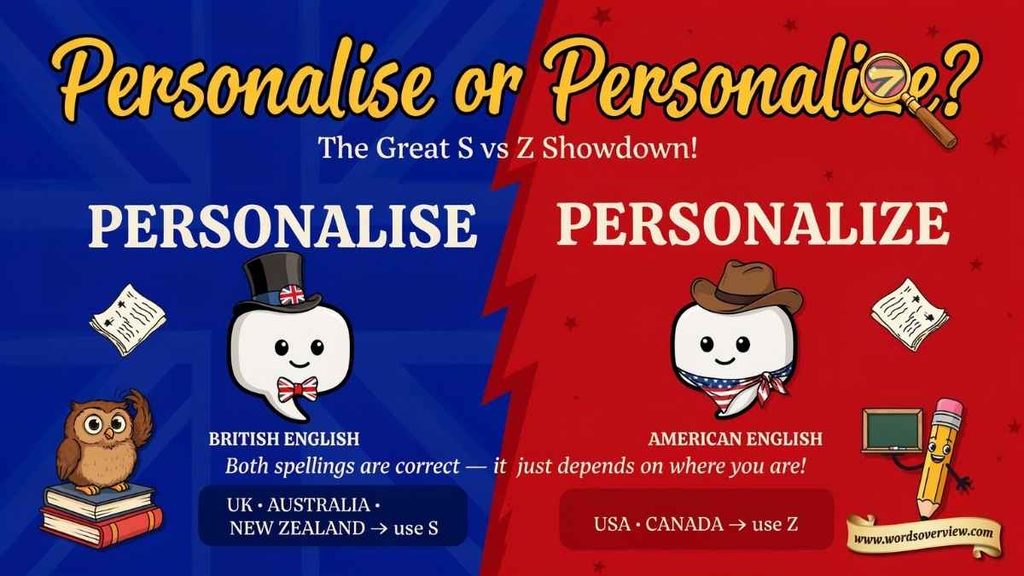
- American English → personalize
- British English → personalise
- Australian English → personalise is commonly used
- New Zealand English → personalise is commonly used
- South African English → personalise is commonly used
However, regional usage can vary according to a publication’s preferred style. Therefore, a professional writer should always follow the relevant style guide when one exists.
Is personalize or personalise correct?
Yes. Both personalize and personalise are correct within their respective spelling conventions.
Calling personalise a misspelling ignores standard British English. Likewise, calling personalize incorrect ignores standard American English.
The important point is consistency. If you begin an article in American English, continue using American spellings throughout. If you write in British English, maintain British spelling throughout the document.
Personalize or Personalise Meaning and Definition
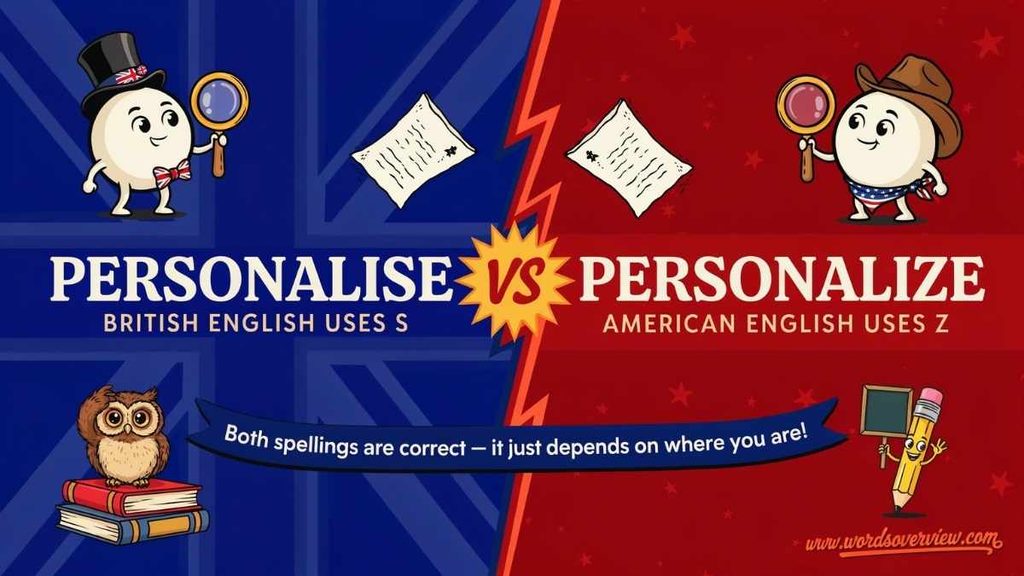
The personalize definition is to make something more suitable for a particular person by considering that person’s preferences, needs or characteristics.
The personalise definition is exactly the same.
When you personalize something, you adapt it rather than treating every person in exactly the same way. That adaptation can take many forms.
For example, a company might personalize an email by using a customer’s name. A website might personalize its recommendations according to a visitor’s interests. Similarly, someone might personalize a gift by adding a name or initials.
In simple terms, to personalize something means to make it more personal or tailored to an individual.
What does personalize mean?
The personalize meaning centers on adapting something for a particular person.
Consider these examples:
- A company personalizes marketing emails according to customer interests.
- A website personalizes content for different users.
- An app personalizes recommendations based on previous activity.
- A retailer personalizes products with names or initials.
- A teacher personalizes learning materials around a student’s needs.
Importantly, personalization doesn’t always involve adding a person’s name. It can also involve changing content, recommendations, settings or services according to individual needs.
For instance, an educational platform might adjust the difficulty of exercises based on a student’s performance. That process can qualify as personalization even though nobody adds the student’s name to the exercises.
What does personalise mean?
The personalise meaning is identical to the meaning of personalize.
Personalise means to adapt something for a particular person or to make something reflect an individual’s preferences.
For example:
The hotel allows guests to personalise their rooms.
Here, personalise means that guests can make their rooms better suited to their own preferences.
Consequently, personalise meaning in English and personalize meaning in English describe the same basic concept.
Learn the difference between everyday English mistakes
Slushy or Slushie: Correct Spelling, Meaning and Usage
Personalize vs Personalise The Main Spelling Difference
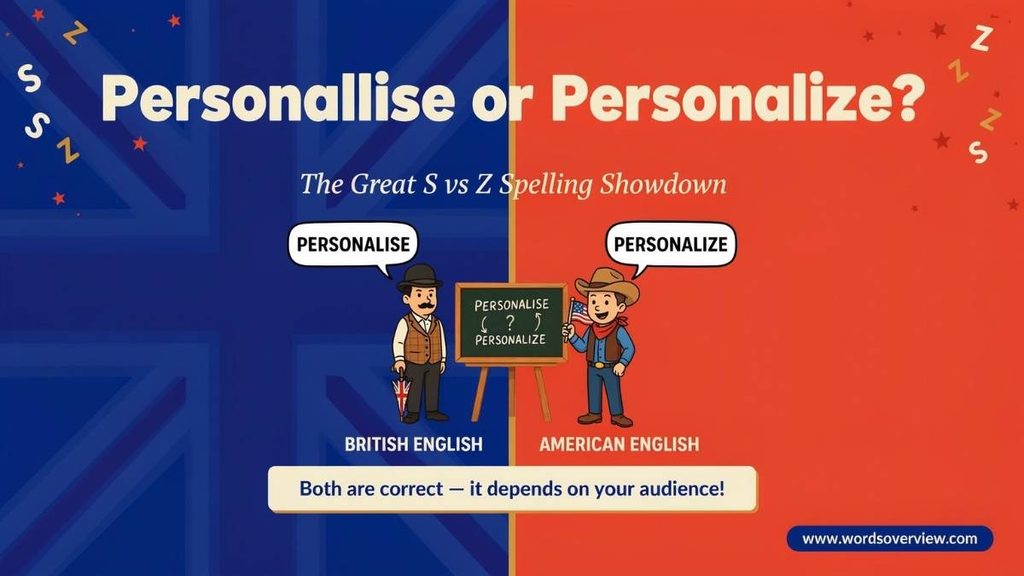
The personalize spelling and personalise spelling differ by only one letter.
- personalize ends in ize
- personalise ends in ise
This small difference reflects a broader pattern in regional English spelling.
American English commonly uses ize in words such as organize and realize. British English commonly uses ise in the corresponding forms organise and realise.
Therefore, the personalize spelling difference doesn’t create a different word. Instead, it reflects a regional spelling convention.
The same distinction continues through related forms.
| American English | British English |
| personalize | personalise |
| personalizes | personalises |
| personalized | personalised |
| personalizing | personalising |
| personalization | personalisation |
As a result, choosing the base form also affects the related forms you use later.
For example, an American article should normally use personalized rather than personalised. Similarly, a British article should normally use personalised rather than personalized.
Learn how to use confusing more words correctly
Organiser or Organizer: Which Spelling Is Correct?
Why Does Personalize Have Two Spellings?
English developed through centuries of contact between languages and regional varieties. As English spread to different parts of the world, writers and publishers developed different spelling preferences.
American English eventually developed a distinct spelling tradition in several areas. British English retained or standardized other conventions.
The ize/ise distinction provides one well-known example of this regional variation.
However, the story isn’t simply that American English “changed” every ise word to ize. English spelling has a more complicated history. In fact, both ize and ise forms have historical roots in English usage.
For everyday writing, though, you don’t need to study the entire history of English orthography. The practical rule remains much easier:
American English generally uses personalize. British English generally uses personalise.
Personalize in American English
For readers in the United States, personalize is the preferred standard form.
The American spelling personalize appears frequently in technology, marketing, business communication, education and everyday writing.
You might encounter phrases such as:
- Personalize your account
- Personalize your experience
- Personalize your recommendations
- Personalize your settings
- Personalized products
- Personalized content
- Personalized service
- Personalized recommendations
Personalize as a verb
Personalize functions as a verb.
Its main forms are:
- personalize — base form
- personalizes — third-person singular present
- personalized — past tense and past participle
- personalizing — present participle
For example:
Customers can personalize their orders.
The platform personalizes recommendations according to user activity.
She personalized the invitation with a handwritten message.
The company is personalizing its customer experience.
These examples show that the word works naturally with both physical objects and digital services.
Examples of personalize in American English
Here are useful examples of personalize in a sentence:
You can personalize your phone’s home screen with widgets and shortcuts.
The store lets customers personalize mugs with names and photos.
The application uses your viewing history to personalize recommendations.
We personalize each training plan according to the learner’s goals.
She personalized the invitation with a handwritten note.
Notice that personalization can involve adding information, changing options or adapting content. The exact method changes according to the context while the basic verb remains the same.
Personalise in British English
For British readers, personalise is the preferred standard form.
The British spelling personalise appears in many of the same contexts as personalize. British websites, businesses, educational institutions and publications commonly use this form when following UK English conventions.
Common expressions include:
- Personalise your account
- Personalise your experience
- Personalise your recommendations
- Personalise your settings
- Personalised products
- Personalised content
- Personalised service
- Personalised recommendations
Examples of personalise in British English
Here are natural examples of personalise in a sentence:
You can personalise your account with a profile picture.
Customers can personalise their orders before checkout.
The website lets visitors personalise their preferences.
The service creates a personalised experience for every customer.
She personalised the card with the recipient’s name.
Again, the grammar doesn’t change. Only the regional spelling changes.
Learn the difference between tricky English words with easy explanations
Congrats or Congratulations: Which One Is Correct?
Personalize or Personalise in Other English Varieties
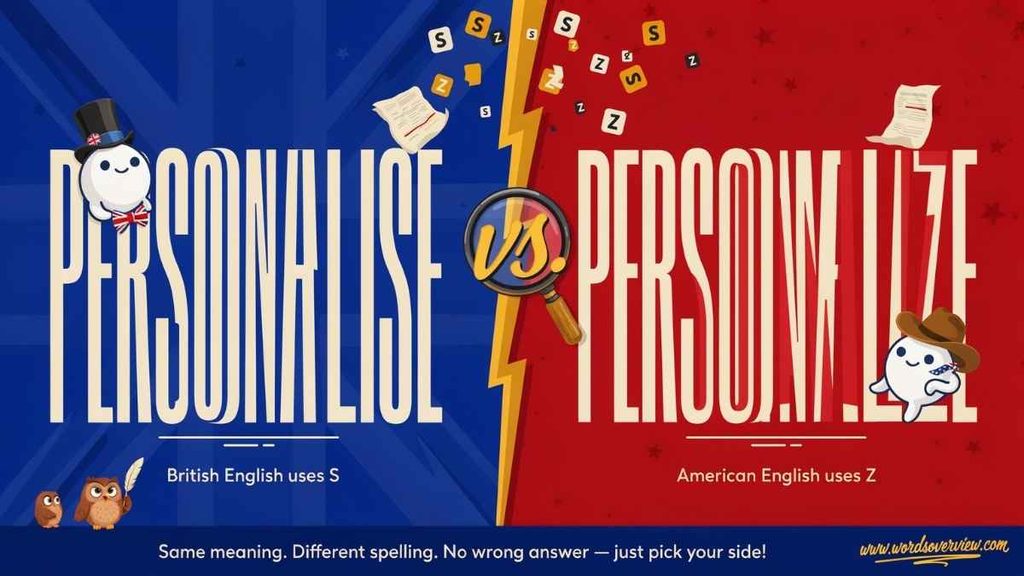
The distinction becomes more interesting when you look beyond American and British English.
Several varieties influenced by British English commonly use personalise. This includes Australian English, New Zealand English and South African English.
Still, regional English isn’t completely uniform. Individual publishers organizations and style guides may make different choices.
Australian English spelling personalise
Australian spelling personalise is commonly used in Australian English.
It follows British-style spelling in many words ending in ise. Therefore, Australian readers commonly encounter:
- personalise
- personalised
- personalising
- personalisation
For example:
You can personalise your account before placing an order.
New Zealand English spelling personalise
New Zealand English also commonly uses personalise.
For example:
Customers can personalise their subscriptions according to their preferences.
The spelling fits the broader regional convention used in many New Zealand publications.
South African English spelling personalise
South African English commonly uses British-style spelling in this area as well.
Therefore, personalise appears frequently in South African writing.
The broader lesson is that Commonwealth English spelling often favors the ise form. However, writers should check the preferred style of their particular publication when precision matters.
Learn the difference between commonly misused words
Fair or Fare: Which Is Correct?
Personalize or Personalise Which Spelling Should You Use?
The answer depends mainly on your audience.
Before choosing a spelling, identify the variety of English your content follows. Then apply that choice consistently.
Use personalize for American English
Choose personalize when writing primarily for:
- Readers in the United States
- US businesses
- American schools and universities
- US-focused websites
- American customers
- Publications that follow US English spelling
If your writing already uses color organize, analyze and center, then personalize fits naturally into that spelling system.
Use personalise for British English
Choose personalise when writing primarily for:
- Readers in the United Kingdom
- British businesses
- UK publications
- British educational institutions
- UK customers
- Publications that follow British spelling
If your content uses colour organise, analyse and centre, then personalise generally matches the same regional style.
What about international websites?
International websites need a clear editorial policy because readers may come from several English-speaking regions.
A company targeting American customers might choose personalize across its website. A UK-focused company might choose personalise instead.
For a global website, either approach can work when the organization applies it consistently.
The key principle is simple:
Choose one spelling system and use it consistently.
Learn the difference between confusing word pairs
Doggy or Doggie: Which Spelling Is Correct?
Personalize and Personalise Related Word Forms
The spelling difference continues through the word’s grammatical and noun forms.
If you choose personalize, use its American forms. If you choose personalise, use its British forms.
| Form | American English | British English |
| Base verb | personalize | personalise |
| Third-person present | personalizes | personalises |
| Past tense | personalized | personalised |
| Present participle | personalizing | personalising |
| Noun | personalization | personalisation |
This consistency matters in professional writing.
For example, an American article might say:
Our platform personalizes content and provides a personalized experience through advanced personalization.
A British version would normally say:
Our platform personalises content and provides a personalised experience through advanced personalisation.
The sentence structure remains similar. The spelling system changes throughout.
Personalized vs personalised
Personalized and personalised have the same meaning.
Use personalized in American English.
Use personalised in British English.
For example:
The company offers personalized recommendations.
The company offers personalised recommendations.
The personalized meaning and personalised meaning both describe something adapted for a particular person.
Personalization vs personalisation
The noun also follows the same regional pattern.
- personalization → American English
- personalisation → British English
Both terms describe the process or result of adapting something to an individual.
For example:
Personalization can make digital content more relevant.
Personalisation can make digital content more relevant.
Therefore, the personalization vs personalisation distinction follows the same basic rule as personalize vs personalise.
Learn the difference between tricky words and use them correctly
Many or Meny: Which Spelling Is Correct?
Personalize vs Personalise in Everyday Writing
The difference appears frequently in modern digital communication.
Emails
Businesses often personalize emails by using customer information, previous activity or stated preferences.
American English:
We personalize our emails according to your interests.
British English:
We personalise our emails according to your interests.
Websites
Websites can adapt content according to user behavior or account preferences.
American English:
The website personalizes your homepage.
British English:
The website personalises your homepage.
Marketing
Marketing teams use personalization to make messages more relevant to particular audiences.
Common examples include:
- Personalized offers
- Personalized email campaigns
- Personalized product suggestions
- Personalized landing pages
- Personalized content
- Personalized recommendations
British English changes these forms to personalised and personalisation.
Technology
Technology provides some of the clearest examples of personalization.
A user may be able to personalize:
- Dashboard layouts
- Notification preferences
- Content feeds
- Search settings
- Profiles
- Recommendations
- Accessibility settings
Consequently, the word appears often in software interfaces and product documentation.
Learn the difference between tricky grammar words
Vain or Vein: Key Difference and Use?
Personalization vs Customization: What’s the Difference?
It generally focuses on adapting something to an individual based on their preferences, behavior or information.
Customization often focuses on giving the user control over specific choices or features.
Consider an online store.
If the store analyzes your previous purchases and recommends products you might like, that’s personalization.
If the store lets you select the product’s color, size, material or engraving, that’s customization.
| Situation | Personalization | Customization |
| Shopping | Recommends products based on your history | Lets you select product options |
| Shows content based on your interests | Lets you choose email categories | |
| Software | Adapts recommendations to you | Lets you change interface settings |
| Education | Adapts content to your learning needs | Lets you select learning options |
| Gifts | Suggests suitable products | Lets you add names or designs |
Learn the difference between similar English words
Invision or Envision Which Spelling Is Correct?
Personalization vs customization examples
The distinction becomes clearer through real-world examples.
Example one: Online shopping
A website recommends running shoes because you frequently browse athletic products. That’s personalization.
The website then lets you choose the shoe’s color and size. That’s customization.
Example two: Streaming services
A streaming platform recommends movies based on your viewing history. That’s personalization.
If the platform lets you create your own profile settings or select categories, those features involve customization.
Example three: Education
An educational platform adjusts the difficulty of exercises based on your performance. That’s personalization.
If students can choose their preferred lesson format, that involves customization.
Therefore, customization vs personalization often comes down to who controls the adaptation.
A simple way to remember the distinction is:
Personalization: “This was selected or adapted for you.”
Customization: “You can change this yourself.”
The two concepts can also work together. A personalized product can still offer several customization options.
Personalize or Personalise Common Mistakes
Although the spelling rule looks simple, writers often make a few predictable mistakes.
Treating personalise as a misspelling
British writers sometimes see personalize online so often that they assume personalise must be incorrect.
It isn’t.
Personalise is the British spelling and works correctly in British English.
Treating personalize as a misspelling
The opposite mistake occurs when someone assumes that every English word must follow British spelling.
That’s incorrect as well.
Personalize is the standard spelling in American English.
Mixing American and British spellings
One of the most common style problems involves switching between regional forms.
For example:
You can personalize your profile and view your personalised recommendations.
The sentence combines American and British spellings.
A consistent American version would be:
You can personalize your profile and view your personalized recommendations.
A consistent British version would be:
You can personalise your profile and view your personalised recommendations.
Changing only the base word
Some writers correctly choose personalize but later use personalised without realizing that they’ve switched conventions.
Regional spelling applies to related forms as well.
Therefore, if your content follows US English, maintain personalize, personalized, personalizing and personalization.
If it follows UK English, maintain personalise, personalised, personalising and personalisation.
Assuming spelling changes pronunciation
The spelling difference doesn’t mean that the two words require completely different pronunciations.
The how to pronounce personalize and how to pronounce personalise questions therefore lead to essentially the same spoken form in standard usage.
The visible difference lies mainly in the written ending.
Learn the difference between commonly misused words
Palate or Palette: Which Is Correct?
Personalize or Personalise: Synonyms and Related Terms
The best synonyms of personalize and synonyms of personalise depend on the context.
Useful alternatives include:
- customize / customise
- tailor
- adapt
- modify
- adjust
- individualize / individualise
However, these words aren’t interchangeable in every situation.
For example:
The company personalized the recommendations.
You could replace personalized with:
The company tailored the recommendations to each user.
That replacement preserves much of the original meaning.
On the other hand:
The company modified the recommendations.
This sentence doesn’t necessarily tell the reader that the company adapted them for individual users.
Tailor
Tailor works particularly well when something is designed around a person’s specific needs.
The consultant tailored the training program to the client’s goals.
Adapt
Adapt emphasizes changing something so that it works better for a particular purpose or person.
The teacher adapted the lesson for students with different learning needs.
Customize
Customize often emphasizes changes selected by the user.
Customers can customize the product before placing an order.
Therefore, choosing a synonym requires attention to the exact context rather than simply replacing one word with another.
Personalize or Personalise: Practical Case Study
Imagine a software company operates in both New York and London.
Its US website displays:
Personalize your dashboard to see the information you use most.
Its UK website displays:
Personalise your dashboard to see the information you use most.
The software feature doesn’t need to change. The spelling changes because the websites follow different regional writing standards.
Now consider a mixed version:
Personalize your dashboard and view your personalised recommendations.
The sentence isn’t grammatically broken. However, it combines American and British spelling.
A professional US version would use:
Personalize your dashboard and view your personalized recommendations.
A professional UK version would use:
Personalise your dashboard and view your personalised recommendations.
This small case study demonstrates why regional spelling differences matter in professional writing. Consistency makes the content look deliberate rather than accidentally mixed.
Learn the difference between similar English words
Sole or Soul: Difference In Meaning And Usage
Personalize or Personalise: Comparison Table
| Feature | Personalize | Personalise |
| Main variety | American English | British English |
| Basic meaning | Adapt something for a particular person | Adapt something for a particular person |
| Word class | Verb | Verb |
| Past form | personalized | personalised |
| -ing form | personalizing | personalising |
| Noun | personalization | personalisation |
| Standard in US English | Yes | No |
| Standard in UK English | No | Yes |
| Common in Australian English | Less typical | Common |
| Common in New Zealand English | Less typical | Common |
| Common in South African English | Less typical | Common |
This comparison shows that personalize vs personalise isn’t a battle between correct and incorrect spelling. It’s a difference between regional English conventions.
Learn the difference between confusing more English words
Businesses or Business’s: Which Is Correct?
How to Remember the Difference
You don’t need a complicated trick to remember these spellings.
Use this simple rule:
US English → personalize
UK English → personalise
You can reinforce the rule by comparing other familiar spelling pairs.
| American English | British English |
| organize | organise |
| realize | realise |
| recognize | recognise |
| personalize | personalise |
These examples provide a useful pattern. However, English spelling contains exceptions and variations, so don’t assume that every word ending in ise or ize follows exactly the same rule.
For practical writing, the best approach remains audience-based.
If your audience expects US English spelling, choose personalize.
If your audience expects UK English spelling, choose personalise.
Which Spelling Is Correct?
The correct spelling of personalize is personalize when you’re following American English conventions.
The correct spelling of personalise is personalise when you’re following British English conventions.
So, which spelling is correct? Both can be correct.
The answer depends on the regional English standard behind your writing.
For American English
Use:
personalize → personalizes → personalized → personalizing → personalization
For British English
Use:
personalise → personalises → personalised → personalising → personalisation
This pattern makes the choice much easier because you aren’t memorizing separate vocabulary. You’re applying one regional spelling system consistently.
Practice Session
Fill in each blank with the correct word or form: personalize, personalise, personalized, personalised, personalization, personalisation, customize or customise.
- In American English, the standard spelling is ______.
- In British English, the standard spelling is ______.
- You can ______ your profile by adding a photo.
- The website offers a ______ shopping experience for each customer.
- The company lets customers ______ their products before ordering.
- British users can ______ their account settings.
- The American spelling of the past tense is ______.
- The British spelling of the past tense is ______.
- Adding a customer’s name to an email is an example of ______.
- The British English noun form is ______.
- The American English noun form is ______.
- The store offers ______ recommendations based on customer preferences.
- You can ______ the message by adding the recipient’s name.
- The British version of “personalizing” is ______.
- The American version of “personalising” is ______.
- Both ______ and ______ are correct spellings of the verb.
- In American English, you would write “______ your learning experience.”
- In British English, you would write “______ your learning experience.”
- The service creates a ______ experience based on each user’s interests.
- The website allows visitors to ______ their preferences.
- American English uses “personalized” while British English uses “______.”
- American English uses “personalization” while British English uses “______.”
- To make something better suited to an individual, you can ______ it.
- The company uses ______ to recommend products that match each customer’s interests.
- When writing for an American audience, choose ______ and stay consistent.
Answer Session
- personalize
- personalise
- personalize
- personalized
- customize
- customise
- personalized
- personalised
- personalization
- personalisation
- personalization
- personalized
- personalize
- personalising
- personalizing
- personalize, personalise
- personalize
- personalise
- personalized
- customize
- personalised
- personalisation
- personalize
- personalization
- personalize
Frequently Asked Questions
Which is correct: personalize or personalise?
Both personalize and personalise are correct spellings. Personalize is the standard American English spelling while personalise is the usual British English spelling.
What does personalize mean?
Personalize means to change or adapt something to suit a particular person’s preferences, needs or characteristics. For example, you can personalize a message by adding someone’s name.
What is the difference between personalized and personalised?
There is no difference in meaning. Personalized follows the American English spelling while personalised follows the British English spelling.
How do you spell personalize?
The American English spelling is personalize. In British English, the standard spelling is personalise.
What is another word for personalize?
Depending on the context, synonyms for personalize include tailor, customize, adapt, individualize and modify. The best choice depends on what you are changing and why.
Can you use personalize in a sentence?
Yes. For example: “You can personalize your profile by adding a photo and choosing your preferred settings.”
What is personalization?
Personalization is the process of adapting a product, service, message or experience to suit a particular person’s preferences or needs. For example, personalized recommendations show content based on a user’s interests.
Is personalized or customised better?
Neither word is automatically better. Personalized usually emphasizes adapting something to an individual while customized often emphasizes making specific changes or choices. The two terms can overlap depending on the context.
Which is correct: customize or customise?
Both spellings are correct. Customize is the standard American English form while customise is the usual British English form. The same regional pattern applies to personalize and personalise.
Does Canada use US or British spelling?
Canadian English uses a mixture of American and British spelling conventions. For words such as personalized and personalised, Canadian usage can vary by publication and style guide. When writing for Canadian readers, follow the spelling style required by your organization or chosen style guide.
Conclusion
The personalise or personalize debate looks more complicated than it really is. Both spellings are correct. The difference comes down to regional English. Personalize is the standard form in American English while personalise is the usual form in British English and several other varieties of Commonwealth English.
So which one should you choose? Match your spelling to your audience then stay consistent throughout your writing. If you’re writing for American readers choose personalize. If your audience follows British English choose personalise. There’s no need to let two letters ruin your day. Once you know the regional rule this spelling mystery becomes much easier to handle.

Ethan AJS is an experienced blogger and language enthusiast at Words Overview, dedicated to making English easier to understand and use. He writes about grammar, vocabulary, spelling, word meanings and commonly confused words, turning tricky language questions into clear, practical insights. With a passion for effective communication, Ethan creates engaging, readerfocused content that helps readers write accurately, choose the right words and communicate with confidence.




