
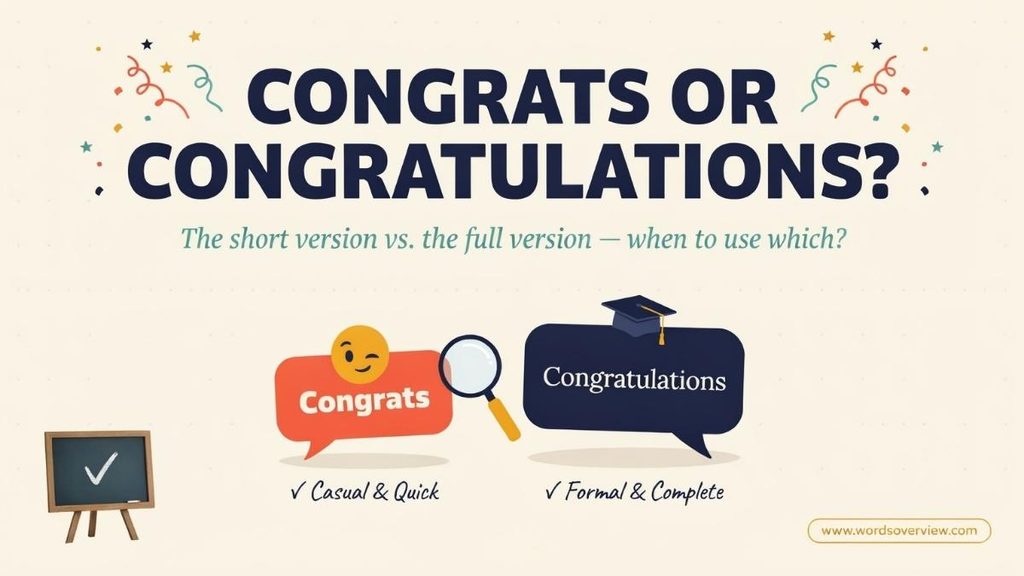
Choosing between “Congrats” and “Congratulations” can feel like a tiny English test hiding inside a happy moment. You celebrate someone’s promotion, graduation or wedding, then suddenly wonder, “Wait, should I say congrats or congratulations?” Don’t worry; your grammar trophy isn’t at risk. Both expressions are correct, but they don’t always fit the same situations. One sounds relaxed and friendly, while the other works comfortably in formal and professional settings. The confusion usually starts when people mistake a shorter word for an incorrect one. Once you understand the difference in tone, usage and grammar, choosing the right expression becomes much easier and your next congratulatory message can celebrate the achievement instead of stressing over vocabulary.
Quick Answer: Congrats or Congratulations?
Both congrats and congratulations are correct.
Congratulations is the full and more formal expression. Congrats is an established informal shortened form of congratulations.
| Word | Correct? | Meaning | Tone | Common Uses |
| Congratulations | Yes | An expression of praise or good wishes | Formal to neutral | Emails, cards, speeches, professional messages |
| Congrats | Yes | Short form of congratulations | Informal | Texts, chats, social media, friendly messages |
| Congratulation | Yes, in specific grammatical contexts | The act or expression of congratulating | Formal | “A letter of congratulation” |
| Congratulate | Yes | To express pleasure or praise for an achievement | Neutral | “I congratulate you on your success.” |
Therefore, congrats vs congratulations is not a question of correct versus incorrect spelling. Instead, it is mainly a question of register and context.
What Does Congratulations Mean?
Congratulations is an expression used to show pleasure, approval or good wishes when someone experiences a success, achievement, milestone or other happy event.
You can use it after many different occasions, including:
- A graduation
- A promotion
- A new job
- A wedding
- An engagement
- An award
- A major achievement
- A competition victory
- A successful project
- A personal milestone
For example:
Congratulations on your graduation!
Here, the speaker expresses happiness about another person’s graduation.
You can also use the word by itself:
Congratulations!
This short expression works when the situation already makes the reason clear.
For example, if your friend tells you that they got a new job, you can simply say:
Congratulations!
You don’t always need to mention the specific achievement.
Congratulations Meaning in Simple English
In simple terms, congratulations means:
“I’m happy for you because you achieved something good.”
It can also communicate praise, recognition, celebration and good wishes.
For instance:
Congratulations on your promotion.
This sentence recognizes the person’s professional achievement while expressing positive feelings about it.
What Does Congrats Mean?
Congrats means the same basic thing as congratulations, but it has a more informal tone.
It is a shortened form of congratulations and dictionaries recognize it as an informal noun and congratulatory expression.
For example:
Congrats on your new job!
This means essentially the same thing as:
Congratulations on your new job!
However, the first sentence sounds more casual.
You might send “Congrats!” to a friend in a text message. You could also write it beneath someone’s graduation photo on social media.
For example:
Congrats on graduating! You worked hard for this.
The expression feels friendly and relaxed.
Is Congrats a Word?
Yes. Congrats is a word.
It is not merely a typing mistake or an incorrect abbreviation. Major English dictionaries recognize congrats as an informal shortened form of congratulations.
Its informal status matters, though. A word can be correct while still being unsuitable for certain situations.
For example, “Congrats!” may sound perfectly natural in a conversation with a friend. However, “Congratulations!” usually fits better in a formal business announcement.
Therefore, the question “Is congrats correct?” has a clear answer: yes, but use it according to the context.
Learn the difference between commonly mixed-up more words
Foward or Forward: Which Spelling Is Correct?
Congrats vs Congratulations: What Is the Difference?
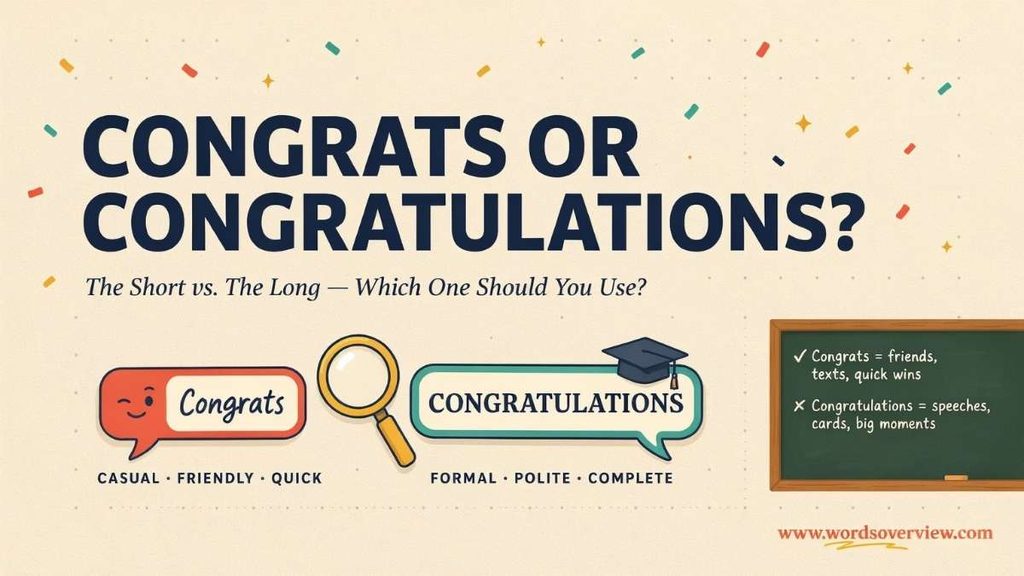
The main difference between congrats and congratulations is not meaning. It is tone and formality.
Both expressions communicate praise or good wishes. However, congratulations has a broader range of use.
You can use it in casual situations:
Congratulations! You did it!
You can also use it in formal situations:
Congratulations on your outstanding achievement.
By contrast, congrats generally sounds more relaxed:
Congrats! You nailed it.
That doesn’t make it wrong. It simply makes it less formal.
A Simple Way to Remember the Difference
Think of the two words as different levels of formality:
Congratulations → full, standard, more formal
Congrats → shortened, casual, informal
The meaning stays almost the same. The social tone changes.
Is Congratulations More Formal Than Congrats?
Yes.
Congratulations is generally more formal and versatile than congrats.
For example, if you’re writing to a university professor, employer, client, manager or professional organization, congratulations is usually the safer choice.
Consider these two sentences:
Congratulations on your promotion.
Congrats on your promotion.
Both are grammatically acceptable. However, the first sentence sounds more polished and professional.
Meanwhile, the second sentence sounds warmer and more conversational.
Therefore, if you aren’t sure which one to choose, consider your relationship with the person and the setting.
When to Use Congratulations
Use congratulations when you want your message to sound complete, respectful or professional.
It works particularly well in:
- Professional emails
- Business announcements
- Graduation cards
- Wedding cards
- Formal letters
- Speeches
- Workplace messages
- Official announcements
- Academic communication
- Public recognition
For example:
- Congratulations on your well-deserved promotion.
- Congratulations on completing your degree.
- Congratulations to the entire team on this important achievement.
Please accept my congratulations on your success.
These sentences sound polished without becoming overly formal.
Learn the difference between commonly confused words in English
Pair or Pare: Meaning, Difference and Use Correctly
Congratulations in a Professional Email
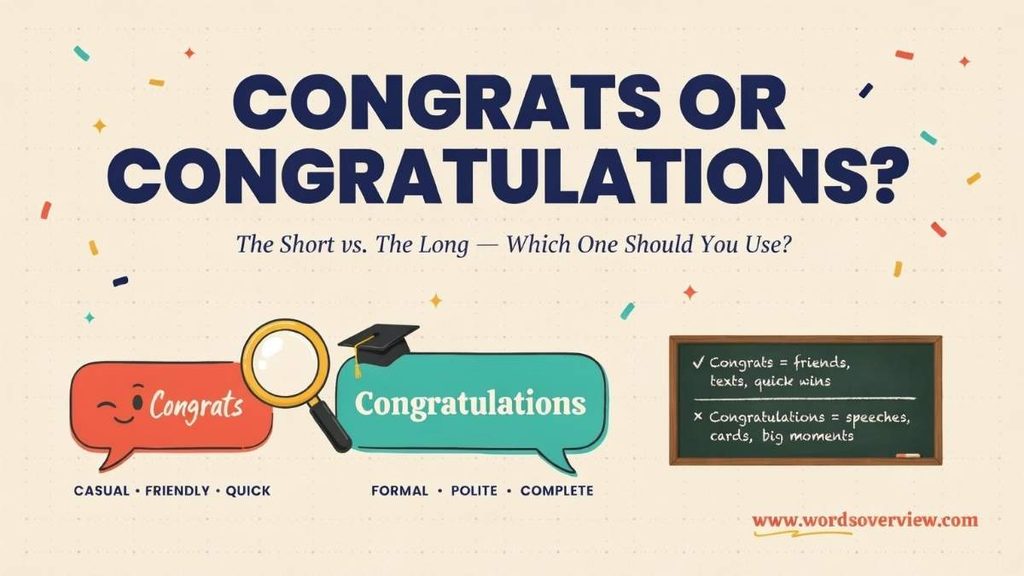
It is usually the better choice in professional communication.
For example:
Congratulations on your promotion to Senior Manager. Your dedication and hard work have clearly paid off.
This sounds professional and sincere.
You could technically write:
Congrats on your promotion!
However, the shorter form may sound too casual depending on your workplace and relationship with the recipient.
When to Use Congrats
Use congrats when the situation is relaxed and the people involved have a friendly or familiar relationship.
Common situations include:
- Text messages
- Group chats
- Social media comments
- Messages to friends
- Informal workplace chats
- Casual conversations
- Friendly emails
For example:
Congrats on your new job!
Congrats! You earned it.
Congrats on graduating!
Congrats to everyone who participated!
These sentences sound natural in everyday communication.
Is Congrats Formal or Informal?
Congrats is informal.
That doesn’t mean it is incorrect or poor English. It simply belongs to a more casual register.
English has many shortened forms that work naturally in everyday communication. The important point is knowing when a casual expression fits.
For instance, “Congrats!” can sound perfectly natural between friends. However, a formal award announcement would usually use “Congratulations!”
Learn the difference between basic English word mistakes
This Is She or This Is Her: Which Is Correct?
Formal vs Informal Congratulations
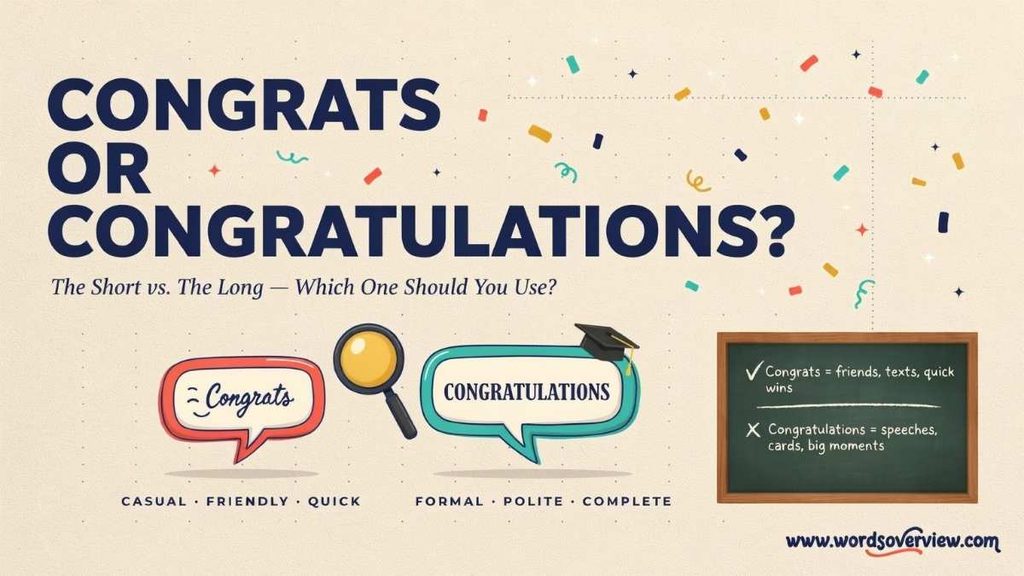
The difference becomes clearer when you compare similar messages.
| Situation | More Formal | More Casual |
| Promotion | Congratulations on your promotion. | Congrats on your promotion! |
| Graduation | Congratulations on your graduation. | Congrats on graduating! |
| New job | Congratulations on your new position. | Congrats on the new job! |
| Wedding | Congratulations on your wedding. | Congrats on getting married! |
| Award | Congratulations on receiving this award. | Congrats on the award! |
| Achievement | Congratulations on your achievement. | Congrats on your achievement! |
| Team success | Congratulations to the entire team. | Congrats to the whole team! |
Neither column contains inherently wrong English.
Instead, the first column generally suits formal or professional communication, while the second works naturally in casual communication.
British vs American English: Is Congrats a Different Spelling?
No. Congrats and congratulations are not primarily a British-versus-American spelling issue.
Both forms appear in English varieties used in the United States and the United Kingdom. The major distinction concerns register, not national spelling.
Similarly, you should not treat congrats as the American spelling and congratulations as the British spelling. That would give the wrong impression.
For readers in both the UK and US, the practical rule remains the same:
Use congratulations for a full or more formal expression and use congrats for a casual shortened expression.
This distinction also explains why someone may prefer one form in a particular situation even though both forms are correct.
Is Congrats Short for Congratulations?
Yes.
Congrats is short for congratulations.
It developed as a shortened informal form of the longer word. Although the spelling is shorter, the basic meaning remains the same.
For example:
Congratulations on your success.
and
Congrats on your success.
Both sentences congratulate someone on their success.
The difference lies mainly in tone.
You can think of congrats as the conversational shortcut. It delivers the same message with fewer letters and a more relaxed feel.
Learn the difference between tricky grammar words
Studying or Studing: Which Spelling Is Correct?
Congratulations or Congratulation: Which Is Correct?
This question causes a different kind of confusion.
Congratulation is a real English noun. However, when you directly praise someone for an achievement, the standard expression is usually congratulations.
For example:
Congratulations on your achievement.
This is natural and standard.
You would not normally say:
Congratulation on your achievement.
The singular form can appear in specific grammatical constructions.
For example:
She sent him a letter of congratulation.
Here, congratulation refers to the act or expression of congratulating someone.
Therefore:
Congratulations = the normal expression used to congratulate someone.
Congratulation = a singular noun used in particular grammatical contexts.
Why Is Congratulations Plural?
The expression congratulations commonly appears in the plural when people offer praise or good wishes.
For example:
Congratulations on your success!
My congratulations to the entire team.
Please accept my congratulations.
So, if you’re directly congratulating someone, congratulations is usually the form you want.
Learn the difference between tricky words and use them correctly
Many or Meny: Which Spelling Is Correct?
Congratulations On or Congratulations To?
Both congratulations on and congratulations to are correct, but they serve different purposes.
Use congratulations on when you identify the achievement, event or occasion.
Examples:
- Congratulations on your promotion.
- Congratulations on your graduation.
- Congratulations on your wedding.
- Congratulations on your success.
Use congratulations to when you identify the person or group receiving the congratulations.
Examples:
- Congratulations to Sarah on her promotion.
- Congratulations to the graduating class.
- Congratulations to the entire team.
You can combine both structures:
Congratulations to Sarah on her promotion.
This sentence identifies both the recipient and the reason.
Congrats On or Congrats To?
The same basic pattern applies to congrats.
Use congrats on for an achievement or event:
Congrats on your new job!
Congrats on your graduation!
Use congrats to for the person or group:
Congrats to Sarah!
Congrats to the entire team!
You can also combine them:
Congrats to everyone on a fantastic performance!
Therefore, congrats on and congrats to are both correct when used appropriately.
Learn the difference between confusing word pairs
Emigrate or Immigrate Difference, Meaning and Usage
Common Mistakes With Congrats and Congratulations
Although these expressions are simple, several common mistakes appear in everyday writing.
Using Congratulation for a Direct Message
A common error is writing:
Congratulation on your promotion.
The natural expression is:
Congratulations on your promotion.
The plural form is the standard choice for this congratulatory expression.
Treating Congrats as Incorrect
Some people assume that congrats is wrong because it is shorter.
That isn’t accurate.
Congrats is a recognized informal form of congratulations. However, its informal register makes it less suitable for some professional or ceremonial contexts.
Learn the difference between confusing English words step by step
Maximise or Maximize: Which Spelling Is Correct?
Using the Wrong Preposition
Another common mistake involves on and to.
For an achievement, use on:
Congratulations on your achievement.
For the recipient, use to:
Congratulations to you.
You can also use both:
Congratulations to you on your achievement.
Making a Formal Message Too Casual
The expression itself may be grammatically correct while the overall tone doesn’t fit the situation.
For example:
Congrats, buddy!
works perfectly in a friendly conversation.
However, it may not suit an official university announcement.
In that context, something like this would sound more appropriate:
Congratulations on this outstanding academic achievement.
The lesson is simple: correct grammar and appropriate tone are not always the same thing.
Congrats in a Sentence
Here are several natural examples of congrats in a sentence:
- Congrats on your promotion!
- Congrats on passing your exam.
- Congrats on the new job!
- Congrats to the whole team.
- Congrats on your graduation!
- Congrats! You worked hard for this moment.
These examples work well in casual English.
However, if you need a more formal tone, replace congrats with congratulations.
Congratulations in a Sentence
Here are examples of congratulations in a sentence:
- Congratulations on your promotion.
- Congratulations on your graduation.
- Congratulations on your wedding.
- Congratulations to the entire team.
- Congratulations on your remarkable achievement.
- Congratulations on your new position.
Please accept my congratulations on your success.
The longer form works in both everyday and formal English, which makes it more versatile.
Learn the difference between more words people mix up
Swifty or Swiftie: Spelling, Usage and Correct Word
Real-World Context: Choosing the Right Expression
Imagine that three people have just received the same promotion.
The first message comes from a close friend:
Congrats on the promotion! You deserve it.
That message sounds warm and casual.
The second comes from a coworker:
Congratulations on your promotion. Well deserved!
This version sounds professional while remaining friendly.
The third appears in an official company announcement:
Congratulations to Sarah Ahmed on her promotion to Senior Manager.
This version fits a formal workplace setting.
Notice what changes. The achievement remains the same. The message changes because the relationship, audience and communication setting change.
That is the real difference between congrats vs congratulations.
Congratulations Messages and Congratulatory Expressions
When you write a congratulations message, consider three things: the occasion, the recipient and the tone.
For a friend, you might write:
Congrats on your new job! I’m really happy for you.
For a colleague:
Congratulations on your promotion. Wishing you continued success in your new role.
For a graduation card:
Congratulations on your graduation. Your hard work has paid off and this achievement is worth celebrating.
For a wedding:
Congratulations on your wedding. Wishing you both a wonderful future together.
For a team:
Congratulations to the entire team on this outstanding achievement.
These examples show why context matters more than simply choosing the “correct” word.
Is Congratulations Correct?
Yes.
Congratulations is correct standard English.
It is the full form and the usual expression for congratulating someone.
You can use it in casual conversations as well as formal communication.
For example:
Congratulations!
is perfectly natural when speaking to a friend.
You don’t have to use congrats simply because the situation is casual. The longer form remains completely natural.
Is Congrats Correct?
Yes.
Congrats is also correct.
It is an established informal shortened form of congratulations.
The important distinction is that correct does not automatically mean appropriate for every situation.
For example, “Congrats!” works naturally in a text message.
However, when writing a formal letter, academic announcement or professional recognition, “Congratulations!” usually creates a more polished impression.
Learn the difference between tricky words and use them correctly
Genious or Genius: Which Spelling Is Correct?
Congratulations vs Congrats: Which Should You Choose?
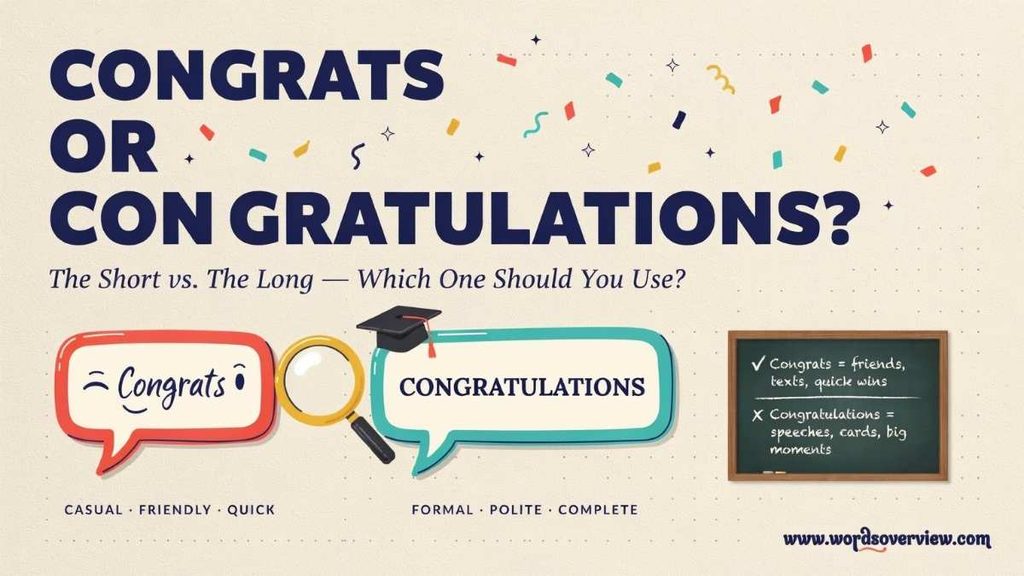
The choice depends on the situation.
Choose congratulations when:
- You want a professional tone.
- You are writing a formal email.
- You are preparing an official announcement.
- You are writing a formal letter.
- You are speaking at a ceremony.
- You want the safest option for an unfamiliar audience.
Choose congrats when:
- You are messaging a friend.
- You are commenting on social media.
- You are chatting casually.
- You want a short, friendly expression.
- The relationship is informal.
If you’re uncertain, congratulations is the more versatile choice.
It works across a wider range of situations without sounding inappropriate.
Practice Session
Complete each sentence with the correct word or phrase: congrats, congratulations, congratulation, on or to.
- ________ on your graduation!
- ________ to the entire team for completing the project.
- ________ on your new job!
- Please accept my ________ on your achievement.
- ________ on your promotion. You deserve it!
- ________ to Sarah for winning the award.
- “________!” she said after hearing the good news.
- I sent him a message saying, “________ on your success!”
- ________ to everyone who participated in the competition.
- The manager wrote, “________ on your well-deserved promotion.”
- “________, bro! You finally did it!”
- She received a letter of ________ after winning the competition.
- ________ on your wedding!
- ________ to the graduates on this important milestone.
- “________ on passing your exam!” his friend texted him.
- Please join us in offering our ________ to the winners.
- ________ to you on completing your degree.
- “________!” is a common informal way to congratulate someone.
- ________ on your outstanding achievement.
- The company announced, “________ to our new team leader.”
- Which sounds more formal: “________” or “congrats”?
- Which expression is more casual: “congratulations” or “________”?
- We wrote a message of ________ for her promotion.
- ________ to the whole class for achieving excellent results.
- ________ on your new position! Wishing you continued success.
Answer Session
- Congratulations
- Congratulations
- Congrats
- congratulations
- Congratulations
- Congratulations
- Congratulations
- Congrats
- Congratulations
- Congratulations
- Congrats
- congratulation
- Congratulations
- Congratulations
- Congrats
- congratulations
- Congratulations
- Congrats
- Congratulations
- Congratulations
- Congratulations
- congrats
- congratulation
- Congratulations
- Congratulations
Frequently Asked Questions
Is “Congrats” grammatically correct?
Yes. “Congrats” is grammatically correct and is a recognized informal shortened form of “congratulations.” It works especially well in texts, chats, social media and friendly conversations. For formal communication, “congratulations” is usually the better choice.
What does “Congrats” mean?
“Congrats” means “congratulations.” People use it to express happiness, praise or good wishes when someone achieves something or experiences a happy event, such as a promotion, graduation, wedding or new job.
When should you say “Congrats”?
Say “congrats” when you’re communicating in a casual or friendly setting. For example, you can say “Congrats on your promotion!” to a friend or coworker. However, “congratulations” may sound more appropriate in a formal email, speech or official announcement.
Should I say “Congrats” or “Congratulations”?
Both are correct, but they suit different levels of formality. “Congratulations” is the full and more formal expression, while “congrats” is shorter and more casual. If you’re unsure which one to choose, “congratulations” is the more versatile option.
Can “Congrats” be used in a professional message?
Yes, but the context matters. “Congrats” can work in an informal workplace chat or friendly message to a colleague. However, “congratulations” is generally more suitable for formal emails, official announcements, business letters and professional recognition.
What is the difference between “Congrats” and “Congratulations”?
The main difference is tone rather than meaning. “Congratulations” is the complete expression and works in both formal and informal situations. “Congrats” is an informal shortened form that creates a more relaxed and conversational tone.
Is “Congratulation” or “Congratulations” correct?
Both words exist, but “congratulations” is the normal form when you directly praise someone for an achievement. The singular “congratulation” appears in specific grammatical constructions, such as “a letter of congratulation.”
Do you say “Congratulations on” or “Congratulations to”?
Use “congratulations on” when you mention the achievement or occasion, such as “Congratulations on your graduation.” Use “congratulations to” when you identify the person or group receiving the praise, such as “Congratulations to the entire team.”
Is “Congrats” a greeting?
“Congrats” is not usually a general greeting like “hello” or “good morning.” Instead, it is a congratulatory expression used to respond to someone’s achievement, success or happy event. For example, “Congrats on your new job!” congratulates someone on a specific accomplishment.
What is the best way to congratulate someone professionally?
For professional communication, use a clear and respectful expression such as “Congratulations on your achievement” or “Congratulations on your promotion.” You can then add a brief positive message, such as a wish for continued success.
Conclusion
The good news is that you don’t need to panic over congrats or congratulations. Neither word is hiding a grammar trap under the rug. Both are correct and both express good wishes when someone achieves something worth celebrating. The real difference is tone. “Congratulations” is the full, more formal choice, while “congrats” is a shorter, casual expression that fits naturally in texts, chats and friendly conversations.
Also, don’t accidentally turn congratulations into “congratulation” when you’re celebrating someone’s achievement. Remember the useful grammar pattern: congratulations on an achievement and congratulations to the person or group. Once you understand these simple distinctions, choosing the right expression becomes easy and your grammar can celebrate, too!

Ethan AJS is an experienced blogger and language enthusiast at Words Overview, dedicated to making English easier to understand and use. He writes about grammar, vocabulary, spelling, word meanings and commonly confused words, turning tricky language questions into clear, practical insights. With a passion for effective communication, Ethan creates engaging, readerfocused content that helps readers write accurately, choose the right words and communicate with confidence.




