
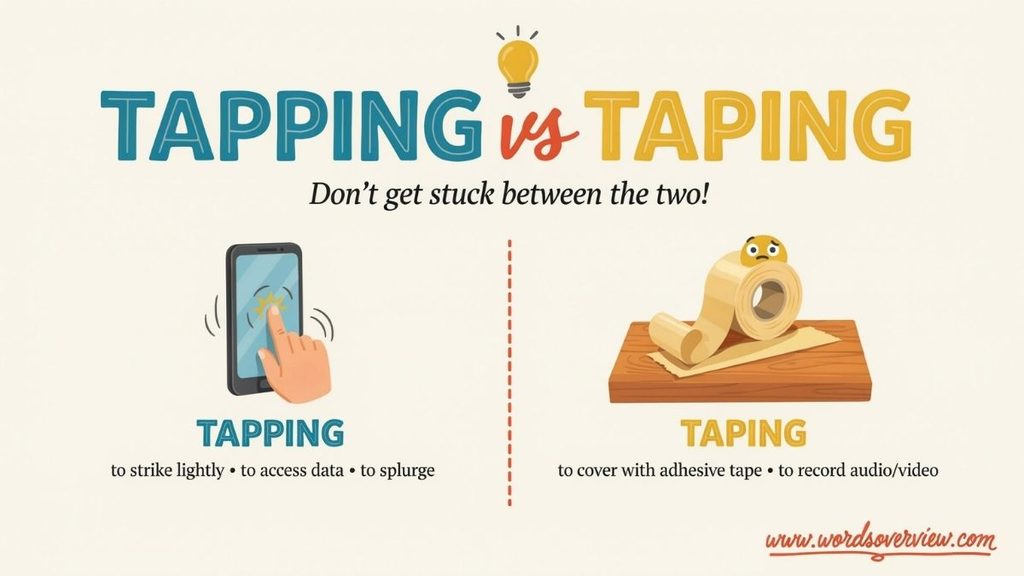
Have you ever caught yourself tapping vs taping and wondered whether your fingers need a keyboard or a roll of adhesive tape? You’re not alone! These two words look almost identical, yet confusing them can turn a simple sentence into an unexpected comedy. Imagine telling someone you’re taping your phone when you simply want to open an app. Are you using a touchscreen or preparing your phone for shipping? The difference matters more than you might think. Fortunately, a simple spelling rule can save you from these grammatical mix-ups. Let’s explore their meanings, common mistakes and practical examples so you can use both words correctly.
What’s the Difference Between Tapping and Taping?
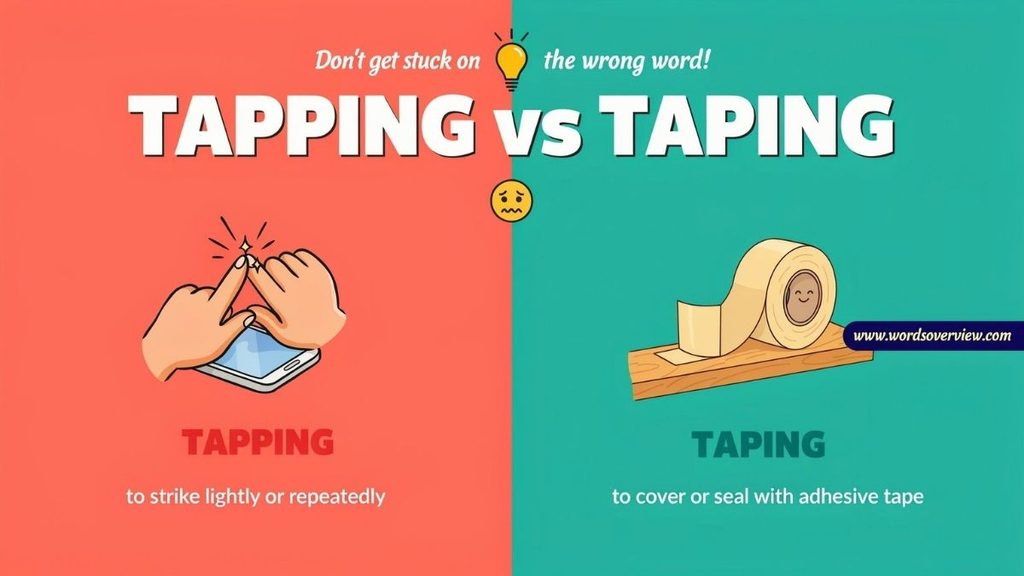
The main difference between tapping and taping lies in their meanings and the verbs from which they come. Tapping comes from tap while taping comes from tape.
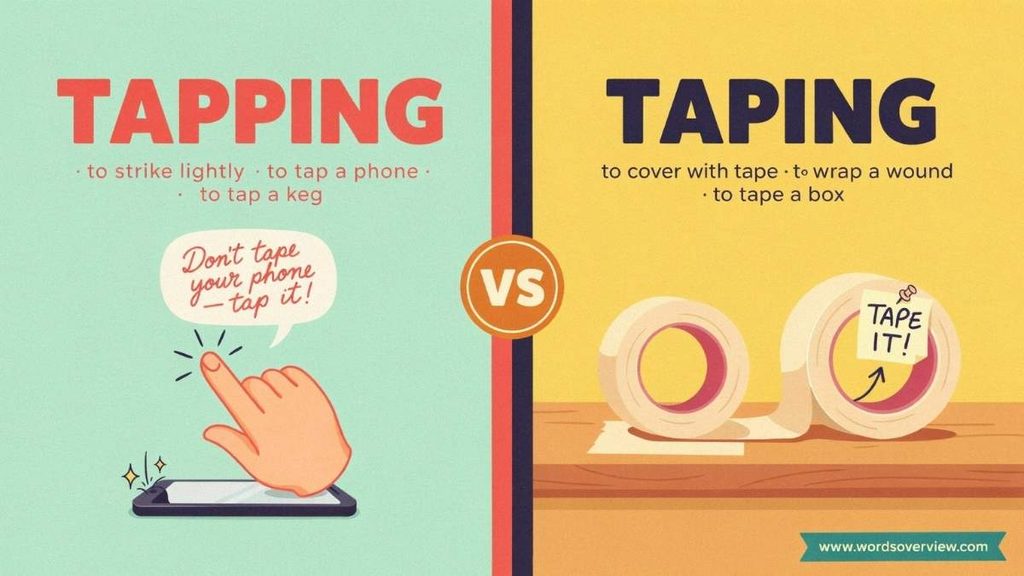
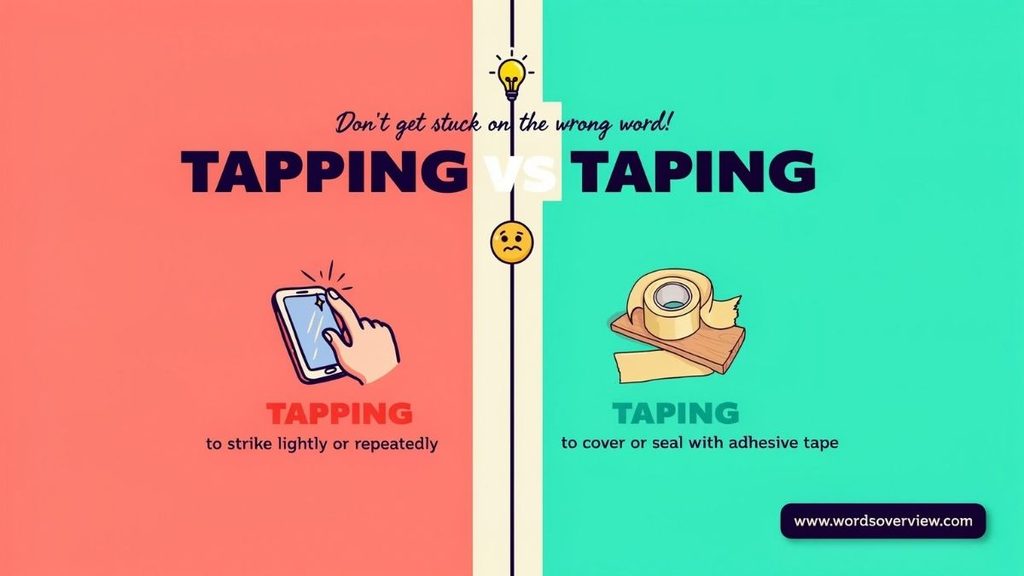
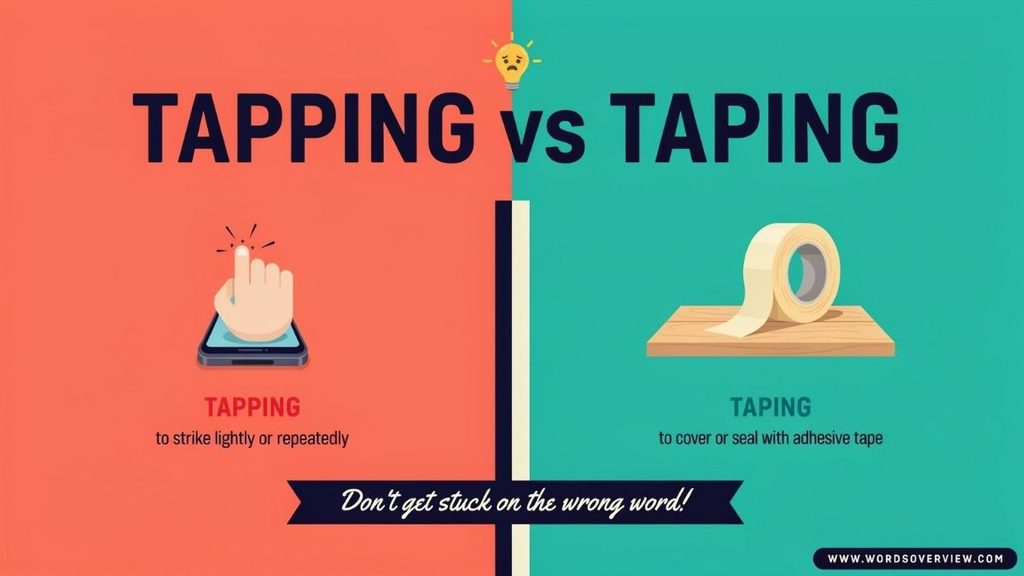
When you tap something, you usually touch or strike it lightly. For example, you might tap your fingers on a desk, tap a phone screen or tap someone on the shoulder to get their attention.
In contrast, when you tape something, you use adhesive tape to attach, secure or cover it. You might tape a cardboard box before moving or tape a note to a wall.
However, taping has another common meaning. In media production, it can refer to recording a television show, interview or other content.
| Word | Base verb | Main meaning | Example |
| Tapping | Tap | Touching or striking lightly | She is tapping the table. |
| Taping | Tape | Attaching or securing with tape | He is taping the package. |
| Tapping | Tap | Using or accessing a resource | The company is tapping new markets. |
| Taping | Tape | Recording audio or video | They are taping an interview. |
Therefore, choose the word according to the action you want to describe. If someone touches a screen with a finger, they are tapping it. If someone uses adhesive tape to secure a cable, they are taping it.
What Does Tapping Mean?
Tapping is the present participle of the verb tap. It can describe a light touch, a gentle strike or the action of accessing something useful.
Although physical tapping is the most familiar meaning, the word also appears in technology, business, medicine and specialized technical fields.
Tapping a Surface
Tapping a surface means touching or striking it lightly, often with a finger or another small object. The action may produce a sound or signal someone’s attention.
For example, you might tap a desk while waiting for a meeting to begin. Similarly, a teacher might tap a student’s desk to redirect their attention without interrupting the entire class.
Common examples include:
- Tapping your fingers on a table.
- Tapping a pencil against a notebook.
- Tapping on a window to get someone’s attention.
- Tapping a glass lightly with a spoon.
In each case, tapping describes a light physical action. It doesn’t involve adhesive tape.
Tapping on a Phone Screen
In digital technology, tapping means touching a touchscreen briefly with a finger. Smartphones, tablets and other touchscreen devices use this gesture to recognize commands.
For example, you might tap an app icon to open an application. You can also tap a button to submit a form or tap a notification to read a message.
Consider these sentences:
- She is tapping the screen to open the settings.
- I keep tapping the wrong button on my phone.
- The user is tapping the payment option to continue.
Although people sometimes say they’re tapping a phone, the action usually involves touching its screen. Therefore, tapping is the correct word when you describe a touchscreen gesture.
Tapping Your Foot or Fingers
People often tap their feet or fingers when they feel impatient, nervous, excited or absorbed in music. The repeated movement may happen consciously or without much thought.
For example, a student might tap a foot while waiting for exam results. Meanwhile, a musician might tap a foot to maintain the beat.
Here are a few more examples:
- He was tapping his fingers while waiting for the bus.
- She started tapping her foot when the music began.
- The child kept tapping the table during dinner.
These examples describe repeated physical movements. They don’t involve attaching anything with tape.
Learn the difference between everyday English mistakes
Slushy or Slushie: Correct Spelling, Meaning and Usage
Tapping Someone on the Shoulder
Tapping someone on the shoulder means touching their shoulder lightly to get their attention. People commonly use this gesture in crowded places, workplaces and social situations.
For instance, you might tap a colleague on the shoulder when they can’t hear you calling their name. Likewise, a passenger might tap another person’s shoulder to let them know that they dropped something.
The phrase can also describe a polite way to interrupt someone. In this context, tapping often communicates a simple message without requiring words.
Example: The manager tapped Daniel on the shoulder to let him know that the meeting was about to begin.
Tapping Into a Resource or Opportunity
It doesn’t always describe a physical action. It can also mean accessing, using or making the most of a resource, skill or opportunity.
This figurative meaning appears frequently in business, education and professional communication.
For example, a company might tap into a new market to reach more customers. A student might tap into online resources to improve their understanding of a difficult subject.
Consider these examples:
- The business is tapping into a growing customer base.
- She is tapping into her creative skills to solve the problem.
- The organization wants to tap into local talent.
- Researchers are tapping into new sources of information.
In each sentence, tapping means making use of something valuable. The word doesn’t refer to touching a surface or using adhesive tape.
Tapping Trees for Sap
In agriculture and forestry, tapping a tree means making a small cut or opening in its trunk to collect sap. Maple trees, for example, can be tapped to collect sap used in maple syrup production.
This process requires appropriate equipment and careful handling. The goal is to collect the sap while minimizing damage to the tree.
Example: Farmers are tapping maple trees during the sap collection season.
This meaning differs from everyday tapping because it describes a specialized agricultural process. Nevertheless, the spelling follows the same rule: tap becomes tapping.
Tapping in Emotional Freedom Techniques
Tapping also appears in Emotional Freedom Techniques (EFT), a practice that involves gently tapping specific points on the body while focusing on particular thoughts or feelings.
Practitioners use this technique as part of a broader approach to managing emotional distress. However, claims about its effectiveness vary and it shouldn’t replace appropriate medical or mental health care.
Example: She is learning tapping techniques as part of a stress-management routine.
Here, tapping describes a repeated physical action performed in a specific sequence. The context makes its meaning clear.
Tapping in Metalworking
In metalworking, tapping means cutting internal threads into a hole so that a threaded fastener, such as a screw or bolt, can fit into it.
For example, a technician may drill a hole into a metal component and then use a tap to create the internal threads.
Example: The mechanic is tapping the hole before installing the bolt.
This technical meaning is different from tapping a desk or tapping a phone screen. However, the spelling remains unchanged because the base verb is still tap.
What Does Taping Mean?
Taping is the present participle of the verb tape. It usually describes attaching, covering or securing something with adhesive tape. It can also refer to recording audio or video.
The intended meaning depends on the context.
- In a household, taping often involves packaging or repairs.
- In sports and medicine, it may involve applying specialized tape to the body.
- In media production, it often means recording content.
Taping Objects Together
Taping objects together means joining them with adhesive tape. People use this method for temporary repairs, crafts, household tasks and packaging.
For example, you might tape two pieces of paper together to create a larger sheet. Similarly, you could tape a loose cable to a surface to keep it in place.
Common examples include:
- Taping two sheets of paper together.
- Taping a loose wire along a wall.
- Taping a torn poster back together.
- Taping cardboard pieces together for a craft project.
The key detail is the use of tape as an adhesive material. Therefore, taping is the correct choice for these actions.
Taping a Package or Box
Taping a package means applying adhesive tape to secure its contents or close its openings. This action is especially common when people prepare parcels for shipping or pack belongings for a move.
For example, a warehouse worker might tape a cardboard box before placing it on a delivery pallet. Likewise, you might tape a moving box to prevent its flaps from opening during transportation.
Consider these sentences:
- He is taping the box before shipping it.
- We are taping the packages for delivery.
- She finished taping the carton before lunch.
In these examples, taping describes the application of adhesive tape. Using tapping would change the meaning and make the sentences incorrect for the intended action.
Taping a Note to a Wall
People often tape notes, photographs, posters and reminders to walls or other surfaces. This method allows them to display items without using nails or permanent fixtures.
For instance, a student might tape a study schedule above a desk. Similarly, an employee might tape a reminder beside a computer monitor.
Example: Maria is taping the meeting agenda to the office wall.
The word taping works because Maria uses adhesive tape to attach the agenda. She isn’t lightly touching the wall.
Taping Before Painting
In painting and decorating, taping involves applying painter’s tape to protect selected areas from unwanted paint. Painters commonly place it along trim, window frames, edges and other surfaces that need clean boundaries.
For example, a painter might tape the edges of a window before painting the surrounding wall. After the paint dries sufficiently, the painter removes the tape according to the product instructions.
Taping helps create cleaner lines and reduces accidental paint marks. However, the result also depends on proper surface preparation and careful application.
Example: The decorator is taping the baseboards before painting the room.
This is another practical example of taping because adhesive tape plays a direct role in the task.
Taping in Sports and Medicine
Athletes, trainers and healthcare professionals may use specialized tape to support or protect particular areas of the body. The exact method depends on the purpose and type of tape.
For example, athletic tape may help restrict certain movements around a joint. Kinesiology tape is often applied differently and is used for various sports and rehabilitation purposes.
Common examples include:
- Taping an ankle before a sports activity.
- Taping a wrist according to a clinician’s instructions.
- Applying kinesiology tape to a selected area of the body.
The term can also describe taping a sports injury, although the application should match the injury and the person’s needs. Tape doesn’t treat every injury and some conditions require professional assessment.
Example: The athletic trainer is taping the player’s ankle before practice.
Here, taping refers to applying a material to the body rather than touching the ankle lightly.
Taping an Audio or Video Recording
In media production, taping can mean recording a program, interview, performance or other content. The term became common when magnetic tape was widely used for audio and video recording.
Today, people still use the word even when they record digitally rather than onto physical tape.
For example, a production team might tape an interview for a documentary. A television crew might also tape a program before its scheduled broadcast.
Consider these sentences:
- The team is taping an interview with the director.
- We are taping the presentation for employees who can’t attend.
- The studio is taping a new episode this afternoon.
In these contexts, taping means recording. It doesn’t mean attaching objects with adhesive tape.
Why Does Tap Become Tapping but Tape Become Taping?
The difference between tapping and taping follows a common English spelling rule for verbs ending in a silent e or a single consonant.
When you add ing to tap, you usually double the final consonant. However, when you add ing to tape, you drop the silent e.
These changes produce two different spellings:
- Tap + ing = tapping
- Tape – e + ing = taping
Although the words look similar, their spelling reflects the different forms of their base verbs.
Learn the difference between more words people mix up
Personalise or Personalize: Which Spelling Is Correct?
The Rule for Tapping: Double the Final Consonant
The verb tap has one syllable and ends in a consonant-vowel-consonant pattern: t-a-p. When you add a suffix beginning with a vowel, such as ing, you double the final consonant.
As a result, tap becomes tapping rather than taping.
Other verbs follow a similar pattern:
| Base verb | Correct form | Example |
| Run | Running | She is running outside. |
| Sit | Sitting | He is sitting near the window. |
| Stop | Stopping | The bus is stopping here. |
| Plan | Planning | We are planning a trip. |
| Tap | Tapping | She is tapping the screen. |
This rule helps preserve the intended short vowel sound in the base verb. Therefore, writing taping when you mean the action of tapping would create a spelling error.
The Rule for Taping: Drop the Silent E
The verb tape ends in a silent e. When you add ing, you usually remove that final e.
Therefore, tape becomes taping, not tapeing.
The same pattern appears in several common English verbs:
| Base verb | Correct form | Example |
| Make | Making | She is making dinner. |
| Write | Writing | He is writing a report. |
| Hope | Hoping | They are hoping for good news. |
| Drive | Driving | I am driving home. |
| Tape | Taping | He is taping the package. |
Notice that the silent e disappears before ing. However, the long vowel sound in the base verb remains.
Tapping vs Taping: Verb Forms
Looking at related verb forms can make the difference easier to understand. Both verbs follow regular patterns, but their spelling changes when you add certain endings.
| Verb form | Tap | Tape |
| Base form | Tap | Tape |
| Third-person singular | Taps | Tapes |
| Simple past | Tapped | Taped |
| Present participle | Tapping | Taping |
| Present continuous example | She is tapping. | She is taping. |
The past-tense forms also show the difference. Tapped doubles the final consonant, while taped keeps the final e before adding -d.
For example, you might say, “She tapped the screen yesterday.” However, you would say, “She taped the box yesterday.”
The spelling changes because the verbs have different base forms and follow different suffix rules.
Learn the difference between tricky grammar words
Vain or Vein: Key Difference and Use?
Tapping vs Taping: Pronunciation Differences
Tapping and taping also sound different. The most noticeable difference appears in their vowel sounds.
In American English, tapping has a short vowel sound like the one in cat. In contrast, taping has a long vowel sound like the one in day.
This difference helps distinguish the words in conversation even when you can’t see their spelling.
| Word | Pronunciation | Main vowel sound | Rhymes approximately with |
| Tapping | /ˈtæpɪŋ/ | Short a | Mapping |
| Taping | /ˈteɪpɪŋ/ | Long a | Shaping |
To practice, say both words aloud slowly. First, pronounce the short vowel in tapping. Then pronounce the long vowel sound in taping.
The distinction becomes easier when you connect each sound to its meaning. Tapping involves a tap, while taping involves tape.
Tapping vs Taping: Examples in Sentences
The best way to understand the difference is to compare the words in everyday situations. Each example below uses the spelling that matches the intended action.
Examples of Tapping
- She is tapping her fingers on the desk while waiting for the meeting to begin.
- I keep tapping the screen, but the application won’t open.
- The child was tapping the window to get his father’s attention.
- He started tapping his foot when the music began.
- The company is tapping into new markets to expand its customer base.
- Workers are tapping maple trees to collect sap.
- The technician is tapping the metal hole to create internal threads.
- She is tapping the notification to read the latest message.
Each sentence describes light contact, a repeated movement, a specialized technical action or access to a resource.
Examples of Taping
- He is taping the cardboard box before sending it to the customer.
- She is taping two sheets of paper together for an art project.
- The painter is taping the window frame before applying the paint.
- The trainer is taping the athlete’s ankle before practice.
- We are taping the interview for the company’s website.
- They finished taping the package before the courier arrived.
- Maria is taping a reminder to the refrigerator.
- The production team is taping the next episode of the show.
These sentences describe applying adhesive tape or recording content. Therefore, taping is the appropriate word in each example.
Common Mistakes With Tapping and Taping
Writers sometimes confuse tapping and taping because the words differ by only one letter. However, the mistake can change the meaning of a sentence.
Using Taping for a Touchscreen Gesture
Incorrect: She is taping the icon to open the application.
Correct: She is tapping the icon to open the application.
The corrected sentence describes touching the screen. No adhesive tape is involved.
Using Tapping for Packaging
Incorrect: He is tapping the box before shipping it.
Correct: He is taping the box before shipping it.
The corrected sentence describes sealing the box with adhesive tape.
Writing Taping Instead of Tapping
Incorrect: The student is taping his fingers on the desk.
Correct: The student is tapping his fingers on the desk.
The action involves repeatedly touching the desk. Therefore, tapping is correct.
Writing Taping as Tapeing
Incorrect: She is tapeing the package.
Correct: She is taping the package.
The verb tape loses its silent e before the suffix ing. As a result, the correct spelling is taping.
Learn the difference between similar English words
Sole or Soul: Difference In Meaning And Usage
Writing Taping as Taping When You Mean Tapping
Sometimes, a sentence is grammatically possible but communicates the wrong action. For example, “He is taping the table” could mean he is applying tape to the table. However, if he is lightly striking the surface with his fingers, the sentence should use tapping.
Therefore, don’t rely on spelling alone. Consider the action and the surrounding context before choosing the word.
Quick Comparison: Tapping vs Taping
Use this table when you need a quick reminder of the differences in meaning, spelling and usage.
| Feature | Tapping | Taping |
| Base verb | Tap | Tape |
| Main action | Touching or striking lightly | Attaching or securing with tape |
| Other meanings | Accessing a resource or creating internal threads | Recording audio or video |
| Spelling rule | Double the final consonant | Drop the silent e |
| Vowel sound | Short a | Long a |
| Example | He is tapping the screen. | He is taping the box. |
The simplest way to choose is to identify the action first. If someone touches a surface lightly, use tapping. If someone applies tape or records a program, use taping.
Learn the difference between confusing English words step by step
Vinal or Vinyl: Spelling, Differences and Usage
An Easy Way to Remember Tapping vs Taping
You don’t need to memorize complicated grammar rules to remember these words. Instead, connect each spelling to its base verb.
Tapping comes from tap. The word tap ends with a single consonant after a short vowel. Therefore, you double the final consonant before adding ing.
Taping comes from tape. The word tape ends with a silent e. Therefore, you remove the e before adding ing.
You can also use a simple meaning-based trick:
- Tapping: Think of tapping your phone screen with a finger.
- Taping: Think of taping a cardboard box with adhesive tape.
These everyday examples connect the spelling to a clear action. As a result, you’ll be less likely to confuse the two words when writing.
Practice Questions
Fill in the blank with Tapping or Taping.
- She is ______ the phone screen to open her favorite app.
- He is ______ the cardboard box before shipping it.
- The student kept ______ his fingers on the desk during class.
- We are ______ two sheets of paper together for the project.
- The painter is ______ the window frames before applying paint.
- My brother is ______ a pencil against the table.
- The company is ______ into new markets to reach more customers.
- The production team is ______ an interview for its website.
- She started ______ her foot to the rhythm of the music.
- The worker is ______ the package securely with adhesive tape.
- He is ______ his colleague on the shoulder to get her attention.
- The athletic trainer is ______ the player’s ankle before practice.
- I keep ______ the wrong button on my smartphone.
- Maria is ______ a reminder to the refrigerator door.
- Farmers are ______ maple trees to collect sap.
- The mechanic is ______ a hole to create internal threads.
- The television crew is ______ a new episode of the show.
- She is ______ the loose cable to the wall.
- The impatient customer was ______ his fingers on the counter.
- He is ______ a torn poster back together with adhesive tape.
- The organization is ______ into local talent for its new project.
- They spent the afternoon ______ a video for their website.
- Please stop ______ the glass with your spoon.
- The movers are ______ the boxes before loading the truck.
- She is ______ the screen repeatedly because the app isn’t responding.
Answer Key
- Tapping
- Taping
- Tapping
- Taping
- Taping
- Tapping
- Tapping
- Taping
- Tapping
- Taping
- Tapping
- Taping
- Tapping
- Taping
- Tapping
- Tapping
- Taping
- Taping
- Tapping
- Taping
- Tapping
- Taping
- Tapping
- Taping
- Tapping
Frequently Asked Questions
What’s the Difference Between Tapping and Taping?
Tapping means touching or striking something lightly, such as tapping a phone screen. Taping usually means attaching something with adhesive tape or recording audio or video. The correct word depends on the action you want to describe.
Why Does Tap Become Tapping but Tape Become Taping?
The verb tap doubles its final consonant before adding ing, forming tapping. However, tape drops its silent e before adding ing, forming taping. These spelling rules help preserve the intended vowel sounds.
What Does Tapping Mean in Everyday English?
Tapping usually means touching or striking something lightly with a finger or another object. It can also mean accessing a resource or opportunity. For example, tapping a screen opens an app while tapping into expertise means making use of someone’s knowledge.
What Does Taping Mean in Physical Therapy?
In physical therapy, taping involves applying specialized tape to the body to support movement, provide sensory feedback or help manage certain symptoms. The technique depends on the person’s condition and treatment goals. Taping doesn’t replace a proper assessment or an individualized rehabilitation plan.
Does Kinesiology Tape Really Help Reduce Pain?
Kinesiology tape may provide short-term symptom relief for some people. However, research findings vary depending on the condition and application method. It shouldn’t replace appropriate treatment, exercise or professional medical advice when needed.
What Are the Different Types of Taping?
Common types include athletic taping, kinesiology taping, rigid sports taping and protective taping. Each serves a different purpose. For example, rigid tape can restrict certain movements while kinesiology tape allows more flexibility. The appropriate method depends on the intended use.
What Are the Risks of Using Kinesiology Tape?
Kinesiology tape may cause skin irritation, itching, redness or an allergic reaction. Applying it incorrectly or too tightly can also cause discomfort. Avoid applying tape to damaged skin and remove it if irritation develops. People with sensitive skin or certain medical conditions should seek professional advice before use.
How Long Should You Leave Kinesiology Tape On?
Many kinesiology tapes can remain on the skin for several days, depending on the product instructions and individual skin tolerance. However, you should remove the tape sooner if you experience itching, pain, redness or other signs of irritation. Always follow the manufacturer’s guidance.
Is Taping Better Than Bracing a Knee?
Neither option is always better. Taping may provide targeted support or sensory feedback, whereas a knee brace can offer more structured support depending on its design. The best choice depends on the injury, symptoms and activity level. A healthcare professional can help you select the appropriate option.
Can You Use Tapping and Taping Interchangeably?
No. Although the words look similar, they describe different actions. You might tap a screen to open an application, but you would tape a package before shipping it. Using the wrong word can change the meaning of your sentence and confuse your reader.
Conclusion
Confusing tapping vs taping may seem like a tiny spelling slip, but it can leave readers wondering whether you’re touching a screen or wrapping it up for delivery! Fortunately, the difference is easy to remember. Tapping comes from tap and describes touching something lightly or accessing a resource. Taping comes from tape and usually means attaching something with adhesive tape or recording audio or video. Remember the spelling rules: double the final p in tap before adding ing and drop the silent e from tape. Once you understand these differences, you’ll tap the right word every time without taping your grammar mistakes in place!

Ethan AJS is an experienced blogger and language enthusiast at Words Overview, dedicated to making English easier to understand and use. He writes about grammar, vocabulary, spelling, word meanings and commonly confused words, turning tricky language questions into clear, practical insights. With a passion for effective communication, Ethan creates engaging, readerfocused content that helps readers write accurately, choose the right words and communicate with confidence.




