
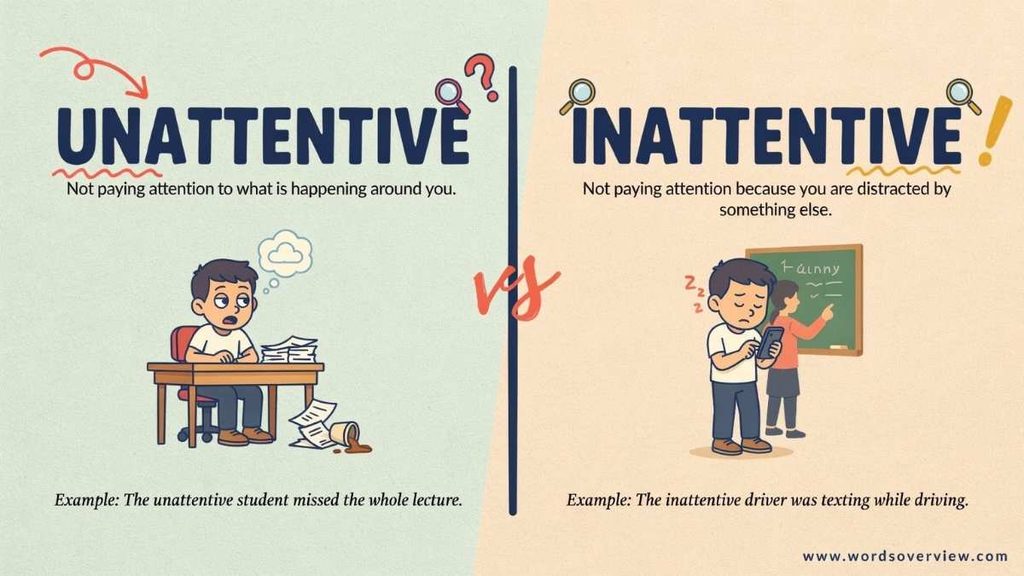
Have you ever stared at unattentive or inattentive and wondered whether English is playing another one of its little spelling tricks? You’re not alone. Both words can mean “not attentive,” but that doesn’t mean they’re equally common or equally natural in everyday writing. Choosing the wrong form can make an otherwise polished sentence look like it needs a quick grammar check. The good news is that the difference becomes much easier once you understand how each word is used. In this guide, you’ll discover what inattentive and unattentive mean, whether both are correct, which form is preferred and how to use each confidently without letting English trip you up.
Unattentive or Inattentive Quick Answer
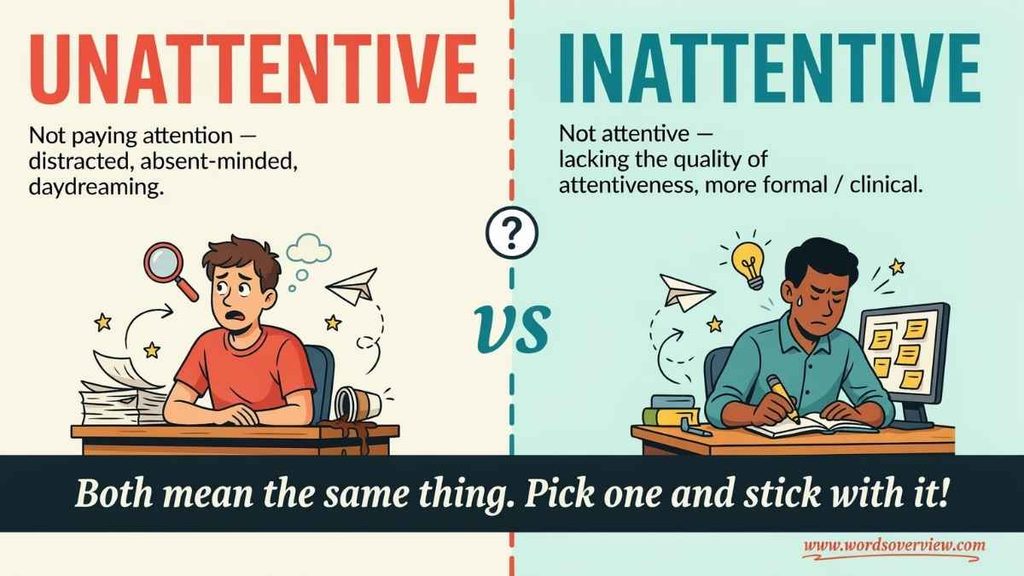
Both words express the idea of not being attentive. However, inattentive is the more established and widely used form in modern English.
| Word | Meaning | Usage | Best choice in standard writing |
| Inattentive | Not paying attention | Common and well established | Yes |
| Unattentive | Not attentive | Recognized but much less common | Usually choose inattentive |
The inattentive meaning is straightforward. It describes someone who isn’t giving enough attention to a person, activity, task, or situation.
For example:
The inattentive student missed an important instruction.
An inattentive driver may fail to notice a hazard.
The waiter seemed inattentive to the customers.
She became inattentive during the long meeting.
Merriam-Webster defines inattentive as “not attentive” and “not paying attention.” Cambridge gives a similar definition and commonly uses the construction inattentive to when someone fails to give attention to a person or thing.
The practical rule is simple: when you need the familiar standard form, use inattentive.
Learn the difference between more words people mix up
Emasculate or Demasculate: Meaning, Difference and Usage
What Does Inattentive Mean?
The inattentive definition is “not paying attention” or “not giving attention to someone or something.”
The word describes a person’s behavior or mental focus when attention isn’t directed toward what matters. It can describe a temporary lapse in concentration or a repeated pattern of failing to notice important details.
Imagine a teacher explaining an important assignment while a student looks out the window. The student may be described as inattentive because the student’s attention isn’t focused on the lesson.
The same meaning works across many situations.
1: An inattentive driver may fail to notice a changing traffic signal.
2: An inattentive listener may miss part of a conversation.
3: An inattentive employee may overlook an important detail in a report.
Inattentive Meaning in English
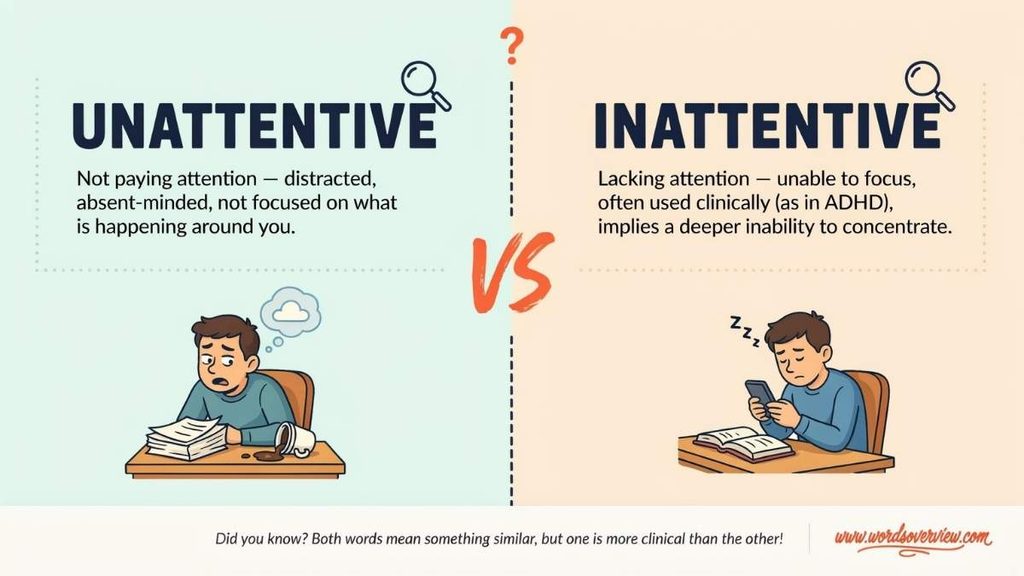
The inattentive meaning in English centers on a lack of attention. In everyday conversation, the word can describe someone who isn’t listening carefully, doesn’t notice what is happening, overlooks important details, or struggles to maintain focus.
However, inattentive doesn’t automatically mean careless, irresponsible, or thoughtless.
Someone can become inattentive for a few minutes without being an inattentive person in general.
For example:
The normally focused employee became inattentive during the afternoon meeting.
This sentence describes a particular situation. It doesn’t necessarily suggest that the employee always performs poorly.
Learn the difference between commonly confused words in English
Employees or Employee’s Which Is Correct?
Inattentive as an Adjective
Inattentive is an adjective, so it describes a noun or subject.
Compare these examples:
The inattentive student missed the instructions.
The student was inattentive during the lecture.
His inattentiveness caused several mistakes.
The first two sentences use inattentive as an adjective. The third uses the related noun inattentiveness.
This distinction becomes useful when you want to describe either a person or the state of lacking attention.
Is Inattentive a Word?
Yes. Inattentive is unquestionably an English word.
Major dictionaries recognize it as an adjective. Merriam-Webster lists the word and records its first known use as 1692. Cambridge also includes it in its English and American English dictionary entries.
The word therefore has a long history in English. It isn’t a recent internet expression or an informal invention.
If you’re asking, “Is inattentive a correct word?” the answer is straightforward. Yes, it is both grammatically correct and widely used.
You can naturally use it in expressions such as inattentive behavior, inattentive student, inattentive listener, inattentive driver, inattentive employee, inattentive to detail and inattentive to surroundings.
Learn the difference between similar English words the easy way
Tomorrows or Tomorrow’s Difference, Meaning and Usage
Is Unattentive a Word?
Here’s where the distinction becomes more interesting.
Unattentive is also a word.
Merriam-Webster records unattentive as an adjective and defines it as “not attentive.” Therefore, saying that unattentive isn’t a word would be too absolute.
The more useful question concerns how often people use the two forms and which one sounds more natural to modern readers.
Although dictionaries recognize unattentive, inattentive is much more common and familiar. As a result, readers are more likely to encounter inattentive in everyday English, formal writing, educational material and edited publications.
Unattentive Meaning
The unattentive meaning is essentially the same as the meaning of inattentive: not attentive or not paying attention.
For example:
The employee appeared unattentive during the discussion.
A reader can understand the sentence without difficulty. However, this version sounds less natural to many readers than:
The employee appeared inattentive during the discussion.
The distinction, therefore, isn’t mainly about meaning. It concerns established usage and reader expectations.
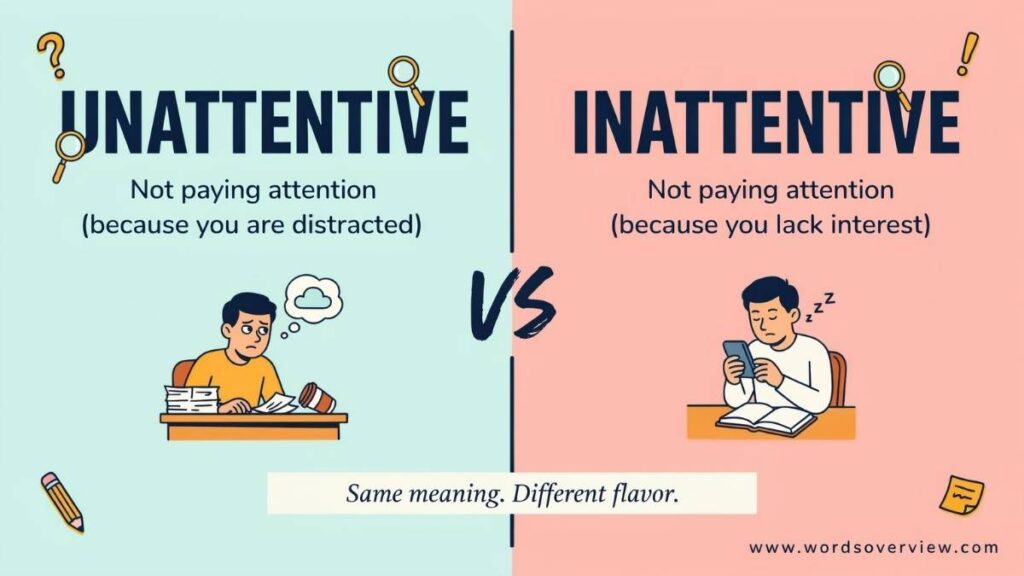
Inattentive or Unattentive What’s the Difference?
The inattentive vs unattentive question is primarily a question of usage rather than a major difference in definition.
Both forms communicate a lack of attention. However, inattentive has stronger recognition and much wider use in modern English.
| Feature | Inattentive | Unattentive |
| Part of speech | Adjective | Adjective |
| Basic meaning | Not attentive | Not attentive |
| Dictionary recognition | Yes | Yes |
| Common in modern English | Yes | Less common |
| Familiar to readers | Very familiar | Less familiar |
| Suitable for formal writing | Yes | Usually replace with inattentive |
| Preferred default | Yes | No |
So, when someone searches for inattentive vs unattentive meaning, the answer shouldn’t suggest that the two words describe completely different behaviors. Their meanings overlap closely.
The practical difference is that inattentive is the stronger default choice.
Learn the difference between more words people mix up
Inact or Enact: Which Spelling Is Correct?
Why Is Inattentive More Common Than Unattentive?
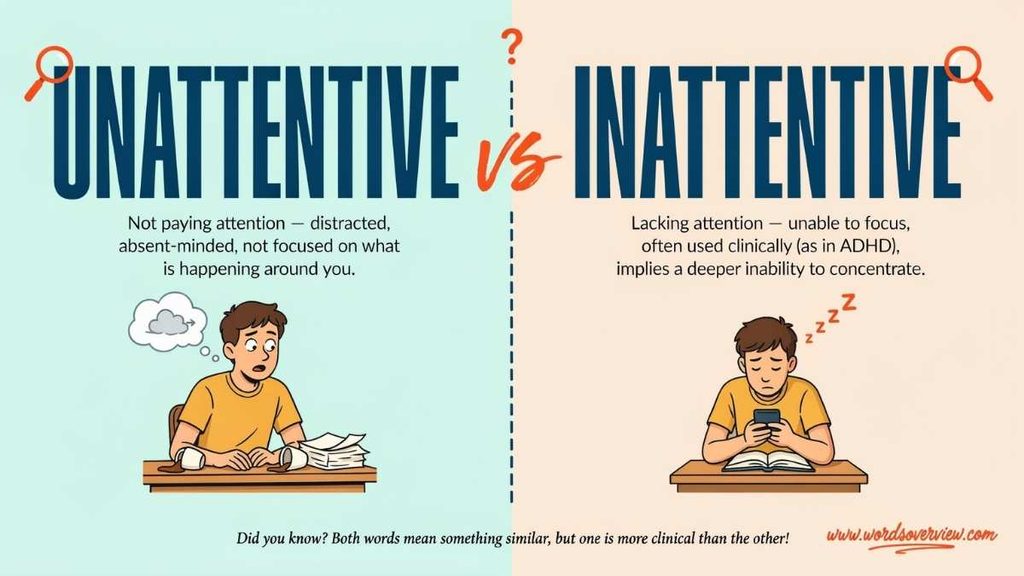
English has several ways to form negative words. Sometimes it uses un-, while other words use in-, im-, il-, or ir-.
For example:
attentive → inattentive
accurate → inaccurate
complete → incomplete
active → inactive
possible → impossible
legal → illegal
regular → irregular
English doesn’t apply one negative prefix consistently to every adjective.
A learner might reasonably assume that unattentive should be the natural form because un- often means “not.” That reasoning makes sense at first glance. However, established vocabulary doesn’t always follow a predictable modern formula.
In this case, inattentive became the dominant form, while unattentive remained comparatively uncommon.
Inattentive or Unattentive Word Formation
Understanding word formation can make the spelling easier to remember.
The Prefix in Inattentive
Inattentive contains the negative prefix in- followed by attentive.
In this construction, in- carries the sense of “not.”
In- + attentive → inattentive
The resulting adjective means “not attentive.”
English contains many words that use in- or related negative forms. For example, inaccurate means “not accurate,” incomplete means “not complete,” and inactive means “not active.”
However, these patterns don’t mean that speakers can freely attach in- to any adjective. Established English usage determines which forms become standard.
Why Unattentive Looks Logical
Unattentive follows another familiar English pattern:
Un- + attentive → unattentive
The prefix un- commonly creates negative adjectives such as unhappy, unclear, unfair, unkind and unaware.
Because this pattern is productive, unattentive looks perfectly logical. That’s also why people sometimes use it.
Yet logical word formation doesn’t automatically make one form more common than another. English speakers ultimately settle on forms through historical development and repeated usage.
Learn the difference between confusing word pairs
To or Too What’s the Difference? Meaning And Examples
When Should You Use Inattentive?
In most situations, inattentive should be your first choice.
The word works especially well in academic assignments, professional emails, reports, essays, articles, business documents, educational material and formal correspondence.
Consider these examples:
The inattentive driver failed to notice the warning sign.
The teacher noticed that several students were inattentive during the lecture.
The manager criticized the inattentive employee for overlooking an important detail.
These sentences sound natural because inattentive is familiar and well established.
If your goal is clear, professional English, there’s little reason to choose the less familiar alternative when the established form is readily available.
Can You Say Unattentive?
Yes, you can encounter and understand unattentive and dictionaries record it.
However, the fact that a dictionary recognizes a word doesn’t necessarily mean that the word has the same frequency or stylistic status as another synonymous form.
That distinction matters here.
Unattentive communicates the intended meaning, but it may sound unusual to some readers. Inattentive, by contrast, is immediately familiar.
For most professional, academic and general writing, inattentive remains the better choice.
Learn the difference between everyday English mistakes
Handle or Handel Correct Spelling, Meaning and Usage
Unattentive Usage
The question of unattentive usage becomes particularly relevant in formal writing.
Compare:
The student was unattentive during the examination.
with:
The student was inattentive during the examination.
The second sentence is generally the stronger choice because inattentive is more familiar and conventional.
The first sentence isn’t meaningless. A reader can understand it. Still, when a standard and widely recognized alternative exists, choosing the more familiar form usually improves clarity and naturalness.
Inattentive in a Sentence: Examples
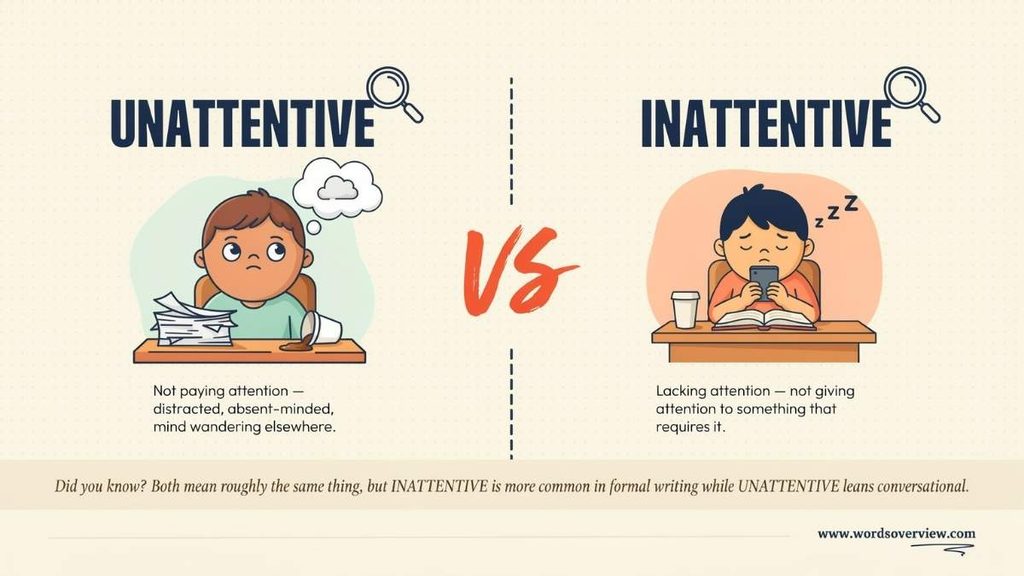
Seeing a word in context often makes its meaning much easier to remember.
Everyday Examples
My brother was inattentive while I was explaining the problem.
The child became inattentive after sitting through the long presentation.
The inattentive passenger almost missed the announcement.
She was inattentive to the warning signs.
School Examples
The inattentive student missed several important instructions.
The teacher asked the inattentive class to focus on the experiment.
His inattentive behavior affected his performance on the test.
Workplace Examples
An inattentive employee may overlook a small detail that later becomes a serious problem.
The manager considered the worker’s inattentive response unusual because she normally paid close attention.
The report contained an error caused by inattentive proofreading.
Driving Examples
Inattentive driving can cause a driver to miss a pedestrian, warning sign, or changing traffic condition.
These examples show why inattentive works naturally with words connected to attention, concentration, observation, listening and awareness.
Learn the difference between tricky English words with easy explanations
Incurable or Uncurable? Meaning, Difference and Correct Usage
Unattentive in a Sentence
Because many readers search for unattentive in a sentence, it’s useful to examine the form directly.
The customer complained that the waiter seemed unattentive.
The child appeared unattentive during the lesson.
His unattentive manner made it difficult to explain the problem.
These sentences demonstrate the intended meaning clearly.
However, for polished writing, the following versions will generally sound more natural:
The customer complained that the waiter seemed inattentive.
The child appeared inattentive during the lesson.
His inattentive manner made it difficult to explain the problem.
The lesson isn’t that unattentive has no meaning. The more accurate lesson is that inattentive is the established choice most writers should reach for first.
Learn the difference between confusing English words step by step
Emerse or Immerse Which Spelling Is Correct?
Inattentive Synonyms and Related Words
When you search for an inattentive synonym, you’ll find several possibilities. However, synonyms don’t always carry exactly the same meaning.
| Synonym | Main emphasis |
| Distracted | Attention has shifted toward something else |
| Absent-minded | Someone is forgetful or mentally elsewhere |
| Unfocused | Concentration isn’t directed effectively |
| Heedless | Someone fails to consider or notice something important |
| Unmindful | Someone fails to notice or consider something |
| Oblivious | Someone is unaware of something happening |
| Careless | Someone doesn’t take enough care |
| Unobservant | Someone fails to notice things |
| Preoccupied | Someone’s thoughts are occupied by something else |
Inattentive vs. Distracted
A distracted person may want to concentrate but has their attention pulled toward something else.
An inattentive person simply isn’t giving enough attention to the task or situation.
She was distracted by a loud noise.
She was inattentive during the instructions.
The cause of the attention problem differs in these examples.
Inattentive vs. Careless
Careless can suggest a lack of caution, responsibility, or care.
Inattentive focuses specifically on attention.
A person may be inattentive during a meeting without being generally careless.
Inattentiveness, Inattention and Inattentive
These related forms often cause confusion because they all describe a lack of attention.
| Word | Part of speech | Meaning | Example |
| Inattentive | Adjective | Not paying attention | The student was inattentive. |
| Inattention | Noun | Lack of attention | His inattention caused the error. |
| Inattentiveness | Noun | The state or quality of being inattentive | Her inattentiveness became noticeable. |
Is Inattentiveness a Word?
Yes. Inattentiveness is a recognized noun formed from inattentive.
For example:
His inattentiveness during the meeting caused him to miss an important instruction.
Another related noun is inattention:
His inattention to detail caused the mistake.
Both nouns work naturally, although the best choice depends on the sentence and the meaning you want to emphasize.
Inattentive Pronunciation
The inattentive pronunciation can seem challenging because the word contains several syllables.
Cambridge gives the US pronunciation as /ˌɪn.əˈten.t̬ɪv/ and the UK pronunciation as /ˌɪn.əˈten.tɪv/.
The main stress falls on the “ten” syllable.
When learning the word, avoid giving every syllable equal emphasis. The stressed syllable should stand out more clearly.
Learn the difference between commonly misused words
Maxxed or Maxed Which Spelling Is Correct?
What About Unattentive Pronunciation?
The unattentive pronunciation follows the expected sound pattern of the word. Because unattentive occurs much less frequently, however, many speakers will feel more familiar with inattentive.
The bigger issue isn’t pronunciation. It’s knowing which form sounds most natural in the context.
Inattentive in American English
In US English, inattentive is a well-established adjective.
Cambridge’s American English entry defines it in terms of failing to listen to what someone says or failing to give attention to what is happening.
The word appears naturally in contexts involving students, drivers, listeners, employees, customers, parents, children, audiences, readers and spectators.
For example:
The inattentive student missed the teacher’s instructions.
The inattentive driver failed to notice the pedestrian.
The audience became inattentive during the final part of the presentation.
The meaning remains connected to attention and concentration regardless of the context.
Inattentive Behavior What Does It Describe?
Inattentive behavior means behavior that shows a lack of attention.
Someone may display inattentive behavior by looking at a phone while another person speaks, missing instructions, overlooking details, failing to notice changes in the environment, or losing focus during an important task.
Context remains important.
Checking a phone once during a meeting doesn’t automatically make someone an inattentive person. Likewise, forgetting one instruction doesn’t necessarily demonstrate a permanent attention problem.
The adjective describes behavior in context. It shouldn’t automatically become a judgment about someone’s personality.
Inattentive ADHD: A Different Context
The phrase inattentive ADHD belongs to a medical and diagnostic context rather than ordinary grammar.
In everyday English, inattentive simply means not paying attention.
In ADHD terminology, however, inattentive describes a pattern associated with attention-related symptoms. These can include difficulty sustaining attention, organizing tasks, following instructions, or completing activities.
For this article, the important point is the distinction between ordinary language and medical terminology.
The word inattentive has a normal dictionary meaning outside discussions of ADHD. The surrounding context determines whether the word describes everyday behavior or a clinical concept.
Inattentive to Detail
One particularly common expression is inattentive to detail.
It describes someone who fails to pay enough attention to small but important elements.
For example:
The editor was inattentive to detail and missed several spelling errors.
The opposite is:
The editor was attentive to detail and caught every error.
This contrast makes the relationship between attentive and inattentive easy to remember.
Attentive means paying attention.
Inattentive means not paying attention.
Learn the difference between everyday English mistakes
Lader or Ladder Which Spelling Is Correct?
Inattentive or Unattentive in Everyday English
In everyday English, speakers commonly use inattentive when they need an adjective that describes a lack of attention.
For example:
He wasn’t listening. He was completely inattentive.
The word fits naturally in conversations about school, work, customer service, driving, reading and many other situations.
Unattentive can communicate the same basic idea. However, because it occurs much less often, it may sound unusual or less polished to some readers.
That’s why word choice matters even when two forms are understandable.
Common Mistakes With Inattentive and Unattentive
Assuming the Prefixes Make Both Words Equally Common
The fact that un- can mean “not” doesn’t guarantee that unattentive will become the dominant form.
English vocabulary doesn’t work like a simple mathematical formula. Established usage determines which formations become normal.
Saying Unattentive Isn’t a Word
This claim goes too far.
Merriam-Webster records unattentive as an adjective meaning “not attentive.”
A more accurate statement is that inattentive is the more common and preferred form for most standard English writing.
Using Unattentive When Inattentive Sounds Natural
If you’re writing an academic paper, professional email, or formal report, choose the more familiar form.
Use:
The student was inattentive.
rather than:
The student was unattentive.
The first version is more likely to sound natural to a broad English-speaking audience.
Confusing Inattentive With Careless
These words overlap in some contexts, but they aren’t identical.
An inattentive person fails to pay attention.
A careless person fails to take enough care.
One can contribute to the other, but the words aren’t interchangeable in every sentence.
Correct Word Inattentive or Unattentive?
If the question is “correct word inattentive or unattentive?” the practical answer is inattentive.
If the question is whether unattentive exists in English, the answer is also yes.
That distinction matters because language isn’t always a simple matter of “correct word versus incorrect word.” Some words exist but remain uncommon, while another established form dominates everyday usage.
Is Inattentive Standard English?
Yes. Inattentive is standard English.
Major dictionaries recognize it and it has a long history of use in English.
Is Unattentive Standard English?
Unattentive also appears in major dictionaries as an adjective meaning “not attentive.”
However, it is considerably less common than inattentive. For that reason, inattentive remains the better default choice for most formal and everyday writing.
Here’s a trusted source for clear more words Comparison:
Grammar Update
Fill in the Blanks
- The __________ student missed several important instructions during the class.
- The manager noticed that the employee had become __________ during the meeting.
- An __________ driver may fail to notice a pedestrian crossing the road.
- Sarah was __________ to the warning signs and continued walking.
- The teacher asked the __________ students to focus on the lesson.
- His __________ behavior caused him to overlook an important detail in the report.
- The normally focused employee seemed __________ during the afternoon meeting.
- An __________ listener may misunderstand what another person is saying.
- The child became __________ after sitting through the long presentation.
- The editor was __________ to several small spelling errors.
- The customer complained that the waiter seemed __________ to their requests.
- Because he was __________ during the instructions, he didn’t understand the assignment.
- The __________ employee entered the wrong information into the system.
- The teacher warned the class that being __________ could lead to mistakes.
- The passenger was __________ and almost missed the announcement.
- She appeared __________ to what was happening around her.
- The __________ student forgot to write down the homework assignment.
- His __________ approach to the task resulted in several avoidable errors.
- The driver became __________ while checking his phone.
- The supervisor spoke to the employee about his __________ attitude toward important details.
- The audience grew __________ as the speaker continued for another hour.
- An __________ person may overlook details that an attentive person would notice.
- The child was unusually __________ during today’s lesson.
- The report contained mistakes because the writer had been __________ when checking the figures.
- When choosing between the two forms, __________ is the more common and preferred word in modern English.
Answer Key
| # | Answer |
| 1 | inattentive |
| 2 | inattentive |
| 3 | inattentive |
| 4 | inattentive |
| 5 | inattentive |
| 6 | inattentive |
| 7 | inattentive |
| 8 | inattentive |
| 9 | inattentive |
| 10 | inattentive |
| 11 | unattentive |
| 12 | inattentive |
| 13 | inattentive |
| 14 | inattentive |
| 15 | inattentive |
| 16 | inattentive |
| 17 | inattentive |
| 18 | inattentive |
| 19 | inattentive |
| 20 | inattentive |
| 21 | inattentive |
| 22 | inattentive |
| 23 | inattentive |
| 24 | inattentive |
| 25 | inattentive |
Frequently Asked Questions About Inattentive and Unattentive
What does inattentive mean?
Inattentive means not paying attention or failing to give enough attention to someone or something. It describes a person who isn’t focused, alert, or careful enough in a particular situation.
How do you spell unattentive?
Unattentive is spelled u-n-a-t-t-e-n-t-i-v-e. It is a dictionary-listed adjective meaning “not attentive,” although inattentive is the more common and preferred form in modern English.
What is another word for “unattentive”?
Depending on the context, alternatives for unattentive include distracted, unfocused, absent-minded, heedless, unobservant and unmindful. The best synonym depends on why someone isn’t paying attention.
What is another word for being inattentive?
Inattention is the most direct noun for being inattentive. Other context-dependent terms include distraction, absent-mindedness, carelessness and lack of concentration.
What is correct, inattentive or unattentive?
Inattentive is the better choice for most modern English writing. Both inattentive and unattentive appear in dictionaries with essentially the same meaning, but inattentive is far more common and familiar.
What does it mean if someone is inattentive?
If someone is inattentive, they aren’t giving sufficient attention to what they’re doing or to what someone else is saying. For example, an inattentive student might miss an important instruction because they aren’t listening carefully.
What is the opposite of inattentive?
The direct opposite of inattentive is attentive. An attentive person listens carefully, notices details and gives proper attention to a person, task, or situation.
What is the opposite of attention?
The opposite of attention depends on the context. Inattention is the closest direct opposite when you mean a lack of attention. Distraction can also describe a situation in which someone’s focus moves away from what they should be concentrating on.
What does inattention mean?
Inattention means a lack of attention or failure to focus on something. It can describe a temporary lapse in concentration, such as missing an instruction because you weren’t listening carefully.
How do you say inattentive?
Inattentive is pronounced approximately in-uh-TEN-tiv, with the main stress on TEN. In US English, its pronunciation is commonly represented as /ˌɪn.əˈten.t̬ɪv/.
What is the word for not paying attention?
The most direct word is inattentive. You can also describe someone as distracted, unfocused, absent-minded, or unobservant, depending on the specific situation.
Can you provide an example sentence using the word “inattentive”?
Certainly: “The inattentive student missed several important instructions during the lesson.” Here, inattentive describes a student who wasn’t paying close enough attention.
What is another word for lack of attention?
Inattention is the most precise word for a lack of attention. Depending on the context, distraction, poor concentration, absent-mindedness, or inattentiveness may also fit.
What is a stronger word for attention?
There isn’t one single “stronger” word for attention because the best choice depends on the intended meaning. Focus, concentration, attentiveness, awareness and close observation can express more specific forms of attention.
What is a better word than attention?
The best alternative depends on the sentence. Focus works well when you mean concentrated attention, concentration emphasizes mental effort and attentiveness emphasizes the quality of paying attention.
Is there a word “unattentive”?
Yes. Unattentive is a real English word and appears in dictionaries as an adjective meaning not attentive. However, it is considerably less common than inattentive, so inattentive is usually the better choice in standard writing.
What is another word for inattentive?
Common alternatives include distracted, unfocused, absent-minded, heedless, unobservant, unmindful and careless. These words overlap with inattentive but can carry slightly different meanings, so context matters.
What does “inattentive” mean?
Inattentive means not attentive or not paying attention. It can describe someone who fails to listen, overlooks details, loses focus, or doesn’t notice what is happening around them.
Inattentive or Unattentive Final Verdict
So, unattentive or inattentive? The grammar mystery has a surprisingly simple ending. Inattentive is the usual and much more common choice in modern English. It describes someone who isn’t paying attention or fails to notice something. Unattentive is also a dictionary-listed word with essentially the same meaning, but it appears far less often. So, if you want your writing to sound natural, polished and grammatically confident, inattentive is your safest choice. Think of “unattentive” as the quiet cousin who technically belongs at the family gathering but rarely shows up. Choose inattentive and you’ll avoid one more unnecessary English-language headache.

Ethan AJS is an experienced blogger and language enthusiast at Words Overview, dedicated to making English easier to understand and use. He writes about grammar, vocabulary, spelling, word meanings and commonly confused words, turning tricky language questions into clear, practical insights. With a passion for effective communication, Ethan creates engaging, readerfocused content that helps readers write accurately, choose the right words and communicate with confidence.




