
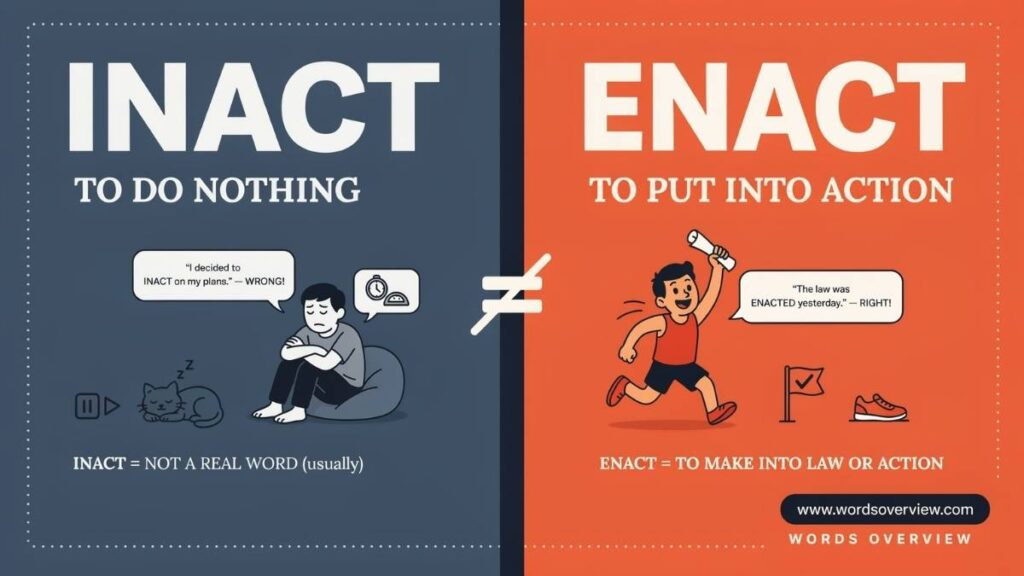
Ever stared at two almost-identical words and wondered whether English was playing a tiny spelling prank on you? If you’re stuck between inact or enact, you’re certainly not alone. These words look like they could be grammatical twins, but modern English gives them very different treatment. Enact is the standard word you’ll use when talking about making laws, establishing policies, or acting out a role. Meanwhile, inact has appeared in historical and specialized usage, but it isn’t the usual modern choice. So, before you let one missing letter turn your sentence into a grammar mystery, let’s explore inact or enact, their meanings, differences, examples and correct usage.
Inact or Enact: Quick Answer
If you’re asking is it inact or enact, choose enact in modern standard English.
Use enact when someone officially establishes a law, policy, regulation, or other measure:
The government plans to enact new environmental regulations.
You can also use it when people perform something:
The students will enact a scene from the play.
The spelling inact doesn’t normally replace enact in either modern use.
Correct Example
The legislature voted to enact the new consumer-protection law.
Here, enact means to officially establish the law.
Common Incorrect Example
The legislature voted to inact the new consumer-protection law.
In contemporary standard English, this sentence should use enact.
So, if you’re searching for inact or enact correct spelling, the answer for modern writing is enact.
Learn the difference between commonly confused words in English
Handle or Handel Correct Spelling, Meaning and Usage
Enact Meaning: What Does Enact Mean?
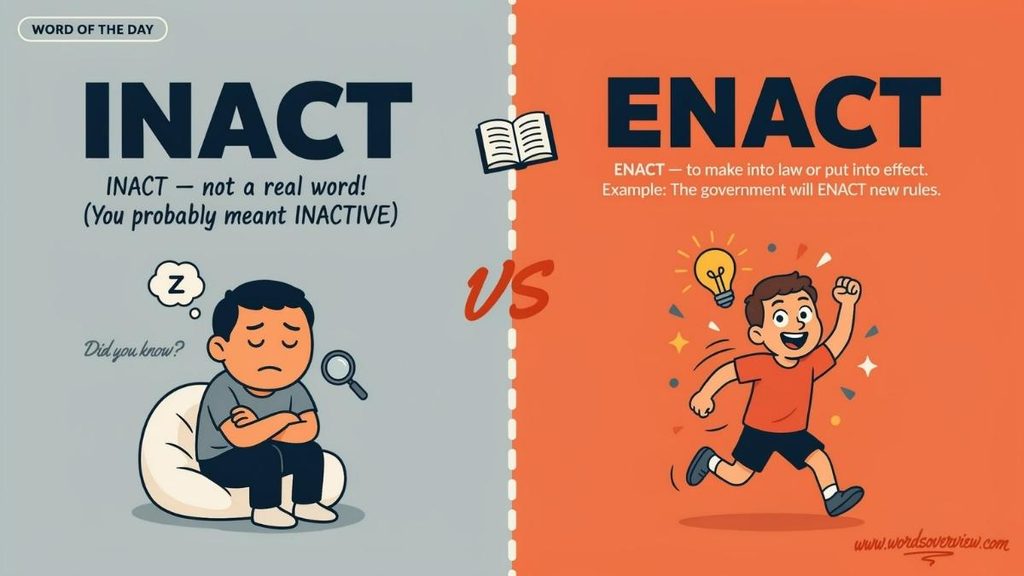
The simplest enact meaning is to officially establish something or to perform something.
The verb has two major modern uses. First, governments and other authorities can enact laws, policies, regulations and measures. Second, performers can enact scenes, roles, stories, or events.
Merriam-Webster defines enact in its legal sense as establishing something through a legal or authoritative act. It also gives the meaning “act out.”
Oxford Learner’s Dictionaries likewise identifies legal and performance-related uses of the verb.
Therefore, the meaning depends partly on context.
| Context | Meaning of enact | Example |
| Law | Officially establish | Congress enacted the bill. |
| Government | Put an official measure into force | The government enacted new regulations. |
| Policy | Formally introduce or establish | The company enacted a new policy. |
| Theater | Perform or act out | The actors enacted the final scene. |
| Education | Perform or recreate | Students enacted a historical event. |
Enact Definition in Simple English
An easy enact definition is:
Enact means to officially establish something or to perform something.
For example, a legislature can enact a law, while a theater group can enact a scene.
That makes the word more flexible than it might first appear. However, its legal use remains especially common in formal English.
Enact Meaning in Legal and Government Contexts
Legal and government writing uses enact frequently because the word describes formal action.
A government might discuss a proposed measure for months. Lawmakers might introduce a bill, debate it, amend it and vote on it. Once the relevant legal process establishes the measure as law, writers can describe the government or legislature as having enacted it.
The exact procedure varies from one legal system to another. Therefore, you shouldn’t treat every stage of lawmaking as identical.
A useful general sequence looks like this:
Proposal → Bill → Debate and approval → Enactment → Law
The verbs surrounding enact also carry different meanings.
Learn the difference between similar English words the easy way
Tomorrows or Tomorrow’s Difference, Meaning and Usage
| Verb | General meaning |
| introduce | Present a bill or proposal |
| debate | Discuss a proposed measure |
| approve | Formally accept something |
| pass | Successfully approve a bill through a legislative process |
| enact | Formally establish a law |
| implement | Put a law or policy into practical operation |
| repeal | Remove or abolish an existing law |
For example:
Lawmakers introduced the bill in March.
Later:
The legislature passed the bill after several amendments.
Then:
The government enacted the new law.
Afterward:
Officials implemented the law across the country.
These verbs describe related actions, but they don’t mean exactly the same thing.
Enact a Law, Legislation, Policy or Regulation
You’ll often see enact followed by words connected with official decisions.
Common combinations include:
- enact a law
- enact legislation
- enact a bill
- enact a statute
- enact regulations
- enact a policy
- enact a rule
- enact reforms
- enact measures
- enact a ban
- enact stricter laws
- enact new legislation
enact change
For example:
Congress enacted legislation to strengthen consumer protections.
The state enacted stricter regulations for food safety.
The organization enacted a new workplace policy.
These combinations work because enact carries the idea of formal establishment or implementation through authority.
However, be careful with enact legislation into law. Although people sometimes use that construction, enact legislation and enact a bill into law often communicate the intended idea more naturally.
Learn the difference between commonly confused words in English
To or Too What’s the Difference? Meaning And Examples
Enacted Meaning and Word Forms
Once you understand enact, its other grammatical forms become easy to recognize.
| Form | Example |
| enact | The legislature will enact the measure. |
| enacts | Congress enacts laws through the legislative process. |
| enacted | The government enacted the policy last year. |
| enacting | Officials are enacting new regulations. |
| enactment | The enactment of the law changed the rules. |
The past tense and past participle both use enacted.
The present participle uses enacting.
The related noun enactment refers to the act or process of enacting something. In legal contexts, it can also refer to a law that a legislative body has enacted.
Therefore, if you’re checking enact grammar, remember that enact normally functions as a transitive verb.
Enact in a Sentence
Looking at enact in a sentence can make its meaning much easier to understand.
The city council enacted a new parking ordinance.
Here, enacted means officially established.
The company enacted a new policy for remote employees.
In this context, the company formally established the policy.
The actors enacted the final scene with great energy.
Here, enacted means performed or acted out.
The students enacted a historical courtroom scene.
Again, the word refers to performance.
Notice how the object changes with the context. In legal writing, the object might be a law, bill, regulation, or policy. In performance writing, it might be a scene, role, story, or event.
Enact in a Performance Context
Legal documents don’t have a monopoly on enact.
The verb can also describe performing or acting out something. This use appears in theater, education, historical demonstrations, storytelling and similar contexts.
For example:
The students enacted a scene from the novel.
The actors enacted the final part of the play.
The performers enacted a historical event.
In these sentences, enact overlaps with words such as perform, portray, represent and act out.
However, the words aren’t always perfect substitutes.
You can say:
The actor portrayed the king.
You can also say:
The actor enacted the scene.
The first sentence focuses more directly on representing a character. The second emphasizes performing or acting out the scene.
Is Inact a Word?
Now we reach the part that causes most of the confusion: is inact a word?
The answer needs historical context.
Inact has appeared in English, but modern English doesn’t normally use it as the standard equivalent of enact.
Oxford identifies inact as a former form of enact. Its entry for enact traces the word to Late Middle English and notes the historical use of inact.
The Dictionary of the Scots Language also records inact in historical Scots legal usage, including senses connected with entering a statute into an official record and enacting or decreeing something.
So, if you’re asking is inact a real word, the answer isn’t simply “no.”
Historical evidence exists.
However, there’s an important difference between historical word existence and modern standard word usage.
A word can appear in historical documents without functioning as a normal choice in contemporary English. That’s exactly why inact needs careful treatment.
Learn the difference between tricky English words with easy explanations
Emasculate or Demasculate: Meaning, Difference and Usage
Inact Meaning: Why It Causes Confusion
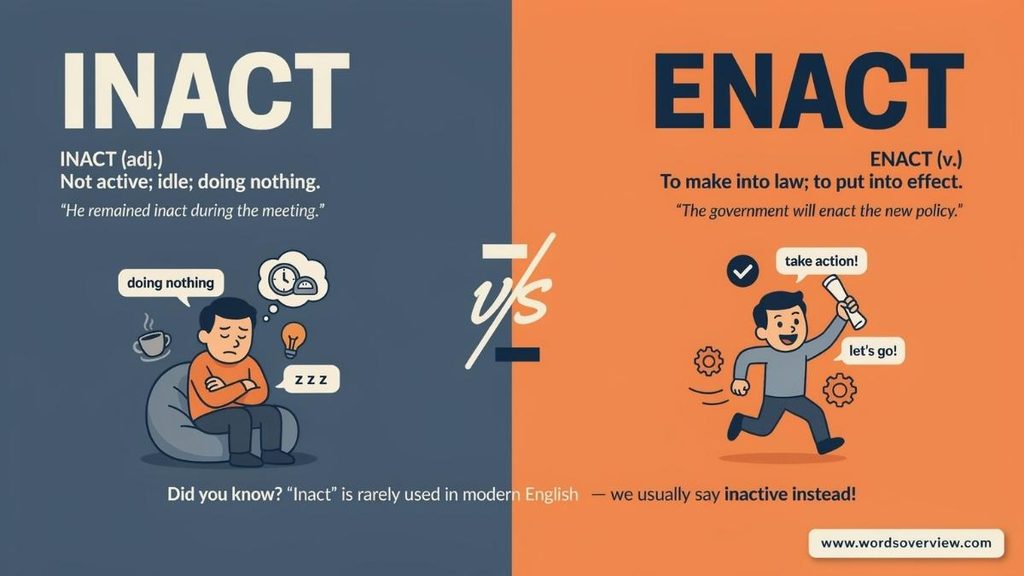
The inact meaning question becomes complicated because the spelling looks logical.
English speakers recognize act as a word. They also recognize in- as a prefix that appears in many English words. As a result, inact can look like a natural construction.
But English doesn’t create every word by following a perfectly predictable formula.
For example, inactive is a standard word. It means not active. That fact can tempt writers to assume that inact must exist as its verb counterpart.
Modern standard English doesn’t normally work that way.
Instead, use inactive when you need the adjective meaning “not active.”
The account is inactive.
The machine remained inactive.
The membership became inactive last year.
Therefore, inact shouldn’t replace inactive, either.
Is Inact the Opposite of Enact?
No.
At first glance, the pair looks almost too neat:
enact = make active
inact = make inactive
Unfortunately, that isn’t how modern English works.
Enact doesn’t mean “make active.” Its modern meanings concern establishing something officially or performing something.
If you want to describe something that isn’t operating, functioning, or participating, use inactive.
The account is inactive.
The system remained inactive during the maintenance period.
The machine became inactive after the power failure.
This distinction answers several common searches, including inact vs inactive, enact vs inactive and difference between enact and inactive.
Enact vs Inactive: What’s the Difference?
The difference becomes obvious when you compare their grammatical roles.
| Word | Part of speech | Meaning | Example |
| enact | Verb | Establish officially or perform | The legislature enacted the law. |
| inactive | Adjective | Not active or operating | The account is inactive. |
These words don’t compete for the same position in a sentence.
You can enact a policy.
You can describe a policy as inactive only in a context where that adjective makes semantic sense.
Therefore, don’t treat enact or inactive as spelling alternatives.
Learn the difference between more words people mix up
Allie or Ally Difference, Meaning, Spelling and Usage
Enact vs Intact: Another Common Confusion
Another word that can enter the spelling mix is intact.
Fortunately, its meaning is very different.
Intact means complete, whole, or undamaged.
The package arrived intact.
The original document remained intact.
The building survived the storm largely intact.
By contrast:
The government enacted a new law.
The two words may look similar at a glance, but they belong to completely different semantic fields.
| Word | Core meaning | Example |
| enact | Establish officially or perform | The legislature enacted the law. |
| intact | Whole or undamaged | The document remained intact. |
So, enact vs intact isn’t really a spelling-choice question. It’s a word-meaning question.
Enact vs Inact vs Inactive vs Intact
Putting all four words together provides the clearest picture.
| Word | Standard modern English? | Part of speech | Core meaning |
| enact | Yes | Verb | Establish officially or perform |
| inact | Historical/limited | Historical verb form | Historical uses related to enact |
| inactive | Yes | Adjective | Not active |
| intact | Yes | Adjective | Whole and undamaged |
Think of them as four separate words rather than four spelling variations.
Enact belongs to laws, policies, official measures and performances.
Inactive describes something that isn’t active.
Intact describes something that remains whole.
Inact mainly appears when historical or specialized usage matters.
That distinction also handles searches such as enact vs inact vs inactive and enact vs inact vs intact.
Learn the difference between everyday English mistakes
Maxxed or Maxed Which Spelling Is Correct?
Enact vs Act: What’s the Difference?
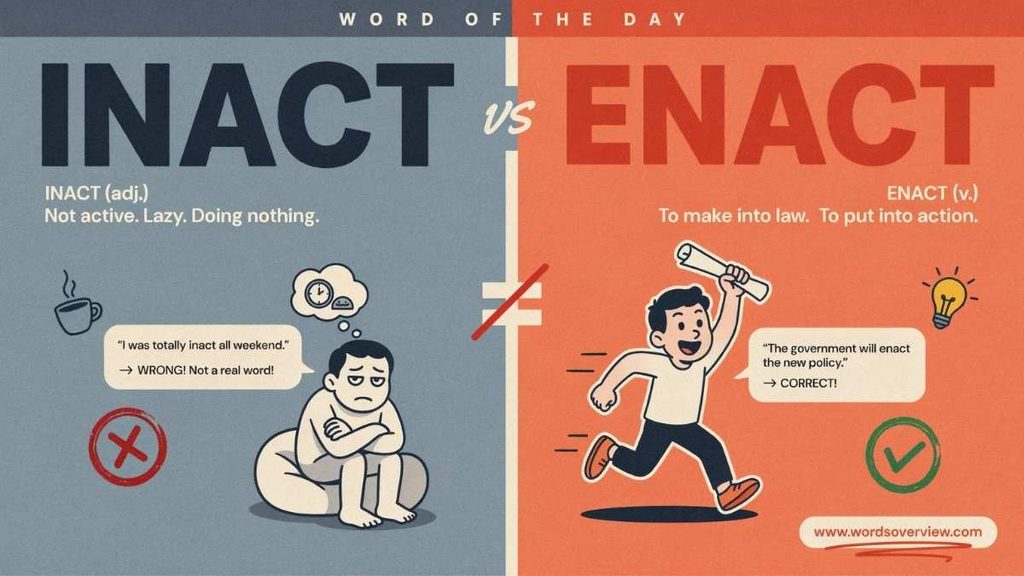
They share the same root, but they don’t always carry the same meaning.
Act has a broad range of meanings. It can mean to do something, behave in a certain way, or perform in theater.
Enact, however, adds a more specific sense. In legal contexts, it means to establish something officially. In performance contexts, it can mean to act something out.
Compare these sentences:
The legislature enacted a new law.
The actor acted in the play.
The students enacted a scene from the play.
The distinction becomes especially important in formal writing. If you mean that lawmakers formally established legislation, enact provides the precise word choice.
Enact Synonym: Which Words Can Replace It?
The best enact synonym depends on the meaning you need.
When enact refers to legislation or official measures, possible alternatives include:
legislate
pass
approve
establish
institute
authorize
make law
bring into force
However, these words don’t always mean exactly the same thing.
For instance, lawmakers can pass a bill, while a government or legislature can enact a law. Similarly, an authority can implement a policy after establishing it.
In performance contexts, useful alternatives include:
perform
act out
portray
represent
play
Again, context determines which synonym sounds most natural.
How to Use Enact in a Sentence
If you’re learning how to use enact in a sentence, pay attention to what follows the verb.
Enact commonly takes a direct object. In other words, something gets enacted.
You can:
- enact a law
- enact legislation
- enact a policy
- enact regulations
- enact a rule
- enact reforms
- enact measures
- enact change
- enact a ban
- enact a statute
For example:
The government enacted new regulations.
Here, new regulations function as the direct object.
Likewise:
The actors enacted the final scene.
Here, the final scene functions as the direct object.
This pattern makes enact grammar relatively straightforward once you understand its meaning.
Inact Grammar: Why You Should Be Careful
The phrase inact grammar can be misleading because modern English doesn’t treat inact as the ordinary counterpart of enact.
Therefore, don’t build a modern sentence around an invented definition such as “inact means to make inactive.”
If your intended meaning is “not active,” use inactive:
The account is inactive.
If your intended meaning is “officially establish,” use enact:
The government enacted the policy.
If your intended meaning is “complete and undamaged,” use intact:
The document remained intact.
This three-way distinction solves many of the spelling problems that lead people to search for inact or enact meaning.
Learn the difference between commonly misused words
Emerse or Immerse Which Spelling Is Correct?
Enact Examples in Different Contexts
The following inact or enact examples show why enact belongs in different types of modern sentences.
Government
The government enacted new environmental regulations.
Legislation
Lawmakers enacted legislation to protect consumers.
Policy
The company enacted a new workplace policy.
Reform
The administration enacted several reforms.
Rule
The organization enacted stricter safety rules.
Change
The school enacted changes to its attendance policy.
Performance
The actors enacted the final scene.
Education
The students enacted a historical courtroom scene.
Historical Recreation
The group enacted an important event from the region’s history.
These examples demonstrate both major modern meanings: official establishment and performance.
Common Mistakes With Inact or Enact
Using Inact Instead of Enact
❌ The government will inact a new law.
✅ The government will enact a new law.
The corrected sentence uses the established modern verb.
Confusing Inact With Inactive
❌ The account is inact.
✅ The account is inactive.
Inactive is the standard adjective.
Assuming Inact Means the Opposite of Enact
❌ The government enacted the policy and later inacted it.
The second verb doesn’t work as a standard modern opposite of enacted.
Depending on the situation, a government might repeal, revoke, rescind, or withdraw a measure.
Confusing Enact With Intact
❌ The document was enact after the inspection.
✅ The document remained intact after the inspection.
Here, the intended meaning concerns the document remaining whole or undamaged, so intact fits.
Learn the difference between basic English word mistakes
Lader or Ladder Which Spelling Is Correct?
Choosing a Word Only Because Its Spelling Looks Logical
English spelling often creates tempting patterns that don’t reflect actual usage.
That’s why dictionary evidence and context matter more than simply asking whether a spelling “looks right.”
Inact or Enact Spelling: How Do You Spell Enact?

If you’re searching how to spell enact, the answer is:
E-N-A-C-T
The standard modern spelling contains en-, not in-.
Therefore:
enact ✅
inact ❌ for the ordinary modern meanings of enact
The historical existence of inact doesn’t change the modern spelling rule.
Is Enact a Word?
Yes. Enact is a well-established English verb.
Merriam-Webster records its legal meaning of establishing something through an authoritative act and its performance-related meaning of acting something out. The dictionary also traces its first known use to the 15th century.
Oxford also lists enact as a modern English verb and provides legal, formal and performance-related meanings.
So, if you’re asking is enact a word in English, the answer is an emphatic yes.
Is Inact an English Word?
If you ask is inact an English word, the most accurate answer requires a historical qualification.
Historical sources document the form. Oxford specifically notes that inact formerly existed as a form of enact. Meanwhile, the Dictionary of the Scots Language records historical legal uses of inact.
However, modern standard English doesn’t normally use inact as the equivalent of enact.
Therefore, if you’re writing something today, don’t use inact merely because you’ve found historical evidence for it.
Historical usage tells us where a word has been. Modern usage tells us which word belongs in your sentence today.
Learn the difference between often confused words
Unattentive or Inattentive Which Word Is Correct?
British English vs American English
Fortunately, this particular spelling doesn’t create an American-versus-British English problem.
Both varieties use enact.
| Feature | American English | British English |
| Standard spelling | enact | enact |
| Past tense | enacted | enacted |
| -ing form | enacting | enacting |
| Legal usage | enact | enact |
| Performance usage | enact | enact |
Therefore, you don’t need to switch to inact when writing for a British audience.
The standard spelling remains enact.
How to Remember the Correct Spelling of Enact
A simple memory trick can make the spelling easier.
Think:
Enact = establish through action.
When lawmakers turn an approved measure into an official law, they enact it.
When actors turn a written scene into a performance, they can also enact it.
So remember two useful phrases:
Enact a law.
Enact a scene.
Then keep the other similar-looking words separate:
Inactive = not active.
Intact = whole and undamaged.
That gives you a practical way to distinguish the four forms without relying on complicated grammar rules.
Inact or Enact: Which Spelling Is Correct?
If you’re still asking inact or enact which is correct, the answer for modern standard English is straightforward:
Enact.
Use enact when you mean to establish a law, regulation, policy, rule, reform, or official measure. You can also use it when you mean to perform or act out something.
For example:
Congress enacted the new legislation.
The company enacted a stricter safety policy.
The students enacted a scene from the play.
By contrast, inact belongs mainly to historical or specialized discussions. It has genuine historical documentation, but that doesn’t make it the preferred modern spelling.
Learn the difference between confusing word pairs
Incurable or Uncurable? Meaning, Difference and Correct Usage
Practice Session: Inact or Enact
Fill in the Blanks
Choose the correct word or form of enact for each sentence.
- The government plans to ________ a new law to protect consumers.
- The parliament ________ stricter regulations last year.
- The new policy will be ________ next month.
- The actors ________ the final scene with great emotion.
- The bill was eventually ________ into law.
- The city council voted to ________ new parking regulations.
- The company decided to ________ a policy against workplace harassment.
- The government needs to ________ meaningful reforms.
- The students were asked to ________ a historical event in class.
- The legislature ________ the measure after several debates.
- The new regulations were ________ to improve public safety.
- The director asked the actors to ________ the scene again.
- The government wants to ________ legislation addressing environmental concerns.
- The parliament ________ a law requiring safer building standards.
- The phrase “be it ________” commonly appears in formal legal documents.
- The organization plans to ________ stricter workplace rules.
- The actors ________ the characters’ emotions convincingly.
- The proposed bill could become law once lawmakers ________ it.
- The government has ________ several measures to reduce pollution.
- The company hopes to ________ changes that will improve customer service.
- The historical drama ________ an important event from the past.
- Lawmakers worked together to ________ the proposed legislation.
- The new rules were ________ after receiving the required approval.
- Remember that ________ is the standard modern English spelling when you mean to establish something officially.
- If you mean “not active,” use inactive, not “________.”
Answer Session
- enact
- enacted
- enacted
- enact
- enacted
- enact
- enact
- enact
- enact
- enacted
- enacted
- enact
- enact
- enacted
- enacted
- enact
- enacted
- enact
- enacted
- enact
- enacted
- enact
- enacted
- enact
- inact
Here’s a trusted source for clear more words Comparison:
Grammar Update
Frequently Asked Questions About Inact or Enact
Is “inact” a word?
“Inact” has historical and specialized usage, but it isn’t the standard modern English word people normally use. In contemporary English, use “enact” when you mean to establish a law, policy, rule, or official measure. Historical sources record “inact” in older legal and Scots usage, so calling it completely nonexistent would be inaccurate.
Is “enact” the correct spelling?
Yes. “Enact” is the standard modern English spelling. You use it when you mean to establish something officially, especially a law, policy, rule, or regulation. It can also mean to perform or act out something, such as a role or scene.
What does “enact” mean?
“Enact” is a verb that commonly means to make something official through a formal or legal process. For example, a government may enact a new law or regulation. It can also mean to perform or act out a role, event, or scene.
What does “be it enacted” mean?
“Be it enacted” is a formal legal phrase that introduces a law or statute. It essentially means that the following provision is formally established as law by the relevant legislative authority. You’ll most often encounter this wording in legal documents, statutes and historical legislation.
What does it mean to enact a law?
To enact a law means to formally establish it as law through the required legislative process. Once the appropriate authority enacts legislation, the measure becomes legally established according to that jurisdiction’s rules.
What does it mean when a bill is enacted?
When a bill is enacted, it has completed the necessary legal process and has become law. A bill may pass through stages such as introduction, debate, approval and formal enactment before it takes legal effect, depending on the jurisdiction.
Who can enact a law?
The authority that can enact a law depends on the legal system and level of government involved. Generally, a legislature or other legally authorized lawmaking body enacts legislation. The exact process varies between countries, states, provinces and local governments.
Is it “inact” or “enact”?
In modern standard English, the correct choice is usually “enact.” Use “enact” for meanings such as formally establishing a law or policy or acting out a role. “Inact” may appear in historical or specialized sources, but it isn’t the standard modern equivalent.
What is the difference between “enact” and “inact”?
“Enact” is the standard modern English verb meaning to establish something officially or to perform something. “Inact” has historical or specialized usage but doesn’t function as the normal modern counterpart of “enact.” Therefore, if you’re writing contemporary English, “enact” is generally the word you want.
What is another word for “enact”?
Depending on the context, synonyms for “enact” include “establish,” “pass,” “legislate,” “implement,” “authorize,” “institute,” and “put into effect.” However, these words aren’t always interchangeable. For example, “pass” commonly describes legislative approval, while “implement” focuses on putting a law or policy into practice.
What is another word for “enact a law”?
Depending on the context, you can use phrases such as “pass a law,” “establish a law,” “legislate,” or “put a law into effect.” In formal legal writing, however, “enact a law” remains a precise and widely used expression.
What does it mean to enact change?
To enact change means to put a proposed change into official practice or make it effective through formal action. For example, a government might enact changes to its education policy, while an organization might enact changes to its workplace rules.
How do you use “enact” in a sentence?
You can use “enact” as a transitive verb followed by the law, policy, rule, measure, or action being established or performed. For example: “The government enacted new regulations to improve road safety.”
Can “enact” mean to perform a role?
Yes. “Enact” can mean to perform, act out, or portray something. For example, an actor may enact a character’s role in a dramatic production. The word can also describe acting out a scene, event, or behavior.
Conclusion: Inact or Enact
So, inact or enact? The spelling mystery doesn’t need a courtroom trial. In modern standard English, enact is the word you’ll usually want. Use it when a government formally establishes a law, when an organization introduces an official policy, or when someone performs or acts out a role or scene. Although inact appears in historical and specialized sources, it isn’t the standard modern equivalent of enact. Also, don’t confuse it with inactive, which means “not active.” Once you remember that enact contains act, the choice becomes much easier. English may enjoy throwing spelling curve balls, but this one is easy to catch.

Ethan AJS is an experienced blogger and language enthusiast at Words Overview, dedicated to making English easier to understand and use. He writes about grammar, vocabulary, spelling, word meanings and commonly confused words, turning tricky language questions into clear, practical insights. With a passion for effective communication, Ethan creates engaging, readerfocused content that helps readers write accurately, choose the right words and communicate with confidence.




