
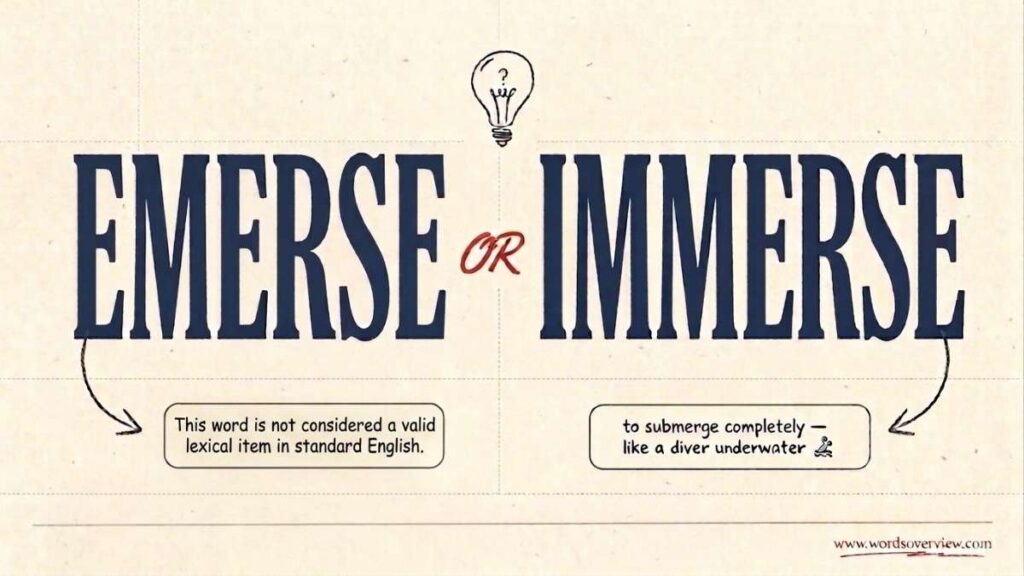
Emerse or immerse? If you’ve ever typed this word and paused, wondering whether the first syllable begins with e or i, you’re not alone. These look-alike words can turn a simple spelling choice into a surprisingly tricky grammar puzzle.
Here’s the short answer: immerse is the standard modern English verb you want when you mean “to put something into a liquid” or “to become deeply involved in something.” You can immerse a cloth in water or immerse yourself in a new language.
But there’s an interesting twist. Emerse does appear in historical and specialized usage, particularly in connection with aquatic plants. It isn’t, however, the normal modern spelling of the verb immerse.
Then there’s emerge, another similar-looking word that means to come out, appear, or become visible.
Let’s untangle these easily confused words so you can use the right one with confidence.
Emerse or Immerse: Quick Answer
If you’re asking, “Is emerse or immerse correct?”, the answer for ordinary modern English is immerse.
Use immerse when you mean:
- to put something into a liquid so that it becomes surrounded or covered
- to dip or plunge something into another substance
- to become deeply involved in an activity or subject
- to become completely absorbed in an experience
Correct Example
She immersed herself in Spanish literature to improve her language skills.
Here, immersed means that she became deeply involved in Spanish literature.
Another example:
Immerse the cloth completely in the dye.
In this sentence, immerse has its literal meaning. The cloth goes into the liquid and becomes surrounded by it.
Incorrect Example
❌ She emersed herself in Spanish literature.
If you mean that she became deeply involved in literature, immersed is the correct choice.
The Simple Rule
Immerse = go into something deeply.
That “something” can be water, another liquid, a subject, a culture, a book, or an activity.
Learn the difference between similar English words
Handle or Handel Correct Spelling, Meaning and Usage
What Does “Immerse” Mean?
The immerse meaning becomes easier to understand when you think about the idea of going deeply into something.
Immerse has two main modern uses: a literal physical meaning and a figurative meaning.
Immerse as a Physical Action
In its literal sense, immerse means to put something into a liquid or surrounding substance, especially until it is covered.
For example:
- Immerse the seeds in water for several hours.
- The scientist immersed the sample in a solution.
- Immerse the fabric completely in the dye.
- The instructions say to immerse the object in warm water.
The words dip, plunge, and submerge can sometimes have similar meanings, but they aren’t always interchangeable.
For example, if you dip your hand into water, you may place only part of your hand beneath the surface. To submerge something usually means to put it beneath the surface. Immerse emphasizes placing something into a surrounding substance.
Immerse as Deep Involvement
The figurative meaning of immerse is equally common.
When you immerse yourself in something, you become deeply involved in it. You give it sustained attention instead of merely giving it a quick look.
For example:
He immersed himself in the study of ancient history.
He didn’t simply read one article about ancient history. He became deeply engaged with the subject.
You can immerse yourself in:
- a language
- a culture
- a book
- a hobby
- your studies
- a research project
- music
- art
- work
- a new environment
For example:
Traveling allowed her to immerse herself in the local culture.
Here, immerse has nothing to do with physically going underwater. It describes becoming deeply involved in an experience.
Immerse Definition and Examples
| Meaning | Explanation | Example |
|---|---|---|
| Physical | Put something into a liquid or surrounding substance | Immerse the cloth in water. |
| Physical | Surround something with a liquid | The object was immersed in oil. |
| Figurative | Become deeply involved in something | She immersed herself in her studies. |
| Figurative | Become completely absorbed in an experience | He immersed himself in the local culture. |
The central idea remains the same: deep involvement.
Learn the difference between often confused words
To or Too What’s the Difference? Meaning And Examples
What Does “Emerse” Mean?
This is where the spelling question gets more interesting.
If you’re asking “Is emerse a word?”, the most accurate answer is yes, but it isn’t the standard everyday verb you should use instead of immerse.
Historical English records include emerse as an obsolete form of immerse. At the same time, modern specialized sources use emerse in aquatic-plant contexts.
In other words, emerse isn’t simply meaningless. However, its limited usage doesn’t make it the correct replacement for immerse in ordinary English.
Emerse in Specialized Usage
In aquatic-plant terminology, emerse can describe plants or plant growth occurring above the water surface.
For example:
The aquarium plants were cultivated in emerse conditions.
In this specialized context, the plants are grown above the water rather than fully submerged.
A related and more established form is emersed:
The emersed leaves developed a different shape from the submerged leaves.
This distinction is particularly useful if you’re reading about aquarium plants, aquatic botany, or specialized plant cultivation.
Think of it this way:
Immerse → into the water
Emersed → above the water
That simple contrast makes the unusual spelling easier to remember.
Emerse Definition and Examples
| Term | Typical Context | Meaning |
|---|---|---|
| immerse | General English | Put into something or become deeply involved |
| emerse | Historical/specialized usage | Rare form; may appear in aquatic-plant terminology |
| emersed | Botany/aquatic plants | Standing or growing above a liquid surface |
| emerge | General English | Come out, appear, or become visible |
So, if you’re writing about studying, reading, culture, work, hobbies, or becoming deeply involved, immerse is almost certainly the word you need.
Learn the difference between everyday English mistakes:
Unattentive or Inattentive Which Word Is Correct?
Emerse Or Immerse: What’s the Difference?
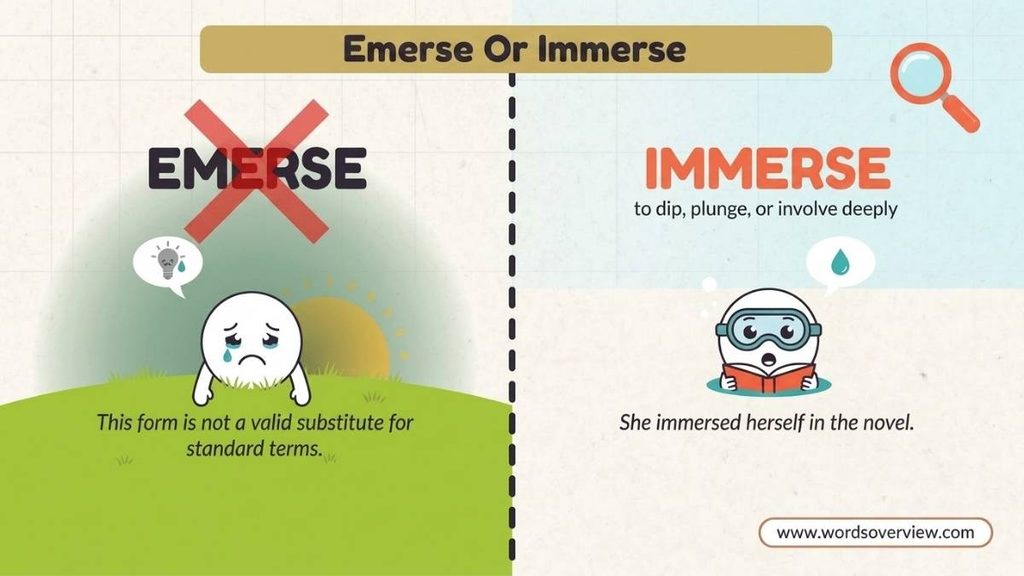
The emerse or immerse question isn’t a matter of American versus British spelling. The two forms have different histories and uses.
Immerse is the common modern English verb. It means to put something into a surrounding substance or to become deeply involved in something.
Emerse has a much narrower profile. It has historical usage as an obsolete form of immerse and appears in specialized contexts involving aquatic plants.
Learn the difference between often confused words
Inact or Enact: Which Spelling Is Correct?
Emerse or Immerse Spelling Comparison
| Word | Standard Everyday English? | Main Meaning |
|---|---|---|
| Immerse | Yes | Put into liquid or become deeply involved |
| Emerse | Rare/specialized | Historical form; specialized aquatic-plant usage |
| Emersed | Specialized | Standing or growing above a liquid surface |
| Emerge | Yes | Come out, appear, or become visible |
The practical lesson is simple:
Don’t use emerse when you mean the ordinary modern verb immerse.
Immerse vs. Emerge: What’s the Difference?
The immerse vs. emerge distinction is one of the easiest ways to avoid this spelling confusion.
Immerse
Immerse means to put something into a surrounding substance or to become deeply involved in something.
The child immersed the toy in the water.
She immersed herself in the project.
Emerge
Emerge means to come out of something, appear, or become visible or known.
The child emerged from the water.
New evidence emerged during the investigation.
Notice the directional contrast:
Immerse → in
Emerge → out
That makes a handy memory trick.
Immerse Or Emerge Comparison
| Word | Core Idea | Example |
|---|---|---|
| Immerse | Go into or become deeply involved | She immersed herself in the project. |
| Emerge | Come out, appear, or become known | New details emerged during the investigation. |
| Emersed | Above a liquid surface | The emersed leaves grew above the water. |
Consider this mini-story:
The scientist immersed the sample in water. Later, the sample emerged from the container. Nearby, an emersed aquatic plant grew above the water surface.
Three similar-looking terms. Three different jobs.
That’s why context matters more than visual similarity.
Learn the difference between everyday English mistakes
Tomorrows or Tomorrow’s Difference, Meaning and Usage
Why Do People Confuse “Emerse” or “Immerse”?
The spelling confusion isn’t mysterious. Several factors make these words easy to mix up.
They Look Almost Identical
Compare the words:
- immerse
- emerse
- emerge
Only a few letters separate them. Yet their meanings are quite different.
That’s a classic spelling trap: familiar letters arranged in unfamiliar ways.
Pronunciation Can Cause Confusion
Immerse is pronounced roughly like ih-MERS. The first syllable is short and unstressed, so someone who has heard the word without seeing it written may incorrectly remember an initial e.
This is a common reason people write the word based on how they think it sounds.
“Emerge” Is a Familiar Word
There’s another trap: emerge is a common English word.
It means to come out, appear, become visible, or become known.
The swimmer emerged from the water.
That sentence describes movement out of the water.
By contrast:
The swimmer immersed himself in the water.
That describes going into the water.
The two verbs can therefore describe opposite directions, which makes them easy to confuse when you’re writing quickly.
Is “Emerse” the British Spelling of “Immerse”?
No.
This is an important misconception to clear up.
Immerse is the standard spelling in both American English and British English.
For example:
American English:
She immersed herself in the course.
British English:
She immersed herself in the course.
The spelling doesn’t change.
There can be pronunciation differences between British and American English, but emerse isn’t the British spelling of immerse.
So whether you’re writing for readers in the United States, the United Kingdom, or an international audience, use immerse when you mean “to put into” or “become deeply involved in.”
Learn the difference between basic English word mistakes
Emasculate or Demasculate: Meaning, Difference and Usage
How to Use “Immerse” Correctly
Learning the definition is useful, but knowing the sentence patterns makes correct usage much easier.
One of the most common structures is:
immerse + object + in + something
For example:
Immerse the cloth in warm water.
Here, the cloth is the object, while warm water is the surrounding substance.
Another common structure is:
immerse yourself in + noun
For example:
She immersed herself in the local culture.
You can also use the passive form:
The samples were immersed in a chemical solution.
Common Sentence Structures
| Structure | Example |
|---|---|
| immerse + object + in | Immerse the seeds in water. |
| immerse yourself in | Immerse yourself in the language. |
| be immersed in | The equipment was immersed in liquid. |
| become immersed in | He became immersed in the novel. |
Because immerse frequently appears with in, this pattern can serve as another useful memory aid.
Immerse in a Sentence Natural Examples
If you’re looking for immerse in a sentence examples, here are several natural uses.
Literal Examples
Immerse the vegetables in boiling water for two minutes.
The researcher immersed the sample in a clear liquid.
The instructions say to immerse the device only up to the marked line.
Learning Examples
She immersed herself in French to improve her conversational skills.
The students immersed themselves in the history of the region.
Work Examples
He immersed himself in the project and finished it ahead of schedule.
The novelist immersed herself in research before writing the book.
Culture Examples
Traveling allowed him to immerse himself in the local culture.
She spent six months immersed in Japanese language and literature.
Literature Examples
I became so immersed in the novel that I lost track of time.
These examples show why immerse works so well as a figurative verb. You don’t need actual water. You can be deeply engaged, absorbed, or fully involved in something.
Emerse in a Sentence: When Is It Appropriate?
The phrase emerse in a sentence requires some caution because most readers will interpret it as a possible misspelling of immerse.
In specialized aquatic or botanical contexts, however, you may encounter emerse to describe growth above water.
For example:
The aquarium plants were cultivated in emerse conditions.
A related form, emersed, is also used:
The emersed leaves developed a different shape from the submerged leaves.
The important point is context.
Don’t take a specialized term and insert it into an ordinary sentence where readers expect standard English.
For example:
❌ She emersed herself in literature.
If you mean that she became deeply involved in literature, write:
✅ She immersed herself in literature.
Is “Immerse” a Word?
Yes. Immerse is an established standard English verb.
Major dictionaries recognize it with both literal and figurative meanings. Its literal sense involves placing something into a surrounding substance, especially a liquid. Its figurative sense involves becoming deeply absorbed or involved in something.
The standard forms include:
- immerse
- immerses
- immersed
- immersing
For example:
I want to immerse myself in the course.
She immerses herself in her work.
He immersed himself in research.
They are immersing themselves in the language.
Learn the difference between confusing English words step by step:
Immerse Spelling and Verb Forms
The spelling immerse remains consistent across its main verb forms, although the ending changes when suffixes are added.
| Verb Form | Correct Spelling | Example |
|---|---|---|
| Base form | immerse | I want to immerse myself in the course. |
| Third-person singular | immerses | She immerses herself in her work. |
| Past tense | immersed | He immersed himself in research. |
| Past participle | immersed | She was immersed in the book. |
| Present participle | immersing | They are immersing themselves in the language. |
A common spelling mistake is imerse, with only one m.
Remember:
I-M-M-E-R-S-E
There are two m’s.
Learn the difference between confusing more English words
Lader or Ladder Which Spelling Is Correct?
Immerse Synonyms: What Words Can Replace It?
The best immerse synonym depends on the meaning you’re trying to express.
When You Mean Physical Immersion
Possible synonyms include:
- submerge
- dip
- plunge
- sink
- dunk
For example:
Immerse the fabric in water.
can become:
Submerge the fabric in water.
The meanings are close, although the exact implication can differ.
When You Mean Deep Involvement
Possible synonyms include:
- absorb
- engage
- involve
- engross
- occupy
- devote oneself to
For example:
She immersed herself in the research.
could become:
She became deeply involved in the research.
The key is to choose a synonym that matches the intended meaning.
What Is an Antonym of “Immerse”?
The opposite of immerse depends on which meaning you’re using.
For the figurative meaning, possible opposites include:
- disengage
- withdraw
- detach
- distance oneself
- remain uninvolved
For the physical meaning, the opposite idea could be expressed with phrases such as remove from, take out of, or lift out of a liquid.
Emerge can describe the opposite physical direction in certain situations, but it isn’t a universal antonym of immerse. Emerge has broader meanings of its own.
When Should You Use “Immerse”?
Use immerse when you want to describe deep physical or figurative involvement.
Choose immerse when:
- something is placed into a liquid
- something is surrounded or covered by a substance
- someone becomes deeply involved in a subject
- someone becomes absorbed in an activity
- someone gives sustained attention to a culture or environment
Examples
Immerse the fabric in the solution.
She immersed herself in her studies.
He immersed himself in the local culture.
The equipment was immersed in water.
I became immersed in the novel.
If the meaning is “go deeply into”, immerse is usually the right choice.
When Should You Use “Emerse”?
For ordinary English writing, you generally shouldn’t use emerse as a replacement for immerse.
You may encounter emerse in specialized contexts, particularly discussions of aquatic plants and growth above water. It also has historical usage as an obsolete form of immerse.
So if your sentence is about:
- learning
- studying
- reading
- culture
- work
- hobbies
- becoming involved
- putting something into liquid
use immerse.
If you’re reading scientific, botanical, or aquarium literature and encounter emerse, check the context before assuming it’s simply a spelling error.
A Quick Case Study: How Context Changes the Word
Imagine you’re writing about an aquarium.
You write:
The plants were grown in emerse conditions.
That can make sense in specialized aquarium terminology because the plants are being grown above the water rather than fully submerged.
Now imagine you’re writing about a student:
❌ The student emersed herself in biology.
That doesn’t work in standard modern English.
The correct sentence is:
✅ The student immersed herself in biology.
The spelling changed by only one letter, but the meaning and context changed completely.
That’s why blindly memorizing “one spelling is always right” isn’t quite enough. Word choice depends on meaning and context.
Learn the difference between commonly confused words in English
Allie or Ally Difference, Meaning, Spelling and Usage
Emerse or Immerse: A Simple Decision Guide
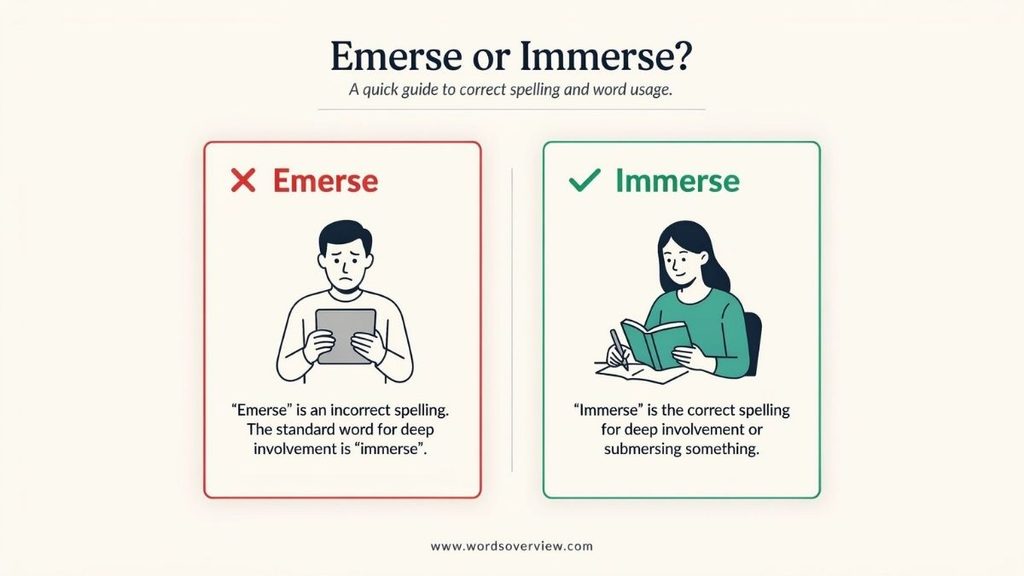
When you’re unsure, ask yourself what the sentence is trying to say.
Are you talking about putting something into a liquid?
→ Use immerse.
Are you talking about becoming deeply involved in something?
→ Use immerse.
Are you talking about something coming out or becoming visible?
→ Use emerge.
Are you reading about aquatic plants growing above the water?
→ You may encounter emerse or emersed as specialized terminology.
This quick test handles most everyday situations.
Emerse or Immerse in a Sentence: Side-by-Side Examples
| Meaning | Correct Sentence |
|---|---|
| Put something into water | Immerse the object in water. |
| Become deeply involved | She immersed herself in the project. |
| Become absorbed | He was immersed in the book. |
| Come out of water | The diver emerged from the water. |
| Become visible | New evidence emerged during the investigation. |
| Grow above water | The plant developed emersed leaves. |
The table highlights an important point: spelling alone doesn’t tell you which word to choose. Meaning and context do.
How to Remember the Correct Spelling of “Immerse”
If you repeatedly forget whether to write emerse or immerse, use a simple association.
Think “In”
Immerse begins with im-, which can remind you of in.
Immerse → in
You’re putting something in something else.
Immerse the brush in water.
The figurative version works too:
Immerse yourself in your studies.
The word also commonly appears with in, which reinforces the connection.
Think “Emerge = Exit”
For emerge, think about movement outward.
Emerge → come out
A swimmer emerges from the water.
A diver emerges from the pool.
A fact emerges during an investigation.
So your mental shortcut is:
Immerse = go in.
Emerge = come out.
Emersed = above the water.
Learn the difference between everyday English mistakes:
Incurable or Uncurable? Meaning, Difference and Correct Usage
Common Mistakes With “Emerse or Immerse”
Using “Emerse” Instead of “Immerse”
❌ She emersed herself in the book.
✅ She immersed herself in the book.
When you mean becoming deeply involved, use immerse.
Confusing “Immerse” With “Emerge”
❌ The swimmer immersed from the water.
✅ The swimmer emerged from the water.
The swimmer comes out, so emerged is correct.
Writing “Imerse”
Some writers accidentally drop one of the two m’s.
❌ imerse
✅ immerse
Remember: I + MM + ERSE.
Assuming “Emerse” Is British English
It isn’t.
British English uses immerse, just as American English does.
Treating “Emerse” as a Normal Synonym
Even though emerse has historical and specialized uses, that doesn’t make it an appropriate everyday replacement for immerse.
A word can exist somewhere in the language without being the right word for your sentence.
That’s an important lesson in English vocabulary: existence doesn’t always equal everyday usability.
Final Comparison: Emerse vs. Immerse vs. Emerge
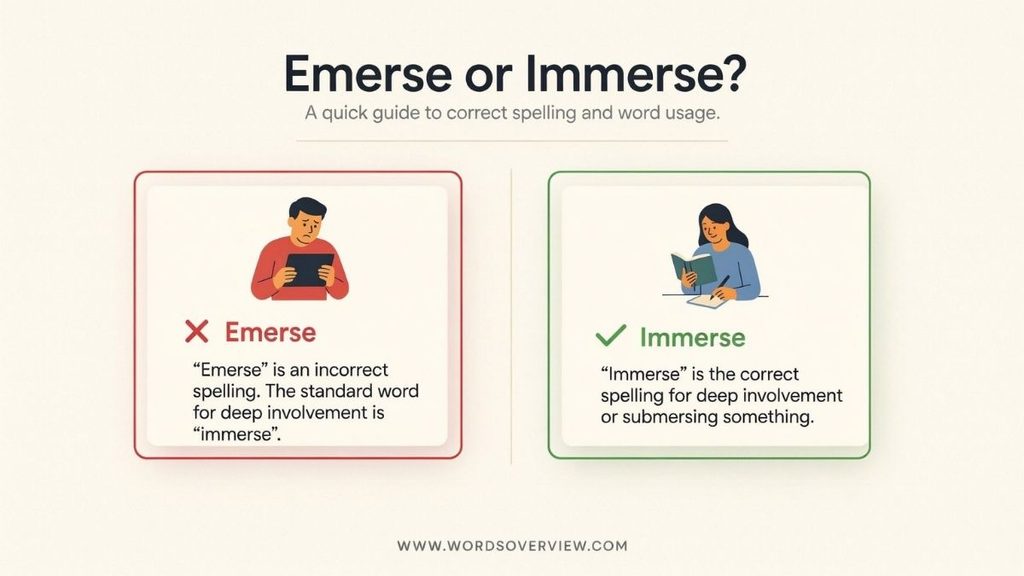
| Immerse | Go into or become deeply involved | Common | Immerse yourself in the language. |
| Emerge | Come out or become visible | Common | The diver emerged from the water. |
| Emersed | Above a water or liquid surface | Specialized | The emersed leaves grew above the water. |
| Emerse | Historical or specialized form | Rare | May appear in historical or aquatic-plant contexts |
The easiest way to remember the distinction is through direction:
Immerse → in
Emerge → out
Emersed → above
Here’s a trusted source for clear more words Comparison:
Grammar Update
Practice Session: Emerse or Immerse
Test yourself by choosing the correct word for each sentence.
Choose from: immerse, immersed, immersing, emerge, emerged, emersed, immersion, immersive, emersion.
Fill in the Blanks
- To learn a language quickly, you should ______ yourself in everyday conversations.
- The instructions say to ______ the cloth completely in warm water.
- She became deeply ______ in her research project.
- The diver ______ from the water after two minutes.
- The students enjoyed an ______ learning experience at the science museum.
- Language ______ can help learners improve their fluency.
- The scientist carefully ______ the sample in a chemical solution.
- The plant developed ______ leaves that grew above the water surface.
- After months of study, he was completely ______ in history books.
- The submarine slowly ______ from beneath the ocean surface.
- Virtual reality can create an ______ environment for users.
- Full ______ in a culture can improve communication skills.
- The chef asked us to ______ the vegetables in boiling water.
- New evidence ______ during the investigation.
- Aquarium plants may grow in ______ conditions above the water.
- The writer ______ herself in historical documents before starting the novel.
- The act of coming out from something can be described as ______.
- We should ______ ourselves in local traditions while traveling.
- The object remained ______ in water for several hours.
- The museum offers an ______ art experience with interactive displays.
- The aquatic plant had ______ stems extending above the surface.
- The child was completely ______ in the adventure story.
- Students can benefit from language ______ programs.
- The swimmer ______ from the lake and walked to the shore.
- To understand a culture, you must ______ yourself in its customs and traditions.
Answer Key
| No. | Answer |
|---|---|
| 1 | immerse |
| 2 | immerse |
| 3 | immersed |
| 4 | emerged |
| 5 | immersive |
| 6 | immersion |
| 7 | immersed |
| 8 | emersed |
| 9 | immersed |
| 10 | emerged |
| 11 | immersive |
| 12 | immersion |
| 13 | immerse |
| 14 | emerged |
| 15 | emerse |
| 16 | immersed |
| 17 | emersion |
| 18 | immerse |
| 19 | immersed |
| 20 | immersive |
| 21 | emersed |
| 22 | immersed |
| 23 | immersion |
| 24 | emerged |
| 25 | immerse |
Frequently Asked Questions About Emerse or Immerse
What does “immerse” mean?
Immerse means to put something completely into a liquid or to become deeply involved in an activity, subject, culture, or experience.
What does “immersion” mean?
Immersion is the act or experience of becoming completely involved in something. It can refer to physical immersion in water or deep involvement in a language, culture, subject, or activity.
What does “emerse” mean?
Emerse is not the standard modern spelling of the everyday verb immerse. It appears in historical usage and in some specialized aquatic-plant contexts. For normal English writing, use immerse.
What is the difference between “immersed” and “emersed”?
Immersed means completely covered by something or deeply involved in something. Emersed describes something standing or growing above a surrounding surface, particularly water, and is commonly associated with aquatic-plant terminology.
What is an example of immersion?
Spending several weeks in a Spanish-speaking community and communicating in Spanish every day is an example of language immersion. The learner actively uses and experiences the language rather than studying it only from a textbook.
What is another word for “immersion”?
Depending on the context, synonyms for immersion include involvement, absorption, engagement, participation, and submersion.
How do you use “immersion” in a sentence?
You can use immersion to describe deep involvement in an activity or complete placement in a liquid.
Language immersion helped her become more confident in everyday conversations.
What are immersion activities?
Immersion activities are experiences that surround you with a subject, language, culture, or environment. Examples include conversations in a target language, cultural exchanges, hands-on projects, role-playing, and living in a community where the language is spoken.
What is another word for “immersed”?
Depending on the context, immersed can mean submerged, absorbed, involved, engaged, engrossed, or deeply involved.
What is the difference between “immersion” and “emersion”?
Immersion refers to going into or being surrounded by something, especially a liquid. Emersion refers to the act of emerging or coming out from something.
A simple way to remember the distinction is:
Immersion = going in.
Emersion = coming out.
What does “emersion” mean?
Emersion means the act of emerging or coming out from something. It is related to emerge, which means to come out, become visible, or become known.
What does “emerce” mean?
Emerce isn’t a standard modern English word. If you’ve encountered it while looking for immerse, emerse, or emerge, it is likely a spelling error or a context-specific term.
What is another word for “immerse”?
Depending on the meaning, synonyms for immerse include submerge, plunge, dip, involve, engage, absorb, and engross.
What is the opposite of “immersion”?
The opposite depends on the context. For physical immersion, the contrasting idea may be emersion, emergence, or removal from a liquid. For figurative immersion, possible opposites include detachment, disengagement, withdrawal, and distraction.
What does “immersive” mean in simple terms?
Immersive means something that makes you feel deeply involved in an experience or environment. An immersive video game, for example, can make you feel as though you’re part of the game rather than simply watching it.
What is an immersive experience?
An immersive experience is one that captures your attention so completely that you feel deeply involved in it. Virtual reality, interactive museums, simulations, games, and cultural experiences can all be immersive.
What is full immersion?
Full immersion means becoming completely involved in an experience, activity, language, environment, or subject. In language learning, for example, full immersion may involve using the target language throughout daily life.
What is the difference between “immerse” and “emerge”?
Immerse means to put something into a substance or become deeply involved in something. Emerge means to come out, appear, or become visible.
Immerse: She immersed herself in her studies.
Emerge: The swimmer emerged from the water.
Remember: immerse = go in; emerge = come out.
Is “immerse” the correct spelling?
Yes. Immerse is the standard spelling when you mean “to put into a liquid” or “to become deeply involved in something.”
✅ He immersed himself in the project.
❌ He emersed himself in the project.
How do you use “immerse” in a sentence?
Use immerse when describing complete involvement or placing something into a liquid.
She immersed herself in learning French.
Immerse the cloth in warm water.
He became immersed in the novel.
The researcher immersed the sample in the solution.
Is “emerse” the same as “emerge”?
No. Emerse and emerge aren’t interchangeable.
Emerge is a standard English verb meaning to come out, appear, or become known. Emerse has limited historical or specialized usage and shouldn’t replace emerge in ordinary writing.
When should I use “immerse”?
Use immerse when you mean to put something into a liquid or to become deeply involved in something.
Try to immerse yourself in the language by speaking it every day.
Is “emerse” commonly used in English?
No. Emerse isn’t commonly used as an everyday English verb. Standard English uses immerse for the meanings “submerge” and “become deeply involved.” You may encounter emerse or related emersed terminology in historical or specialized botanical contexts.
Conclusion: Emerse or Immerse?
So, emerse or immerse? For standard modern English, the answer is immerse.
Use immerse when you put something into water or another liquid. Use it when you become deeply involved in a subject, activity, culture, book, or experience. The spelling is the same in both American and British English.
Emerse isn’t simply a random spelling mistake, either. It has historical usage as an obsolete form of immerse and appears in specialized aquatic-plant terminology. That’s why saying it is “never a word” would be too broad. It just isn’t the everyday verb you want when you mean “submerge” or “become deeply involved.”
And don’t forget emerge. That’s the standard word for coming out, appearing, or becoming known.
When these similar-looking words start swimming around in your head, remember the simplest rule:
Immerse means go in. Emerge means come out.
And if emersed appears in a discussion about aquatic plants, think above the water.
One little I can keep your sentence from taking an unexpected dive into the deep end of English.

Ethan AJS is an experienced blogger and language enthusiast at Words Overview, dedicated to making English easier to understand and use. He writes about grammar, vocabulary, spelling, word meanings and commonly confused words, turning tricky language questions into clear, practical insights. With a passion for effective communication, Ethan creates engaging, readerfocused content that helps readers write accurately, choose the right words and communicate with confidence.




