
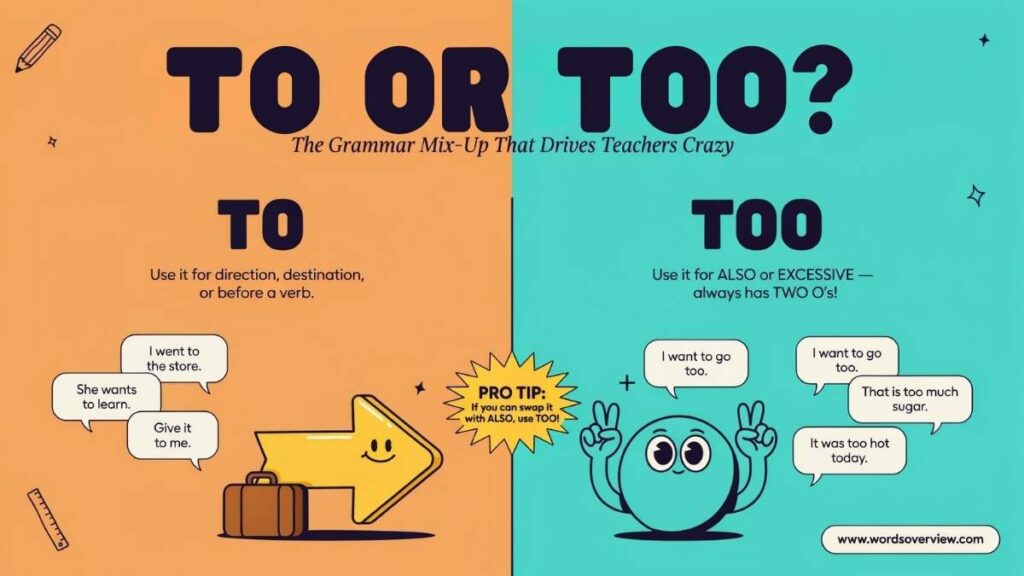
Ever stared at to or too and wondered why English decided one tiny extra “o” should cause so much trouble? You’re not alone. These commonly confused words sound alike, yet they perform completely different jobs in a sentence. Choose the wrong one, and your message can stumble from polished English into an accidental grammar comedy. To usually shows direction, a recipient, or introduces an infinitive, while too means “also” or “more than necessary.” The good news? You don’t need a grammar encyclopedia to master them. With a few clear rules, practical examples, and one simple memory trick, you’ll know exactly which word belongs where.
To or Too: Quick Answer
The easiest way to understand to vs too is to look at what each word does in a sentence.
| Word | Main grammatical role | Common meaning | Example |
| to | Preposition or infinitive marker | Direction, relationship, recipient, or infinitive | I want to leave. |
| too | Adverb | Also or excessively | I want to leave too. |
| two | Number | The number 2 | I have two books. |
For example:
We went to the store.
I want to learn English.
She came too.
This bag is too heavy.
I have two brothers.
Notice how the words sound alike in many varieties of English. However, their meanings and grammatical functions differ.
Therefore, when you’re wondering which is correct, to or too, don’t rely on pronunciation. Instead, examine the role the word plays in the sentence.
What Does “To” Mean?
The meaning of to depends on its grammatical role. Most often, to works as a preposition or as an infinitive marker.
As a preposition, to can express direction, movement, a destination, a recipient, or a relationship. As an infinitive marker, it appears before the base form of a verb.
“To” as a Preposition
As a preposition, to often shows movement toward a person, place, or destination.
For example:
We walked to school.
She drove to the airport.
He went to the office.
They traveled to New York.
Please send the package to my house.
In the sentence “We walked to school,” to connects the action of walking with the destination, school.
Similarly, in “She drove to the airport,” the airport represents the destination. Therefore, to establishes the direction of the movement.
“To” Shows Direction or Movement
When something moves toward a particular place, to frequently identifies where that movement ends.
Consider these common expressions:
go to work
come to my house
walk to the park
drive to the beach
travel to another city
return to school
For example:
The children ran to the playground.
The playground represents the destination, so to is the correct choice.
However, don’t assume that every location-related phrase requires to. English contains exceptions and fixed expressions, such as “at home” and “go home,” where speakers don’t normally add to before home.
“To” Shows a Recipient
To can also identify the person who receives something.
For example:
Give the book to Maria.
Send the email to your manager.
She handed the keys to her brother.
Please explain the problem to me.
He gave the gift to his friend.
Here, to connects the action with its recipient.
For instance, in “Give the phone to me,” me identifies the person who receives the phone. Consequently, to doesn’t mean “also” or “excessively” in this context.
Learn the difference between similar English words
Handle or Handel Correct Spelling, Meaning and Usage
“To” as an Infinitive Marker
Another major use of to appears in the infinitive construction:
to + base verb
Examples include:
- to eat
- to sleep
- to study
- to learn
- to write
- to understand
- to improve
Consider:
I want to learn English.
Here, to introduces the base verb learn. Together, “to learn” forms an infinitive phrase.
Likewise:
She wants to travel.
We need to study.
They decided to wait.
He hopes to win.
I would like to help.
This pattern appears constantly in everyday English. As a result, recognizing a verb immediately after to can help you choose the correct spelling.
Learn the difference between commonly confused words in English
Unattentive or Inattentive Which Word Is Correct?
Common “To + Verb” Patterns
| Expression | Example |
| want to | I want to leave. |
| need to | We need to talk. |
| like to | I like to read. |
| have to | You have to finish it. |
| used to | I used to live there. |
| going to | We’re going to eat. |
| try to | Try to relax. |
| plan to | They plan to travel. |
| hope to | I hope to see you. |
| would like to | I would like to order. |
Consequently, phrases such as “want to” and “need to” should immediately make you think of the infinitive pattern.
I want to go home.
Not:
I want too go home.
The second sentence uses too incorrectly because the writer needs the infinitive marker to before go.
What Does “Too” Mean?
Unlike to, too has two major everyday meanings.
First, it can mean “also” or “as well.” Second, it can indicate an excessive degree, meaning that something exceeds a desirable, suitable, or manageable level.
Understanding these two meanings gives you the foundation for the correct use of too.
“Too” Meaning “Also”
When too means “also,” it adds another person, thing, or action.
For example:
I like pizza too.
She speaks French too.
He wants to come too.
We watched the movie too.
They were invited too.
Consider:
I want to come too.
This means:
I also want to come.
Therefore, if you can replace too with also without changing the basic meaning, too is probably the correct choice.
This use appears frequently in everyday expressions such as:
Me too.
You too.
I think so too.
I want one too.
She knows too.
“Too” Meaning “Excessively”
The second major use of too describes an excessive degree.
For example:
- too hot
- too cold
- too expensive
- too difficult
- too fast
- too slow
- too late
- too early
- too long
- too far
Consider:
The coffee is too hot to drink.
This sentence doesn’t simply say that the coffee has a high temperature. Instead, it tells you that the temperature has exceeded a practical limit.
Compare:
The coffee is very hot.
with:
The coffee is too hot to drink.
Very describes a high degree. Too suggests that the degree has gone beyond what works for the situation.
Therefore, “too” often carries the idea of excess.
Too With Adjectives and Adverbs
A common pattern is:
too + adjective
Examples include:
- too expensive
- too small
- too difficult
- too heavy
- too noisy
You can also use too before an adverb:
- too quickly
- too slowly
- too loudly
- too easily
For example:
He drove too quickly.
The sentence doesn’t simply state that he drove quickly. Instead, it suggests that his speed exceeded a suitable or safe level.
Too Much and Too Many
The expressions too much and too many both describe excess. However, they work with different types of nouns.
Use too much with uncountable nouns:
- too much water
- too much money
- too much time
- too much food
- too much noise
Use too many with countable plural nouns:
- too many books
- too many people
- too many questions
- too many mistakes
- too many cars
For example:
There is too much sugar in the tea.
But:
There are too many people in the room.
This distinction also explains why “too much or to much” and “too many or to many” are common spelling questions. The correct expressions use too because they express excess.
To or Too What’s the Difference? Meaning And Examples:
Inact or Enact: Which Spelling Is Correct?
To or Too: The Real Difference
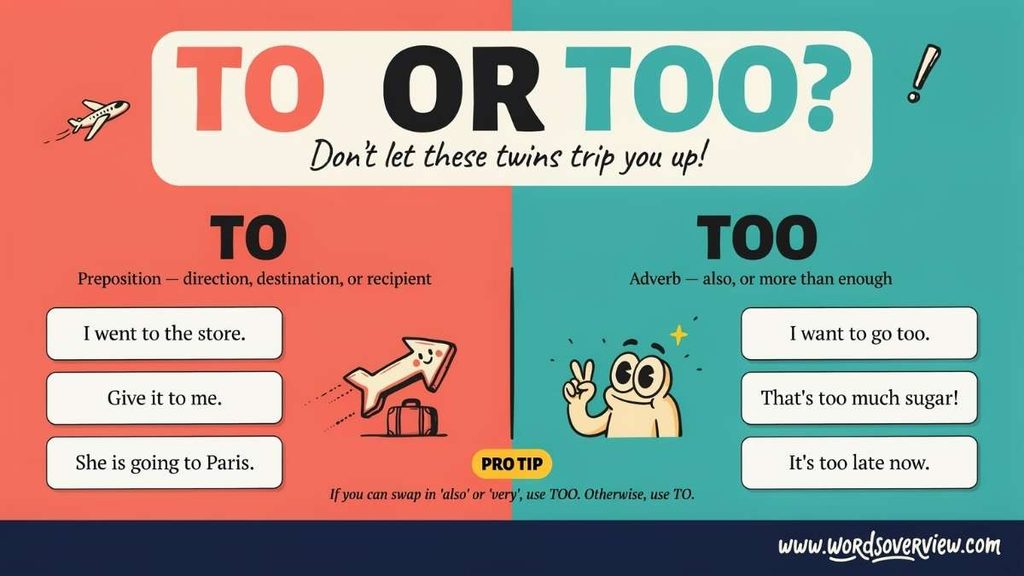
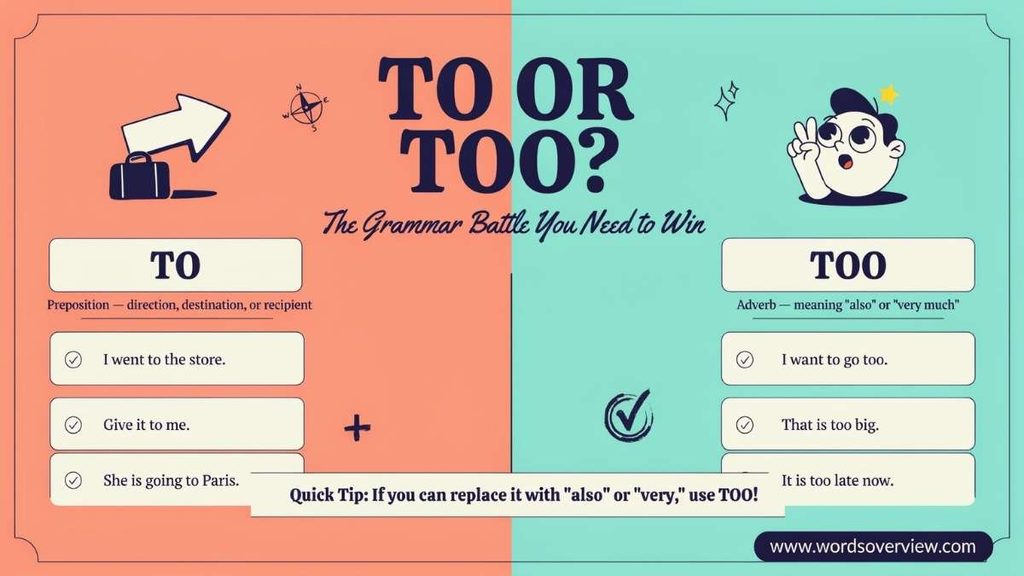
The to and too difference becomes clearer when you compare their grammatical functions directly.
| Feature | To | Too |
| Part of speech | Preposition or infinitive marker | Adverb |
| Shows direction | Yes | No |
| Identifies a recipient | Yes | No |
| Introduces an infinitive | Yes | No |
| Means “also” | No | Yes |
| Means “excessively” | No | Yes |
| Commonly appears before a base verb | Yes | No |
| Example | I want to sleep. | I’m too tired. |
| Example | Give it to John. | John came too. |
In short, to connects, points, or introduces an infinitive. Too adds or intensifies.
That distinction explains the most important difference between to and too with examples.
Consider:
I want to go too.
The first to introduces the verb go. The second too means “also.”
Therefore, both words can appear in the same sentence while performing completely different jobs.
To and Too in a Sentence
Context makes the correct choice much easier.
Examples With “To”
I went to the store.
To shows the destination.
She gave the report to her boss.
To identifies the recipient.
We need to leave now.
To introduces the infinitive leave.
He wants to learn Spanish.
To introduces the infinitive learn.
Examples With “Too”
I want to go too.
Too means “also.”
This box is too heavy.
Too means excessively.
It’s too late.
The time has passed the suitable point.
She talks too quickly.
Her speed exceeds an appropriate level.
Learn the difference between confusing word pairs
Emasculate or Demasculate: Meaning, Difference and Usage
Examples With Both
These examples are especially useful because they show the to and too difference within the same sentence:
I want to come too.
She needs to study too.
We went to the restaurant too.
It’s too late to change the plan.
He tried to run, but he was too tired.
I would like to order dessert too.
They decided to leave too early.
Notice the pattern. Whenever to introduces a verb, it performs a grammatical job. Whenever too means “also” or “excessively,” it performs a different job.
When to Use To or Too
If you’re asking when to use to or too, start with meaning rather than spelling.
Use “To” for Direction
We went to school.
Ask yourself:
Where did we go?
The answer is school. Therefore, to introduces the destination.
Use “To” Before an Infinitive
I need to study.
Here, to comes before the base verb study.
Other examples include:
want to eat
need to work
hope to win
plan to travel
like to read
Use “To” for a Recipient
Give the phone to me.
The word to identifies the person receiving the phone.
Use “Too” for “Also”
I want to come too.
Try replacing too with also:
I also want to come.
The meaning remains clear, so too is correct.
Use “Too” for Excess
The bag is too heavy.
Here, too means that the bag weighs more than is suitable or manageable.
Consequently, when you’re deciding when should I use too instead of to, check whether the word expresses addition or excess.
Learn the difference between similar English words the easy way
Lader or Ladder Which Spelling Is Correct?
How to Use To and Too Correctly
A simple decision process can solve most everyday to or too questions.
Start With Meaning
Ask what you want the word to communicate.
If it expresses:
direction
movement
destination
recipient
relationship
an infinitive
choose to.
If it expresses:
also
as well
in addition
excessive degree
more than necessary
choose too.
Check the Word That Follows
If you see:
to + base verb
you probably have an infinitive.
Examples:
- to eat
- to work
- to sleep
- to learn
- to write
If you see:
too + adjective
too probably expresses an excessive degree.
Examples:
- too expensive
- too difficult
- too cold
- too large
Try the “Also” Test
If you’re unsure about too, replace it with also.
I like it too.
becomes:
I also like it.
The meaning works.
Now try:
I want too go.
Replacing too with also gives:
I want also go.
That doesn’t work in standard English.
Therefore, the correct sentence is:
I want to go.
This simple substitution method can help you understand how to tell the difference between to and too without memorizing complicated terminology.
Learn the difference between often confused words
Tomorrows or Tomorrow’s Difference, Meaning and Usage
Common To or Too Mistakes
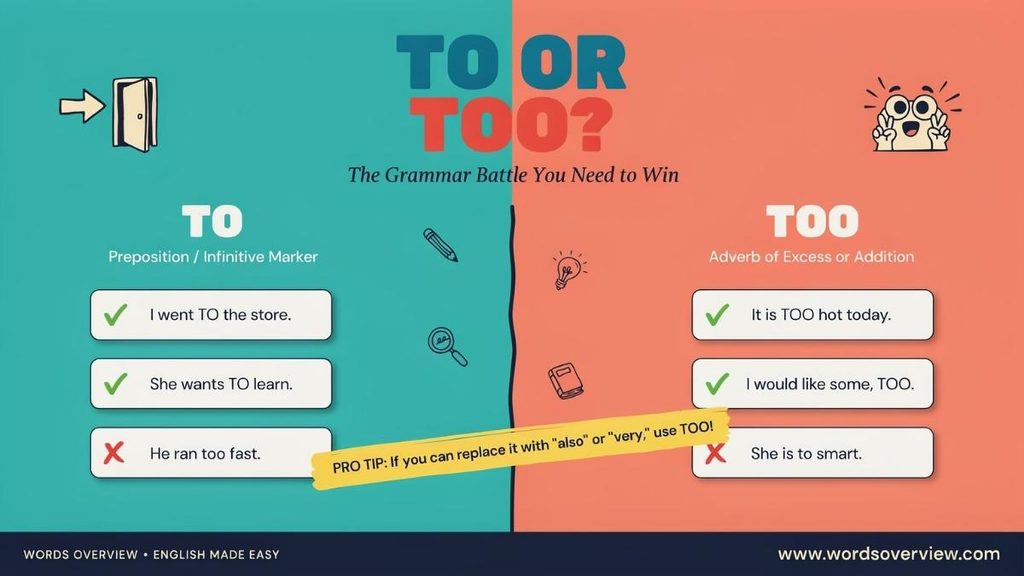
A few errors appear repeatedly in everyday writing.
Too Much or To Much?
The correct expression is:
too much
Use too because the phrase describes an excessive quantity.
Examples:
I ate too much.
There is too much traffic.
You spend too much time online.
He added too much salt.
“Too much” is correct. “To much” is incorrect when you mean “more than necessary.”
Too Many or To Many?
The correct expression is:
too many
Examples:
There are too many people here.
I made too many mistakes.
She asked too many questions.
We have too many meetings.
Again, too expresses excess.
Too Late or To Late?
The correct expression is:
too late
Examples:
It’s too late to call.
We arrived too late.
She realized it was too late to change the decision.
The word too indicates that the timing has gone beyond the suitable point.
Too Early or To Early?
Use:
too early
Examples:
It’s too early to decide.
You woke up too early.
We arrived too early for the meeting.
Too Long or To Long?
Use:
too long
Examples:
The movie was too long.
You waited too long.
This meeting is taking too long.
Too Far or To Far?
Use:
too far
Examples:
Don’t walk too far.
The hotel is too far from the station.
We drove too far before turning around.
Too Fast or To Fast?
Use:
too fast
Examples:
- You’re driving too fast.
- He speaks too fast for me to understand.
- The car was moving too fast.
The same pattern applies to other expressions such as:
- too slow
- too difficult
- too easy
- too expensive
- too good
- too bad
- too big
- too small
- too hard
- too soon
Whenever too expresses an excessive degree, it keeps its two-o spelling.
Me Too or Me To?
This is one of the most common everyday examples.
If you mean “I also agree” or “I feel the same way,” use:
Me too.
For example:
“I love this song.”
“Me too.”
Here, too means “also.”
Similarly:
“Have a great weekend!”
“You too!”
Again, too means “also.”
Therefore, if you’re deciding between me too or me to, use me too when you mean “me also.”
I Would Like To or Too?
The correct expression is:
I would like to…
Why? Because to introduces the infinitive.
Examples:
- I would like to order coffee.
- I would like to speak with you.
- I would like to learn more.
- I would like to ask a question.
However, both words can appear together:
I would like to come too.
The first to introduces come. The second too means “also.”
Therefore, the question “I would like to or too?” has a context-based answer rather than one universal spelling.
Want To or Want Too?
The standard construction is:
want to + verb
Examples:
I want to eat.
I want to sleep.
They want to leave.
We want to travel.
Therefore:
I want to go home.
is correct.
However:
I want to go home too.
is also correct because too means “also.”
This distinction explains why want to and want too can sound confusing when spoken quickly. Their pronunciation may sound identical, but their grammatical roles differ.
Learn the difference between tricky English words with easy explanations
Emerse or Immerse Which Spelling Is Correct?
Need To or Need Too?
Use need to when a verb follows.
I need to study.
We need to leave.
She needs to call him.
However, use too when you mean “also.”
I need a ticket too.
Compare the two:
I need to study.
To introduces the verb study.
I need a ticket too.
Too means “also.”
Consequently, looking at the word that follows can often reveal the correct choice.
Going To or Going Too?
Both forms can be correct, but they communicate different ideas.
I am going to school.
Here, to identifies the destination.
I am going too.
Here, too means “also.”
You can even use both in one sentence:
I am going to school too.
The first to shows destination. The second too adds another person or action to the statement.
To vs Too vs Two
A complete explanation of to or too should also mention two.
Why? Because to, too, and two are common English homophones. They can sound alike, yet their spellings, meanings, and grammatical functions differ.
“To”
Use to for direction, recipients, relationships, and infinitives.
I want to read.
“Too”
Use too for “also” or “excessively.”
I want to read too.
“Two”
Use two for the number 2.
I have two books.
Now consider this sentence:
I went to two stores, and both were too crowded.
All three words appear together:
to = direction
two = number
too = excessively
| Word | Meaning | Example |
| to | Direction, recipient, infinitive | Go to school. |
| too | Also, excessively | It’s too cold. |
| two | Number 2 | I have two pens. |
Therefore, if you’re searching for the difference between to, too, and two, focus on meaning rather than pronunciation.
Learn the difference between basic English word mistakes
Allie or Ally Difference, Meaning, Spelling and Usage
To or Too: A Simple Trick to Remember
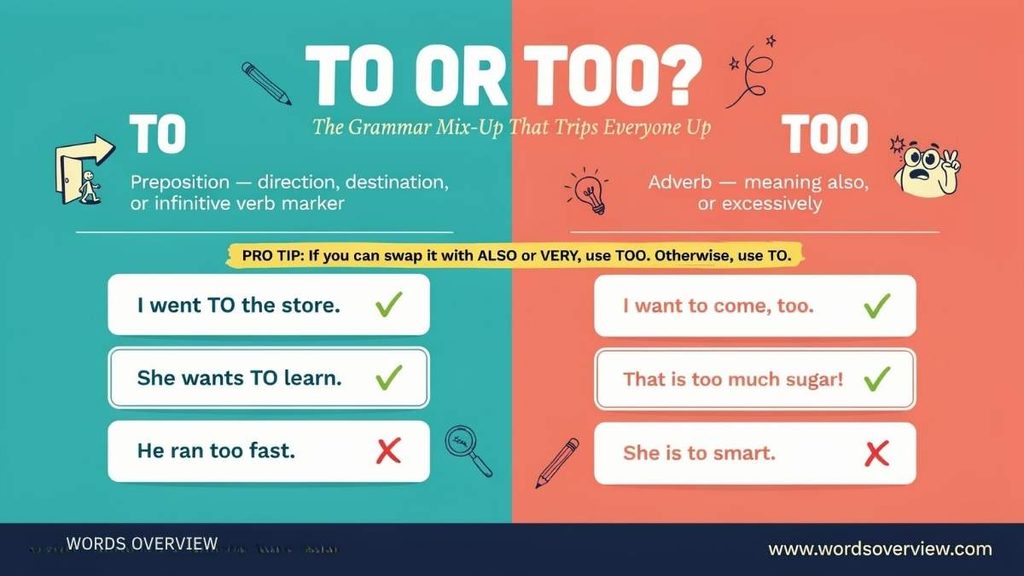
Need a quick way to remember the difference?
Try this memory aid:
To has one o.
Too has two o’s.
You can connect the extra o in too with the idea of something extra.
Too can mean:
something extra: “I want one too.”
something excessive: “It’s too expensive.”
This isn’t a complete grammar rule, but it works as a useful memory trick.
The “Also” Test
Whenever you’re unsure, ask:
Can I replace the word with “also”?
If yes, use too.
She came too.
She also came.
If the substitution doesn’t work, check whether to expresses direction, a recipient, a relationship, or an infinitive.
This gives you a practical answer to the question, “How can I remember to vs too?”
Learn the difference between commonly misused words
Maxxed or Maxed Which Spelling Is Correct?
Tricky To or Too Examples
Some sentences contain both words and therefore make excellent practice.
| Sentence | Explanation |
| I want to go too. | To introduces go; too means also. |
| It’s too late to leave. | Too means excessively; to introduces leave. |
| She went to the party too. | To shows destination; too means also. |
| I need to work too. | To introduces work; too means also. |
| The box is too heavy to lift. | Too expresses excess; to introduces lift. |
| We drove to the beach too early. | To shows destination; too means excessively. |
| I would like to order dessert too. | To introduces order; too means also. |
| He tried to run, but he was too tired. | To introduces run; too expresses excess. |
These examples demonstrate why grammar cannot rely on pronunciation alone. Context determines the correct word.
To vs Too in Everyday Writing
The distinction matters in everyday communication because spelling errors can distract readers or make writing look careless.
Text Messages and Social Media
People often type quickly in texts and social media posts. Consequently, mistakes such as “I want too go” appear frequently.
The intended meaning may remain obvious. However, the standard form is:
I want to go.
Informal writing gives you more freedom with punctuation and style, but it doesn’t change the standard spelling of these words.
Emails
Professional emails require greater attention to grammar and spelling.
Compare:
I would like to discuss the proposal.
with:
I would like too discuss the proposal.
The second version contains a basic grammar error because to should introduce the verb discuss.
However:
I would like to discuss the proposal too.
is correct when the writer means that they also want to discuss it.
Academic Writing
Academic writing also depends on grammatical accuracy.
For example:
The researchers aim to identify the cause.
Here, to introduces the infinitive identify.
Likewise:
The second study examines the issue too.
Here, too means “also.” Depending on the context and desired formality, however, writers may prefer also in academic prose.
Learn the difference between everyday English mistakes
Incurable or Uncurable? Meaning, Difference and Correct Usage
To or Too Practice: Examples With Answers
Fill in each blank with to or too.
| No. | Sentence |
| 1 | I need ___ finish my assignment before dinner. |
| 2 | This suitcase is ___ heavy for me to carry. |
| 3 | She went ___ the market this morning. |
| 4 | I enjoyed the movie ___, especially the ending. |
| 5 | He wants ___ become a software developer. |
| 6 | The coffee is ___ hot to drink right now. |
| 7 | Please give this message ___ your brother. |
| 8 | Are you coming ___ the party tonight? |
| 9 | I would like ___ learn another language. |
| 10 | The music is ___ loud. |
| 11 | She decided ___ stay at home. |
| 12 | I hope you have a great weekend ___. |
| 13 | We walked ___ the station after lunch. |
| 14 | There are ___ many people in this room. |
| 15 | He stayed late ___ complete the project. |
| 16 | I want ___ buy a new laptop. |
| 17 | This question is ___ difficult for beginners. |
| 18 | She sent an invitation ___ all her classmates. |
| 19 | I’d love ___ join you for dinner. |
| 20 | My sister wants ___ come with us ___. |
| 21 | The box is ___ small for all these books. |
| 22 | He went ___ the library ___ study. |
| 23 | I like this song ___. |
| 24 | You need ___ be careful because the road is ___ slippery. |
| 25 | I have ___ much work ___ do today. |
Answers
| No. | Answer | Completed Sentence |
| 1 | to | I need to finish my assignment before dinner. |
| 2 | too | This suitcase is too heavy for me to carry. |
| 3 | to | She went to the market this morning. |
| 4 | too | I enjoyed the movie too, especially the ending. |
| 5 | to | He wants to become a software developer. |
| 6 | too | The coffee is too hot to drink right now. |
| 7 | to | Please give this message to your brother. |
| 8 | to | Are you coming to the party tonight? |
| 9 | to | I would like to learn another language. |
| 10 | too | The music is too loud. |
| 11 | to | She decided to stay at home. |
| 12 | too | I hope you have a great weekend too. |
| 13 | to | We walked to the station after lunch. |
| 14 | too | There are too many people in this room. |
| 15 | to | He stayed late to complete the project. |
| 16 | to | I want to buy a new laptop. |
| 17 | too | This question is too difficult for beginners. |
| 18 | to | She sent an invitation to all her classmates. |
| 19 | to | I’d love to join you for dinner. |
| 20 | to, too | My sister wants to come with us too. |
| 21 | too | The box is too small for all these books. |
| 22 | to, to | He went to the library to study. |
| 23 | too | I like this song too. |
| 24 | to, too | You need to be careful because the road is too slippery. |
| 25 | too, to | I have too much work to do today. |
Here’s a trusted source for clear more words Comparison:
Grammar Update
Frequently Asked Questions About To or Too
Is “too” always used to mean “also”?
No. Too has two main meanings. It can mean “also”, as in “I want to come too,” or it can indicate an excessive degree, as in “The soup is too hot.” The meaning depends on how too functions in the sentence.
Can “to” come before a verb?
Yes. To commonly appears before the base form of a verb to create an infinitive. Examples include “to learn,” “to write,” “to sleep,” and “to understand.” In “She wants to study,” to introduces the verb study.
Can “too” come before an adjective?
Yes. Too can modify an adjective when it means “more than desirable or necessary.” For example, “The box is too heavy” means the box has excessive weight. Other examples include “too expensive,” “too difficult,” and “too small.”
Can “too” modify an adverb?
Yes. Too can modify an adverb to express an excessive degree. For example, “He drove too quickly” means he drove faster than was appropriate. Similarly, “She spoke too loudly” indicates that her speaking volume was excessive.
What is the difference between “too much” and “too many”?
Use too much with uncountable nouns and too many with countable nouns. For example, “There is too much water in the glass” uses an uncountable noun, while “There are too many books on the desk” uses a countable plural noun.
Why is “too” used at the end of “I want to come too”?
In “I want to come too,” too means “also.” It adds the speaker to the group of people who want to come. This use commonly appears at the end of a clause or sentence, although too can sometimes appear elsewhere for emphasis.
Are “to,” “too,” and “two” pronounced the same?
Yes. In most varieties of English, to, too, and two are homophones, meaning they share the same or nearly the same pronunciation while having different meanings and spellings. Their grammatical roles and context tell you which word belongs in writing.
What does “two” mean in “to, too, and two”?
Two is the number 2. It doesn’t function like to or too. For example, “I have two sisters” uses two to describe quantity. This distinction makes the three words easier to remember: to connects, too adds or exceeds, and two counts.
Can “to” and “too” appear in the same sentence?
Yes, and they often do. For example, “I want to go too.” The first to introduces the verb go, while too means “also.” Their identical pronunciation doesn’t change their separate grammatical functions.
Why do “to” and “too” sound alike but have different spellings?
English developed these words from different historical forms, even though their pronunciations eventually became identical in many varieties of English. Their different spellings help readers distinguish their meanings and grammatical roles on the page.
Can “too” mean “very”?
Yes, too can sometimes appear before an adjective or adverb with a meaning close to “very,” particularly in informal or expressive language. However, too often carries an additional sense of excess. For example, “too difficult” usually suggests that something is difficult beyond an acceptable or manageable level.
Is “to” a preposition?
Yes. To commonly functions as a preposition. It can show movement or direction, as in “We walked to the park,” or identify a recipient, as in “Give the letter to Sarah.” It also has another major grammatical role as an infinitive marker before a base verb.
Can “to” show a relationship between people?
Yes. To can connect a person or thing with a recipient or target. In “She gave the keys to her brother,” the preposition to identifies who received the keys. This use differs completely from too, which doesn’t establish that relationship.
Does “too” always indicate something negative?
No. Too can express excess, which often creates a negative or undesirable result, as in “The coffee is too hot.” However, too meaning “also” is completely neutral or positive. For example, “I enjoy reading too” simply adds another person to the statement.
Where does “too” usually appear when it means “also”?
When too means “also,” it frequently appears at the end of a clause or sentence. For example, “She wants to join us too.” It can also appear in other positions for emphasis, although the final position sounds especially natural in everyday English.
Can “too” be used with plural countable nouns?
Yes, but English normally uses too many with plural countable nouns. For example, “There are too many people in the room.” The structure expresses a quantity greater than what is appropriate, expected, or wanted.
Can “too” be used with uncountable nouns?
Yes. English commonly uses too much with uncountable nouns. For example, “There is too much noise outside.” Other examples include too much water, too much information, and too much work.
Can “to” be used to show purpose?
Yes. To + base verb can express purpose. For example, “She went to the library to study.” The second to introduces the purpose of going to the library. In this structure, to isn’t interchangeable with too.
How does context help you choose between “to” and “too”?
Look at the word’s job in the sentence. If it connects a person, place, direction, or verb, to may be appropriate. If it means “also” or expresses excess, choose too. Reading the complete sentence rather than focusing only on pronunciation usually makes the choice clear.
Can “to” be followed by an adjective?
Yes, but not in the same way that too modifies an adjective. For example, “It is nice to meet you” uses to as part of an infinitive phrase. By contrast, “It is too expensive” uses too to modify the adjective expensive.
What is the easiest way to distinguish “to” from “too” while proofreading?
Replace too with “also.” If the sentence still makes sense, too is probably correct. If the sentence describes an excessive degree, too may also be correct. Otherwise, check whether to shows direction, a recipient, or introduces a base verb.
Why is “to” common in phrases such as “have to” and “need to”?
In expressions such as “have to work” and “need to study,” to introduces a base verb. It forms an infinitive structure connected to the preceding verb or phrase. Replacing to with too would change the grammatical function and usually make the sentence incorrect.
Can “too” be moved within a sentence?
Sometimes. When too means “also,” its position can change depending on emphasis and style. For example, “I too enjoy music” is grammatical, while “I enjoy music too” sounds more conversational. Both express the idea that the speaker also enjoys music.
What is a quick test for “too” meaning excessive?
Try replacing too with “more than necessary,” “more than wanted,” or “excessively.” If the meaning remains logical, too is likely correct. For example, “The shirt is too small” means the shirt is smaller than desired.
Why do people confuse “to” and “too” so often?
The main reason is pronunciation. In ordinary speech, to and too often sound identical, so listeners don’t have the spelling distinction available. Writers must rely on grammar and context instead. Once you recognize each word’s function, the confusion becomes much easier to avoid.
Conclusion:
The to or too confusion may look like a tiny spelling problem, but that extra “o” can completely change a sentence’s meaning. The good news is that the rule is easier than English makes it look. Use to for direction, recipients, and infinitive verbs, such as “go to school” or “to learn.” Use too when you mean “also” or “more than necessary,” as in “I want to come too” or “It’s too expensive.” When in doubt, check what job the word performs in the sentence. Master that simple habit, and you’ll stop letting one extra “o” cause two extra minutes of grammar panic.

Ethan AJS is an experienced blogger and language enthusiast at Words Overview, dedicated to making English easier to understand and use. He writes about grammar, vocabulary, spelling, word meanings and commonly confused words, turning tricky language questions into clear, practical insights. With a passion for effective communication, Ethan creates engaging, readerfocused content that helps readers write accurately, choose the right words and communicate with confidence.




