
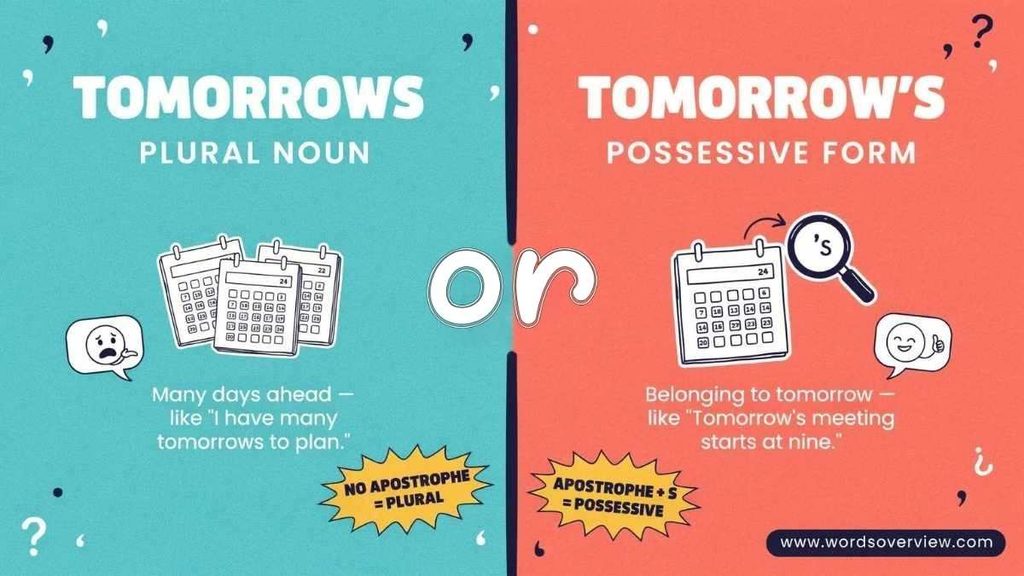
Have you ever written “tomorrow’s” and suddenly wondered whether that tiny apostrophe is doing important grammar work or simply showing off? If so, you’re not alone. The confusion between tomorrows or tomorrow’s often turns a simple future day into a punctuation puzzle. Although the two forms look almost identical, they serve completely different grammatical purposes. “Tomorrows” refers to multiple future days, while “tomorrow’s” can show possession or shorten “tomorrow is.” One tiny apostrophe can change the meaning of an entire sentence, which is quite a lot of responsibility for a little mark. Let’s clear up the confusion with simple rules, examples and practical explanations you can remember.
Tomorrows or Tomorrow’s Quick Answer
The simplest way to understand the difference is to look at the grammatical role of each form.
| Word | Grammatical function | Meaning | Example |
| tomorrow | Noun/adverb | The day after today | “I’ll see you tomorrow.” |
| tomorrows | Plural noun | More than one future day | “We can’t predict all our tomorrows.” |
| tomorrow’s | Possessive form | Something associated with tomorrow | “Tomorrow’s meeting starts at nine.” |
| tomorrow’s | Contraction | Short form of “tomorrow is” | “Tomorrow’s a holiday.” |
So, is it tomorrows or tomorrow’s? Either form can be correct, but they don’t mean the same thing.
Use tomorrows when you mean multiple future days.
Use tomorrow’s when you mean something associated with tomorrow or when tomorrow’s means “tomorrow is.”
For example:
“Tomorrow’s meeting is important.”
Here, tomorrow’s describes the meeting associated with tomorrow.
“We have many tomorrows ahead of us.”
Here, tomorrows refers to multiple future days.
“Tomorrow’s going to be busy.”
Here, tomorrow’s means “tomorrow is.”
Consequently, the surrounding sentence matters more than the spelling alone.
Learn the difference between similar English words
Inact or Enact: Which Spelling Is Correct?
What Does Tomorrow’s Mean?
The most common tomorrow’s meaning is “related to tomorrow” or “associated with tomorrow.” In this use, tomorrow’s functions as the possessive form of tomorrow.
Although the word possessive often suggests ownership, English uses possessive forms for more than literal ownership. They can also show relationships, connections or associations.
For example:
“Tomorrow’s schedule is already full.”
The schedule doesn’t literally belong to tomorrow. Instead, it means the schedule associated with tomorrow.
The same pattern appears in phrases such as tomorrow’s event, tomorrow’s meeting, tomorrow’s weather, tomorrow’s deadline and tomorrow’s appointment.
Consider these examples:
- “Tomorrow’s meeting starts at nine.”
- “Tomorrow’s weather should be cooler.”
- “Tomorrow’s deadline is earlier than expected.”
- “Tomorrow’s event will attract hundreds of visitors.”
- “Tomorrow’s appointment is scheduled for three.”
In each sentence, tomorrow’s identifies something connected with the following day.
Tomorrow’s Possessive Form
The possessive form of tomorrow uses an apostrophe followed by s:
tomorrow + ’s = tomorrow’s
For example:
“Tomorrow’s plan needs a few changes.”
The phrase tomorrow’s plan means “the plan associated with tomorrow.”
This construction appears frequently in everyday English because people often need to identify schedules, plans, events, deadlines, appointments and activities connected with the next day.
However, you shouldn’t automatically assume that every occurrence of tomorrow’s represents possession. The form can also function as a contraction.
What Does Tomorrows Mean?
The tomorrows meaning is straightforward: it refers to multiple future days.
In this usage, tomorrows functions as a plural noun. Therefore, it doesn’t need an apostrophe.
For example:
“We have many tomorrows to make better choices.”
The sentence refers to multiple future days rather than one specific upcoming day.
Similarly:
“The choices we make today can shape our tomorrows.”
Here, tomorrows refers broadly to future days and future experiences.
This form occurs more naturally in literary, reflective, philosophical, motivational or figurative writing than in ordinary scheduling. For instance, a person would usually say “I have meetings on three days” rather than “I have three tomorrows of meetings.”
Nevertheless, tomorrows has a useful place in English when a writer wants to emphasize the future, possibilities or the many days that lie ahead.
Expressions such as brighter tomorrows, better tomorrows, many tomorrows, several tomorrows and countless tomorrows are especially common in this kind of writing.
Learn the difference between confusing word pairs
To or Too What’s the Difference? Meaning And Examples
Tomorrows Definition
The simplest tomorrows definition is:
Tomorrows means multiple future days when tomorrow functions as a plural noun.
For example:
“We hope for brighter tomorrows.”
“Nobody knows what their tomorrows will bring.”
“She believes better tomorrows are possible.”
“Our tomorrows depend partly on what we do today.”
In each case, the plural form refers to future days or future possibilities.
Tomorrows vs Tomorrow’s: Key Difference
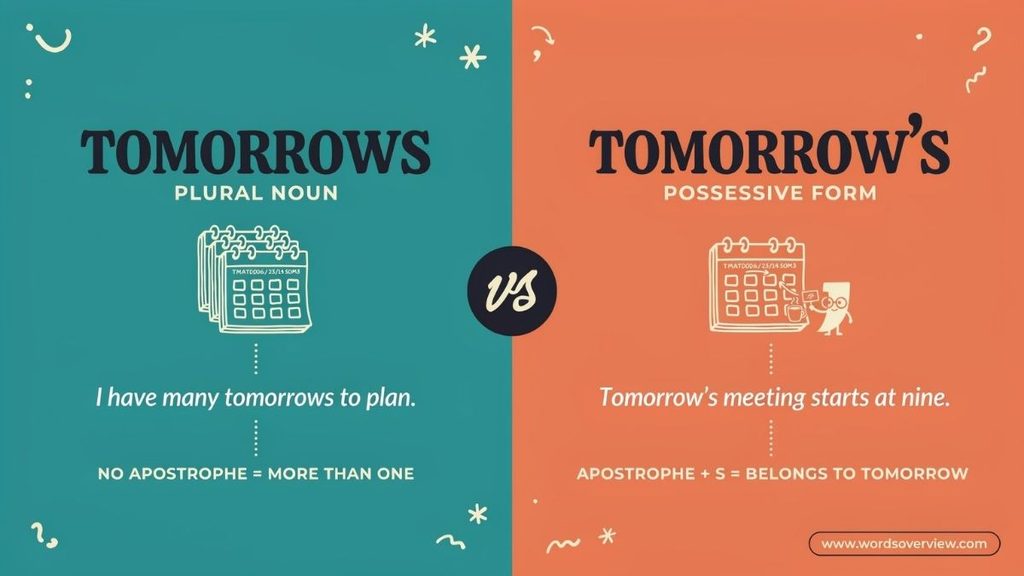
The easiest way to understand tomorrow’s vs tomorrows is to ask what the sentence is trying to express.
- Are you talking about multiple future days? If so, use tomorrows.
- Are you describing something associated with the next day? If so, use tomorrow’s.
- Are you shortening “tomorrow is”? Once again, use tomorrow’s.
| Meaning | Correct form | Example |
| One future day | tomorrow | “I’ll call you tomorrow.” |
| Something associated with tomorrow | tomorrow’s | “Tomorrow’s meeting starts at nine.” |
| More than one future day | tomorrows | “We hope for brighter tomorrows.” |
| “Tomorrow is” | tomorrow’s | “Tomorrow’s going to be busy.” |
This distinction explains the difference between tomorrows and tomorrow’s without making the grammar unnecessarily complicated.
Learn the difference between often confused words
Handle or Handel Correct Spelling, Meaning and Usage
Tomorrows or Tomorrow’s Meaning
The tomorrows vs tomorrow’s meaning difference comes from their grammatical functions.
- Tomorrows is plural.
- Tomorrow’s can be possessive or a contraction.
- Tomorrow, without an ending, refers directly to the following day.
- Therefore, these three forms should not be treated as interchangeable:
- “See you tomorrow.”
- “Tomorrow’s meeting is important.”
- “We hope for better tomorrows.”
Each sentence uses a different grammatical structure.
Is Tomorrows a Word?
Yes, tomorrows is a word.
The question “is tomorrows a word” often appears because the plural form feels less familiar than ordinary words such as days or weeks. Nevertheless, English allows tomorrow to function as a plural noun when the context refers to multiple future days.
For example:
“Nobody knows what their tomorrows will bring.”
Here, tomorrows clearly refers to several future days or future experiences.
However, context matters. In everyday conversation, speakers often choose phrases such as the future, future days, the days ahead or the coming years instead.
For example:
“We don’t know what the future will bring.”
This sentence sounds more natural in many everyday situations than:
“We don’t know what our tomorrows will bring.”
The second sentence isn’t grammatically incorrect. Instead, it carries a more literary and reflective tone.
Is Tomorrow’s a Word?
Yes. Tomorrow’s is a valid English word form and it has two important grammatical uses.
The question “is tomorrow’s a word” has a simple answer. Yes, although its exact grammatical function depends on the sentence.
First, tomorrow’s can function as a possessive form:
“Tomorrow’s schedule has changed.”
Second, tomorrow’s can function as a contraction of “tomorrow is”:
“Tomorrow’s going to be busy.”
Therefore, context determines whether the apostrophe represents possession or omitted letters in a contraction.
Tomorrow’s Possessive
Consider this sentence:
“Tomorrow’s event starts at six.”
Here, tomorrow’s means something associated with tomorrow.
You could think of the phrase as:
“the event associated with tomorrow”
The possessive apostrophe creates that relationship.
Tomorrow’s Contraction
Now consider:
“Tomorrow’s going to be difficult.”
In this sentence, tomorrow’s means “tomorrow is.”
Expand the contraction:
“Tomorrow is going to be difficult.”
The meaning remains intact, so the contraction is clear.
This distinction becomes particularly useful when you encounter tomorrow’s in longer sentences.
Tomorrow’s as a Contraction
The tomorrow’s contraction represents “tomorrow is.”
English regularly uses contractions in conversational and informal writing because they make sentences shorter and more natural.
For example:
“Tomorrow’s going to be exciting.”
This means:
“Tomorrow is going to be exciting.”
Likewise:
“Tomorrow’s a new day.”
means:
“Tomorrow is a new day.”
The contraction often appears before adjectives, nouns or verb phrases.
Learn the difference between basic English word mistakes
Allie or Ally Difference, Meaning, Spelling and Usage
Does Tomorrow’s Mean Tomorrow Is?
Sometimes, yes.
The answer depends on the sentence.
Consider:
“Tomorrow’s meeting starts at eight.”
Here, tomorrow’s doesn’t mean “tomorrow is.” Instead, it describes the meeting associated with tomorrow.
Now compare:
“Tomorrow’s going to be busy.”
Here, tomorrow’s means “tomorrow is.”
A useful test can help. Try expanding tomorrow’s into “tomorrow is.”
If the sentence still makes grammatical sense, you probably have the contraction.
“Tomorrow’s going to be busy.”
“Tomorrow is going to be busy.”
The expanded version works.
However:
“Tomorrow’s meeting begins at nine.”
“Tomorrow is meeting begins at nine.”
The second version doesn’t work. Therefore, tomorrow’s functions as a possessive form in the first sentence.
Tomorrows or Tomorrow’s Grammar
Understanding tomorrows or tomorrow’s grammar requires only a few important English grammar rules.
Use Tomorrows for the Plural
When tomorrow functions as a noun and you mean multiple future days, use tomorrows.
“We hope for brighter tomorrows.”
Here, the word refers to several future days.
Use Tomorrow’s for Possession or Association
When something relates to tomorrow, use tomorrow’s.
“Tomorrow’s deadline is approaching.”
The deadline is associated with tomorrow.
Use Tomorrow’s for “Tomorrow Is”
When tomorrow’s replaces tomorrow is, it forms a contraction.
“Tomorrow’s going to be exciting.”
These three rules explain most tomorrows or tomorrow’s correct spelling questions.
Why Does Tomorrow’s Have an Apostrophe?
The apostrophe in tomorrow’s serves one of two grammatical purposes.
First, it can mark the possessive form:
“Tomorrow’s plan is ready.”
Second, it can represent omitted letters in the contraction “tomorrow is”:
“Tomorrow’s going to be busy.”
Therefore, the apostrophe isn’t decorative. It signals a specific grammatical function.
This also explains why you shouldn’t add an apostrophe when forming the plural tomorrows.
Why Is Tomorrows Written Without an Apostrophe?
Tomorrows doesn’t need an apostrophe because it is simply the plural form.
English normally forms regular plurals without apostrophes:
book → books
student → students
day → days
tomorrow → tomorrows
Therefore:
“We have many tomorrows ahead.”
is correct.
By contrast:
“We have many tomorrow’s ahead.”
is incorrect when the intended meaning is simply “many future days.”
An apostrophe usually signals possession or contraction. It doesn’t normally indicate an ordinary plural.
Learn the difference between everyday English mistakes
Maxxed or Maxed Which Spelling Is Correct?
Tomorrows or Tomorrow’s Correct Usage
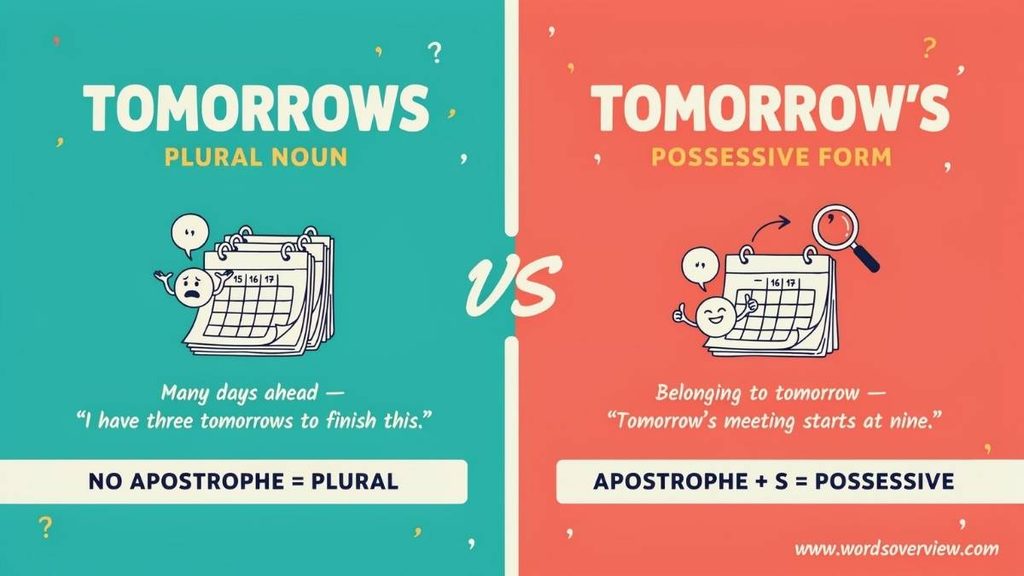
When deciding when to use tomorrows, first ask whether you mean more than one future day.
For example:
“We hope for better tomorrows.”
The sentence discusses multiple future days, so tomorrows is correct.
When deciding when to use tomorrow’s, look for either a noun that it modifies or a structure where it can expand to “tomorrow is.”
For example:
“Tomorrow’s deadline is approaching.”
Here, tomorrow’s modifies deadline.
“Tomorrow’s going to be hectic.”
Here, tomorrow’s means “tomorrow is.”
Consequently, the surrounding grammar provides the answer.
A Quick Decision Method
Use this simple three-part test:
- If you mean the next day, use tomorrow.
- If you mean multiple future days, use tomorrows.
- If you mean something associated with tomorrow or “tomorrow is,” use tomorrow’s.
For example:
“The exam is tomorrow.”
“Tomorrow’s exam is difficult.”
“We hope for brighter tomorrows.”
“Tomorrow’s going to be a long day.”
The difference becomes clear once you identify the intended meaning.
Learn the difference between commonly confused words in English:
Emasculate or Demasculate: Meaning, Difference and Usage
Common Mistakes With Tomorrows and Tomorrow’s
Apostrophe mistakes often happen because the three forms look almost identical. However, each one serves a different purpose.
Mistake: Using Tomorrows for Possession
Incorrect:
“Tomorrows meeting starts at 10.”
Correct:
“Tomorrow’s meeting starts at 10.”
The meeting is associated with tomorrow, so the possessive form requires an apostrophe.
Mistake: Using Tomorrow’s for a Plural
Incorrect:
“We have many tomorrow’s ahead of us.”
Correct:
“We have many tomorrows ahead of us.”
The sentence refers to multiple future days, so the plural form doesn’t need an apostrophe.
Mistake: Confusing Tomorrow With Tomorrow’s
Compare:
“The meeting is tomorrow.”
“Tomorrow’s meeting is important.”
In the first sentence, tomorrow tells you when the meeting occurs.
In the second, tomorrow’s identifies which meeting you mean.
The distinction may look small, but the sentence structure changes significantly.
Tomorrow’s Schedule, Event, Meeting and Session
Searches for phrases such as tomorrow’s schedule, tomorrow’s event, tomorrow’s meeting and tomorrow’s session are common because these constructions appear frequently in everyday English.
Tomorrow’s Schedule
“Please check tomorrow’s schedule before leaving.”
Here, the schedule relates to tomorrow.
Tomorrow’s Event
“Tomorrow’s event begins at 7 p.m.”
The event is associated with the following day.
Tomorrow’s Meeting
“Tomorrow’s meeting will cover the new project.”
The meeting is scheduled for tomorrow.
Tomorrow’s Session
“The instructor moved tomorrow’s session to the afternoon.”
The session is connected with tomorrow.
The same grammatical pattern works with tomorrow’s plan, tomorrow’s deadline, tomorrow’s appointment, tomorrow’s activities and tomorrow’s weather.
Is “Tomorrow’s Morning” Correct?
The phrase tomorrow’s morning deserves special attention because it frequently appears in learner writing.
In standard everyday English, tomorrow morning is the natural expression.
For example:
“I’ll call you tomorrow morning.”
English normally places tomorrow directly before a time period. As a result, you generally don’t need the possessive form.
The natural expressions are:
- “tomorrow morning”
- “tomorrow afternoon”
- “tomorrow evening”
- “tomorrow night”
Therefore, in ordinary writing and conversation, use tomorrow morning rather than tomorrow’s morning.
However, tomorrow’s morning can appear in specialized literary or context-dependent writing when a writer intentionally treats tomorrow as a noun associated with a particular morning. That usage differs from the standard everyday expression.
For practical communication, tomorrow morning is the better choice.
Learn the difference between commonly confused words in English
Emerse or Immerse Which Spelling Is Correct?
Examples of Tomorrows in a Sentence
Tomorrows works best when it refers to multiple future days or future possibilities.
| Sentence | Why it works |
| “We hope for brighter tomorrows.” | It refers to multiple future days. |
| “Nobody knows what their tomorrows will bring.” | It refers to future experiences or days. |
| “The choices we make today shape our tomorrows.” | It refers to future outcomes. |
| “Several tomorrows may look different from what we expect.” | It describes multiple future days. |
| “She believes better tomorrows are possible.” | It uses the plural in a hopeful sense. |
| “Our tomorrows depend partly on what we do today.” | It refers broadly to future days. |
Notice that tomorrows often carries a reflective tone. Writers use it to talk about possibilities, hopes, challenges and future experiences.
Examples of Tomorrow’s in a Sentence
Tomorrow’s appears much more frequently in ordinary practical writing because people regularly describe events, schedules and plans connected with the next day.
| Sentence | Function |
| “Tomorrow’s meeting starts at nine.” | Possessive/association |
| “Tomorrow’s weather looks pleasant.” | Possessive/association |
| “Tomorrow’s event has been moved indoors.” | Possessive/association |
| “Tomorrow’s deadline is firm.” | Possessive/association |
| “Tomorrow’s appointment is at three.” | Possessive/association |
| “Tomorrow’s schedule is already full.” | Possessive/association |
| “Tomorrow’s going to be busy.” | Contraction of “tomorrow is” |
| “Tomorrow’s a big day for the team.” | Contraction of “tomorrow is” |
As you can see, the same spelling can perform two different grammatical jobs.
Learn the difference between similar English words the easy way
Lader or Ladder Which Spelling Is Correct?
Tomorrows or Tomorrow’s: A Practical Case Study
Imagine a student preparing for an important examination.
The student might say:
“The exam is tomorrow.”
Here, tomorrow simply identifies the day when the exam will occur.
Next, the student might say:
“Tomorrow’s exam covers three chapters.”
Now, tomorrow’s describes the exam associated with the next day.
Finally, the student might reflect on the future:
“Today’s preparation can lead to better tomorrows.”
In that sentence, tomorrows refers to multiple future days or future possibilities.
The three sentences demonstrate why context matters more than the appearance of the word.
Tomorrows or Tomorrow’s in Formal and Informal Writing
Both forms can appear in formal and informal English. The key difference comes from grammar rather than formality.
For example, a formal workplace message might say:
“Tomorrow’s deadline requires additional preparation.”
Meanwhile, an informal message might say:
“Tomorrow’s going to be hectic.”
Both sentences are grammatically correct because tomorrow’s performs a different function in each one.
Tomorrows, however, often has a more literary or rhetorical tone.
For example:
“We must make choices today that create better tomorrows.”
That sentence sounds reflective rather than conversational. In ordinary speech, someone might instead say:
“We need to make choices today that improve our future.”
Neither version is inherently better. The appropriate choice depends on the tone and purpose of the writing.
Learn the difference between tricky words and use them correctly
Unattentive or Inattentive Which Word Is Correct?
Tomorrows or Tomorrow’s: Which Is Correct?
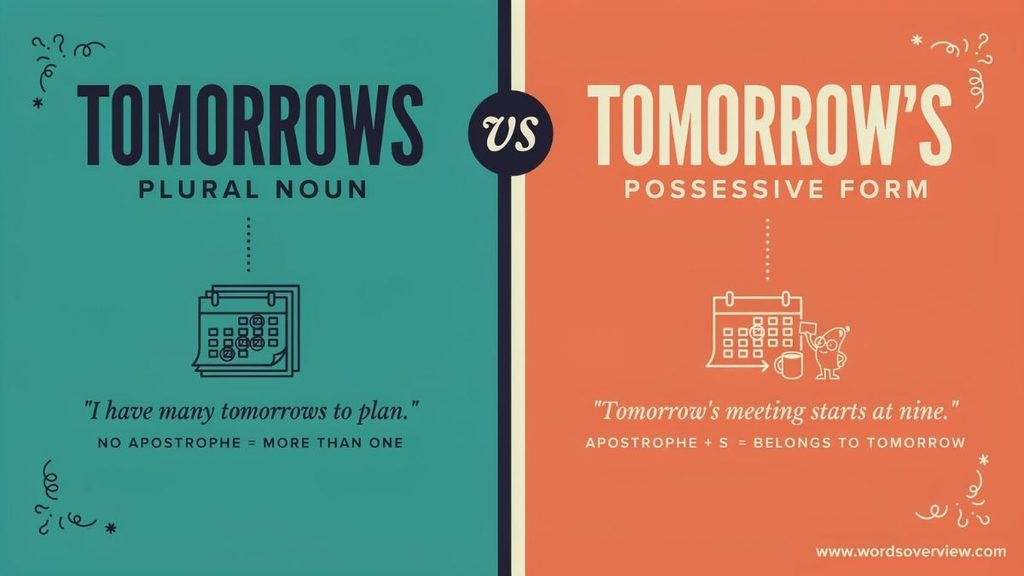
The correct form depends on your intended meaning.
If you’re writing:
“_____ meeting has been canceled.”
Use:
“Tomorrow’s meeting has been canceled.”
If you’re writing:
“We hope for better _____.”
Use:
“We hope for better tomorrows.”
If you’re writing:
“_____ going to be a busy day.”
Use:
“Tomorrow’s going to be a busy day.”
If you’re writing:
“I’ll finish the assignment _____.”
Use:
“I’ll finish the assignment tomorrow.”
Therefore, the question “is it tomorrows or tomorrow’s” cannot be answered correctly without considering the sentence.
Tomorrows or Tomorrow’s Correct Spelling: Final Comparison
| Feature | tomorrow | tomorrows | tomorrow’s |
| Refers to one future day | Yes | No | Indirectly, depending on context |
| Refers to multiple future days | No | Yes | No |
| Forms a plural | No | Yes | No |
| Shows possession or association | No | No | Yes |
| Can mean “tomorrow is” | No | No | Yes |
| Requires an apostrophe | No | No | Yes |
| Example | “See you tomorrow.” | “Brighter tomorrows await.” | “Tomorrow’s plan is ready.” |
This table captures the central difference between the three forms.
How to Remember the Difference Between Tomorrows and Tomorrow’s
If apostrophes make your brain feel like it needs a coffee break, use one simple memory trick.
Think of the apostrophe as a signal.
Tomorrows = more than one tomorrow.
Tomorrow’s = connected with tomorrow or “tomorrow is.”
For example:
“Many tomorrows” means many future days.
“Tomorrow’s plan” means the plan associated with tomorrow.
“Tomorrow’s going to be great” means “tomorrow is going to be great.”
So, when you encounter the word while proofreading, ask yourself what the sentence is trying to say.
- If the answer is “more than one future day,” choose tomorrows.
- If the answer is “something related to tomorrow,” choose tomorrow’s.
- If the answer is “tomorrow is,” choose tomorrow’s.
Learn the difference between tricky English words with easy explanations
Incurable or Uncurable? Meaning, Difference and Correct Usage
Practice Session: Tomorrows or Tomorrow’s
Fill in each blank with tomorrow, tomorrows or tomorrow’s. The answers appear below so you can check your understanding.
Fill in the Blanks
- I’ll finish the assignment ______.
- ______ meeting has been moved to 10 a.m.
- We hope for brighter ______.
- ______ going to be a busy day.
- She has an appointment ______ morning.
- Nobody knows what their ______ will bring.
- Please check ______ schedule before making another appointment.
- I’ll call you ______ evening.
- ______ deadline is earlier than expected.
- The choices we make today can shape our ______.
- ______ a new day, so don’t worry too much.
- We have many ______ ahead of us.
- The teacher announced that ______ class will begin at nine.
- I’ll submit the report ______.
- Better ______ require good decisions today.
- ______ event will attract hundreds of visitors.
- He said ______ would be another opportunity to try.
- ______ going to be difficult, but we can handle it.
- Our actions today can create better ______.
- I need to prepare for ______ meeting.
- The exam starts ______ morning.
- She believes that happier ______ are possible.
- ______ weather should be cooler.
- ______ going to be an important day for the team.
- We don’t know what the future holds, but we can work toward better ______.
Answers
- tomorrow — Refers to the day after today.
- tomorrow’s — Shows that the meeting is associated with tomorrow.
- tomorrows — Refers to multiple future days.
- tomorrow’s — Contraction of “tomorrow is.”
- tomorrow — The standard expression is “tomorrow morning.”
- tomorrows — Refers to multiple future days or future experiences.
- tomorrow’s — The schedule is associated with tomorrow.
- tomorrow — “Tomorrow evening” is the standard expression.
- tomorrow’s — The deadline is associated with tomorrow.
- tomorrows — Refers to multiple future days.
- tomorrow’s — Contraction of “tomorrow is.”
- tomorrows — Means multiple future days.
- tomorrow’s — The class is scheduled for tomorrow.
- tomorrow — Refers to when the report will be submitted.
- tomorrows — Refers to multiple future days.
- tomorrow’s — The event is associated with tomorrow.
- tomorrow — Refers to the following day.
- tomorrow’s — Contraction of “tomorrow is.”
- tomorrows — Refers to future days.
- tomorrow’s — The meeting is scheduled for tomorrow.
- tomorrow — “Tomorrow morning” is the natural standard phrase.
- tomorrows — Means multiple future days or future possibilities.
- tomorrow’s — The weather relates to tomorrow.
- tomorrow’s — Contraction of “tomorrow is.”
- tomorrows — Refers to multiple future days.
Here’s a trusted source for clear more words Comparison:
Grammar Update
FAQs About Tomorrows or Tomorrow’s
Is it correct to say “tomorrow’s”?
Yes. “Tomorrow’s” is correct when it functions as the possessive form of tomorrow or as a contraction of “tomorrow is.”
For example:
- “Tomorrow’s meeting starts at 10 a.m.” possessive form
- “Tomorrow’s going to be busy.” contraction of “tomorrow is”
Which is correct, “Tommorow” or “tomorrow”?
“Tomorrow” is correct. The spelling tommorow is incorrect.
The standard spelling contains one “m” after the “to” and two “r”s:
tomorrow
A useful way to remember it is to break it into sounds: to-mor-row.
What is the meaning of “tomorrow’s”?
“Tomorrow’s” has two possible meanings. It can mean something associated with the following day or it can mean “tomorrow is.”
For example:
“Tomorrow’s class starts at eight.”
Here, tomorrow’s means “the class associated with tomorrow.”
“Tomorrow’s a holiday.”
Here, tomorrow’s means “tomorrow is.”
What is the plural of tomorrow?
The plural of tomorrow is tomorrows when you use tomorrow as a plural noun to refer to multiple future days.
For example:
“Everyone hopes for brighter tomorrows.”
In this expression, tomorrows means multiple future days or future possibilities.
Which is the correct phrase: “tomorrows” or “tomorrow’s call”?
The correct phrase is “tomorrow’s call” when you mean a call scheduled for or associated with the following day.
For example:
“Tomorrow’s call starts at 2 p.m.”
Tomorrows would only work when you mean multiple future days, so it wouldn’t fit naturally before call in this context.
Is there a word for tomorrow’s tomorrow?
There isn’t a standard single English word for the day after tomorrow. The normal expression is “the day after tomorrow.”
For example:
“The meeting is the day after tomorrow.”
Although creative or literary writing may invent expressions for this idea, the day after tomorrow remains the standard English expression.
Is it “tomorrow’s event” or “tomorrow’s event”?
Both phrases are identical: “tomorrow’s event” is the correct form.
The apostrophe in tomorrow’s shows that the event relates to or occurs on tomorrow.
For example:
“Tomorrow’s event begins at noon.”
Is it correct to say “tomorrow’s class”?
Yes. “Tomorrow’s class” is grammatically correct.
The phrase means the class scheduled for tomorrow.
For example:
“Tomorrow’s class will cover the final chapter.”
What is the difference between “tomorrow” and “tomorrow’s”?
Tomorrow refers directly to the day after today, while tomorrow’s either describes something associated with that day or means “tomorrow is.”
Compare:
“I’ll finish it tomorrow.”
“Tomorrow’s deadline is approaching.”
“Tomorrow’s going to be busy.”
The first uses tomorrow as a time reference. The second uses tomorrow’s as a possessive form. The third uses it as a contraction.
Is it “tomorrow morning” or “tomorrow’s morning”?
“Tomorrow morning” is the standard and natural expression.
For example:
“I’ll call you tomorrow morning.”
In everyday English, don’t normally use tomorrow’s morning for this meaning. The same pattern applies to tomorrow afternoon, tomorrow evening and tomorrow night.
Does the word “tomorrow’s” have an apostrophe?
Yes. “Tomorrow’s” always contains an apostrophe when it represents either the possessive form or the contraction “tomorrow is.”
For example:
“Tomorrow’s appointment is at nine.”
“Tomorrow’s going to be exciting.”
By contrast, the plural tomorrows doesn’t use an apostrophe.
Why is tomorrow hard to spell?
Many learners find tomorrow difficult because its spelling doesn’t perfectly match how people pronounce it. The word also contains repeated letters that are easy to mix up.
The correct spelling is:
t-o-m-o-r-r-o-w
A helpful memory trick is to remember the ending “orrow”:
tom + orrow → tomorrow
What is the old-fashioned way to say “tomorrow”?
Older forms of English included expressions such as “on the morrow” and “the morrow.”
Conclusion
When it comes to tomorrows or tomorrow’s, the apostrophe isn’t there for decoration it actually has a job. “Tomorrows” is the plural form of “tomorrow,” so it refers to multiple future days, as in “We hope for brighter tomorrows.” “Tomorrow’s”, on the other hand, can show a relationship with tomorrow, as in “tomorrow’s meeting,” or act as a contraction of “tomorrow is,” as in “Tomorrow’s going to be busy.” Once you understand this simple difference, the confusion becomes much easier to avoid. So, before you blame that tiny apostrophe for your grammar headache, remember: it may be small, but it certainly knows how to change the meaning.

Ethan AJS is an experienced blogger and language enthusiast at Words Overview, dedicated to making English easier to understand and use. He writes about grammar, vocabulary, spelling, word meanings and commonly confused words, turning tricky language questions into clear, practical insights. With a passion for effective communication, Ethan creates engaging, readerfocused content that helps readers write accurately, choose the right words and communicate with confidence.




