
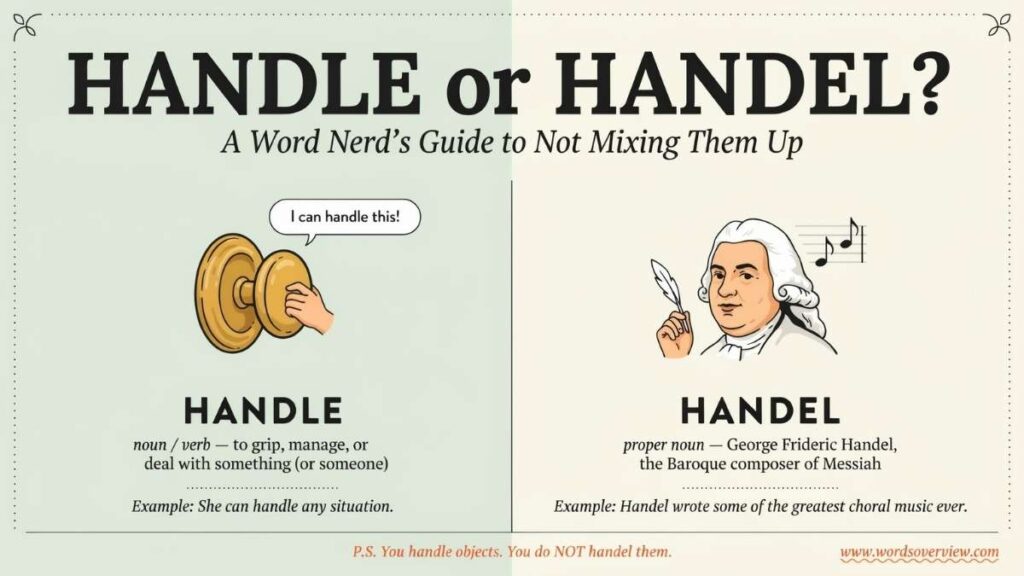
Ever stared at two nearly identical words and wondered whether English was playing a tiny spelling prank on you? The confusion between handle or Handel is a perfect example. One word can help you carry a suitcase, manage a difficult situation, or identify your social media account. The other takes you into the world of classical music and the famous composer George Frideric Handel. They even sound alike, which makes the confusion understandable. But their meanings, spellings, and uses are quite different. In this guide, you’ll learn the correct spelling, pronunciation, definitions, differences, and practical examples so you can handle this word puzzle with confidence.
Handle or Handel Quick Answer
If you’re asking, “Is it handle or handel?” the answer depends on what you mean.
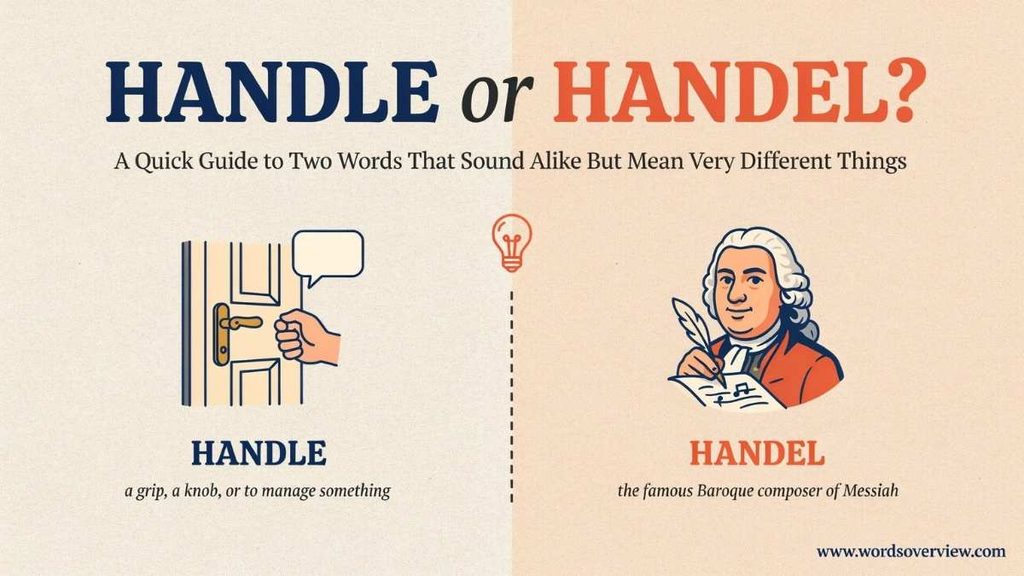
Use handle for the ordinary English word. Use Handel when referring to the surname, especially the famous composer George Frideric Handel.
| Word | Meaning | Typical Use | Example |
| handle | To manage, deal with, hold, touch, or operate something | Noun and verb | “She can handle the pressure.” |
| handle | A part designed for gripping or carrying | Noun | “The door handle is broken.” |
| handle | An online name or username | Noun | “What’s your Instagram handle?” |
| Handel | A surname | Proper noun | “Handel composed Messiah.” |
The distinction becomes even clearer through examples:
“Can you handle this customer complaint?”
“The suitcase handle broke.”
“What’s your social media handle?”
“Handel was an important Baroque composer.”
“George Frideric Handel composed Messiah.”
The simplest rule is this: handle belongs to everyday English, while Handel refers to a name.
Learn the difference between commonly confused words in English
To or Too What’s the Difference? Meaning And Examples
What Does Handle Mean?

The word handle has several connected meanings. At its most basic level, a handle is something you use to hold, carry, open, or control an object.
From that physical idea, the word developed broader meanings related to touching, operating, managing, and dealing with things.
Cambridge Dictionary lists handle as both a noun and a verb. As a noun, it can refer to a part of an object that you use to hold or move it. As a verb, it can mean dealing with something, taking responsibility for it, touching or moving it, or operating something.
Handle as a Noun
As a noun, handle commonly refers to a part of an object that gives you something to grip.
You might see a:
door handle
cup handle
drawer handle
suitcase handle
tool handle
shovel handle
pan handle
For example:
“The suitcase handle snapped while I was carrying it.”
In this sentence, handle refers to the physical part that you grip with your hand.
The noun also has an important modern meaning in digital communication. A social media handle refers to the name or identifier associated with an account on a social platform.
For example:
“The company’s social media handle appears on its website.”
This modern meaning explains why you often see phrases such as Instagram handle, X handle, and social media handle.
Handle as a Verb
As a verb, handle has a much wider range of meanings.
It can mean to deal with, manage, or take responsibility for something.
For example:
“She knows how to handle difficult customers.”
“Can you handle this project?”
“He handled the situation calmly.”
“I don’t think I can handle another deadline today.”
In each sentence, handle means some form of managing, dealing with, or coping with something.
The verb can also describe physically touching or moving an object:
“Please handle the antique vase carefully.”
It can describe operating or controlling something as well:
“This car handles well on winding roads.”
Therefore, when someone asks, “What does handle mean?” the answer depends on context. Common meanings include hold, touch, manage, control, operate, and deal with.
Handle Definition and Examples
A complete handle definition needs to cover both its noun and verb forms.
Handle Definition as a Noun
Handle means a part of an object designed for holding, carrying, moving, opening, or operating it.
Example:
“The drawer has a metal handle.”
Handle can also mean an informal name, nickname, or online account name.
Example:
“Her social media handle is easy to remember.”
Learn the difference between confusing more English words
Incurable or Uncurable? Meaning, Difference and Correct Usage
Handle Definition as a Verb
As a verb, handle means to deal with, manage, control, touch, hold, move, or operate something or someone.
Examples:
“The manager handled the complaint professionally.”
“Don’t handle the documents with dirty hands.”
The exact meaning always depends on the context.
What Does Handel Mean?
Now we reach the spelling that causes most of the confusion.
Handel is primarily a proper noun rather than an alternative spelling of the everyday English word handle.
The most famous person associated with this spelling is George Frideric Handel, the German-born composer who became an important figure in British musical life.
The Library of Congress identifies George Frideric Handel as a composer who lived from 1685 to 1759 and catalogs Messiah among his works.
Therefore, if you’re wondering about the Handel meaning, you shouldn’t treat Handel as another spelling of handle. In ordinary modern English, Handel mainly appears as a surname.
Handel as a Proper Noun
A proper noun identifies a particular person, place, organization, or other specific entity. That explains why you write:
George Frideric Handel
1: Handel’s music
2: Handel’s compositions
3: Handel’s Messiah
You wouldn’t write:
“George Frideric handle composed Messiah.”
You also wouldn’t write:
“Handle composed Messiah.”
Those forms change a person’s surname into an ordinary English word.
Learn the difference between similar English words the easy way
Inact or Enact: Which Spelling Is Correct?
George Frideric Handel The Name Behind Handel
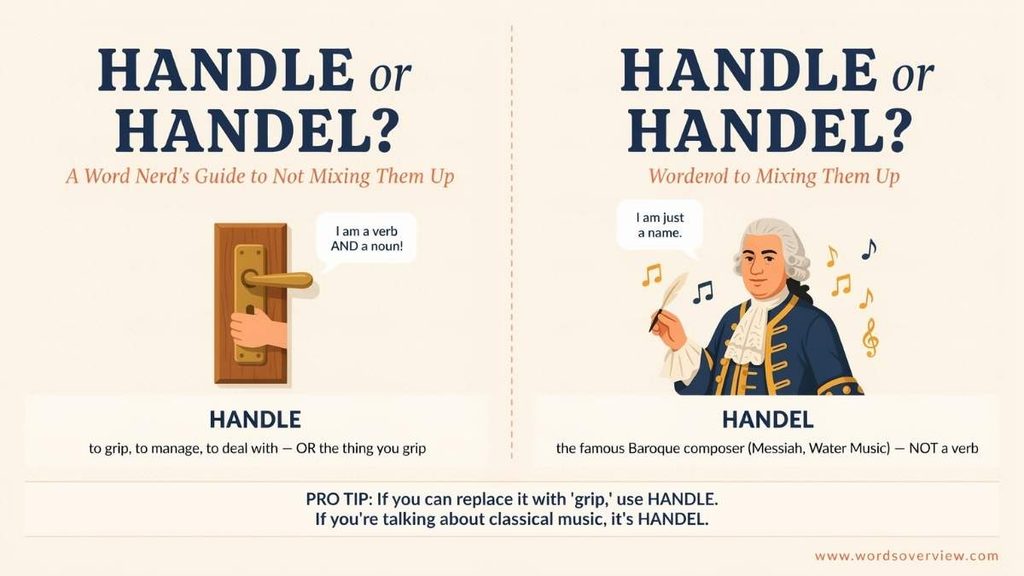
If you’ve searched for “Handel composer,” you’ve encountered the second meaning behind this spelling.
George Frideric Handel was born in 1685 in Halle and died in 1759. He became one of the best-known composers of the Baroque period and developed a lasting reputation through his vocal and instrumental works.
His best-known composition may be Messiah, an oratorio that remains widely performed.
This historical connection provides an easy way to remember the spelling:
Handle helps you hold or manage something. Handel was a composer.
That simple association can make the difference much easier to remember.
Handle or Handel: Key Differences
The handle vs handel distinction becomes much clearer when you compare the words by grammatical function and meaning.
| Feature | Handle | Handel |
| Standard everyday English word | Yes | No |
| Common noun | Yes | No |
| Verb | Yes | No |
| Proper noun | Sometimes as a surname | Yes |
| Physical grip | Yes | No |
| Meaning “manage” | Yes | No |
| Social media username | Yes | No |
| Famous composer | No | Yes |
| Usually lowercase | Yes | No, when referring to the surname |
| Example | “Handle the problem.” | “Handel wrote Messiah.” |
The handle or handel difference has nothing to do with British English versus American English. It comes from the fact that these are different words.
Learn the difference between more words people mix up
Tomorrows or Tomorrow’s Difference, Meaning and Usage
Handle or Handel Pronunciation
Pronunciation adds another layer to this spelling confusion.
In standard English pronunciation, handle has two syllables with stress on the first syllable. Cambridge Dictionary gives the US pronunciation as /ˈhæn.dəl/.
Handel, when referring to the composer, commonly has essentially the same pronunciation in English.
That means handle and Handel can sound alike in ordinary spoken English even though their spellings and meanings differ.
Are Handle and Handel Homophones?
In common English pronunciation, handle and Handel can function as homophones because they share the same pronunciation while having different spellings and meanings.
Homophones often create spelling problems because spoken English doesn’t show the letters on the page.
Consider other familiar examples:
right / write
flower / flour
sea / see
pair / pear
handle / Handel
The important lesson is that pronunciation alone doesn’t determine spelling.
Handle or Handel Pronunciation
If you’re wondering how do you pronounce handle, pronounce it with the stress on the first syllable.
If you’re wondering how do you pronounce Handel, the English pronunciation used for the composer’s surname is essentially the same.
So, if you hear either word in conversation, you may not know which spelling the speaker means. Context provides the answer.
Handle or Handel Meaning: Context Changes Everything
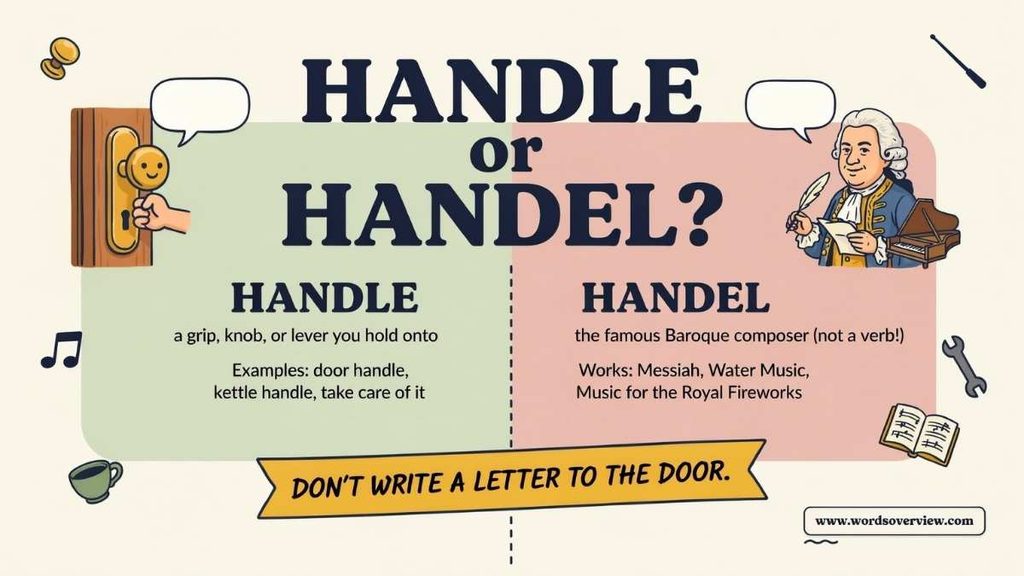
The best way to understand the handle or handel meaning is to examine the context.
Consider these two sentences:
“I can’t handle this workload.”
Here, handle means manage or cope with.
Now compare:
“Handel wrote some of the best-known music of the Baroque period.”
Here, Handel refers to a person.
Another pair makes the distinction even clearer:
“The cup has a broken handle.”
Here, handle refers to a physical part.
“I listened to a recording of Handel last night.”
Here, Handel refers to the composer or his music.
The pronunciation doesn’t tell you which meaning applies. The context does.
Learn the difference between commonly confused words in English
Trialled or Trialed Which Is Correct?
Why Do People Confuse Handle and Handel?
Similar Spelling
The two forms look remarkably similar:
handle
handel
Only one letter separates them. That small visual difference can easily lead to a spelling mistake, especially when you’re writing quickly.
Similar Pronunciation
Because the words can sound the same in spoken English, people sometimes write the spelling they think they heard.
This problem becomes especially noticeable when someone encounters Handel as a surname but already knows handle as an everyday word.
Proper Names Add Another Layer
A writer who knows Handel from music history may naturally recognize the name. Another writer may have encountered only handle in everyday vocabulary.
The two forms can therefore collide when someone relies on memory rather than context.
English Contains Many Homophones
English has a large number of words that share pronunciation while using different spellings.
Learning these words individually can help, but learning them through context often works better.
Instead of memorizing “handle and Handel are different,” connect each spelling to its meaning:
Handle = manage, hold, operate, or online name.
Handel = surname and composer.
Is Handel a Word?
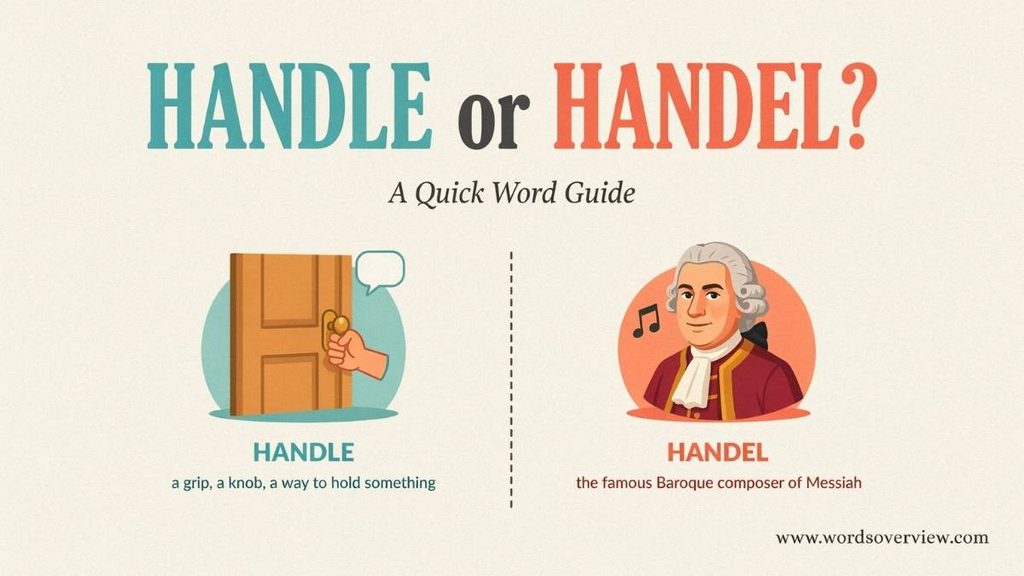
Yes, Handel exists as a written form in English, but it primarily functions as a proper name rather than an ordinary vocabulary word.
If you’re asking whether Handel can replace handle in an everyday sentence, the answer is no.
Incorrect:
“I can’t Handel this problem.”
Correct:
“I can’t handle this problem.”
But this sentence works:
“Handel composed Messiah.”
The distinction is simple: Handel is a name, while handle is the standard English word for the everyday meanings discussed above.
Learn the difference between commonly misused words
Allie or Ally Difference, Meaning, Spelling and Usage
Is Handle a Word?
Yes. Handle is a standard English word that functions as both a noun and a verb.
As a noun:
“The door handle is loose.”
As a verb:
“She can handle difficult situations.”
The word also appears frequently in online communication:
“What’s your Instagram handle?”
This modern usage has made handle even more common in everyday written English.
Handle as a Noun
The noun handle covers several meanings.
Physical Object
A handle gives you something to grip, carry, open, or control.
Common examples include:
door handle
suitcase handle
cup handle
drawer handle
hammer handle
shovel handle
Informal Name
Handle can also refer to an informal name or nickname.
The word gained an especially strong association with online identities as internet communication became more widespread.
Social Media Handle
A social media handle identifies a person’s or organization’s account on a social platform.
For example:
“Follow the organization using its official social media handle.”
The word handle works naturally here because an online handle identifies an account in much the same way that a physical handle gives you something to grasp or work with.
Handle as a Verb
The verb handle has several important uses in everyday English.
Handle Something = Deal With It
When you handle something, you can manage or deal with it.
For example:
“The manager handled the complaint quickly.”
Here, handle means to take responsibility for the problem and respond to it.
Handle a Situation = Manage the Situation
The phrase handle a situation refers to dealing with circumstances effectively.
For example:
“She handled the emergency calmly.”
The sentence suggests that she responded appropriately rather than becoming overwhelmed.
Handle Someone = Deal With a Person
Handle someone can refer to dealing with a person, particularly when that person presents a challenge.
For example:
“He knows how to handle difficult customers.”
Depending on the context, this expression can sound neutral, practical, or forceful. The surrounding words determine the intended meaning.
Handle Something Physically
Handle can also describe physically touching, holding, or moving something.
For example:
“Please handle the glass carefully.”
Here, handle means to touch or move the object with your hands.
Handle Social Media Meaning
The internet has given handle another highly recognizable meaning.
A social media handle refers to a name or identifier associated with an online account. Many platforms display such identifiers with an @ symbol.
For example:
“Follow the company’s official social media handle.”
Instagram Handle Meaning
An Instagram handle refers to the account username or identifier associated with an Instagram account.
If someone asks:
“What’s your Instagram handle?”
they’re essentially asking:
“What’s your Instagram username?”
The correct spelling remains handle, not handel.
Learn the difference between basic English word mistakes
Maxxed or Maxed Which Spelling Is Correct?
Social Media Handle vs. Username
The terms social media handle and username often overlap, although individual platforms may use their own terminology.
| Term | General Meaning |
| username | The name associated with an online account |
| handle | An informal term for an online identity or account name |
| social media handle | A handle used on a social platform |
| Instagram handle | The account identifier used on Instagram |
Handle or Handel in Everyday Writing
Emails
Professional emails commonly use handle when someone refers to a responsibility or task.
For example:
“I’ll handle the report.”
“Maria will handle the client communication.”
News Writing
News writing may use either word depending on the subject.
“Officials are trying to handle the situation.”
But:
“The concert featured music by Handel.”
Social Media
Online writing uses handle when referring to an account name.
“Add your Instagram handle to your profile.”
Formal Writing
Formal writing follows the same spelling distinction.
“The committee handled the issue carefully.”
But:
“Handel’s compositions remain important in the history of Western music.”
Formal writing doesn’t turn handle into handel. The meaning determines the spelling.
Learn the difference between often confused words
Emerse or Immerse Which Spelling Is Correct?
Handle or Handel Common Mistakes
Mistake 1: Writing Handel When You Mean Manage
Incorrect:
“Can you Handel this problem?”
Correct:
“Can you handle this problem?”
The verb always uses handle.
Mistake 2: Thinking Handel Is the British Spelling
This misconception often appears because English has genuine British-American spelling differences.
However, handle isn’t one of them.
British English and American English both use handle for the ordinary English word.
Mistake 3: Writing Handel for Social Media
Incorrect:
“What’s your Instagram Handel?”
Correct:
“What’s your Instagram handle?”
Social media handle is the established expression.
Mistake 4: Lowercasing a Name
When you refer to the composer, write:
“Handel”
rather than:
“handel”
A surname is a proper noun and normally begins with a capital letter.
Mistake 5: Trusting Pronunciation Alone
Hearing a word doesn’t always tell you how to spell it.
If someone says “handle,” you need to consider the meaning before choosing the written form.
The Origin of Handle and Handel
The histories of handle and Handel help explain why you shouldn’t treat them as two spellings of the same word.
The English word handle traces back to Old English. Etymological sources connect the noun with hand and associate its early development with something used by the hand. The verb developed from Old English handlian, with meanings connected to touching, moving, or dealing with something.
That history explains why the modern meanings remain connected.
1: You handle an object with your hands.
2: You handle a problem by dealing with it.
3: You handle responsibility by taking care of it.
4: You handle a customer by dealing with that person.
The physical idea of using your hands developed into broader figurative meanings.
Handel’s Origin Is Different
Handel is a surname rather than an alternative spelling of the English word handle.
The famous composer carried the surname George Frideric Handel. Historical records identify him as a major composer born in 1685 and deceased in 1759.
Therefore, the similarity between handle and Handel shouldn’t make you assume that they represent different forms of the same English word.
Handle or Handel British English vs. American English
Some spelling questions genuinely depend on the variety of English you use.
For example, American and British English differ in forms such as:
color / colour
center / centre
traveled / travelled
Handle and Handel don’t belong to this group.
Both British and American English use handle as the standard spelling of the everyday English word.
Handel remains a proper name.
So you don’t need to choose between British handel and American handle. That spelling distinction doesn’t exist.
Learn the difference between confusing word pairs
Lader or Ladder Which Spelling Is Correct?
Handle or Handel: A Simple Memory Trick
When the spelling starts to blur, connect the word to its meaning.
If You Can Hold It, Use Handle
A handle is something you can hold.
Think about a:
door handle
cup handle
suitcase handle
tool handle
This connection gives you the spelling handle.
If You Can Hear His Music, Use Handel
Handel points to the composer.
Think:
Handel → composer → Messiah
This simple association makes the distinction easier to remember.
Handle or Handel Quick Decision Guide
Ask yourself what you’re talking about.
Are you talking about managing or dealing with something?
Use handle.
Are you talking about a physical grip or part of an object?
Use handle.
Are you talking about an Instagram or social media name?
Use handle.
Are you talking about a username or online identity?
Use handle.
Are you talking about George Frideric Handel?
Use Handel.
Are you talking about Messiah and its composer?
Use Handel.
Once you identify the meaning, the correct spelling usually becomes obvious.
Handle or Handel Comparison Table
| Question | Correct Answer |
| Which spelling means “manage”? | handle |
| Which spelling means a physical grip? | handle |
| Which spelling describes an online username? | handle |
| Which spelling works as a common verb? | handle |
| Which spelling works as a common noun? | handle |
| Which spelling refers to the famous composer? | Handel |
| Is Handel the British spelling of handle? | No |
| Are they commonly pronounced alike? | Yes |
| Do they have different meanings? | Yes |
| Is handle a standard English word? | Yes |
| Is Handel a proper name? | Yes |
Learn the difference between similar English words
Unattentive or Inattentive Which Word Is Correct?
Practice Session Handle or Handel
Fill in each blank with handle or Handel.
- I don’t know how to ______ this difficult situation.
- The door ______ is broken.
- George Frideric ______ was a famous Baroque composer.
- She can ______ pressure very well.
- Please use the suitcase ______ when carrying it upstairs.
- ______ composed the famous oratorio Messiah.
- He knows how to ______ difficult customers professionally.
- The cup has a small ______ on the side.
- My social media ______ is easy to remember.
- We need someone who can ______ this responsibility.
- The chef carefully grabbed the pan by its ______.
- ______ was born in Halle in 1685.
- Can you ______ this problem by yourself?
- She changed her Instagram ______ last week.
- The drawer ______ came loose.
- I can’t ______ all this work alone.
- ______ is remembered for his contributions to Baroque music.
- The hammer has a wooden ______.
- He remained calm and knew exactly how to ______ the situation.
- What’s your Instagram ______?
- The broken door ______ needs to be replaced.
- George Frideric ______ wrote Messiah.
- She learned how to ______ difficult situations at work.
- A social media ______ can identify an account online.
- ______ and Messiah are closely associated with Baroque music.
Answer Key
| # | Answer |
| 1 | handle |
| 2 | handle |
| 3 | Handel |
| 4 | handle |
| 5 | handle |
| 6 | Handel |
| 7 | handle |
| 8 | handle |
| 9 | handle |
| 10 | handle |
| 11 | handle |
| 12 | Handel |
| 13 | handle |
| 14 | handle |
| 15 | handle |
| 16 | handle |
| 17 | Handel |
| 18 | handle |
| 19 | handle |
| 20 | handle |
| 21 | handle |
| 22 | Handel |
| 23 | handle |
| 24 | handle |
| 25 | Handel |
Here’s a trusted source for clear more words Comparison:
Grammar Update
FAQs About Handle or Handel
Is it handle or Handel?
Handle is the correct spelling for the common English word meaning to manage, deal with, hold, touch, or operate something. Handel is primarily a proper name, especially the surname of composer George Frideric Handel.
What is the difference between handle and Handel?
Handle is a common English noun and verb, while Handel is mainly a proper noun and surname. For example, you can handle a situation or hold a door handle, but Handel refers to the composer or someone with that surname.
Is Handel the correct spelling of handle?
No. Handel isn’t an alternative spelling of handle. If you mean “manage,” “deal with,” or a physical grip, the correct spelling is handle.
Are handle and Handel homophones?
Yes. In standard English pronunciation, handle and Handel are commonly pronounced alike or nearly alike. They have different spellings and meanings, however, which makes them a useful example of a homophone pair.
How do you spell handle correctly?
The correct spelling is handle: H-A-N-D-L-E. You use this spelling when referring to a physical grip, an online username, or the act of managing or dealing with something.
What does handle mean?
Handle can mean a physical part that you hold, such as a door or cup handle. As a verb, it can mean to manage, deal with, control, touch, move, or operate something, depending on the context.
What does it mean to handle something?
To handle something means to deal with, manage, control, operate, touch, or move it. For example, “She can handle the project” means she can manage the project successfully.
What does it mean to handle a situation?
To handle a situation means to manage or deal with circumstances in an effective or appropriate way. For example, “He handled the situation calmly” means he responded to the situation without losing control.
What does it mean to handle someone?
To handle someone generally means to deal with or manage a person, especially in a particular situation. For example, “She knows how to handle difficult customers” means she knows how to deal with them effectively.
What is a handle for a person?
For a person, a handle can mean a nickname, informal name, or online username. Today, the term commonly appears in phrases such as social media handle, Instagram handle, and online handle.
What does handle mean on social media?
A social media handle is the name or identifier associated with an account on a social platform. People often use the term to refer to an account’s username, particularly when it appears with an @ symbol.
What does Instagram handle mean?
An Instagram handle refers to the username or account identifier used on Instagram. If someone asks for your Instagram handle, they’re generally asking for the name associated with your Instagram account.
What does “handle it” mean?
Handle it means to deal with, manage, or take responsibility for something. For example, “Don’t worry, I’ll handle it” means the speaker will take care of the matter.
What is another word for handle?
The best synonym depends on how handle appears in the sentence. As a verb, possible alternatives include manage, deal with, control, address, tackle, and take care of. As a noun, alternatives for a physical handle can include grip or knob, depending on the object.
What is another word for handled?
Depending on the context, handled can mean managed, dealt with, addressed, controlled, operated, or took care of. For example, “She handled the complaint” can become “She dealt with the complaint.”
What does “getting handled” mean?
Getting handled can have different meanings depending on context. In ordinary usage, it may mean being dealt with, managed, or taken care of. In informal slang, the expression can have more specific meanings, so the surrounding sentence determines the intended sense.
Why is it called a handle?
The word handle relates historically to the hand because a handle gives you something to hold, grip, carry, open, or control. Over time, the word developed broader meanings connected with managing or dealing with things.
Handle or Handel Final Verdict
So, handle or Handel? Thankfully, this spelling mystery doesn’t need a detective. Handle is the everyday English word you use for a door, suitcase, problem, responsibility, or social media account. Handel, on the other hand, usually refers to George Frideric Handel, the famous Baroque composer. Although the two words sound alike, their meanings and uses are completely different. Remember the simple trick: if you’re talking about managing something or holding something, choose handle. If you’re talking about classical music, choose Handel. Once you know the difference, this commonly confused pair becomes much easier to handle—and your spelling mistakes can finally take a well-deserved bow.

Ethan AJS is an experienced blogger and language enthusiast at Words Overview, dedicated to making English easier to understand and use. He writes about grammar, vocabulary, spelling, word meanings and commonly confused words, turning tricky language questions into clear, practical insights. With a passion for effective communication, Ethan creates engaging, readerfocused content that helps readers write accurately, choose the right words and communicate with confidence.




