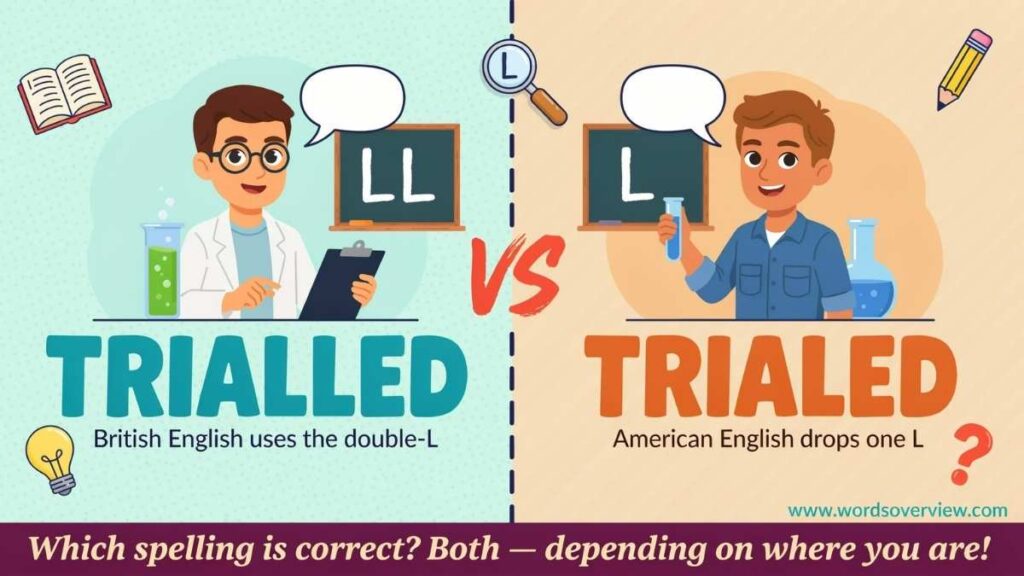
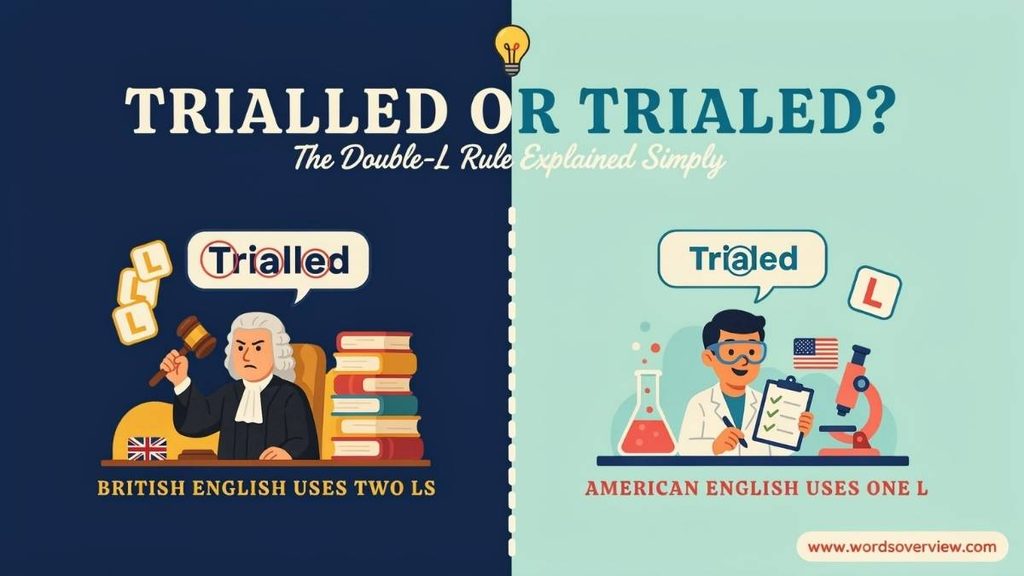
English spelling loves creating tiny mysteries. One extra letter can make a perfectly good word look suspicious and trialled or trialed is a classic example. At first glance, you might wonder whether one spelling is correct and the other belongs in the grammar-error penalty box. Fortunately, there’s no need to panic or reach for the red pen. Both spellings are correct, but they follow different regional conventions. American English generally uses trialed, while British English uses trialled. The meaning remains the same: testing, evaluating or experimenting with something. So, before Grammarly starts judging your spelling, let’s clear up the confusion and discover when to use each form.
Trialled or Trialed Quick Answer
The short answer is simple: both spellings are correct.
| Spelling | Main variety | Meaning | Correct? |
| trialed | American English | Tested or evaluated | Yes |
| trialled | British English | Tested or evaluated | Yes |
Both words come from the verb trial. The spelling changes according to the English variety, but the meaning does not.
In American English, use trialed. In British English, use trialled. Therefore, neither spelling is automatically wrong.
Simple Examples
Here are some examples that show the difference clearly:
- American English: The company trialed the new payment system.
- British English: The company trialled the new payment system.
- American English: Researchers trialed the treatment on a small group.
- British English: Researchers trialled the treatment on a small group.
- American English: The school trialed a new teaching method.
- British English: The school trialled a new teaching method.
In each pair, the meaning stays exactly the same. Only the spelling changes.
The action also remains the same: someone tested something to determine whether it worked, performed well or suited a particular purpose.
What Does Trial Mean as a Verb?
The word trial usually appears as a noun. You may think of a court trial, a product trial or a trial period. However, trial can also function as a verb.
As a verb, trial means to test something or make experimental use of it. In other words, someone trials a product, method, system, treatment or process to see how well it works.
This use appears frequently in business, medicine, education, technology, research and product development.
A useful way to remember the meaning is:
Trial as a verb = test or evaluate something in practice.
For example:
- The hospital trialed a new treatment.
- The hospital trialled a new treatment.
- The engineers trialed the updated system.
- The engineers trialled the updated system.
- The school trialed a new reading program.
- The school trialled a new reading program.
Although the spelling differs, each sentence describes an evaluation or test.
Trial as a Verb in Different Contexts
The verb trial works naturally in several professional and everyday contexts.
Product testing: A company may trial a new product before releasing it to the wider market.
Software testing: A developer may trial a new feature with a limited group of users.
Medical research: Researchers may trial a treatment or intervention to evaluate its effectiveness.
Education: A school may trial a new teaching method before adopting it permanently.
Business processes: An organization may trial a new workflow to determine whether it improves efficiency.
In every case, the central idea remains the same: someone tests something in practice before making a broader decision.Learn the difference between similar English words the easy way
Unvoluntary or Involuntary Which One Is Correct?
Trialed or Trialled Why Are There Two Spellings?
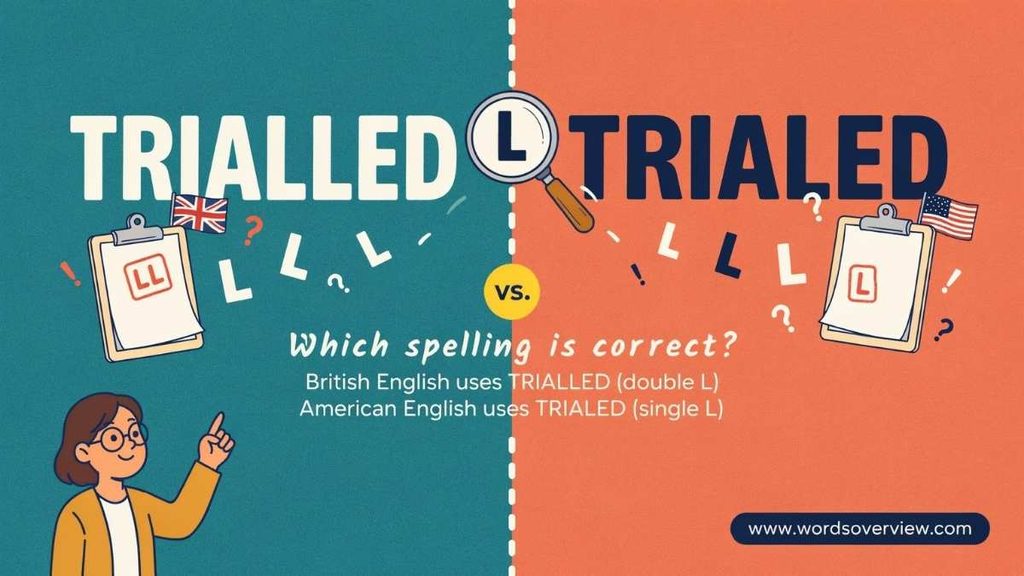
The difference between trialed vs trialled comes from regional spelling conventions rather than a difference in meaning.
English has developed different spelling preferences in the United States and Britain. Over time, American English standardized several shorter spellings, while British English retained or developed forms with additional letters in certain words.
As a result, you can find familiar spelling pairs such as:
traveled / travelled
labeled / labelled
canceled / cancelled
modeled / modelled
trialed / trialled
Therefore, trialed spelling is not a careless version of the British form. Instead, it follows the spelling convention used in American English.
Likewise, trialled spelling is not an exaggerated version of the American form. Rather, it follows British English conventions.
The Spelling Pattern Behind Trialed and Trialled
The difference becomes easier to see when you compare the two forms:
American English:
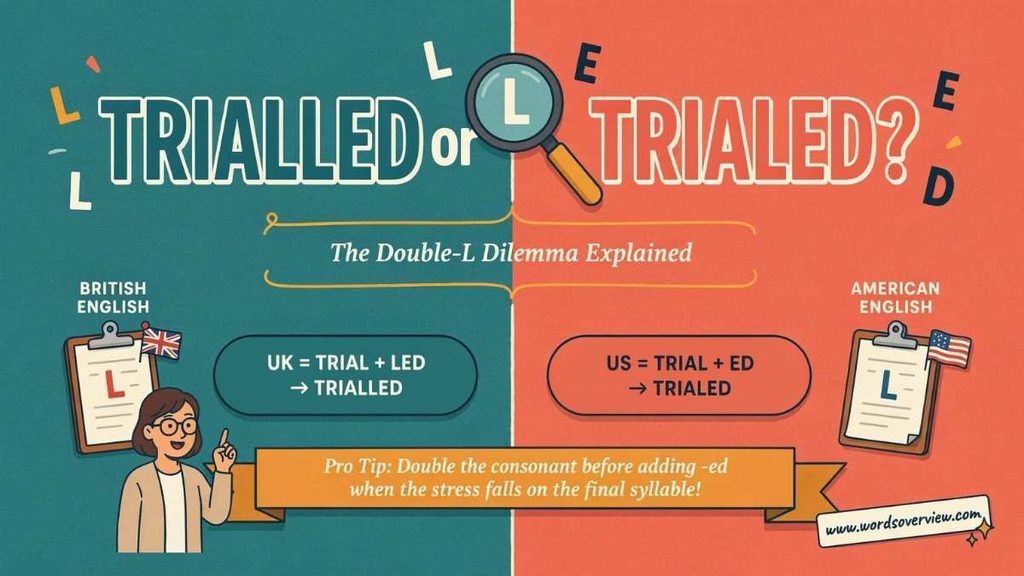
trial + ed → trialed
British English:
trial + led → trialled
The same regional distinction appears in the present participle.
| Verb form | American English | British English |
| Base form | trial | trial |
| Third-person singular | trials | trials |
| Present participle | trialing | trialling |
| Past tense | trialed | trialled |
| Past participle | trialed | trialled |
Therefore, the difference affects more than the past tense. American English uses trialing, while British English uses trialling.
Why the Extra L Doesn’t Change the Meaning
The additional l does not create a new meaning. Both trialed and trialled refer to the same completed action.
Compare these sentences:
The company trialed the software for three months.
The company trialled the software for three months.
Both sentences tell the reader that the company tested the software for three months.
Therefore, this is a spelling variation, not a vocabulary difference.
Learn the difference between commonly confused words in English
Months or Monthes Which Spelling Is Correct?
Trialled or Trialed British English vs American English
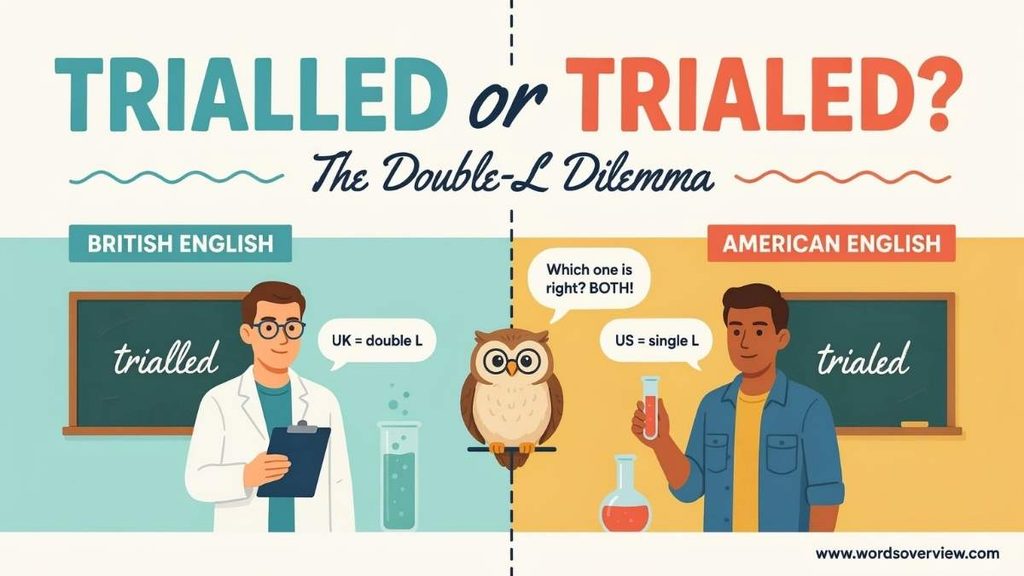
The clearest way to understand trialled vs trialed is to connect each spelling with its regional English variety.
Trialed in American English
Trialed is the standard American English form.
You may commonly see it in US writing about:
- Technology
- Business
- Medicine
- Education
- Product development
- Research
- Testing procedures
For example:
The researchers trialed the new method before recommending it for wider use.
The company trialed the software with selected customers.
The district trialed the new curriculum at three schools.
If your document follows American English spelling, trialed is the natural choice.
Trialled in British English
Trialled is the standard British English form.
For example:
The researchers trialled the new method before recommending it for wider use.
The company trialled the software with selected customers.
The council trialled the new service in several areas.
Therefore, if your document follows British English spelling, choose trialled.
Learn the difference between similar English words the easy way
Alternately or Alternatively Meaning and Difference
What About Canadian, Australian and Other English Varieties?
English does not divide neatly into only two categories.
Different countries and organizations can follow different style traditions. Many Commonwealth varieties share several features with British spelling. However, individual publications, institutions and style guides may follow their own conventions.
For example, trialled can appear naturally in Australian English because Australian English generally uses many British-style spelling conventions.
Still, it is better to avoid an overly rigid rule such as “every Commonwealth country must use trialled.” Actual usage depends on the country’s established conventions and the style guide that a publication or organization follows.
The practical rule is much easier:
Follow the spelling system used by your audience or organization and remain consistent.
Trialed or Trialled Grammar and Word Forms
The trialed or trialled grammar question becomes much easier once you recognize the word as a regular verb.
The basic forms are:
| Verb form | American English | British English |
| Base | trial | trial |
| Present | trial | trial |
| Third person | trials | trials |
| Past tense | trialed | trialled |
| Past participle | trialed | trialled |
| Present participle | trialing | trialling |
Both trialed and trialled can function as the past tense and past participle of trial.
What Is the Past Tense of Trial?
If you ask, “What is the past tense of trial?”, the answer depends on the variety of English:
American English: trialed
British English: trialled
For example:
The engineers trialed the machine last month.
Or:
The engineers trialled the machine last month.
In both sentences, the action happened in the past.
Therefore, the trial past tense has two standard regional spellings.
Learn the difference between commonly confused words in English
Classes or Class’s Meaning And Difference
Trialed and Trialled as Past Participles
The same forms also work as past participles.
For example:
The company has trialed the system.
In British English:
The company has trialled the system.
You can also use these forms with auxiliary verbs:
- had trialed
- has trialed
- have trialed
- had trialled
- has trialled
- have trialled
So, if you’re searching for the trialed past tense of trial, remember that trialed functions as both the past tense and past participle in American English.
Likewise, trialled performs both functions in British English.
Trialed or Tried Are They the Same?
This is where the confusion becomes more interesting.
Trialed and tried can have related meanings in some contexts, but they do not come from the same verb.
Trialed/trialled comes from the verb trial.
Tried comes from the verb try.
The difference becomes clearer when you compare their meanings.
The company trialed the new software.
Here, the sentence means that the company tested the software.
Now compare:
The company tried the new software.
This sentence can also suggest that the company used or attempted the software. However, it does not necessarily emphasize a structured test or evaluation.
That distinction matters.
When Trialed or Trialled Is More Precise
Use trialed or trialled when the context involves deliberately testing something.
For example:
The hospital trialed a new treatment protocol.
The sentence suggests an organized evaluation of the treatment.
Likewise:
The school trialled a new teaching method.
Here, the school tested the method to determine how effectively it worked.
Learn the difference between similar English words the easy way
Boxes or Boxs Which Spelling Is Correct?
When Tried Is the Better Choice
Use tried when you mean attempted or made an effort.
For example:
She tried to fix the printer.
It would sound unnatural to replace tried with trialed because the sentence describes an attempt rather than a testing program.
A simple memory trick can help:
Try = attempt.
Trial = test or evaluate.Learn the difference between basic English word mistakes
Address or Adress Which Spelling Is Correct?
Trialed or Trialled in Court Don’t Confuse It With Tried
Legal language creates another potential trap.
A person can be tried in court, but that does not mean the correct word is trialed or trialled.
For example:
The defendant was tried in court.
Here, tried comes from try in the legal sense of examining or judging a case.
The noun is:
The defendant faced a trial.
The verb is:
The defendant was tried by the court.
This differs from:
The company trialed a new legal software system.
In the second sentence, trialed means tested.
Trial vs Tried in Court
| Word | Role | Meaning |
| trial | Noun | A legal proceeding |
| tried | Verb | Examined or judged in court |
| trialed | Verb | Tested something experimentally |
| trialled | Verb | Tested something experimentally |
Therefore, phrases such as trialled in court and trialed in court can create confusion when the intended meaning concerns a defendant’s legal case.
If you’re talking about a defendant and a court case, tried is normally the relevant verb.
However, if you’re talking about testing a system, procedure or method in a legal setting, trialed or trialled can be correct.
For example:
The court tried the defendant.
But:
The court trialled a new case-management system.
The difference may look small, but the meaning changes significantly.
Trialed in a Sentence Examples
If you’re wondering how to use trialed in a sentence, place it after a subject that deliberately tested something.
Business and Product Testing
The company trialed the new payment system with a small group of customers.
The retailer trialed a redesigned checkout process.
The manufacturer trialed the product before launching it nationwide.
These examples use trialed in the American English sense of testing or evaluating something.
Technology and Software
The development team trialed the new software before releasing it publicly.
The university trialed an online learning platform during the spring semester.
The company trialed the feature with selected users.
In these examples, the verb communicates more than simply using the software. Instead, it suggests that the organization evaluated the software or feature.
Testing a New Method
The researchers trialed a new method for analyzing the data.
The school trialed a different approach to reading instruction.
The engineers trialed the new system under controlled conditions.
These examples show trialed usage clearly because each sentence involves deliberate evaluation.
Learn the difference between tricky words and use them correctly
Stabilise or Stabilize Which Spelling Is Correct?
Trialled in a Sentence Examples
If you’re asking how to use trialled in a sentence, the grammatical structure remains the same. Only the regional spelling changes.
Product Testing
The company trialled the new product with selected customers.
The manufacturer trialled the equipment before full production.
Education
The school trialled a new teaching method.
Several classrooms trialled the program before its wider introduction.
Technology
The company trialled the new software with a limited number of users.
Engineers trialled the system under different conditions.
Research
Researchers trialled several approaches before selecting the most effective one.
In each case, trialled means tested or evaluated.
Learn the difference between commonly confused words in English
Employees or Employee’s Which Is Correct?
Trialed Spelling vs Trialled Spelling
The trialed spelling and trialled spelling provide a classic example of regional English variation.
The easiest comparison looks like this:
| American English | British English |
| trialed | trialled |
| trialing | trialling |
| traveled | travelled |
| labeled | labelled |
| canceled | cancelled |
| modeled | modelled |
This comparison does not mean every English-speaking country uses the British column in every situation. Instead, it illustrates a broader pattern in American vs British spelling.
The most important point is consistency.
If you choose American English, use trialed.
If you choose British English, use trialled.
Furthermore, don’t switch between the two simply because your spell checker accepts both. A professional document should follow one clear spelling system unless a specific quotation, name or source requires otherwise.
Trialed or Trialled A Practical Comparison
| Feature | Trialed | Trialled |
| Base word | trial | trial |
| Meaning | Test or evaluate | Test or evaluate |
| Past tense | Yes | Yes |
| Past participle | Yes | Yes |
| Main association | American English | British English |
| Pronunciation | Same | Same |
| Meaning difference | None | None |
| Spelling difference | One l before -ed | Double l before -ed |
| Present participle | trialing | trialling |
| Suitable for US English | Yes | Generally not preferred |
| Suitable for UK English | Generally not preferred | Yes |
Therefore, the choice depends primarily on your English variety rather than the meaning you want to express.
Is Trialed a Word?
Is trialed a word? Yes.
Trialed is a legitimate English word. It functions as the past tense and past participle of trial in American English.
The trialed definition is essentially tested or used experimentally.
For example:
The company trialed the new system for six months.
The sentence means that the company tested the system for six months.
So, if you’ve written trialed in American English, you haven’t invented a word or made a spelling mistake.
Learn the difference between often confused words
Pre vs Post Meaning, Difference and Grammar Rules
Is Trialled a Word?
Is trialled a word? Yes.
Trialled is also a legitimate English word. It serves as the British English past tense and past participle of trial.
The trialled definition carries the same basic meaning: tested or used experimentally.
For example:
The council trialled the new recycling system.
The council tested the system to determine how well it worked.
Therefore, trialled is not an incorrect version of trialed. Instead, it represents the British spelling.
Is Trialed Correct?
Yes.
Trialed is correct in American English.
If your writing follows US English conventions, trialed is the natural spelling.
For example:
The researchers trialed the new procedure.
There is no need to change it to trialled simply because the latter appears in British publications.
Is Trialled Correct?
Yes.
Trialled is correct in British English.
For example:
The researchers trialled the new procedure.
If your writing follows British English conventions, trialled is the appropriate spelling.
Therefore, both trialed and trialled are correct. The key is choosing the form that matches your regional spelling system.
Is It Trialed or Trialled?
If you’re asking is it trialed or trialled, first identify the English variety you are using.
For US English: choose trialed.
For UK English: choose trialled.
If you’re writing for an international audience, choose the spelling that matches your organization’s style guide or the spelling system used throughout the document.
The real mistake isn’t choosing one of these correct forms. Instead, the bigger problem is mixing spelling systems without a clear reason.
Which Is Correct Trialed or Trialled?
So, which is correct, trialed or trialled?
Both.
The better question is:
Which spelling matches the English variety being used?
For American English, trialed is correct.
For British English, trialled is correct.
Therefore, trialled or trialed which is correct is a question of regional spelling rather than right versus wrong.
Should I Use Trialed or Trialled?
Choose the spelling based on your audience organization and style guide.
Use Trialed If:
- You’re writing in American English.
- Your organization follows US spelling.
- Your publication uses American English.
- Your audience is primarily in the United States.
- The surrounding text follows American spelling conventions.
Use Trialled If:
- You’re writing in British English.
- Your organization follows UK spelling.
- Your publication uses British spelling.
- Your audience is primarily in the United Kingdom.
- The surrounding text consistently uses British spelling.
For Global or Mixed Audiences
A global audience doesn’t mean you should randomly alternate between the two forms.
Instead, establish one spelling system and apply it consistently.
For example, a website that generally uses American English should normally write:
The company trialed the new service.
A British-English publication should write:
The company trialled the new service.
As a result, readers can follow the document without wondering whether the spelling changes have a purpose.
A Short Case Study One Product, Two Spelling Systems
Imagine that a software company tests a new scheduling platform.
An American report might say:
The company trialed the scheduling platform with 500 users before the public launch.
A British report covering the same event might say:
The company trialled the scheduling platform with 500 users before the public launch.
Nothing about the test changed.
The users did not perform a different experiment. The company did not use a different platform. Instead, the spelling reflects the regional variety of English.
This example shows why treating trialled vs trialed as two different words creates unnecessary confusion.
Common Mistakes With Trialed and Trialled
Thinking Trialled Is Wrong
Thinking Trialled Is Wrong
Some American readers see the double l and assume that someone made a typo.
That’s not the case.
Trialled is the standard British form. Therefore, British writers can use it confidently.
Thinking Trialed Is Wrong
The reverse mistake happens too.
A British English reader may be more familiar with trialled and assume that trialed is incorrect.
It isn’t.
Trialed is the standard North American form.
Confusing Trialed With Tried
This mistake involves more than spelling.
Tried is the past tense of try, while trialed/trialled are past forms of trial.
Compare:
She tried to repair the computer.
with:
The company trialed the new computer system.
The first sentence describes an attempt. The second describes testing or evaluation.
Therefore, choosing between tried and trialed/trialled depends on the meaning, not simply the spelling.
Mixing Regional Spellings
A document can look inconsistent when it combines American and British spellings without a clear reason.
For example, using trialled, travelled and labelled in one document while suddenly switching to trialed can make the spelling system unclear.
Instead, pick one convention and stick with it.
Trialing or Trialling?
The same regional distinction appears in the present participle.
American English uses:
trialing
British English uses:
trialling
For example:
American English:
The company is trialing the new software.
British English:
The company is trialling the new software.
Therefore, the regional distinction does not apply only to the past tense. It also appears in the -ing form.
Why Pronunciation Doesn’t Help You Choose
One reason this spelling causes confusion is that trialed and trialled have the same pronunciation.
The additional l does not create an additional sound. Consequently, hearing the word won’t tell you which spelling a writer should use.
Instead, you need to consider the English variety.
This pattern appears frequently in regional spelling differences. The spoken form can remain the same even when the written form changes.
Learn the difference between similar English words the easy way
Presence or Presense Which Is Correct?
Practice Session Trialed or Trialled
Fill in each blank with the correct form: trialed, trialled, tried, trialing or trialling.
Questions
- The company ______ the new software before its official release.
- The British team ______ the new training method last month.
- The American company ______ the new product with a small group of customers.
- Researchers are ______ a new treatment for the condition.
- British researchers are ______ the new treatment this year.
- The engineers ______ several designs before choosing the final one.
- The school ______ a new teaching approach last semester.
- The manufacturer is ______ a more efficient production process.
- The manufacturer is ______ a more efficient production process in the UK.
- The new system was ______ successfully before launch.
- The new system was ______ successfully by the British engineering team.
- The scientists ______ the equipment under different conditions.
- The hospital ______ the new procedure before introducing it widely.
- The British company ______ the updated software with selected users.
- The American company is ______ a new version of the app.
- The British company is ______ a new version of the app.
- The defendant was ______ in court for the alleged offense.
- The researchers ______ the experimental method to determine whether it worked.
- The team ______ several possible solutions before selecting one.
- The company has ______ the new service in several cities.
- The company has ______ the new service in several British cities.
- The school is ______ a four-day timetable this semester.
- The British school is ______ a four-day timetable this semester.
- Remember that ______ is generally preferred in American English, while ______ is preferred in British English.
- In a legal context, use ______, not “trialed” or “trialled,” when referring to a defendant appearing before a court.
Answer Session
- trialed
- trialled
- trialed
- trialing
- trialling
- trialed
- trialed
- trialing
- trialling
- trialed
- trialled
- trialed
- trialed
- trialled
- trialing
- trialling
- tried
- trialed
- tried
- trialed
- trialled
- trialing
- trialling
- trialed; trialled
- tried
Here’s a trusted source for clear more words Comparison:
Grammar Update
Frequently Asked Questions
What does it mean to be trialed?
To be trialed means to have something tested, evaluated or used experimentally. In American English, trialed is the standard past tense and past participle of the verb “trial.” For example, “The company trialed the new software before releasing it.”
How do you use “trialled” in a sentence?
You can use trialled as the past tense or past participle of “trial” in British English. For example: “The researchers trialled the new treatment on a small group of patients.”
What does it mean to be trialled?
To be trialled means to undergo testing or evaluation. British English uses trialled, while American English generally uses trialed. Both forms have the same meaning.
How do you spell “trialled” in the UK?
In UK English, the correct spelling is trialled, with two l’s. The related present participle is trialling, also with two l’s.
Is “trialed” correct in American English?
Yes. Trialed is the standard American English spelling. American English generally uses one l in both trialed and trialing, while British English uses trialled and trialling.
Is it “tried” or “trialled” in court?
When referring to someone appearing before a court to determine their guilt or innocence, tried is the correct word. For example, “The defendant was tried in court.” Trialled refers to testing or evaluating something, not conducting a legal case against someone.
What is another word for “trialled”?
Depending on the context, alternatives to trialled include tested, evaluated, assessed, examined, experimented with and piloted. The best choice depends on what you’re describing.
Are “trialed” and “trialled” the same word?
Yes. Trialed and trialled are regional spelling variants of the same verb form. American English generally prefers trialed, while British English prefers trialled. Neither spelling changes the meaning.
Is “trialling” or “trialing” correct?
Both are correct, but they follow different regional conventions. Trialling is standard in British English, while trialing is standard in American English. Both mean testing or evaluating something.
Should I use “trialed” or “trialled”?
Choose the spelling that matches your variety of English and your audience. Use trialed for American English and trialled for British English. If you’re following a specific organization’s style guide, use its preferred spelling consistently.
Conclusion
The trialled or trialed debate sounds more dramatic than it really is. Luckily, English hasn’t created a spelling disaster here. Both forms are correct; the choice simply depends on the variety of English you use. American English generally prefers trialed, while British English uses trialled. The meaning stays exactly the same testing or evaluating something to see how well it works.
So, before Grammarly waves its imaginary red pen, check your audience and follow their regional spelling convention. Just remember one important distinction: when someone faces a courtroom, they are tried, not trialed or trialled. Once you remember that, this spelling mystery can finally go to trial and, thankfully, the verdict is easy: both spellings are correct!

Ethan AJS is an experienced blogger and language enthusiast at Words Overview, dedicated to making English easier to understand and use. He writes about grammar, vocabulary, spelling, word meanings and commonly confused words, turning tricky language questions into clear, practical insights. With a passion for effective communication, Ethan creates engaging, readerfocused content that helps readers write accurately, choose the right words and communicate with confidence.