
Have you ever typed a word so confidently that your keyboard almost deserved a medal, only to discover that one tiny letter ruined everything? The confusion around “presence or presense” creates exactly that kind of spelling trap. Although both forms may look convincing at first glance, only one belongs in standard English. In this guide, we’ll settle the presence or presense debate once and for all. You’ll learn the correct spelling, understand what presence means, discover why presense is incorrect and see how to use the word naturally in sentences. So, before your spell-checker starts judging you, let’s clear up this surprisingly common mistake.
Presence or Presense Quick Answer
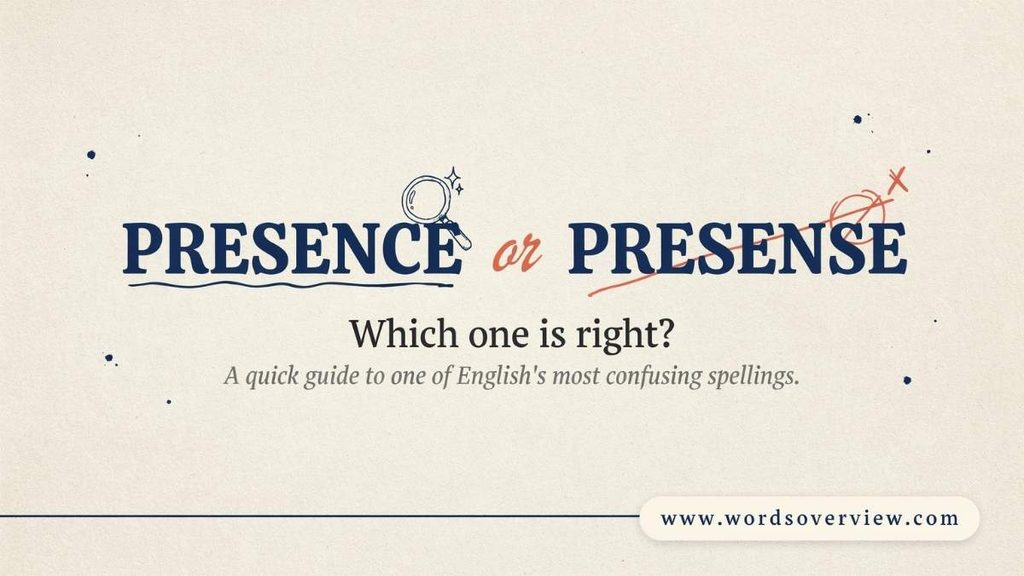
Presence is the correct spelling.
Presense is incorrect.
Here’s the difference at a glance:
| Word | Correct? | Meaning |
| Presence | Yes | The state or fact of being present |
| Presense | No | A misspelling of presence |
For example:
Her presence made the meeting more comfortable.
Not:
Her presense made the meeting more comfortable.
So, if you’re searching for presence or presense which is correct, the answer is presence.
The same answer applies to questions such as presence or presense which is right, is presence or presense correct and what is the correct spelling presence or presense.
There’s also no American-versus-British spelling difference. Both American and British English use presence.
What Does Presence Mean?
The presence meaning centers on the idea of being present. As a noun, presence generally refers to the state, fact or condition of being present in a particular place or situation.
A simple presence definition is:
Presence means the state or fact of being in a particular place or the noticeable effect, influence or quality that someone or something has.
This definition covers several common uses.
For example:
- Her presence was reassuring.
- The presence of students changed the atmosphere.
- The company has a strong online presence.
- Police presence increased in the area.
- His presence at the ceremony was important.
In each example, presence refers to something being there or having an identifiable effect.
Presence as Being in a Place
First, presence can refer to someone’s physical existence in a particular location.
If someone attends a meeting, their physical presence means they are actually there.
The manager requested the employee’s physical presence at the meeting.
Here, presence relates closely to attendance or being present. However, it doesn’t necessarily mean that the person participated actively. The word simply emphasizes that the person was there.
Presence as a Noticeable Quality
Sometimes, presence describes the effect a person has on others.
A person with a strong presence may attract attention without saying much. Their confidence, behavior, appearance, voice or personality can make them noticeable.
The speaker had a commanding presence on stage.
This meaning goes beyond simply being in a room. Someone can be physically present without having a particularly noticeable presence.
Presence as Existence or Influence
Presence can also describe the existence or influence of something in a particular environment.
For example:
The company has expanded its presence in the European market.
Here, presence doesn’t necessarily mean that the company has a physical office in every location. Instead, the phrase can describe its business activity, visibility, influence or availability.
For that reason, expressions such as online presence, professional presence and social presence have become common in modern English.
Learn the difference between commonly confused words in English
Months or Monthes Which Spelling Is Correct?
Presence or Presense Correct Spelling Why Is Presence Right?
The correct spelling of presence is presence, with a c before the final e.
The incorrect form, presense, replaces the c with an s.
Presence or Presense at a Glance
| Correct Form | Incorrect Form |
| presence | presense |
| presence spelling | presense spelling |
| presence meaning | presense meaning |
| presence definition | presense definition |
| presence in a sentence | presense in a sentence |
The easiest way to remember the spelling is to connect presence to present.
Present → Presence
That connection gives you a useful spelling anchor.
Consider these examples:
present → presence
absent → absence
Notice the pattern. Both presence and absence use the “-ence” ending.
Therefore, once you recognize the word family, presense becomes much easier to identify as an incorrect spelling.
How Do You Spell Presence?
If you’re asking how do you spell presence, the answer is:
P-R-E-S-E-N-C-E
The word contains a c rather than an s near the end.
How to Spell Presence Correctly
A useful memory method starts with present:
PRESENT → PRESENCE
You can remember the connection with this sentence:
If you are present, your presence can be noticed.
This approach works better than trying to memorize a string of letters without context.
Another helpful comparison is:
| Base Word | Related Noun |
| present | presence |
| absent | absence |
Both related nouns use the “ence” ending.
So, when you’re unsure about the presence spelling, don’t rely entirely on pronunciation. Instead, connect the word to present.
Is Presense a Word?
No. Presense is not the standard English word.
If you’re asking is presense a word, is presense a correct word or is presense a word in English, the answer remains no in standard modern English usage.
Writers generally use presense when they intend to write presence.
Therefore, treat presense as a spelling error, not as an alternative form.
Is Presence a Word?
Yes. Presence is a standard English word and functions as a noun.
For example:
The teacher’s presence helped keep the classroom calm.
The word appears in everyday English, academic writing, professional communication, literature, journalism, business writing and many other contexts.
The distinction is simple:
| Word | Status |
| Presence | Correct English word |
| Presense | Incorrect spelling |
Learn the difference between similar English words the easy way
Unvoluntary or Involuntary Which One Is Correct?
Presence or Presense Meaning What Does Presence Mean in English?
The presence meaning in English changes slightly according to context. However, the central idea remains the same: being there or having an observable effect.
Here are the main meanings:
| Meaning | Explanation | Example |
| Physical presence | Being physically somewhere | Her presence was required at the event. |
| Attendance | Being present at an occasion | Your presence is requested at the ceremony. |
| Existence | Something exists in a place or situation | Scientists detected the presence of water. |
| Influence | A noticeable effect or role | The brand has a strong presence online. |
| Personal quality | A noticeable or impressive quality | The actor has a powerful stage presence. |
This range explains why presence appears in many types of writing.
Learn the difference between commonly confused words in English
Trialled or Trialed Which Is Correct?
What Does Your Presence Mean?
The phrase what does your presence mean usually asks what someone’s being there represents or how their presence affects a situation.
For example:
Your presence means a lot to me.
Here, the speaker isn’t simply saying that the other person occupies the same physical space. Instead, the sentence can express emotional value, support, companionship or importance.
Similarly:
Thank you for your presence at the ceremony.
In this case, the phrase can simply mean that someone attended the event.
Therefore, context determines the exact meaning.
Presence or Presense in a Sentence
Seeing the word in context makes its meaning easier to understand. These examples of presence in a sentence show how the noun works in different situations.
Everyday Examples
- I noticed her presence as soon as I entered the room.
- Your presence made the celebration more special.
- The teacher requested everyone’s presence.
- His presence helped calm the children.
- We appreciated your presence at the dinner.
Professional Examples
- The company has built a strong presence in the local market.
- The director’s presence changed the tone of the meeting.
- The organization is improving its professional presence online.
- The manager requested his physical presence at the office.
- The brand has a growing presence across several countries.
Scientific and Technical Examples
Presence also describes the existence of something.
Researchers confirmed the presence of bacteria in the sample.
The test detected the presence of certain chemicals.
The presence of moisture affected the results.
Scientists investigated the presence of ice beneath the surface.
In these examples, presence means existence or occurrence rather than attendance.
Common Uses of Presence
Certain expressions appear so frequently that learning them as complete phrases can improve your English naturally.
Physical Presence
Physical presence means being physically located somewhere.
The patient must be examined in the doctor’s physical presence.
The phrase becomes especially useful when you need to distinguish being physically there from communicating remotely.
Online Presence
An online presence refers to how visible or active a person, company organization or brand is on the internet.
The company is working to strengthen its online presence.
A website, social media account, online reviews and published content can all contribute to an organization’s online presence.
Strong Presence
A strong presence describes someone or something that is noticeable, influential or prominent.
The brand has a strong presence in the technology sector.
When describing a person, the phrase can suggest confidence, charisma, authority or an ability to attract attention.
She has a strong presence whenever she speaks publicly.
Learn the difference between similar English words the easy way
Boxes or Boxs Which Spelling Is Correct?
Presence of Mind
Presence of mind is an established idiom. It means remaining calm enough to think clearly and act sensibly during a difficult or unexpected situation.
He had the presence of mind to call emergency services immediately.
The expression doesn’t describe physical attendance. Instead, it refers to mental alertness and composure.
In the Presence Of
In the presence of means being with someone or something or being within someone’s sight or proximity.
The contract was signed in the presence of two witnesses.
It can also describe being around something that has an effect on you:
She remained calm in the presence of danger.
Make Your Presence Known
To make your presence known means to ensure that others notice that you are there or recognize your involvement.
The new manager quickly made her presence known during the first meeting.
The expression can describe physical visibility, participation, influence or authority.
Learn the difference between commonly confused words in English
Classes or Class’s Meaning And Difference
Presence or Present What’s the Difference?
Although present and presence are related, they don’t always perform the same grammatical role.
Present can function as an adjective, noun or verb. Presence, on the other hand, functions as a noun.
| Word | Function | Example |
| present | Adjective | Everyone is present. |
| present | Verb | She will present the report. |
| present | Noun | He gave me a birthday present. |
| presence | Noun | Her presence was reassuring. |
The relationship between these words also helps explain the spelling:
present → presence
This connection makes the correct spelling presence or presense easier to remember.
Why Do People Spell Presence as Presense?
The presence or presense difference involves only one letter, yet that small difference causes many spelling errors.
The Pronunciation Can Be Misleading
English spelling doesn’t always provide a perfect guide to pronunciation.
When people hear presence, they may not immediately identify whether the word contains c or s in the final part.
As a result, some writers spell it as presense.
However, pronunciation alone isn’t a reliable method for determining English spelling.
Confusion With Other ense Words
English contains legitimate words ending in ense including:
defense, expense, suspense, offense
Because those spellings are familiar, someone may assume that presense follows the same pattern.
It doesn’t.
The standard spelling remains presence.
The Word Resembles Other Familiar Words
English learners often remember spelling patterns through related words. In this case, present, presence, absent and absence provide useful connections.
Once those relationships become familiar, the correct spelling becomes easier to recall.
Fast Typing Creates Simple Errors
A quick typing mistake can turn presence into presense, particularly when someone writes quickly and doesn’t review the text.
Spellcheck can catch many such mistakes. Nevertheless, understanding the correct form gives you a more reliable solution.
Is Presense Ever Correct?
For standard English writing, presense is not the correct spelling.
- It is not a separate American spelling.
- It is not a British spelling.
- It is not a formal variant.
- It is not an accepted alternative noun.
If you intend to refer to the state or fact of being present, use:
presence
This applies to:
- academic writing
- business documents
- emails
- websites
- social media
- reports
- essays
- professional correspondence
- formal applications
If a document contains presense, correct it to presence.
Presence in American and British English
Unlike words such as color and colour or organize and organise, presence does not have a standard American-versus-British spelling difference.
Both varieties use:
presence
The spelling remains the same.
| English Variety | Correct Spelling |
| American English | presence |
| British English | presence |
| Canadian English | presence |
| Australian English | presence |
Therefore, the claim that presense represents a British or American variation is incorrect.
The presence spelling remains consistent across these major varieties of English.
Learn the difference between similar English words the easy way
Alternately or Alternatively Meaning and Difference
Presence and Absence Opposite Ideas
One of the easiest ways to understand presence is to compare it with absence.
Presence means someone or something is there.
Absence means someone or something isn’t there.
| Word | Meaning | Example |
| Presence | Being present | Her presence helped the team. |
| Absence | Not being present | Her absence was noticeable. |
Consider these examples:
The presence of the manager reassured the employees.
The absence of the manager created uncertainty.
The two words often appear together because they describe opposite conditions.
Presence Synonyms: What Words Can Replace Presence?
A presence synonym depends on the meaning you intend.
When Presence Means Being There
Possible synonyms include:
- attendance
- existence
- being
- proximity
- company
For example:
His presence at the meeting was important.
Depending on the context, you could write:
His attendance at the meeting was important.
However, these words aren’t always interchangeable.
When Presence Means Influence
Useful alternatives include:
- influence
- impact
- effect
- prominence
- visibility
For example:
The company has a strong presence in the industry.
You could sometimes write:
The company has strong influence in the industry.
However, the meaning changes slightly. Presence can suggest visibility or prominence without necessarily claiming direct influence.
Learn the difference between basic English word mistakes
Address or Adress Which Spelling Is Correct?
When Presence Means Personal Bearing
Depending on context, alternatives can include:
- charisma
- bearing
- demeanor
- authority
- confidence
For example:
The speaker had a commanding presence.
In some contexts, charisma may work as a substitute. However, it doesn’t capture every aspect of presence. A commanding presence can come from confidence, authority, appearance, communication style or a combination of these qualities.
Presence in Professional and Digital English
Modern communication has expanded the ways people use presence.
Online Presence
An online presence describes the visibility and activity of a person, company organization or brand on the internet.
It can include:
- websites
- social media profiles
- online reviews
- published articles
- business listings
- digital communities
- search results
For example:
A professional website can strengthen a company’s online presence.
Professional Presence
Professional presence describes how someone presents themselves and how others perceive them in a workplace or professional environment.
It can involve:
- communication
- reliability
- confidence
- appearance
- behavior
- knowledge
- leadership
- professionalism
A person can have a strong professional presence without dominating every conversation.
Social Presence
Social presence refers to the sense that a person is socially engaged and recognizable within an interaction or community.
The concept appears frequently in discussions about online communities, education, communication and digital interaction.
Presence Meaning in the Bible
The presence meaning in the Bible usually relates to being before God or experiencing God’s nearness, attention or manifest activity.
The presence in the Bible is a broad theological concept rather than a completely separate dictionary definition of the English word.
Expressions such as presence of God and divine presence can describe the idea of God’s nearness to people.
For example, biblical passages may describe people as being in God’s presence, seeking God’s presence or experiencing God’s presence.
However, the exact interpretation depends on the passage and theological tradition.
It is also important to distinguish this religious use from the ordinary English meaning. In everyday English, presence can simply mean being physically somewhere:
The teacher’s presence was required.
In a religious context, however, presence can carry a spiritual or theological meaning.
Learn the difference between often confused words
Pre vs Post Meaning, Difference and Grammar Rules
Presence or Presense Common Mistakes

Several mistakes appear repeatedly when people use this word.
Mistake: Writing Presense
❌ Her presense was noticeable.
✅ Her presence was noticeable.
Mistake: Assuming the Spelling Changes by Region
❌ Presense is the British spelling.
✅ Presence is the standard spelling in both American and British English.
Mistake: Guessing From Pronunciation
❌ Writing the word entirely according to how it sounds.
✅ Check the standard spelling or connect it to a related word such as present.
Mistake: Confusing Presence With Present
❌ His present was important at the meeting.
✅ His presence was important at the meeting.
The first sentence means his gift was important. The second means his being there was important.
That difference can completely change the meaning of a sentence.
Learn the difference between tricky words and use them correctly
Stabilise or Stabilize Which Spelling Is Correct?
Presence or Presense Difference A Practical Comparison
If you’re still wondering about the difference between presence and presense, there is no meaningful difference in meaning because presense is not the correct standard form.
| Category | Presence | Presense |
| Standard English word | Yes | No |
| Correct spelling | Yes | No |
| Noun | Yes | No |
| Meaning | Being present or having an observable effect | No standard meaning |
| American English | Correct | Incorrect |
| British English | Correct | Incorrect |
| Common usage | Standard | Common misspelling |
So, the presence or presense difference is ultimately a matter of correct spelling versus incorrect spelling.
How to Remember the Correct Spelling of Presence
Here’s the simplest trick:
Present → Presence
Don’t memorize presence as an isolated group of letters. Instead, connect it with the familiar word present.
You can also remember this sentence:
Present people have a presence.
Then compare:
Absent → Absence
Both related nouns use “-ence.”
Therefore, when you’re unsure about the presence spelling, use these word-family connections rather than guessing from pronunciation.
Quick Facts About Presence
Presence is a noun.
The standard spelling is presence.
Presense is a misspelling.
Presence can refer to physical attendance.
It can describe existence, visibility, influence or personal bearing.
Present → presence provides a useful spelling connection.
Absence offers another helpful comparison.
Presence has the same standard spelling in American and British English.
Online presence is a common modern expression.
Presence of mind is an established idiom.
In the presence of is a common phrase referring to someone’s company, sight or proximity.
The word can have ordinary, professional, social, scientific and religious uses.
Learn the difference between commonly confused words in English
Employees or Employee’s Which Is Correct?
Practice Session Presence or Presense
Fill in each blank with the correct word or form. Use the context to decide whether the answer should be presence, present, presence of or another appropriate form.
Fill in the Blanks
- Her ________ made the entire room feel more welcoming.
- Please confirm your ________ at tomorrow’s meeting.
- The teacher noticed the student’s ________ during the discussion.
- His calm ________ helped everyone remain focused.
- The company has a strong online ________.
- I always enjoy being in your ________.
- The doctor asked about the ________ of any unusual symptoms.
- The manager’s ________ encouraged the team to work harder.
- She felt nervous in the ________ of so many important guests.
- Your ________ means a lot to me.
- The correct spelling is ________, not “presense.”
- The security guard confirmed the ________ of an unauthorized visitor.
- His ________ at the event surprised everyone.
- The speaker had a commanding ________ on stage.
- We appreciate your ________ at this important celebration.
- The children became quiet in the ________ of their teacher.
- Her friendly ________ made it easy for everyone to talk to her.
- The word “presense” is a common spelling ________ of “presence.”
- The manager asked all employees to be ________ before the meeting started.
- The artist’s ________ could be felt throughout the exhibition.
- The team needs your ________ and support during the presentation.
- The ________ of mind helped him react quickly during the emergency.
- She has a natural ________ that attracts people’s attention.
- The security system detected the ________ of someone inside the building.
- Always check the spelling of ________ before submitting your article.
Answer Session
- presence
- presence
- presence
- presence
- presence
- presence
- presence
- presence
- presence
- presence
- presence
- presence
- presence
- presence
- presence
- presence
- presence
- mistake
- present
- presence
- presence
- presence
- presence
- presence
- presence
Here’s a trusted source for clear more words Comparison:
Grammar Update
Frequently Asked Questions
Is “presence” or “presense” correct?
“Presence” is the correct spelling. “Presense” is a common misspelling and is not considered a standard English word. For example, “Her presence made everyone feel comfortable.”
What does “presense” mean?
“Presense” does not have a standard English meaning because it is an incorrect spelling of “presence.” The correct word, “presence,” refers to the state of being present, existing in a place or having a noticeable effect or influence.
What does “presence” mean in simple words?
In simple words, “presence” means being somewhere or being noticeable. It can describe a person’s physical attendance, a strong impression or the feeling that someone or something exists nearby.
What is the correct spelling of “presence”?
The correct spelling is “presence,” with a “c” before the final “e.” A useful way to remember it is to connect it with “present”: present → presence.
How do you use “presence” in a sentence?
You can use “presence” as a noun when talking about someone or something being present. For example, “Your presence made the celebration more special.”
What is another word for “presence”?
The best synonym depends on the context. Common alternatives include “attendance,” “existence,” “appearance,” “company,” “influence,” “impact,” “aura,” and “proximity.”
What does “presence” mean when describing a person?
When “presence” describes a person, it often refers to the noticeable impression they make. For example, someone with a strong presence may appear confident, calm, authoritative or naturally attention-grabbing.
What does “your presence” mean?
“Your presence” means your being in a particular place or the effect you have when you are there. For example, “Your presence means a lot to me” usually expresses appreciation for someone being there.
What does “in the presence of” mean?
“In the presence of” means being in the same place as a particular person or thing. For example, “She remained calm in the presence of her manager.”
What does “presence” mean spiritually?
In a spiritual context, “presence” can refer to the perceived nearness, influence or existence of a divine or spiritual being. Its exact meaning depends on the religious or spiritual tradition and the context in which the term appears.
Conclusion
The confusion between “presence or presense” may seem like a tiny spelling issue, but one misplaced letter can quickly turn a correct sentence into an English-language speed bump. The correct spelling is “presence,” while “presense” is a common misspelling and not a standard English word.
Remember the simple connection: “present” becomes “presence.” The letter “c” stays in the word, even though its pronunciation can make the spelling feel tricky. Whether you are talking about someone’s physical presence, a strong professional presence, an online presence or the presence of mind, always choose presence. So, the next time presense looks tempting, give it a polite correction and move on. Your grammar checker and your readers will thank you.

Ethan AJS is an experienced blogger and language enthusiast at Words Overview, dedicated to making English easier to understand and use. He writes about grammar, vocabulary, spelling, word meanings and commonly confused words, turning tricky language questions into clear, practical insights. With a passion for effective communication, Ethan creates engaging, readerfocused content that helps readers write accurately, choose the right words and communicate with confidence.




