
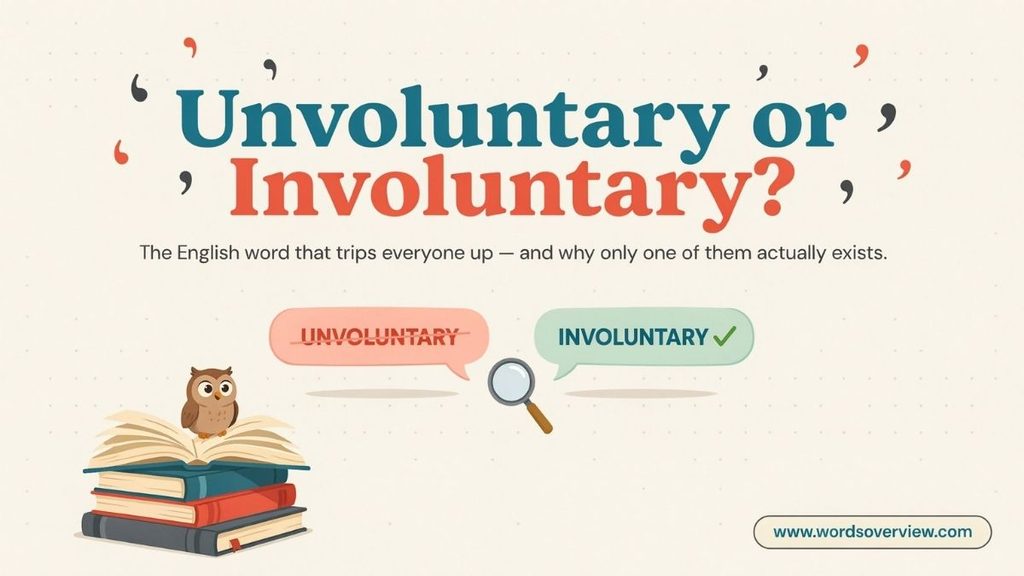
Have you ever written a sentence, reread it and thought, “Wait, did I just invent a word?” That’s exactly what can happen with unvoluntary or involuntary. These two words look like they should be twins, but English grammar clearly didn’t send them the same invitation. While “unvoluntary” appears in historical and rare usage, “involuntary” is the standard modern choice. Knowing the difference helps you avoid awkward wording in essays, emails, reports and everyday conversations. In this guide, you’ll discover what each word means, why “involuntary” usually wins the grammar contest and how to use it correctly without letting confusing vocabulary sneak into your sentences.
Unvoluntary or Involuntary Quick Answer
When you need a word that means “not voluntary,” choose involuntary.
Involuntary describes something that happens without conscious choice, deliberate intention or control of the will. It can describe physical reactions, movements, emotional responses, behaviors and situations that occur without someone’s willing choice.
For example:
- She gave an involuntary gasp.
- His hand made an involuntary movement.
- The bright light caused an involuntary blink.
- She laughed involuntarily.
- The reaction was completely involuntary.
By contrast, unvoluntary has a much more limited place in modern English. Historical writers used it with essentially the same meaning as involuntary, but contemporary writers generally avoid it.
| Word | Modern status | Meaning | Recommended use |
| Involuntary | Standard | Not voluntary or not consciously controlled | Yes |
| Unvoluntary | Rare or obsolete in its traditional sense | Historically, not voluntary | Generally avoid |
| Voluntary | Standard | Done by choice or free will | Yes |
Therefore, if you’re writing an article, essay, report, email, academic assignment or professional document, involuntary is the safer and more natural choice.
Learn the difference between often confused words
Pre vs Post Meaning, Difference and Grammar Rules
What Does Involuntary Mean?
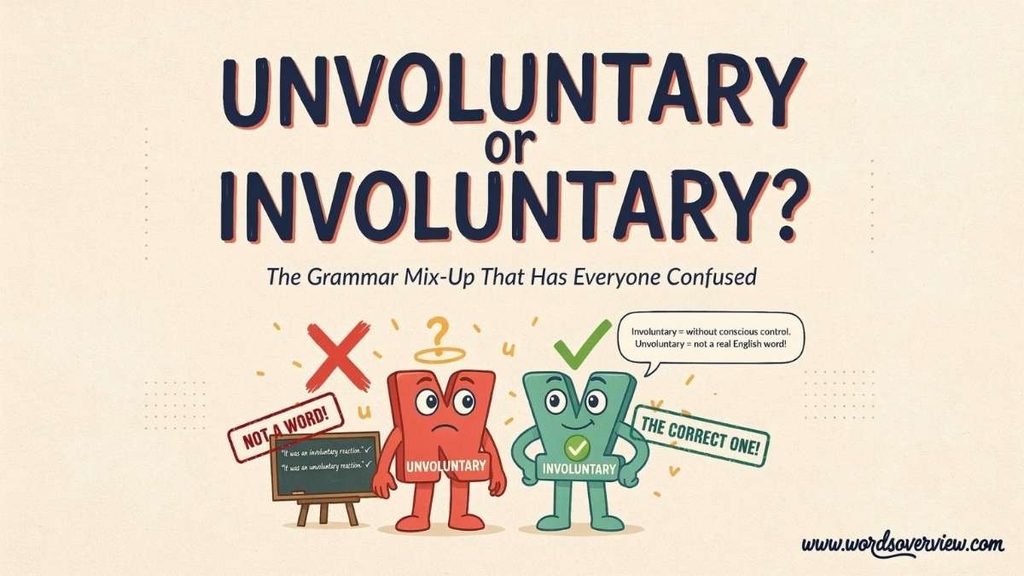
The involuntary meaning centers on a lack of conscious choice, deliberate intention or control.
Something is involuntary when it doesn’t result from a person’s deliberate decision. Depending on the context, the word can describe a physical movement, an emotional reaction, a bodily function, a behavior or an action that someone didn’t consciously choose.
For example, you don’t normally decide to blink every time your eyes need protection. Your body handles the response automatically. Likewise, a sudden gasp after hearing unexpected news may happen before you consciously decide how to react.
Consider these examples:
- an involuntary movement
- an involuntary response
- an involuntary reaction
- an involuntary reflex
- an involuntary muscle movement
- an involuntary gasp
- an involuntary sneeze
- an involuntary laugh
The context matters, though. Involuntary doesn’t always mean completely impossible to control. Instead, it usually emphasizes the absence of deliberate choice or conscious control at the moment an action or reaction occurs.
Involuntary Definition
A clear involuntary definition is:
Not voluntary; occurring without conscious choice, deliberate intention or control of the will.
This definition works across several contexts.
For instance:
“She made an involuntary movement.”
Here, the word emphasizes physical control. She didn’t deliberately make the movement.
“He gave an involuntary laugh.”
In this sentence, the emphasis falls on intention. He didn’t consciously decide to laugh.
“The employee experienced involuntary unemployment.”
Here, the meaning shifts toward choice and circumstances. The person didn’t choose to become unemployed.
As these examples show, involuntary has a broader meaning than simply “automatic.”
Learn the difference between similar English words the easy way
Boxes or Boxs Which Spelling Is Correct?
What Does Unvoluntary Mean?
The unvoluntary meaning historically overlaps with involuntary. In other words, writers have used unvoluntary to describe something that isn’t voluntary or doesn’t result from the will.
However, modern English rarely uses the word in ordinary communication.
That distinction matters because a word can have a genuine history without remaining a common modern expression. English contains many words that appear in older literature or historical dictionaries but sound unusual to contemporary readers.
Therefore, if you’re searching for unvoluntary meaning, the simplest explanation is:
Unvoluntary has historically meant “involuntary,” but modern English strongly favors “involuntary.”
Unvoluntary Definition
The traditional unvoluntary definition essentially means not voluntary or not controlled by the will.
However, that definition doesn’t make unvoluntary the preferred modern spelling.
For example, a historical text might contain a sentence using unvoluntary to describe an action that occurred without conscious choice. A modern writer would normally replace that word with involuntary.
That small change makes the sentence sound natural without changing its basic meaning.
Is Unvoluntary a Word?
Yes, unvoluntary is an attested English word. However, that answer needs some context.
The word has appeared in historical English and dictionaries record it. Nevertheless, modern sources generally treat it as rare or obsolete in the traditional sense of “involuntary.”
So, three different questions need separate answers:
Is unvoluntary a word? Yes.
Is it common modern English? No.
Should you normally use it instead of involuntary? No.
This distinction prevents an easy mistake. Saying that unvoluntary never existed would be inaccurate. At the same time, treating it as an equally common alternative to involuntary would also mislead readers.
Is Unvoluntary a Correct Word?
The answer depends on what you mean by correct.
If you mean “Does this word have a real history in English?” then yes.
If you mean “Is this the standard modern word that most writers should use?” then no.
Modern writing depends not only on whether a word exists but also on common usage, clarity, context and accepted English conventions.
For that reason, choose involuntary in contemporary writing.
Learn the difference between commonly confused words in English
Allie or Ally Difference, Meaning, Spelling and Usage
Is Involuntary a Word?
Yes. Involuntary is a standard and well-established English word.
It appears naturally in everyday conversation as well as in formal fields such as medicine, psychology, law, economics and academic writing.
Common expressions include:
- involuntary movement
- involuntary action
- involuntary response
- involuntary reaction
- involuntary reflex
- involuntary behavior
- involuntary unemployment
- involuntary muscle movement
Because speakers and writers use the word across so many contexts, involuntary is the correct spelling and standard modern form.
Why Is Involuntary Used Instead of Unvoluntary?
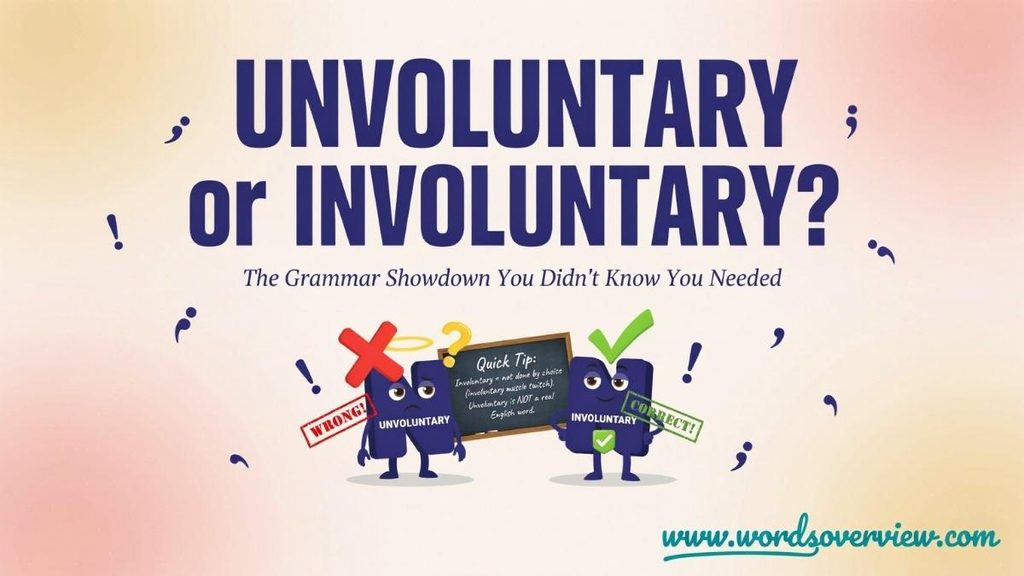
The confusion becomes easier to understand when you look at how English forms opposites.
A reader might naturally think:
voluntary → unvoluntary
After all, English frequently uses un- to create opposites:
- happy → unhappy
- fair → unfair
- certain → uncertain
- willing → unwilling
- known → unknown
However, English doesn’t apply this pattern to every adjective.
Instead, English also uses other prefixes to create negative or opposite meanings:
- legal → illegal
- regular → irregular
- responsible → irresponsible
- possible → impossible
- mature → immature
- voluntary → involuntary
Therefore, un- doesn’t automatically become the correct prefix simply because the resulting word looks logical.
How Involuntary Is Formed
The word involuntary combines in- with voluntary.
In this formation, in- carries the sense of “not.” Thus, involuntary expresses the opposite of voluntary.
The established relationship is:
voluntary → involuntary
English speakers have used this form for centuries, which explains why it now feels completely natural.
Why Unvoluntary Sounds Right
So why does unvoluntary still feel tempting?
The answer lies in pattern recognition.
When you already know words such as unhappy, unfair and unwilling, your brain naturally applies the same pattern to voluntary. The result looks logical:
un + voluntary = unvoluntary
Unfortunately, language doesn’t always follow perfect mathematical rules.
Think of English word formation as a road system rather than a straight line. Several routes can reach similar meanings, but only some routes became established through actual usage.
In this case, involuntary became the standard route.
Learn the difference between tricky words and use them correctly
Stabilise or Stabilize Which Spelling Is Correct?
The Origin of Voluntary and Involuntary
The word voluntary connects to the idea of will, willingness, choice and desire. Its history ultimately traces back to Latin terms associated with the will.
Today, the meaning remains closely connected to choice.
For example:
She made a voluntary donation.
The person chose to make the donation.
Likewise:
He joined the program voluntarily.
He made the decision himself.
How Involuntary Is Formed
Involuntary developed as the negative counterpart of voluntary. The prefix in- gives the word its negative sense.
The relationship is therefore simple:
voluntary = by choice
involuntary = not by choice
That relationship has become firmly established in modern English.
Why English Doesn’t Use Unvoluntary
English doesn’t require every negative adjective to use the same prefix.
Historical development plays a major role in determining which form becomes standard. Once speakers consistently adopt one form, that form becomes part of the established vocabulary.
That is exactly what happened with involuntary.
Although unvoluntary may appear logically constructed, it never became the normal modern counterpart of voluntary.
Learn the difference between similar English words the easy way
Alternately or Alternatively Meaning and Difference
Unvoluntary or Involuntary Meaning

When comparing unvoluntary or involuntary meaning, the biggest difference isn’t the basic idea. Instead, it concerns modern usage and status.
Historically, both forms have expressed the idea of something not being voluntary. However, contemporary English overwhelmingly prefers involuntary.
| Feature | Involuntary | Unvoluntary |
| Basic meaning | Not voluntary | Historically, not voluntary |
| Modern usage | Common | Rare |
| Historical usage | Established | Attested |
| Standard modern English | Yes | Generally no |
| Formal writing | Recommended | Usually avoid |
| Everyday English | Natural | Unusual |
Consequently, the difference between unvoluntary and involuntary is primarily a matter of established modern usage.
Involuntary or Unvoluntary The Practical Difference
The practical rule is simple:
Use “involuntary” when you mean “not voluntary.”
Consider the following pair:
She experienced an involuntary movement.
This sentence sounds natural and immediately communicates the intended meaning.
Now compare it with:
She experienced an unvoluntary movement.
The reader can understand the sentence. However, the unusual word may look like a spelling mistake.
Good writing should make the meaning clear without forcing readers to stop and question the vocabulary.
Therefore, involuntary remains the better choice.
Involuntary or Voluntary
Understanding involuntary or voluntary makes the distinction even clearer.
Voluntary Meaning
Voluntary describes something a person chooses to do.
Examples include:
- voluntary participation
- voluntary donation
- voluntary movement
- voluntary decision
- voluntary agreement
A voluntary action involves some level of conscious choice.
Involuntary Meaning
Involuntary describes something that occurs without deliberate choice or conscious control.
Examples include:
- involuntary movement
- involuntary reaction
- involuntary reflex
- involuntary laughter
- involuntary response
Involuntary or Voluntary Difference
| Voluntary | Involuntary |
| Done by choice | Not deliberately chosen |
| Usually intentional | Often unintentional |
| Involves conscious choice | Often occurs without conscious control |
| Can involve deliberate planning | Can happen automatically |
| Example: raising your hand | Example: blinking |
However, the distinction isn’t always absolute.
For example, normal breathing occurs automatically, yet you can consciously change your breathing for a period of time. Therefore, involuntary often describes the normal or automatic nature of a process rather than claiming that conscious control is impossible.
Learn the difference between commonly confused words in English
Emasculate or Demasculate: Meaning, Difference and Usage
Involuntary Action Meaning
The involuntary action meaning refers to an action or response that occurs without deliberate conscious choice.
Common examples include:
- blinking
- sneezing
- coughing
- flinching
- shivering
- certain reflexes
- some muscle movements
An involuntary action can occur when the nervous system responds rapidly to a stimulus.
For example, imagine touching a very hot surface. Your body may pull your hand away before you consciously plan the movement. That rapid response demonstrates how an involuntary physical response can protect the body.
Involuntary Movement Meaning
An involuntary movement occurs without deliberate conscious control.
Some involuntary movements are completely ordinary. Blinking, shivering and certain reflexes fall into this category.
Other involuntary movements can occur in medical conditions. In those contexts, the phrase describes a symptom or physical phenomenon rather than simply an everyday reflex.
The important point is that involuntary movement describes the nature of the movement. It doesn’t automatically indicate that something is wrong.
Is Breathing an Involuntary Action?
Normal breathing is largely an involuntary action.
Your body continuously regulates breathing without requiring you to consciously plan every inhale and exhale. However, you can deliberately change your breathing for short periods.
For example, you can:
- hold your breath
- take a deep breath
- breathe slowly
- breathe quickly
- pause briefly
This example demonstrates an important principle: a bodily function can operate automatically while still allowing some conscious control.
Involuntary Response and Involuntary Reaction
An involuntary response occurs without deliberate choice, often after a particular stimulus.
For example:
The bright light caused an involuntary blink.
An involuntary reaction can describe a physical or emotional response that happens without conscious intention.
For example:
He gave an involuntary gasp when the glass suddenly shattered.
Both phrases occur naturally in modern English.
The difference between them usually depends on context rather than strict grammar. Response often sounds more neutral or physiological, while reaction can describe either a physical or emotional response.
Learn the difference between commonly misused words
Classes or Class’s Meaning And Difference
Unvoluntary or Involuntary Examples
When looking for unvoluntary or involuntary examples, the best approach is to compare the unusual form with the standard modern form.
| Avoid in modern writing | Preferred form |
| She gave an unvoluntary gasp. | She gave an involuntary gasp. |
| He made an unvoluntary movement. | He made an involuntary movement. |
| It was an unvoluntary response. | It was an involuntary response. |
| She laughed unvoluntarily. | She laughed involuntarily. |
| His blink was unvoluntary. | His blink was involuntary. |
The left column doesn’t necessarily communicate a meaningless idea. Instead, it uses a rare form where modern English strongly prefers another word.
Unvoluntary or Involuntary in a Sentence

If you’re searching for unvoluntary or involuntary in a sentence, these examples demonstrate natural modern usage.
She gave an involuntary gasp when she heard the loud crash.
His hand made an involuntary movement.
The bright light caused an involuntary blink.
She laughed involuntarily during the serious discussion.
The patient experienced an involuntary muscle movement.
He had an involuntary reaction to the sudden noise.
Notice how naturally involuntary fits before nouns such as reaction, movement and response.
Involuntary or Unintentional
Another useful comparison involves involuntary, unintentional and accidental.
These words overlap, but they don’t carry exactly the same emphasis.
Involuntary
Involuntary focuses on the absence of conscious choice or control.
He gave an involuntary gasp.
Unintentional
Unintentional focuses on the absence of intent.
Her comment was unintentional.
Accidental
Accidental focuses on something happening by chance rather than through deliberate action.
The damage was accidental.
| Word | Main emphasis | Example |
| Involuntary | Lack of conscious choice or control | He gave an involuntary gasp. |
| Unintentional | Lack of intention | Her comment was unintentional. |
| Accidental | Happening by chance | The damage was accidental. |
As a result, these words can overlap without becoming exact synonyms.
Learn the difference between basic English word mistakes
Address or Adress Which Spelling Is Correct?
Involuntary Synonyms
If you’re searching for an involuntary synonym, the best option depends on the context.
Useful alternatives include:
- unintentional
- unintended
- automatic
- instinctive
- spontaneous
- reflexive
- uncontrolled
- unwilled
- unconscious
- nonvoluntary
However, don’t replace involuntary automatically.
For example, automatic often emphasizes something that happens without conscious thought. Unintentional emphasizes a lack of intent. Uncontrolled suggests that a person couldn’t control the action.
Therefore, context should determine the best synonym.
Involuntarily Meaning
The involuntarily meaning is closely related to the adjective involuntary.
Involuntarily means without deliberate intention, conscious choice or voluntary control.
For example:
- She involuntarily blinked.
- He involuntarily stepped backward.
- She involuntarily laughed.
- His hand moved involuntarily.
The grammatical relationship is simple:
| Form | Part of speech | Example |
| Involuntary | Adjective | an involuntary reaction |
| Involuntarily | Adverb | reacted involuntarily |
| Involuntariness | Noun | the involuntariness of the action |
In everyday writing, however, simpler expressions can sometimes sound more natural than involuntariness, such as lack of control or lack of choice.
Common Mistakes With Unvoluntary and Involuntary
Mistake: Assuming “Un-” Always Creates the Opposite
This mistake makes unvoluntary look much more convincing than it actually is.
English does use un- to form many opposites. However, the language also uses in-, im-, il-, ir- and other forms.
Therefore, you can’t always create a correct English word by attaching un- to an adjective.
Mistake: Calling Unvoluntary a Completely Fake Word
That claim goes too far.
Unvoluntary has genuine historical evidence. Writers have used it and dictionaries record it.
The more accurate description is that unvoluntary is rare or obsolete in its traditional sense and isn’t the preferred modern form.
That distinction makes the explanation more precise.
Mistake: Treating Both Words as Equally Common
They aren’t.
Involuntary is firmly established in modern English. It appears in everyday speech as well as professional, academic, medical and formal contexts.
By comparison, unvoluntary appears much less often and can sound dated or unusual.
Mistake: Assuming Unvoluntary Is British English
Unvoluntary isn’t the British spelling of involuntary.
American English and British English both use involuntary as the standard form.
This isn’t a spelling variation like:
- color / colour
- center / centre
- organize / organise
Instead, involuntary remains the standard word across major varieties of English.
A Historical Case Study: Why Dictionary Evidence Matters
Suppose you discover an old book containing the word unvoluntary.
It would be tempting to conclude:
“The word appears in a published book, so it must be just as correct as involuntary today.”
However, historical evidence doesn’t work that way.
A word can have genuine historical usage while becoming rare, archaic or obsolete later.
In fact, older forms can survive in dictionaries precisely because lexicographers document the history of English. Their presence in a dictionary doesn’t necessarily mean modern writers should use them freely.
This gives us an important distinction:
Historical existence does not automatically equal modern preference.
That principle explains the status of unvoluntary particularly well.
Is Unvoluntary the Correct Spelling?
The unvoluntary correct spelling is not the main issue.
Yes, unvoluntary can be spelled that way when you’re discussing the historical word. However, if you’re trying to express the modern idea of “not voluntary,” you should use involuntary.
In other words:
Historical word: unvoluntary
Standard modern choice: involuntary
So, if you’re wondering how to spell involuntary, remember the established pair:
voluntary → involuntary
Don’t construct the opposite yourself.
Involuntary Correct Spelling
The involuntary correct spelling is:
involuntary
The word contains the familiar base voluntary with the prefix in-:
in + voluntary = involuntary
For spelling practice, connect the two words rather than trying to memorize involuntary as an isolated sequence of letters.
voluntary → involuntary
This approach also reinforces the meaning.
Voluntary means by choice.
Involuntary means not voluntary.
Learn the difference between similar English words the easy way
Months or Monthes Which Spelling Is Correct?
Why Involuntary Works Better in Formal English
Professional writing depends on clarity. Therefore, familiar standard vocabulary usually works better than a rare form when both communicate the same basic idea.
Compare these sentences:
The patient experienced an involuntary response.
and:
The patient experienced an unvoluntary response.
The first sentence sounds natural immediately. The second may make the reader wonder whether the writer made a spelling mistake.
That hesitation adds no value.
Consequently, involuntary works better in:
- academic assignments
- professional reports
- business communication
- medical writing
- educational content
- formal essays
- websites
- everyday communication
If a standard word communicates the idea clearly, there’s little reason to choose a rare alternative.
A Simple Way to Remember Involuntary
The easiest rule is:
Voluntary means by choice. Involuntary means not by choice.
Keep the pair together:
VOLUNTARY INVOLUNTARY
Once you remember that relationship, the spelling becomes much easier.
You don’t need to wonder whether un- should replace in-.
The standard pair already exists.
Learn the difference between commonly confused words in English
Presence or Presense Which Is Correct?
Practice Session: Unvoluntary or Involuntary
Fill in the Blanks
Choose the correct word to complete each sentence.
- Blinking is usually an __________ action.
- She __________ smiled when she heard the funny comment.
- The doctor noticed an __________ movement in the patient’s hand.
- He __________ stepped back when the dog suddenly barked.
- Choosing to attend the meeting was a __________ decision.
- The loud noise caused an __________ reaction.
- She laughed __________ during the serious conversation.
- An automatic sneeze is an example of an __________ response.
- The word __________ is the standard choice in modern English for something done without voluntary control.
- The traditional form __________ exists in historical English but is rarely used today.
- “He blinked __________” uses an adverb to explain how the action happened.
- “She made an __________ gesture” uses an adjective to describe the gesture.
- A conscious decision is generally considered a __________ action.
- A sudden muscle twitch may be described as an __________ movement.
- The child __________ flinched when the balloon popped.
- Breathing normally occurs as an __________ bodily process.
- The opposite of “involuntary” is generally __________.
- “Involuntary” is an adjective, while “involuntarily” is an __________.
- If you do something without intending to do it, you may describe the action as __________.
- If an action occurs without conscious control, the most appropriate word is often __________.
- “She reacted __________” is grammatically correct because the sentence needs an adverb.
- “It was an __________ reaction” is correct because the sentence needs an adjective.
- An involuntary response can happen automatically without a conscious __________.
- Modern professional writing generally prefers “involuntary” over the rare or obsolete traditional use of __________.
- A person who deliberately raises their hand performs a __________ action.
Answer Key
- involuntary
- involuntarily
- involuntary
- involuntarily
- voluntary
- involuntary
- involuntarily
- involuntary
- involuntary
- unvoluntary
- involuntarily
- involuntary
- voluntary
- involuntary
- involuntarily
- involuntary
- voluntary
- adverb
- unintentional
- involuntary
- involuntarily
- involuntary
- choice
- unvoluntary
- voluntary
Here’s a trusted source for clear more words Comparison:
Grammar Update
FAQs About Unvoluntary or Involuntary
Is it involuntary or involuntarily?
Both words are correct, but they serve different grammatical roles. Involuntary is an adjective that describes a noun, while involuntarily is an adverb that describes an action. For example, “She made an involuntary movement” uses the adjective, while “She smiled involuntarily” uses the adverb.
What does “involuntary” mean?
Involuntary means happening without conscious choice, deliberate intention or voluntary control. For example, blinking, sneezing and certain reflexes can occur involuntarily. The word can also describe something that happens without a person’s willing participation.
What is an example of an involuntary action?
A sneeze is a common example of an involuntary action. You may sometimes feel a sneeze coming, but you generally don’t consciously decide to trigger the physical reflex. Other examples include blinking, certain muscle reflexes and many automatic bodily functions.
What is involuntary behavior?
Involuntary behavior refers to behavior or a physical response that occurs without deliberate conscious control or intention. For example, someone may blush, flinch or laugh involuntarily in response to a situation.
Is “unvoluntary” a word?
Yes, unvoluntary is an attested English word, but it is rare and often considered obsolete in its traditional sense. Modern English generally prefers involuntary. Therefore, use “involuntary” in everyday, academic, professional and formal writing.
What is the difference between involuntary and unvoluntary?
Involuntary is the standard modern English word for something done without voluntary choice or conscious control. Unvoluntary has historical and dictionary evidence, but its traditional meaning is rare or obsolete today. In contemporary writing, involuntary is the safer and more natural choice.
What does “involuntarily” mean?
Involuntarily means doing something without intending to do it or without conscious control over the action. It is the adverbial form of involuntary. For example, “He involuntarily stepped backward” means that he stepped backward without deliberately choosing to do so.
What is another word for involuntarily?
Depending on the context, synonyms for involuntarily include unintentionally, automatically, instinctively, unconsciously, accidentally, spontaneously and without intending to. However, these words are not always interchangeable because each can carry a slightly different meaning.
What is the opposite of involuntary?
The most direct opposite of involuntary is voluntary. A voluntary action involves conscious choice, willingness or deliberate control. For example, choosing to raise your hand is voluntary, while an automatic reflex may be involuntary.
What are involuntary actions?
Involuntary actions are actions or responses that occur without deliberate conscious control. Common examples include blinking, sneezing, reflex movements and many automatic bodily processes. Some involuntary responses can also be influenced or temporarily controlled through conscious effort.
What is an involuntary movement?
An involuntary movement is a physical movement that occurs without deliberate control. It may result from a reflex, automatic bodily process or other physical response. For example, a sudden muscle twitch can be described as an involuntary movement.
Is breathing an involuntary action?
Yes, breathing is largely an involuntary action because the body normally regulates it automatically. However, people can consciously control their breathing for short periods, such as when taking a deep breath, holding their breath or speaking.
How is “involuntary” different from “unintentional”?
Involuntary emphasizes a lack of voluntary control, while unintentional emphasizes a lack of intention. For example, a reflex can be involuntary, whereas sending the wrong file to someone may be unintentional. An action can therefore be unintentional without being completely involuntary.
What is the correct word for something done without conscious control?
The standard word is involuntary. It describes an action, response, movement or process that occurs without conscious or voluntary control. For example, “The loud noise caused an involuntary reaction.”
Which is correct: “involuntary” or “involuntarily”?
Neither is universally “more correct” because they perform different grammatical functions. Use involuntary as an adjective before or after a noun, such as “an involuntary reaction.” Use involuntarily as an adverb when describing how an action occurs, such as “She reacted involuntarily.”
Conclusion
English loves to keep things interesting and unvoluntary or involuntary is a perfect example. Although “unvoluntary” has appeared in historical and rare usage, “involuntary” is the clear winner in modern English. Use involuntary when something happens without voluntary choice, conscious control or deliberate intention. Use involuntarily when you need the adverb to explain how an action happens. Meanwhile, “voluntary” describes something you choose or control deliberately. So, when your grammar checker raises an eyebrow at “unvoluntary,” don’t argue with it just choose “involuntary.” Your sentence will sound more natural, your reader will understand you faster and your vocabulary will stay on the right side of modern English.

Ethan AJS is an experienced blogger and language enthusiast at Words Overview, dedicated to making English easier to understand and use. He writes about grammar, vocabulary, spelling, word meanings and commonly confused words, turning tricky language questions into clear, practical insights. With a passion for effective communication, Ethan creates engaging, readerfocused content that helps readers write accurately, choose the right words and communicate with confidence.




