
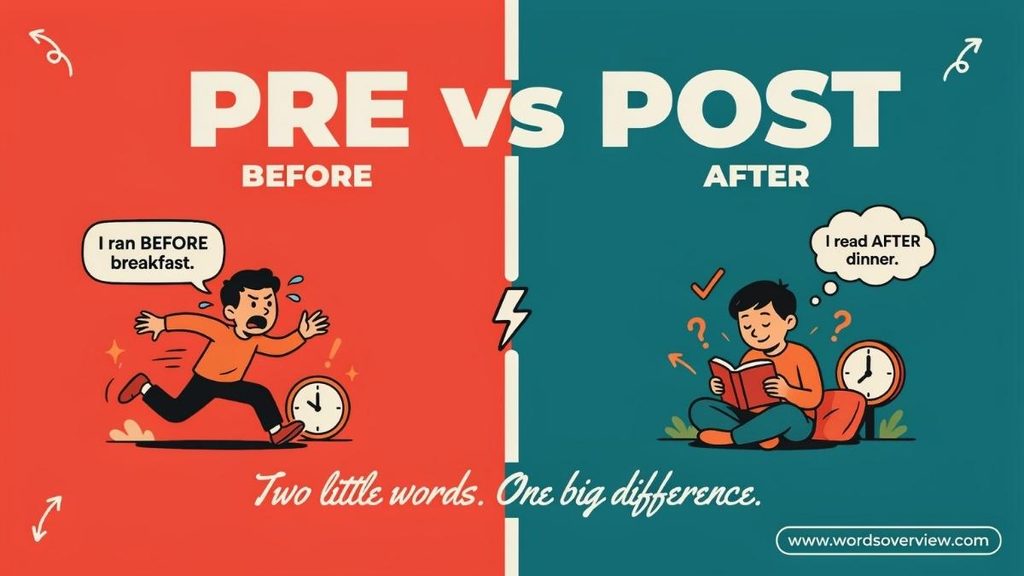
English has a funny habit of making simple ideas look complicated and pre vs post is a perfect example. One tiny prefix can tell you whether something happens before or after an event, yet mixing them up can completely change your meaning. Think of a pretest and a posttest: take them in the wrong order and your sentence may send readers on a grammatical roller coaster. The confusion becomes even trickier when “post” works as a noun or verb instead of a prefix. Fortunately, the rule is simple: pre means before, while post means after. This guide clears up the confusion with practical examples, grammar tips and easy explanations.
Pre vs Post Quick Answer
The simplest pre vs post meaning is:
Pre = before
Post = after
When used as temporal prefixes, these terms show where something falls in relation to a particular event, period, condition or stage.
| Term | Basic meaning | Time relationship | Example |
| Pre | Before | Earlier than a reference point | pretest |
| Post | After | Later than a reference point | posttest |
| Pre-event | Before an event | Prior to the event | pre-event planning |
| Post-event | After an event | Following the event | post-event review |
| Preproduction | Before production | Earlier production stage | preproduction planning |
| Postproduction | After production | Later production stage | postproduction editing |
So, if you’re wondering “pre before or after,” the answer is before.
If you’re asking “post before or after,” the answer is after when post- functions as the temporal prefix.
A useful way to visualize the pre post difference is:
Pre → Event → Post
The event acts as the reference point. Anything that comes earlier falls on the pre side. Anything that follows it falls on the post side.
What Does “Pre” Mean?
The pre meaning generally relates to before, earlier, prior to or in advance of something.
In modern English, pre- commonly appears as a prefix. A prefix attaches to the beginning of a base word and adds a particular meaning to it.
For example:
- pretest = a test that occurs before another stage
- prepayment = payment made in advance
- prewar = relating to the period before a war
- prehistoric = relating to the period before recorded history
- preproduction = preparation before production
- preview = a viewing that occurs before the main presentation
Therefore, the pre definition centers on an earlier position in time, sequence or development.
Pre- as a Prefix
The prefix pre- has roots in the Latin word prae, which means “before” or “in front of.” English developed many words from Latin elements and pre- became a productive part of English word formation.
Consider the word prepayment. If you make a prepayment, you pay before the normal payment date or before receiving the relevant service or product.
Similarly, preproduction refers to work that takes place before the main production stage.
Importantly, pre- doesn’t always refer to a specific moment on a clock. It can identify an earlier stage, period, condition or process.
For example:
The team completed its prelaunch planning several weeks before the product launch.
Here, prelaunch identifies the stage that comes before the launch.
Learn the difference between commonly confused words in English
Months or Monthes Which Spelling Is Correct?
What Does Pre Mean in Everyday English?
You may also encounter “pre” as an informal shortened form in expressions such as pregame or pre-show.
For example:
The players attended a pregame meeting.
In this sentence, pregame refers to something that occurs before the game.
However, pre isn’t a universal replacement for the word before. You can’t simply attach pre to any word and assume the result will sound natural or count as a standard English term.
For instance, English speakers normally say:
We met before the ceremony.
They wouldn’t normally replace before with pre simply because both express an earlier time.
That distinction matters in English usage. Established words and compounds follow conventional patterns.
What Does “Post” Mean?
The post meaning depends on how you use the word.
As the prefix post-, it generally means after, following or later than something.
Common examples include:
- postwar = after a war
- postgraduate = relating to study after undergraduate education
- posttest = a test that occurs afterward
- postproduction = work that follows production
- postoperative = relating to the period after an operation
- post-pandemic = relating to the period following a pandemic
The post definition as a prefix therefore focuses on a later stage, period or condition.
However, post has several other meanings in English. That’s where some confusion begins.
Post- as a Prefix
The prefix post- establishes a relationship with something that happened or existed earlier.
For example:
The company conducted a post-event survey.
The survey followed the event.
Likewise:
The film entered postproduction after filming ended.
The postproduction stage came after production.
In both examples, post- establishes a later position in a sequence.
Post as a Noun
Post doesn’t always mean after.
As a noun, post can refer to a physical support:
The fence post needs repair.
It can also refer to a job or position:
She accepted a teaching post at the university.
In digital communication, a post can mean something published online:
He shared a new post on the website.
None of these meanings comes from the temporal prefix post-.
Post as a Verb
Post can also function as a verb meaning to publish or share something.
For example:
She posted the announcement online.
Here, posted means published or shared. It doesn’t mean “placed after.”
Therefore, when someone asks “what does post mean,” context matters. The temporal prefix post- means after, but the independent word post has several other meanings.
Learn the difference between commonly confused words in English
Trialled or Trialed Which Is Correct?
Pre vs Post: Side-by-Side Comparison
The difference between pre and post becomes clearer when you place both terms around the same reference point.
| Feature | Pre | Post |
| Core meaning | Before | After |
| Relative position | Earlier | Later |
| Prefix | pre- | post- |
| Temporal relationship | Prior to | Following |
| Common related words | earlier, prior, preceding | later, following, subsequent |
| Example | pretest | posttest |
| Event example | pre-event | post-event |
| Production example | preproduction | postproduction |
| Tax example | pre-tax | post-tax |
In short, pre looks toward an earlier stage, while post identifies a later stage.
Pre vs Post on a Timeline
A timeline offers one of the easiest ways to understand the pre and post meaning.
Pre → Main Event → Post
Imagine a professional conference.
Before the conference organizers might handle registration, scheduling, speaker preparation and venue setup. These activities belong to the pre-event stage.
After the conference organizers might review attendance, collect feedback and prepare reports. Those activities belong to the post-event stage.
The same pattern appears in many fields.
| Before | Reference Point | After |
| pre-election | election | post-election |
| pretest | instruction or training | posttest |
| preproduction | production | postproduction |
| pregame | game | postgame |
| pre-pandemic | pandemic | post-pandemic |
Once you identify the reference point, choosing between pre and post becomes much easier.
How to Use Pre Correctly
Understanding what does pre mean is only the first step. You also need to know how English speakers use pre- in actual words.
Pre- Means Before an Event
The prefix can identify something that happens before a particular event.
Common examples include:
- pregame preparation
- pre-event registration
- preflight inspection
- pre-election activity
- pretest assessment
For example:
The athletes completed their pregame warm-up before the match.
The warm-up happens before the game, so pregame fits naturally.
Learn the difference between basic English word mistakes
Address or Adress Which Spelling Is Correct?
Pre- Can Describe an Earlier Period
Pre- can also identify a historical or social period that comes before a particular development.
For example:
The museum displays artifacts from the prehistoric period.
Likewise:
Researchers compared pre-pandemic data with later data.
In both cases, pre- establishes an earlier period.
Pre- Can Indicate Advance Action
Sometimes pre- describes something completed ahead of time.
For example:
Customers must make a prepayment before delivery.
The payment occurs in advance, so prepayment accurately describes it.
How to Use Post Correctly
The post meaning becomes clear when you identify what came first.
Post- Means After an Event
Use post- when something follows an event or stage.
For example:
The organizers conducted a post-event survey.
The survey came after the event.
Similarly:
The newspaper published a post-election analysis.
The analysis followed the election.
Post- Can Describe a Later Period
Post- can identify a period that follows a major event or historical development.
Common examples include:
- postwar
- post-pandemic
- postcolonial
- postindustrial
- postmodern
For example:
The country experienced major economic changes during the postwar period.
Here, postwar identifies the period following the war.
Post- Can Describe a Later Stage
The prefix can also identify a later step in a process.
Film production provides a clear example:
Preproduction → Production → Postproduction
Preproduction covers preparation before filming. Production covers the actual filming process. Postproduction follows filming and can include editing, sound work, visual effects and other finishing tasks.
Learn the difference between similar English words the easy way
Alternately or Alternatively Meaning and Difference
Pre and Post Words Examples
English contains many established words that use pre- and post-.
Words With the Pre Prefix
Some common words with pre prefix include:
- prearrange
- predate
- preexisting
- prehistory
- prepayment
- preproduction
- pretest
- preview
- prehistoric
- prewar
These words don’t all describe exactly the same kind of “before.” Some refer to time, while others describe an earlier condition, stage or action.
Words With the Post Prefix
Common words with post prefix include:
- postdate
- postgraduate
- posthumous
- postindustrial
- postmodern
- postnatal
- postoperative
- postproduction
- posttest
- postwar
Again, the prefix establishes a relationship with something that comes earlier.
However, you shouldn’t assume that every English noun can take pre- or post-. A word needs established usage to sound natural and standard.
Pre vs Post Examples in Sentences
The following pre vs post examples show how the terms work around the same reference point.
| Pre example | Post example |
| The students completed a pretest before the lesson. | The students completed a posttest after the lesson. |
| The team held a pregame meeting. | The coach gave a postgame interview. |
| We completed pre-event registration. | We collected post-event feedback. |
| The studio finished preproduction first. | The editors handled postproduction later. |
| The company calculated pre-tax income. | The report showed post-tax income. |
| Researchers examined pre-pandemic data. | They compared it with post-pandemic data. |
These examples show an important pattern: the reference point determines whether pre or post makes sense.
Learn the difference between commonly confused words in English
Classes or Class’s Meaning And Difference
Pre vs Post in Different Contexts
The basic pre vs post meaning stays consistent across many fields. However, the reference point changes from one context to another.
Education
Education provides some of the clearest examples.
A pretest measures knowledge, skills or performance before a particular lesson, course, intervention or training period. A posttest measures the relevant outcome afterward.
For example:
Students completed a pretest before the training session and a posttest after the session.
The terms describe position in the learning sequence. They don’t simply mean “first test” and “second test.”
Business
Businesses frequently use pre- and post- to describe activities around meetings, launches, campaigns and projects.
Examples include:
- premeeting preparation
- prelaunch planning
- pre-event registration
- postmeeting notes
- postlaunch analysis
- post-event reporting
For instance, a company might conduct research before launching a product. After the launch, the same company might analyze customer responses.
Film and Media
Film production offers a particularly clear three-stage sequence:
Preproduction → Production → Postproduction
During preproduction, teams plan schedules, prepare locations organize equipment, develop scripts and handle other preparation.
Production covers the actual filming or recording stage.
Postproduction follows production. Depending on the project, it may involve editing, sound work, visual effects, color correction and other finishing work.
Tax and Finance
You may also encounter pre-tax and post-tax in financial discussions.
Pre-tax generally describes an amount before the relevant tax is deducted or applied.
Post-tax describes an amount after tax.
For example:
The report compares pre-tax income with post-tax income.
The exact financial treatment depends on the type of income, tax, transaction and accounting context. Therefore, the prefixes establish the relevant stage, but they don’t provide the complete financial definition by themselves.
Audio Production
Technical language provides another interesting example with pre-fader and post-fader.
A volume fader controls the level of an audio signal. An auxiliary send can route part of that signal to another destination.
A pre-fader send takes the signal before the relevant fader affects its level. A post-fader send takes the signal after the fader’s level adjustment.
This example demonstrates that pre- and post- don’t always describe ordinary calendar time. They can also describe a position within a technical process or signal path.
Learn the difference between similar English words the easy way
Unvoluntary or Involuntary Which One Is Correct?
Pre vs Post Grammar and Hyphenation
One of the more complicated areas of pre vs post grammar involves hyphenation.
There isn’t a universal rule requiring every word containing pre- or post- to use a hyphen. Instead, English follows established spelling and usage patterns.
When Pre- and Post- Form One Word
Many established compounds appear as single words.
Examples include:
- preview
- prepayment
- prewar
- postgraduate
- postwar
- postproduction
These forms have become established parts of English vocabulary.
When a Hyphen May Be Used
Some constructions commonly use a hyphen, especially when the writer needs to make the compound relationship clear.
Examples include:
- pre-event
- post-event
- pre-tax
- post-tax
- pre-fader
- post-fader
However, hyphenation can vary depending on the exact term, dictionary treatment and editorial style.
Therefore, don’t assume that every pre- or post- construction follows the same rule.
Pre and Post Grammar in Compound Words
The most reliable approach is to treat pre- and post- as prefixes that participate in English word formation.
For example, pretest and posttest are established compounds. That doesn’t mean you can attach pre- or post- to every noun and automatically create a standard English word.
When you’re uncertain, check the established form of the specific compound.
Is Pre the Opposite of Post?
In many contexts, yes. Pre- and post- express opposing temporal relationships.
For example:
pre-event ↔ post-event
pretest ↔ posttest
preproduction ↔ postproduction
However, they aren’t universal grammatical opposites.
Consider postgraduate. It refers to education or study that follows an undergraduate degree. English doesn’t normally use pregraduate as its everyday counterpart.
Similarly, prehistoric has an established meaning, but that doesn’t mean posthistoric functions as its direct opposite in ordinary English.
Therefore, the pre post difference depends on the specific word and context.
A useful rule is:
Pre- marks what comes before a reference point, while post- marks what follows it.
That rule explains their central relationship without suggesting that every pre- word must have a matching post- word.
Learn the difference between similar English words the easy way
Presence or Presense Which Is Correct?
Pre vs Post vs During
The difference becomes even clearer when you add during to the timeline.
Before → During → After
Or:
Pre → Event → Post
Consider a conference:
- pre-conference preparation = before the conference
- conference session = during the conference
- post-conference follow-up = after the conference
Now consider an examination:
- pretest preparation = before the assessment
- test = the assessment itself
- posttest analysis = after the assessment
This three-stage model helps when a process includes preparation, the main event and follow-up.
Is Pre Always Before?
If you’re asking, “Does pre mean before?” the answer is yes when you’re referring to the temporal prefix pre-.
However, “before” can express several related ideas, including:
- earlier in time
- prior to an event
- ahead of a stage
- in advance
- preceding another condition
The precise meaning depends on the word.
For example, prepayment means payment in advance. Prehistory refers to a period before recorded history. Preproduction refers to an earlier stage of a production process.
So, pre = before provides the foundation, but context determines the exact sense.
Is Post Always After?
When you’re discussing the temporal prefix post-, it generally means after or following.
Therefore:
post = after
works for words such as:
- postwar
- posttest
- postproduction
- postoperative
However, the standalone word post has other meanings.
A post can mean a physical support, a job position or an online publication. As a verb, post can mean to publish or share something.
Consequently, the phrase “post means after” applies specifically to the temporal prefix post-, not to every use of the independent word post.
Learn the difference between similar English words the easy way
Boxes or Boxs Which Spelling Is Correct?
Common Pre vs Post Mistakes
A few mistakes appear frequently when people use these terms.
Reversing the Timeline
The most obvious mistake involves assigning the wrong prefix to an event.
Incorrect:
The postgame meeting happened before the game.
Correct:
The postgame meeting happened after the game.
Likewise:
The pregame meeting happened before the game.
A quick timeline check can prevent this error.
Assuming Every Pair Exists
English doesn’t create a perfect pre- and post- counterpart for every concept.
For example, postgraduate is a standard word, but pregraduate isn’t a normal everyday counterpart.
Therefore, don’t create a word simply because its opposite seems logical.
Treating Post as Only a Prefix
In postwar, post- means after.
In social media post, post is a noun.
In she posted the photo, posted is a verb.
Context determines the meaning.
Applying One Hyphen Rule to Every Word
Some compounds appear as single words, while others commonly use hyphens.
For example:
- postwar
- postproduction
- prepayment
- pre-event
- post-event
The best approach is to check the established spelling of the specific expression.
Pre and Post Prefixes: Their Origins
Both prefixes have strong historical connections to Latin.
The pre- prefix comes from Latin prae, meaning “before” or “in front of.”
The post- prefix comes from Latin post, meaning “after” or “behind.”
These Latin elements entered English through different historical pathways and became productive parts of English word formation.
That history helps explain why the two prefixes have such clear opposing meanings:
prae → pre- → before
post → post- → after
You don’t need to know Latin to use either prefix correctly. Still, understanding the origin helps explain why so many English words share these patterns.
Learn the difference between tricky words and use them correctly
Stabilise or Stabilize Which Spelling Is Correct?
Pre vs Post A Practical Case Study
Imagine a company preparing to launch a new mobile application.
Before launch, the team might conduct:
prelaunch testing
prelaunch marketing
pre-event planning
preproduction work
The launch then takes place.
Afterward, the company might conduct:
postlaunch analysis
post-event surveys
postlaunch customer research
postproduction work, where applicable
The reference point remains the same:
Prelaunch → Launch → Postlaunch
This example shows why context matters more than memorizing isolated words. Once you identify the event, you can determine whether the activity belongs before or after it.
How to Remember the Pre Post Difference
A simple memory trick can make the distinction easier to remember:
PRE = PRIOR
POST = FOLLOWING
Think about any event and place it in the middle:
Pre → Event → Post
If something happens earlier, think pre-.
If something happens later, think post-.
For example, preparation before a meeting is pre-meeting preparation. Reviewing the results afterward is post-meeting analysis.
The reference event acts like a dividing line. Pre belongs on the earlier side. Post belongs on the later side.
Pre vs Post Quick Reference
| If you mean… | Use… |
| Before an event | pre- |
| After an event | post- |
| An earlier stage | pre- |
| A later stage | post- |
| Before a test | pretest |
| After a test | posttest |
| Before production | preproduction |
| After production | postproduction |
| Before tax | pre-tax |
| After tax | post-tax |
Learn the difference between often confused words
Employees or Employee’s Which Is Correct?
Practice Session Pre vs Post
Fill in each blank with pre or post. Check the answer key after completing all 25 questions.
Fill in the Blanks
- The students took a ______test before the training began.
- The teacher gave a ______test after the lesson.
- We completed the ______event registration before arriving at the venue.
- The team conducted a ______event survey after the conference.
- The players attended a ______game meeting before the match.
- The coach gave a ______game interview after the match.
- The production team handled ______production planning before filming.
- The editors worked on ______production after filming ended.
- The company calculated its ______tax income before taxes were applied.
- The report showed the employee’s ______tax income after taxes.
- Researchers compared ______pandemic data with data collected later.
- The study examined health trends during the ______pandemic period.
- Customers were asked to make a ______payment in advance.
- The company conducted a ______launch analysis after introducing the product.
- The doctor explained the patient’s ______operative care after surgery.
- The students completed a ______course assessment before starting the program.
- The researchers conducted a ______study evaluation after collecting the results.
- The organizers arranged ______conference materials before the event.
- The team prepared a ______conference report after the event.
- The technician checked the equipment during the ______flight inspection.
- The company performed a ______launch test before releasing the application.
- The marketing team analyzed customer responses during the ______launch period.
- A ______test measures knowledge before instruction, while a ______test measures it afterward.
- In the basic timeline, ______ comes before the main event, while ______ comes after it.
- ______ means before, while ______ means after.
Answer Session
- pre
- post
- pre
- post
- pre
- post
- pre
- post
- pre
- post
- pre
- post
- pre
- post
- post
- pre
- post
- pre
- post
- pre
- pre
- post
- pre, post
- pre, post
- pre, post
Here’s a trusted source for clear more words Comparison:
Grammar Update
Frequently Asked Questions
What is the difference between pre and post?
Pre means before or earlier than a reference point, while post means after or later than that reference point. For example, a pretest occurs before a learning stage, while a posttest occurs afterward.
Is pre before or after?
Pre means before. As a prefix, pre- indicates something that happens earlier than a particular event, stage or period. Examples include pregame, pretest and preproduction.
Does post mean after?
Yes, when post- functions as a temporal prefix, it means after or following. For example, post-event means something that takes place after an event, while postproduction refers to work that follows production.
What do pre and post mean?
Pre means before and post means after. Together, they describe the position of something in relation to a reference point: Pre → Event → Post.
What is first, pre or post?
Pre comes first, followed by post. Pre describes what happens before an event, while post describes what happens after it.
Should pre and post have a hyphen?
Not always. Some established words are written as one word, such as prepayment and postwar, while other compounds commonly use a hyphen, such as pre-event and post-event. The correct form depends on the specific compound and established usage.
What does pre mean in English?
Pre means before, prior to, earlier than or in advance of something. It commonly appears as a prefix in words such as pretest, prepayment, preview and preproduction.
What does post mean in English?
Post has several meanings. As the prefix post-, it means after or following. As a noun, it can mean a position, physical support or online publication. As a verb, it can mean to publish or share something.
What is an example of pre and post?
A pretest takes place before a lesson, training session or intervention, while a posttest takes place afterward. Other examples include pre-event/post-event and preproduction/postproduction.
What does pre and post test mean?
A pretest measures knowledge or performance before a particular learning experience or intervention. A posttest measures the relevant knowledge or performance afterward. Together, they can help show changes between the two stages.
Conclusion
The pre vs post confusion may seem like a tiny grammar problem, but one little prefix can send your sentence in the wrong direction. Fortunately, the rule is easier than it first appears: pre means before, while post means after. So, a pretest comes before a test or learning stage, while a posttest follows it. The same pattern works with pre-event and post-event, preproduction and postproduction and many other terms. Just remember the timeline: Pre → Event → Post. Also, don’t assume that every word needs a pre- or post- version and don’t forget that “post” has other meanings. Once you master this simple difference, these prefixes won’t cause grammatical chaos again.

Ethan AJS is an experienced blogger and language enthusiast at Words Overview, dedicated to making English easier to understand and use. He writes about grammar, vocabulary, spelling, word meanings and commonly confused words, turning tricky language questions into clear, practical insights. With a passion for effective communication, Ethan creates engaging, readerfocused content that helps readers write accurately, choose the right words and communicate with confidence.




