
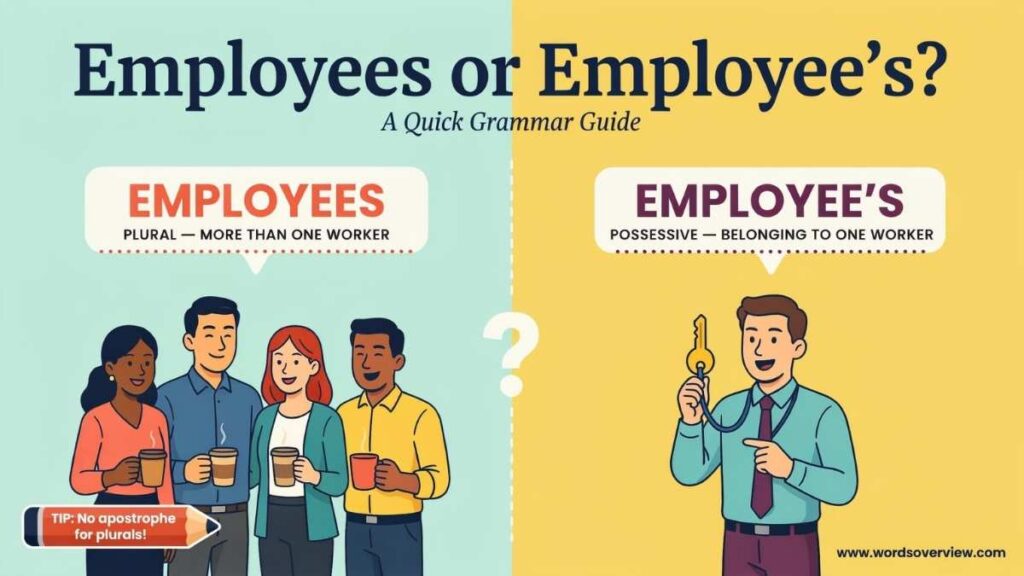
Ever stared at Employees or Employee’s and wondered whether the apostrophe was invited to the meeting or simply showed up unannounced? You’re not alone. This tiny punctuation mark causes surprisingly big grammar mistakes, especially in workplace writing. The problem gets even trickier when employees’ joins the conversation. Although these forms look nearly identical, each one has a different grammatical job. Employees means more than one worker, while employee’s shows possession by one employee. Meanwhile, employees’ shows possession by multiple employees. Once you understand this simple pattern, the apostrophe stops playing hide-and-seek and starts making perfect sense. Let’s clear up the confusion once and for all.
Employees or Employee’s Quick Answer
The correct form depends on what you want to say.
| Form | Meaning | Example |
| employee | One worker | The employee arrived early. |
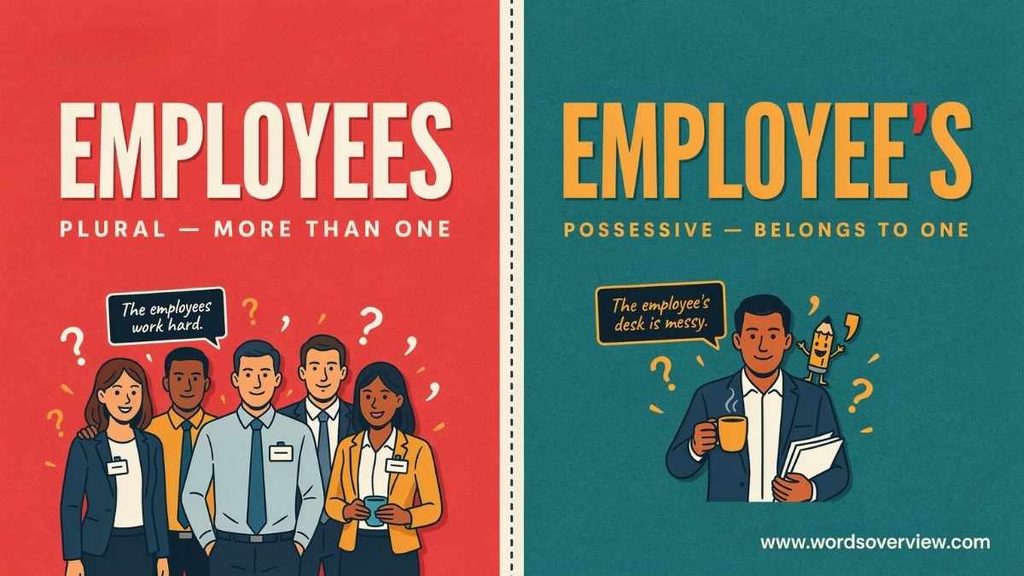
| employees | More than one worker | The employees arrived early. |
| employee’s | Something belonging to one employee | The employee’s desk is clean. |
| employees’ | Something belonging to multiple employees | The employees’ desks are clean. |
So, employees and employee’s are not interchangeable.
Use employees when you mean two or more workers. Use employee’s when you show possession by one worker. If several employees own, use or control something, use employees’.
Employees Means More Than One Employee
The word employees is the regular plural form of employee.
For example:
The company has 150 employees.
Here, employees simply tells you that the company has more than one worker. The word does not show possession, so it does not need an apostrophe.
More examples include:
- The employees attended the meeting.
- Several employees requested additional training.
- New employees receive an orientation guide.
- The employees work in different departments.
- All employees must follow company policies.
Notice the pattern: employees refers to people, not something that belongs to them.
Employee’s Shows Singular Possession
Employee’s contains an apostrophe before the s. This form usually shows that something belongs to or relates to one employee.
For example:
The employee’s computer needs an update.
The sentence refers to one employee and one computer associated with that employee.
Consider these examples:
- The employee’s salary increased this year.
- The employee’s ID card is on the desk.
- The employee’s manager approved the request.
- The employee’s performance improved significantly.
- The employee’s responsibility includes updating records.
In each example, employee’s refers to one employee.
Employees’ Shows Plural Possession
When something belongs to or relates to multiple employees, use employees’.
For example:
The employees’ concerns deserve attention.
The concerns belong to or come from multiple employees. Therefore, the apostrophe comes after the plural s.
More examples include:
- The employees’ salaries were reviewed.
- The employees’ desks are located upstairs.
- The employees’ feedback helped improve the policy.
- The employees’ responsibilities vary by department.
- The employees’ requests were reviewed by management.
The easiest way to remember the rule is simple:
One employee → employee’s
Several employees → employees’
Learn the difference between commonly confused words in English
Months or Monthes Which Spelling Is Correct?
Employee, Employees, Employee’s and Employees’ The Four Forms Compared
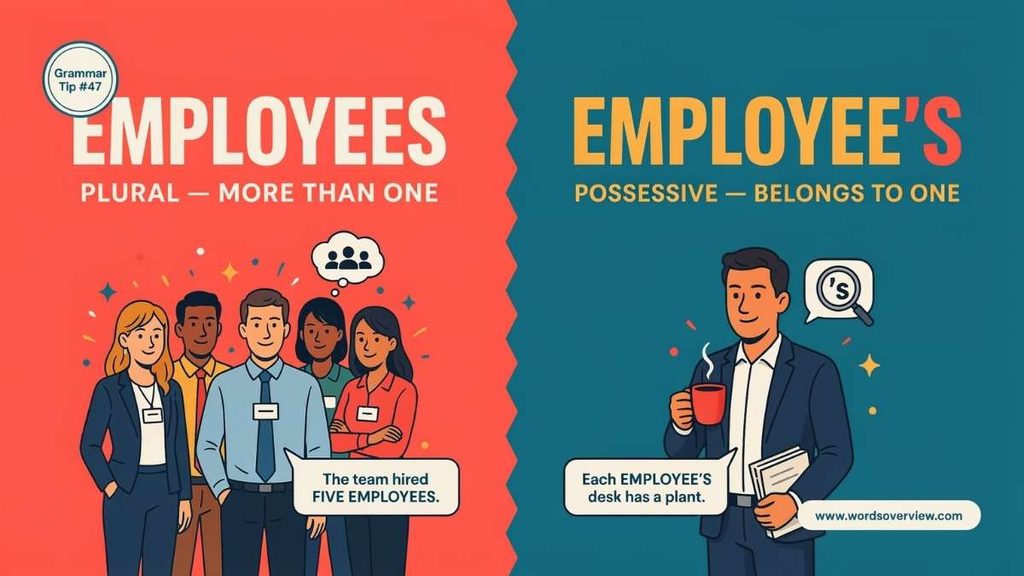
These four forms represent different grammatical functions.
Employee is singular.
An employee called the manager.
Employees is plural.
Several employees called the manager.
Employee’s is singular possessive.
The employee’s phone rang.
Employees’ is plural possessive.
The employees’ phones rang.
The apostrophe does not simply decorate the word. It changes the relationship between the employee and another noun.
That distinction matters in workplace writing, HR documents, emails, reports, policies and everyday communication.
What Does Employees Mean?
Employees is the plural form of employee. It refers to two or more people who work for an organization, business, company or individual.
For example:
The company hired five new employees.
The word employees functions as a plural noun. Therefore, it normally takes plural verbs.
The employees are attending training.
Not:
The employees is attending training.
Employees as the Subject
When employees acts as the subject, it refers to multiple workers who perform an action.
Examples:
- Employees receive annual training.
- Employees contribute to workplace culture.
- Employees complete their assignments on time.
- Employees can request flexible schedules.
- Employees should report workplace problems.
Because employees is plural, the sentence normally uses a plural verb.
Employees as the Object
Employees can also receive an action.
For example:
The company invited employees to the annual event.
Here, company performs the action, while employees receive it.
Other examples include:
- The manager thanked the employees.
- The company promoted several employees.
- HR contacted the employees.
- The supervisor trained new employees.
- The organization surveyed its employees.
Again, no apostrophe appears because the word simply refers to multiple workers.
Learn the difference between similar English words the easy way
Presence or Presense Which Is Correct?
When Employees Does Not Need an Apostrophe
A common mistake occurs when writers see the s and assume that an apostrophe belongs there.
It doesn’t.
The employees completed the project.
This sentence needs employees, not employee’s or employees’.
Likewise:
Employees must submit their forms by Friday.
There is no possession here. Therefore, the regular plural employees works correctly.
What Does Employee’s Mean?
Employee’s can show possession or indicate something connected with one employee.
The apostrophe appears before the s because the noun remains singular.
For example:
The employee’s laptop is missing.
Only one employee owns or uses the laptop in the context of the sentence.
Employee’s for Ownership
The clearest use of employee’s occurs when one employee possesses something.
Examples include:
- The employee’s laptop was damaged.
- The employee’s car is parked outside.
- The employee’s phone is ringing.
- The employee’s documents are confidential.
- The employee’s uniform needs cleaning.
The basic structure is:
one employee + ’s + noun
Employee’s for Work or Responsibility
Possession doesn’t always mean legal ownership. English often uses possessives to describe a relationship, responsibility, association or connection.
For example:
The employee’s responsibilities include customer support.
The employee does not necessarily own the responsibilities. Instead, those responsibilities belong to that person’s role.
Similarly:
- The employee’s department handles customer complaints.
- The employee’s role requires strong communication skills.
- The employee’s schedule changes every week.
- The employee’s performance improved this quarter.
- The employee’s manager approved the request.
In each case, the sentence focuses on one employee.
Employee’s in Workplace Expressions
You may encounter employee’s in sentences about one specific worker.
For example:
The employee’s attendance record shows consistent improvement.
The writer discusses one employee’s record.
However, don’t automatically add an apostrophe just because a noun follows employee. English often uses employee as a modifier without an apostrophe.
For example:
The company updated its employee handbook.
Here, employee handbook is a standard compound noun. It means a handbook intended for employees. It doesn’t need an apostrophe.
That distinction prevents a common workplace-writing mistake.
Learn the difference between similar English words the easy way
Unvoluntary or Involuntary Which One Is Correct?
What Is the Plural of Employee?
The plural of employee is employees.
The change is simple:
employee → employees
For example:
One employee joined the company.
Ten employees joined the company.
You don’t need an apostrophe to form the plural.
Therefore:
employee’s is not the plural of employee.
employees’ is not the regular plural either.
The correct plural form is simply employees.
Employee Singular Form
Use employee when you mean one person.
Examples:
- The employee is working remotely.
- An employee requested leave.
- Every employee receives an ID card.
- One employee reported the issue.
Employees Plural Form
Use employees when you mean two or more people.
Examples:
- The employees are working remotely.
- Several employees requested leave.
- All employees receive ID cards.
- Two employees reported the issue.
This singular-versus-plural distinction provides the foundation for understanding the possessive forms.
How Apostrophes Change the Meaning
Apostrophes can cause significant confusion because their position matters.
The Apostrophe Before S
When you write employee’s, the apostrophe comes before the s.
This normally indicates singular possession.
The employee’s desk is clean.
One employee has a desk.
The Apostrophe After S
When you write employees’, the apostrophe comes after the s.
This normally indicates plural possession.
The employees’ desks are clean.
Multiple employees have desks.
No Apostrophe for a Regular Plural
When you simply mean more than one employee, write employees.
The employees attended the meeting.
There is no possession, so no apostrophe appears.
A useful three-part pattern looks like this:
| Meaning | Correct form |
| One worker | employee |
| More than one worker | employees |
| Something belonging to one worker | employee’s |
| Something belonging to multiple workers | employees’ |
Learn the difference between commonly confused words in English
Classes or Class’s Meaning And Difference
Employee’s or Employees’ The Difference Between One and Many
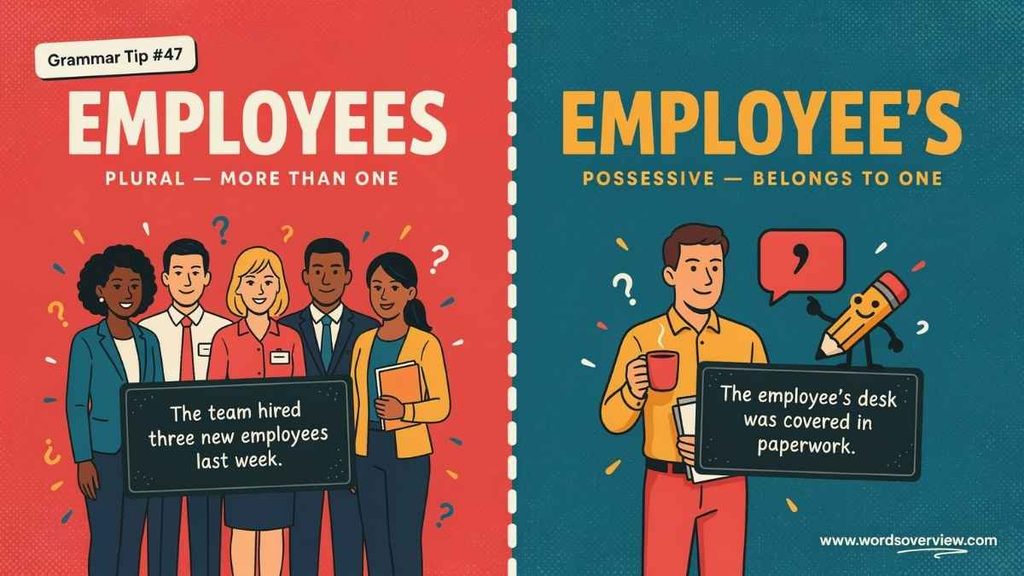
The difference between employee’s and employees’ comes down to number.
Consider these sentences:
The employee’s computer is new.
This refers to one employee.
Now compare:
The employees’ computers are new.
This refers to multiple employees.
The apostrophe tells you where possession occurs, while the number of s forms tells you how many employees the sentence refers to.
That means the position of the apostrophe matters.
Employee’s = one employee possesses or relates to something.
Employees’ = multiple employees possess or relate to something.
Common Mistakes With Employees and Employee’s
Even experienced writers sometimes make mistakes with these forms. Fortunately, most errors follow predictable patterns.
Mistake 1: Using Employee’s as the Plural
Incorrect:
The company has 200 employee’s.
Correct:
The company has 200 employees.
Why? The sentence simply refers to 200 workers. It doesn’t show possession.
Learn the difference between similar English words the easy way
Boxes or Boxs Which Spelling Is Correct?
Mistake 2: Using Employees for Possession
Incorrect:
The employees salary increased.
Correct:
The employee’s salary increased.
If the sentence refers to one employee’s salary, use employee’s.
For multiple employees, use:
The employees’ salaries increased.
Notice that the noun after the possessive also changes naturally.
Mistake 3: Confusing Employee’s and Employees’
Incorrect:
The employees’s records are confidential.
Correct:
The employees’ records are confidential.
You don’t normally write employees’s. The plural noun already ends in s, so place the apostrophe after it.
Mistake 4: Adding an Apostrophe to Employees
Incorrect:
All employee’s must attend the meeting.
Correct:
All employees must attend the meeting.
The sentence doesn’t show possession. It simply refers to multiple workers.
Mistake 5: Choosing the Form Based on Sound
Sometimes people choose an apostrophe because a sentence sounds possessive when spoken.
However, pronunciation shouldn’t determine the spelling.
Instead, ask what the sentence means.
Does it refer to:
- one employee?
- multiple employees?
- something connected to one employee?
- something connected to multiple employees?
Once you answer that question, the correct form usually becomes obvious.
Learn the difference between basic English word mistakes
Address or Adress Which Spelling Is Correct?
Employees or Employee’s in Workplace Writing
Workplace communication often contains these words because companies constantly discuss workers, responsibilities, salaries, policies, schedules and performance.
Therefore, using the correct form can make professional writing much clearer.
Emails and Internal Messages
Consider this example:
All employees must complete the training by Friday.
The writer refers to multiple workers, so employees is correct.
Now consider:
Please review the employee’s application.
The sentence refers to one applicant, so employee’s works if the applicant is already an employee.
For multiple workers:
Please review the employees’ applications.
The apostrophe moves after the s because multiple employees possess or are associated with the applications.
HR Documents
HR departments frequently use all four forms.
For example:
Each employee must update their emergency contact information.
Here, employee refers to one person at a time.
Now compare:
Employees must update their emergency contact information.
This statement addresses workers as a group.
For possession:
The employee’s benefits depend on their employment status.
For plural possession:
The employees’ benefits vary according to their employment status.
Context determines the correct form.
Company Policies
Company policies often address employees collectively.
For example:
Employees must follow the company’s security policy.
Here, employees refers to workers in general.
However:
An employee’s access may be suspended after a security violation.
The writer now refers to one employee.
The difference may look small, but it changes the grammatical meaning.
Learn the difference between commonly confused words in English
Trialled or Trialed Which Is Correct?
Employees or Employee’s Side-by-Side Examples

The fastest way to understand these forms is to compare them directly.
| Incorrect or confusing form | Correct form | Reason |
| The company has 50 employee’s. | The company has 50 employees. | Plural noun |
| The employee’s are ready. | The employees are ready. | More than one employee |
| The employees salary is high. | The employee’s salary is high. | One employee |
| The employee’s salaries are high. | The employees’ salaries are high. | Multiple employees |
| All employee’s attended. | All employees attended. | Plural noun |
| The employees’s office is upstairs. | The employees’ office is upstairs. | Plural possessive |
These examples reveal the underlying pattern. First, determine whether you’re talking about one person or several. Then determine whether you need to show possession.
Common Phrases With Employees, Employee’s and Employees’
Certain expressions appear frequently in workplace writing.
Common Phrases With Employees
Use employees in phrases such as:
- company employees
- full-time employees
- part-time employees
- new employees
- current employees
- remote employees
- senior employees
- former employees
- temporary employees
- employees and managers
These phrases usually describe workers rather than ownership.
Common Phrases With Employee’s
Use employee’s when one employee has a connection to the following noun.
Examples include:
- employee’s salary
- employee’s role
- employee’s schedule
- employee’s performance
- employee’s manager
- employee’s contract
- employee’s responsibilities
- employee’s records
- employee’s request
- employee’s benefits
Again, the form refers to one employee.
Common Phrases With Employees’
Use employees’ when multiple employees have a connection to the following noun.
Examples include:
- employees’ salaries
- employees’ responsibilities
- employees’ records
- employees’ concerns
- employees’ rights
- employees’ benefits
- employees’ feedback
- employees’ schedules
- employees’ requests
- employees’ performance reviews
The apostrophe comes after the plural s.
When to Use Employees
Use employees when you mean two or more workers and don’t need to show possession.
For example:
The employees attended the workshop.
The company hired several employees.
Employees receive annual performance reviews.
Many employees prefer flexible schedules.
In each sentence, employees functions as a regular plural noun.
When to Use Employee’s
Use employee’s when one employee owns, controls, possesses or has a relationship with something.
For example:
- The employee’s computer is on the desk.
- The employee’s performance improved.
- The employee’s manager approved the request.
- The employee’s schedule changed.
The apostrophe appears before the s because the noun is singular.
When to Use Employees’
Use employees’ when multiple employees possess or relate to something.
For example:
- The employees’ concerns were discussed during the meeting.
- The employees’ salaries were reviewed.
- The employees’ workstations need maintenance.
- The employees’ feedback influenced the decision.
Because employees is already plural, the apostrophe comes after the s.
A Simple Rule for Employee Apostrophe Rules
Here’s the easiest rule to remember:
No apostrophe = plural
employees
Apostrophe before s = singular possessive
employee’s
Apostrophe after s = plural possessive
employees’
You can think of the apostrophe as a small ownership marker. However, first decide whether the noun refers to one person or multiple people.
This gives you a reliable formula:
One + possession → employee’s
Many + possession → employees’
Many + no possession → employees
Learn the difference between tricky words and use them correctly
Stabilise or Stabilize Which Spelling Is Correct?
Employees or Employee’s How to Choose the Right Form
If you still hesitate, use this three-step method.
Step One: Count the Employees
Ask yourself whether you’re talking about one employee or more than one.
One:
employee
More than one:
employees
Step Two: Look for Possession
Next, ask whether something belongs to, relates to or connects with the employee.
If not, use the regular noun.
The employees arrived.
If yes, continue to the next step.
Step Three: Place the Apostrophe Correctly
For one employee, place the apostrophe before the s:
employee’s
For multiple employees, place the apostrophe after the s:
employees’
This method works in most everyday situations.
Learn the difference between similar English words the easy way
Alternately or Alternatively Meaning and Difference
Choosing the Correct Form
Imagine that a company has hired 500 workers.
A manager wants to write:
The company has 500 employee’s.
The sentence contains a simple plural. Therefore, the correct version is:
The company has 500 employees.
Later, the manager writes:
The employee’s contract needs an update.
Now the sentence refers to one specific worker. Therefore, employee’s is correct.
Finally, the manager writes:
The employees’ contracts need updates.
This sentence refers to contracts belonging to or associated with multiple employees. Therefore, employees’ is correct.
The meaning determines the spelling every time.
Employee Plural or Singular
| Question | Answer |
| What is the singular of employees? | employee |
| What is the plural of employee? | employees |
| What is the singular possessive? | employee’s |
| What is the plural possessive? | employees’ |
| Does employees need an apostrophe for plural meaning? | No |
| Does employee’s usually refer to one employee? | Yes |
| Does employees’ usually refer to multiple employees? | Yes |
| Where does the apostrophe go in employee’s? | Before the s |
| Where does the apostrophe go in employees’? | After the s |
This table gives you the entire rule at a glance.
Learn the difference between often confused words
Pre vs Post Meaning, Difference and Grammar Rules
Practice Session Employees, Employee’s or Employees’?
Fill in each blank with the correct form: employee, employees, employee’s or employees’.
Questions
- The company hired five new ________ last month.
- The ________ desk is near the reception area.
- All ________ must attend the training session.
- The ________ salary was increased after the promotion.
- The ________ salaries were reviewed by HR.
- Each ________ must submit an identification document.
- The company provides benefits to all ________.
- The ________ performance has improved significantly.
- The ________ feedback helped the company improve its policies.
- Several ________ requested flexible working hours.
- The ________ responsibility is to handle customer complaints.
- The manager thanked the ________ for their hard work.
- The ________ meeting begins at 10 a.m.
- The ________ meetings are scheduled for Monday.
- Every ________ receives an identification card.
- The company reviewed its ________ records.
- One ________ reported the problem to the manager.
- The ________ concerns were discussed during the meeting.
- The company has more than 500 ________.
- The ________ contract expires next month.
- The ________ contracts expire at different times.
- Several ________ attended the annual company event.
- The ________ manager approved the request.
- The company listened carefully to its ________.
- The ________ feedback was useful for improving workplace policies.
Answer Session
- employees
- employee’s
- employees
- employee’s
- employees’
- employee
- employees
- employee’s
- employees’
- employees
- employee’s.
- employees
- employee’s
- employees’
- employee
- employees’
- employee
- employees’
- employees
- employee’s
- employees’
- employees
- employee’s
- employees
- employees’
Here’s a trusted source for clear more words Comparison:
Grammar Update
Frequently Asked Questions
What is the plural form of employee?
The plural form of employee is employees. Use it when referring to two or more people who work for a company organization or individual. For example, “The company has 50 employees.”
Which is correct: employees or employee’s?
Both employees and employee’s are correct, but they have different meanings. Employees means more than one worker, while employee’s shows possession or association with one employee. For example, “The employees attended the meeting” and “The employee’s desk is clean.”
What does employee’s mean?
Employee’s is the singular possessive form of employee. It usually shows that something belongs to, relates to or is associated with one employee. For example, “The employee’s salary increased this year.”
What is the difference between employee’s and employees?
Employee’s refers to one employee in a possessive construction, while employees refers to two or more employees without showing possession. For example, “The employee’s report is ready” refers to one employee, while “The employees are ready” refers to several employees.
Where does the apostrophe go in employees’?
In employees’, the apostrophe comes after the s because the word is plural and possessive. For example, “The employees’ concerns were discussed during the meeting.” The sentence refers to concerns associated with multiple employees.
What is the difference between employees and employees’?
Employees is the regular plural form of employee, while employees’ is the plural possessive form. Use employees when you mean multiple workers and employees’ when something belongs to or relates to multiple workers. For example, “The employees arrived” versus “The employees’ schedules changed.”
Is each employee singular or plural?
Each employee is singular because each refers to one person at a time. Therefore, use the singular noun employee, not employees. For example, “Each employee must complete the form.” The verb also remains singular: “Each employee is responsible.”
What is the correct form: employee name or employee’s name?
Both forms can be correct, depending on the context. Employee name commonly appears as a label or compound noun, such as on a form or database field. Employee’s name uses the possessive form and means the name belonging to one employee. For example, “Enter the employee name” and “The employee’s name is Sarah.”
What is another word for employee?
Common alternatives include worker, staff member, team member, personnel member and associate. The best choice depends on the workplace and context. For formal business writing, staff member or team member can sound more natural than repeatedly using employee.
What does employees mean?
Employees is the plural form of employee. It refers to two or more people who work for a company organization or employer. For example, “The employees attended the annual meeting.” Unlike employee’s and employees’, the word employees does not contain an apostrophe.
Conclusion
Apostrophes may be tiny, but they can create surprisingly big grammar headaches. The good news is that employees or employee’s doesn’t have to remain a punctuation puzzle. Use employee for one worker and employees for two or more. When possession enters the sentence, use employee’s for one employee and employees’ for multiple employees. In other words, count the employees first, then decide whether you need to show possession. That simple habit can prevent common mistakes in emails, reports, HR documents and everyday writing. Once you understand the pattern, the apostrophe loses its mystery and finally stops acting like the office troublemaker nobody invited.

Ethan AJS is an experienced blogger and language enthusiast at Words Overview, dedicated to making English easier to understand and use. He writes about grammar, vocabulary, spelling, word meanings and commonly confused words, turning tricky language questions into clear, practical insights. With a passion for effective communication, Ethan creates engaging, readerfocused content that helps readers write accurately, choose the right words and communicate with confidence.




