

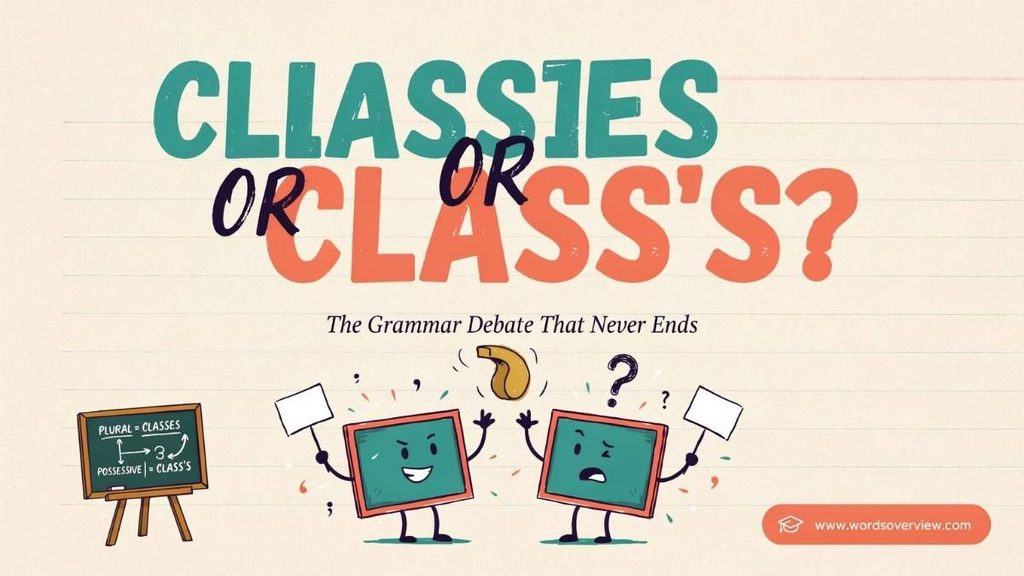
Have you ever stared at classes or class’s and wondered which tiny punctuation mark is causing all the trouble? You’re not alone. English grammar has a funny habit of turning simple words into miniature spelling puzzles. The difference between classes and class’s may look small, but that apostrophe completely changes the job of the word. Classes means more than one class, while class’s shows possession or a connection to one class. Mix them up and your sentence can suddenly say something you never intended. In this guide, you’ll learn the difference, understand the apostrophe rule and master these commonly confused forms with clear examples.
Classes or Class’s: Quick Answer
The correct choice depends on what you want the sentence to mean.
| Form | Grammatical role | Meaning | Example |
| class | Singular noun | One class | The class starts at 9 a.m. |
| classes | Plural noun | More than one class | The classes start at 9 a.m. |
| class’s | Singular possessive | Belonging to one class | The class’s project is finished. |
| classes’ | Plural possessive | Belonging to multiple classes | The classes’ projects are finished. |
So, when someone asks, “Is it classes or class’s?” the answer depends on the sentence.
- Use classes when you mean more than one class.
- Use class’s when you mean that something belongs to or relates to one class.
- Use classes’ when something belongs to or relates to multiple classes.
Simple Examples
- Classes: I have three classes today.
- Class’s: The class’s teacher arrived early.
- Classes’: The classes’ teachers attended the meeting.
Notice how the apostrophe changes the grammatical function. It doesn’t simply make the noun look different. Instead, it signals possession.
The Quick Rule
Ask yourself one question:
Am I talking about multiple classes or am I showing possession?
- If you mean more than one class, use classes.
- If something belongs to one class, use class’s.
- If something belongs to multiple classes, use classes’.
That simple test solves most questions involving classes or class’s.
Learn the difference between basic English word mistakes
Address or Adress Which Spelling Is Correct?
Classes or Class’s: The Core Difference

The biggest source of confusion comes from the similar appearance of classes and class’s. However, they represent different grammatical forms.
What Does “Classes” Mean?
The classes meaning is the plural of class. It refers to two or more classes.
The word class has several meanings. It can describe a lesson, a group of students, a category, a social group, a level or a classification. Therefore, classes can carry different meanings depending on context.
For example:
- I have two classes this morning.
- The school offers evening classes.
- Several classes attended the event.
- Scientists use different classes of compounds.
- The programming language supports different classes of objects.
In each example, classes functions as a plural noun.
So, if you’re asking, “What does classes mean?” the simplest answer is more than one class.
What Does “Class’s” Mean?
The class’s meaning is different. It is the singular possessive form of class.
It usually shows that something belongs to, relates to or connects with one class.
Consider these examples:
- The class’s teacher is absent.
- The class’s project won first place.
- The class’s schedule changed.
- The class’s room was unusually quiet.
In the sentence “The class’s project won first place,” the project belongs to or relates to one class.
The apostrophe and s don’t mean “more than one.” Instead, they indicate possession or association.
The One-Question Test
Here’s an easy way to distinguish class’s or classes:
Does the sentence need a plural noun or a possessive noun?
Compare these two sentences:
The school has five classes.
Here, classes tells you that the school has more than one class.
The class’s project is due tomorrow.
Here, class’s shows that the project belongs to or relates to one class.
Although the forms look similar, their meanings differ completely.
Learn the difference between commonly confused words in English
Employees or Employee’s Which Is Correct?
Why Does “Class’s” Have an Apostrophe?
The apostrophe in class’s follows the standard rule for forming the singular possessive of a noun.
For most singular nouns, English forms the possessive by adding ’s.
| Singular noun | Singular possessive |
| teacher | teacher’s |
| student | student’s |
| school | school’s |
| class | class’s |
| book | book’s |
Therefore:
class + ’s = class’s
This pattern forms part of standard apostrophe usage in English.
The Apostrophe Shows Possession
A possessive noun tells the reader that one thing belongs to, relates to or connects with another.
For example:
- the student’s book
- the teacher’s desk
- the school’s library
- the class’s project
Possession doesn’t always mean literal ownership. A class cannot physically own a project in the same way a person owns a phone. Instead, class’s shows the relationship between the class and the project.
That’s why showing possession can also mean showing association.
“Class’s” Is Not a Plural
This is one of the most important apostrophe rules to remember.
Class’s does not mean multiple classes.
Incorrect:
There are four class’s today.
Correct:
There are four classes today.
The apostrophe doesn’t create the plural. Instead, standard English uses the plural form classes.
A useful rule is:
An apostrophe does not normally make a noun plural.
That rule prevents one of the most common apostrophe mistakes in English.
Learn the difference between similar English words the easy way
Unvoluntary or Involuntary Which One Is Correct?
How to Form the Plural and Possessive of Class

Understanding the four forms of this noun makes the entire classes grammar question much easier.
Singular: Class
Class is a singular noun. It refers to one class.
The class begins at 10 a.m.
Here, the sentence describes one class.
Plural: Classes
The plural of class is classes.
Because class ends in ss, English adds -es to form the plural:
class + es = classes
This is the correct plural form of class.
Examples include:
one class
two classes
several classes
many classes
Therefore, if someone asks, “What is the plural of class?” the answer is simply classes.
Singular Possessive: Class’s
To form the singular possessive, add ’s:
class + ’s = class’s
Examples include:
- the class’s teacher
- the class’s schedule
- the class’s assignment
- the class’s project
This is the singular possessive of class.
Plural Possessive: Classes’
Once class becomes the plural classes, you can make it possessive by adding an apostrophe after the final s:
classes + ’ = classes’
Examples include:
- the classes’ schedules
- the classes’ teachers
- the classes’ projects
- the classes’ rooms
This is the plural possessive of class.
Learn the difference between commonly confused words in English
Trialled or Trialed Which Is Correct?
Classes or Class’s or Classes’? A Complete Comparison

The three forms become much clearer when you compare them directly.
| Form | Number | Possessive? | Meaning |
| class | Singular | No | One class |
| classes | Plural | No | More than one class |
| class’s | Singular | Yes | Belonging to one class |
| classes’ | Plural | Yes | Belonging to multiple classes |
Consider these four sentences:
The class is ready.
The classes are ready.
The class’s project is ready.
The classes’ projects are ready.
Each sentence uses a different noun form. More importantly, each form communicates a different grammatical relationship.
That’s why classes or classes’ is another important distinction. The first is plural. The second is plural possessive.
When to Use Classes
Use classes whenever you need the ordinary plural of class.
Talking About Multiple Lessons
I have three classes today.
The speaker has more than one lesson.
Talking About Multiple Groups
The classes gathered in the auditorium.
Here, classes refers to multiple groups of students.
Talking About Categories
The word class doesn’t only describe school lessons.
For example:
Scientists use different classes of compounds.
Here, classes means categories or groups.
Talking About Levels or Types
You may also see classes in academic, technical, social and organizational contexts.
For example:
The training program offers several classes for beginners and advanced learners.
The exact meaning depends on the context. However, the grammar remains the same.
Learn the difference between similar English words the easy way
Alternately or Alternatively Meaning and Difference
When to Use Classes
Use classes when:
- You mean more than one class.
- You need the ordinary plural of class.
- The sentence doesn’t express possession.
- You don’t need an apostrophe.
For example:
The college offers evening classes.
Not:
The college offers evening class’s.
The second version incorrectly uses an apostrophe to form a plural.
When to Use Class’s
Use class’s when one class has, owns, produces, controls or relates to something.
A Class’s Schedule
The class’s schedule changed because of the holiday.
There is one class and one schedule associated with it.
A Class’s Teacher
The class’s teacher explained the assignment.
The teacher is associated with one particular class.
A Class’s Assignment
The class’s assignment requires three sources.
The assignment belongs to or was assigned to one class.
A Class’s Project
The class’s project impressed the judges.
The project is associated with one class.
The pattern remains consistent:
one class + possession = class’s
This makes the class’s usage much easier to understand.
When to Use Classes’
This is where apostrophe placement becomes especially important.
Classes’ is the plural possessive form of class.
Use it when something belongs to or relates to multiple classes.
Compare these sentences:
The class’s schedule was changed.
One class has a schedule.
The classes’ schedules were changed.
Multiple classes have schedules.
The difference looks small, but the meaning changes.
Examples of Classes’
- The classes’ schedules were posted online.
- The classes’ projects were displayed in the hallway.
- The classes’ teachers attended the meeting.
- The classes’ rooms were cleaned after school.
The apostrophe comes after the final s because classes is already plural.
This is the standard class plural possessive pattern:
classes → classes’
Learn the difference between basic English word mistakes
Months or Monthes Which Spelling Is Correct?
Class’s or Classes’: The Difference

The difference between class’s or classes’ comes down to the number of classes involved.
Class’s means one class possesses or relates to something.
Classes’ means multiple classes possess or relate to something.
| Singular possessive | Plural possessive |
| the class’s teacher | the classes’ teachers |
| the class’s schedule | the classes’ schedules |
| the class’s project | the classes’ projects |
| the class’s room | the classes’ rooms |
A quick test can help:
class’s → one class
classes’ → multiple classes
Therefore, if you’re unsure about class’s or classes’, first identify whether the sentence refers to one class or several.
Learn the difference between similar English words the easy way
Presence or Presense Which Is Correct?
Class’s or Class’: Which Singular Possessive Form Is Correct?
This question often appears because writers encounter both class’s and class’.
For standard modern English, class’s is the safest general form for the singular possessive.
For example:
The class’s project was excellent.
However, class’ can appear under certain style conventions. Some style guides or publishing traditions allow or prefer different treatments for singular nouns ending in s.
Therefore, the best approach is to follow the style guide required by your school, workplace, publication or organization. If no specific style guide applies, class’s provides a clear and widely accepted choice.
Compare the Forms
| Form | Meaning |
| class | One class |
| classes | More than one class |
| class’s | Belonging to one class |
| class’ | Alternative singular possessive style in some conventions |
| classes’ | Belonging to multiple classes |
The important point is that class’ does not mean plural. The ordinary plural remains classes.
Classes or Class’s: Common Mistakes
Apostrophes may look tiny, but they can change the grammatical meaning of a sentence.
Mistake 1: Using Class’s as a Plural
Incorrect:
The university offers several class’s.
Correct:
The university offers several classes.
The sentence describes multiple classes, so it needs the plural form classes.
Mistake 2: Forgetting Possession
Consider:
The class project was submitted yesterday.
This sentence can be completely correct. Class project can function as a compound noun.
Now consider:
The class’s project was submitted yesterday.
This version specifically emphasizes that the project belongs to or relates to one particular class.
Both constructions can work, but they don’t always communicate exactly the same nuance.
Mistake 3: Confusing Class’s and Classes’
Compare:
The class’s projects were graded.
One class has multiple projects.
Now compare:
The classes’ projects were graded.
Multiple classes have projects.
Both sentences can be grammatically correct. The difference lies in the number of classes involved.
Mistake 4: Adding an Apostrophe to Ordinary Plurals
Incorrect:
The student’s studied hard.
Correct:
The students studied hard.
The first sentence incorrectly treats students as a possessive noun.
This mistake often happens when writers remember that apostrophes have something to do with nouns but forget the difference between plural and possessive.
Learn the difference between similar English words the easy way
Boxes or Boxs Which Spelling Is Correct?
Class Plural or Singular: How to Tell
The question “Is class singular or plural?” has a straightforward answer.
Class is singular.
Classes is plural.
Verb agreement can also provide a useful clue.
The class is ready.
The classes are ready.
The singular noun class works with is.
The plural noun classes works with are.
This gives you another practical way to check the correct form of class.
If the sentence refers to one class, use class.
If it refers to multiple classes, use classes.
Class or Classes Grammar in Real Sentences
Real examples make class or classes grammar easier to remember.
School Classes
The school offers six classes in the morning.
Here, classes is plural.
The class’s teacher arrived ten minutes early.
Here, class’s is singular possessive.
The classes’ teachers met after school.
Here, classes’ is plural possessive.
Class Schedules
The class schedule is posted online.
Here, class schedule works as a compound noun.
The class’s schedule was changed.
Here, the possessive explicitly connects the schedule with one class.
The classes’ schedules were posted on the website.
Here, multiple classes have their own schedules.
These examples show why context matters more than simply looking at the letters surrounding the apostrophe.
Learn the difference between tricky words and use them correctly
Stabilise or Stabilize Which Spelling Is Correct?
My Class’s or Class: What’s the Difference?
The phrase my class’s can confuse writers because the word my already identifies the class.
Consider:
My class is preparing for the competition.
This sentence says that one class is preparing.
Now compare:
My class’s project is almost finished.
Here, class’s shows that the project belongs to or relates to the speaker’s class.
Therefore, both my class and my class’s can be correct. They simply perform different grammatical jobs.
My Class’s Meaning
The my class’s meaning is that something belongs to or relates to the class identified by my.
For example:
My class’s teacher gave us extra homework.
The teacher is associated with the speaker’s class.
However, not every noun that follows class needs an apostrophe.
Compare:
my class project
with:
my class’s project
The first phrase can describe a type of project or a project connected with class. The second emphasizes the relationship between a particular class and its project.
Classes or Classes’: The Apostrophe Test
The distinction between classes or classes’ becomes simple when you focus on possession.
Classes
Use classes when the noun simply functions as a plural.
The classes begin at 8 a.m.
No possession exists, so no apostrophe appears.
Classes’
Use classes’ when multiple classes possess or relate to something.
The classes’ schedules begin at different times.
Here, the schedules relate to multiple classes.
Another comparison makes the difference even clearer:
Several classes participated.
versus:
Several classes’ projects were displayed.
The first sentence needs only the plural noun classes.
The second requires the plural possessive classes’ because the projects belong to or relate to multiple classes.
Learn the difference between often confused words
Pre vs Post Meaning, Difference and Grammar Rules
Classes or Class’s: Examples at a Glance
| Sentence | Correct form | Why |
| The school has five ___. | classes | More than one class |
| The ___ teacher arrived early. | class’s | One class’s teacher |
| The ___ teachers met today. | classes’ | Teachers associated with multiple classes |
| The ___ starts at noon. | class | One class |
| Three ___ start at noon. | classes | Multiple classes |
| The ___ project won. | class’s | One class’s project |
| The ___ projects won. | classes’ | Multiple classes’ projects |
| The ___ schedule changed. | class’s | One class’s schedule |
| The ___ schedules changed. | classes’ | Multiple classes’ schedules |
This table provides a practical reference for correct English usage.
How to Choose the Correct Form in Seconds
When you’re stuck between classes or class’s, don’t focus only on the apostrophe. First, determine what the sentence means.
If You Mean One
Use:
class
Example:
The class is quiet.
If You Mean More Than One
Use:
classes
Example:
The classes are quiet.
If One Class Has Something
Use:
class’s
Example:
The class’s room is quiet.
If Multiple Classes Have Something
Use:
classes’
Example:
The classes’ rooms are quiet.
The complete pattern is worth remembering:
One class → class
More than one → classes
One class possessing something → class’s
Multiple classes possessing something → classes’
This four-part pattern covers nearly every everyday question about the noun forms.
Classes Spelling and Class’s Spelling
The correct spelling of classes is:
classes
Not:
class’s
when you simply mean more than one class.
The class’s spelling is correct when you need the singular possessive:
class’s
These forms may look similar when you type quickly. However, they don’t perform the same grammatical function.
Classes Spelling Rule
Because class ends in ss, English adds -es to form the plural:
class + es = classes
You can see similar patterns in words such as:
bus → buses
box → boxes
church → churches
watch → watches
The exact spelling rule varies according to the ending of each noun. For class, however, the practical rule is simple: add -es.
Apostrophe Placement: The Rule That Solves the Confusion
Apostrophe placement reveals whether you’re dealing with singular or plural possession.
Singular Possessive
For one class:
class’s
The apostrophe comes before the added s.
Plural Possessive
For multiple classes:
classes’
The plural already ends in s, so the apostrophe comes after the existing s.
Compare:
class’s = one class + possession
classes’ = multiple classes + possession
This distinction applies to many possessive nouns, not just class.
A Useful Case Study: Three Similar Sentences
Consider these three sentences:
The class is presenting a project.
The class’s project is impressive.
The classes’ projects are impressive.
The first sentence talks about one class.
The second identifies a project associated with one class.
The third identifies projects associated with multiple classes.
Now change the sentence slightly:
The classes are presenting projects.
Here, classes is simply plural. No apostrophe is necessary.
These examples demonstrate why punctuation and meaning work together. The apostrophe isn’t decorative. It performs a specific grammatical function.
Does an Apostrophe Make a Word Plural?
No.
An apostrophe generally indicates possession rather than ordinary pluralization.
Compare:
student → students
with:
student → student’s
The first form is plural.
The second form is singular possessive.
The same principle applies here:
class → classes
and:
class → class’s
So, if you’re asking, “Can class’s be plural?”, the answer is no when you’re using standard noun forms. Class’s is the singular possessive form. The ordinary plural is classes.
Correct English Usage: A Practical Checklist
Before you submit an essay, email, report, article or academic assignment, check the sentence with these questions:
Am I talking about one class? → Use class.
Am I talking about multiple classes? → Use classes.
Does something belong to one class? → Use class’s.
Does something belong to multiple classes? → Use classes’.
Am I using an apostrophe simply to create a plural? → Remove it.
Does a required style guide specify a different possessive convention? → Follow that guide consistently.
This checklist catches most classes grammar and class’s grammar mistakes.
Classes or Class’s: Which Is Correct?
The question “classes or class’s which is correct?” doesn’t have one universal answer because the two forms aren’t interchangeable.
If the sentence means multiple classes, use:
classes
If it means belonging to one class, use:
class’s
If it means belonging to multiple classes, use:
classes’
For example:
The college has several classes.
The class’s teacher is experienced.
The classes’ schedules are available online.
All three forms are correct because each sentence communicates a different meaning.
Classes or Class’s Grammar: The Essential Rule
The entire topic becomes much easier when you separate pluralization from possession.
Pluralization answers:
How many?
Possession answers:
Whose? or associated with what?
Therefore:
classes → How many? More than one.
class’s → Whose? One class.
classes’ → Whose? Multiple classes.
That is the heart of classes or class’s grammar.
Practice Session: Classes or Class’s
Fill in each blank with the correct form: class, classes, class’s, or classes’.
Fill in the Blanks
- I have three ________ today.
- The ________ starts at 9 a.m.
- The ________ teacher gave us a difficult assignment.
- Several ________ participated in the competition.
- The ________ projects were displayed in the hallway.
- Our ________ schedule has changed.
- The school offers evening ________.
- The ________ students are preparing for the exam.
- The ________ project won first place.
- Two ________ are taking the test today.
- The ________ schedules were posted online.
- My ________ begins after lunch.
- The ________ teacher explained the new lesson.
- The university has several computer ________.
- The ________ rooms are located on the second floor.
- Our ________ assignment is due tomorrow.
- All the ________ finished their presentations.
- The ________ projects require additional research.
- This ________ is smaller than the previous one.
- The ________ teachers attended the meeting.
- I attended two ________ this morning.
- The ________ schedule was changed because of the holiday.
- Several ________ were canceled because of the weather.
- The ________ assignments were submitted before the deadline.
- The ________ students completed their final project.
Answer Key
- classes
- class
- class’s
- classes
- classes’
- class’s
- classes
- class’s
- class’s
- classes
- classes’
- class
- class’s
- classes
- classes’
- class’s
- classes
- classes’
- class
- classes’
- classes
- class’s
- classes
- classes’
- class’s
Here’s a trusted source for clear more words Comparison:
Grammar Update
Frequently Asked Questions About Classes or Class’s
Is it correct to say “class’s”?
Yes. “Class’s” is correct when you need the singular possessive form of class. It shows that something belongs to or relates to one class. For example, “The class’s project was completed on time.”
What is the possessive form of “class”?
The standard singular possessive form is “class’s.” For example, “The class’s teacher explained the lesson.” The apostrophe and s show possession or association with one class.
What is the plural of “class”?
The plural of class is “classes.” Because class ends in ss, you add -es to form the plural. For example, “The school offers several classes.”
What is the plural possessive of “class”?
The plural possessive form is “classes’.” Use it when something belongs to or relates to multiple classes. For example, “The classes’ schedules were updated.”
Should I use an apostrophe after “class”?
It depends on the meaning. Use class’s for the singular possessive and classes’ for the plural possessive. However, don’t use an apostrophe simply to make class plural. The correct plural is classes.
Is it “class” or “class’s”?
Both forms are correct, but they serve different purposes. Class refers to one class, while class’s shows possession or association with one class. For example, “The class is ready” versus “The class’s project is ready.”
When should I use “classes”?
Use classes when you mean more than one class. For example, “I have three classes today.” It is the ordinary plural form of class, so it does not need an apostrophe.
What is the difference between “class’s” and “classes’”?
Class’s is singular possessive and refers to one class. Classes’ is plural possessive and refers to multiple classes. For example, “The class’s project” refers to one class, while “The classes’ projects” refers to multiple classes.
Does an apostrophe make “class” plural?
No. An apostrophe does not normally form a plural. The plural of class is classes, not class’s. Use an apostrophe when you need to show possession, such as class’s or classes’.
What are the correct forms of “class”?
The four useful forms are class, classes, class’s, and classes’. Class is singular, classes is plural, class’s is singular possessive, and classes’ is plural possessive.
Conclusion:
The classes or class’s confusion may look like a tiny punctuation problem, but that little apostrophe can cause a surprisingly big grammatical mess. The good news is that the rule is simple. Classes means more than one class, while class’s shows possession or a connection to one class. When several classes own or relate to something, use classes’. In other words, the apostrophe is not there for decoration and it certainly does not create a plural. So, before you let that tiny mark cause another grammar headache, ask yourself one simple question: Am I talking about number or possession? Once you answer that, the correct form becomes much easier to spot.

Ethan AJS is an experienced blogger and language enthusiast at Words Overview, dedicated to making English easier to understand and use. He writes about grammar, vocabulary, spelling, word meanings and commonly confused words, turning tricky language questions into clear, practical insights. With a passion for effective communication, Ethan creates engaging, readerfocused content that helps readers write accurately, choose the right words and communicate with confidence.




